How to Teach Fractions
This guide is for teachers who use CommeUnJeu with a class, from the first halves in PYP 1 to the algebraic fractions and the proportions of MYP 4. It is in two parts, because a fraction is used in two ways that the textbooks mix and that the pupils confuse. First, the fraction is a number: a share of one unit, a length, a point on the number line, which is compared, added and multiplied like the other numbers. Then, the fraction is a tool: it acts on a quantity (two thirds of the pupils, \(25\,\pourcent\) of a price, a plan at \(1:100\)), and that is the ratio, the proportion, the percentage and the scale. The number comes first because the tool uses it: “\(\dfrac{2}{3}\) of \(30\)” becomes a multiplication only once \(\dfrac{2}{3}\) is a number. Every step is shown the way the lessons teach it: concrete (a cake, a strip of paper, a bag of marbles), then pictorial (the figure of the lesson, to project on the board), then abstract (the writing the pupils keep). The figures below are those of the lessons, or drawn in the same style. One thread runs through all of them: a unit is shared into equal parts, the share is measured as a length, and that length becomes a point on the number line.
In each chapter you will find:
In each chapter you will find:
- in many sections, a short video first, in English and in French (this guide shows them too, at the head of the passages they belong to);
- the lesson: definitions, methods and worked examples, to project on the board;
- under each section, the skills to practise: groups of exercises corrected at once, each answer followed by a worked correction;
- at the end, a quiz and, from PYP 2 on, a Going further section with harder exercises;
- some exercises are written on paper: the pupil sends a photo of the page to have it corrected.
Two Readings of One Drawing
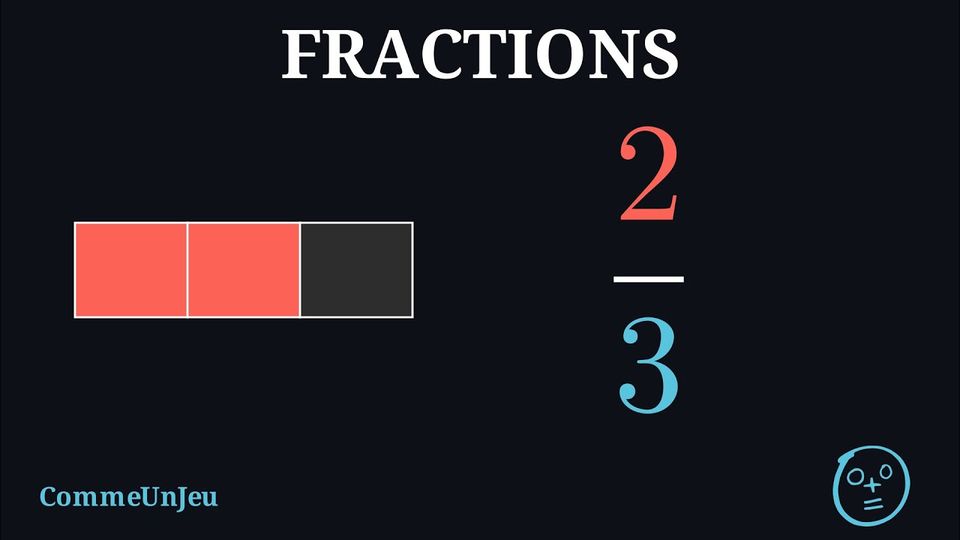
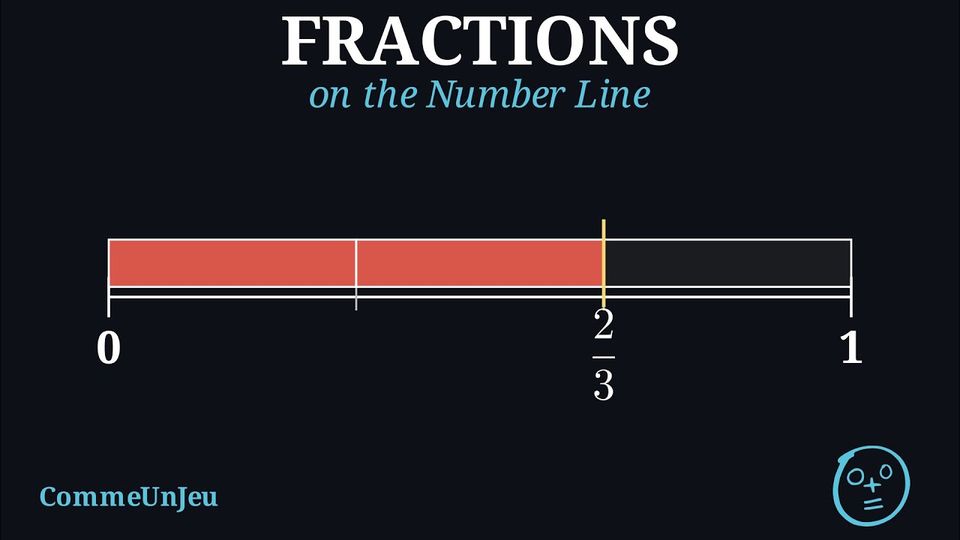
The same bar, cut into \(3\) equal parts with \(2\) of them shaded, is read in two ways. The number \(\dfrac{2}{3}\) is the same in both; what changes is the question asked, and the label of the whole tells which. 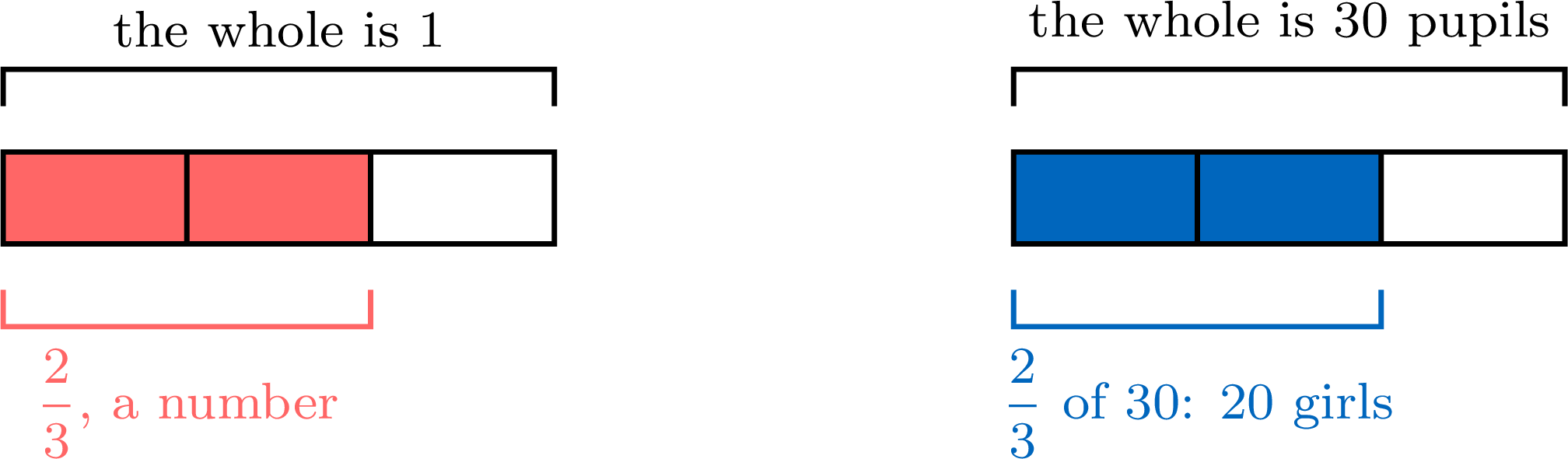
- The whole is \(1\). The bar is the unit, and \(\dfrac{2}{3}\) is a number: the point two thirds of the way from \(0\) to \(1\). The result of a calculation is a fraction: \(\dfrac{2}{3} + \dfrac{1}{6} = \dfrac{5}{6}\).
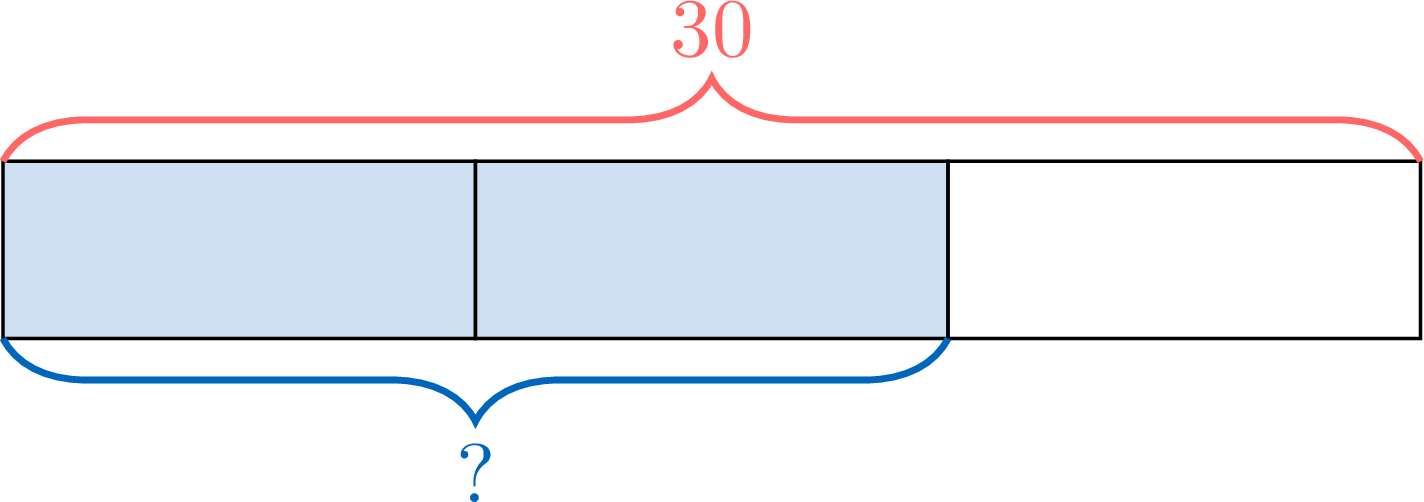
- The whole is a quantity. The bar is the class, \(30\) pupils, and the question is “how much is two thirds of it?”: the same number \(\dfrac{2}{3}\) now acts as a multiplier, and the result is a quantity, \(20\) girls. Behind the action there is a comparison, the ratio: \(2\) girls for every \(3\) pupils, a part to the whole, which is the fraction \(\dfrac{2}{3}\) again; or \(2\) girls for every boy, a part to a part, \(2:1\). The ratio leads to the proportion, the percentage and the scale.
Part One: The Fraction as a Number
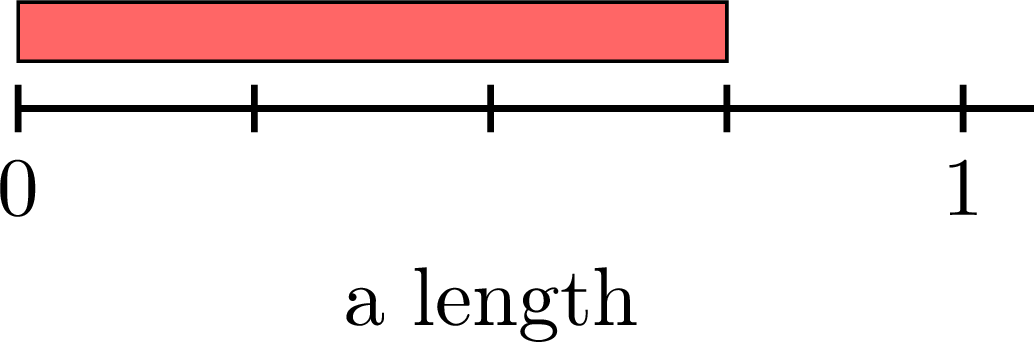
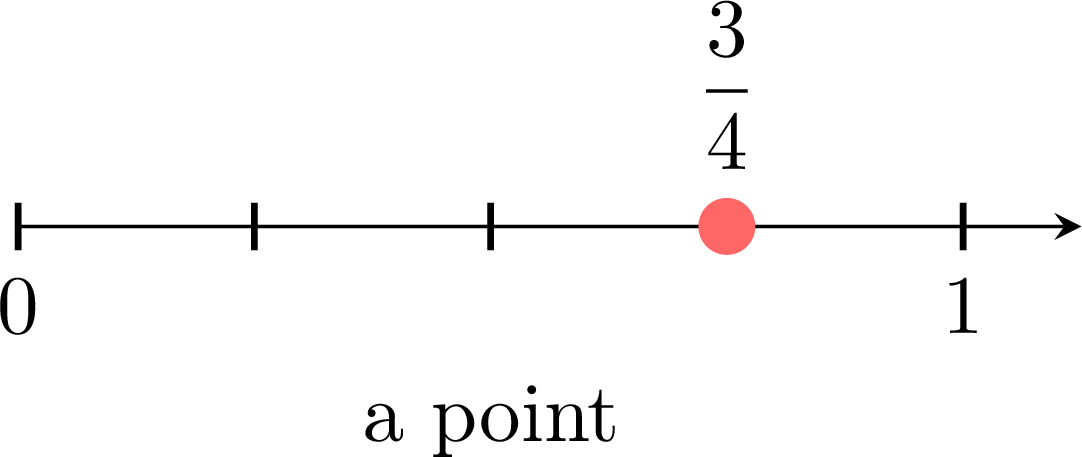
A fraction is first a share of one unit cut into equal parts. That share is then read as a length: the bar of \(\dfrac{3}{4}\) is three quarters of the unit bar long. Placed from \(0\), that length ends at a point of the number line, and the fraction takes its place among the numbers. 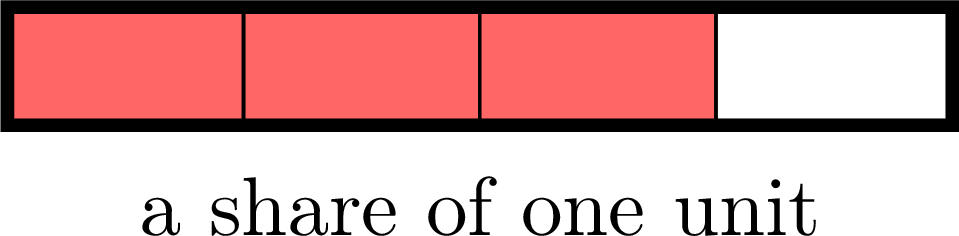
Four habits for the classroom:
- Always name the unit. “The unit is the whole bar”, “the unit is the segment from \(0\) to \(1\)”: say it at every exercise. Many errors on the number line come from a pupil who has lost track of the unit.
- The bar rather than the disc. A disc is a good object for sharing (a cake, a pizza), and the early lessons use it. But a bar can be laid on a ruler, continued beyond \(1\) and put end to end with another bar; a sector cannot. In the lessons, the bar carries the definitions, the number line and the calculations.
- Keep the two readings apart. In this part the whole is always \(1\). When an exercise says “\(\dfrac{2}{3}\) of \(30\)”, the whole has changed: that is the tool of Part Two, and the lessons write it as a multiplication only in PYP 5 and MYP 1, once \(\dfrac{2}{3}\) already has its place on the line.
- Bars that are compared stand upright. A bar on its own usually lies flat: a strip of paper, a length. As soon as two fractions face each other (\(<\), \(>\), \(=\), equivalent, simplified, added), the exercises and most lessons stand the bars up, side by side, with the same height for the unit and the feet aligned: the colour rises from the foot of each bar, its top is a level, and the pupil compares the levels reached by the colour, like water in two glasses. “Higher” is read at once; “further to the right” is a convention that the number line teaches in PYP 3. A single bar also stands when the value goes beyond the unit: the units are then stacked, and \(\dfrac{3}{2}\) is taller than the unit. The bars of the tool (Part Two), with their braces, stay flat: nothing is compared on them, a quantity is read. A few lessons still lay a comparison flat; the guide stands those bars up and says so.
The Path, Year by Year
Each chapter takes up what the year before taught, then goes one step further. The table gives the step and the link to the chapter.
| Year | Chapter | What is new |
| PYP 1 | Halves and Quarters | fair shares; halves and quarters of shapes |
| PYP 2 | Fractions | the notation; unit fractions; comparing; first sums |
| PYP 3 | Fractions | equivalent fractions; the number line and the ruler; sums |
| PYP 4 | Fractions | beyond \(1\) on the line; mixed numbers; sums step by step |
| PYP 5 | Fractions: Equivalence and Comparison | simplifying; comparing any fractions |
| PYP 5 | Operations with Fractions | models of \(\times\) and \(\div\); fraction of a quantity (Part Two) |
| MYP 1 | Fractions | the fraction as a quotient; graduating a segment |
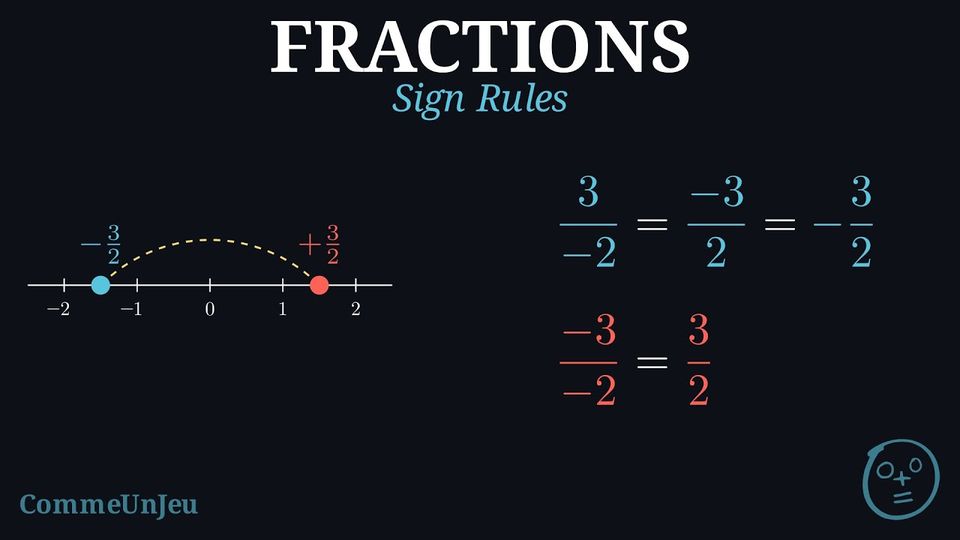
| MYP 2 | Fractions | the four operations; negative fractions |
| MYP 3 | Rational Numbers | number sets; recurring decimals |
| MYP 3 | Algebraic Expressions and Fractions | first algebraic fractions |
| MYP 4 | Algebraic Fractions | excluded values; lowest common denominator |
Year by Year, with the Figures of the Lessons
Sharing One Unit (PYP 1 and PYP 2)
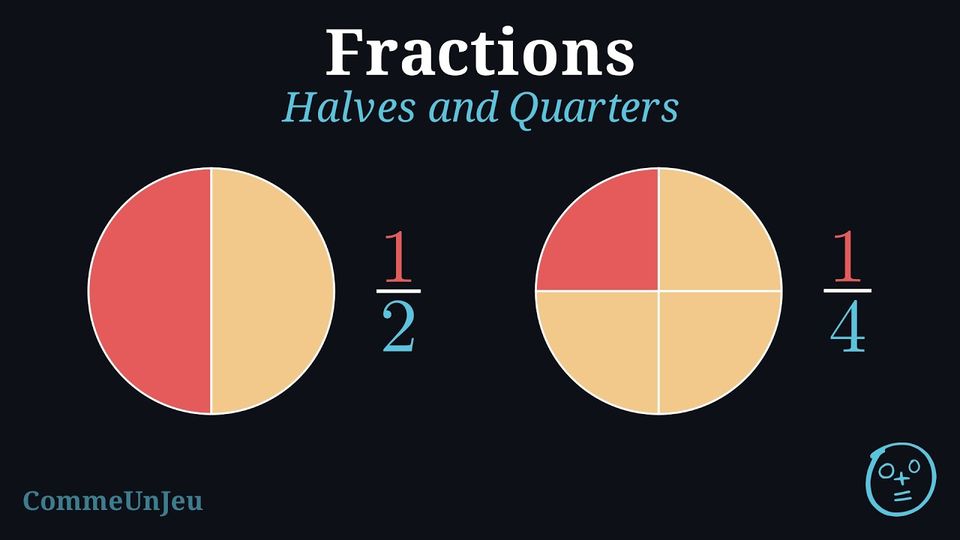
Concrete. Hugo has one cake, the unit. He cuts it into \(2\) equal parts and takes \(1\) part out of \(2\). Do it with a real strip of paper: fold it in two, then in two again. 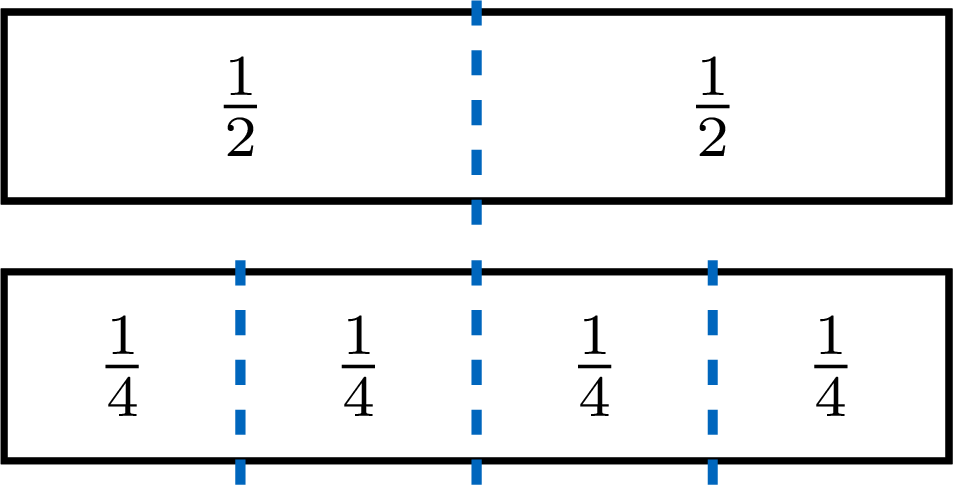
Pictorial. The lesson shows one quarter on a disc, a square and a strip (and one half the same way): the parts must be equal, and two halves make the unit, four quarters make the unit. 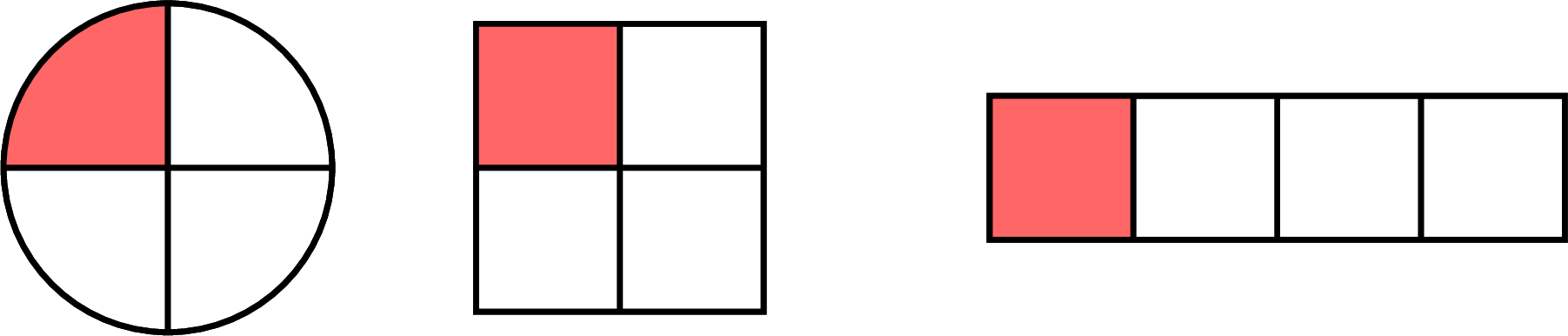
Abstract. PYP 2 gives the notation. Read the figure with the pupils: the bottom number is the cutting, the top number is the count. 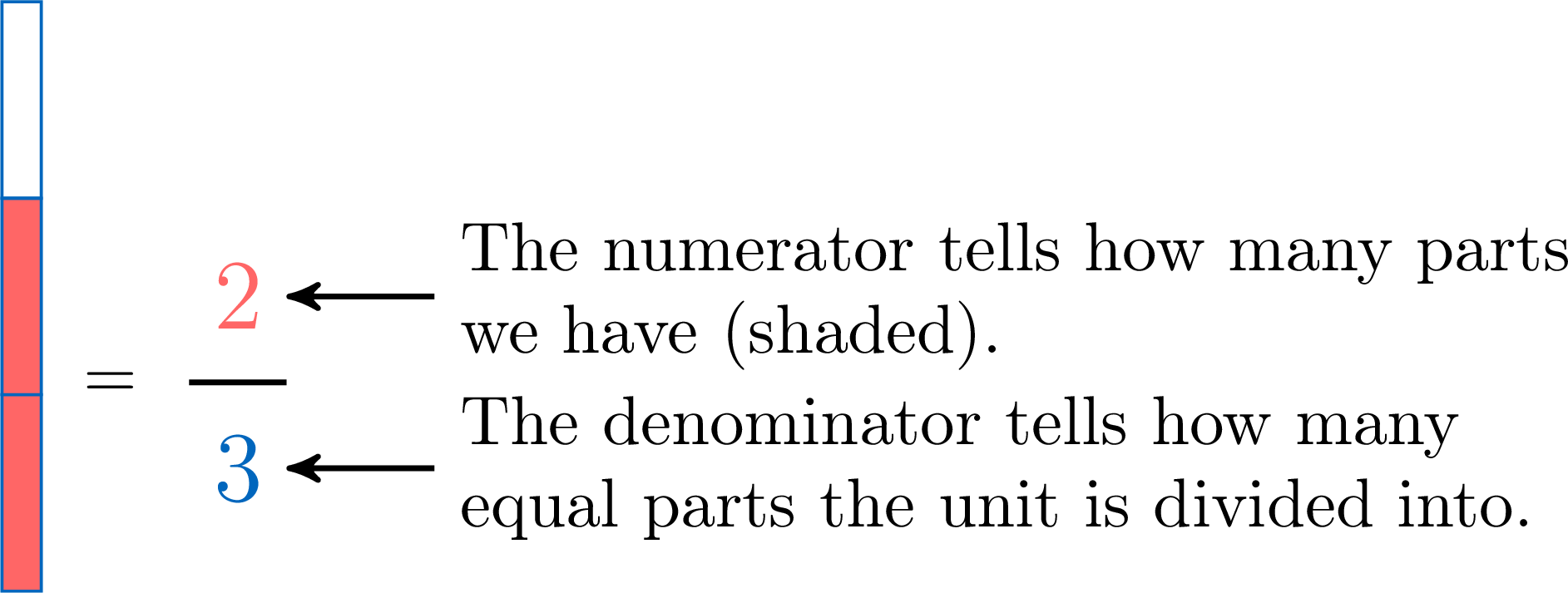
Then the key sentence of the year, every fraction is made of unit fractions: \(\dfrac{3}{8}\) is three times \(\dfrac{1}{8}\). 
$$\dfrac{3}{8} \;=\; \dfrac{1}{8} + \dfrac{1}{8} + \dfrac{1}{8}$$ Where to find it. PYP 1: Folding a Strip into Halves and Quarters; exercises Telling Whether the Parts Are Equal, Colouring a Half or a Quarter. PYP 2: Every Fraction is Made of Unit Fractions; exercises Building a Fraction from Unit Fractions.
Comparing: Smaller Parts, Bigger Bottom Number (PYP 2)
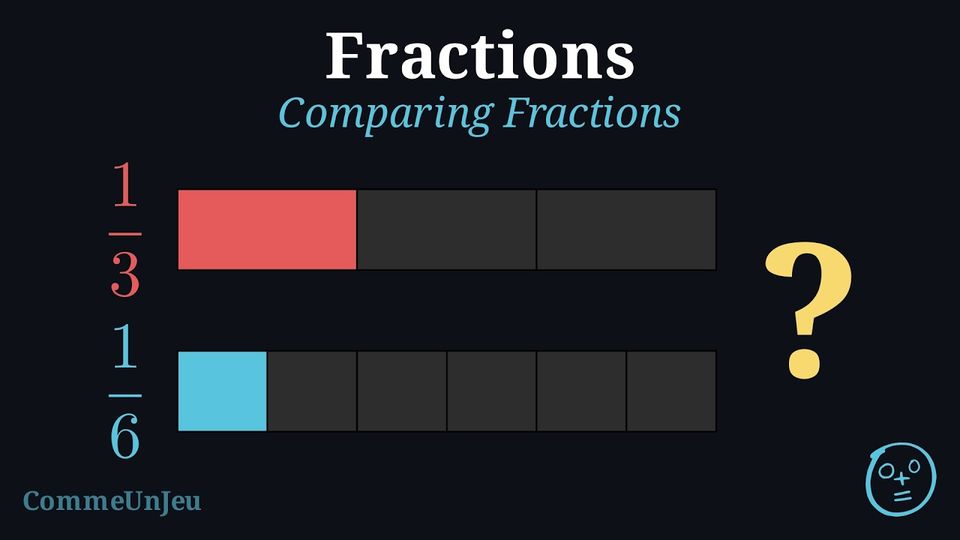
Concrete. One cake for \(3\) children, the same cake for \(6\) children: who gets the bigger piece?
Pictorial. The same unit, cut two ways, and the two bars standing side by side, as the exercises draw the comparisons (the PYP 2 lesson still lays these two flat; the guide stands them up and adds the dashed level). The colour rises from the foot of each bar; the pupil compares how high it goes. \(6\) is bigger than \(3\), and yet the colour of \(\dfrac{1}{6}\) stops lower than the colour of \(\dfrac{1}{3}\). 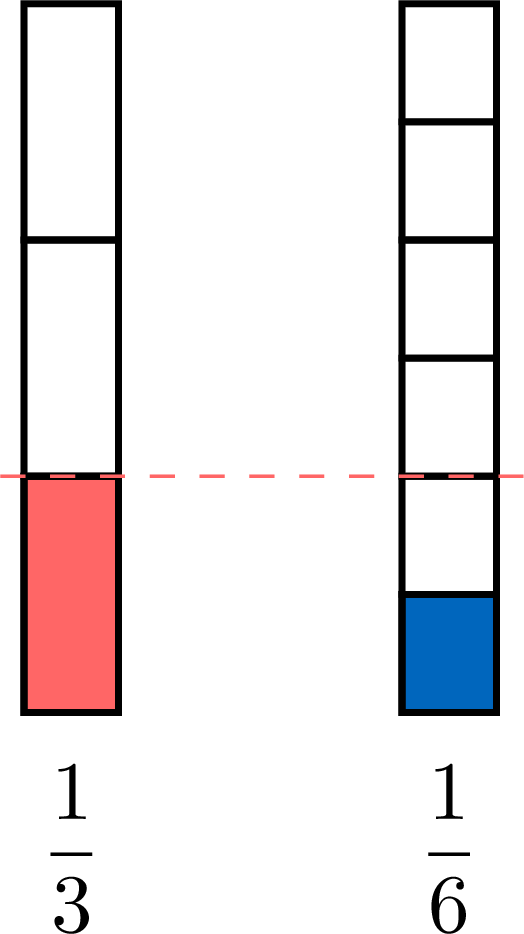
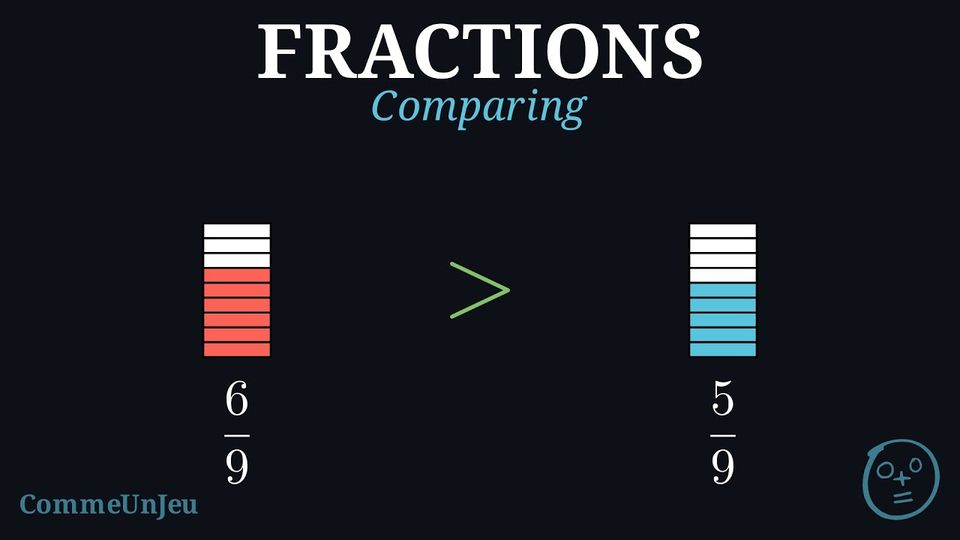
Abstract. \(\dfrac{1}{6} < \dfrac{1}{3}\). The more equal parts the same unit is divided into, the smaller each part. With the same bottom number, the rule is the usual one, and the exercises write the comparison on one line, a bar at each end:  \(=\dfrac{5}{8}\lt \dfrac{7}{8}=\)

The exercise Choosing the Right Rule mixes the two cases on purpose: that is where the error \(\dfrac{1}{6} > \dfrac{1}{3}\) “because \(6 > 3\)” comes out, and where the two standing bars settle it.
Later. In MYP 1, Comparing Fractions opens on the same standing bars, with \(\dfrac{3}{4}\) and \(\dfrac{5}{8}\): parts of different sizes, two close levels, the eye hesitates, and that is the reason for the common denominator. Once \(\dfrac{3}{4}\) is written \(\dfrac{6}{8}\), the two levels are read again.  \(\;=\;\)
 \(\;>\;\)

Where to find it. PYP 2, Comparing Fractions: When the Top Number is 1; exercises Comparing with Same Denominator, When the Top Number is 1, Choosing the Right Rule. MYP 1, Comparing Fractions.
Pictorial. The same unit, cut two ways, and the two bars standing side by side, as the exercises draw the comparisons (the PYP 2 lesson still lays these two flat; the guide stands them up and adds the dashed level). The colour rises from the foot of each bar; the pupil compares how high it goes. \(6\) is bigger than \(3\), and yet the colour of \(\dfrac{1}{6}\) stops lower than the colour of \(\dfrac{1}{3}\).
\(=\dfrac{5}{8}\lt \dfrac{7}{8}=\) Later. In MYP 1, Comparing Fractions opens on the same standing bars, with \(\dfrac{3}{4}\) and \(\dfrac{5}{8}\): parts of different sizes, two close levels, the eye hesitates, and that is the reason for the common denominator. Once \(\dfrac{3}{4}\) is written \(\dfrac{6}{8}\), the two levels are read again.
\(\;=\;\) \(\;>\;\) The Bridge: from the Bar to the Number Line (PYP 3)
This is the central year. The bar becomes a length, then a point.
Concrete. A strip of paper folded into quarters is a ruler graduated in quarters of a unit. Lay it with its \(0\) at one end of a segment and read the other end. Here, on a ruler in tenths, the coloured strip ends between \(\dfrac{7}{10}\) and \(\dfrac{8}{10}\). 
Pictorial. To place \(\dfrac{2}{3}\), the lesson has three steps, each with its figure: mark \(0\) and \(1\); cut the unit into \(3\) equal parts; count \(2\) parts from \(0\), one arrow per part. Ask the pupils to draw the arrows: it is what stops them counting the tick marks. 
Equivalent fractions are seen on two identical bars, standing side by side: \(\dfrac{3}{4}\) and \(\dfrac{6}{8}\) reach the same level (the lesson lays them flat; the guide stands them up, as the exercises do). 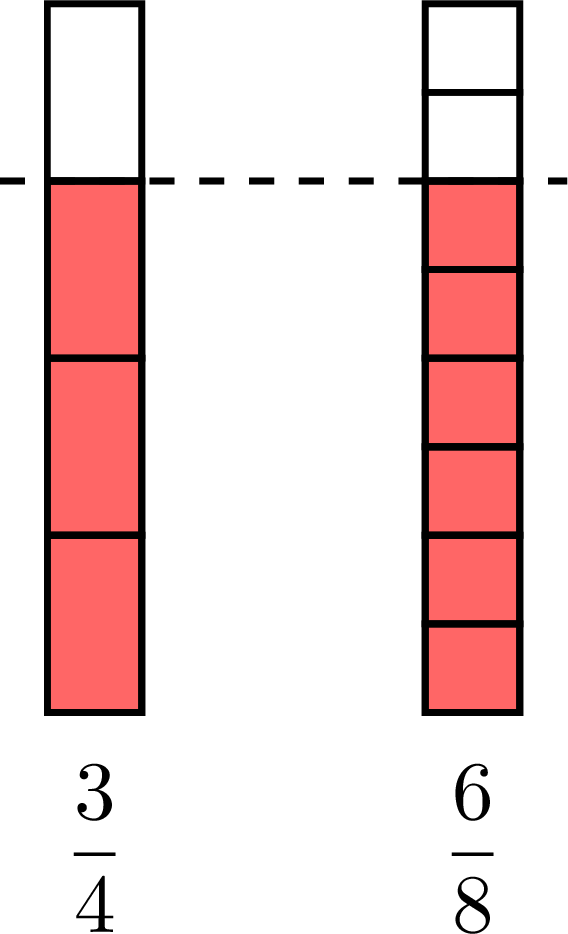
Then, once the line is there, the same point: \(\dfrac{1}{2}\) and \(\dfrac{2}{4}\) are two names for one number. 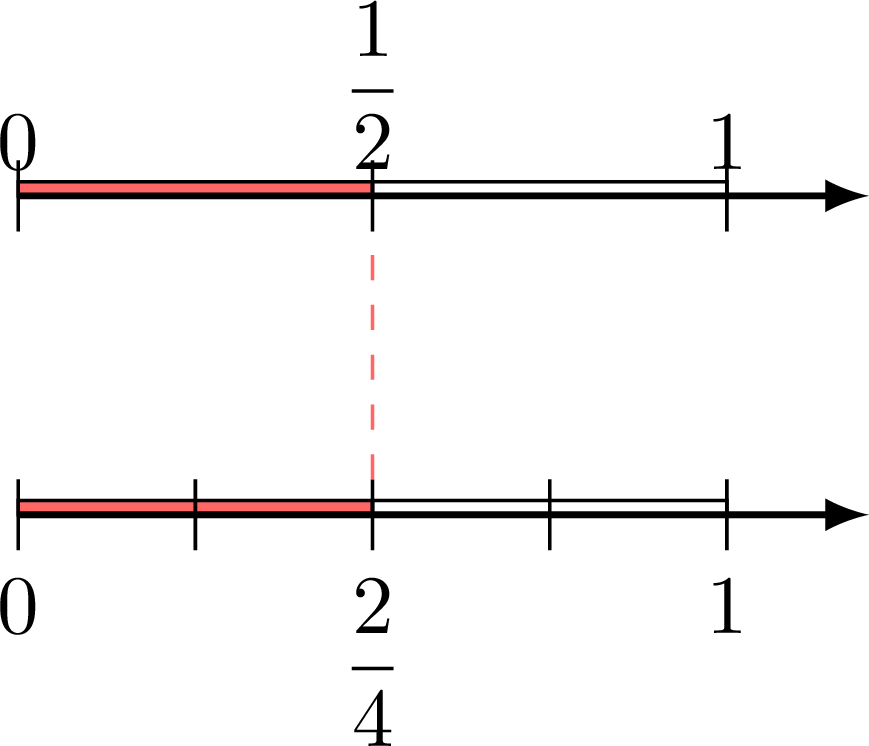
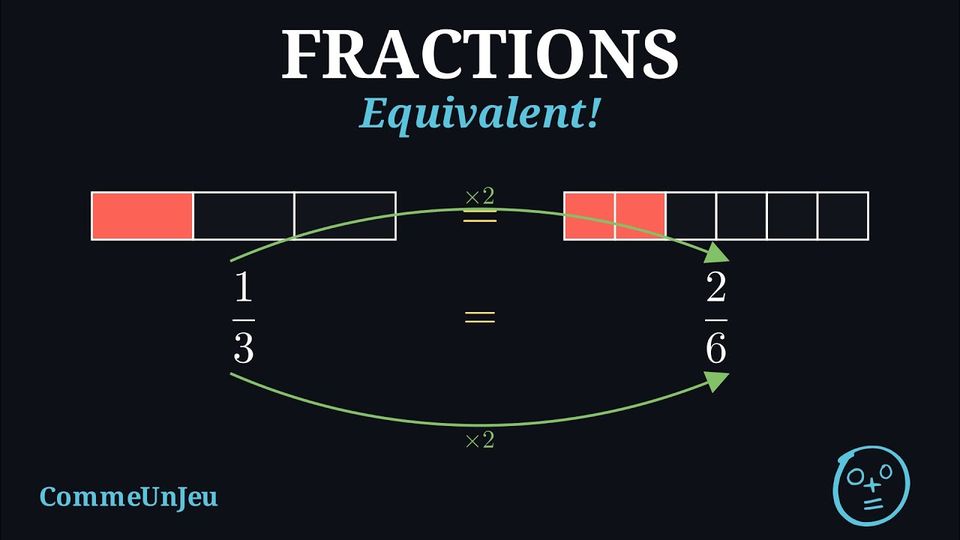
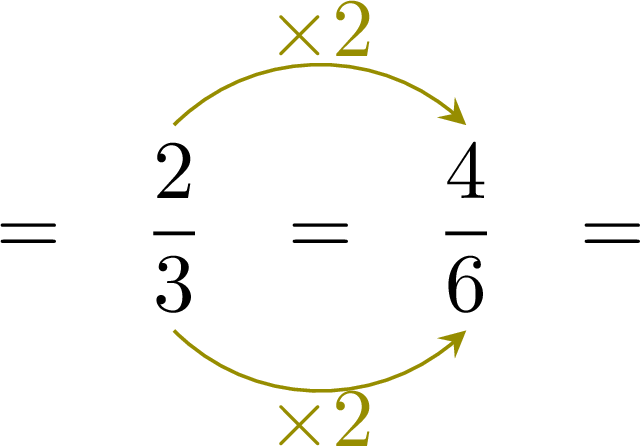
Abstract. The rule, written with its arrows: cutting every part in two multiplies both numbers by \(2\). 

Here the bars stand: the two colours stop at the same level. On the line, comparing becomes comparing lengths: the fraction further to the right is the greater, which is what “higher” becomes once the bar is laid along the line. Same top number, \(5\) steps each time, but the steps of the twelfths are smaller: \(\dfrac{5}{12} < \dfrac{5}{8}\). 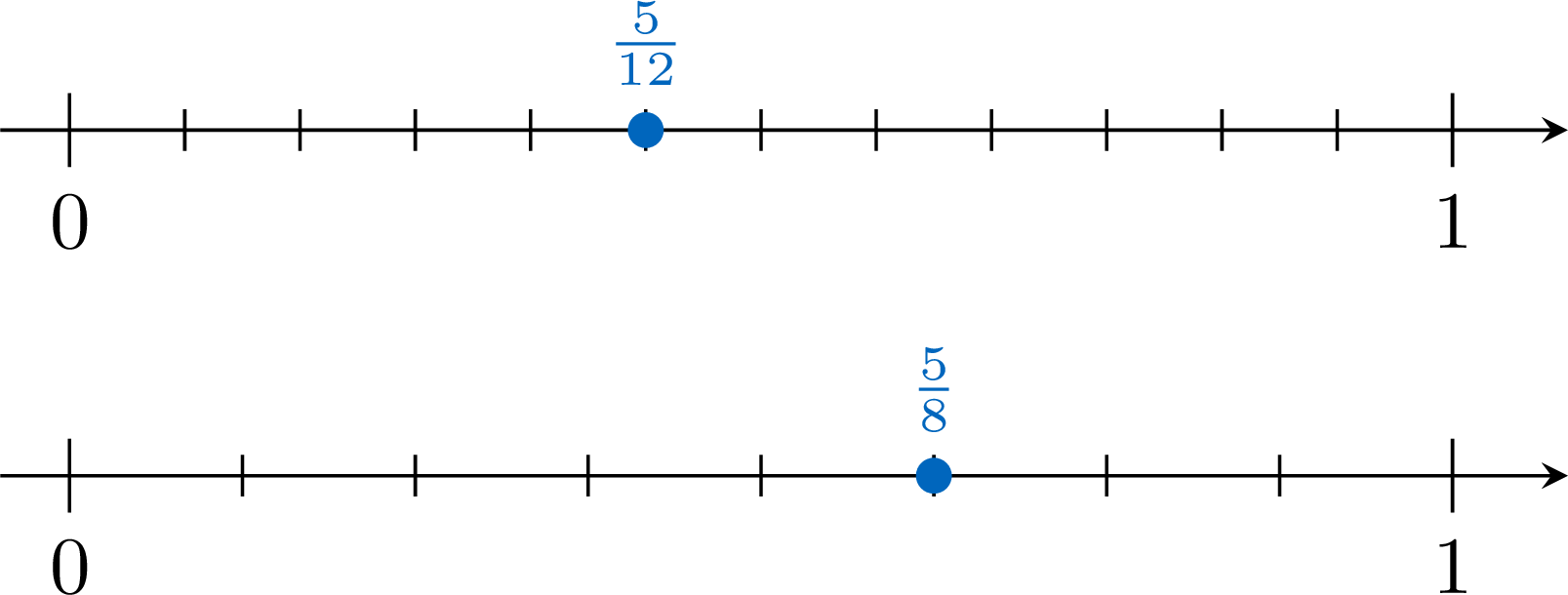
Where to find it. PYP 3, On the Number Line: Representing a Fraction on the Number Line, Measuring with a Ruler Graduated in Fractions of a Unit, Drawing a Segment of a Given Length; exercises Graduating the Unit Strip, Placing Fractions on the Number Line, The Same Point on the Number Line, Reading a Length on the Ruler, Drawing a Segment of a Given Length; Comparing Fractions on the Number Line.
Concrete. A strip of paper folded into quarters is a ruler graduated in quarters of a unit. Lay it with its \(0\) at one end of a segment and read the other end. Here, on a ruler in tenths, the coloured strip ends between \(\dfrac{7}{10}\) and \(\dfrac{8}{10}\).
Beyond One (PYP 4)
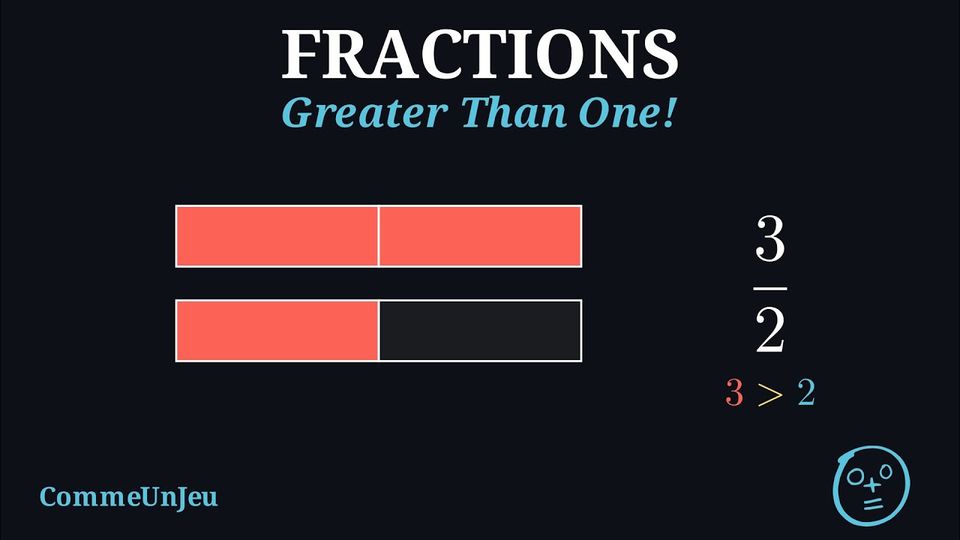
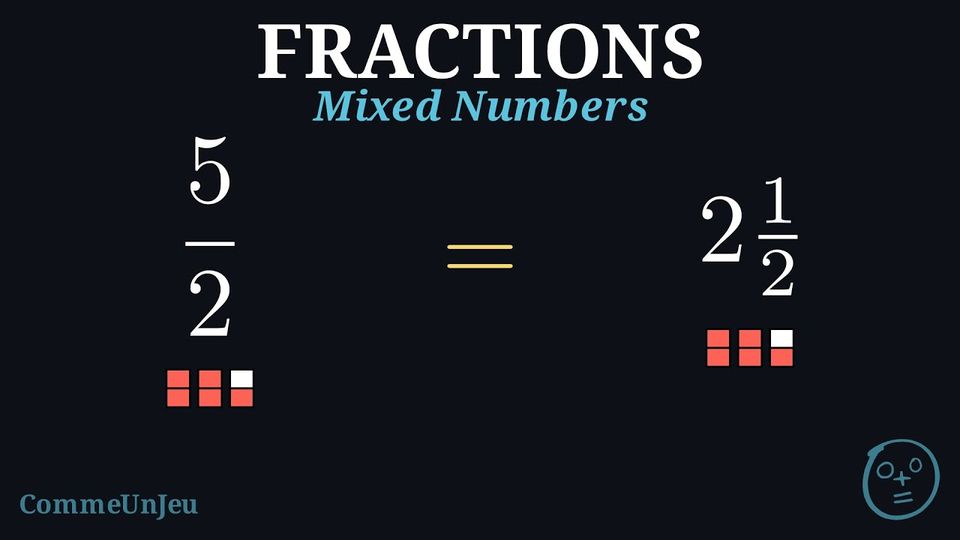
Concrete. Five thirds of a cake: more than one cake. Lay strips end to end.
Pictorial. The chapter opens on a standing bar (What is a Fraction?): one unit, and above it a second unit with one half coloured. Taller than the unit, so more than \(1\), before anything is counted; then \(3\) halves in all, \(\dfrac{3}{2}\) (the brace is the guide's; the small gap between the two units stands for no quantity). 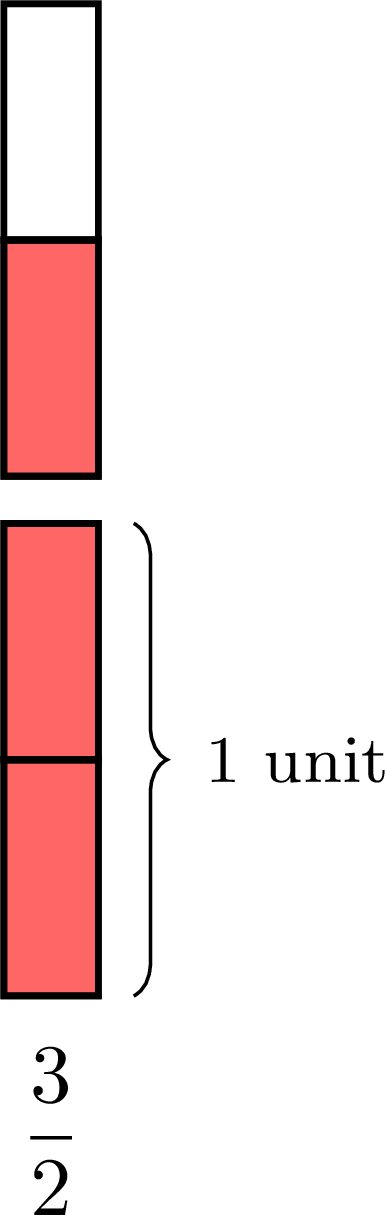
The line continues past \(1\): each unit is cut into thirds, and the pupil counts \(5\) thirds from \(0\). After \(3\) parts, \(1\); two more, the point. (PYP 4 practises it in Finding Fractions Greater than 1 on the Number Line; the arrows are the guide's.) 
The same point, reached as \(1\) unit then \(2\) thirds: 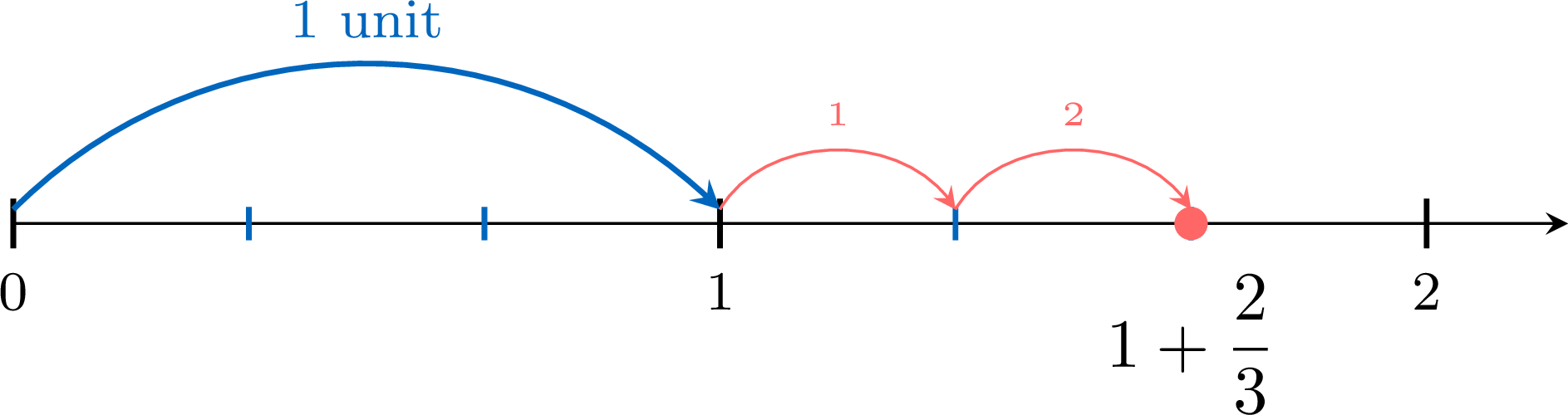
Abstract. \(\dfrac{5}{3} = 1 + \dfrac{2}{3}\), and \(1 < \dfrac{5}{3} < 2\). The chain gives the reason: $$\begin{aligned}\dfrac{5}{3} &= \dfrac{3}{3} + \dfrac{2}{3} && \text{(3 thirds make 1 unit)}\\
&= 1 + \dfrac{2}{3}\end{aligned}$$ Watch for. “You can't take five parts out of three.” The pupil still reads “parts out of all the parts”. On the line there is no reason to stop at \(1\): count thirds.
Where to find it. PYP 4, Fractions Greater than 1, On the Number Line, Improper Fractions and Mixed Numbers: Decomposing a Fraction Greater Than 1, Bounding a Fraction Between Two Whole Numbers; exercises Finding Fractions Greater than 1 on the Number Line, Decomposing into a Whole Number Plus a Fraction, Bounding Between Two Consecutive Whole Numbers.
Pictorial. The chapter opens on a standing bar (What is a Fraction?): one unit, and above it a second unit with one half coloured. Taller than the unit, so more than \(1\), before anything is counted; then \(3\) halves in all, \(\dfrac{3}{2}\) (the brace is the guide's; the small gap between the two units stands for no quantity).
Where to find it. PYP 4, Fractions Greater than 1, On the Number Line, Improper Fractions and Mixed Numbers: Decomposing a Fraction Greater Than 1, Bounding a Fraction Between Two Whole Numbers; exercises Finding Fractions Greater than 1 on the Number Line, Decomposing into a Whole Number Plus a Fraction, Bounding Between Two Consecutive Whole Numbers.
The Fraction as a Quotient (MYP 1)
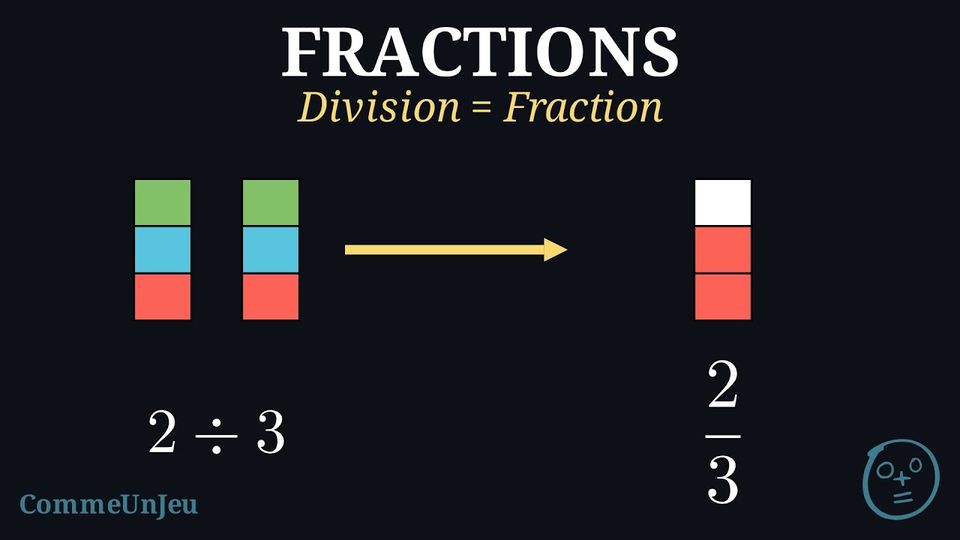
Concrete. Two identical cakes for three people. Each cake is cut into \(3\), and each person receives one part of each cake: two thirds. 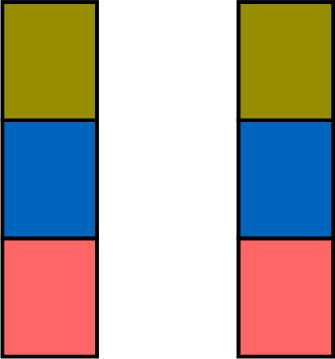
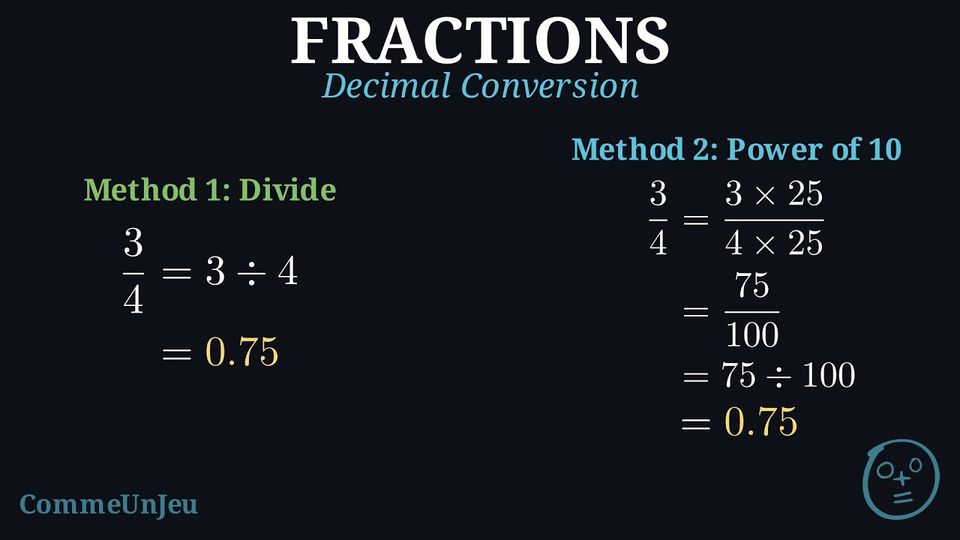
Abstract. \(2 \div 3 = \dfrac{2}{3}\). The fraction \(\dfrac{a}{b}\) is the number which, multiplied by \(b\), gives \(a\): a second meaning, added to the first one, not replacing it. $$a \div b = \dfrac{a}{b} \qquad (b \neq 0)$$ Pictorial, to graduate without measuring. A sheet of equally spaced parallel lines (the lines of an exercise book) cuts any segment long enough into equal parts: \(A\) on the first line, \(B\) on the sixth, and the four lines in between give the fifths. 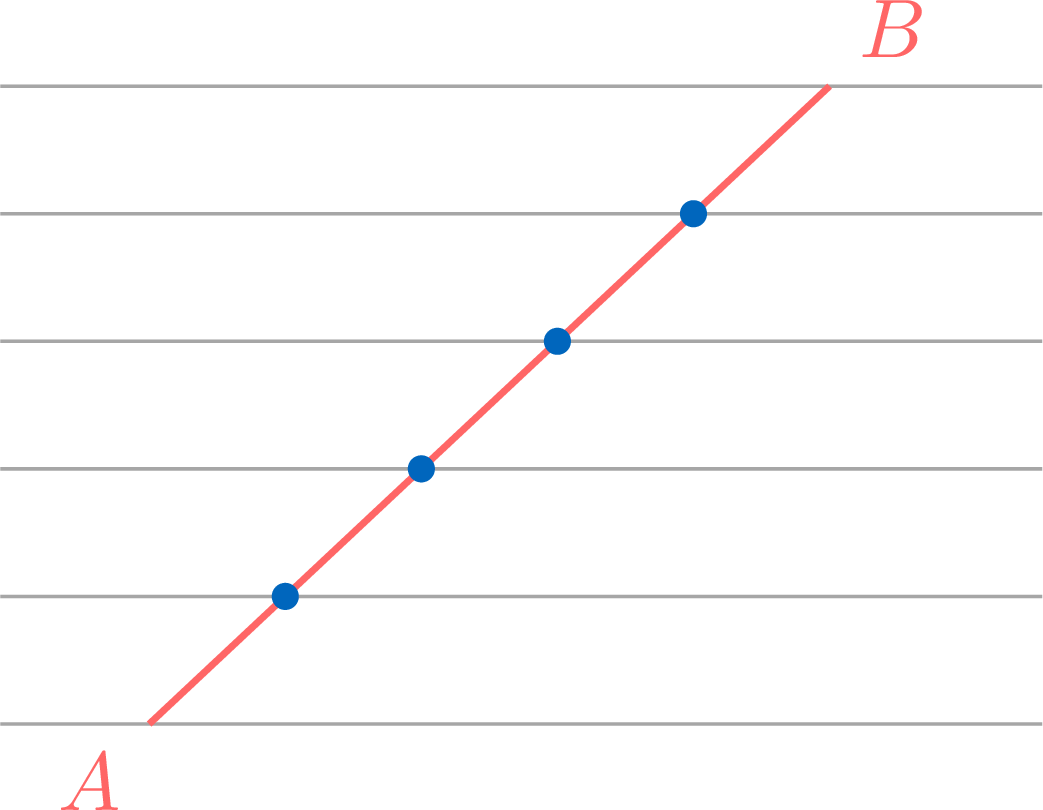
Multiplying and Dividing (PYP 5, MYP 1 and MYP 2)
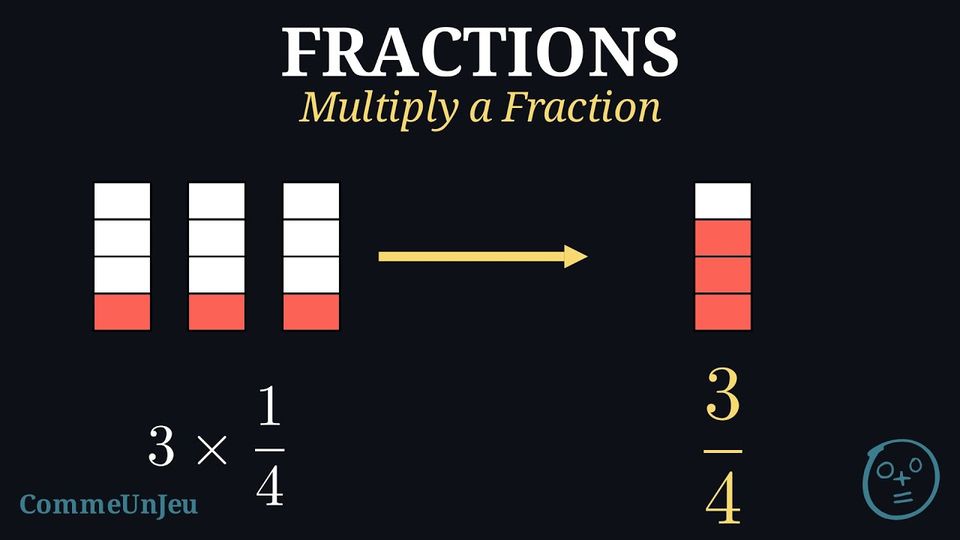
Concrete. Three strips of two thirds of a unit, laid end to end: they make exactly two units. The whole is still \(1\); the product is a length.
Pictorial. Three figures of the lessons answer three questions before any rule. A whole number times a fraction is a repeated addition: \(3\) jumps of \(\dfrac{2}{3}\). 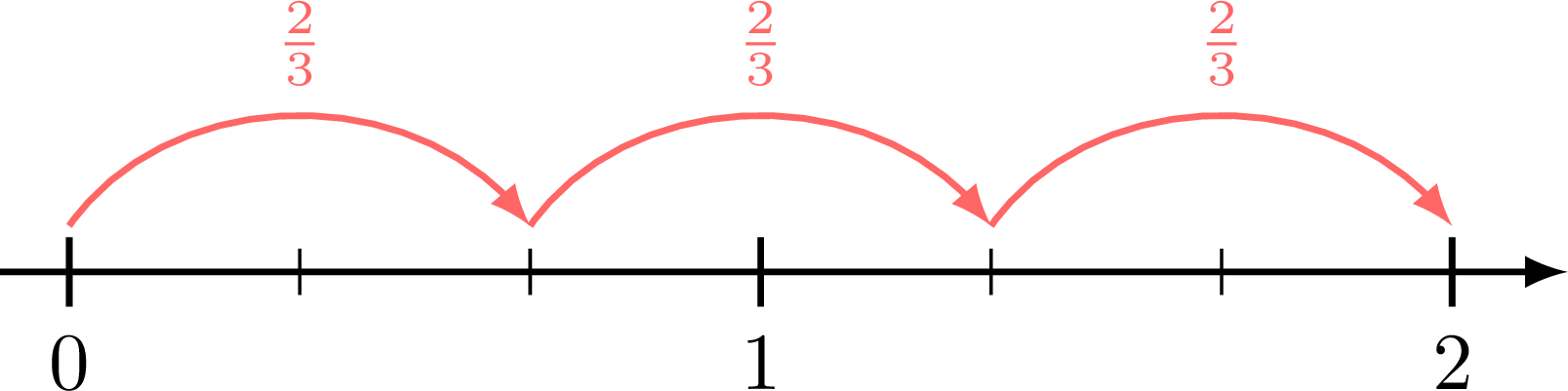
$$3 \times \dfrac{2}{3} = \dfrac{6}{3} = 2$$ The same repeated addition, in bars, as MYP 2 writes it:
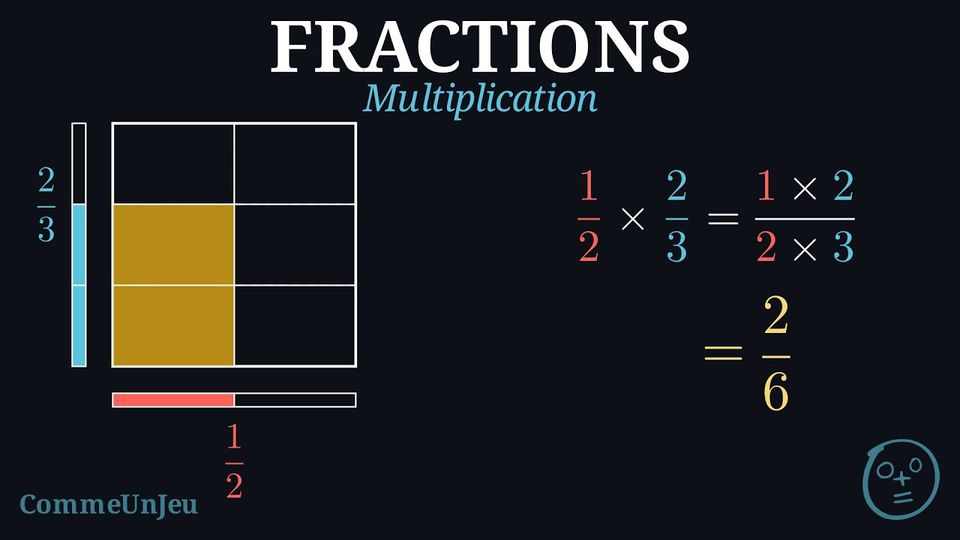
A fraction of a fraction is an area: half of one third of the unit square is one small part out of \(6\). 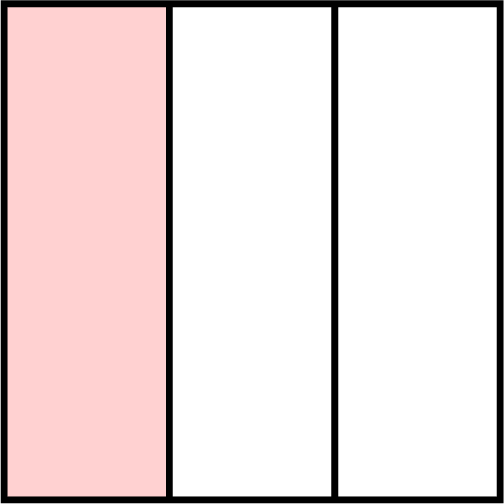
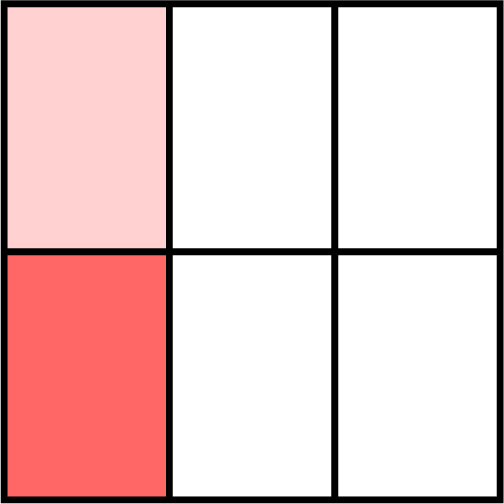
$$\dfrac{1}{2} \text{ of } \dfrac{1}{3} = \dfrac{1}{2} \times \dfrac{1}{3} = \dfrac{1}{6}$$ In general the product of two fractions is the area of a rectangle in the unit square: \(\dfrac{2}{3} \times \dfrac{1}{2}\) covers \(2\) of the \(6\) small rectangles. 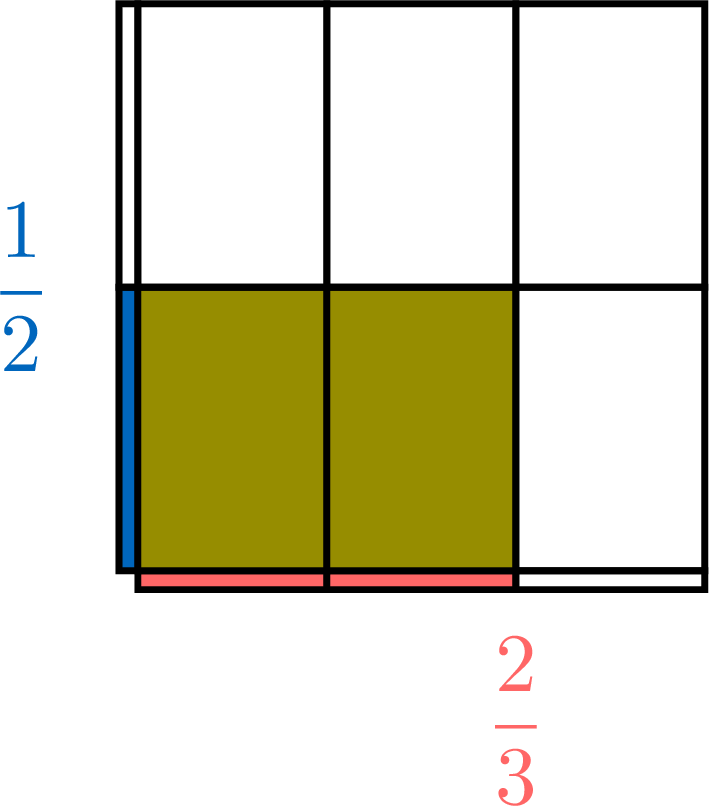
$$\dfrac{2}{3} \times \dfrac{1}{2} = \dfrac{2 \times 1}{3 \times 2} = \dfrac{2}{6}$$ Dividing by a unit fraction asks “how many of these parts fit in it?”: there are \(6\) halves in \(3\). 
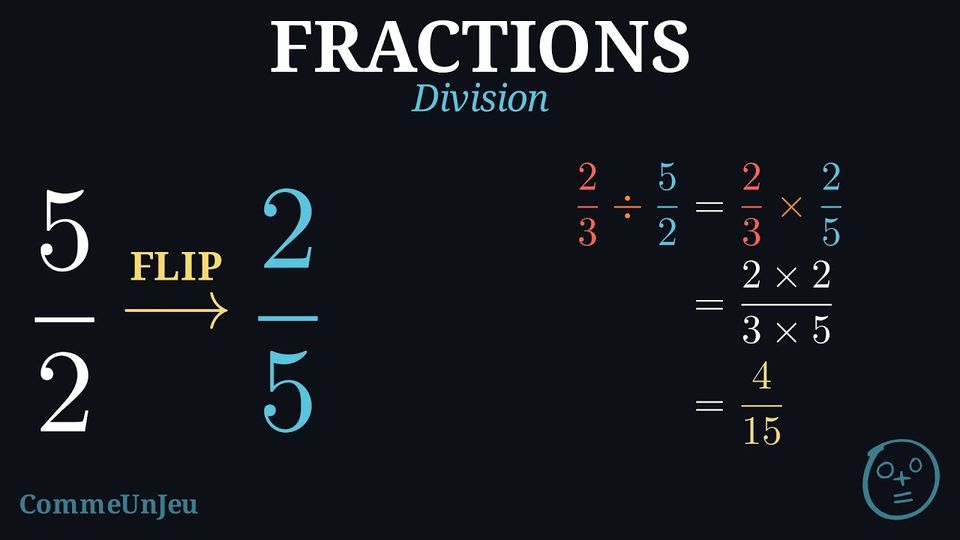
$$3 \div \dfrac{1}{2} = 6$$ Abstract. Multiply the top numbers together and the bottom numbers together; dividing by a non-zero fraction is multiplying by its reciprocal, and the picture “how many halves in \(3\)?” is the one to recall when the rule is forgotten.
Watch for. “Multiplying always makes bigger, dividing always makes smaller.” Before any calculation, ask for the size of the result: \(3 \times \dfrac{2}{3}\) is less than \(3\), \(\dfrac{1}{2}\) of \(\dfrac{1}{3}\) is less than \(\dfrac{1}{3}\), \(3 \div \dfrac{1}{2}\) is more than \(3\). The figures say why. And the procedure for subtracting, met with positive fractions, says that the first fraction must not be smaller than the second: with negative numbers that condition goes, \(\dfrac{2}{3}-\dfrac{3}{4}=-\dfrac{1}{12}\). Say it to the class.
Where to find it. PYP 5, Operations with Fractions: Multiplication and Division with Fractions: Models; exercises Predicting the Size of the Result, A Whole Number Times a Fraction, A Fraction of a Fraction, How Many Unit Fractions in a Whole Number? MYP 1, Fractions and Whole Numbers: Multiplying a Fraction by a Whole Number. MYP 2, Operations with Fractions: The Product of Two Fractions, Reciprocals and Division; Negative Fractions and the Order of Operations; exercises Multiplying Fractions, Dividing Fractions, Comparing Signed Fractions.
Pictorial. Three figures of the lessons answer three questions before any rule. A whole number times a fraction is a repeated addition: \(3\) jumps of \(\dfrac{2}{3}\).
\(3\times\)  | \(=\) | \(+\) \(+\) |
| \(=\) |  |
Watch for. “Multiplying always makes bigger, dividing always makes smaller.” Before any calculation, ask for the size of the result: \(3 \times \dfrac{2}{3}\) is less than \(3\), \(\dfrac{1}{2}\) of \(\dfrac{1}{3}\) is less than \(\dfrac{1}{3}\), \(3 \div \dfrac{1}{2}\) is more than \(3\). The figures say why. And the procedure for subtracting, met with positive fractions, says that the first fraction must not be smaller than the second: with negative numbers that condition goes, \(\dfrac{2}{3}-\dfrac{3}{4}=-\dfrac{1}{12}\). Say it to the class.
Where to find it. PYP 5, Operations with Fractions: Multiplication and Division with Fractions: Models; exercises Predicting the Size of the Result, A Whole Number Times a Fraction, A Fraction of a Fraction, How Many Unit Fractions in a Whole Number? MYP 1, Fractions and Whole Numbers: Multiplying a Fraction by a Whole Number. MYP 2, Operations with Fractions: The Product of Two Fractions, Reciprocals and Division; Negative Fractions and the Order of Operations; exercises Multiplying Fractions, Dividing Fractions, Comparing Signed Fractions.
Letters in the Fraction (MYP 3 and MYP 4)
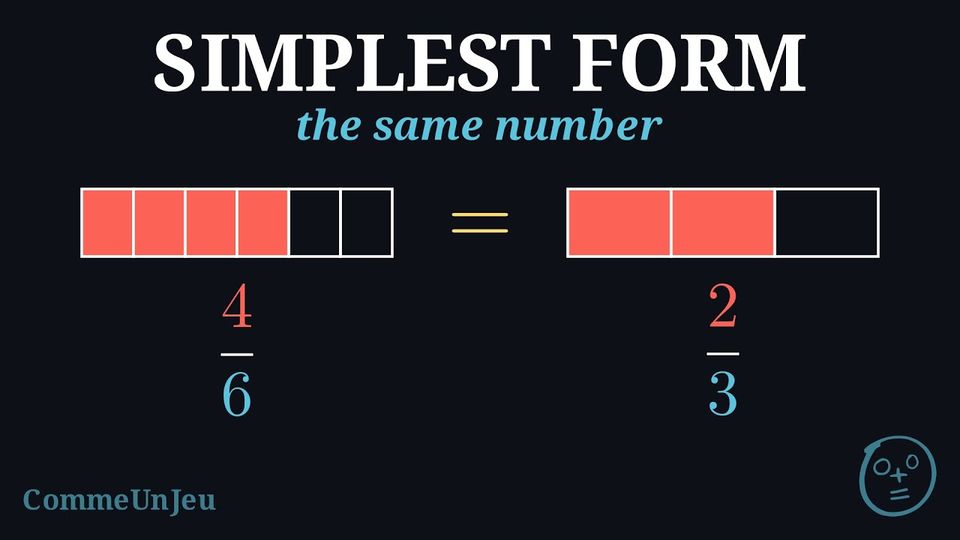
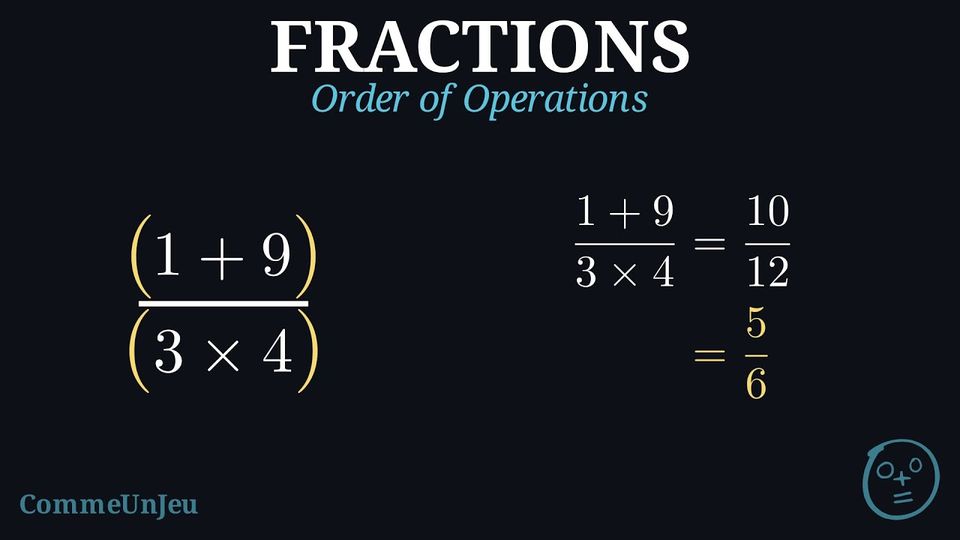
Abstract, with a numerical check. The same chains serve algebraic fractions. Two errors appear once letters enter, and both are caught by a number.
Cancelling a term: \(\dfrac{x+2}{2}\) is not \(x\). Check with \(x = 6\): \(\dfrac{6+2}{2} = 4\), not \(6\). Only a common factor cancels: $$\dfrac{2x+4}{2} = \dfrac{2(x+2)}{2} = x+2$$ Losing the excluded value: \(\dfrac{9x^3}{30x}\) and \(\dfrac{3x^2}{10}\) are equal for every \(x\) except \(0\), where the first one does not exist. The lesson writes the condition beside every cancellation; ask for it in every answer: $$\dfrac{9x^3}{30x} = \dfrac{3x^2}{10} \qquad \text{(for } x \neq 0\text{)}$$ Where to find it. MYP 3, Algebraic Fractions: Simplifying Algebraic Fractions. MYP 4: Excluded Values; Simplifying by Factorising, Adding and Subtracting with the Lowest Common Denominator; exercises Finding Excluded Values, Simplifying by Factorising, Adding with Numerical and Monomial Denominators.
Cancelling a term: \(\dfrac{x+2}{2}\) is not \(x\). Check with \(x = 6\): \(\dfrac{6+2}{2} = 4\), not \(6\). Only a common factor cancels: $$\dfrac{2x+4}{2} = \dfrac{2(x+2)}{2} = x+2$$ Losing the excluded value: \(\dfrac{9x^3}{30x}\) and \(\dfrac{3x^2}{10}\) are equal for every \(x\) except \(0\), where the first one does not exist. The lesson writes the condition beside every cancellation; ask for it in every answer: $$\dfrac{9x^3}{30x} = \dfrac{3x^2}{10} \qquad \text{(for } x \neq 0\text{)}$$ Where to find it. MYP 3, Algebraic Fractions: Simplifying Algebraic Fractions. MYP 4: Excluded Values; Simplifying by Factorising, Adding and Subtracting with the Lowest Common Denominator; exercises Finding Excluded Values, Simplifying by Factorising, Adding with Numerical and Monomial Denominators.
Addition Written as Equations Between Bars
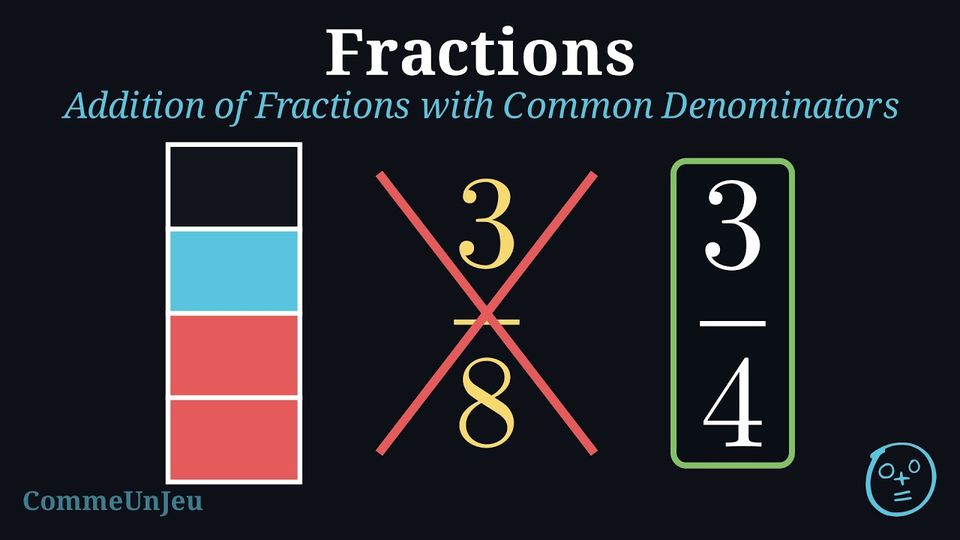
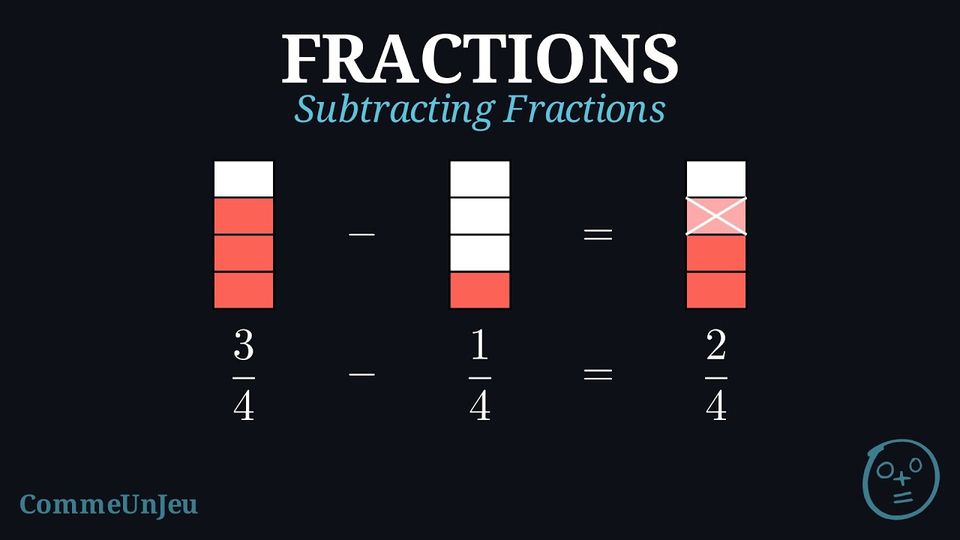
In CommeUnJeu, an addition of fractions is not illustrated by a drawing placed next to the calculation: it is written with the bars. Each term is a bar of the same unit, shaded to its fraction; the signs \(+\) and \(=\) go between the bars, as between numbers; in the result bar, the parts of each term keep their colour, so that the pupil sees the two colours stacked in one bar. The bars stand, so that the heights can be read, and it is an equality in the full sense: the sign \(=\) says that the coloured height of the result is the sum of the coloured heights of the two terms.
The first corrections write the same calculation three times: with the bars, with the symbols, and in a sentence.
Ask for the sentence first, then the chain. The sentence says why the denominator does not change: we count eighths, and eighths stay eighths.
The first corrections write the same calculation three times: with the bars, with the symbols, and in a sentence.
| Bars |  \(+\)  \(=\)  |
| Symbols | \(\begin{aligned}[t]\dfrac{3}{8} + \dfrac{4}{8} &= \dfrac{3 + 4}{8} \\&= \dfrac{7}{8}\end{aligned}\) |
| Words | Three eighths of the unit plus four eighths of the unit make seven eighths of the unit. |
When the Parts Are Not the Same Size
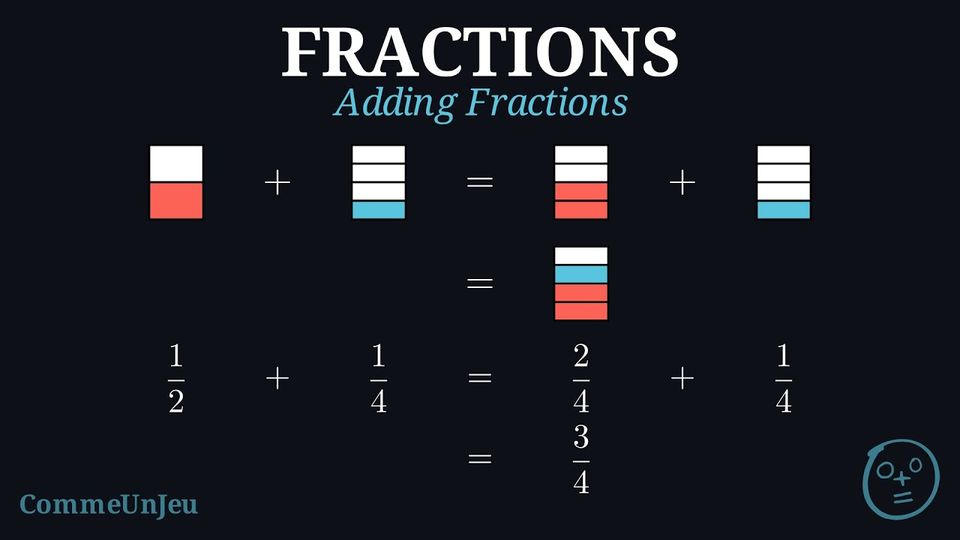
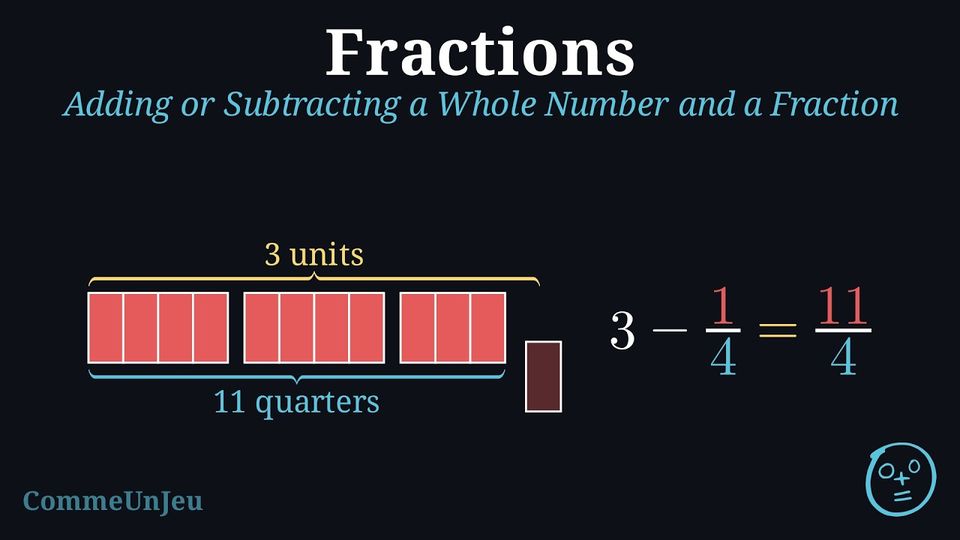
With different denominators, the equality between bars becomes a chain of equalities between bars, written line by line above the chain of symbols. Here is \(\dfrac{1}{2}+\dfrac{1}{4}\), as the lesson writes it:
The middle line is the important one: the half is cut again into two quarters. The bar does not change length, only the way it is cut: that is why the line is written with \(=\). This is the common denominator, seen before it is computed. Halves and quarters cannot be counted together; quarters and quarters can.
And the error of the year, caught by the bars. Louis writes \(\dfrac{1}{2}+\dfrac{1}{4}=\dfrac{2}{6}\). Draw \(\dfrac{1}{2}\) and \(\dfrac{2}{6}\) on two identical bars, standing: the “sum” stops lower than \(\dfrac{1}{2}\) alone. Yet the sum of two positive numbers is greater than each of them. 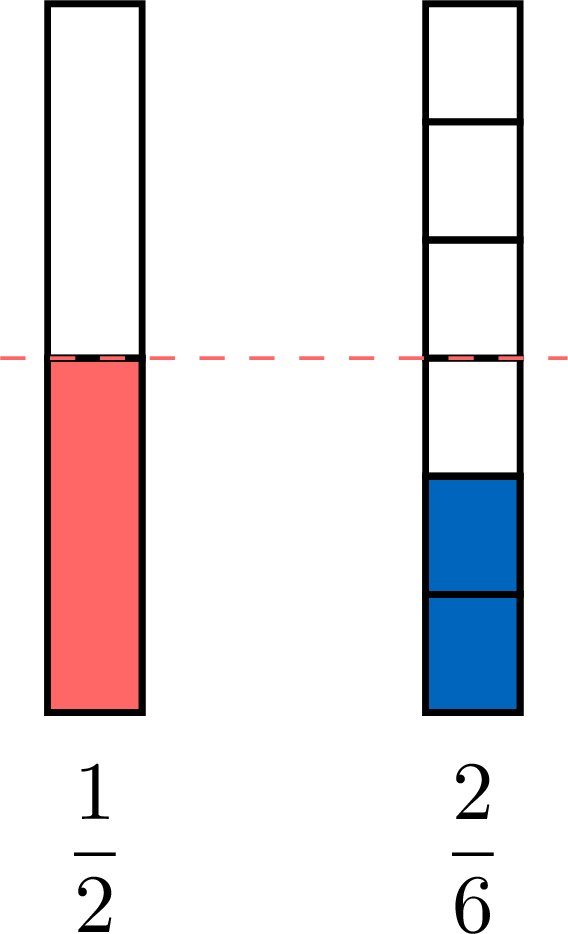
 \(+\)  | \(=\) |  \(+\) |
| \(=\) |  | |
| \(\dfrac{1}{2}+\dfrac{1}{4}\) | \(=\) | \(\dfrac{2}{4}+\dfrac{1}{4}\) |
| \(=\) | \(\dfrac{3}{4}\) |
And the error of the year, caught by the bars. Louis writes \(\dfrac{1}{2}+\dfrac{1}{4}=\dfrac{2}{6}\). Draw \(\dfrac{1}{2}\) and \(\dfrac{2}{6}\) on two identical bars, standing: the “sum” stops lower than \(\dfrac{1}{2}\) alone. Yet the sum of two positive numbers is greater than each of them.
In Class
- Draw every bar standing, with the same height for one unit, the feet aligned; beyond \(1\), repeat the unit upwards. Two units of different heights compare parts of different sizes, and the equality no longer means anything.
- Write \(+\) and \(=\) between the bars, as between numbers, and read the line aloud.
- Under each line of bars, write the matching line of symbols. Each symbol line must say what the drawing above it shows.
- Check the height. When both terms are positive, the colour of the result reaches a higher level than that of either term.
- Let the bar step back. With twelfths or fifteenths, the drawing no longer computes; it checks one step. The chain of symbols takes over, with a reason written beside the line that changes something.
Errors to Watch For, and the Figure That Answers Each
These errors are not carelessness: for most of them, the pupil applies to fractions what was true of whole numbers. For each one, a figure of the lesson gives the answer; the pupil draws it, and the error shows.
- “\(\dfrac{1}{6} > \dfrac{1}{3}\), because \(6 > 3\).” Two bars of the same unit, standing side by side: the colour of \(\dfrac{1}{6}\) stops lower. The more parts, the smaller each part (PYP 2, Choosing the Right Rule).
- “\(\dfrac{1}{2} + \dfrac{1}{4} = \dfrac{2}{6}\).” Two identical bars, standing: \(\dfrac{2}{6}\) stops lower than \(\dfrac{1}{2}\) alone, so it cannot be the sum (PYP 3, equations between bars).
- \(\dfrac{3}{8}\) placed one mark off. The pupil counted the mark at \(0\) as “one” and stopped at \(\dfrac{2}{8}\). Count the intervals, with one arrow per part (PYP 3, Placing Fractions on the Number Line).

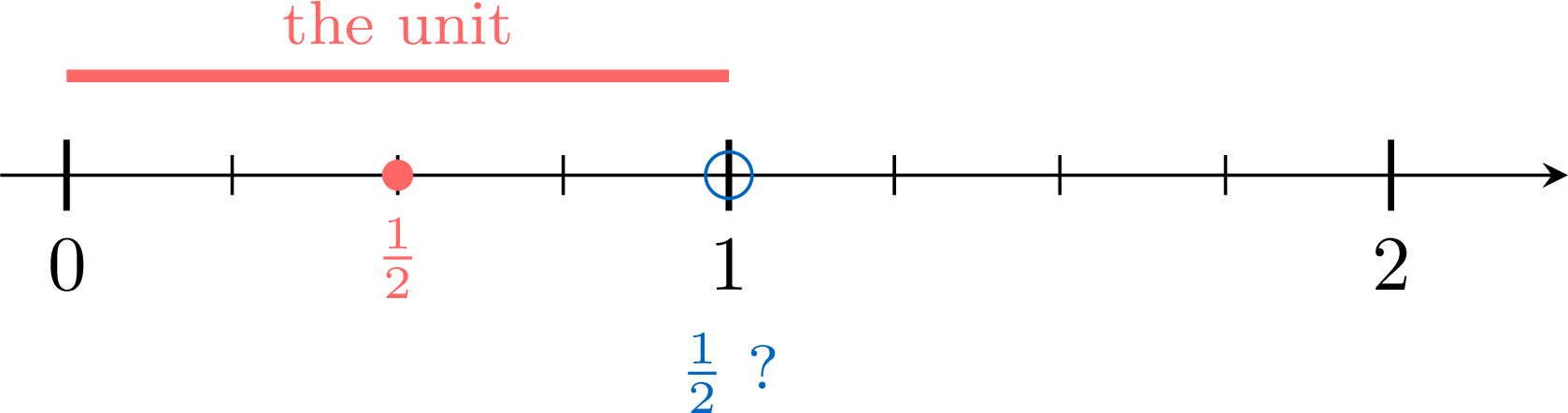
- \(\dfrac{1}{2}\) placed in the middle of a line from \(0\) to \(2\). The pupil took the whole line as the unit. Name the unit: from \(0\) to \(1\) (PYP 4, On the Number Line).
- “\(\dfrac{1}{2}\) and \(\dfrac{2}{4}\) are two different numbers.” The same point on the line (PYP 3, Placing Equivalent Fractions on the Number Line).
- “Five parts out of three is impossible.” Count thirds beyond \(1\): the figure of PYP 4.
- “A product is always bigger.” Half of one third on the square: the dark part is smaller than the column (PYP 5, Predicting the Size of the Result).
- \(\dfrac{x+2}{2} = x\). Try \(x = 6\). Only a factor cancels (MYP 4, Simplifying by Factorising).
One Task Taken Apart: Placing a Fraction on the Number Line
The same task, “place a fraction on the number line”, can be easy or hard. Four settings decide it; the exercises vary them one at a time. Here are the four.
- The cutting given. The unit is already cut into eighths: the pupil counts.


- Graduation and denominator. Placing \(\dfrac{1}{2}\) on a line cut into quarters is already an equivalence task: \(\dfrac{1}{2} = \dfrac{2}{4}\) (PYP 3, Placing Equivalent Fractions on the Number Line).

- The length of the line. A line from \(0\) to \(1\) hides the unit, since the segment drawn is the unit. A line from \(0\) to \(2\) reveals the pupil who takes the whole line as the unit (PYP 4, Finding Fractions Greater than 1 on the Number Line).
- The size of the fraction. \(\dfrac{5}{3}\) cannot be reached by counting “parts out of” the unit: it separates the pupils who count thirds from those who count parts of a whole.

Part Two: The Fraction as a Tool
Now the whole is a quantity: a class of \(30\) pupils, a price, the real length of a garden. The fraction keeps its place on the number line, but it is now used as a multiplier: it acts on the quantity, and the result is a quantity too. The lessons keep the bar, but its label changes: the brace above the bar reads \(30\), not \(1\), and the brace below the shaded part asks for a number of pupils. 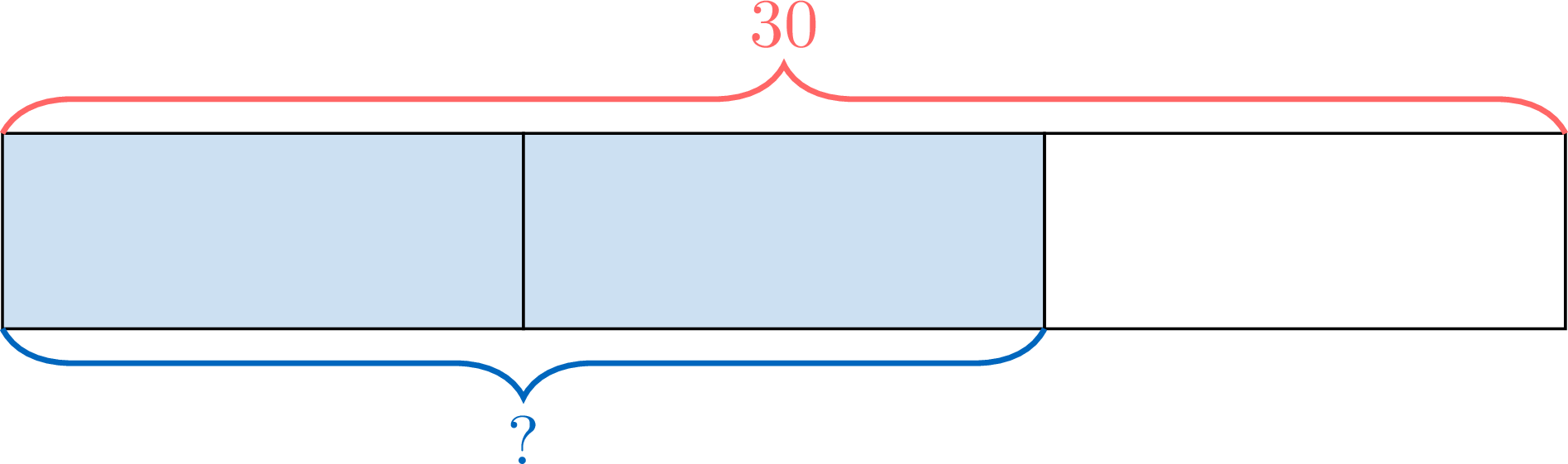
This is the bar of the tool, the one the Singapore method calls the bar model. It is drawn exactly like the bar of Part One, and that is the point: the pupil who can read “two thirds of the unit” can read “two thirds of \(30\)”. Only the whole has changed.
Three habits for this part:
Three habits for this part:
- Write the whole on the bar. “\(30\) pupils”, “the price before the discount”, “the real length”: the brace above the bar says what is shared. A pupil who cannot say what the whole is cannot start.
- Share first, multiply after. Two thirds of \(30\) is found by sharing (\(30 \div 3 = 10\), then \(2\) parts: \(20\)) long before it is written \(\dfrac{2}{3} \times 30\). The lessons write the multiplication in PYP 5 and MYP 1, when \(\dfrac{2}{3}\) is already a number.
- Say what the result counts. \(20\) girls, \(12\) cm, \(15\,\pourcent\) of the price: the answer of the tool is a quantity, or a comparison of two named quantities. A bare “\(20\)” has forgotten what was shared.
The Path of the Tool, Year by Year
The tool runs through two families of chapters: the fractions chapters, where a collection is shared and the action is written as a multiplication, and the chapters on ratios, proportionality, percentages and scale, where the tool is the subject.
| Year | Chapter | The tool in it |
| PYP 1 | Halves and Quarters | a half or a quarter of a collection |
| PYP 2 | Fractions | a fraction of a collection |
| PYP 4 | Position, Grids and Scale | reading and drawing a plan |
| PYP 5 | Operations with Fractions | from “half of” to “multiply by” |
| PYP 5 | Percentages and Ratios | part-whole and part-part ratios; \(\pourcent\) |
| PYP 5 | Location: Grids, Compass and Scale | plans and maps to scale |
| MYP 1 | Fractions | a fraction of a quantity |
| MYP 1 | Percentage | a part as a percentage; a percentage of a quantity |
| MYP 2 | Ratios, Rates and Percentages | proportions; unit rates; percentage change |
| MYP 3 | Ratio, Rates and Speed | sharing in a ratio; scale diagrams; speed |
| MYP 3 | Percentages and Money | multipliers; successive changes |
| MYP 4 | Direct and Inverse Proportion | \(y = kx\); inverse proportion |
The Tool, Year by Year, with the Figures of the Lessons
A Fraction of a Collection (PYP 1 and PYP 2)
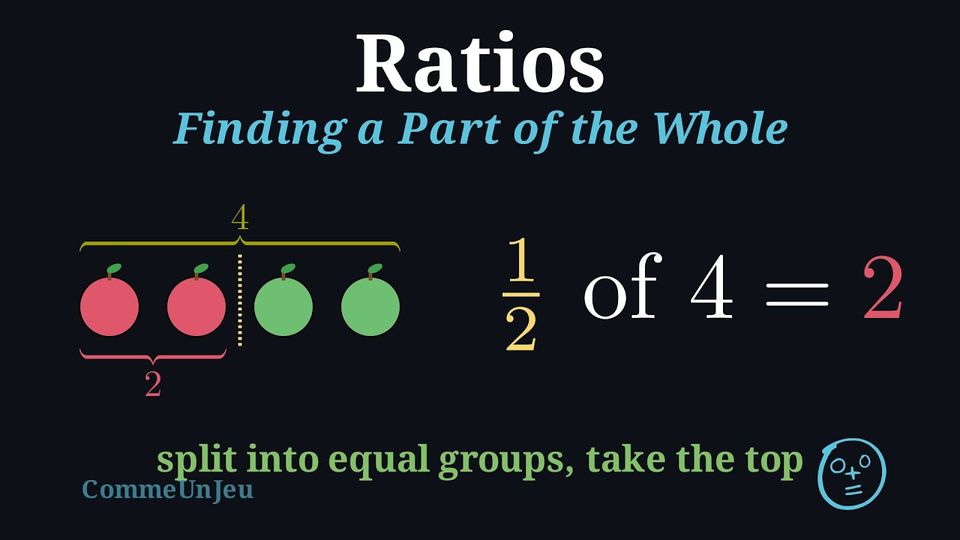
Concrete. Half of \(8\) counters: the pupil shares them into \(2\) equal groups, one by one, until none is left. One group is one half. A quarter: \(4\) equal groups. 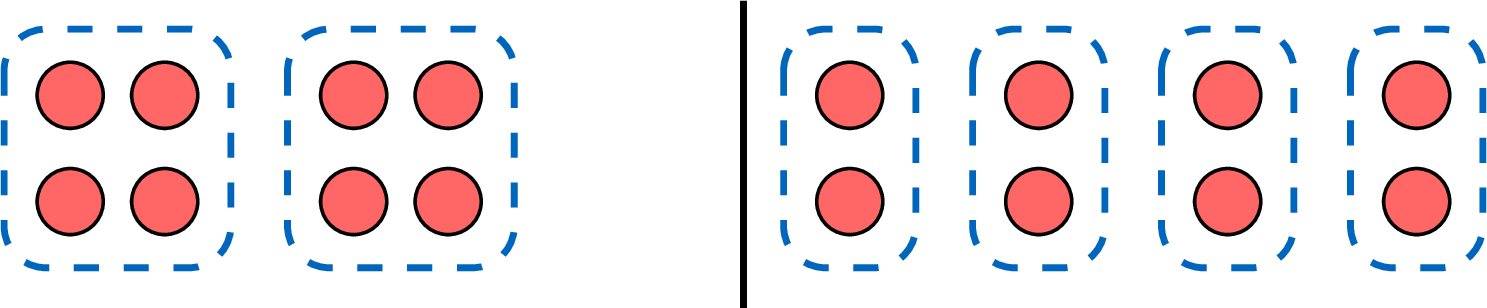
Pictorial. In PYP 2 the groups are drawn: \(12\) beads shared into \(3\) equal groups, one group is one third of the beads. 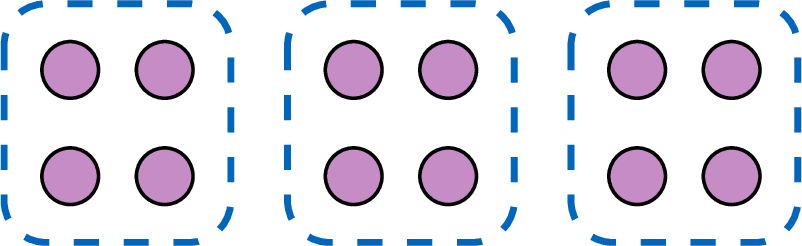
Abstract. Nothing is written yet but the sentence: one half of \(8\) counters is \(4\) counters, one third of \(12\) beads is \(4\) beads. The check is a sum: \(4 + 4 = 8\), \(4 + 4 + 4 = 12\). The pupil shares, then counts; no multiplication appears. This works only when nothing is left over: \(7\) counters cannot be shared into \(2\) equal groups, and the lesson says so.
Watch for. The answer is a number of objects, “\(4\) counters”, never the fraction “\(\dfrac{1}{2}\)”. The whole is the collection; the pupil who answers \(\dfrac{1}{2}\) has slipped back to the number.
Where to find it. PYP 1, A Half or a Quarter of a Collection; PYP 2, A Fraction of a Collection; exercises Finding a Fraction of a Collection.
From Sharing to Multiplying (PYP 5 and MYP 1)
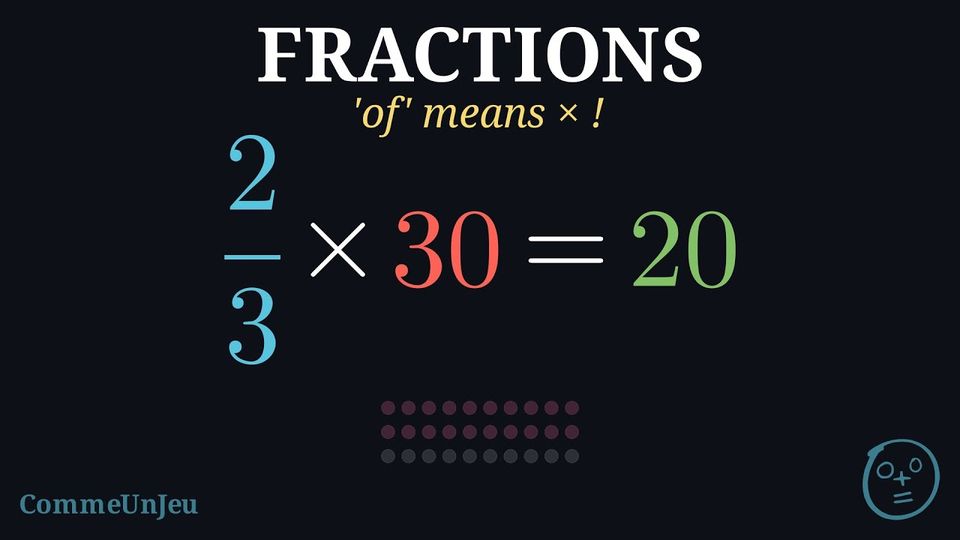
This is the hinge between the two parts. Concrete. Half of \(4\) apples: the pupils have done it since PYP 1, by sharing. 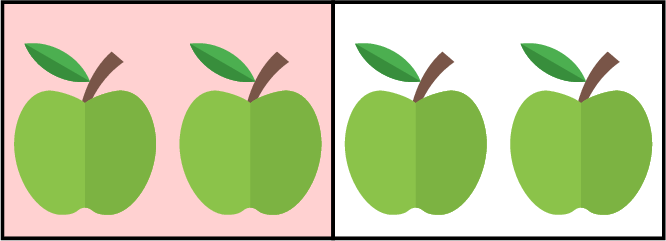
Abstract. The same action, read two ways: as a sharing, \(4 \div 2 = 2\); as a multiplication, \(\dfrac{1}{2} \times 4 = 2\). The sharing reading is the one that computes; the multiplication reading is the one that writes. The lesson writes it only now, when \(\dfrac{1}{2}\) has been a number on the line for two years: the number of Part One becomes the tool of Part Two.
Pictorial. Two thirds of \(12\) apples, in the bars of the lesson: one third first, \(12 \div 3 = 4\); then two of these parts, \(4 \times 2 = 8\). 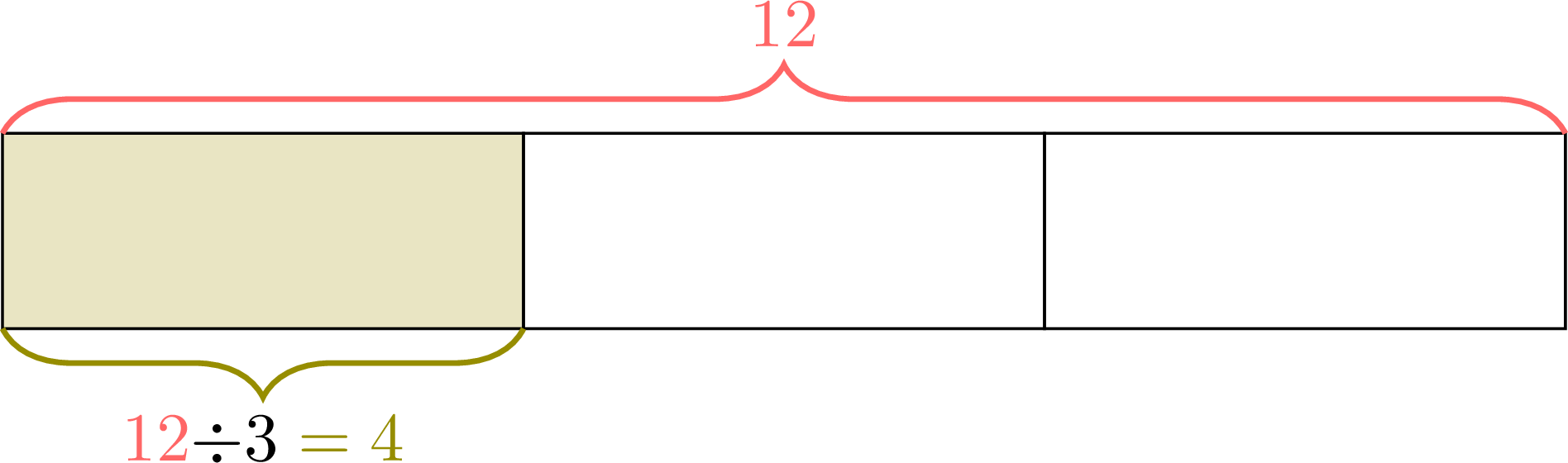
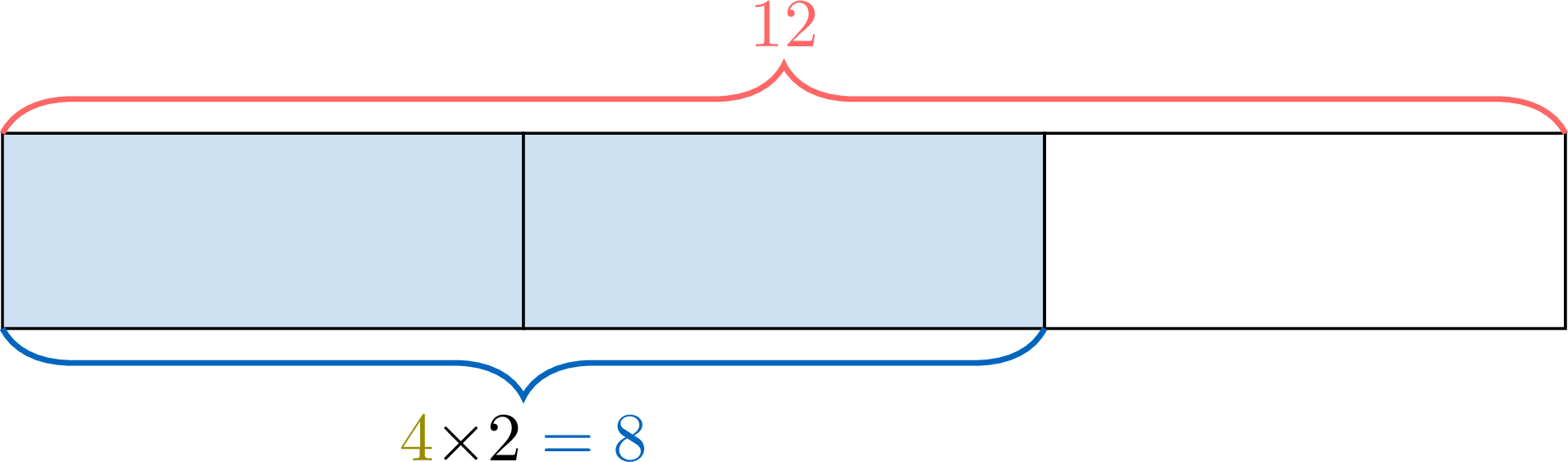
$$\begin{aligned}\text{two thirds of } 12 &= (12 \div 3) \times 2 && \text{(3 equal parts, 2 of them taken)}\\
&= 4 \times 2 = 8\end{aligned}$$ And in MYP 1, the class of \(30\) pupils of which two thirds are girls: the same bars, then the formula. 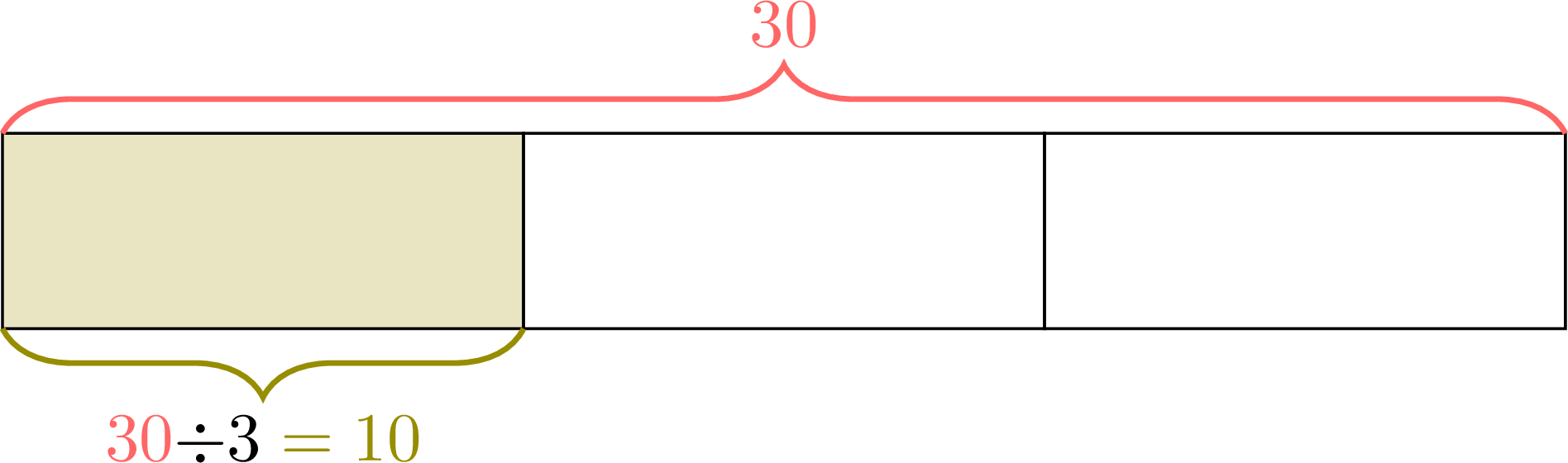
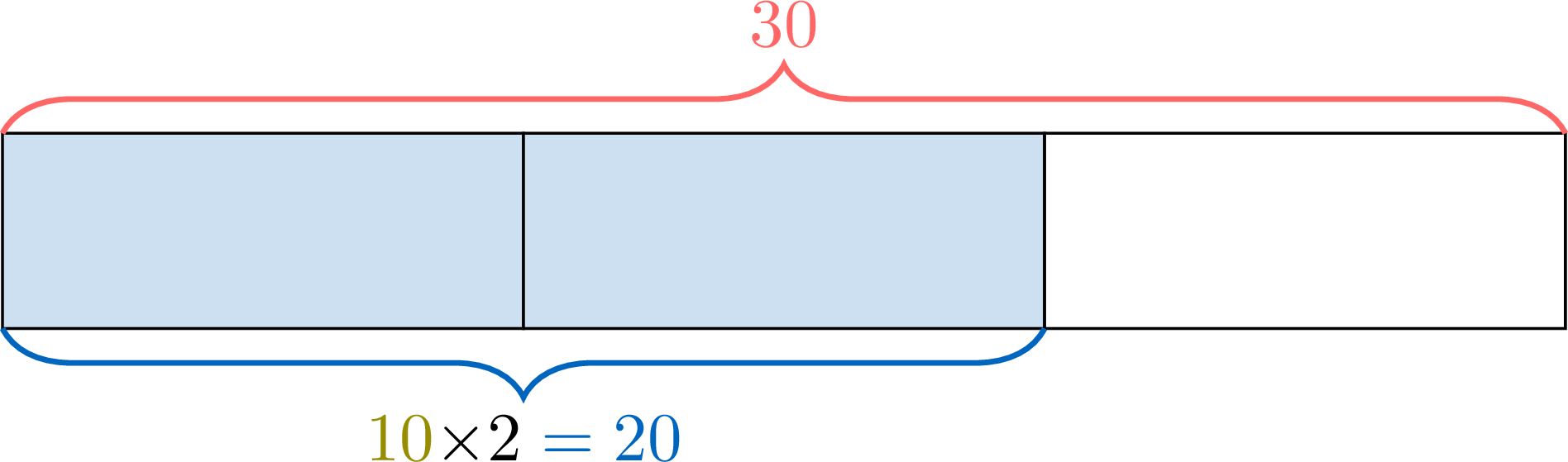
$$\text{number of girls} = \dfrac{2}{3} \text{ of } 30 = \dfrac{2}{3} \times 30 = \dfrac{2 \times 30}{3} = 20$$ Divide by the denominator, multiply by the numerator, or the other way round: the two readings agree, and the check reads the result back as a part of the whole, \(\dfrac{20}{30} = \dfrac{2}{3}\).
Watch for. A result bigger than the whole (\(\dfrac{2}{3}\) of \(30\) “\(= 45\)”, the pupil divided by \(2\) and multiplied by \(3\)): the bar shows the part inside the whole, so a part of \(30\) is less than \(30\). And a result without unit: “\(20\)” is not an answer, “\(20\) girls” is.
Where to find it. PYP 5, Operations with Fractions: From “half of” to “multiply by”; exercises Recognising a Part as a Multiplication. MYP 1, Fractions and Whole Numbers: A Fraction of a Quantity.
Pictorial. Two thirds of \(12\) apples, in the bars of the lesson: one third first, \(12 \div 3 = 4\); then two of these parts, \(4 \times 2 = 8\).
Watch for. A result bigger than the whole (\(\dfrac{2}{3}\) of \(30\) “\(= 45\)”, the pupil divided by \(2\) and multiplied by \(3\)): the bar shows the part inside the whole, so a part of \(30\) is less than \(30\). And a result without unit: “\(20\)” is not an answer, “\(20\) girls” is.
Where to find it. PYP 5, Operations with Fractions: From “half of” to “multiply by”; exercises Recognising a Part as a Multiplication. MYP 1, Fractions and Whole Numbers: A Fraction of a Quantity.
The Ratio: a Part and the Whole, a Part and a Part (PYP 5 and MYP 2)
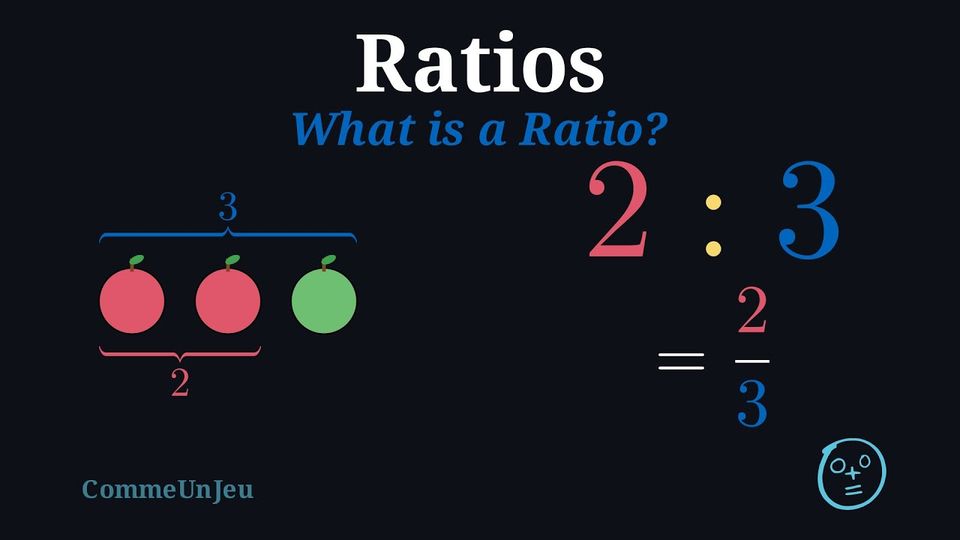
Concrete. A juice is made with \(1\) lemon and \(2\) oranges. Two questions, two ratios: oranges to all the fruit, \(2\) out of \(3\); oranges to lemons, \(2\) for \(1\).
Pictorial. The lesson draws the whole with a brace above and the part with a brace below: the ratio of oranges to the fruit is \(2:3\), “or as the fraction \(\dfrac{2}{3}\)”. This is the brace picture of the opening section, and it is where the fraction and the ratio meet. 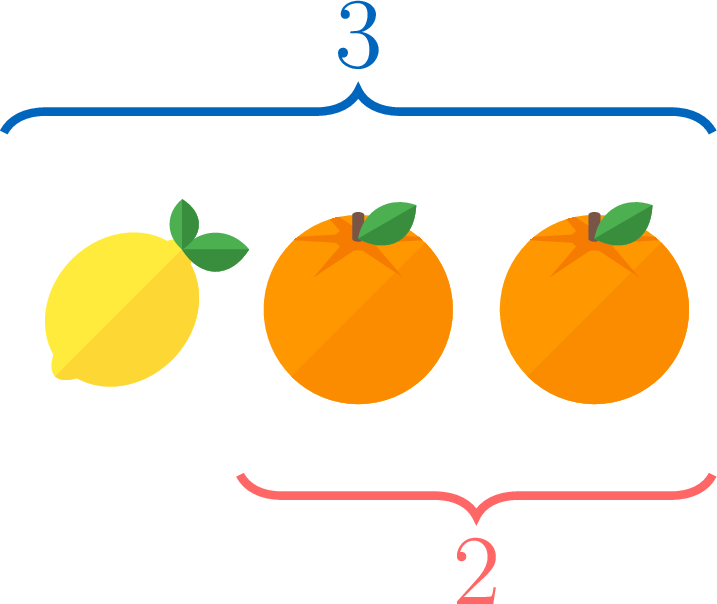
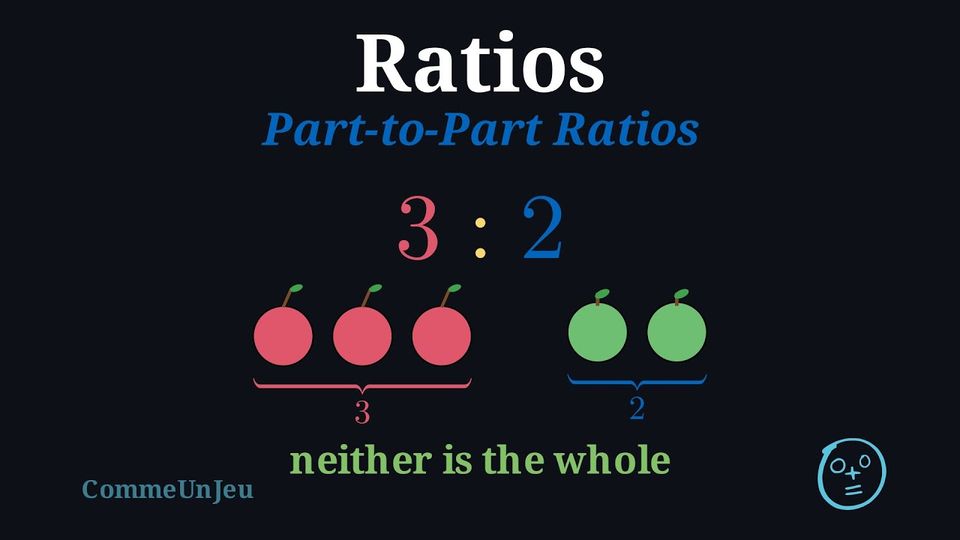
When neither quantity is the whole, the lesson draws two parts side by side under one bar: a part-to-part ratio, \(3:2\), compares two parts of a same whole, and that whole has \(5\) parts. 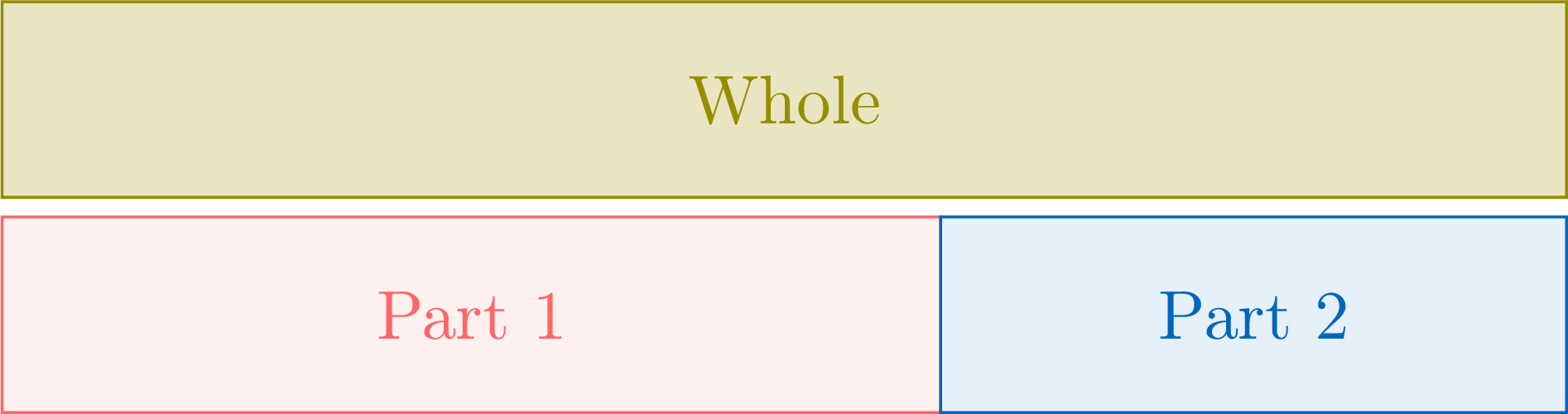
Abstract. Equivalent ratios are equivalent fractions, with the same arrows as in Part One: \(1:2 = 2:4\) because \(\dfrac{1}{2} = \dfrac{2}{4}\). 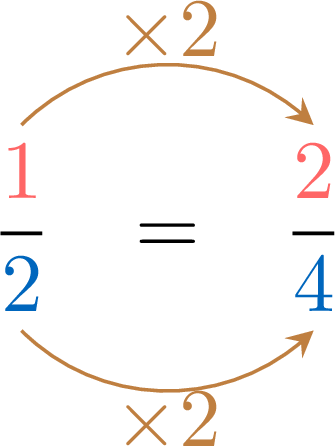
Sharing in a ratio uses the bar of the tool: \(30\) euros shared \(2:3\) is a bar of \(5\) equal parts, one part is \(30 \div 5 = 6\), the shares are \(12\) and \(18\).
Watch for. “\(2\) girls for \(3\) boys, so the girls are \(\dfrac{2}{3}\) of the class.” The ratio \(2:3\) here is part to part; the whole has \(5\) parts, and the girls are \(\dfrac{2}{5}\) of the class. The bar with its two parts settles it: ask which brace is the whole.
Where to find it. PYP 5, Percentages and Ratios: What Is a Ratio?, Part-to-Part Ratios, Part-Whole Ratios, Equivalent Ratios; exercises Finding Ratios in Part-Part Relationships, Finding Ratios in Part-Whole Relationships, Simplifying Ratios. MYP 2, Ratios, Rates and Percentages: What a Ratio Is, Equal Ratios, Proportions, Dividing a Quantity in a Ratio; exercises Identifying a Proportion, Sharing Proportionally. MYP 3, Ratio, Rates and Speed: Sharing in a Ratio of Three Parts.
Pictorial. The lesson draws the whole with a brace above and the part with a brace below: the ratio of oranges to the fruit is \(2:3\), “or as the fraction \(\dfrac{2}{3}\)”. This is the brace picture of the opening section, and it is where the fraction and the ratio meet.
Watch for. “\(2\) girls for \(3\) boys, so the girls are \(\dfrac{2}{3}\) of the class.” The ratio \(2:3\) here is part to part; the whole has \(5\) parts, and the girls are \(\dfrac{2}{5}\) of the class. The bar with its two parts settles it: ask which brace is the whole.
Where to find it. PYP 5, Percentages and Ratios: What Is a Ratio?, Part-to-Part Ratios, Part-Whole Ratios, Equivalent Ratios; exercises Finding Ratios in Part-Part Relationships, Finding Ratios in Part-Whole Relationships, Simplifying Ratios. MYP 2, Ratios, Rates and Percentages: What a Ratio Is, Equal Ratios, Proportions, Dividing a Quantity in a Ratio; exercises Identifying a Proportion, Sharing Proportionally. MYP 3, Ratio, Rates and Speed: Sharing in a Ratio of Three Parts.
Proportionality: the Coefficient Is a Quotient (MYP 2 to MYP 4)
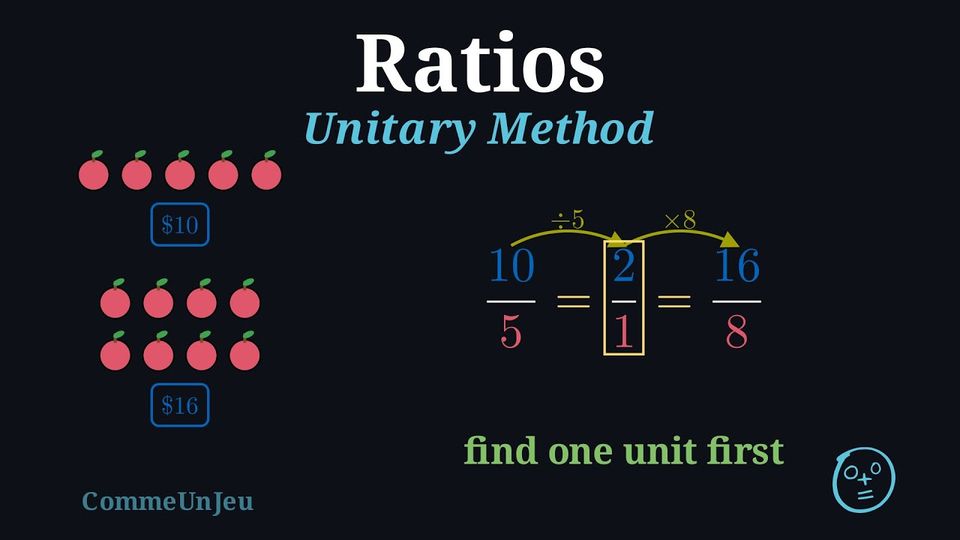
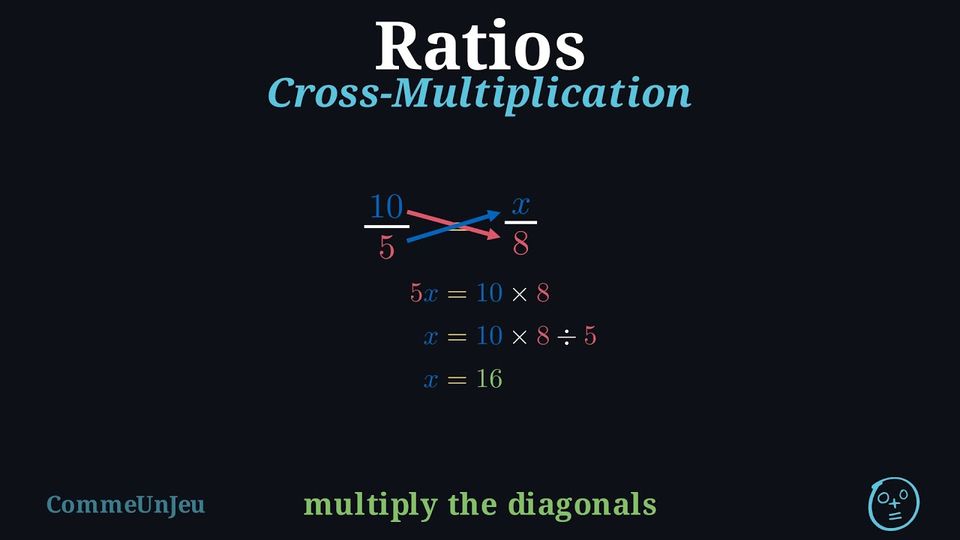
Concrete. \(4\) pens cost \(12\) dollars. How much do \(7\) pens cost? Twice as many pens cost twice as much; and the price of one pen, \(12 \div 4 = 3\), gives every other price.
Pictorial. Another situation of the lesson, \(2\) kg for \(6\) dollars: the table with its two arrows, multiply by the coefficient (\(3\) dollars per kg) to go down from the quantities to the prices, divide by it to come back up. 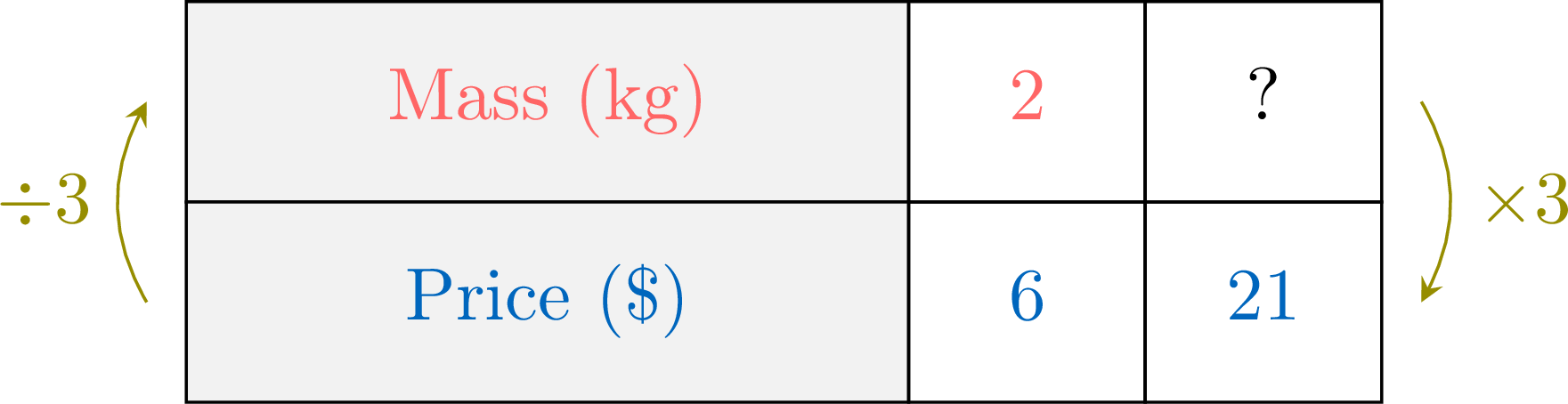
The lessons also reason on the quantities themselves: twice as much, the sum of two columns (MYP 3, Choosing the Adapted Procedure). On a third table, at \(5\) dollars per kg, proportionality preserves sums; the figure is the one of the French Grade 6 chapter, and MYP 2 reaches the same values through the unit rate. 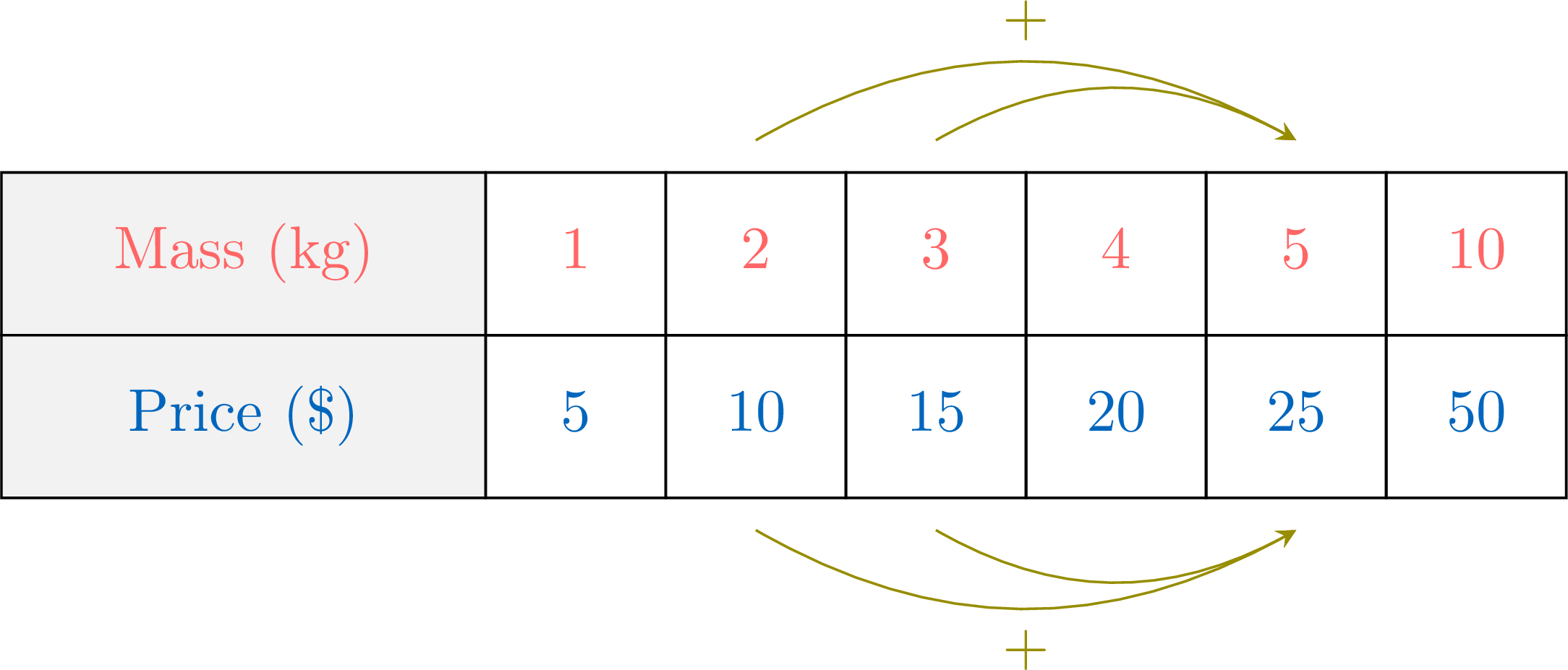
Abstract. The coefficient is the value for one unit, found by a division: \(12 \div 4 = 3\) dollars per pen. It is a quotient, the fraction of Part One with a unit attached, and the unitary method is the fraction's own chain of equalities. For \(5\) apples costing \(10\) dollars: \(\dfrac{10}{5} = \dfrac{2}{1} = \dfrac{16}{8}\), one apple costs \(2\), eight cost \(16\). 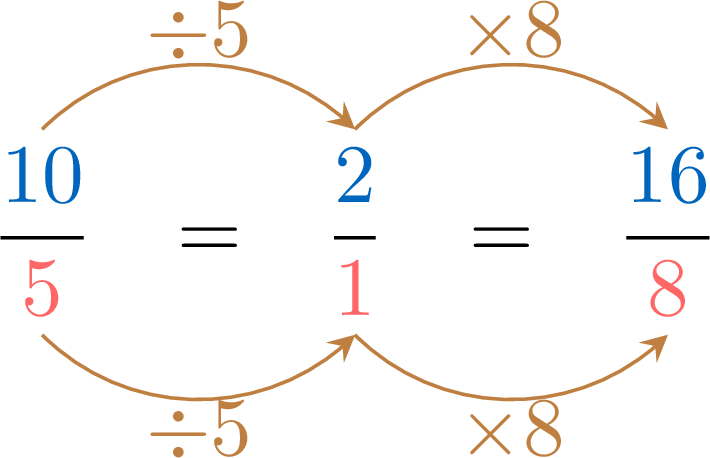
From MYP 2 the coefficient can be a quantity of its own, a rate; MYP 3 develops speed in km per hour and density; in MYP 4 it is the \(k\) of \(y = kx\), read on a line through the origin.
Watch for. Adding instead of multiplying: “\(4\) pens cost \(12\), so \(6\) pens cost \(14\)”. Ask the pupil to say the relation aloud, “\(6\) pens are \(4\) pens and \(2\) pens”, before any number. And the recipe applied blindly: cross-multiplication is the last tool of the lessons, after “twice as much” and “back to the unit”.
Where to find it. MYP 2, Ratios, Rates and Percentages: Proportional Quantities and the Unit Rate, The Unitary Method and the Better Buy, Cross-Multiplication; exercises Calculating a Unit Rate, Bringing to the Unit and Back. MYP 3, The Fourth Proportional, Rates; exercises Choosing Between the Procedures. MYP 4, Directly Proportional Quantities, Proportionality on a Graph.
Pictorial. Another situation of the lesson, \(2\) kg for \(6\) dollars: the table with its two arrows, multiply by the coefficient (\(3\) dollars per kg) to go down from the quantities to the prices, divide by it to come back up.
Watch for. Adding instead of multiplying: “\(4\) pens cost \(12\), so \(6\) pens cost \(14\)”. Ask the pupil to say the relation aloud, “\(6\) pens are \(4\) pens and \(2\) pens”, before any number. And the recipe applied blindly: cross-multiplication is the last tool of the lessons, after “twice as much” and “back to the unit”.
Where to find it. MYP 2, Ratios, Rates and Percentages: Proportional Quantities and the Unit Rate, The Unitary Method and the Better Buy, Cross-Multiplication; exercises Calculating a Unit Rate, Bringing to the Unit and Back. MYP 3, The Fourth Proportional, Rates; exercises Choosing Between the Procedures. MYP 4, Directly Proportional Quantities, Proportionality on a Graph.
Percentages: the Whole Brought to 100 (PYP 5 to MYP 3)
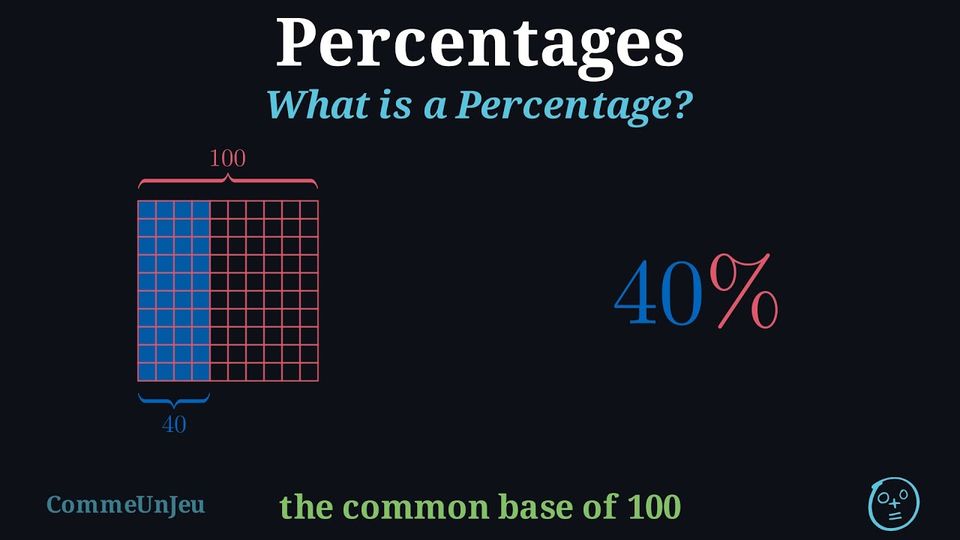
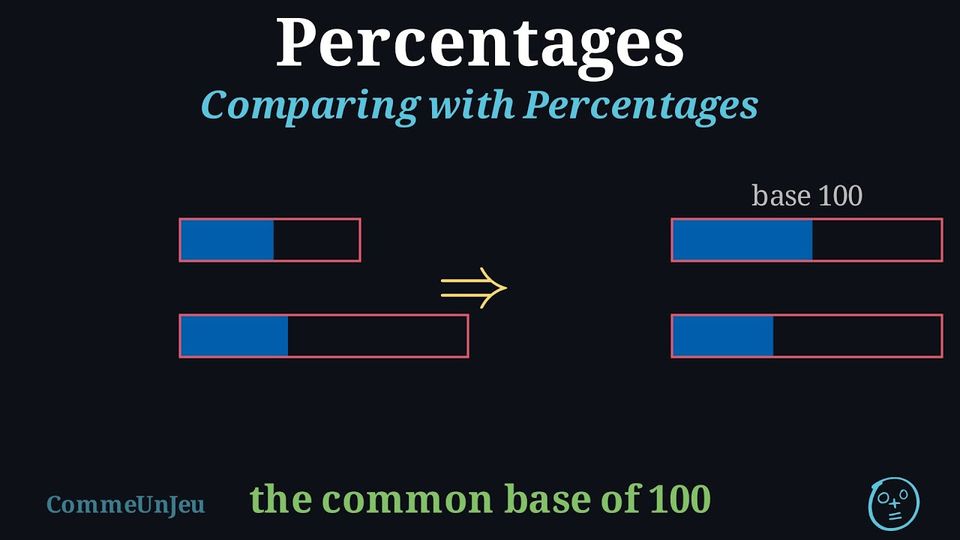
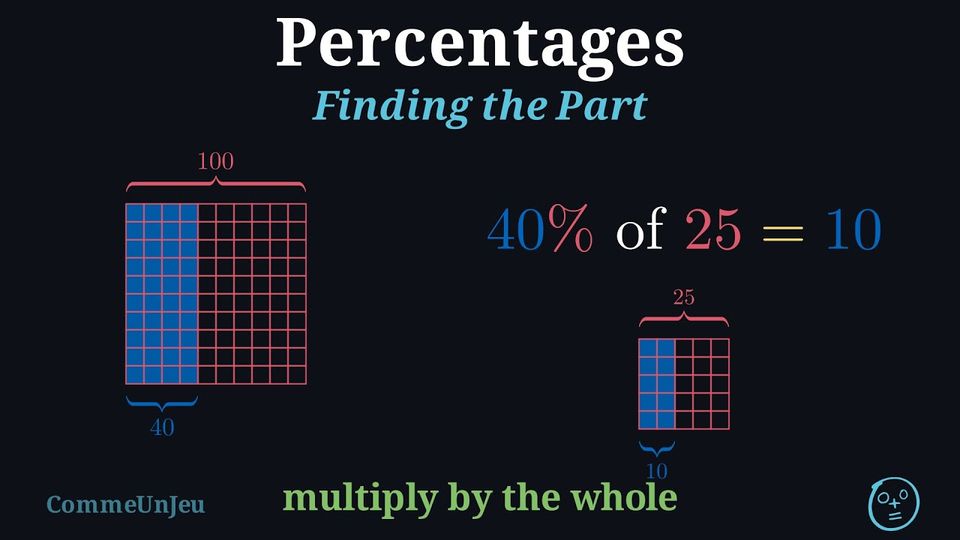
Concrete. In one class \(5\) pupils out of \(25\) walk to school; in another, \(12\) out of \(20\). In which class is the share of walkers larger? The wholes differ, so the parts cannot be compared as they are.
Pictorial. The lesson starts from a grid of \(100\) squares: \(23\) coloured squares, \(23\,\pourcent\) of the grid. 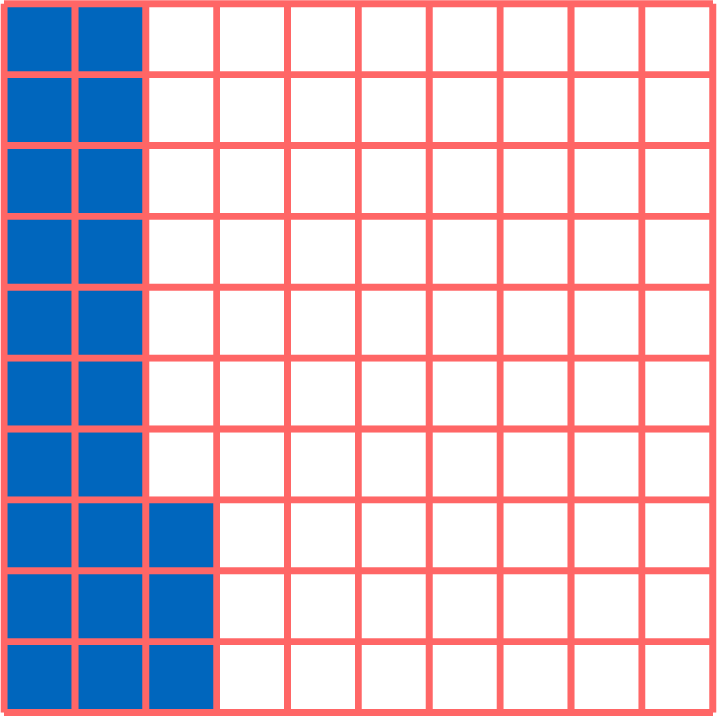
Then it brings a whole of \(25\) to a whole of \(100\): \(5\) out of \(25\) becomes \(20\) out of \(100\), the equivalent fraction of Part One, drawn on two grids. 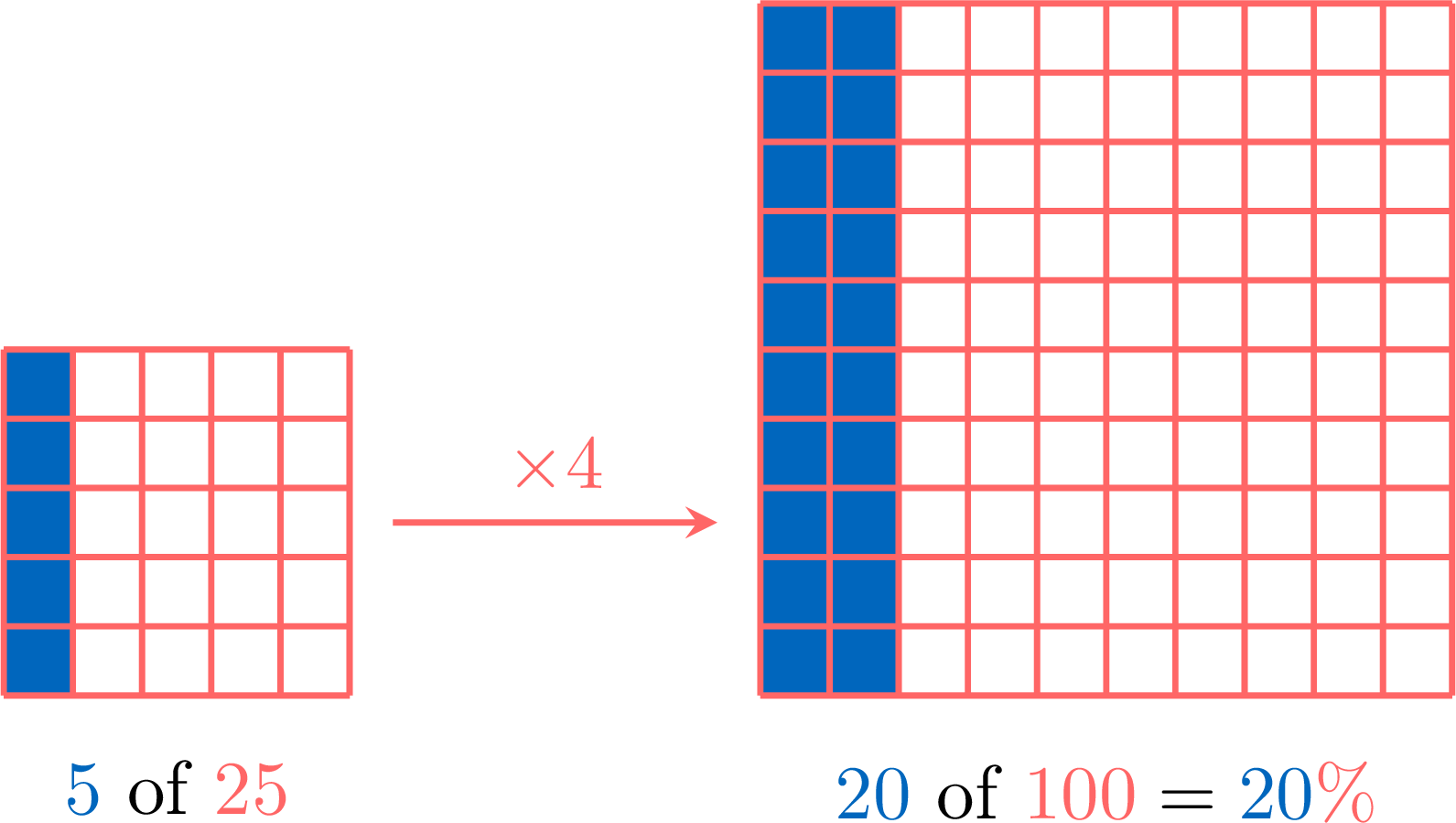
Abstract. A percentage is a fraction with denominator \(100\): \(23\,\pourcent = \dfrac{23}{100}\), and \(\dfrac{3}{4} = \dfrac{75}{100} = 75\,\pourcent\) with the arrows of Part One. 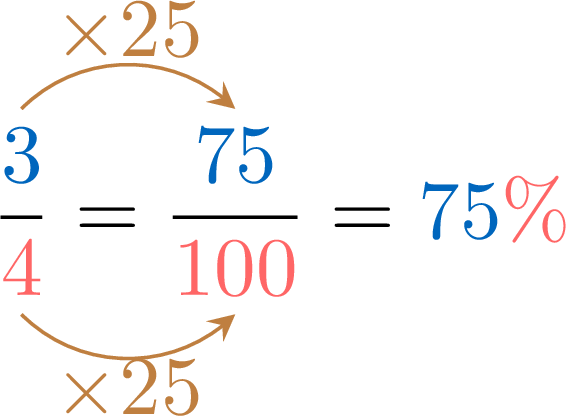
So the two classes compare on a common base of \(100\): \(\dfrac{5}{25} = 20\,\pourcent\) and \(\dfrac{12}{20} = 60\,\pourcent\). And taking \(x\,\pourcent\) of a quantity is taking the fraction \(\dfrac{x}{100}\) of it, the tool of the previous sections: \(60\,\pourcent\) of \(200\) pupils is \(120\) pupils, read “\(60\) for every \(100\), so \(2 \times 60\) for \(200\)”.
The percentages to know by heart are fractions in disguise: \(50\,\pourcent\) is a half, \(25\,\pourcent\) a quarter, \(10\,\pourcent\) a tenth; \(100\,\pourcent\) is the whole quantity.
Watch for. The percentage of the wrong whole. “\(35\) cm is \(35 \div 7 = 500\,\pourcent\) of \(7\) m”: same unit first, \(35\) cm out of \(700\) cm is \(5\,\pourcent\), and a part never exceeds its whole. “\(-25\,\pourcent\) then \(+10\,\pourcent\) makes \(-15\,\pourcent\)”: the second change applies to the price at that moment, not to the first price, and percentages of two different wholes do not add.
Where to find it. PYP 5, Percentages and Ratios: What Is a Percentage?, Converting Between Forms, Percentages to Know by Heart; exercises Converting Fraction Models to Percentages, Converting Fractions to Percentages with Bar Models, Calculating a Percentage Mentally. MYP 1, Percentage: Expressing a Part as a Percentage, Comparing with Percentages, Finding a Percentage of a Quantity, Percentage Increase and Decrease; exercises Converting to the Same Unit First, Finding a Part Using Percentages. MYP 2, Increase, Decrease and Discounts, Percentage Change. MYP 3, The Multiplier, Successive and Reciprocal Changes.
Pictorial. The lesson starts from a grid of \(100\) squares: \(23\) coloured squares, \(23\,\pourcent\) of the grid.
| Pupils | \(100\) | \(200\) |
| Girls | \(60\) | \(120\) |
Watch for. The percentage of the wrong whole. “\(35\) cm is \(35 \div 7 = 500\,\pourcent\) of \(7\) m”: same unit first, \(35\) cm out of \(700\) cm is \(5\,\pourcent\), and a part never exceeds its whole. “\(-25\,\pourcent\) then \(+10\,\pourcent\) makes \(-15\,\pourcent\)”: the second change applies to the price at that moment, not to the first price, and percentages of two different wholes do not add.
Where to find it. PYP 5, Percentages and Ratios: What Is a Percentage?, Converting Between Forms, Percentages to Know by Heart; exercises Converting Fraction Models to Percentages, Converting Fractions to Percentages with Bar Models, Calculating a Percentage Mentally. MYP 1, Percentage: Expressing a Part as a Percentage, Comparing with Percentages, Finding a Percentage of a Quantity, Percentage Increase and Decrease; exercises Converting to the Same Unit First, Finding a Part Using Percentages. MYP 2, Increase, Decrease and Discounts, Percentage Change. MYP 3, The Multiplier, Successive and Reciprocal Changes.
Scale: a Ratio of Lengths (PYP 4, PYP 5 and MYP 3)
Concrete. The plan of a park, drawn on a grid of \(1\) cm squares. The pond is \(3\) cm long on the plan. How long is it really?
Pictorial. In PYP 4 the scale is a sentence and a bar: “\(1\) cm stands for \(5\) m”. The pond is \(3\) times \(1\) cm, so \(3\) times \(5\) m: \(15\) m. 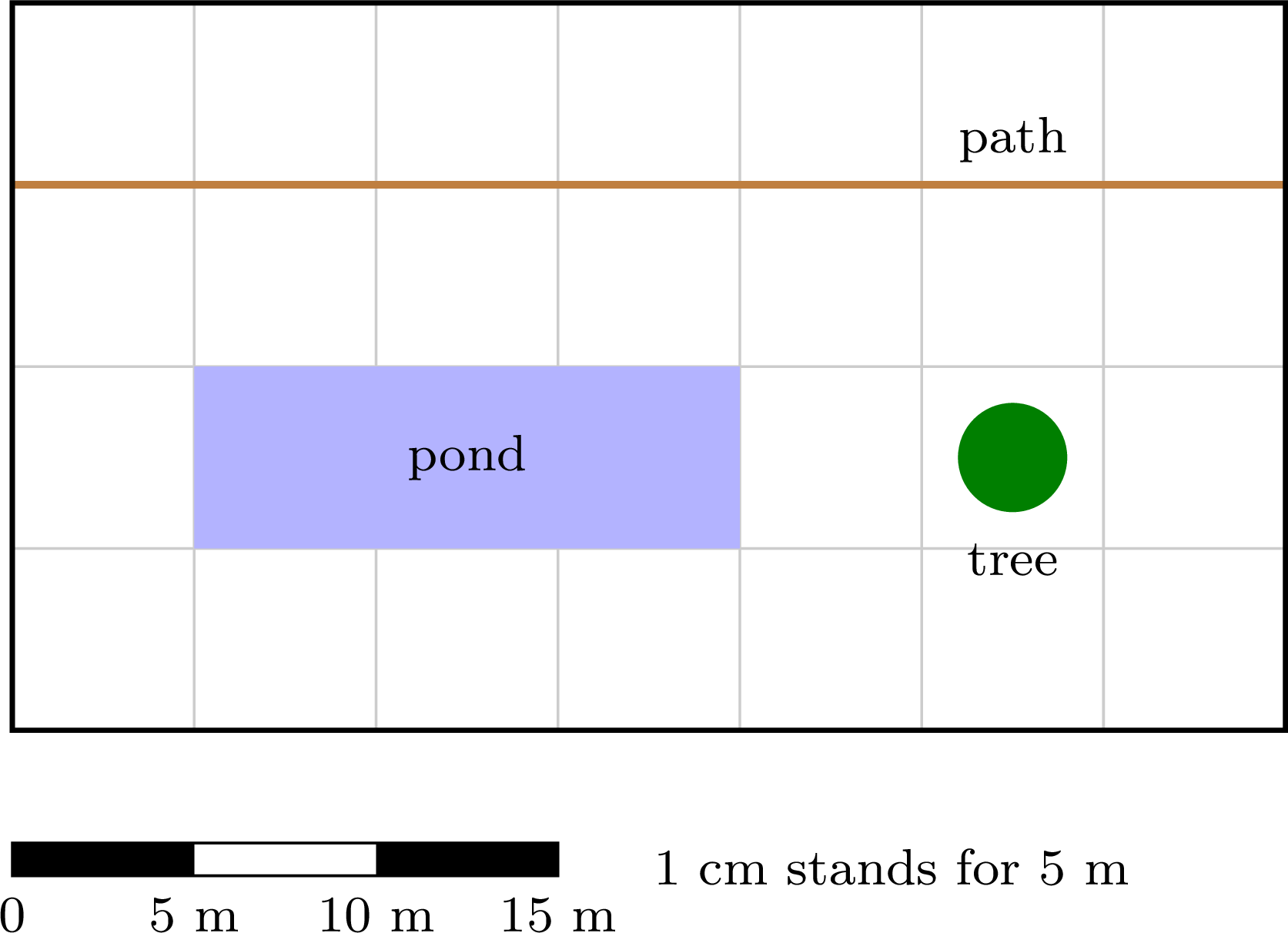
Abstract. In MYP 3 the sentence becomes a ratio of two lengths in the same unit, simplified so that the drawn term is \(1\): \(4\) cm for \(8\) m is \(4:800 = 1:200\). The second term, \(200\), is the scale factor: the real length is the drawn length multiplied by \(200\), and back by a division, in the same unit. The two arrows of proportionality again. 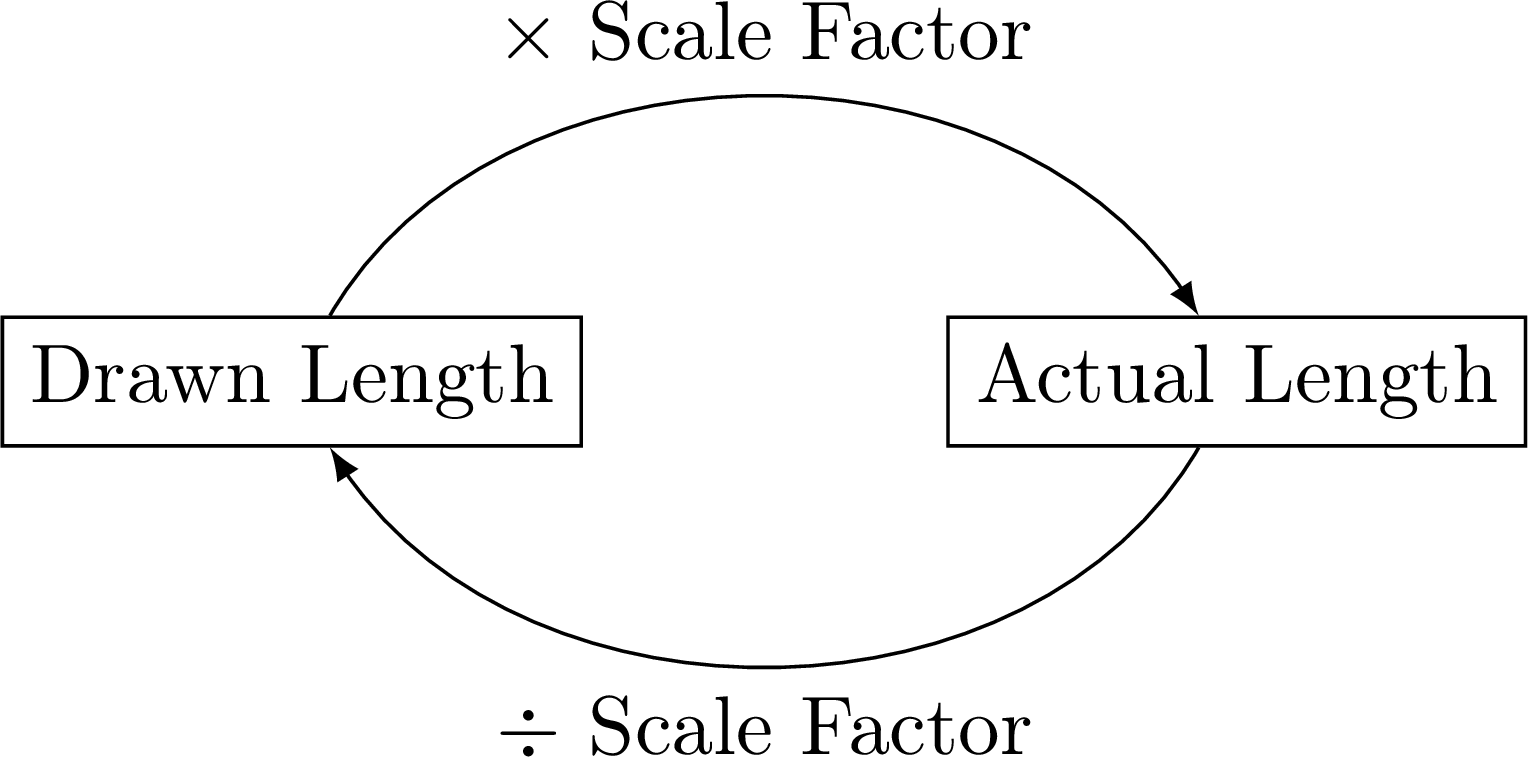
A scale is the ratio of a drawn length to the matching real length, both in the same unit: at \(1:200\), every drawn length is \(\dfrac{1}{200}\) of the real one. It compares two lengths; the drawing is not a part of the real object.
Watch for. “Scale \(1:200\), so \(1\) cm is \(200\) m.” The two terms of a scale are in the same unit: \(1\) cm for \(200\) cm, that is \(2\) m. Say whether the length asked for is on the plan or in reality, and write its unit.
Where to find it. PYP 4, Position, Grids and Scale: Reading a Plan, Drawing a Plan; exercises Reading a Scale, Finding a Real Length, Drawing a Plan to Scale. PYP 5, Location: Grids, Compass and Scale; exercises Finding Directions and Distances on a Map. MYP 1, Length and Perimeter: Scale Diagrams; exercises Converting between the Plan and Reality, Finding Lengths Using the Formulae.
Pictorial. In PYP 4 the scale is a sentence and a bar: “\(1\) cm stands for \(5\) m”. The pond is \(3\) times \(1\) cm, so \(3\) times \(5\) m: \(15\) m.
Watch for. “Scale \(1:200\), so \(1\) cm is \(200\) m.” The two terms of a scale are in the same unit: \(1\) cm for \(200\) cm, that is \(2\) m. Say whether the length asked for is on the plan or in reality, and write its unit.
Where to find it. PYP 4, Position, Grids and Scale: Reading a Plan, Drawing a Plan; exercises Reading a Scale, Finding a Real Length, Drawing a Plan to Scale. PYP 5, Location: Grids, Compass and Scale; exercises Finding Directions and Distances on a Map. MYP 1, Length and Perimeter: Scale Diagrams; exercises Converting between the Plan and Reality, Finding Lengths Using the Formulae.
Errors to Watch For in the Second Part
Most errors of the tool come from a whole that was lost or swapped. For each one, the figure that answers.
- “\(\dfrac{2}{3}\) of \(30\) is \(\dfrac{2}{3}\).” The result of the tool is a quantity: \(20\) girls. Ask for the unit in every answer; the brace below the bar asks for a number of pupils (MYP 1, A Fraction of a Quantity).
- “\(\dfrac{2}{3}\) of \(30\) is \(45\).” Divided by \(2\), multiplied by \(3\). The bar shows the part inside the whole: a part of \(30\) is less than \(30\) (PYP 5, Recognising a Part as a Multiplication).
- “\(2\) girls for \(3\) boys, so the girls are \(\dfrac{2}{3}\) of the class.” Part to part is not part to whole: the whole has \(5\) parts, the girls are \(\dfrac{2}{5}\). The bar with two parts under one whole (PYP 5, Part-to-Part Ratios).
- “\(4\) pens cost \(12\), so \(6\) pens cost \(14\).” Proportionality multiplies, it does not add \(2\): \(6\) pens are \(4\) pens and \(2\) pens, \(12 + 6 = 18\). The table with its sums (MYP 3, Choosing the Adapted Procedure).
- “\(35\) cm is \(500\,\pourcent\) of \(7\) m.” Same unit first: \(35\) cm out of \(700\) cm is \(5\,\pourcent\). A part never exceeds its whole (MYP 1, Converting to the Same Unit First).
- “\(-25\,\pourcent\) then \(+10\,\pourcent\) makes \(-15\,\pourcent\).” The second change applies to the price at that moment: \(80 \times 0.75 = 60\), then \(60 \times 1.10 = 66\), not \(68\). Percentages of two wholes do not add (MYP 3, Successive and Reciprocal Changes).
- “Scale \(1:200\), so \(1\) cm is \(200\) m.” The two terms are in the same unit: \(1\) cm for \(200\) cm (MYP 1, Scale Diagrams).
- “Half of the class is \(15\) girls, so \(\dfrac{1}{2} = 15\).” The two readings have been merged. On the line, \(\dfrac{1}{2}\) stays the point halfway from \(0\) to \(1\); on the bar of \(30\), half is \(15\) pupils. Draw the two bars of the opening section side by side.
In Class: Telling the Two Readings Apart
- Ask “what is the whole?” before any calculation, and write the answer on the bar: \(1\), or the quantity.
- Keep the two bars side by side on the board, the bar of \(1\) and the bar of the quantity, for the whole year of PYP 5 and MYP 1, when the two readings meet.
- Share before multiplying. \(\dfrac{2}{3} \times 30\) is accepted once the pupil can find \(20\) by sharing; not before.
- Require the answer to say what it counts in Part Two (\(20\) pupils, \(15\,\pourcent\) of the price), and keep the calculations of Part One bare: \(\dfrac{2}{3} + \dfrac{1}{6} = \dfrac{5}{6}\) is a number.
- One task to find out where a pupil stands. In a class of \(30\) pupils, two thirds are girls. (a) Place \(\dfrac{2}{3}\) on a number line from \(0\) to \(1\). (b) How many girls are there? Two answers, a point and a quantity; a pupil who writes \(20\) on the line, or \(\dfrac{2}{3}\) as the number of girls, has merged the two readings.

Going Further
The choices described here (one unit, the bar, the number before the tool, equations between bars) are analysed in a research article, in English, which also says where the chapters still fall short of them: Sharing a unit, measuring a length.