International Baccalaureate · PYP 5
Location: Grids, Compass and Scale
I
The Eight Compass Points
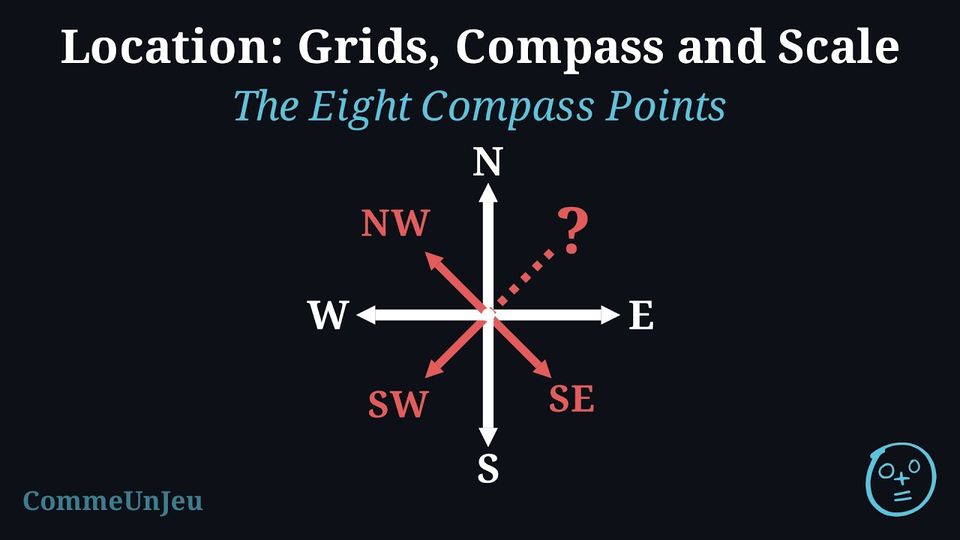
The four cardinal points — North, East, South and West — name only four directions. On a map, a place that is halfway between North and East, along the diagonal, has no name yet. Four more directions fill the gaps between the cardinal points. 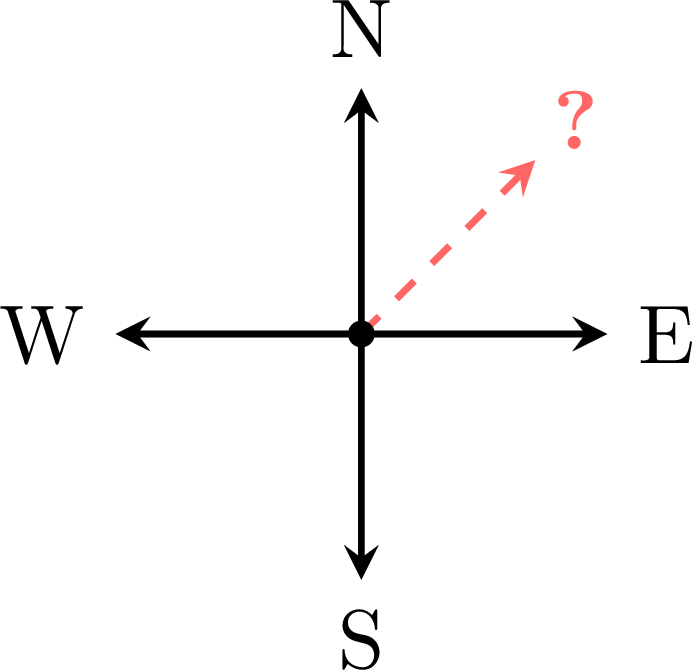
Definition — Intercardinal Points
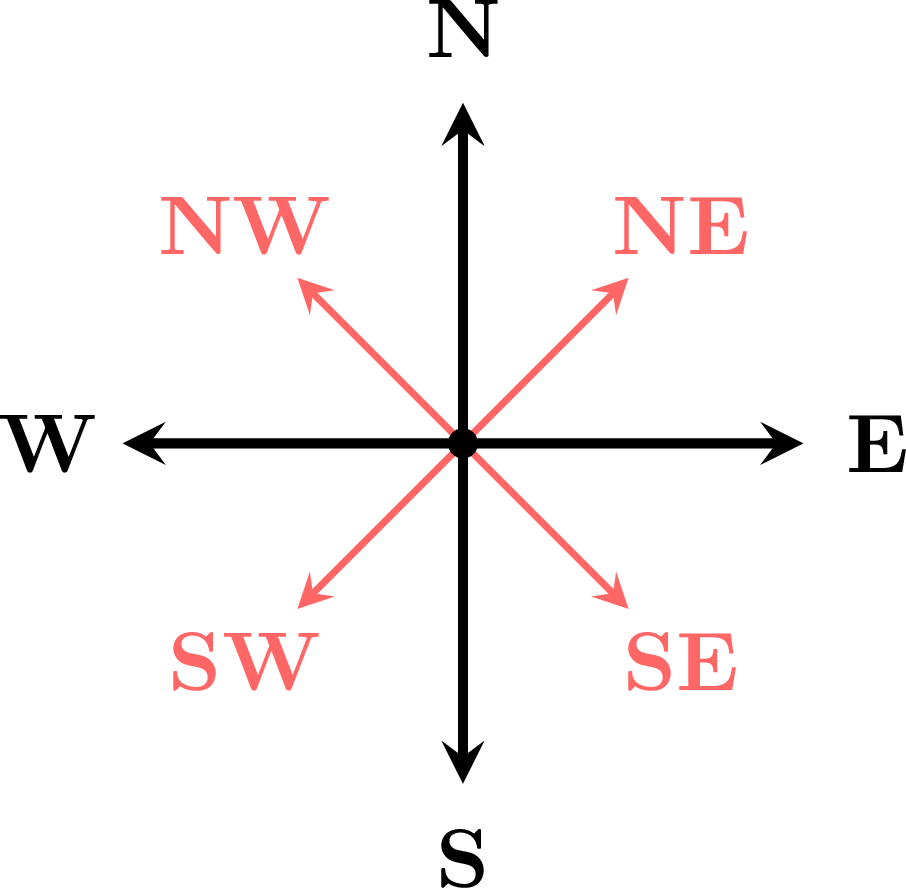
Halfway between two neighbouring cardinal points lies an intercardinal point (also called an ordinal point). There are four of them: - north-east (NE), halfway between North and East;
- south-east (SE), halfway between South and East;
- south-west (SW), halfway between South and West;
- north-west (NW), halfway between North and West.
Method — Finding the Direction of One Point from Another
On a map where North is up, to find the direction of a place \(B\) seen from a place \(A\): - Start from \(A\). “\(B\) from \(A\)” means: stand at \(A\) and look towards \(B\).
- Count the squares from \(A\) to \(B\): how many to the East or to the West, and how many to the North or to the South.
- Moves of one kind only: \(B\) is in a cardinal direction (North, East, South or West).
- As many squares East or West as North or South: \(B\) lies along the diagonals of the squares, in an intercardinal direction. Join the two words, North or South first: \(2\) squares East and \(2\) squares North give north-east.
Example
On this map, North is up. - From the Well, in which direction is each of the seven other places?
- In which direction is the Castle from the Lake?
- In which direction is the Well from the Castle?
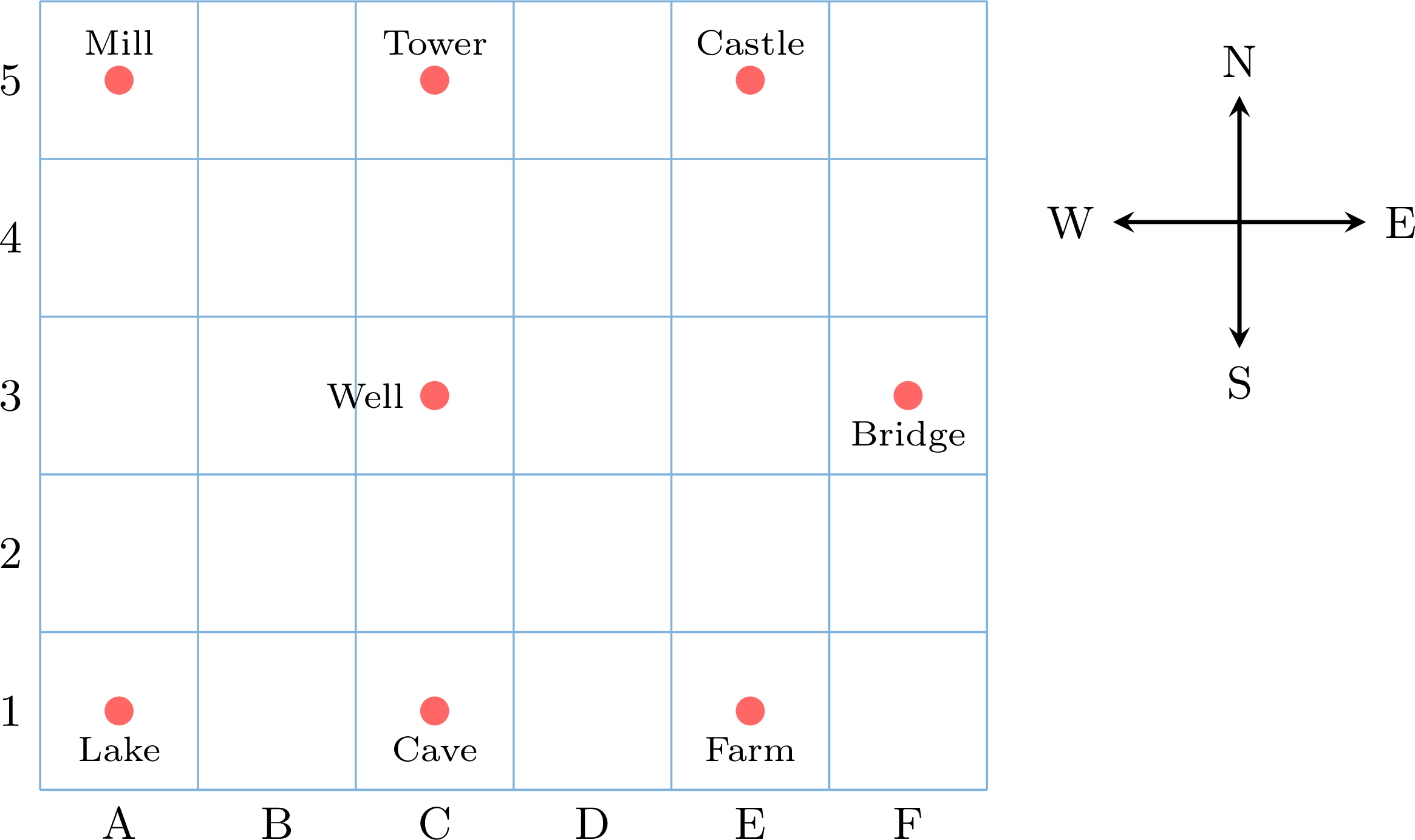
- The Well is in square C3. For each place, count the squares from the Well, then name the direction:
Place East or West North or South Direction from the Well Tower (C5) none \(2\) North North Castle (E5) \(2\) East \(2\) North north-east Bridge (F3) \(3\) East none East Farm (E1) \(2\) East \(2\) South south-east Cave (C1) none \(2\) South South Lake (A1) \(2\) West \(2\) South south-west Mill (A5) \(2\) West \(2\) North north-west 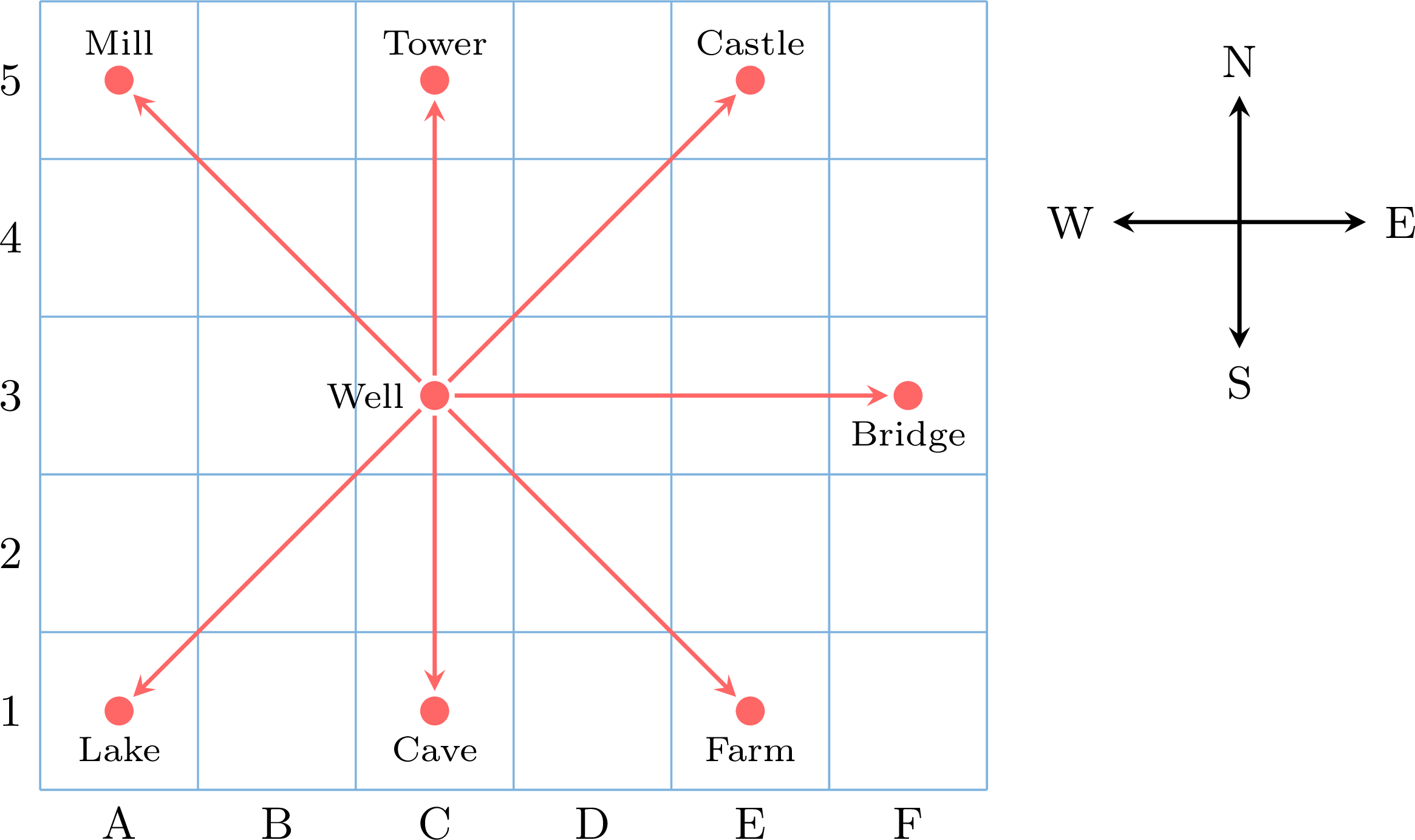
- From the Lake (A1) to the Castle (E5): \(4\) squares East and \(4\) squares North, as many East as North. The Castle is north-east of the Lake. The Lake, the Well and the Castle are on the same diagonal.
- From the Castle (E5) to the Well (C3): \(2\) squares West and \(2\) squares South. The Well is south-west of the Castle — the opposite of question 1, where the Castle is north-east of the Well.
Method — Turning from One Direction to Another
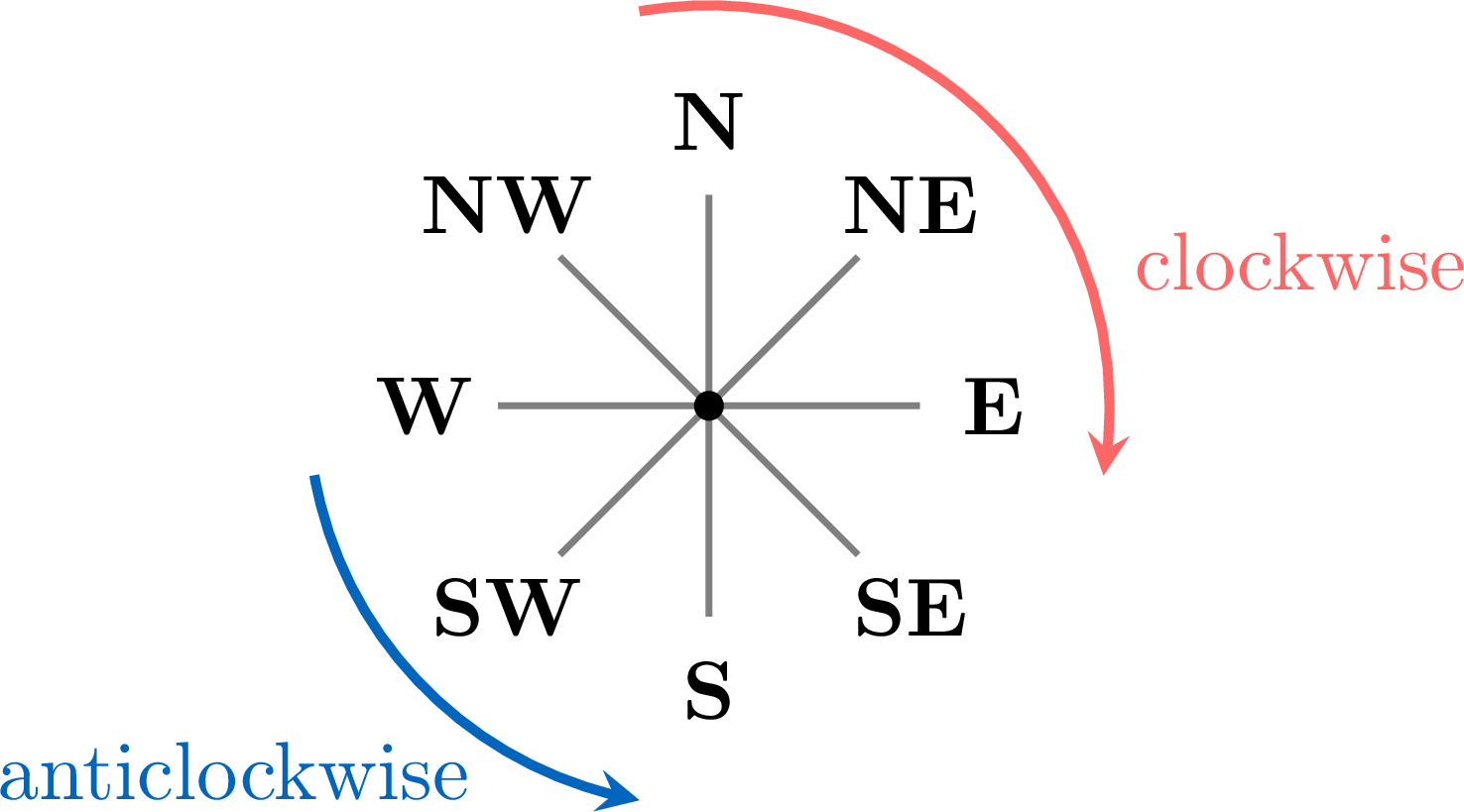
Going round the compass rose the way the hands of a clock turn (clockwise), the eight points come in this order: N, NE, E, SE, S, SW, W, NW, then N again. Turning the other way is turning anticlockwise. - An eighth of a turn (half a right angle, \(45^\circ\)) moves to the next point.
- A quarter turn (a right angle, \(90^\circ\)) moves two points.
- A half turn (\(180^\circ\)) moves four points: it gives the opposite direction, whichever way you turn.
- Count the steps on the compass rose, one eighth of a turn per step, in the direction of the turn.
Example
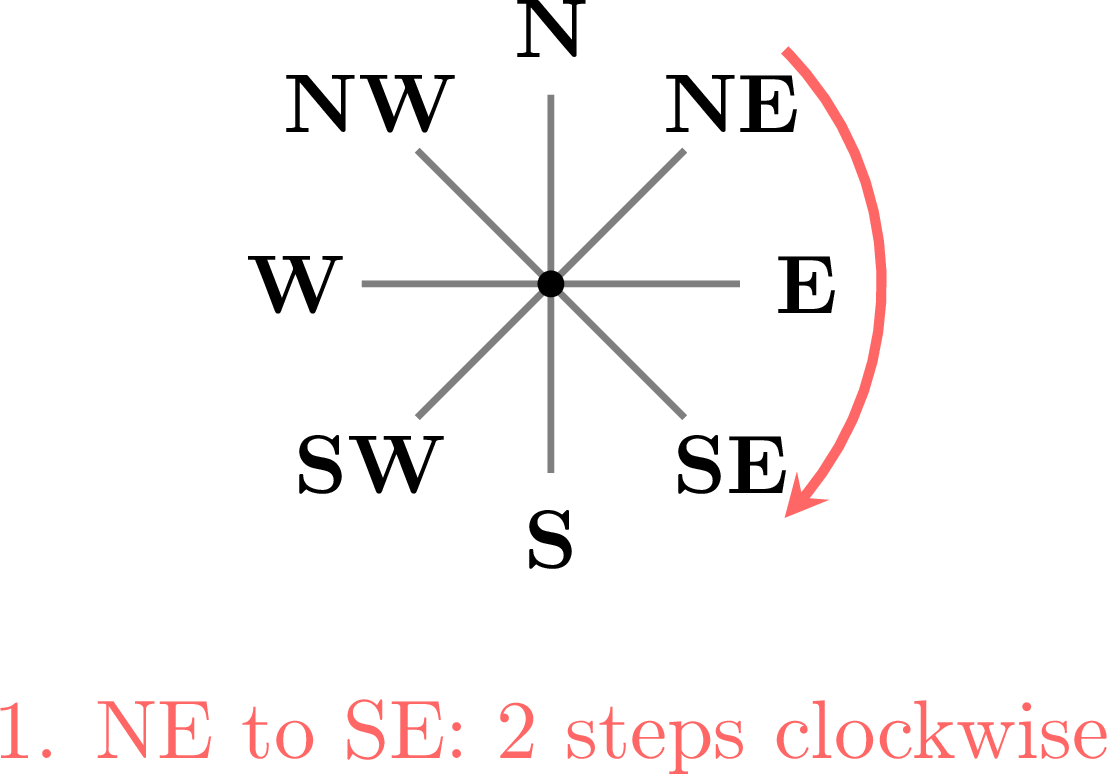
- Léa faces north-east and makes a quarter turn clockwise. Which way does she face now?
- Then she makes a half turn. Which way does she face?
- Tom faces west and makes three eighths of a turn anticlockwise. Which way does he face now?
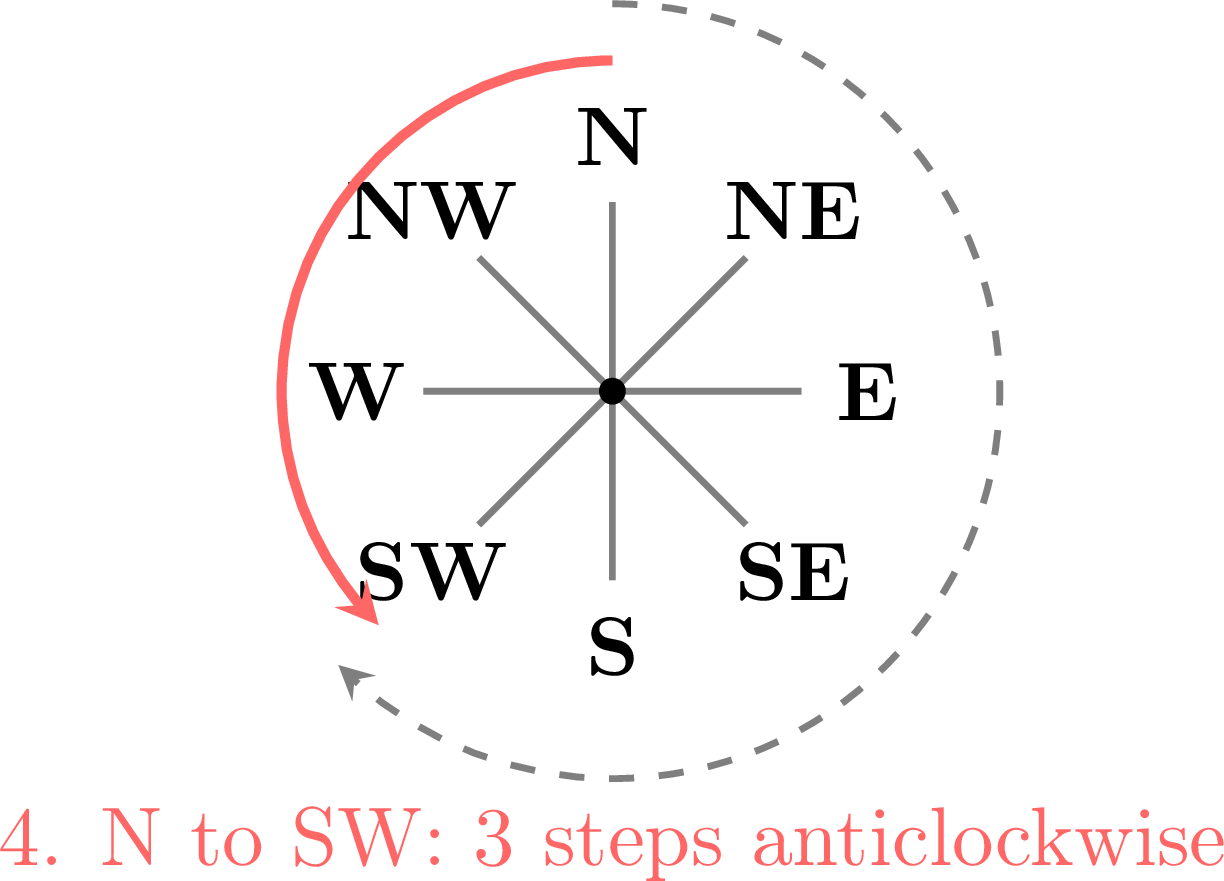
- What is the smallest turn that takes someone facing North to facing south-west?
- A quarter turn is two steps. Clockwise from NE: E (\(1\)), SE (\(2\)). Léa faces south-east.
- A half turn is four steps and gives the opposite direction. From SE: S (\(1\)), SW (\(2\)), W (\(3\)), NW (\(4\)). She faces north-west, the opposite of south-east.
- Three eighths of a turn is three steps. Anticlockwise from W: SW (\(1\)), S (\(2\)), SE (\(3\)). Tom faces south-east.
- Clockwise, from N to SW takes \(5\) steps (NE, E, SE, S, SW). Anticlockwise, it takes \(3\) steps (NW, W, SW). The smallest turn is three eighths of a turn anticlockwise.
 \(\qquad\)
Example
On a grid with North up, moving one square north-east means moving to the square that is one column to the right and one row up, across the corner of the square. A robot starts in square A2 and follows these moves: \(2\) squares north-east, then \(3\) squares East, then \(2\) squares south-west. In which square does it arrive? 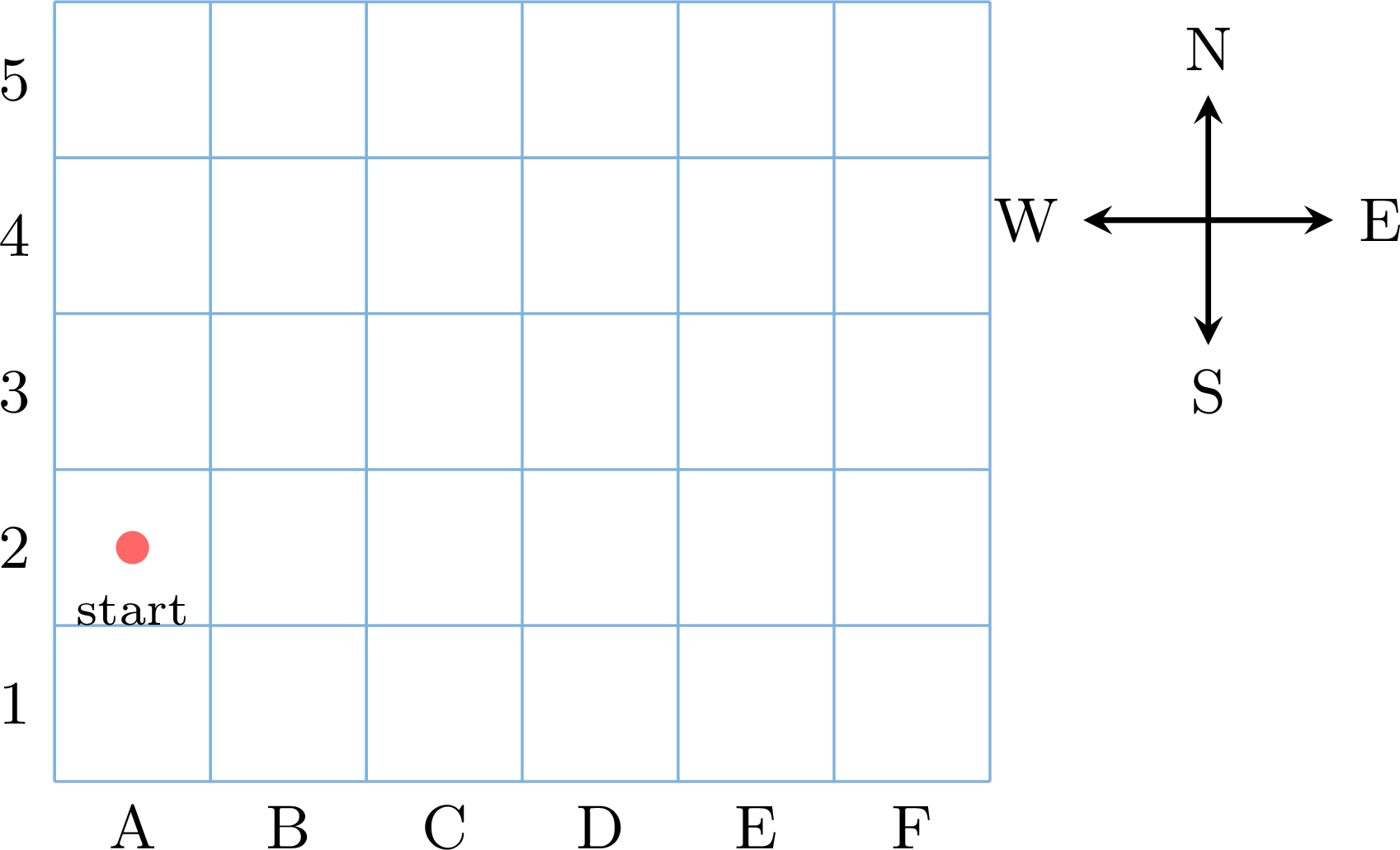
One move at a time, one square at a time: 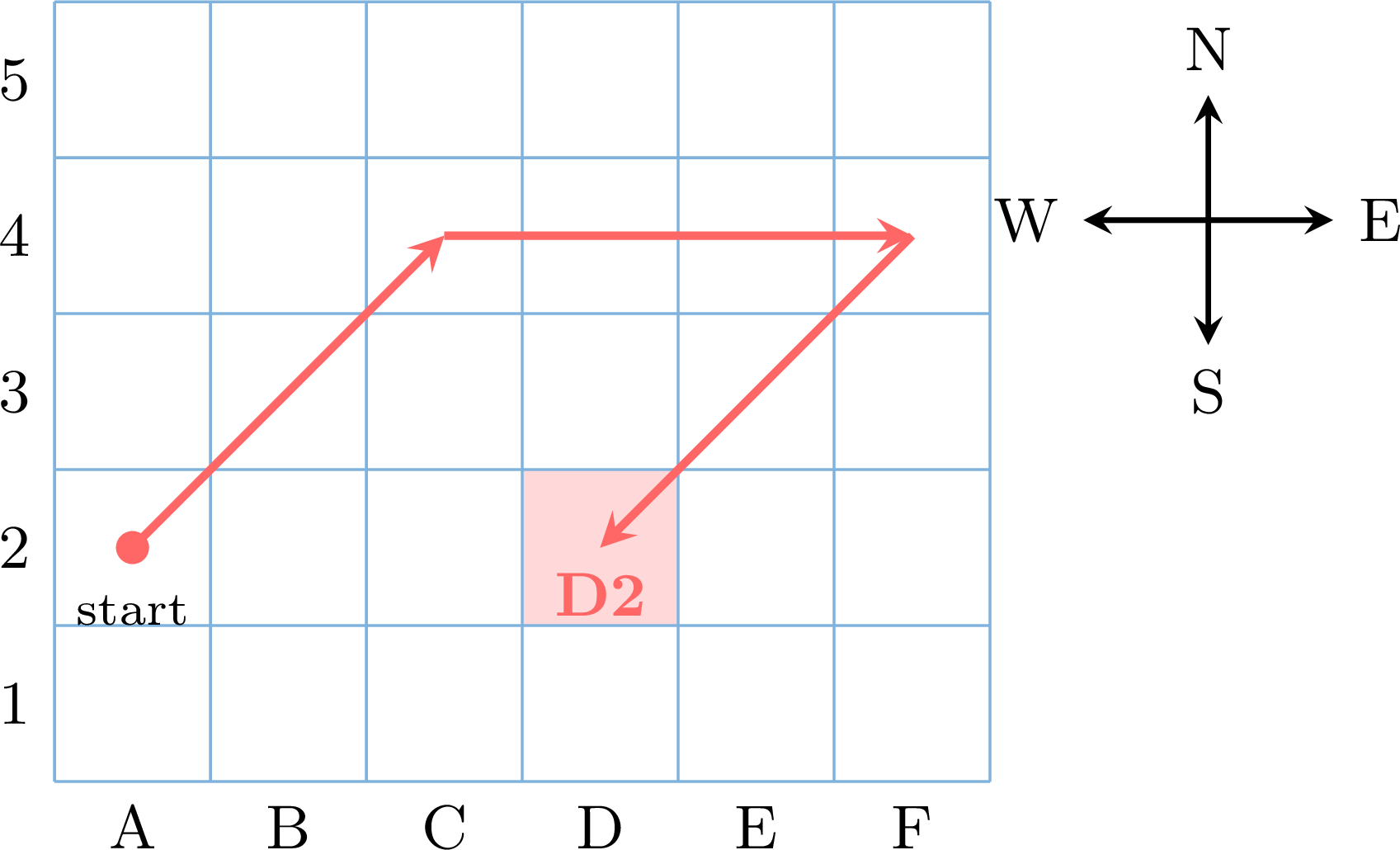
- \(2\) squares north-east: from A2 to B3, then to C4 (each step: one column right, one row up);
- \(3\) squares East: D4, E4, F4;
- \(2\) squares south-west: E3, then D2 (each step: one column left, one row down).
Skills to practice
- Recognising Compass Points
- Finding the Direction of One Place from Another
- Turning Between Compass Points
- Finding Directions and Distances on a Map
- Explaining with Compass Points
II
Review & Quizz
Skills to practice
- Quiz
Jump to section