International Baccalaureate · MYP 3
Rational Numbers
I
Number Sets
I.1
What a Rational Number Is
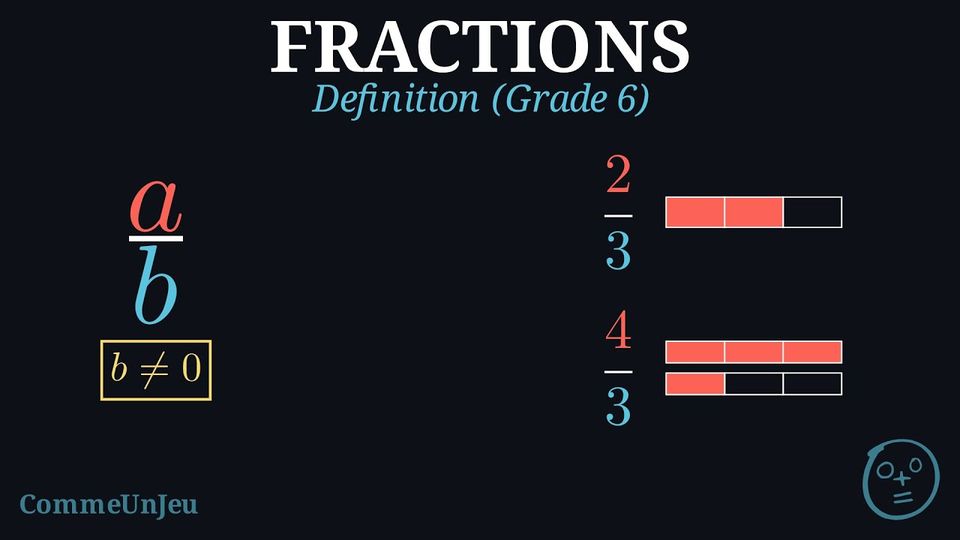
Definition — Rational Number
Any number that can be expressed as a fraction \(\dfrac{a}{b}\), where \(a\) and \(b\) are integers and \(b \neq 0\), is a rational number.The terms of a fraction are:

- Symbolic Form:$$\frac{2}{3}$$
- Verbal Form:
“Two-thirds” or “Two over three” - Linear Model:

- Number Line Model:

Example
Show that each of the following numbers is a rational number, by writing it as a quotient of two integers: $$-\dfrac{3}{4}\,, \qquad 7\,, \qquad -2.5.$$ - \(-\dfrac{3}{4} = \dfrac{-3}{4}\): the quotient of the integers \(-3\) and \(4\).
- \(7 = \dfrac{7}{1}\): every integer is a rational number.
- \(-2.5 = \dfrac{-25}{10}\): the quotient of the integers \(-25\) and \(10\) (it can also be written \(\dfrac{-5}{2}\)).

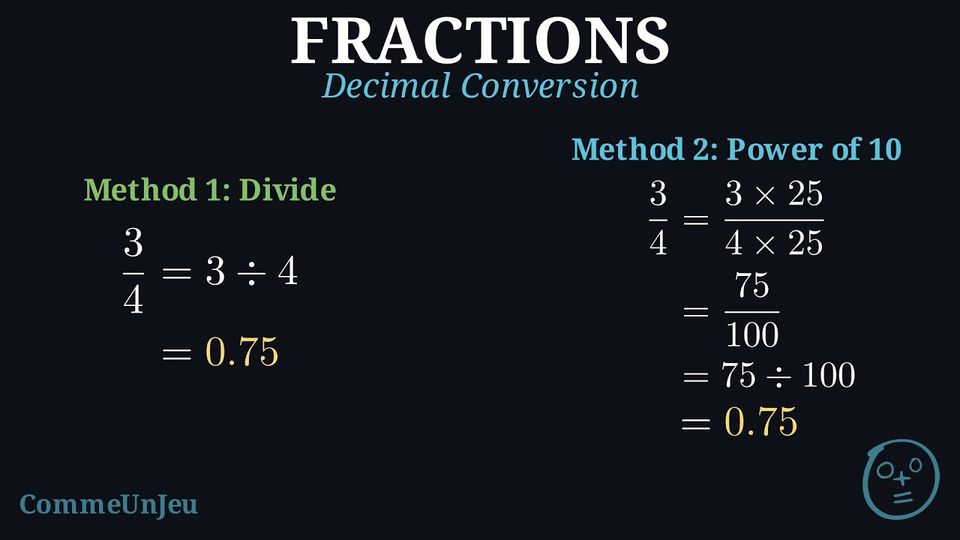
Method — Converting a Fraction to a Decimal Number
There are two primary methods for converting a fraction to a decimal number, when this is possible. - Method 1: Direct Division
Since a fraction \(\frac{a}{b}\) is equal to the quotient \(a \div b\), perform the division of the numerator by the denominator. When the division stops, it gives the decimal writing of the fraction; otherwise, the fraction is not equal to any decimal number. - Method 2: Denominator as a Power of 10 (equal fractions)
Find an equivalent fraction where the denominator is a power of 10 (e.g., 10, 100, 1000). This new fraction is then written as a decimal number: \(\dfrac{75}{100} = 0.75\). This method only works when the denominator can be turned into a power of \(10\) (for example \(2\), \(4\), \(5\), \(25\)). For a denominator such as \(3\), no power of \(10\) works, so use Method 1: \(\frac{1}{3} = 1 \div 3 = 0.333\ldots\) (the decimal expansion never ends).
Method — Converting a Decimal to a Fraction
The procedure for converting a terminating decimal to a fraction is as follows: - Write the decimal as the numerator of a fraction without the decimal point.
- The denominator is 1 followed by as many zeros as there are decimal places in the original number.
- Simplify the fraction to its lowest terms, if necessary.
Skills to practice
- Writing as a Quotient of Two Integers
I.2
Rational and Irrational Numbers
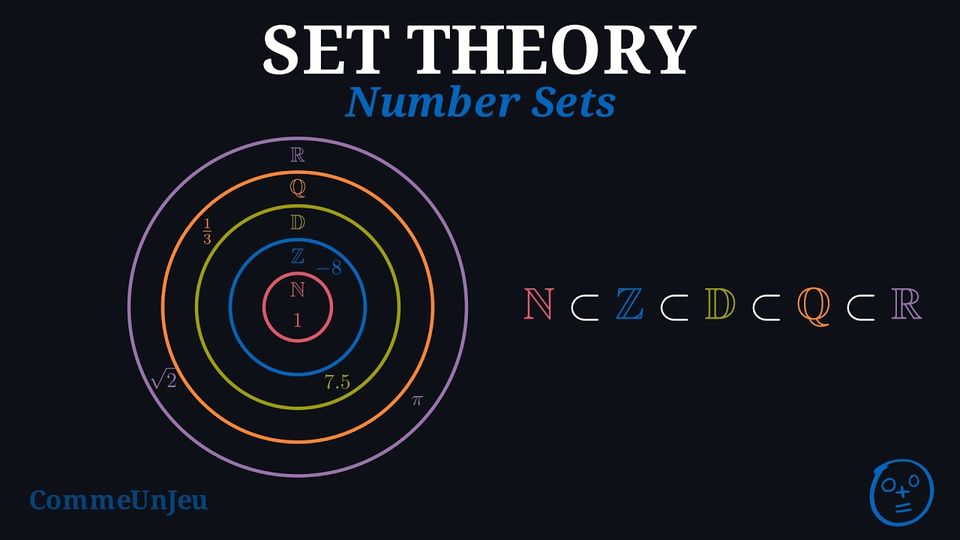
Number sets are collections of numbers defined by shared properties and they form a foundation of mathematics. We begin with the natural numbers (\(\N\)), used for counting. By including negative numbers, we obtain the integers (\(\Z\)). Allowing quotients of integers (with nonzero denominator) leads to the rational numbers (\(\Q\)). Among real numbers (\(\R\)), we also find irrational numbers (such as \(\sqrt{2}\) and \(\pi\)), which together with the rationals fill the entire number line. Each of these sets contains the previous ones.
Definition — Number Sets
- The natural numbers, denoted \(\N\), are the counting numbers, starting from zero:$$\N = \{0, 1, 2, 3, 4, 5, 6, \dots\}$$
- The integers, denoted \(\Z\), are the natural numbers and their opposites (negative, zero, positive):$$\Z = \{\dots, -3, -2, -1, 0, 1, 2, 3, \dots\}$$
- The terminating decimals (the set \(\mathbb{D}\) of French textbooks) are numbers that can be written as a fraction where the denominator is a power of 10:$$\mathbb{D} = \left\{ \frac{a}{10^n} \mid a \in \Z,\, n \in \N \right\}$$
- The rational numbers, denoted \(\Q\), are all numbers that can be written as a fraction \(\frac{p}{q}\), where \(p\) and \(q\) are integers and \(q \neq 0\):$$\Q = \left\{ \frac{p}{q} \mid p, q \in \Z,\, q \neq 0 \right\}$$
- The real numbers, denoted \(\R\), include all points on the number line. A real number that is not rational is called irrational, such as \(\sqrt{2}\) and \(\pi\): the real numbers are the rational numbers and the irrational numbers.
Example
- \(1\in \N, 1\in \Z, 1\in \mathbb{D},1\in \Q, 1\in\R\)
- \(-5 \in \Z\), \(-5 \notin \N\)
- \(0.25 = \frac{25}{100} = \frac{1}{4} \in \mathbb{D}\) (and also in \(\Q\) and \(\R\))
- \(\frac{1}{3} \in \Q\) but \(\frac{1}{3} \notin \mathbb{D}\)
- \(\sqrt{2} \in \R\) but \(\sqrt{2} \notin \Q\) (irrational)
Proposition — Relationships Between Number Sets
The number sets are nested as follows:$$\N \subset \Z \subset \mathbb{D} \subset \Q \subset \R$$ This means: every natural number is an integer, every integer is a decimal number, every decimal number is a rational number, and every rational number is a real number. 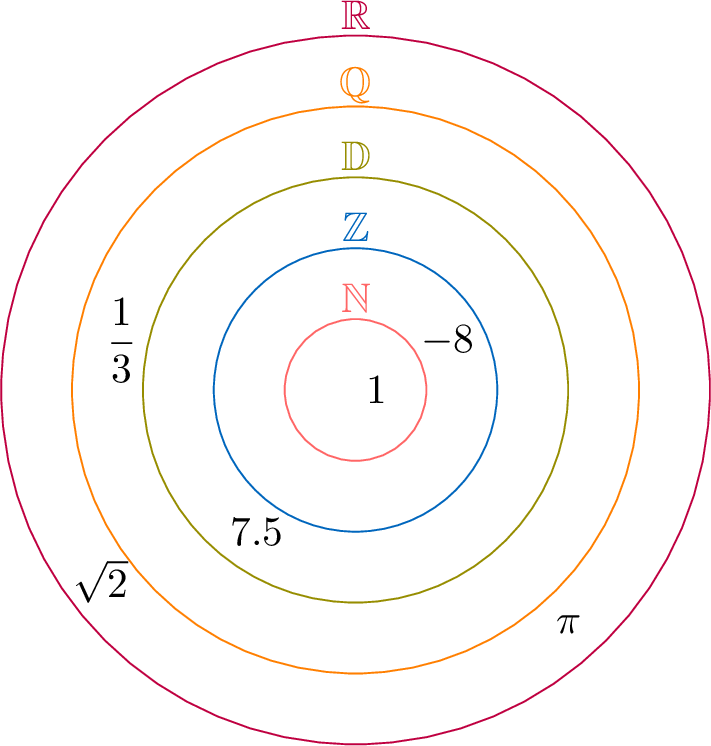
Proposition — Irrationality of \(\sqrt{2}\)
\(\sqrt{2}\) is an irrational number.
Assume \(\sqrt{2}\) is rational. Then \(\sqrt{2} = \frac{p}{q}\) where \(\frac{p}{q}\) is a fraction in lowest terms.
Squaring both sides: \(2 = \frac{p^2}{q^2} \implies p^2 = 2q^2\).
This implies \(p^2\) is even, so \(p\) must be even — indeed, if \(p\) were odd, its square would be odd. Let \(p = 2k\).
Substitute back: \((2k)^2 = 2q^2 \implies 4k^2 = 2q^2 \implies 2k^2 = q^2\).
This implies \(q^2\) is even, so \(q\) must be even. If both \(p\) and \(q\) are even, they have a common factor of 2, contradicting that the fraction is in lowest terms.
Thus, \(\sqrt{2}\) cannot be rational.
Skills to practice
- Checking Membership
II
Recurring Decimals
II.1
Terminating and Recurring Decimals
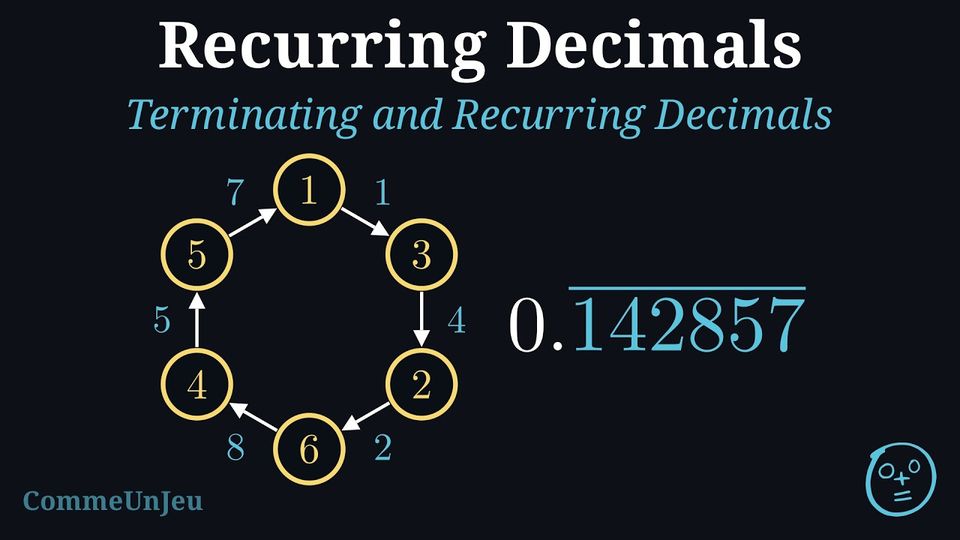
Three divisions are started by hand: \(1 \div 4\), \(1 \div 3\) and \(1 \div 7\).
Carry on each division, writing zeros after the decimal point, and write down every remainder. Which division stops? Which ones never stop, and what do their digits do?
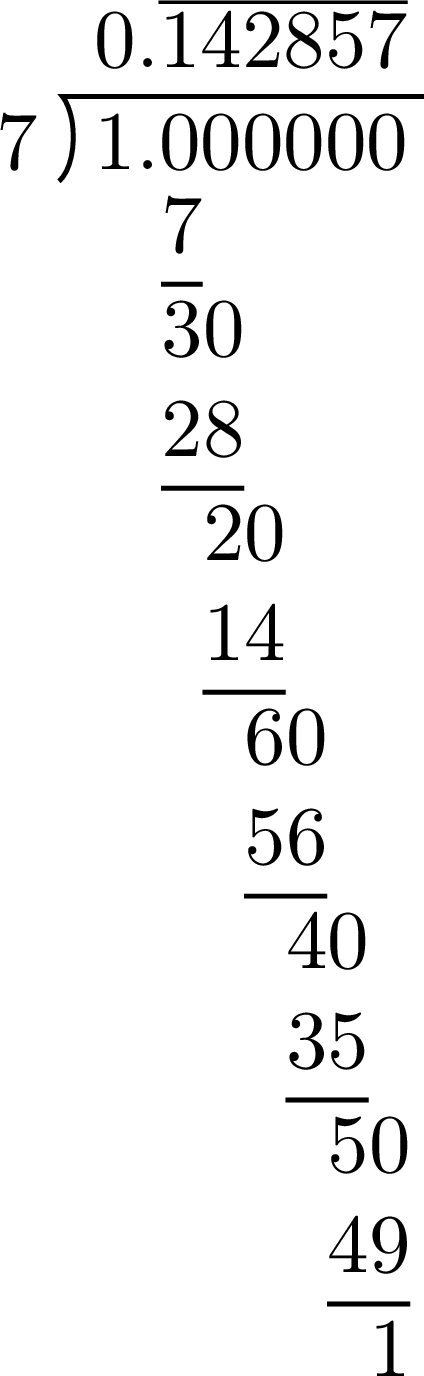
A division that never stops is not random: as soon as a remainder comes back, its digits repeat in blocks.
Carry on each division, writing zeros after the decimal point, and write down every remainder. Which division stops? Which ones never stop, and what do their digits do?
- \(1 \div 4\): \(10 = 4 \times 2 + 2\), then \(20 = 4 \times 5 + 0\). The remainder \(0\) stops the division: \(\dfrac{1}{4} = 0.25\).
- \(1 \div 3\): \(10 = 3 \times 3 + 1\). The remainder \(1\) comes back at every step, so the digit \(3\) comes back for ever: \(\dfrac{1}{3} = 0.333\ldots\)
- \(1 \div 7\): the remainders are \(3\), \(2\), \(6\), \(4\), \(5\), and then \(1\) again, the remainder of the start. From there the same steps restart in the same order, so the six digits \(142857\) repeat for ever: $$\frac{1}{7} = 0.142857\,142857\ldots$$
Definition — Terminating and Recurring Decimals
The decimal expansion of a number is its writing with a decimal point and the digits that follow the point. - It is terminating when it stops after a certain number of digits: \(\dfrac{3}{8} = 0.375\).
- It is recurring when, from a certain decimal place onward, one block of digits, not made of \(0\)s only, repeats for ever: \(\dfrac{5}{6} = 0.8333\ldots\) and \(\dfrac{3}{11} = 0.272727\ldots\) The shortest block that repeats is the period of the decimal.
Example
Write each recurring decimal with a bar, then with dots. - \(0.5555\ldots\)
- \(2.090909\ldots\)
- \(0.41666\ldots\)
- \(0.123123123\ldots\)
- The period is \(5\): \(0.5555\ldots = 0.\overline{5} = 0.\dot{5}\). With a period of one digit, the bar and the dot sit over the same digit.
- The block \(09\) repeats after the whole part \(2\): \(2.090909\ldots = 2.\overline{09} = 2.\dot{0}\dot{9}\).
- Only the \(6\) repeats; the digits \(4\) and \(1\) are written once: \(0.41666\ldots = 0.41\overline{6} = 0.41\dot{6}\).
- The block \(123\) repeats: \(0.123123123\ldots = 0.\overline{123} = 0.\dot{1}2\dot{3}\). The dots go over the first and the last digits of the period only.
Example
Find the \(50\)th digit after the decimal point of \(\dfrac{1}{7} = 0.\overline{142857}\), then the \(20\)th digit after the decimal point of \(0.3\overline{27}\). - The period \(142857\) has \(6\) digits, so the digits come back every \(6\) places. Divide the place by the length of the period: \(50 = 6 \times 8 + 2\). After \(8\) whole periods, the \(50\)th digit is the \(2\)nd digit of the period: \(\mathbf{4}\).
- In \(0.3\overline{27}\), the \(3\) fills the \(1\)st place, and the period \(27\) starts at the \(2\)nd place. The \(20\)th place is the \(19\)th place of the repeating part, and \(19 = 2 \times 9 + 1\): it is the \(1\)st digit of the period, \(\mathbf{2}\). Count the places of the period only after the digits written once.
A Calculator Display Is Rounded
A calculator shows only a limited number of digits. For \(2 \div 3\) it may display \(0.6666666667\): the last digit shown is rounded, and the digits that do not fit are lost. The display is an approximate value; the exact value is \(\dfrac{2}{3} = 0.\overline{6}\), whose digits are all \(6\). A display such as \(0.4545454545\) suggests a recurring decimal, but only a calculation shows that the pattern goes on for ever.
Skills to practice
- Reading the Recurring Notation
- Finding a Digit of a Recurring Decimal
II.2
From a Fraction to a Decimal
Proposition — Finite Decimal Expansion
A number is a decimal number if and only if its decimal expansion is finite. Example
\(\frac{3}{4} = 0.75\) (finite, so decimal).\(\frac{1}{3} = 0.3333\dots\) (infinite, so not decimal).
Proposition — Characterisation of Decimal Numbers
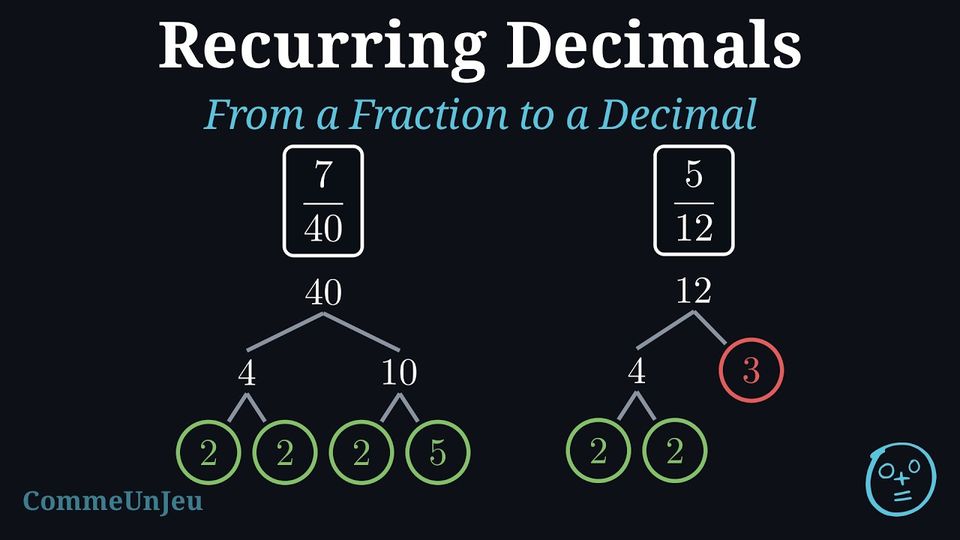
A number is a decimal number if and only if it can be written as a fraction in lowest terms of the form \(\frac{a}{2^m \times 5^p}\) with \(a \in \mathbb{Z}, m \in \mathbb{N}, p \in \mathbb{N}\): in lowest terms, its denominator has no prime factor other than \(2\) and \(5\). - \(\Rightarrow\) If \(x\) is a decimal number, by definition \(x = \frac{a}{10^n}\). Since \(10 = 2 \times 5\), we have \(10^n = 2^n \times 5^n\). Thus \(x = \frac{a}{2^n \times 5^n}\). Simplifying this fraction to lowest terms divides its denominator by a common factor of \(a\) and \(2^n \times 5^n\), which is made of \(2\)s and \(5\)s only: in lowest terms, the denominator is still of the form \(2^m \times 5^p\).
- \(\Leftarrow\) Conversely, suppose \(x = \frac{a}{2^m \times 5^p}\). Let \(n = \max(m, p)\) be the larger of the two exponents. We can multiply the numerator and denominator by powers of 2 or 5 to make the exponents equal to \(n\).
$$ x = \frac{a \times 2^{n-m} \times 5^{n-p}}{2^n \times 5^n} = \frac{A}{10^n}, $$ where \(A = a \times 2^{n-m} \times 5^{n-p}\) is an integer. Since the denominator is a power of 10, \(x\) is a decimal number.
Proposition — One Third is Not a Decimal Number
The rational number \(\dfrac{1}{3}\) is not a decimal number: no fraction \(\dfrac{a}{10^n}\) with \(a\) an integer equals \(\dfrac{1}{3}\).
We argue by contradiction: suppose that \(\dfrac{1}{3}\) is a decimal number. Then there are an integer \(a\) and a natural number \(n\) such that $$\frac{1}{3} = \frac{a}{10^n}.$$ Multiplying both sides by \(3 \times 10^n\): $$10^n = 3\,a.$$ So \(10^n\) would be a multiple of \(3\). But the sum of the digits of \(10^n = 1\underbrace{0\cdots0}_{n}\) is \(1\), which is not divisible by \(3\): by the divisibility criterion, \(10^n\) is not a multiple of \(3\). This contradiction shows that the assumption was false: \(\dfrac{1}{3}\) is not a decimal number.
Method — Finding the Decimal Expansion of a Fraction
To write \(\dfrac{a}{b}\) as a decimal, where \(a\) and \(b\) are whole numbers and \(b \neq 0\): - Divide \(a\) by \(b\) by long division: the quotient is the whole part, and the remainder is the first remainder. Then carry on after the decimal point, writing zeros as needed.
- Write down every remainder, from the first one on. If a remainder is \(0\), the division stops: the decimal is terminating.
- After the decimal point, if a remainder comes back, the same steps start again in the same order: the digits obtained between its two appearances form the period, and they repeat for ever. Write the decimal with a bar over the period.
Example
Write \(\dfrac{5}{12}\) as a decimal.
We divide \(5\) by \(12\) and write down each remainder. $$\begin{aligned}[t] 5 &= 12 \times 0 + 5 && \text{(whole part } 0\text{, remainder } 5\text{)}\\
50 &= 12 \times 4 + 2 && \text{(digit } 4\text{, remainder } 2\text{)}\\
20 &= 12 \times 1 + 8 && \text{(digit } 1\text{, remainder } 8\text{)}\\
80 &= 12 \times 6 + 8 && \text{(digit } 6\text{, remainder } 8 \text{ again)} \end{aligned}$$ 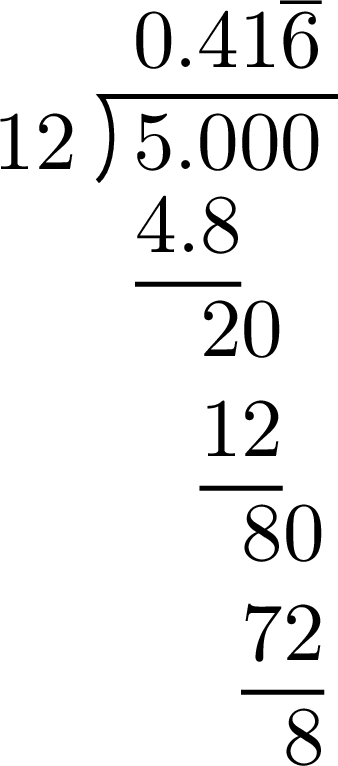
The remainder \(8\) has come back: the step \(80 = 12 \times 6 + 8\) is repeated for ever, and so is the digit \(6\). Only the \(6\) lies between the two appearances of the remainder \(8\), so the period is \(6\): $$\frac{5}{12} = 0.41666\ldots = 0.41\overline{6}.$$ Check: a calculator displays \(5 \div 12 = 0.4166666667\), a rounded display of \(0.41\overline{6}\).
Proposition — A Fraction Terminates or Recurs
The decimal expansion of a fraction \(\dfrac{a}{b}\), where \(a\) and \(b\) are whole numbers and \(b \neq 0\), is either terminating or recurring. When it recurs, its period has at most \(b-1\) digits.
Divide \(a\) by \(b\). Once the digits of \(a\) are used up, each step multiplies the remainder by \(10\) and divides by \(b\): the next digit and the next remainder depend only on the current remainder. Every remainder is a whole number from \(0\) to \(b-1\).
- If a remainder is \(0\), every following digit is \(0\): the decimal expansion terminates.
- Otherwise every remainder is one of the \(b-1\) numbers \(1, 2, \ldots, b-1\). Among \(b\) successive remainders, two are therefore equal: some remainder comes back after at most \(b-1\) steps. From then on the same steps are repeated in the same order, so the digits obtained between its two appearances repeat for ever. The expansion recurs, and its period has at most \(b-1\) digits.
Method — Predicting Whether a Decimal Terminates
To know, without dividing, whether a fraction has a terminating or a recurring decimal expansion: - Write the fraction in lowest terms.
- Write its denominator as a product of prime factors.
- If it has no prime factor other than \(2\) and \(5\), the decimal is terminating. If any other prime factor appears, the decimal is recurring.
Skills to practice
- Deciding Whether a Decimal Terminates
- Finding the Period of a Fraction
- Simplifying Fractions and Identifying Decimal Numbers
- Converting a Fraction by Division
II.3
From a Recurring Decimal to a Fraction
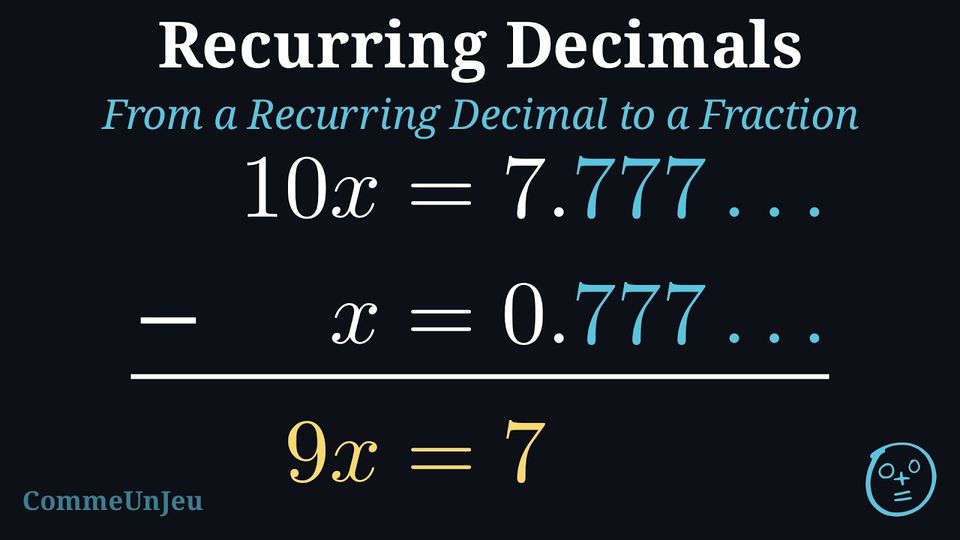
Method — Converting a Recurring Decimal to a Fraction
- Call the number \(x\).
- Multiply \(x\) by \(10\), \(100\), \(1\,000\), … — by \(1\) followed by as many zeros as the period has digits — so that the repeating digits of the result line up with those of \(x\).
- Subtract \(x\): the repeating digits cancel, and an equation with no recurring digits is left.
- Solve the equation and give the fraction in lowest terms.
Example
Write \(0.\overline{7}\) and \(0.\overline{36}\) as fractions in lowest terms. - Let \(x = 0.\overline{7} = 0.777\ldots\) The period has one digit: we multiply by \(10\), and \(10x = 7.777\ldots\) has the same digits after the point as \(x\). $$\begin{aligned}[t] 10x - x &= 7.777\ldots - 0.777\ldots && \text{(the repeating digits cancel)}\\ 9x &= 7\\ x &= \frac{7}{9}. && \text{(divide both sides by } 9\text{)} \end{aligned}$$ Check: \(7 \div 9 = 0.777\ldots\) So \(0.\overline{7} = \dfrac{7}{9}\).
- Let \(x = 0.\overline{36} = 0.363636\ldots\) The period has two digits: we multiply by \(100\), and \(100x = 36.3636\ldots\) $$\begin{aligned}[t] 100x - x &= 36.3636\ldots - 0.3636\ldots && \text{(the repeating digits cancel)}\\ 99x &= 36\\ x &= \frac{36}{99} && \text{(divide both sides by } 99\text{)}\\ &= \frac{4}{11}. && \text{(simplify by } 9\text{)} \end{aligned}$$ Check: \(4 \div 11 = 0.3636\ldots\) So \(0.\overline{36} = \dfrac{4}{11}\).
Example
Write \(0.2\overline{3}\) as a fraction in lowest terms.
Let \(x = 0.2\overline{3} = 0.2333\ldots\) The period \(3\) starts one place after the point, so we first multiply by \(10\): \(10x = 2.333\ldots\), whose period starts right after the point. Its period has one digit, so we multiply again by \(10\): \(100x = 23.333\ldots\) $$\begin{aligned}[t] 100x - 10x &= 23.333\ldots - 2.333\ldots && \text{(the repeating digits cancel)}\\
90x &= 21\\
x &= \frac{21}{90} && \text{(divide both sides by } 90\text{)}\\
&= \frac{7}{30}. && \text{(simplify by } 3\text{)} \end{aligned}$$ Check: \(7 \div 30 = 0.2333\ldots\) So \(0.2\overline{3} = \dfrac{7}{30}\). Subtracting \(x\) from \(10x\) also works: \(10x - x = 2.333\ldots - 0.2333\ldots = 2.1\), so \(9x = 2.1\), but it leaves a decimal; multiplying first by \(10\) gives an equation with whole numbers at once.
Proposition — A Recurring Decimal Is a Fraction
Every terminating or recurring decimal is equal to a fraction. So the numbers that can be written as a fraction of two integers, the rational numbers, are exactly the numbers whose decimal expansion terminates or recurs, with a minus sign in front for the negative ones. A number whose decimal expansion neither terminates nor recurs is not a fraction: it is irrational.
A terminating decimal with \(n\) digits after the point is a fraction whose denominator is \(1\) followed by \(n\) zeros: \(0.375 = \dfrac{375}{1\,000}\). Let \(x\) be a recurring decimal whose period has \(k\) digits and starts right after the decimal point, and let \(M\) be \(1\) followed by \(k\) zeros. Multiplying by \(M\) moves the decimal point \(k\) places to the right, past exactly one period: \(Mx\) has the same digits after the point as \(x\). Their difference is therefore a whole number \(N\): $$\begin{aligned}[t] Mx - x &= N\\
(M - 1)\,x &= N\\
x &= \frac{N}{M - 1}, && \text{(divide both sides by } M - 1\text{)} \end{aligned}$$ a fraction. If the period starts later, multiplying \(x\) by \(10\), \(100\), … first gives a number \(y\) of the previous kind; \(y\) is a fraction, and \(x\), which is \(y\) divided by \(10\), \(100\), …, is a fraction too. Together with the previous proposition, every fraction terminates or recurs: the rational numbers are exactly the terminating and the recurring decimals.
Irrational Numbers Exist
The number \(\sqrt{2} = 1.41421356\ldots\) is irrational: it can be proved that no fraction has a square equal to \(2\). The number \(\pi = 3.14159265\ldots\) is irrational too, although its proof is much harder. Their decimal expansions go on for ever without ever becoming recurring. A calculator display such as \(1.414213562\) is a terminating decimal, hence a fraction: it is only an approximate value of \(\sqrt{2}\).
Skills to practice
- Converting a Recurring Decimal to a Fraction
- Writing Out a Conversion to a Fraction
III
Going further
Skills to practice
- Reasoning with Recurring Decimals
- Investigating Recurring Decimals
- Solving Problems with Recurring Decimals
- Quiz
Jump to section