International Baccalaureate · MYP 3
Algebraic Expressions and Fractions
I
Algebraic Expressions
I.1
Algebraic Notation
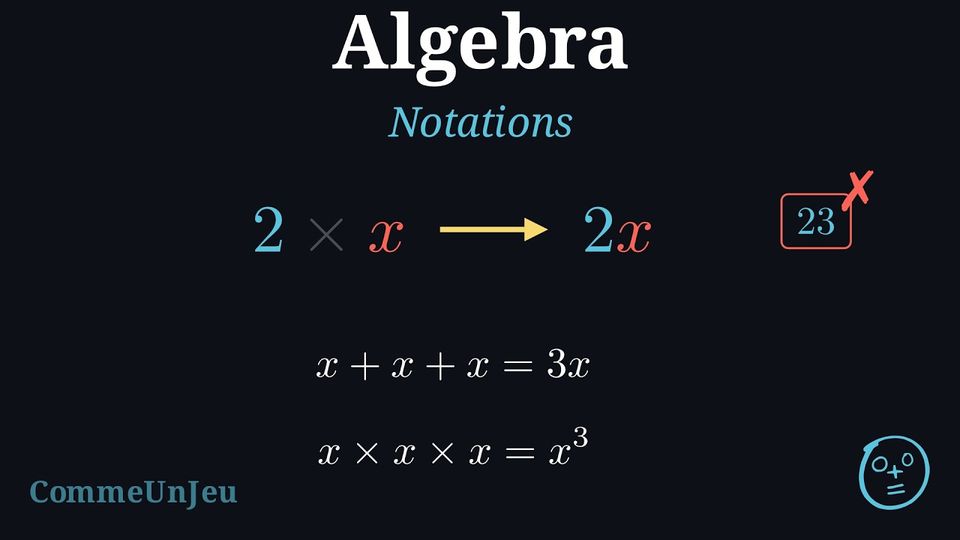
Definition — Product Notation
We can omit the \(\times\) sign when it is followed by a variable or by a bracket \((\) (also called a parenthesis). Example
- \(2 \times x = 2x\)
- \(2 \times (l+w) = 2(l+w)\)
Definition — Repeated Addition
$$\overbrace{x + x + \ldots + x}^{n\text{ terms}} = n\times x$$ Definition — Repeated Multiplication
For a whole number \(n \geq 1\): $$\overbrace{x \times x \times \ldots \times x}^{n\text{ factors}} = x^n$$ Skills to practice
- Simplifying Products of Terms with Powers
I.2
Identities and Like Terms
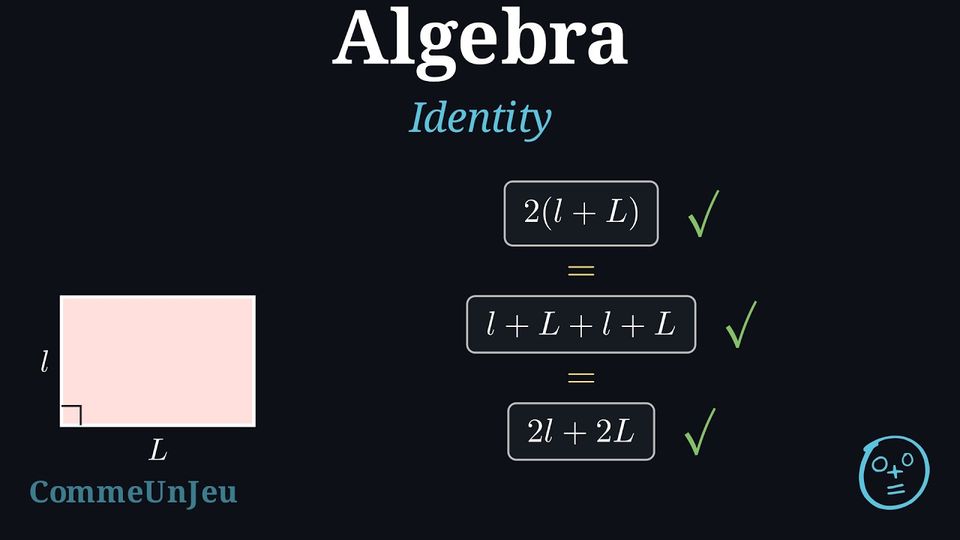
Definition — Identity
An identity is an equality between two expressions such that their evaluations produce the same value for all values of the variables for which both expressions are defined. Proposition — Properties of Multiplying by 1 and 0
$$1 \times x = x \qquad \text{and} \qquad 0 \times x = 0$$ Proposition — The Commutative Laws
$$\textcolor{colordef}{a} + \textcolor{colorprop}{b} = \textcolor{colorprop}{b} + \textcolor{colordef}{a}\qquad \text{and} \qquad\textcolor{colordef}{a} \times \textcolor{colorprop}{b} = \textcolor{colorprop}{b} \times \textcolor{colordef}{a}$$ Proposition — The Associative Laws
$$(\textcolor{colordef}{a} + \textcolor{colorprop}{b}) + \textcolor{olive}{c} = \textcolor{colordef}{a} + (\textcolor{colorprop}{b} + \textcolor{olive}{c})\qquad \text{and} \qquad(\textcolor{colordef}{a} \times \textcolor{colorprop}{b}) \times \textcolor{olive}{c} = \textcolor{colordef}{a} \times (\textcolor{colorprop}{b} \times \textcolor{olive}{c})$$ Method — Simplifying by Collecting Like Terms
Simplifying an expression by collecting like terms involves combining terms that have the same variables raised to the same powers. - Identify like terms: Like terms are terms that have the same variable(s) raised to the same power. For example, \(3x\) and \(5x\) are like terms, but \(3x\) and \(3x^2\) are not.
- Combine like terms: Add or subtract the coefficients (numerical parts) of the like terms. The variable part remains the same.
Example
Simplify the expression: \(2x + 4 + x - 2\)
$$\begin{aligned}[t]2x + 4 + x - 2 &= \textcolor{colordef}{2x} \textcolor{colorprop}{+4} \textcolor{colordef}{+x} \textcolor{colorprop}{-2} &&(\text{identifying like terms}) \\
&= \textcolor{colordef}{(2+1)x} + \textcolor{colorprop}{4-2} &&(\text{combining like terms}) \\
&= \textcolor{colordef}{3x} + \textcolor{colorprop}{2} &&(\text{simplifying})\end{aligned}$$
Proposition — Simplifying a Product
To multiply terms such as \(3x\) and \(2x\), multiply the numbers together and the letters together — the order of the factors does not matter: $$3x \times 2x = (3 \times 2) \times (x \times x) = 6x^2.$$ In particular, \(x \times x = x^2\). When simplifying a sum, like terms collect together: the \(x^2\) terms with the \(x^2\) terms, the \(x\) terms with the \(x\) terms. Example
Simplify the products: \(5 \times 2x\); \(3x \times 2x\); \(x \times 4x\).
$$\begin{aligned}[t] 5 \times 2x &= (5 \times 2) \times x && {\scriptstyle\text{(group the numbers)}}\\
&= \textcolor{colordef}{10x}\\
3x \times 2x &= (3 \times 2) \times (x \times x) && {\scriptstyle\text{(group the numbers, group the letters)}}\\
&= \textcolor{colordef}{6x^2} && {\scriptstyle(x \times x = x^2)}\\
x \times 4x &= 4 \times (x \times x) \\
&= \textcolor{colordef}{4x^2} \end{aligned}$$
Skills to practice
- Simplifying Products of Terms
- Simplifying Sums of Products
II
Algebraic Fractions
II.1
Quotients Written as Fractions
Numerical fractions can be written, simplified, added, multiplied and divided. Their numerator and denominator are integers — numbers like \(\dfrac{2}{3}\), \(\dfrac{6}{9}\) or \(\dfrac{7}{4}\).
Algebraic fractions go one step further: the numerator or the denominator may contain a letter (for example \(x\), \(a\), \(y\)). Such a fraction is called an algebraic fraction. Every rule of numerical fractions still works. The new ideas are: how to read these expressions, when they make sense (the denominator must not take the value zero), and how to simplify them when the numerator and the denominator share a common factor.
Algebraic fractions go one step further: the numerator or the denominator may contain a letter (for example \(x\), \(a\), \(y\)). Such a fraction is called an algebraic fraction. Every rule of numerical fractions still works. The new ideas are: how to read these expressions, when they make sense (the denominator must not take the value zero), and how to simplify them when the numerator and the denominator share a common factor.
The fraction bar is, fundamentally, a division sign. Whenever a problem ends with divide \(A\) by \(B\), the answer can be written as the algebraic fraction \(\dfrac{A}{B}\). This is how letters naturally enter geometry, sharing problems, and any situation where the data is a quantity per unit.
Proposition — Fraction as a Quotient
For all algebraic expressions \(A\) and \(B\) with \(B \neq 0\): $$A \div B = \dfrac{A}{B}.$$ Example
Sharing problem. You have \(x\) marbles, where \(x\) is a multiple of \(4\), and you share them equally among \(4\) friends. Each friend receives: $$x \div 4 = \dfrac{x}{4}.$$ Geometric problem. The two sides forming the right angle of a right-angled triangle both measure \(x\). Its area is half the area of a square of side \(x\): $$\text{Area} = \dfrac{x \times x}{2} = \dfrac{x^2}{2}.$$ Skills to practice
- Writing a Quotient as a Fraction
II.2
Simplifying Algebraic Fractions
A fraction is in simplest form (or in lowest terms) when there is no common factor left between the numerator and the denominator — the common factor can be a number, a letter, or a product of both. To simplify an algebraic fraction, factorise the numerator and the denominator, then cancel every common factor. A common factor can also be a whole bracket, such as \((x-3)\).
Method — Simplifying an algebraic fraction
- Write the numerator and the denominator as products (factor out the numbers and the letters).
- Identify every factor that appears both on top and on bottom.
- Cancel each common factor (one cancellation at the top, one at the bottom, for each).
- Multiply what remains.
Example
Simplification when only a number is shared: $$\dfrac{10x^2}{4} = \dfrac{\cancel{2}\times 5x^2}{\cancel{2}\times 2} = \dfrac{5x^2}{2}.$$ Simplification when a letter is shared too (valid for \(x \neq 0\), since the original denominator contains \(30x\)): $$\dfrac{9x^3}{30x} = \dfrac{\cancel{3}\times 3 x^2 \times \cancel{x}}{\cancel{3}\times 10 \times \cancel{x}} = \dfrac{3x^2}{10}.$$
Note
A trap to avoid: cancellation only works on factors of a product, never on terms of a sum. The fraction \(\dfrac{x+2}{2}\) cannot be simplified to \(\dfrac{x+\cancel{2}}{\cancel{2}} = x\). The \(2\) on top is a term added to \(x\), not a factor multiplying everything.
By contrast, \(\dfrac{2x+4}{2} = \dfrac{2(x+2)}{2} = x+2\) does work, because \(2\) is a common factor of both terms in the numerator \(2x+4\) and of the denominator \(2\).
By contrast, \(\dfrac{2x+4}{2} = \dfrac{2(x+2)}{2} = x+2\) does work, because \(2\) is a common factor of both terms in the numerator \(2x+4\) and of the denominator \(2\).
Skills to practice
- Simplifying Algebraic Fractions
II.3
Multiplying Algebraic Fractions
Multiplying two algebraic fractions follows exactly the rule for numerical fractions: numerator times numerator, denominator times denominator. It is more efficient to simplify before multiplying whenever a factor in a numerator matches a factor in a denominator.
Proposition — Multiplication of Algebraic Fractions
For algebraic expressions \(A\), \(B\), \(C\), \(D\) with \(B \neq 0\) and \(D \neq 0\): $$\dfrac{A}{B} \times \dfrac{C}{D} = \dfrac{A \times C}{B \times D}.$$ Example
A direct multiplication, then a simplification (valid for \(x \neq 0\)): $$ \begin{aligned} \dfrac{2x}{3} \times \dfrac{5}{4x} &= \dfrac{2x \times 5}{3 \times 4x} \\
&= \dfrac{10x}{12x} \\
&= \dfrac{\cancel{2} \times 5 \times \cancel{x}}{\cancel{2} \times 6 \times \cancel{x}} && \text{(cancel } 2,\ x\text{)} \\
&= \dfrac{5}{6}. \end{aligned} $$ Simplifying before multiplying (always faster), valid for \(x \neq 0\): $$ \begin{aligned} \dfrac{4x}{9} \times \dfrac{3}{2x} &= \dfrac{\cancel{2}\times 2 \times \cancel{x} \times \cancel{3}}{\cancel{3}\times 3 \times \cancel{2}\times \cancel{x}} && \text{(cancel } 2,\ 3,\ x\text{)} \\
&= \dfrac{2}{3}. \end{aligned} $$ Skills to practice
- Multiplying Algebraic Fractions: Level 1
- Multiplying Algebraic Fractions: Level 2
II.4
Dividing Algebraic Fractions
Dividing by an algebraic fraction is the same as multiplying by its reciprocal (its inverse). This is the single most useful identity to remember for algebraic fractions.
Definition — Reciprocal of an Algebraic Fraction
The reciprocal of the fraction \(\dfrac{A}{B}\) (with \(A \neq 0\) and \(B \neq 0\)) is the fraction $$\dfrac{B}{A},$$ obtained by swapping the numerator and the denominator. Proposition — Division of Algebraic Fractions
For algebraic expressions \(A\), \(B\), \(C\), \(D\) with \(B \neq 0\), \(C \neq 0\), \(D \neq 0\): $$\dfrac{A}{B} \div \dfrac{C}{D} = \dfrac{A}{B} \times \dfrac{D}{C} = \dfrac{A \times D}{B \times C}.$$ Example
For this division to be defined, the divisor \(\dfrac{2x}{5}\) must be non-zero, hence \(x \neq 0\): $$ \begin{aligned} \dfrac{3x}{4} \div \dfrac{2x}{5} &= \dfrac{3x}{4} \times \dfrac{5}{2x} && \text{(multiply by the reciprocal)} \\
&= \dfrac{3 \cancel{x} \times 5}{4 \times 2 \cancel{x}} && \text{(cancel } x\text{)} \\
&= \dfrac{15}{8}. \end{aligned} $$ Skills to practice
- Dividing Algebraic Fractions
- Simplifying Nested Fractions
III
Going further
Skills to practice
- Solving Problems in Context
- Investigating Patterns
- Quiz
Jump to section