International Baccalaureate · MYP 3
Percentages and Money
I
Percentages and Multipliers
I.1
Finding the Whole
Method — Finding the Part
To find a part of a total, multiply the percentage by the whole. $$\textcolor{colorprop}{\text{Part}} = \text{Percentage} \times \textcolor{colordef}{\text{Whole}}$$ Taking \(x\pourcent\) of a number means taking the fraction \(\dfrac{x}{100}\) of it. Remember to convert the percentage to a decimal or fraction before calculating. Method — Finding the Whole
To find the whole when a part and its percentage are known, divide the part by the percentage — which requires a non-zero percentage: a part representing \(0\pourcent\) says nothing about the whole. $$\textcolor{colordef}{\text{Whole}} = \frac{\textcolor{colorprop}{\text{Part}}}{\text{Percentage}}$$ Remember to convert the percentage to a decimal or fraction before calculating. Example
In a class, \(\textcolor{colorprop}{40}\textcolor{colordef}{\pourcent}\) of the students are girls. If there are \(\textcolor{colorprop}{14}\) girls, what is the total number of students?
Method 1: Using the formula $$\begin{aligned}\textcolor{colordef}{\text{Total students}} &= \frac{\textcolor{colorprop}{14}}{\textcolor{colorprop}{40}\textcolor{colordef}{\pourcent}} \\
&= \frac{\textcolor{colorprop}{14}}{0.40} \\
&= \textcolor{colordef}{35}\end{aligned}$$ There are \(\textcolor{colordef}{35}\) students in the class. Method 2: Cross-Multiplication
Set up a proportion where \(x\) is the total number of students. $$\begin{aligned}\frac{\textcolor{colorprop}{40}}{\textcolor{colordef}{100}} &= \frac{\textcolor{colorprop}{14}}{\textcolor{colordef}{x}} \\ \textcolor{colorprop}{40} \times \textcolor{colordef}{x} &= \textcolor{colorprop}{14} \times \textcolor{colordef}{100} \\ \textcolor{colordef}{x} &= \frac{1400}{40} = \textcolor{colordef}{35}\end{aligned}$$
Set up a proportion where \(x\) is the total number of students. $$\begin{aligned}\frac{\textcolor{colorprop}{40}}{\textcolor{colordef}{100}} &= \frac{\textcolor{colorprop}{14}}{\textcolor{colordef}{x}} \\ \textcolor{colorprop}{40} \times \textcolor{colordef}{x} &= \textcolor{colorprop}{14} \times \textcolor{colordef}{100} \\ \textcolor{colordef}{x} &= \frac{1400}{40} = \textcolor{colordef}{35}\end{aligned}$$
Skills to practice
- Finding the Whole Using Percentages
I.2
The Multiplier
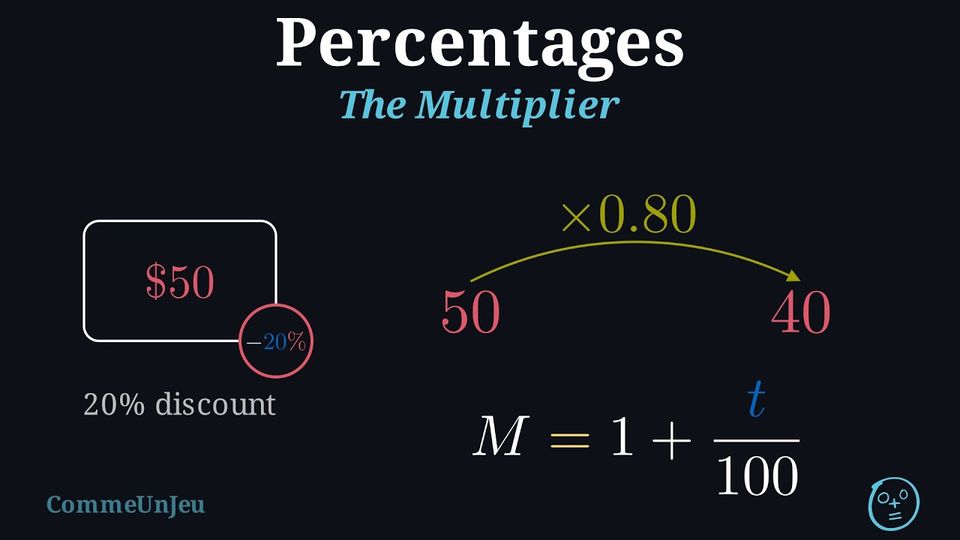
Quantities often change by a given percentage:
- A store offers a \(20\pourcent\) discount (a decrease).
- A salary rises by \(7\pourcent\) (an increase).
- A city's population grows by \(10\pourcent\).
Definition — Multiplier
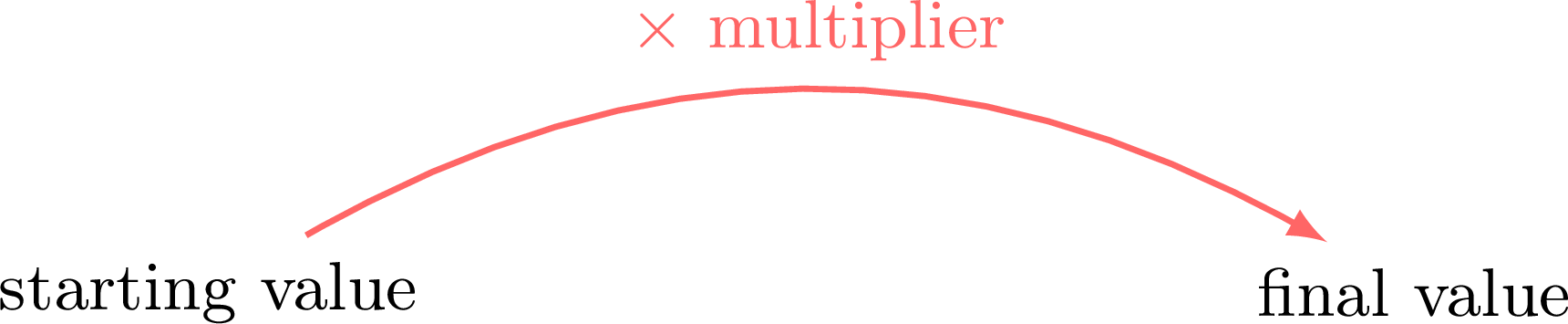
- Increasing a quantity by \(t\pourcent\) means multiplying it by \(1 + \dfrac{t}{100}\).
- Decreasing a quantity by \(t\pourcent\) means multiplying it by \(1 - \dfrac{t}{100}\).
A sign can also be given to the percentage change: a rise of \(15\pourcent\) is a change of \(+15\pourcent\), a drop of \(15\pourcent\) a change of \(-15\pourcent\). The two formulas then become one: with the signed number \(t\), the multiplier (written \(M\)) is always \(M = 1 + \dfrac{t}{100}\), for instance \(1 + \dfrac{-15}{100} = 1 - \dfrac{15}{100} = 0.85\). Beware of mixing the two writings: with a signed \(t = -15\), writing \(1 - \dfrac{t}{100}\) would give \(1.15\), a rise.
The Two-Step Method Is the Same One
The multiplier hides the elementary two-step method — compute the change, then add or subtract it. Both roads lead to the same place. Take \(\dollar 20\) with a \(25\pourcent\) discount:
- One step. Multiply by \(1 - \dfrac{25}{100} = 0{.}75\): \(\quad 20 \times 0{.}75 = \dollar 15\).
- Two steps. The discount is \(\dfrac{25}{100}\times 20 = \dollar 5\), then \(20 - 5 = \dollar 15\).
Example
The original price of a shirt is \(\dollar 50\). Find the final price after a \(20\pourcent\) discount.
A discount is a decrease, so the multiplier is \(1 - \dfrac{20}{100} = 0{.}80\). $$50 \times 0{.}80 = \dollar 40.$$ 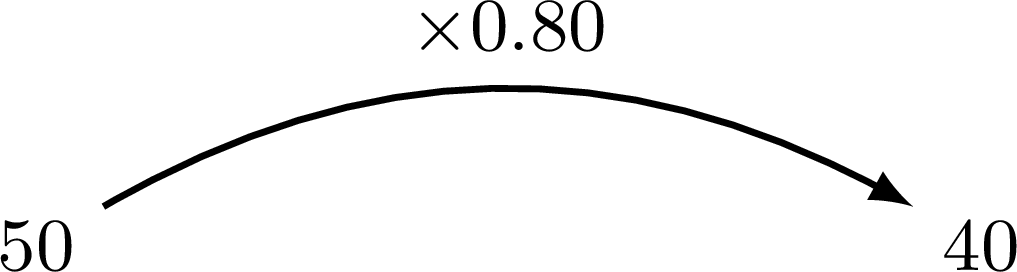
Example
A rent of \(\dollar 640\) rises by \(5\pourcent\). Determine the new rent. Then a town of \(1\,200\) inhabitants sees its population rise by \(150\pourcent\): determine the new population.
A rise: the multiplier is larger than \(1\). $$\begin{aligned} 1 + \dfrac{5}{100} &= 1.05 && \text{(multiplier of the rise)}\\
640 \times 1.05 &= \textcolor{colordef}{672} && \text{(new rent, in dollars)} \end{aligned}$$ A percentage change may exceed \(100\pourcent\): the multiplier is then larger than \(2\). $$\begin{aligned} 1 + \dfrac{150}{100} &= 2.5 && \text{(multiplier of the rise)}\\
1\,200 \times 2.5 &= \textcolor{colordef}{3\,000} && \text{(new population)} \end{aligned}$$ Rising by \(150\pourcent\) multiplies by \(2.5\) — not by \(150\), and not by \(1.5\) either.
Skills to practice
- Converting an Increase or a Decrease into a Percentage Change
- Finding the Multiplier
- Finding the New Quantity
I.3
Percentage Change
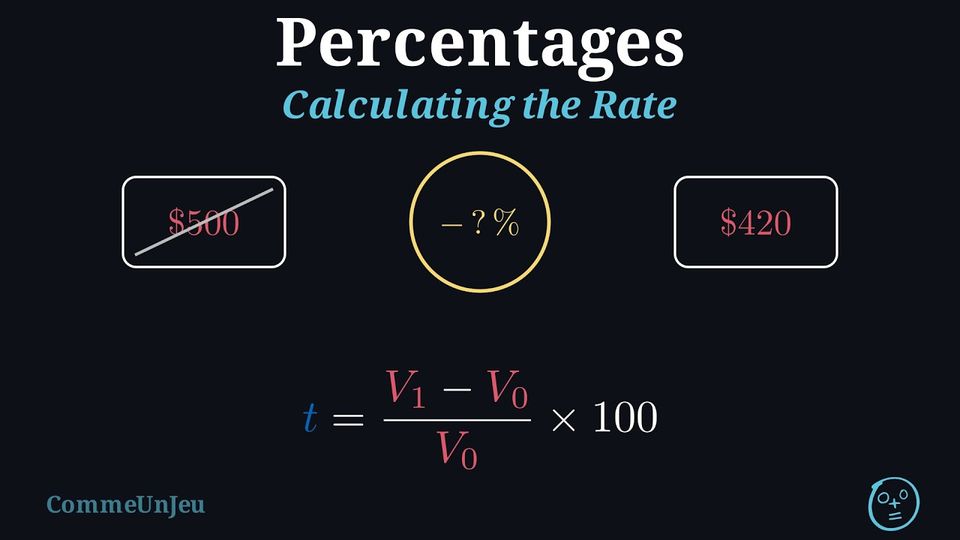
Method — Finding the Percentage Change from Two Values
When the starting value and the final value are both known, the starting value being strictly positive: - compute the change: final value \(-\) starting value;
- compare that change to the starting value, as a percentage:
Method — Recovering the Percentage Change from Two Values
When the starting value \(V_0\) (not zero) and the final value \(V_1\) are known, the multiplier and then the percentage change are found in two steps: - the multiplier: \(M = \dfrac{V_1}{V_0}\);
- the percentage change \(t\pourcent\), with \(t = (M - 1) \times 100\), that is \(t = \dfrac{V_1 - V_0}{V_0} \times 100\).
The multiplier turns the starting value into the final value: \(V_1 = V_0 \times M\). Dividing both sides by \(V_0\), which is not zero, gives $$M = \frac{V_1}{V_0}.$$ Since \(M = 1 + \dfrac{t}{100}\): $$\begin{aligned} \frac{t}{100} &= M - 1 && \text{(subtracting } 1 \text{ from both sides)}\\
t &= (M - 1) \times 100 && \text{(multiplying both sides by } 100\text{)}\\
&= \left(\frac{V_1}{V_0} - 1\right) \times 100 && \left(M = \tfrac{V_1}{V_0}\right)\\
&= \frac{V_1 - V_0}{V_0} \times 100 && \left(1 = \tfrac{V_0}{V_0}\right) \end{aligned}$$
Example
A price drops from \(\dollar 500\) to \(\dollar 420\). Find the percentage change.
The change is \(420 - 500 = -80\), compared to the starting value \(500\): $$\frac{420-500}{500}\times 100\pourcent = \frac{-80}{500}\times 100\pourcent = -16\pourcent.$$ The result is negative: this is a decrease of \(16\pourcent\). Check: \(500 \times 0{.}84 = 420\). 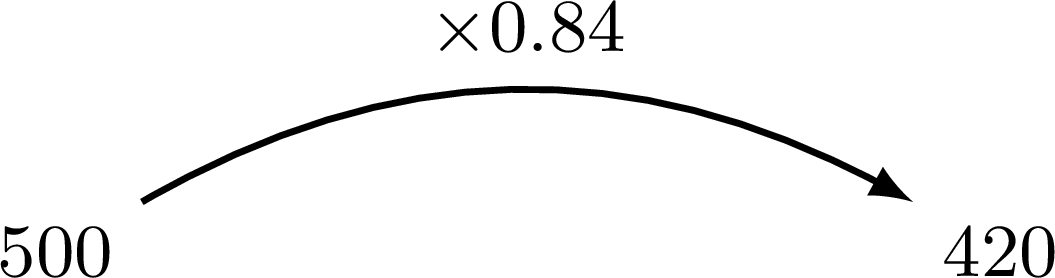
Skills to practice
- Reading the Percentage Change from a Multiplier
- Calculating a Percentage Change
I.4
Successive and Reciprocal Changes
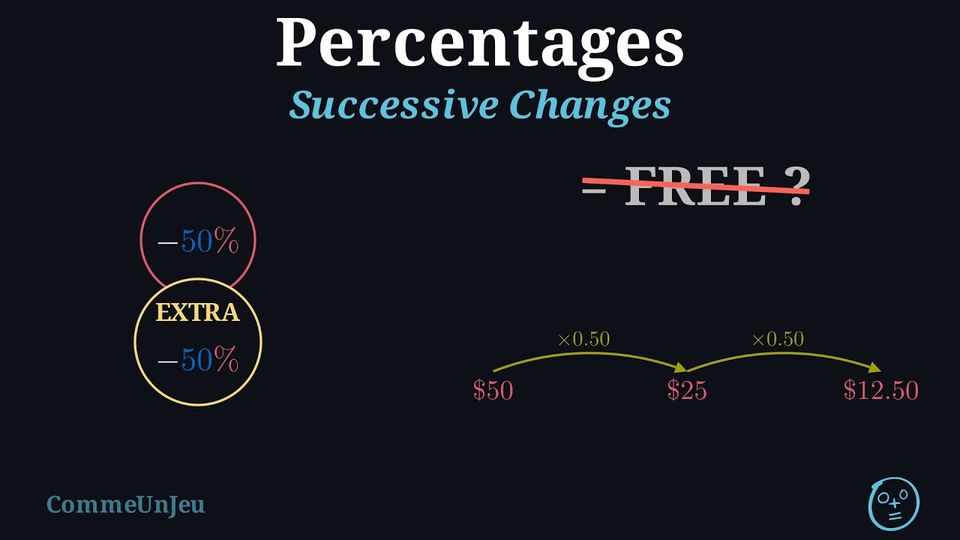
A coat is priced at \(\dollar 80\). During the sales it drops by \(25\pourcent\); a month later the price goes up again by \(10\pourcent\). The shopkeeper announces: “altogether, the coat has dropped by \(15\pourcent\)”. Is the announcement correct?
The two prices are computed one after the other, each change applying to the price at that moment: $$80 \times 0.75 = 60, \qquad\text{then}\qquad 60 \times 1.10 = 66.$$ From \(80\) to \(66\), the percentage change is $$\dfrac{66-80}{80} = \dfrac{-14}{80} = -0.175 = \textcolor{colorprop}{-17.5\pourcent}.$$ The announcement is wrong: the \(+10\pourcent\) applies to \(\dollar 60\), not to \(\dollar 80\). Percentage changes do not add up in general — \(-25\pourcent\) and \(+10\pourcent\) do not make \(-15\pourcent\).
Proposition — Global Multiplier
When a quantity undergoes two successive changes, the global multiplier is the product of the two multipliers: 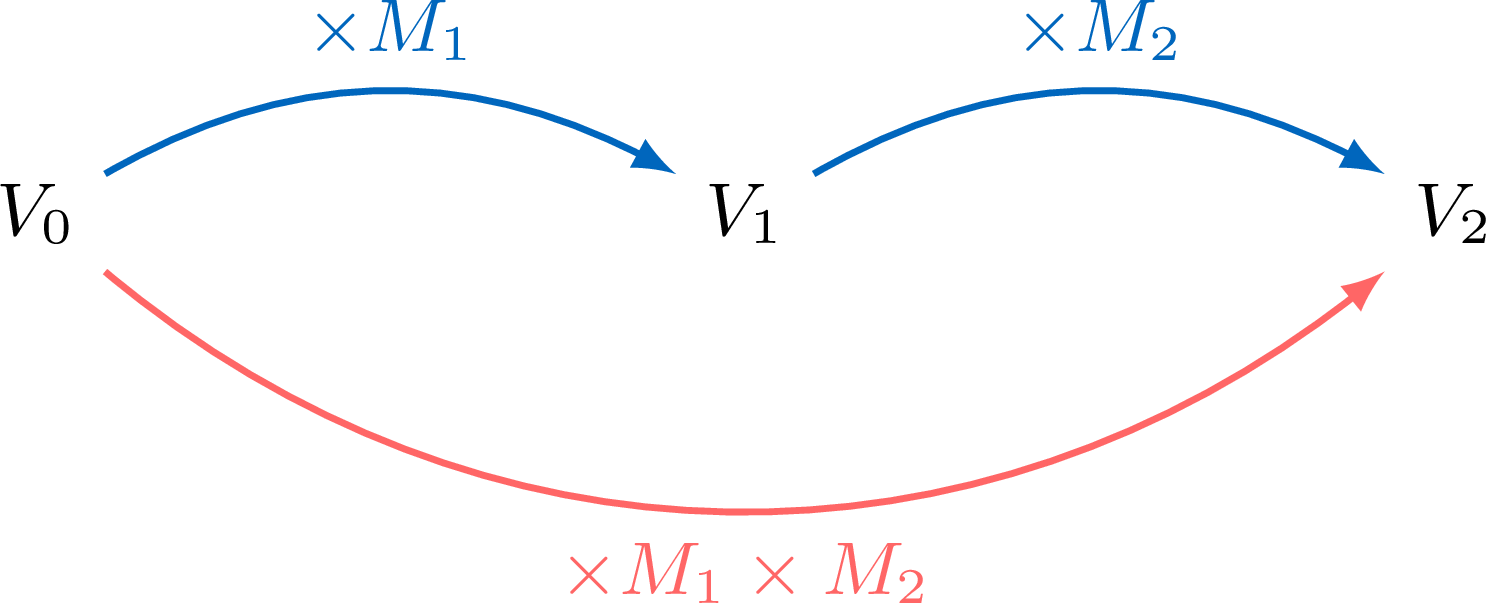
The global percentage change is then read off that single multiplier, exactly as for one change: a multiplier larger than \(1\) is a rise, smaller than \(1\) a drop.
Example
A rent rises by \(12\pourcent\), then drops by \(25\pourcent\). Determine the global multiplier, then the global percentage change.
$$\begin{aligned} M &= 1.12 \times 0.75 && \text{(product of the two multipliers)}\\
&= \textcolor{colordef}{0.84} \end{aligned}$$ The multiplier is smaller than \(1\): it is a drop. Since \(0.84 = 1 - 0.16\), the global percentage change is \(\textcolor{colorprop}{-16\pourcent}\) — and not \(+12\pourcent - 25\pourcent = -13\pourcent\).
Proposition — Reciprocal Change
To come back to the starting value after a change of multiplier \(M\), the quantity is multiplied by the inverse multiplier: $$M' = \dfrac{1}{M}.$$ Indeed, \(V_1 = V_0 \times M\) gives \(V_0 = V_1 \div M = V_1 \times \dfrac{1}{M}\). This inverse exists as soon as \(M\) is not zero — a drop of \(100\pourcent\) brings the quantity to zero, and no multiplication brings it back. The reciprocal percentage change is not, in general, the opposite one: undoing a drop of \(20\pourcent\) takes a rise of \(25\pourcent\). 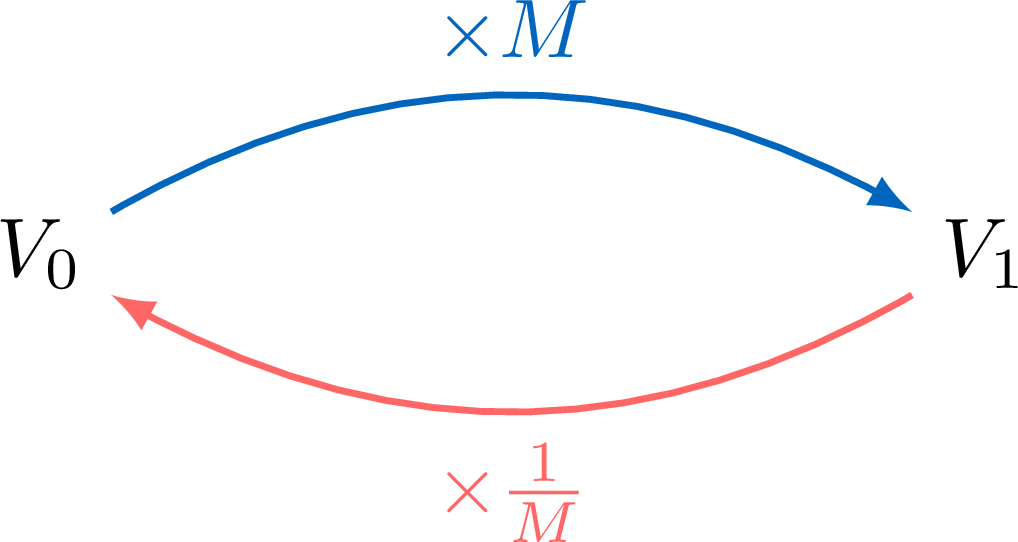
Example
After the drop of \(20\pourcent\) on a price of \(\dollar 50\), determine the rise that brings the price back to \(\dollar 50\).
The drop multiplies by \(0.80\) and gives \(50 \times 0.80 = 40\) dollars. Coming back means multiplying by $$M' = \dfrac{1}{0.80} = 1.25,$$ that is a rise of \(\textcolor{colordef}{25\pourcent}\) — indeed \(40 \times 1.25 = 50\). A drop of \(20\pourcent\) is undone by a rise of \(25\pourcent\), because the rise applies to a smaller price.
Skills to practice
- Composing and Undoing Changes
- Calculating Reciprocal Changes
II
Money
II.1
Sales Tax (VAT and GST)
In a country with a \(10\pourcent\) goods and services tax (GST), a shop prints the receipt below, where two lines are missing.
How are the two missing lines computed? Can the total to pay be obtained from the total before tax in one single multiplication?
| Item | Price |
| Headphones | \(\dollar 45.00\) |
| Charger | \(\dollar 15.00\) |
| Total before tax | \(\dollar 60.00\) |
| GST \(10\pourcent\) | \(?\) |
| Total to pay | \(?\) |
The tax is \(10\pourcent\) of the total before tax, then it is added to it: $$\begin{aligned}[t] \text{GST} &= 0.10 \times 60 && \text{(}10\pourcent\text{ of the total before tax)}\\
&= 6,\\
\text{total to pay} &= 60 + 6\\
&= 66. \end{aligned}$$ The receipt reads GST \(\dollar 6.00\) and total to pay \(\dollar 66.00\). Adding \(10\pourcent\) is an increase of \(10\pourcent\): by the multiplier, one multiplication does it, \(60 \times 1.10 = 66\). The tax is always computed on the price before tax.
Definition — Sales Tax
In most countries a sales tax is added to the price of goods and services. It is a percentage of the price before tax, fixed by law: the tax rate. Depending on the country it is called value added tax (VAT) or goods and services tax (GST). The price the customer pays is the price including tax: $$\text{price including tax} = \text{price before tax} + \text{tax}.$$ Some countries display prices including tax, others add the tax at the till: a statement always says which price it gives. Method — Adding the Tax
For a tax rate \(r\) written as a decimal (for example \(15\pourcent = 0.15\)): $$\text{tax} = r \times \text{price before tax}, \qquad \text{price including tax} = \text{price before tax} \times (1 + r).$$ Adding the tax is an increase of the price before tax by the tax rate: the price is multiplied by the multiplier \(1 + r\), since \(\text{price} + r \times \text{price} = \text{price} \times (1 + r)\). Example
A bicycle costs \(\dollar 360\) before a GST of \(15\pourcent\). Find the GST, then the price including tax.
The rate as a decimal is \(15\pourcent = 0.15\). $$\begin{aligned}[t] \text{GST} &= 0.15 \times 360\\
&= 54,\\
\text{price including tax} &= 360 \times 1.15 && \text{(multiplier } 1 + 0.15)\\
&= 414. \end{aligned}$$ The GST is \(\dollar 54\) and the bicycle costs \(\dollar 414\) including tax. Check: \(360 + 54 = 414\).
Method — Finding the Price Before Tax
When only the price including tax is known, the multiplication by \(1 + r\) is undone by a division (the reciprocal change): $$\text{price before tax} = \frac{\text{price including tax}}{1 + r}.$$ The tax is then the difference between the two prices. The tax is not \(r\) times the price including tax: the rate applies to the price before tax, which is smaller. Example
A pair of trainers costs \(\dollar 96\) including a VAT of \(20\pourcent\). Find the price before tax and the VAT.
The VAT multiplied the price before tax by \(1 + 0.20 = 1.20\); dividing undoes it: $$\begin{aligned}[t] \text{price before tax} &= \frac{96}{1.20} && \text{(undoing the multiplication by } 1.20)\\
&= 80,\\
\text{VAT} &= 96 - 80\\
&= 16. \end{aligned}$$ The trainers cost \(\dollar 80\) before tax and the VAT is \(\dollar 16\). Check: \(80 \times 1.20 = 96\). Taking \(20\pourcent\) of \(96\) instead gives \(19.20\) and a price before tax of \(76.80\) — but \(76.80 \times 1.20 = 92.16\), not \(96\).
Skills to practice
- Recognising How a Tax Changes a Price
- Calculating the Tax and the Price Including Tax
- Finding the Price Before Tax
II.2
Profit and Loss as a Percentage
Two stallholders compare their day at a weekend market. Amira bought scarves for \(\dollar 120\) and sold them all for \(\dollar 150\). Ben bought lamps for \(\dollar 400\) and sold them all for \(\dollar 440\). Ben says: “I made the larger profit, so my stall did better.” Who made the larger profit? Who made the better use of the money spent?
The profits are \(150 - 120 = \dollar 30\) for Amira and \(440 - 400 = \dollar 40\) for Ben: Ben made the larger profit. But Ben spent more than three times as much. Comparing each profit with the money spent to earn it: $$\frac{30}{120} = 0.25 = 25\pourcent, \qquad \frac{40}{400} = 0.10 = 10\pourcent.$$ Each dollar Amira spent brought back \(25\) cents of profit, each dollar Ben spent only \(10\) cents: Amira made the better use of her money. To compare two businesses, the profit is expressed as a percentage of the cost.
Definition — Profit and Loss
How well a business is doing is described by its profit or its loss. Two amounts are needed to calculate it: - Income (or Revenue): the total amount of money received from selling something.
- Expenses (or Costs): the total amount of money spent to make and sell the product.
Definition — Percentage Profit and Percentage Loss
A trader buys an item at its cost price and sells it at its selling price. As for a business, the profit is the income minus the expenses: here the two prices give a profit when the selling price is greater and a loss when it is smaller: $$\text{profit} = \text{selling price} - \text{cost price}, \qquad \text{loss} = \text{cost price} - \text{selling price}.$$ The percentage profit is the profit expressed as a percentage of the cost price, and the percentage loss is the loss expressed as a percentage of the cost price: $$\text{percentage profit} = \frac{\text{profit}}{\text{cost price}} \times 100, \qquad \text{percentage loss} = \frac{\text{loss}}{\text{cost price}} \times 100.$$
A Percentage of Which Price
Unless a statement says otherwise, a percentage profit or loss is a percentage of the cost price: a percentage profit is then the percentage change from the cost price to the selling price, and a percentage loss is that percentage change without its minus sign (a loss of \(15\pourcent\) is a change of \(-15\pourcent\)). Some businesses quote instead the profit as a percentage of the selling price, which they call the profit margin. It is a different quantity: for a profit it is always smaller, because the selling price is larger than the cost price. An item bought for \(\dollar 60\) and sold for \(\dollar 80\) makes a profit of \(\dollar 20\), that is $$\frac{20}{60} \times 100 \approx 33.3\pourcent \text{ of the cost price}, \qquad \frac{20}{80} \times 100 = 25\pourcent \text{ of the selling price}.$$ A percentage given without the price it refers to is ambiguous.
Example
A cycle shop buys a bicycle for \(\dollar 250\) and sells it for \(\dollar 320\). Find the profit and the percentage profit.
The selling price is greater than the cost price: it is a profit. $$\begin{aligned}[t] \text{profit} &= 320 - 250\\
&= 70,\\
\text{percentage profit} &= \frac{70}{250} \times 100 && \text{(percentage of the cost price)}\\
&= 28. \end{aligned}$$ The shop makes a profit of \(\dollar 70\), that is \(28\pourcent\) of the cost price. Check: \(250 \times 1.28 = 320\).
Example
A phone bought for \(\dollar 480\) is resold for \(\dollar 408\). Find the loss and the percentage loss.
The selling price is smaller than the cost price: it is a loss. $$\begin{aligned}[t] \text{loss} &= 480 - 408\\
&= 72,\\
\text{percentage loss} &= \frac{72}{480} \times 100 && \text{(percentage of the cost price)}\\
&= 15. \end{aligned}$$ The loss is \(\dollar 72\), that is \(15\pourcent\) of the cost price. Check: \(480 \times 0.85 = 408\).
Method — From a Percentage Profit to the Prices
A profit of \(p\) of the cost price (\(p\) written as a decimal) is an increase of the cost price by \(p\); a loss of \(p\) is a decrease by \(p\): $$\text{selling price} = \text{cost price} \times (1 + p) \quad \text{(profit)}, \qquad \text{selling price} = \text{cost price} \times (1 - p) \quad \text{(loss)}.$$ To find the cost price from the selling price, divide the selling price by the same multiplier, \(1 + p\) or \(1 - p\) — for a loss, \(p\) is smaller than \(1\): a loss of \(100\pourcent\) gives a selling price of \(0\), from which no cost price can be recovered. Example
A florist sells every bunch of flowers with a \(40\pourcent\) profit on the cost price. - A bunch of roses costs her \(\dollar 15\). Find its selling price.
- A bouquet is sold for \(\dollar 63\). Find its cost price.
- A pot plant that did not sell is let go at a loss of \(20\pourcent\) of its cost price, for \(\dollar 36\). Find its cost price.
A profit of \(40\pourcent\) multiplies the cost price by \(1 + 0.40 = 1.40\).
- $$\begin{aligned}[t] \text{selling price} &= 15 \times 1.40\\ &= 21. \end{aligned}$$ The roses are sold for \(\dollar 21\).
- The cost price is found by dividing by the same multiplier: $$\begin{aligned}[t] \text{cost price} &= \frac{63}{1.40}\\ &= 45. \end{aligned}$$ The bouquet cost \(\dollar 45\). Check: \(45 \times 1.40 = 63\). Subtracting \(40\pourcent\) of \(63\) would give \(37.80\), a cost price whose \(40\pourcent\) profit is not \(63\).
- A loss of \(20\pourcent\) multiplied the cost price by \(1 - 0.20 = 0.80\); dividing undoes it: $$\begin{aligned}[t] \text{cost price} &= \frac{36}{0.80}\\ &= 45. \end{aligned}$$ The plant cost \(\dollar 45\). Check: \(45 \times 0.80 = 36\).
Skills to practice
- Recognising a Percentage Profit or Loss
- Calculating a Percentage Profit or Loss
- Finding the Selling Price or the Cost Price
III
Going further
Skills to practice
- Using the Multiplier
- Solving Percentage Problems
- Solving Problems on Receipts and Market Stalls
- Investigating Patterns in Tax and Profit
- Quiz
Jump to section