International Baccalaureate · PYP 4
Fractions
I
Fractions Greater than 1
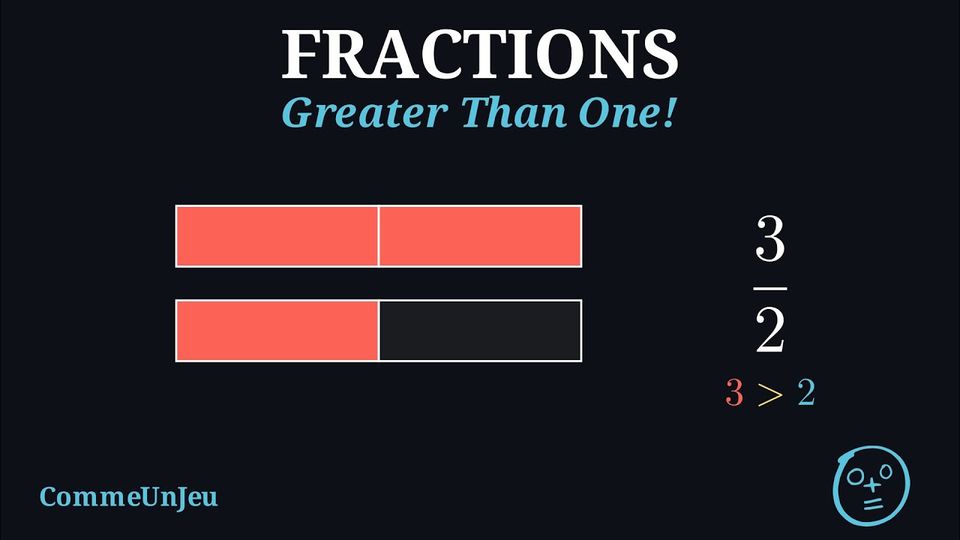
Consider the model below, which illustrates one whole unit and one half:  . To express this length as a single fraction, we follow two steps:
 - Identify the denominator: The units are divided into halves, so the denominator is 2.
- Count the parts: In total, there are three shaded parts of this size. This count becomes the numerator.
Definition — Fraction
A fraction has two numbers separated by a fraction bar: the numerator (on top) and the denominator (on the bottom). 
Skills to practice
- Finding Fractions Greater than 1 in Diagrams
II
On the Number Line, Beyond 1
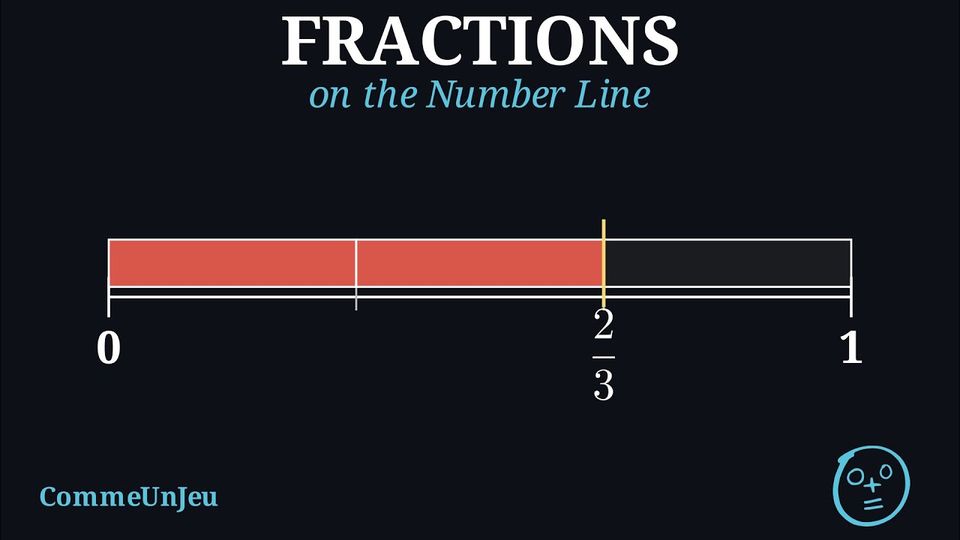
Fractions do not only represent parts of a shape; they can also represent points on a number line. The segment from 0 to 1 is one unit.
If we divide the unit into 2 equal parts, the point in the middle represents the fraction \(\dfrac{1}{2}\). 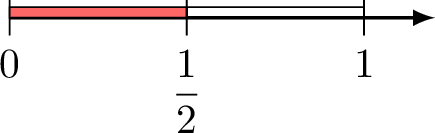
If we divide the unit into 2 equal parts, the point in the middle represents the fraction \(\dfrac{1}{2}\).
Method — Representing a Fraction on the Number Line
To represent the fraction \(\dfrac{\textcolor{colordef}{2}}{\textcolor{colorprop}{3}}\) on a number line: - Draw a straight line and mark the points \(0\) and \(1\).

- Divide the segment from \(0\) to \(1\) into \(\textcolor{colorprop}{3}\) equal parts (the denominator).

- Count \(\textcolor{colordef}{2}\) parts from \(0\) (the numerator) and mark the point at \(\dfrac{\textcolor{colordef}{2}}{\textcolor{colorprop}{3}}\).

Method — Placing a Fraction Greater than 1 on the Number Line
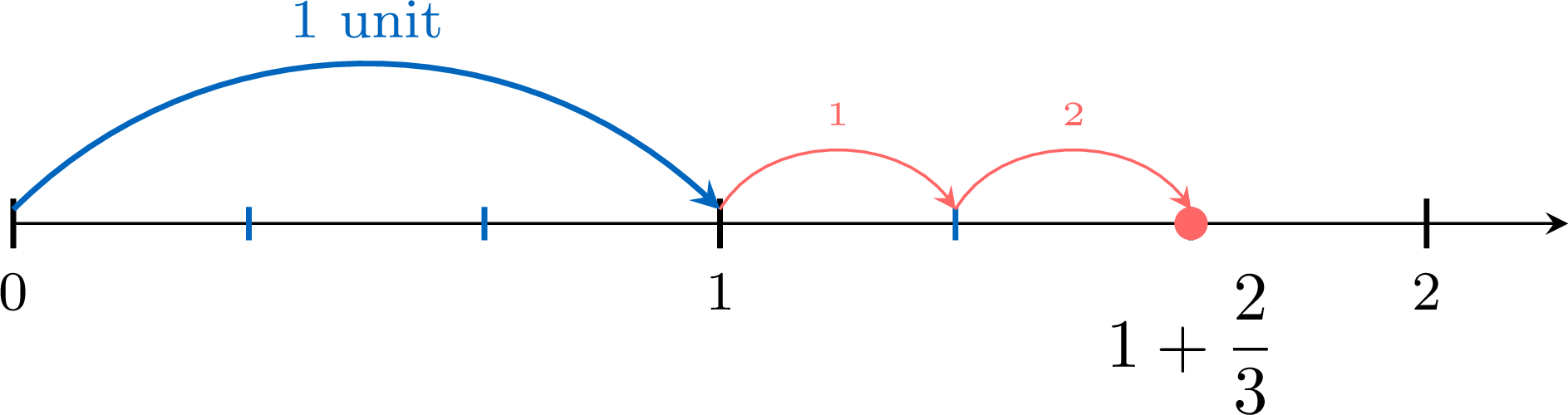
A fraction greater than \(1\) is placed like any fraction: the denominator says into how many equal parts each unit is divided, the numerator counts these parts from \(0\). To place \(\dfrac{\textcolor{colordef}{5}}{\textcolor{colorprop}{3}}\): - Mark \(0\), \(1\), \(2\) at equal distances, and divide each unit into \(\textcolor{colorprop}{3}\) equal parts (the denominator).

- Count \(\textcolor{colordef}{5}\) parts from \(0\) (the numerator). After \(3\) parts you reach \(1\), because \(\dfrac{3}{3} = 1\); \(2\) more parts give the point.

Example
Place on a number line: - the fraction \(\dfrac{9}{4}\);
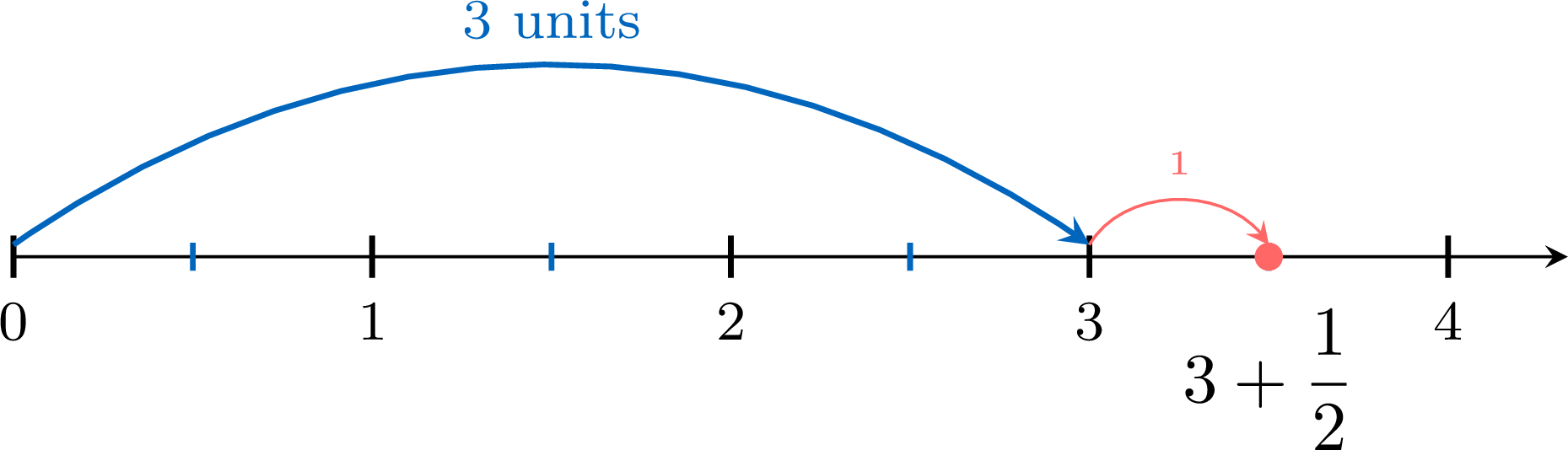
- the number \(3 + \dfrac{1}{2}\).
- The denominator is \(4\): each unit is divided into \(4\) equal parts. Count \(9\) parts from \(0\): \(4\) parts reach \(1\), \(4\) more parts reach \(2\), and \(1\) more part gives the point.

- Here the fraction added to \(3\) is \(\dfrac{1}{2}\): each unit is divided into \(2\) equal parts. Go to the whole number \(3\), then count \(1\) half after it.
Skills to practice
- Finding Fractions Greater than 1 on the Number Line
- Placing a Fraction Greater than 1 or a Whole Number Plus a Fraction
III
Equivalent Fractions
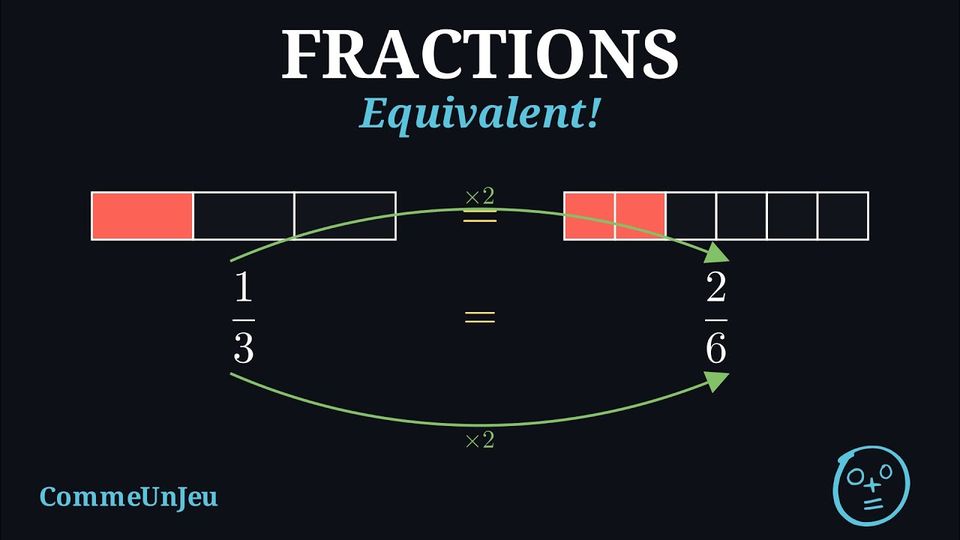
A cake is cut into 3 equal parts. One part, representing \(\dfrac{1}{3}\) of the cake, is set aside. 
Then each of the three parts is cut in half. Now the cake is divided into 6 equal parts. The same amount of cake as before is now 2 of these parts. 
Even though the number of pieces changed, did the shaded amount of cake change?
No—the amount of cake did not change. The models show that the shaded portion is the same in both cases. \(\quad=\quad\) Therefore, the fractions \(\dfrac{1}{3}\) and \(\dfrac{2}{6}\) represent the same value.
\(\quad=\quad\)Definition — Equivalent Fractions
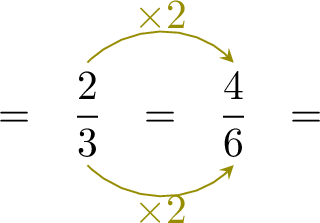
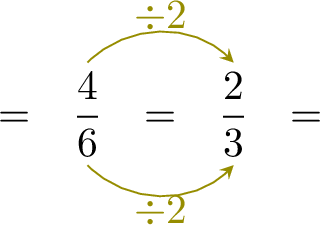
Two fractions are equivalent if they represent the same amount. You get an equivalent fraction by cutting every part into the same number of smaller parts: the numerator and the denominator are multiplied by that number. Grouping the parts back does the opposite: both are divided by the same number, which must divide the numerator and the denominator exactly. 

Skills to practice
- Identifying Equivalent Fractions (with Models)
- Identifying Equivalent Fractions (Symbolic)
- Writing Equivalent Fractions
- Finding the Missing Numerator
- Finding the Missing Denominator
IV
Addition and Subtraction of Fractions with Common Denominators
Hugo's cake is cut into \(4\) equal parts (quarters). Hugo eats \(\dfrac{2}{4}\) of the cake \(=\)  , then \(\dfrac{1}{4}\) more \(=\)
 .
What fraction of the cake has he eaten?
, then \(\dfrac{1}{4}\) more \(=\) .What fraction of the cake has he eaten?
The parts are all the same size (quarters), so the eaten parts can simply be counted together: \(2+1=3\) quarters. 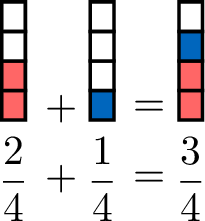
Hugo has eaten \(\dfrac{3}{4}\) of the cake.
Definition — Addition of Fractions with Common Denominators
To add fractions with the same denominator, add the numerators and keep the denominator the same: 
Another day, \(\dfrac{3}{4}\) of Hugo's cake is left \(=\)  . Hugo eats \(\dfrac{1}{4}\) more.
What fraction of the cake is left now?
. Hugo eats \(\dfrac{1}{4}\) more.What fraction of the cake is left now?
The parts are the same size (quarters), so subtract the counts: \(3-1=2\) quarters are left. 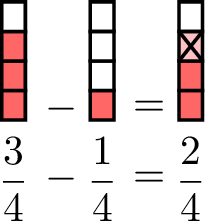
\(\dfrac{2}{4}\) of the cake is left.
Definition — Subtraction of Fractions with Common Denominators
To subtract fractions with the same denominator, subtract the numerators and keep the denominator the same:
The Whole Cake
Hugo cuts a cake into \(3\) equal parts — and eats them all:  . He has eaten \(3\) parts out of \(3\): the whole cake. $$\dfrac{3}{3} = 1$$ Before the first bite, it was the other way round — \(0\) parts out of \(3\), nothing of the cake:
 . $$\dfrac{0}{3} = 0$$
. He has eaten \(3\) parts out of \(3\): the whole cake. $$\dfrac{3}{3} = 1$$ Before the first bite, it was the other way round — \(0\) parts out of \(3\), nothing of the cake: . $$\dfrac{0}{3} = 0$$
Proposition — When the Fraction is Worth 1 or 0
When the two numbers are equal, every part is taken: the fraction is the whole unit. It is worth \(1\). 

Skills to practice
- Adding Fractions with Common Denominators (with Models)
- Adding Fractions with Common Denominators (Symbolic)
- Subtracting Fractions with Common Denominators (with Models)
- Subtracting Fractions with Common Denominators (Symbolic)
- Adding and Subtracting: Showing the Steps
V
Adding and Subtracting with Related Denominators
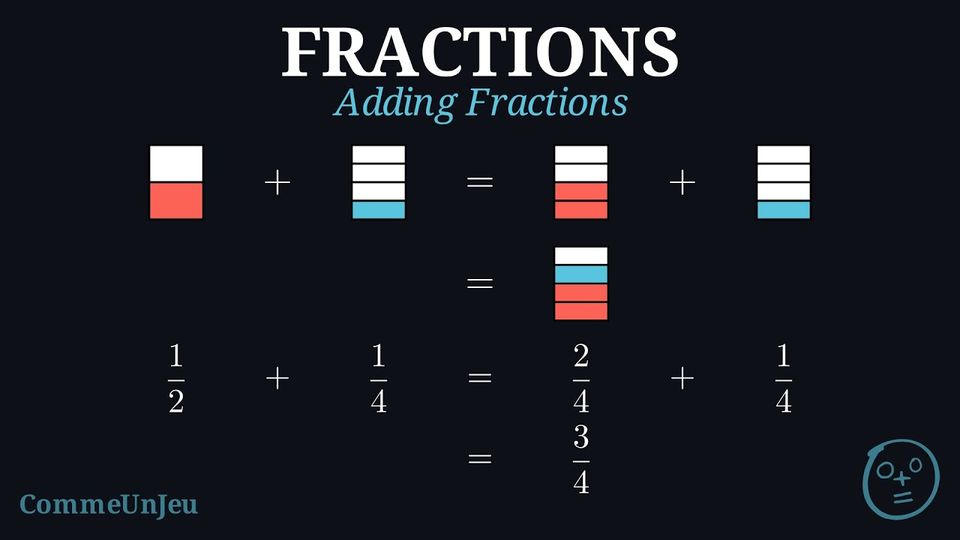
Method — Procedure for Adding or Subtracting Fractions
To add or subtract fractions with unlike denominators, follow this three-step procedure: - Find a Common Denominator: Identify a common multiple of the denominators.
- Create Equivalent Fractions: Convert each fraction to an equivalent fraction with the common denominator.
- Add or Subtract the Numerators: With the denominators now the same, perform the operation on the numerators and keep the common denominator. For a subtraction, the first fraction must not be smaller than the second.
The Sum of Two Positive Numbers
Louis writes \(\dfrac{1}{2} + \dfrac{1}{4} = \dfrac{2}{6}\): he has added the numerators together and the denominators together. On two identical bars, \(\dfrac{2}{6}\) is shorter than \(\dfrac{1}{2}\) alone. 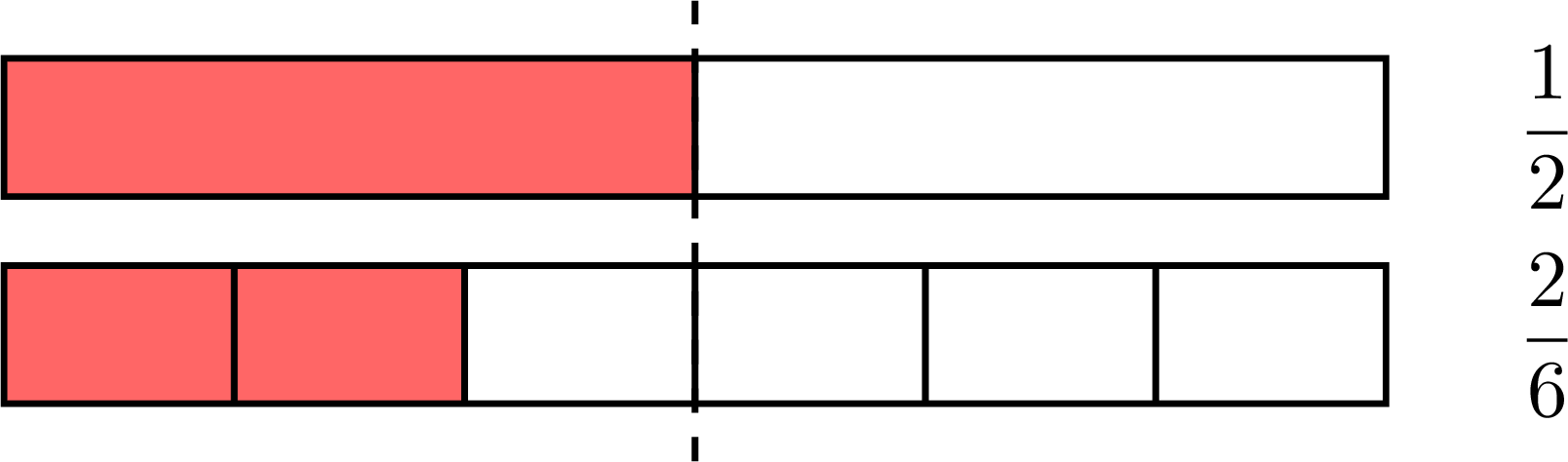
Yet the sum of two positive numbers is greater than each of them: put end to end, the lengths \(\dfrac{1}{2}\) and \(\dfrac{1}{4}\) make more than \(\dfrac{1}{2}\). Louis's answer is wrong. Only parts of the same size can be counted together: halves and quarters are not the same size, so the half is first cut into two quarters. $$\begin{aligned}\dfrac{1}{2} + \dfrac{1}{4} &= \dfrac{2}{4} + \dfrac{1}{4} && \text{(one half is two quarters)}\\
&= \dfrac{3}{4}\end{aligned}$$
When One Denominator Is a Multiple of the Other
When one of the two denominators is a multiple of the other, the common denominator is simply the bigger one, and only one fraction has to be rewritten.
Skills to practice
- Subtracting with Related Denominators
VI
Improper Fractions and Mixed Numbers
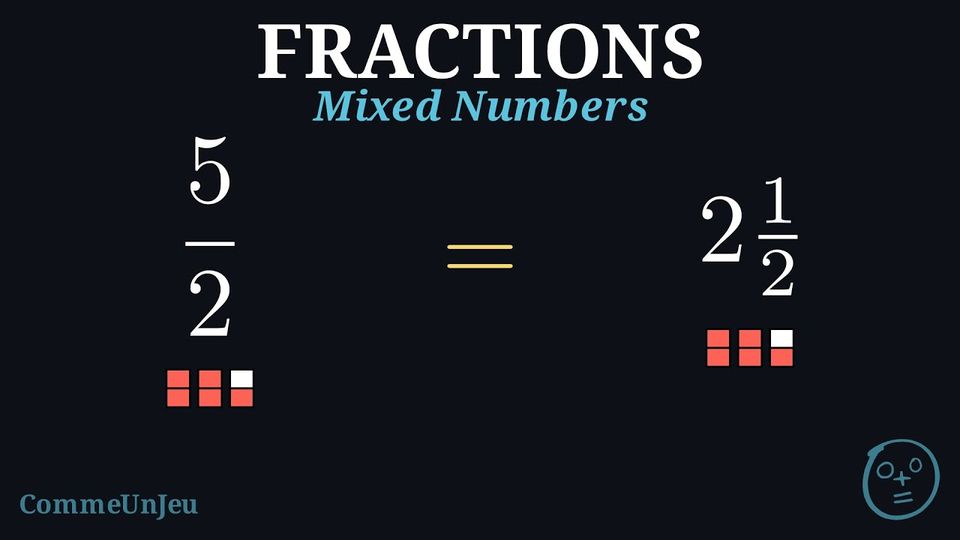
Fractions can represent values greater than one. Consider the fraction \(\dfrac{5}{2}\), which represents 5 half-sized parts of a unit. 
While this “improper fraction” is a valid mathematical representation, it is often more intuitive to express such numbers as a combination of whole units and a remaining fractional part.
Definition — Proper and Improper Fractions
Fractions are classified based on the relationship between the numerator and the denominator. - A proper fraction is a fraction where the numerator is less than the denominator. Its value is always less than 1. Example: \(\dfrac{2}{3}\).
- An improper fraction is a fraction where the numerator is greater than or equal to the denominator. Its value is always greater than or equal to 1. Example: \(\dfrac{5}{3}\).
Proposition — Whole Number Plus a Fraction
Every fraction greater than \(1\) can be written as the sum of a whole number and a fraction less than \(1\); conversely, the sum of a non-zero whole number and a non-zero fraction less than \(1\) is a fraction greater than \(1\): 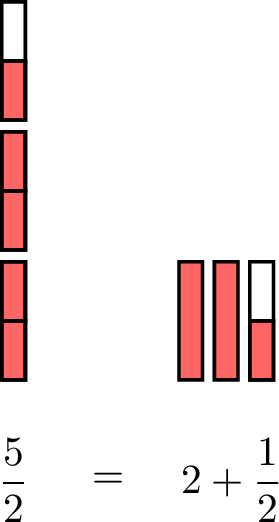
Definition — Mixed Number
A mixed number is an alternative way to represent an improper fraction. It consists of an integer part (the number of whole units) and a proper fraction part.The improper fraction \(\dfrac{5}{2}\) can be visualised as two whole units and one half.
Method — Decomposing a Fraction Greater Than 1
To write \(\dfrac{n}{b}\) as a whole number plus a fraction less than \(1\): - Count the whole units: each whole unit is made of \(b\) parts, so divide with remainder: \(n = q \times b + r\), with a remainder \(r\) smaller than \(b\).
- The \(r\) remaining parts form the fraction: \(\dfrac{n}{b} = q + \dfrac{r}{b}\), and \(\dfrac{r}{b} < 1\) because \(r < b\).
Example
Write \(\dfrac{7}{3}\) as the sum of a whole number and a fraction less than \(1\).
\(\begin{aligned}[t]\dfrac{7}{3}&=\dfrac{2\times 3+1}{3}&&(\text{division of 7 by 3: } 7=2\times 3+1)\\&=\dfrac{2\times 3}{3}+\dfrac{1}{3}\\&=2+\dfrac{1}{3}\\\end{aligned}\) 
Example
Write \(3 + \dfrac{2}{5}\) as a single fraction.
\(\begin{aligned}[t]3+\dfrac{2}{5}&=\dfrac{3\times 5}{5}+\dfrac{2}{5}&&\left(3=\dfrac{15}{5}\right)\\&=\dfrac{15+2}{5}\\&=\dfrac{17}{5}\\\end{aligned}\)
Skills to practice
- Finding Mixed Numbers from Bar Models
- Decomposing into a Whole Number Plus a Fraction
- Recomposing into a Single Fraction
- Finding Fractions from Mixed Numbers
- Finding Mixed Numbers from Fractions
VII
Bounding a Fraction Between Two Whole Numbers
Method — Placing a Fraction Between Two Whole Numbers
Once a fraction greater than \(1\) is written as a whole number plus a fraction less than \(1\), its place on the number line is settled: the whole number is the one just below, and the next whole number is just above. $$\dfrac{7}{3} = 2 + \dfrac{1}{3} \qquad\text{so}\qquad 2 < \dfrac{7}{3} < 3$$ 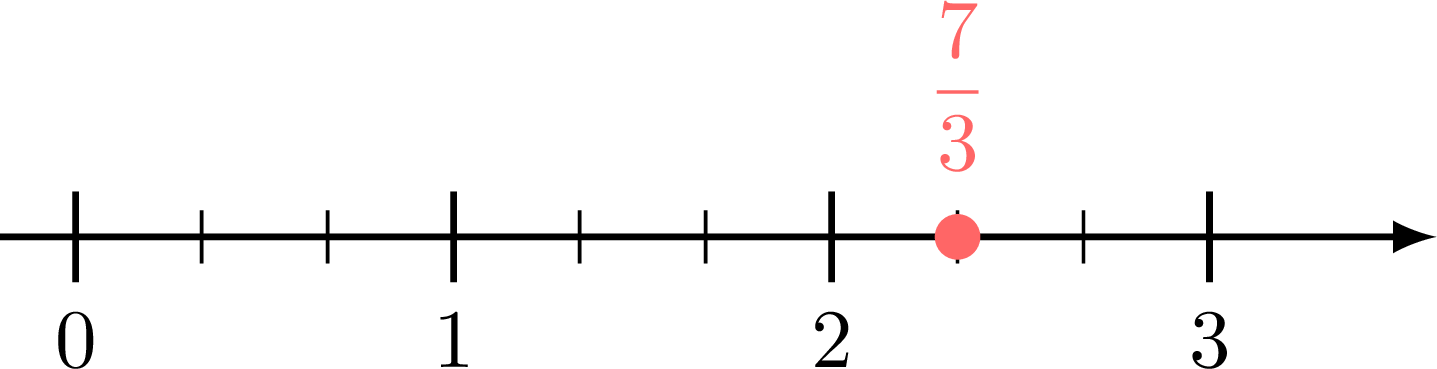
Example
Place \(\dfrac{11}{4}\) between two consecutive whole numbers.
\(\dfrac{11}{4}=2+\dfrac{3}{4}\) (division of 11 by 4: \(11 = 2 \times 4 + 3\)), so: $$2 < \dfrac{11}{4} < 3.$$
Example
Place \(\dfrac{29}{4}\) between two consecutive whole numbers.
$$\begin{aligned}[t] 29 &= 7 \times 4 + 1 && \text{(division with remainder by the denominator)} \\
\dfrac{29}{4} &= 7 + \dfrac{1}{4} && \text{(the 7 whole units, then the remaining part)} \\
7 &< \dfrac{29}{4} < 8 && \text{(the remainder is not zero)} \end{aligned}$$
Skills to practice
- Bounding Between Two Consecutive Whole Numbers
VIII
Going further
Skills to practice
- Reasoning and Problem-Solving
- Quiz
Jump to section