International Baccalaureate · PYP 2
Fractions
I
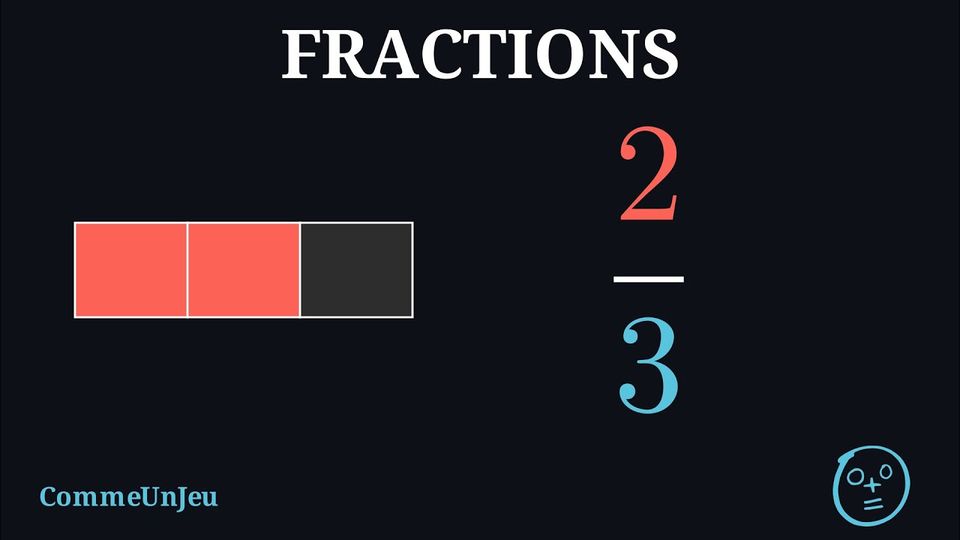
What is a Fraction?
Hugo has 1 unit, which is one complete cake:  . He cuts the unit into 2 equal parts to share. Hugo takes 1 part out of 2 equal parts:
 . We write this as \(\displaystyle \dfrac{1}{2}\). What part of the cake is left for his sister?
. He cuts the unit into 2 equal parts to share. Hugo takes 1 part out of 2 equal parts: . We write this as \(\displaystyle \dfrac{1}{2}\). What part of the cake is left for his sister? Definition — Fraction
A fraction has two numbers separated by a fraction bar: the numerator (on top) and the denominator (on the bottom). 
Definition — Reading a Fraction Aloud
The bottom number has a name, and that name says what one part is called. | \(\dfrac{1}{2}\) | \(\dfrac{1}{3}\) | \(\dfrac{1}{4}\) | \(\dfrac{1}{5}\) | \(\dfrac{1}{6}\) | \(\dfrac{1}{8}\) | \(\dfrac{1}{10}\) |
| one half | one third | one quarter | one fifth | one sixth | one eighth | one tenth |
Definition — Unit Fraction
A fraction with \(1\) on top is called a unit fraction: it is one single part of the unit. 
Proposition — Every Fraction is Made of Unit Fractions
Every fraction is made of unit fractions, put together. 
Skills to practice
- Finding Fractions in Diagrams
- Finding Fractions
- Finding Fractions in Word Problems
- Finding Numerators and Denominators
- Writing Fractions from Words
- Building a Fraction from Unit Fractions
- Drawing Fractions
II
Comparing Fractions
Léa and Tom each have a strip of paper. The two strips are identical, and both are cut into tenths. Léa has coloured \(\dfrac{3}{10}\) of hers, Tom \(\dfrac{7}{10}\) of his. Léa  Tom

Say who has coloured more.
Tom
Tom has. And nothing had to be counted twice: the two strips are identical, cut the same way, so every part is the same size.
When the parts are the same size, only how many are coloured decides. Tom has \(7\) coloured parts, Léa has \(3\), and \(3\) is smaller than \(7\). $$\dfrac{3}{10} \lt \dfrac{7}{10}$$
When the parts are the same size, only how many are coloured decides. Tom has \(7\) coloured parts, Léa has \(3\), and \(3\) is smaller than \(7\). $$\dfrac{3}{10} \lt \dfrac{7}{10}$$
Proposition — Ordering Fractions with the Same Denominator
For two fractions with the same denominator, the fraction with the larger numerator is larger.  \(= \dfrac{6}{8} > \dfrac{5}{8} = \)

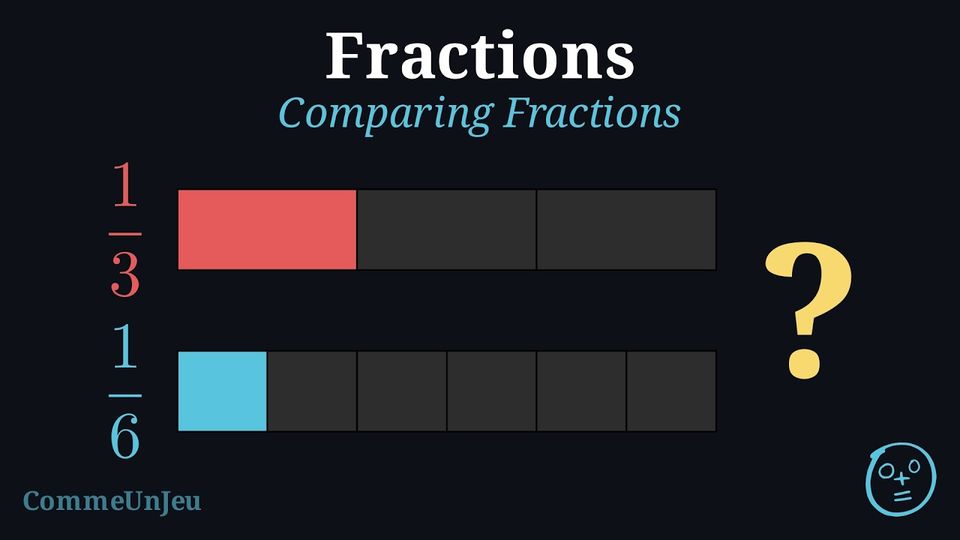
Method — When the Top Number is 1
Careful — here things work the other way round from what one expects. Take the same unit, and cut it in two different ways: into \(3\) equal parts, then into \(6\) equal parts. 

Skills to practice
- Comparing with Same Denominator
- Comparing When the Top Number Is 1
- Choosing the Right Rule
III
A Fraction of a Collection
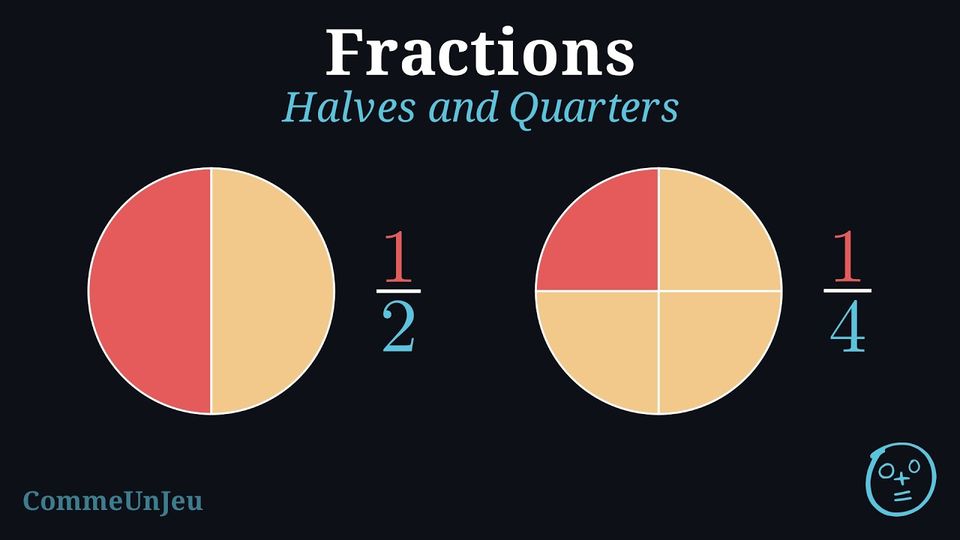
Method — A Half or a Quarter of a Collection
A collection of objects can be shared in the same way. - To find one half of a collection, share the objects into \(2\) equal groups, one by one, until none is left. One group is one half of the collection.
- To find one quarter, share the objects into \(4\) equal groups. One group is one quarter of the collection.
This works only when no object is left over: \(7\) counters cannot be shared into \(2\) equal groups.
Example — A Fraction of a Collection
Inès has \(12\) beads and Léo has \(16\) marbles. 
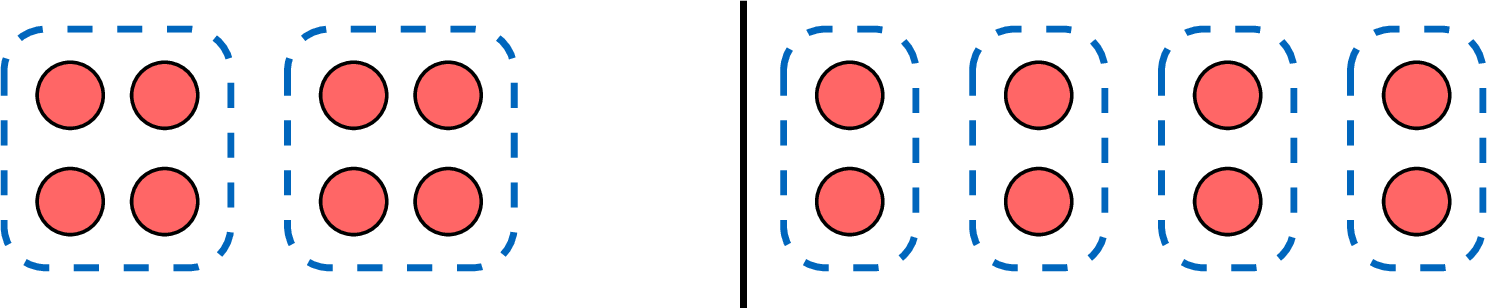
To find \(\dfrac{1}{3}\) of the beads, share them into \(3\) equal groups: one group is one third of the beads. In the same way, to find \(\dfrac{1}{8}\) of the marbles, share them into \(8\) equal groups: one group is one eighth of the marbles. 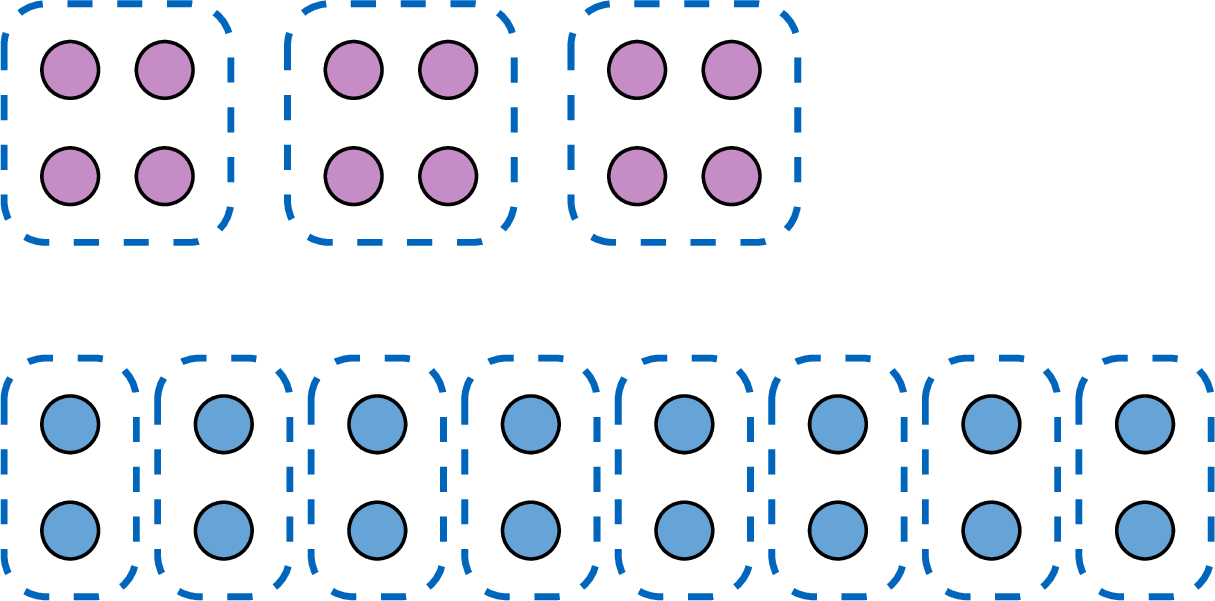
- \(12\) beads shared into \(3\) equal groups make \(3\) groups of \(4\) beads. So \(\dfrac{1}{3}\) of the \(12\) beads is 4 beads. Check: \(4 + 4 + 4 = 12\).
- \(16\) marbles shared into \(8\) equal groups make \(8\) groups of \(2\) marbles. So \(\dfrac{1}{8}\) of the \(16\) marbles is 2 marbles. Check: \(2 + 2 + 2 + 2 + 2 + 2 + 2 + 2 = 16\).
Skills to practice
- Finding a Fraction of a Collection
- Comparing Two Fractions of a Collection
IV
Adding Fractions
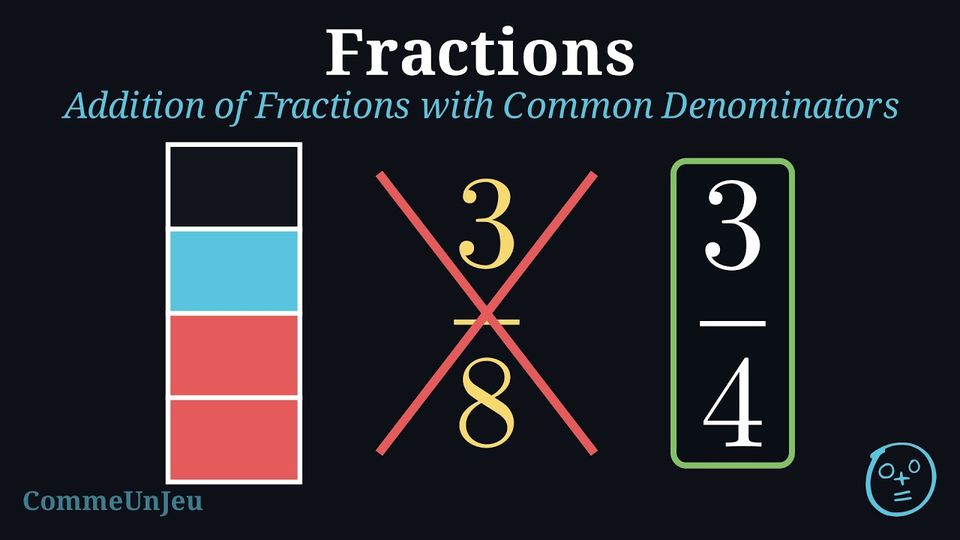
Hugo's cake is cut into \(4\) equal parts (quarters). Hugo eats \(\dfrac{2}{4}\) of the cake \(=\)  , then \(\dfrac{1}{4}\) more \(=\)
 .
What fraction of the cake has he eaten?
, then \(\dfrac{1}{4}\) more \(=\) .What fraction of the cake has he eaten?
The parts are all the same size (quarters), so the eaten parts can simply be counted together: \(2+1=3\) quarters. 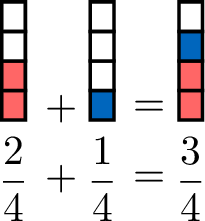
Hugo has eaten \(\dfrac{3}{4}\) of the cake.
Definition — Addition of Fractions with Common Denominators
To add fractions with the same denominator, add the numerators and keep the denominator the same: Skills to practice
- Adding Fractions with the Same Denominator
V
Subtracting Fractions
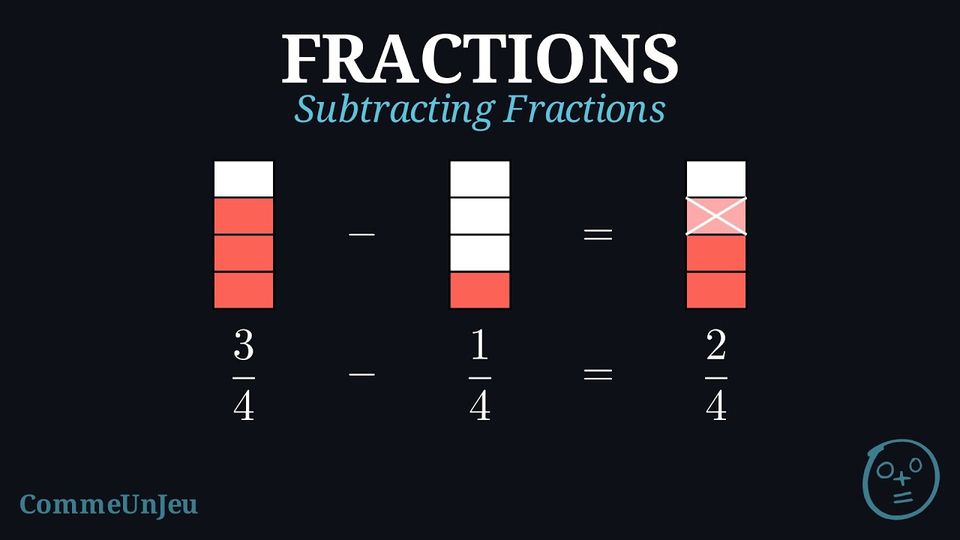
Another day, \(\dfrac{3}{4}\) of Hugo's cake is left \(=\)  . Hugo eats \(\dfrac{1}{4}\) more.
What fraction of the cake is left now?
. Hugo eats \(\dfrac{1}{4}\) more.What fraction of the cake is left now?
The parts are the same size (quarters), so subtract the counts: \(3-1=2\) quarters are left. 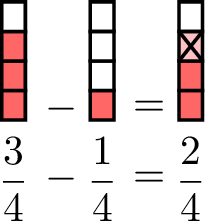
\(\dfrac{2}{4}\) of the cake is left.
Definition — Subtraction of Fractions with Common Denominators
To subtract fractions with the same denominator, subtract the numerators and keep the denominator the same:
The Whole Cake
Hugo cuts a cake into \(3\) equal parts — and eats them all:  . He has eaten \(3\) parts out of \(3\): the whole cake. $$\dfrac{3}{3} = 1$$ Before the first bite, it was the other way round — \(0\) parts out of \(3\), nothing of the cake:
 . $$\dfrac{0}{3} = 0$$
. He has eaten \(3\) parts out of \(3\): the whole cake. $$\dfrac{3}{3} = 1$$ Before the first bite, it was the other way round — \(0\) parts out of \(3\), nothing of the cake: . $$\dfrac{0}{3} = 0$$
Proposition — When the Fraction is Worth 1 or 0
When the two numbers are equal, every part is taken: the fraction is the whole unit. It is worth \(1\). 

Skills to practice
- Subtracting Fractions with the Same Denominator
VI
Going further
Skills to practice
- Completing Fractions with Pictures
- Colouring and Joining Fractions on Figures
- Quiz
Jump to section