International Baccalaureate · MYP 2
Fractions
I
Equal Fractions and Simplest Form
I.1
Simplifying by Cancelling
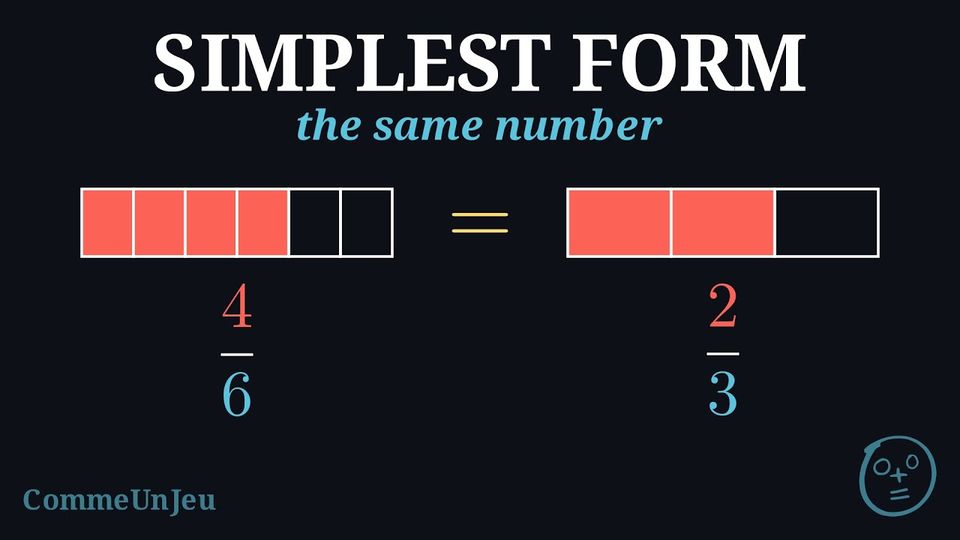
Definition — Equivalent Fractions
Equivalent fractions are fractions that represent the same numerical value, even though they are written differently.The fundamental rule for generating equivalent fractions is to multiply or divide both the numerator and the denominator by the same non-zero number.
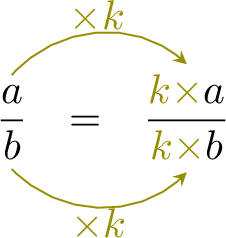
- When you multiply the numerator and the denominator by the same non-zero number (\(k\)), the fractions are equivalent:
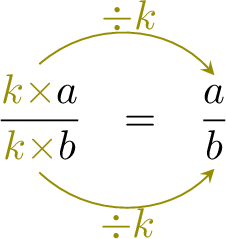
- When you divide the numerator and the denominator by a common factor (\(k\)), the fractions are equivalent. This process is also known as simplification.
Definition — Simplest Form of a Fraction
A fraction is considered to be in its simplest form (or lowest terms) when its numerator and denominator share no common factors other than 1. Example
- The fraction \(\frac{2}{3}\) is in simplest form because the only common factor of 2 and 3 is 1.
- The fraction \(\frac{4}{6}\) is not in simplest form because 4 and 6 share a common factor of 2. It can be simplified to the equivalent fraction \(\frac{2}{3}\).
Method — Procedure for Simplifying a Fraction
To simplify a fraction, the numerator and denominator must be divided by their highest common factor (HCF). This can be achieved by cancelling all common factors. Example
Simplify the fraction \(\dfrac{4}{6}\).
$$\begin{aligned}[t]\dfrac{4}{6} &= \dfrac{2 \times \textcolor{olive}{\cancel{2}}}{3 \times \textcolor{olive}{\cancel{2}}}\quad \text{(Cancel the common factor 2)}\\
&= \dfrac{2}{3}\end{aligned}$$
Method — Writing a Fraction in Simplest Form by Successive Simplifications
To write a fraction in simplest form: - Find a common factor of the numerator and the denominator — any one you can see (the divisibility criteria for \(2\), \(3\) and \(5\) help) — and divide both by it.
- Repeat with the fraction obtained, as long as the numerator and the denominator still have a common factor other than \(1\).
- When no common factor other than \(1\) is left, the fraction is in simplest form: it cannot be simplified any further.
Example
Write the fraction \(\dfrac{84}{126}\) in simplest form by successive simplifications.
$$\begin{aligned}[t]\dfrac{84}{126} &= \dfrac{42}{63} && \text{(Divide both by the common factor 2)} \\
&= \dfrac{14}{21} && \text{(Divide both by the common factor 3)} \\
&= \dfrac{2}{3} && \text{(Divide both by the common factor 7)}\end{aligned}$$ The numbers \(2\) and \(3\) have no common factor other than \(1\): the fraction \(\dfrac{2}{3}\) is in simplest form. Check: the successive divisors multiply to \(2 \times 3 \times 7 = 42\), and \(2 \times 42 = 84\), \(3 \times 42 = 126\).
Example
Express each quantity as a fraction of the other, in simplest form: - \(20\) minutes as a fraction of one hour;
- \(750\)~g as a fraction of \(2\)~kg.
The two quantities must first be written in the same unit; the fraction is then the first quantity divided by the second.
- One hour is \(60\) minutes: $$\begin{aligned}[t] \dfrac{20\text{ min}}{1\text{ h}}&=\dfrac{20\text{ min}}{60\text{ min}} &&\text{(same unit)}\\ &=\dfrac{20}{60}\\ &=\dfrac{1}{3} &&\text{(divide both by }20\text{)} \end{aligned}$$ \(20\) minutes is one third of an hour.
- Two kilograms is \(2\,000\)~g: $$\begin{aligned}[t] \dfrac{750\text{ g}}{2\text{ kg}}&=\dfrac{750\text{ g}}{2\,000\text{ g}} &&\text{(same unit)}\\ &=\dfrac{75}{200} &&\text{(divide both by }10\text{)}\\ &=\dfrac{3}{8} &&\text{(divide both by }25\text{)} \end{aligned}$$ Without the conversion, \(\dfrac{750}{2}\) would be greater than \(1\), although \(750\)~g is less than \(2\)~kg.
Skills to practice
- Writing in Simplest Form
- Expressing One Quantity as a Fraction of Another
- Writing in Simplest Form and Justifying
I.2
Cross-Multiplication: Testing Equal Fractions
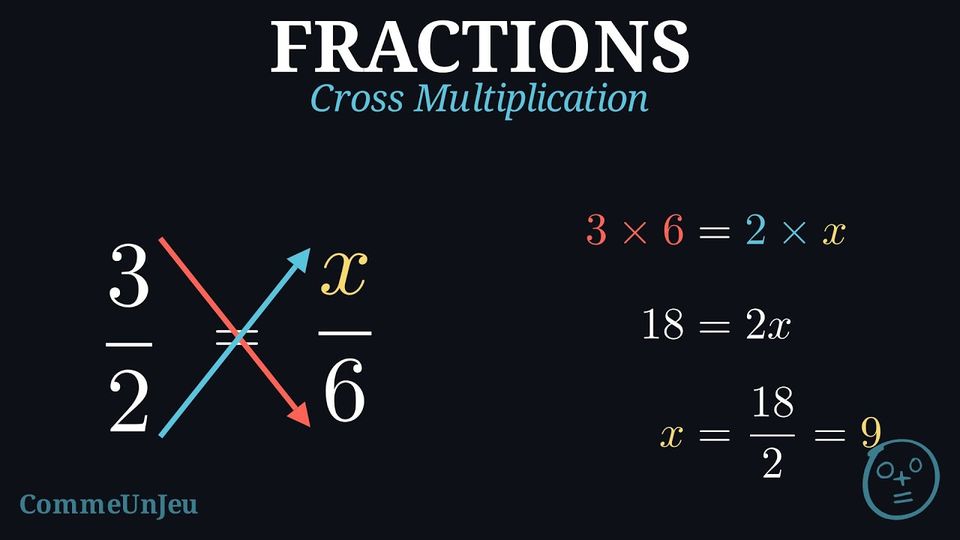
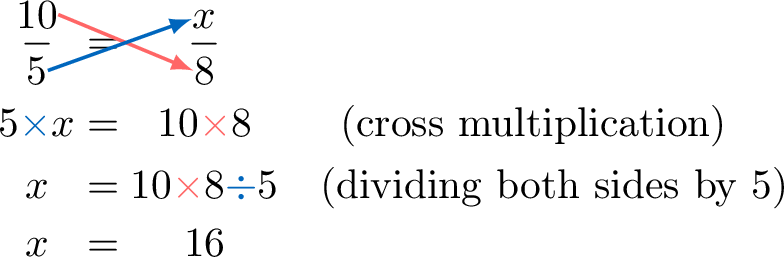
Proposition — Cross Multiplication Property
For any numbers \(a,b,c,d\) with \(b\neq 0\) and \(d\neq 0\), 
Why it works
Let \(a\) and \(c\) be whole numbers, and \(b\) and \(d\) non-zero whole numbers. Cut each part of size \(\dfrac{1}{b}\) into \(d\) equal pieces, and each part of size \(\dfrac{1}{d}\) into \(b\) equal pieces: every piece is now \(\dfrac{1}{b \times d}\) of the unit, and $$\frac{a}{b} = \frac{a \times d}{b \times d}, \qquad \frac{c}{d} = \frac{b \times c}{b \times d}.$$ Both fractions now count pieces of the same size, so they are equal exactly when they count the same number of pieces: $$\frac{a}{b} = \frac{c}{d} \quad \text{exactly when} \quad a \times d = b \times c.$$ This proves both directions at once.
Why it works
Here is why this works. Let \(b\neq0\) and \(d\neq0\), and start from $$\frac{a}{b} = \frac{c}{d}$$ Multiply both sides by the non-zero number \(b \times d\), then regroup the factors. By definition of the quotient, \(\dfrac{a}{b}\) is the number which, multiplied by \(b\), gives \(a\): so \(\dfrac{a}{b} \times b = a\), and likewise \(\dfrac{c}{d} \times d = c\). $$\begin{aligned}[t] \frac{a}{b} \times (b \times d) &= \frac{c}{d} \times (b \times d) && \text{(both sides multiplied by \(b \times d\))}\\
\Big(\frac{a}{b} \times b\Big) \times d &= \Big(\frac{c}{d} \times d\Big) \times b && \text{(factors regrouped)}\\
a \times d &= c \times b && \text{(definition of the quotient)} \end{aligned}$$ Conversely, if \(a \times d = b \times c\), dividing both sides by \(b \times d\), which is not zero, gives $$\frac{a \times d}{b \times d} = \frac{b \times c}{b \times d},$$ that is \(\dfrac{a}{b} = \dfrac{c}{d}\). The equality \(ad = bc\) is known as the cross-product. It provides a direct method for testing the equivalence of fractions and for solving for an unknown variable in a proportion. 
Skills to practice
- Testing Whether Two Fractions Are Equal with Cross Products
II
Adding and Subtracting Fractions
II.1
Unrelated Denominators
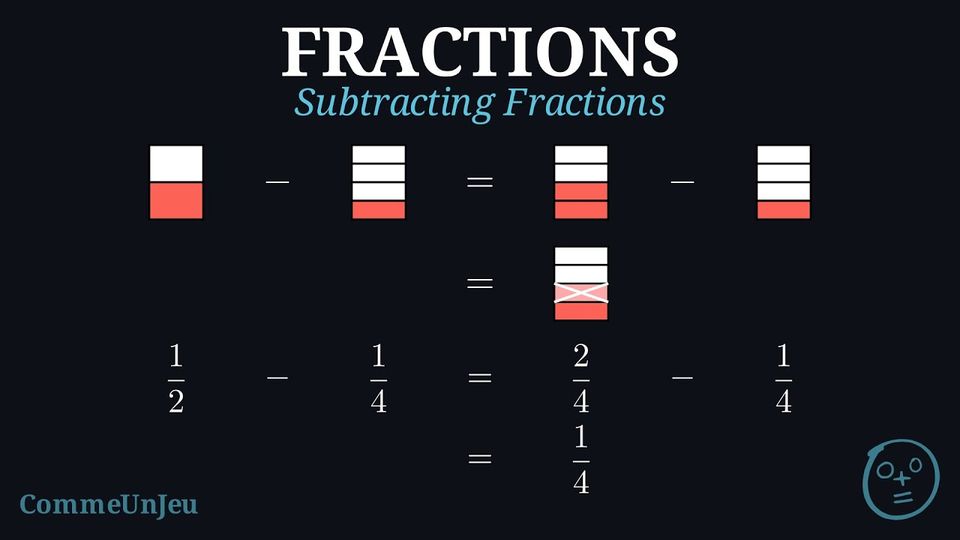
Definition — Addition and Subtraction of Fractions with Common Denominators
For any numbers \(a,b,c\) with \(c\neq 0\), - To add fractions with common denominators, the numerators are added, and the denominator is retained.$$\frac{a}{c} + \frac{b}{c} = \frac{a+b}{c}$$
- To subtract fractions with common denominators, the numerators are subtracted, and the denominator is retained.$$\frac{a}{c} - \frac{b}{c} = \frac{a-b}{c}$$
Method — Procedure for Adding or Subtracting Fractions
To add or subtract fractions with unlike denominators, follow this three-step procedure: - Find a Common Denominator: Identify a common multiple of the denominators.
- Create Equivalent Fractions: Convert each fraction to an equivalent fraction with the common denominator.
- Add or Subtract the Numerators: With the denominators now the same, perform the operation on the numerators and keep the common denominator. For a subtraction, the first fraction must not be smaller than the second.
Example
Calculate \(\dfrac{3}{4} + \dfrac{5}{6}\). - Find a common denominator: To add fractions, they must have the same denominator.
- Multiples of 4: 4, 8, 12, 16, 20, \(\dots\)
- Multiples of 6: 6, 12, 18, 24, \(\dots\)
- The smallest common denominator is 12.
- \(\begin{aligned}[t]\dfrac{3}{4}+\dfrac{5}{6}&= \frac{3 \times \textcolor{olive}{3}}{4 \times \textcolor{olive}{3}}+\frac{5 \times \textcolor{olive}{2}}{6 \times \textcolor{olive}{2}}&&\\&=\dfrac{9}{12}+\dfrac{10}{12}&&\quad\text{(common denominator}= 12)\\&=\dfrac{9+10}{12}&&\quad\text{(adding numerators)}\\&=\dfrac{19}{12}&&\\\end{aligned}\)
- Visual representation:
 \(+\)

\(=\)  \(+\)

\(=\) 
Example
Calculate \(\dfrac{5}{6} - \dfrac{3}{4}\).
Neither denominator is a multiple of the other: a common multiple of \(6\) and \(4\) is \(12\). $$\begin{aligned}[t] \dfrac{5}{6} - \dfrac{3}{4} &= \dfrac{5\times 2}{6\times 2} - \dfrac{3\times 3}{4\times 3} && \text{(common denominator 12)}\\
&= \dfrac{10}{12} - \dfrac{9}{12}\\
&= \dfrac{1}{12}. \end{aligned}$$
Example
Lucie walks \(\dfrac{1}{4}\) of the way to school, then \(\dfrac{2}{5}\) of the way more. What fraction of the way has she walked? What fraction is left?
The distance walked is the sum of the two fractions; a common multiple of \(4\) and \(5\) is \(20\): $$\dfrac{1}{4} + \dfrac{2}{5} = \dfrac{5}{20} + \dfrac{8}{20} = \dfrac{13}{20}.$$ The whole way is \(\dfrac{20}{20}\), so the remaining part is $$\dfrac{20}{20} - \dfrac{13}{20} = \dfrac{7}{20}.$$ Check: \(\dfrac{13}{20} + \dfrac{7}{20} = \dfrac{20}{20} = 1\).
Skills to practice
- Rewriting with the Lowest Common Denominator
- Adding and Subtracting with the Lowest Common Denominator
III
Multiplying Fractions
III.1
A Fraction Times a Number
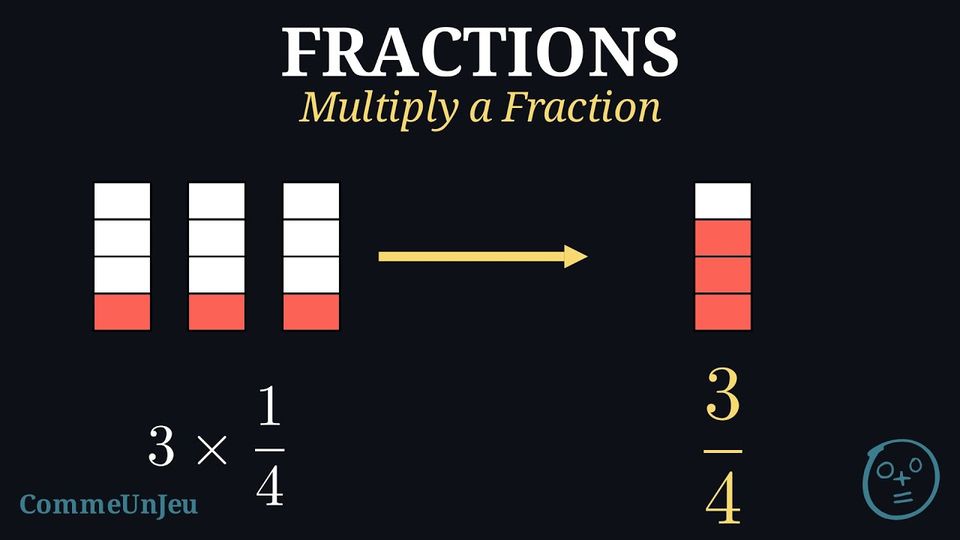
Definition — Multiplication of a Fraction by a Number
To multiply a fraction by a number, multiply the number by the numerator of the fraction, and retain the original denominator.For any numbers \(a,b,c\) with \(c\neq 0\),$$ a \times \frac{b}{c} = \frac{a \times b}{c} $$
Skills to practice
- Multiplying Fractions by Whole Numbers
III.2
The Product of Two Fractions
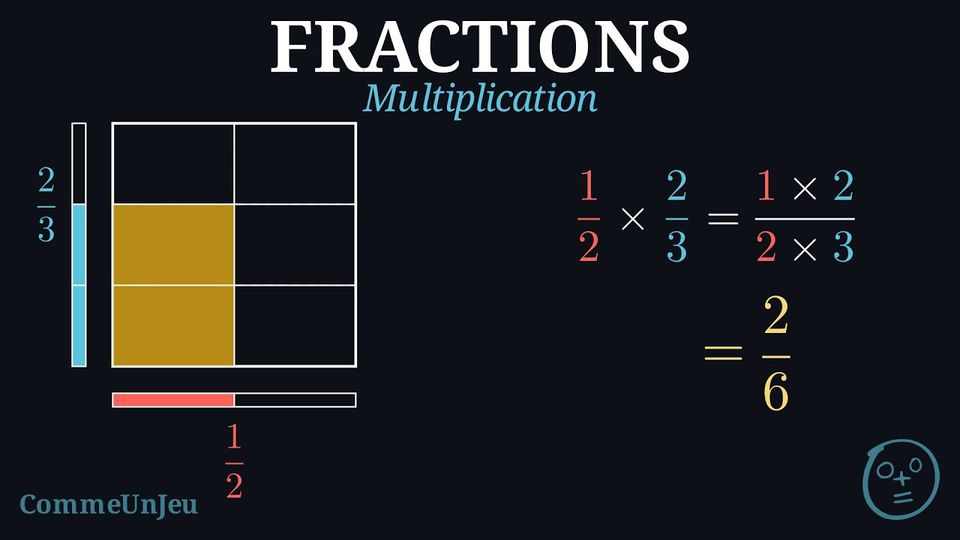
The multiplication of two fractions can be modelled by finding the area of a rectangle whose side lengths are given by those fractions. Consider the product \(\textcolor{colordef}{\dfrac{2}{3}} \times \textcolor{colorprop}{\dfrac{1}{2}}\). This corresponds to the area of the shaded rectangle within a unit square. 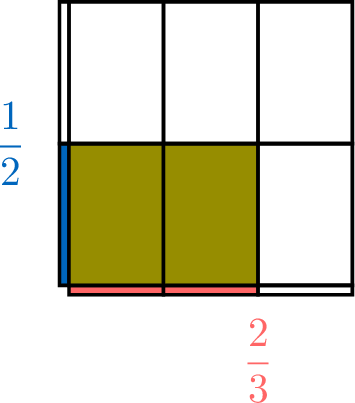
To determine the area of the shaded region, we observe the following:
- The unit square is partitioned into \(\textcolor{colordef}{3}\) columns and \(\textcolor{colorprop}{2}\) rows, resulting in a total of \(3 \times 2 = 6\) equal sub-rectangles. This determines the denominator of the resulting fraction.
- The shaded region covers \(\textcolor{colordef}{2}\) columns and \(\textcolor{colorprop}{1}\) row, comprising a total of \(2 \times 1 = \textcolor{olive}{2}\) of these sub-rectangles. This determines the numerator.
Definition — Multiplication of Fractions
To multiply two fractions, one must multiply the numerators to find the numerator of the product, and multiply the denominators to find the denominator of the product.For any numbers \(a,b,c,d\) with \(b\neq 0\) and \(d\neq 0\),$$\textcolor{colordef}{\frac{a}{b}} \times \textcolor{colorprop}{\frac{c}{d}} = \frac{\textcolor{colordef}{a} \times \textcolor{colorprop}{c}}{\textcolor{colordef}{b} \times \textcolor{colorprop}{d}}$$
Example
Calculate \( \dfrac{5}{2} \times \dfrac{3}{4}\).
Applying the rule for multiplication of fractions:$$\begin{aligned}[t]\dfrac{5}{2} \times \dfrac{3}{4} &= \dfrac{5 \times 3}{2 \times 4} \\
&= \dfrac{15}{8}\end{aligned}$$
Method — Simplification by Cancelling Common Factors
To simplify the multiplication process, any common factor that appears in both a numerator and a denominator can be cancelled out before performing the multiplication. This is a direct application of simplification. Example
Calculate \(\dfrac{31}{7} \times \dfrac{12}{31}\).
The number 31 is a factor in both a numerator and a denominator. It can be cancelled before multiplying.$$\begin{aligned}[t]\dfrac{31}{7} \times \dfrac{12}{31}&= \dfrac{\textcolor{colordef}{\cancel{31}} \times 12}{7 \times \textcolor{colordef}{\cancel{31}}} \quad \text{(Cancel the common factor 31)} \\
&= \dfrac{12}{7}\end{aligned}$$
Skills to practice
- Multiplying Fractions
- Solving Problems by Multiplying Fractions
IV
Dividing Fractions
IV.1
Reciprocals and Division
Method — How Many Halves in 3?
Dividing a whole number by a unit fraction answers the question how many of these parts fit in it? \(3 \div \dfrac{1}{2}\) asks: how many halves are there in \(3\)? On a number line graduated in halves, count the jumps of \(\dfrac{1}{2}\) from \(0\) to \(3\): 
Larger or Smaller?
Before calculating, predict the size of the result.
- \(3 \times \dfrac{2}{3} = 2\) is smaller than \(3\): less than a unit, taken \(3\) times, is less than \(3\).
- \(\dfrac{1}{2}\) of \(\dfrac{1}{3}\) is smaller than \(\dfrac{1}{3}\): half of a part is smaller than the part.
- \(3 \div \dfrac{1}{2} = 6\) is larger than \(3\): the pieces are smaller than a unit, so more than \(3\) of them fit.
The operation of division is formally defined as the inverse of multiplication by a non-zero number. To establish a procedure for dividing by a fraction, we must therefore utilise the concept of a multiplicative inverse. The multiplicative inverse is the value that “undoes” a multiplication, returning the result to the multiplicative identity, 1. This value is formally known as the reciprocal. Understanding the reciprocal is the necessary first step to developing the algorithm for fraction division.
Definition — Reciprocal
For any non-zero number \(x\), its reciprocal is the number which, when multiplied by \(x\), yields the multiplicative identity, 1. Proposition — Notation of the Reciprocal
For any non-zero number \(x\), its reciprocal is the quotient \(\dfrac{1}{x}\), since $$x \times \dfrac{1}{x} = 1.$$ Proposition — Reciprocal of a fraction
For a fraction \(\dfrac{a}{b}\) (where \(a\neq 0, b \neq 0\)), its reciprocal is the fraction \(\dfrac{b}{a}\).
The proof that \(\dfrac{b}{a}\) is the reciprocal of \(\dfrac{a}{b}\) is as follows:$$\begin{aligned}[t]\dfrac{a}{b} \times \dfrac{b}{a} &= \dfrac{a \times b}{b \times a} \\
&= \dfrac{ab}{ab} \\
&= 1\end{aligned}$$
Example
State the reciprocal of \(\dfrac{5}{7}\).
The reciprocal of \(\dfrac{5}{7}\) is \(\dfrac{7}{5}\).
Definition — Division of fractions
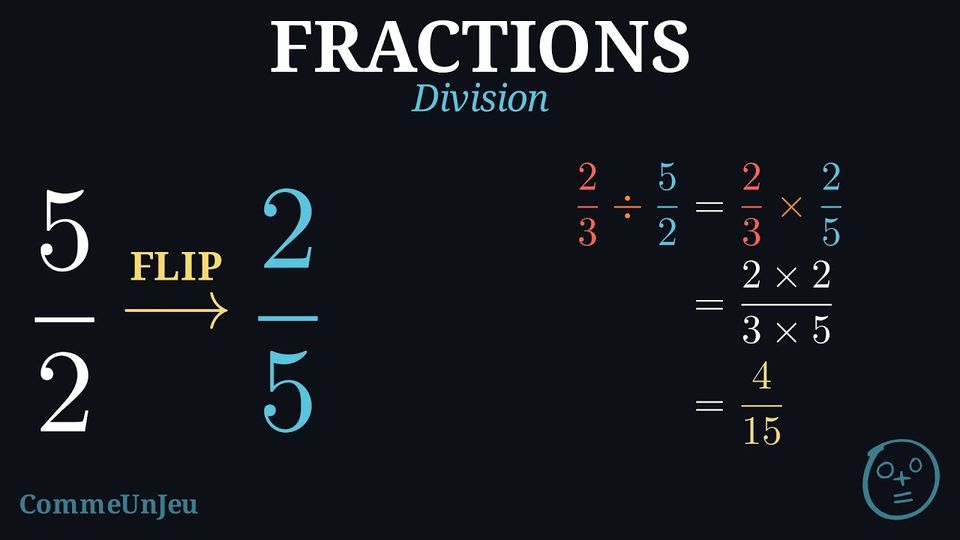
To divide by a fraction, multiply by its reciprocal.For any numbers \(a,b,c,d\) with \(b\neq 0, c\neq 0\) and \(d\neq 0\),$$\dfrac{a}{b} \div \dfrac{c}{d} = \dfrac{a}{b} \times \dfrac{d}{c}$$ Equivalently, for a complex fraction:$$\dfrac{\frac{a}{b}}{\frac{c}{d}} = \dfrac{a}{b} \times \dfrac{d}{c}$$
Why?
Dividing \(\dfrac{a}{b}\) by \(\dfrac{c}{d}\) asks for the number that, multiplied by \(\dfrac{c}{d}\), gives \(\dfrac{a}{b}\). The number \(\dfrac{a}{b} \times \dfrac{d}{c}\) works: $$\begin{aligned}[t]\left(\dfrac{a}{b} \times \dfrac{d}{c}\right) \times \dfrac{c}{d} &= \dfrac{a}{b} \times \left(\dfrac{d}{c} \times \dfrac{c}{d}\right) && \text{(grouping the factors)}\\
&= \dfrac{a}{b} \times 1 && \text{(\(\tfrac{d}{c}\) is the reciprocal of \(\tfrac{c}{d}\))}\\
&= \dfrac{a}{b}\end{aligned}$$ The divisor must not be zero: \(c \neq 0\). With a unit fraction, it is the question “how many halves are there in \(3\)?”: \(3 \div \dfrac{1}{2} = 3 \times 2 = 6\), since each unit holds \(2\) halves.
Example
Calculate \(\dfrac{2}{3} \div \dfrac{5}{7}\).
Applying the procedure for fraction division:$$\begin{aligned}[t]\frac{2}{3} \div \frac{5}{7} &= \frac{2}{3} \times \frac{7}{5} && \text{(Multiply by the reciprocal of the divisor)} \\
&= \frac{2 \times 7}{3 \times 5} && \text{(Multiply numerators and denominators)} \\
&= \frac{14}{15}\end{aligned}$$
Skills to practice
- Finding Reciprocals
- Dividing Fractions
V
Negative Fractions
V.1
Signs in Fractions
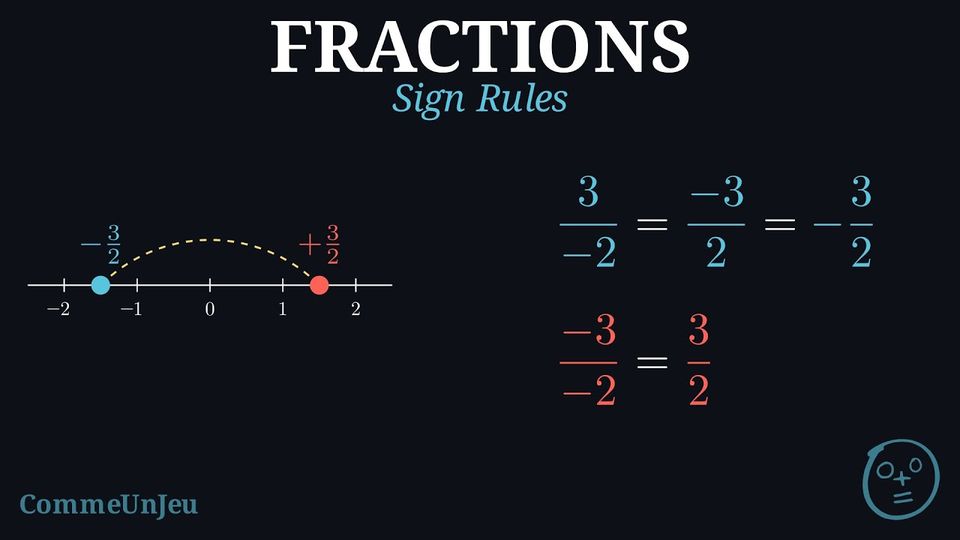
The sign of a fraction is determined by the rules of division for integers, as the fraction bar denotes division. Let us analyse the placement of a single negative sign.
Consider the division of \(-3\) by \(2\):$$\frac{-3}{2}=\overbrace{(-3)}^{\text{negative}} \div \overbrace{2}^{\text{positive}}=\overbrace{-\left(3\div 2\right)}^{\text{negative}}=-\frac{3}{2}$$ Now consider the division of \(3\) by \(-2\):$$\frac{3}{-2}=\overbrace{3}^{\text{positive}} \div \overbrace{(-2)}^{\text{negative}}=\overbrace{-\left(3\div 2\right)}^{\text{negative}}=-\frac{3}{2}$$ In both cases, the result is the same negative rational number, \(-\dfrac{3}{2}\). This demonstrates that a single negative sign in either the numerator or the denominator results in a negative fraction.
Consider the division of \(-3\) by \(2\):$$\frac{-3}{2}=\overbrace{(-3)}^{\text{negative}} \div \overbrace{2}^{\text{positive}}=\overbrace{-\left(3\div 2\right)}^{\text{negative}}=-\frac{3}{2}$$ Now consider the division of \(3\) by \(-2\):$$\frac{3}{-2}=\overbrace{3}^{\text{positive}} \div \overbrace{(-2)}^{\text{negative}}=\overbrace{-\left(3\div 2\right)}^{\text{negative}}=-\frac{3}{2}$$ In both cases, the result is the same negative rational number, \(-\dfrac{3}{2}\). This demonstrates that a single negative sign in either the numerator or the denominator results in a negative fraction.
Proposition — Properties of Signs in Fractions
For any numbers \(a,b\) with \(b\neq 0\), - A single negative sign can be placed with the numerator, with the denominator, or in front of the fraction; all three forms are equal. $$ \frac{-a}{b} = \frac{a}{-b} = -\frac{a}{b} $$
- Two negative signs (one in the numerator and one in the denominator) cancel each other out. $$ \frac{-a}{-b} = \frac{a}{b} $$
Example
Simplify the fraction \(\dfrac{-4}{-6}\).
The simplification follows these steps:$$\begin{aligned}[t]\frac{-4}{-6} &= \frac{4}{6} && \text{(Applying the sign rule: negative } \div \text{ negative } = \text{ positive)} \\
&= \frac{2 \times \cancel{2}}{3 \times \cancel{2}} && \text{(Factoring and cancelling the common factor of 2)} \\
&= \frac{2}{3}\end{aligned}$$
Opposite of a Rational Number
The opposite of a rational number is obtained by changing its sign: the opposite of \(\dfrac{a}{b}\) is \(-\dfrac{a}{b}\), because their sum is \(0\). By the sign properties above, it can also be written \(\dfrac{-a}{b}\) or \(\dfrac{a}{-b}\). The opposite of \(0\) is \(0\).
Example
Calculate \(-\dfrac{2}{3}\times\dfrac{5}{7}\) and \(\left(-\dfrac{3}{4}\right)\div\dfrac{2}{5}\).
The sign rules for signed numbers transfer to fractions: one negative factor gives a negative result. $$\begin{aligned} -\dfrac{2}{3}\times\dfrac{5}{7} &= -\dfrac{2\times5}{3\times7} && \text{(one negative factor: negative)}\\
&= \textcolor{colorprop}{-\dfrac{10}{21}.} \end{aligned}$$ Dividing means multiplying by the reciprocal: $$\begin{aligned} \left(-\dfrac{3}{4}\right)\div\dfrac{2}{5} &= -\dfrac{3}{4}\times\dfrac{5}{2}\\
&= \textcolor{colorprop}{-\dfrac{15}{8}.} \end{aligned}$$ 
Method — Writing with a Positive Denominator
Before comparing or adding rational numbers, each one is written with a positive denominator: - Spot a negative denominator;
- Change the two signs — that of the numerator and that of the denominator — which does not change the number: \(\dfrac{a}{-b} = \dfrac{-a}{b}\);
- Carry the sign in front of the fraction if it helps: \(\dfrac{-a}{b} = -\dfrac{a}{b}\).
Example
Compare \(-\dfrac{2}{3}\) and \(-\dfrac{3}{4}\), then \(-\dfrac{2}{3}\) and \(\dfrac{3}{4}\).
Both denominators are already positive. For two negative numbers, the one closer to zero is the larger, so the distances to zero are compared over the common denominator \(12\): $$\begin{aligned} \dfrac{2}{3} = \dfrac{8}{12} \quad\text{and}\quad \dfrac{3}{4} = \dfrac{9}{12}, && \text{(common denominator)}\\
\dfrac{8}{12} < \dfrac{9}{12} \quad\text{so}\quad -\dfrac{2}{3} > -\dfrac{3}{4}. && \text{(the order is reversed by the sign)} \end{aligned}$$ The second pair needs no computation: a negative number is smaller than a positive one, so \(-\dfrac{2}{3} < \dfrac{3}{4}\). 
Example
Calculate \(\dfrac{2}{3} - \dfrac{3}{4}\), then \(-\dfrac{2}{3} - 2\), then \(-\dfrac{2}{3} - \left(-\dfrac{4}{3}\right)\).
Adding and subtracting work as before; only the numerators carry the signs, and a subtraction is read as adding the opposite. $$\begin{aligned} \dfrac{2}{3} - \dfrac{3}{4} &= \dfrac{8}{12} - \dfrac{9}{12} && \text{(common denominator)}\\
&= \dfrac{8-9}{12} && \text{(same denominator)}\\
&= \textcolor{colorprop}{-\dfrac{1}{12}.} && \text{(the result may be negative)} \end{aligned}$$ The condition met with positive fractions, that the first fraction must not be smaller than the second, is no longer needed: with negative numbers, every subtraction has a result. $$\begin{aligned} -\dfrac{2}{3} - 2 &= -\dfrac{2}{3} - \dfrac{6}{3} && \left(2 = \dfrac{6}{3}\right)\\
&= \dfrac{-2-6}{3} = \textcolor{colorprop}{-\dfrac{8}{3}.} \end{aligned}$$ $$\begin{aligned} -\dfrac{2}{3} - \left(-\dfrac{4}{3}\right) &= -\dfrac{2}{3} + \dfrac{4}{3} && \text{(subtracting is adding the opposite)}\\
&= \dfrac{-2+4}{3} = \textcolor{colordef}{\dfrac{2}{3}.} && \text{(taking away a negative makes bigger)} \end{aligned}$$
Skills to practice
- Simplifying with Signed Numbers
- Finding the Opposite of a Signed Fraction
- Comparing Signed Fractions
- Operating with Signed Fractions
- Multiplying and Dividing Signed Fractions
- Finding Reciprocals of Signed Numbers
VI
Calculations with Fractions
VI.1
The Fraction Bar in the Order of Operations
Proposition — The Fraction Bar as a Grouping Symbol
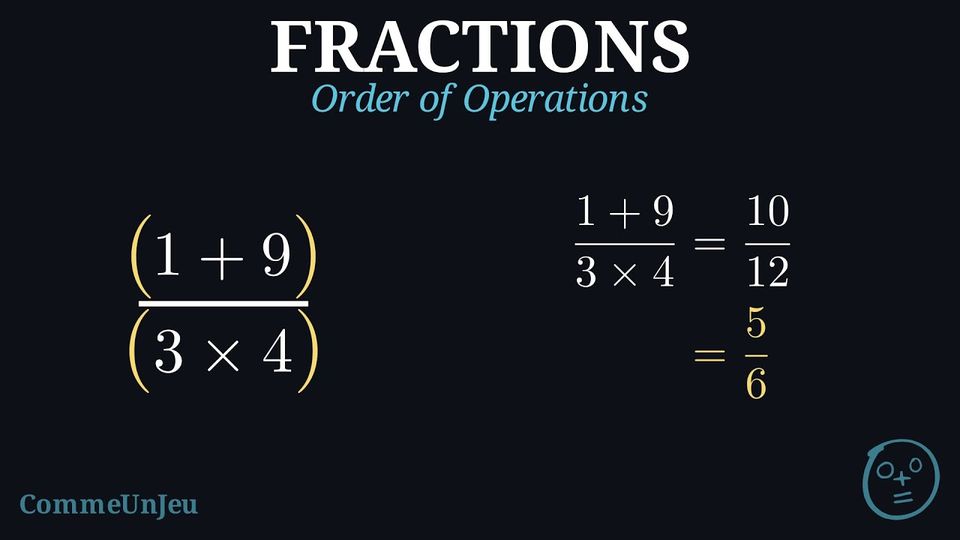
In the order of operations, the fraction bar functions as a grouping symbol for both the entire numerator and the entire denominator. This means that any expressions in the numerator and denominator must be fully evaluated to a single value before the final division, represented by the fraction itself, is considered.The expression \(\dfrac{A}{B}\) is mathematically equivalent to \((A) \div (B)\), where the value of \(B\) is not zero.
Therefore, the procedure is as follows:
- Evaluate the entire expression in the numerator.
- Evaluate the entire expression in the denominator.
- Simplify the resulting fraction, if possible.
Example
Simplify the expression \(\dfrac{1+7}{3\times 4}\).
Applying the order of operations for fractions:$$\begin{aligned}[t]\frac{1+7}{3\times 4} &= \frac{(1+7)}{(3\times 4)} && \text{(Recognise the implicit grouping)} \\
&= \frac{8}{12} && \text{(Evaluate the numerator and denominator)} \\
&= \frac{2 \times \cancel{4}}{3 \times \cancel{4}} && \text{(Simplify by cancelling the common factor 4)} \\
&= \frac{2}{3}\end{aligned}$$
Example
Calculate and give the result in simplest form: \(B = \dfrac{5}{6} - \dfrac{1}{6} \times 2\).
$$\begin{aligned}[t]B &= \dfrac{5}{6} - \dfrac{2}{6} && \text{(Multiplication first)} \\
&= \dfrac{3}{6} && \text{(Subtract the numerators)} \\
&= \dfrac{1}{2} && \text{(Divide both by 3)}\end{aligned}$$ The numbers \(1\) and \(2\) have no common factor other than \(1\): the result \(\dfrac{1}{2}\) is in simplest form.
In every calculation with fractions, the final result is expected in simplest form. Simplify at the very end — or better, simplify along the way, before multiplying: the numbers stay smaller.
Skills to practice
- Evaluating Expressions with Fractions
- Calculating and Giving the Result in Simplest Form
VII
Going further
Skills to practice
- Writing Out Fraction Calculations
- Solving Problems with Fractions
- Investigating Patterns in Fraction Calculations
- Spotting a Wrong Sum
- Quiz
Jump to section