International Baccalaureate · PYP 5
Percentages and Ratios
I
Percentages
I.1
What Is a Percentage?
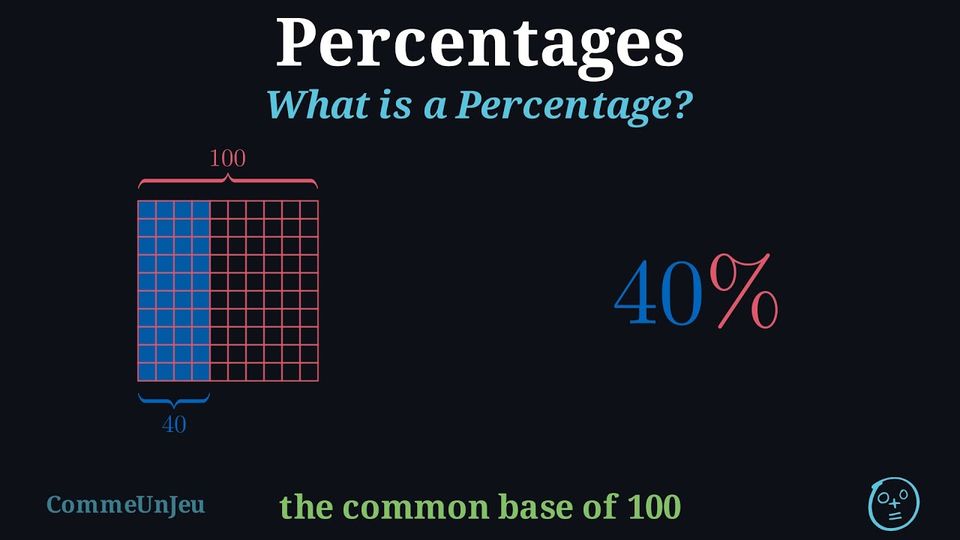
Definition — Percentage
A percentage is a way of writing a fraction with denominator \(100\): \(42\pourcent\) is \(\dfrac{42}{100}\), that is \(42\) out of \(100\).The symbol \(\pourcent\) means “percent”, which comes from the phrase “per centum”, meaning “out of one hundred”.
Example
This grid has 100 squares. Since \(\textcolor{colorprop}{23}\) out of \(\textcolor{colordef}{100}\) squares are coloured, we say that \(\textcolor{colorprop}{23}\textcolor{colordef}{\pourcent}\) of the grid is coloured. 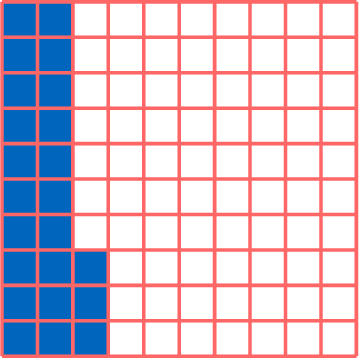
Skills to practice
- Converting Fraction Models to Percentages
I.2
Converting Between Forms
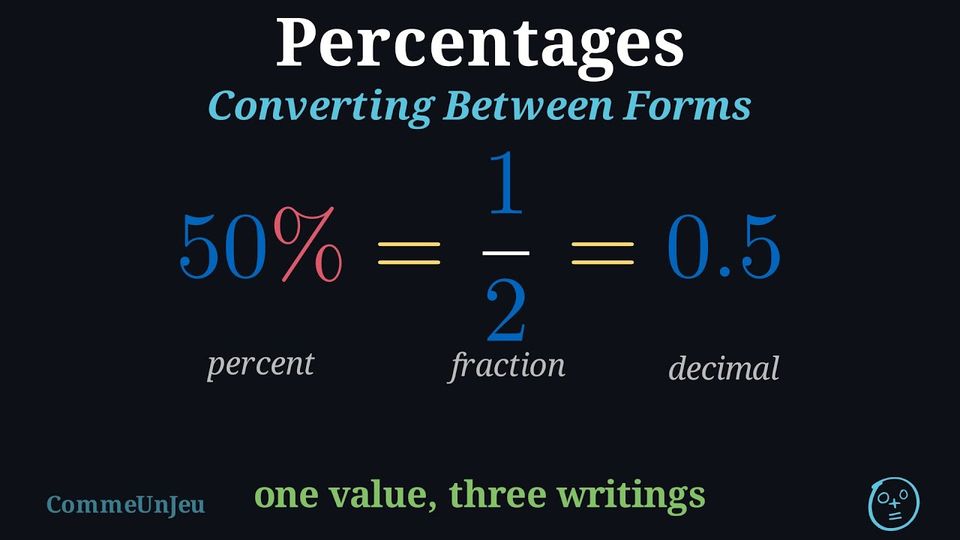
Percentages, fractions, and decimals are three different ways to talk about the same value. For example, \(\textcolor{colorprop}{50}\textcolor{colordef}{\pourcent}\), the fraction \(\dfrac{\textcolor{colorprop}{1}}{\textcolor{colordef}{2}}\), and the decimal \(0.5\) all mean “half”. Being able to convert between these forms is a very useful skill.
Remark: A very important idea is that \(100\pourcent = \dfrac{100}{100} = 1\).
Since \(100\pourcent\) is just another way of writing the number \(1\), you can multiply any number by \(100\pourcent\) without changing its value. This is a very useful trick for converting decimals and fractions into percentages.
Method — Percentage to Fraction
To convert a percentage to a fraction, write it as a fraction over 100, then simplify if possible. 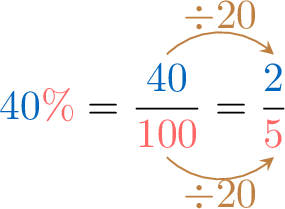
Method — Fraction to Percentage
To convert a fraction like \(\dfrac{\textcolor{colorprop}{3}}{\textcolor{colordef}{4}}\) to a percentage, you have two common methods: - Method 1: Equal Fractions. Find an equal fraction with denominator \(100\) (when possible, in particular when the denominator divides \(100\); it is not possible for \(\dfrac{1}{3}\)).
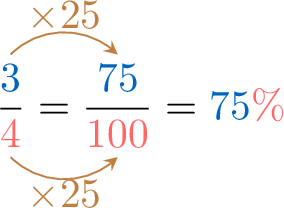
- Method 2: Multiply by \(100\pourcent\). This works because multiplying by \(100\pourcent\) is the same as multiplying by 1. $$ \begin{aligned} \dfrac{\textcolor{colorprop}{3}}{\textcolor{colordef}{4}} &= 0.75 \quad (\text{since } 3 \div 4 = 0.75) \\ &= 0.75 \times \textcolor{colordef}{100\pourcent} \\ &= \textcolor{colorprop}{75}\textcolor{colordef}{\pourcent} \end{aligned} $$
Method — Percentage to Decimal
To convert a percentage to a decimal, divide by 100. A quick way to do this is to move the decimal point two places to the left. $$ \textcolor{colorprop}{45}\textcolor{colordef}{\pourcent} = \textcolor{colorprop}{45} \div \textcolor{colordef}{100} = 0.45 $$ Method — Decimal to Percentage
To convert a decimal to a percentage, multiply by 100. A quick way to do this is to move the decimal point two places to the right and add the percent sign (\(\pourcent\)). $$ 0.68 = 0.68 \times 100\pourcent = \textcolor{colorprop}{68}\textcolor{colordef}{\pourcent} $$ Method — Percentages to Know by Heart
Some percentages are fractions in disguise, and their value is found by a division: - \(50\pourcent = \dfrac{50}{100} = \dfrac{1}{2}\): half — divide by \(2\);
- \(25\pourcent = \dfrac{1}{4}\): a quarter — divide by \(4\); \(75\pourcent = \dfrac{3}{4}\): three quarters;
- \(10\pourcent = \dfrac{1}{10}\): a tenth — divide by \(10\); \(20\pourcent = \dfrac{1}{5}\): a fifth — divide by \(5\);
- \(5\pourcent\) is half of \(10\pourcent\); \(100\pourcent\) is the whole quantity.
Example
Compute mentally: \(25\pourcent\) of \(32\), \(10\pourcent\) of \(250\), \(75\pourcent\) of \(4\), \(5\pourcent\) of \(60\).
$$\begin{aligned}[t] 25\pourcent \text{ of } 32 &= 32 \div 4 = 8 &&\text{(a quarter)}\\
10\pourcent \text{ of } 250 &= 250 \div 10 = 25 &&\text{(a tenth)}\\
75\pourcent \text{ of } 4 &= 3 \times (4 \div 4) = 3 &&\text{(three quarters)}\\
5\pourcent \text{ of } 60 &= 6 \div 2 = 3 &&\text{(half of } 10\pourcent \text{ of } 60\text{)} \end{aligned}$$
Skills to practice
- Converting Percentages into Fractions
- Converting Fractions into Percentages
- Converting Fractions to Percentages with Bar Models
- Converting Percentages into Decimals
- Converting Decimals into Percentages
- Calculating a Percentage Mentally
II
Ratios
II.1
What Is a Ratio?
Definition — Ratio
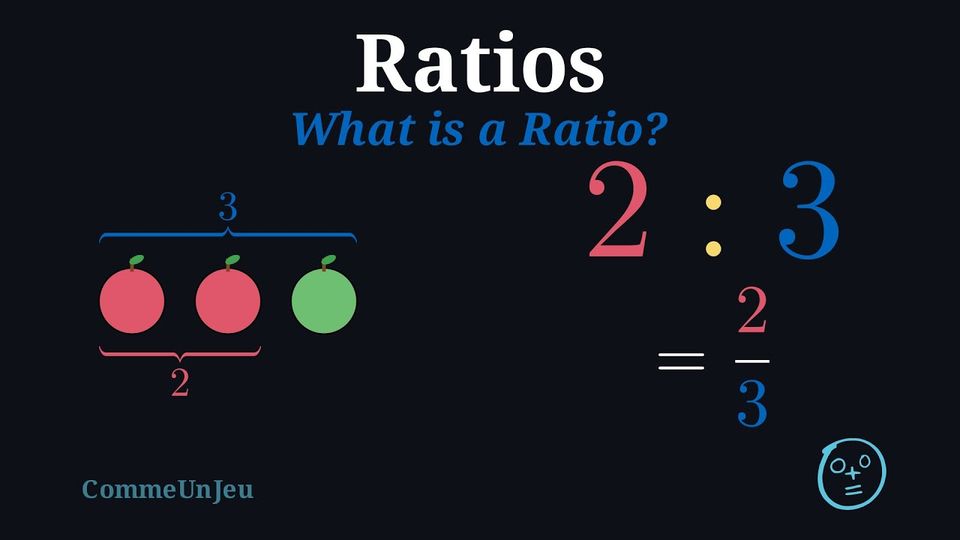
A ratio is a comparison of two quantities. The ratio of \(\textcolor{colordef}{2}\) to \(\textcolor{colorprop}{3}\) is written \(\textcolor{colordef}{2}:\textcolor{colorprop}{3}\) (read “\(2\) to \(3\)”). Skills to practice
- Expressing Ratios in Different Forms
II.2
Part-to-Part Ratios
Definition — Part-Part Ratio
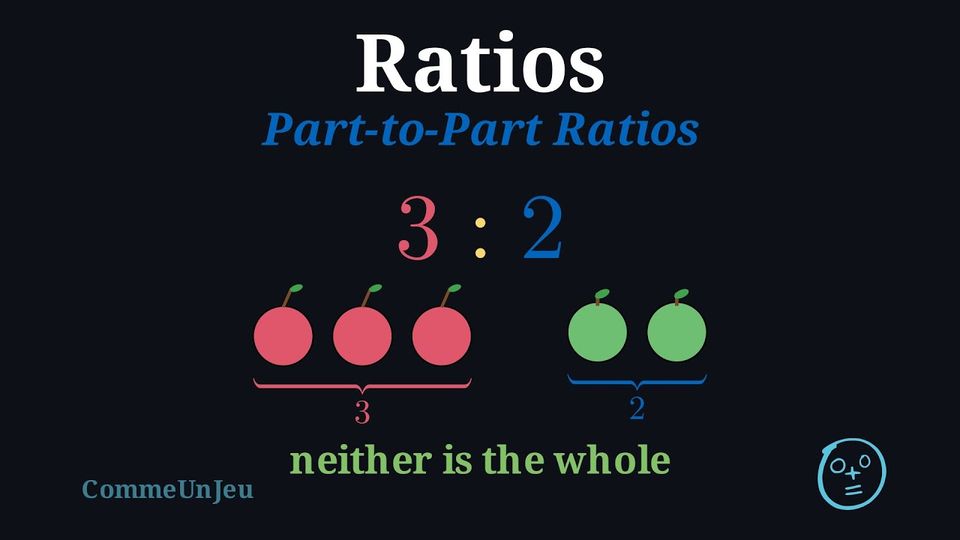
A part-part ratio compares two distinct parts of a whole.$$\textcolor{colordef}{\text{Part 1}}:\textcolor{colorprop}{\text{Part 2}}$$ 
Example
A fruit bowl contains 3 cherries and 2 apples. What is the ratio of cherries to apples? 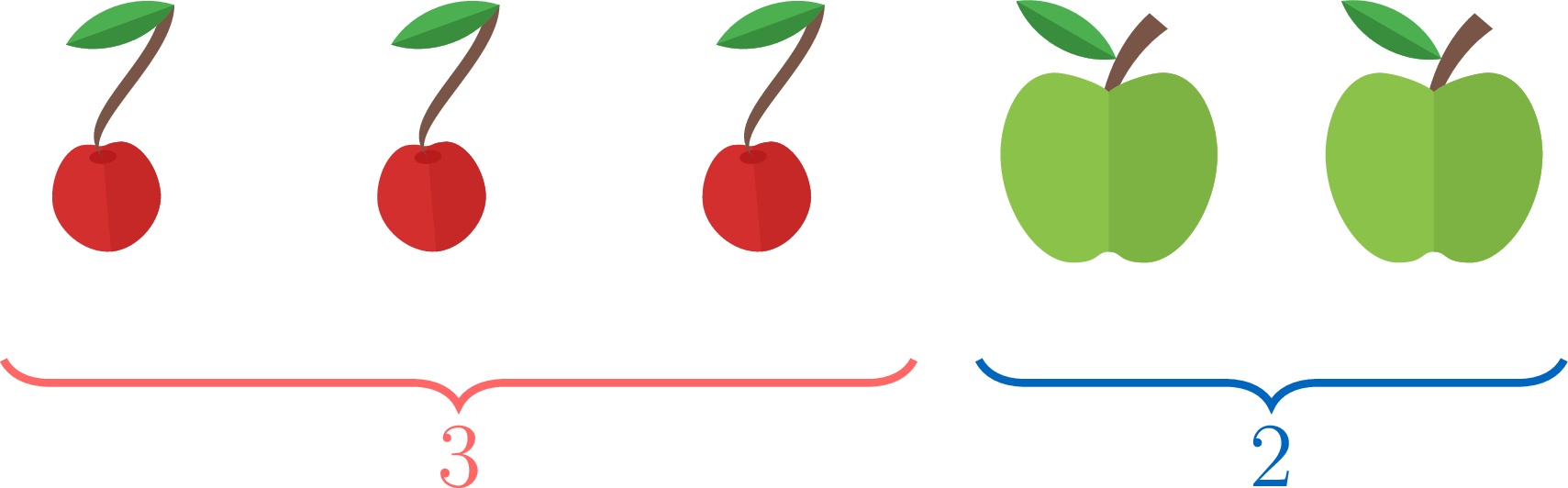
The ratio of cherries to apples is \(\textcolor{colordef}{3}:\textcolor{colorprop}{2}\). This compares the two parts of the fruit collection to each other.
Skills to practice
- Finding Ratios in Part-Part Relationships
II.3
Part-Whole Ratios
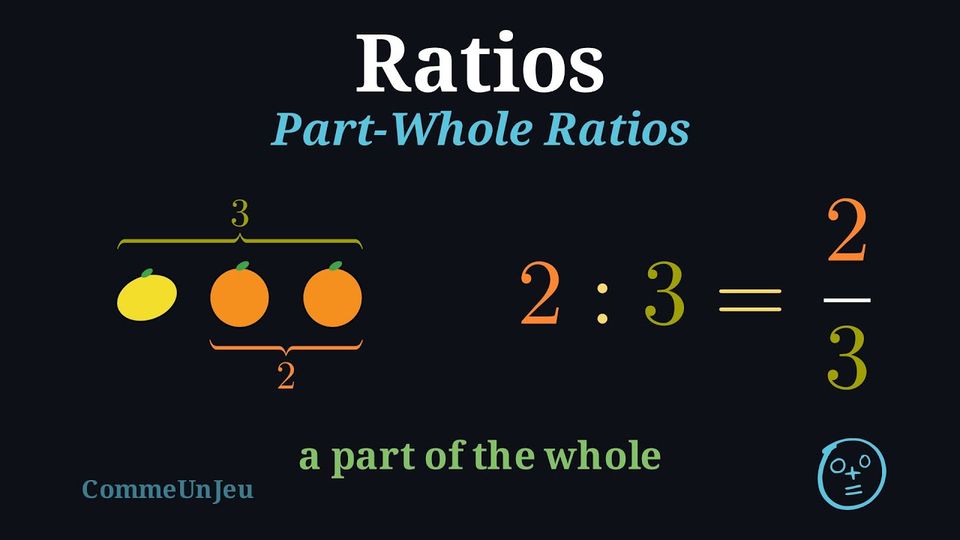
Definition — Part-Whole Ratio
A part-whole ratio compares one part of a whole to the whole.$$\textcolor{colordef}{\text{Part 1}}:\textcolor{olive}{\text{Whole}}\text{ or }\textcolor{colorprop}{\text{Part 2}}:\textcolor{olive}{\text{Whole}}$$ 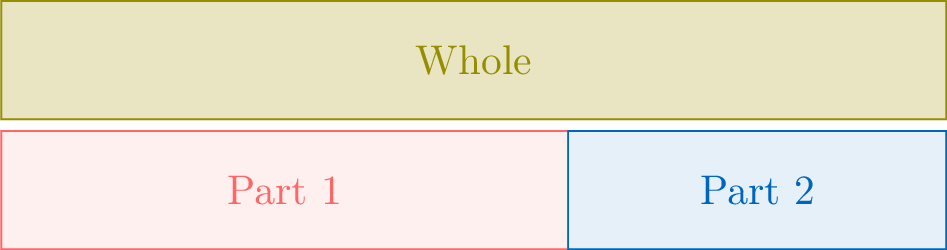
Example
A juice is made with 1 lemon and 2 oranges. What is the ratio of oranges to the total number of fruits? 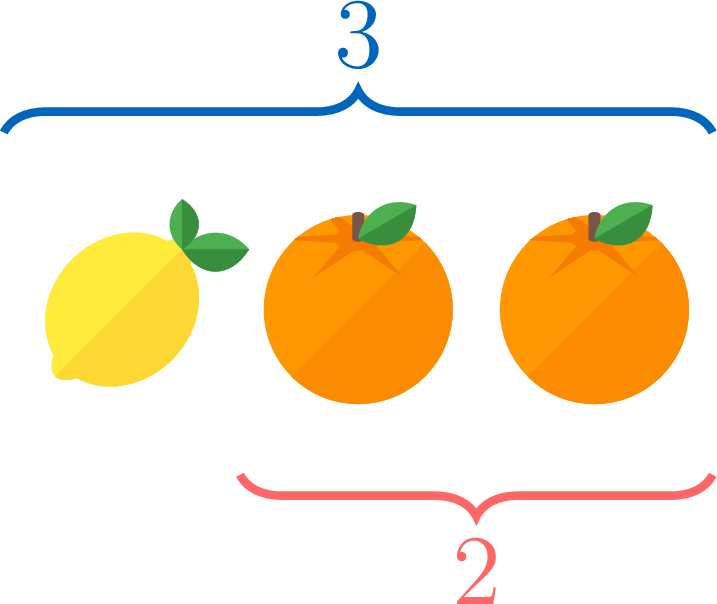
- First, determine the total number of fruits. The total is \(1 + 2 = 3\) fruits.
- The ratio of oranges (the part) to the total number of fruits (the whole) is \(\textcolor{orange}{2}:3\).
- This part-to-whole ratio can also be expressed as the fraction \(\dfrac{\textcolor{orange}{2}}{3}\).
Always ask what is compared
The same notation \(a:b\) can mean two different things, so always ask what is compared to what.
- In the part-part ratio cherries: apples \(= \textcolor{colordef}{3}:\textcolor{colorprop}{2}\), the fraction \(\dfrac{3}{2}\) is \(\text{cherries} \div \text{apples}\) (there are \(\tfrac{3}{2}\) as many cherries as apples). It is not a part of the whole: the cherries are \(\dfrac{3}{3+2} = \dfrac{3}{5}\) of the fruit.
- In the part-whole ratio oranges: total \(= \textcolor{orange}{2}:3\), the fraction \(\dfrac{2}{3}\) is the part of the whole: the oranges are \(\dfrac{2}{3}\) of the fruit.
Skills to practice
- Finding Ratios in Part-Whole Relationships
II.4
Equivalent Ratios
Definition — Equivalent Ratios
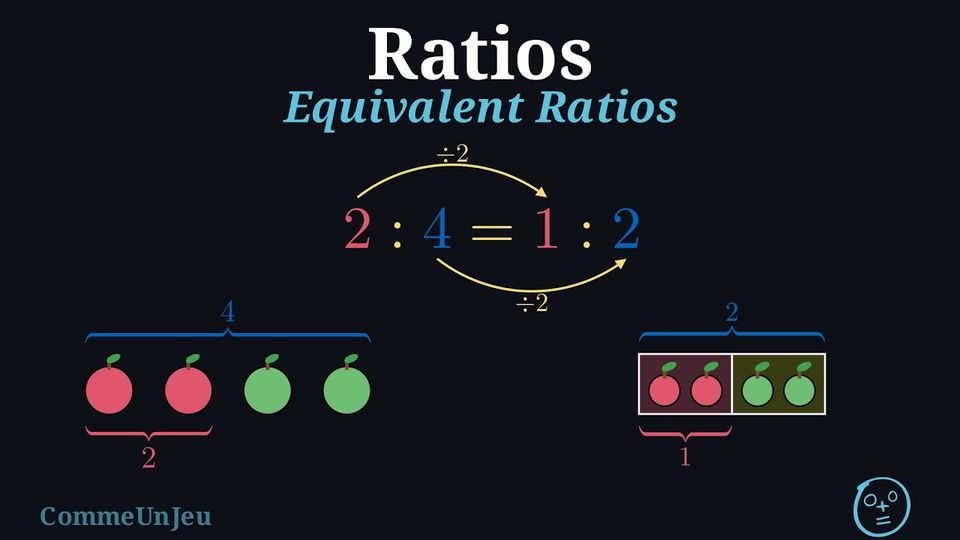
Two ratios are equivalent if they represent the same relationship. You can find equivalent ratios by multiplying or dividing both parts of the ratio by the same nonzero number. Example
The ratio of red apples to all apples is \(\dfrac{2}{4}\), which is equivalent to \(\dfrac{1}{2}\) (half of the apples are red). 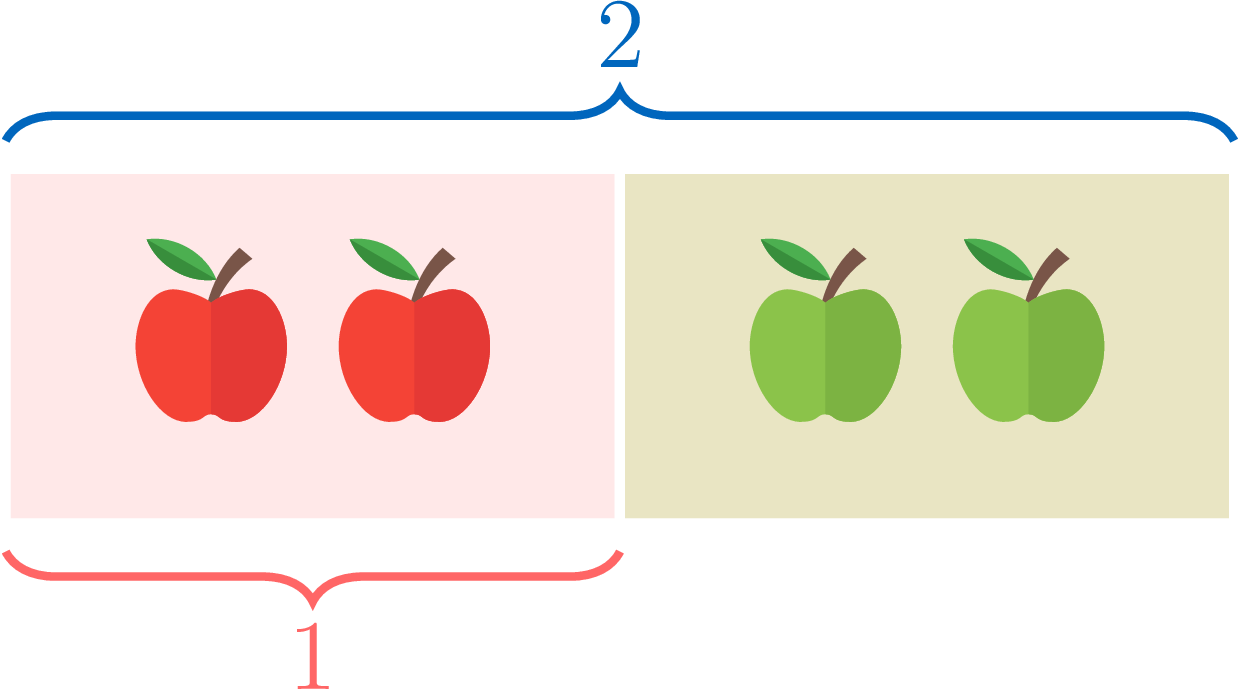
Method — Using Fractions
To check if two ratios are equivalent, we can compare their fractions. If the fractions are equivalent, then the ratios are equivalent. Example
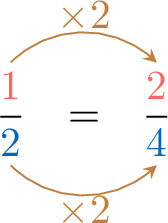 , the ratios are equivalent: \(\textcolor{colordef}{1}:\textcolor{colorprop}{2}=\textcolor{colordef}{2}:\textcolor{colorprop}{4}\)
Skills to practice
- Multiplying the Ratios
- Finding the Missing Value
- Simplifying Ratios
III
Going further
Skills to practice
- Converting between Percentages and Fractions
- Using and Comparing Ratios
- Quiz
Jump to section