International Baccalaureate · PYP 5
Fractions: equivalence and comparison
I
Fractions Greater than One
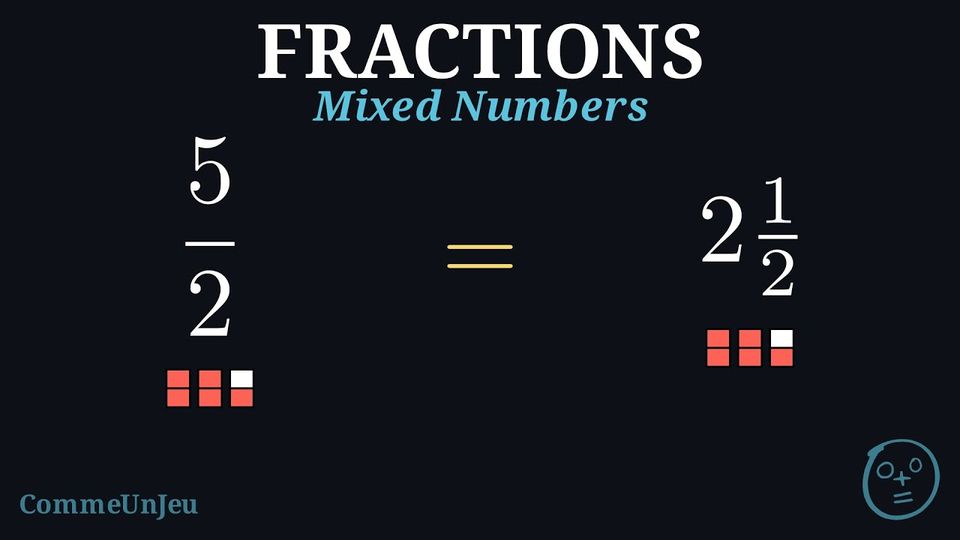
Fractions can represent values greater than one. Consider the fraction \(\dfrac{5}{2}\), which represents 5 half-sized parts of a unit. 
While this “improper fraction” is a valid mathematical representation, it is often more intuitive to express such numbers as a combination of whole units and a remaining fractional part.
Definition — Proper and Improper Fractions
Fractions are classified based on the relationship between the numerator and the denominator. - A proper fraction is a fraction where the numerator is less than the denominator. Its value is always less than 1. Example: \(\dfrac{2}{3}\).
- An improper fraction is a fraction where the numerator is greater than or equal to the denominator. Its value is always greater than or equal to 1. Example: \(\dfrac{5}{3}\).
Proposition — Whole Number Plus a Fraction
Every fraction greater than \(1\) can be written as the sum of a whole number and a fraction less than \(1\); conversely, the sum of a non-zero whole number and a non-zero fraction less than \(1\) is a fraction greater than \(1\): 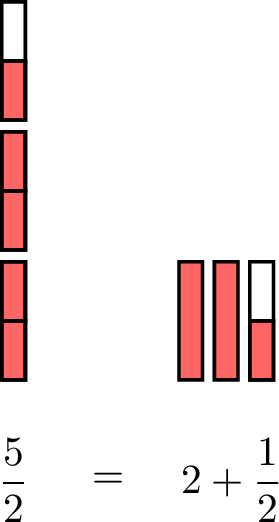
Definition — Mixed Number
A mixed number is an alternative way to represent an improper fraction. It consists of an integer part (the number of whole units) and a proper fraction part.The improper fraction \(\dfrac{5}{2}\) can be visualised as two whole units and one half.
Method — Decomposing a Fraction Greater Than 1
To write \(\dfrac{n}{b}\) as a whole number plus a fraction less than \(1\): - Count the whole units: each whole unit is made of \(b\) parts, so divide with remainder: \(n = q \times b + r\), with a remainder \(r\) smaller than \(b\).
- The \(r\) remaining parts form the fraction: \(\dfrac{n}{b} = q + \dfrac{r}{b}\), and \(\dfrac{r}{b} < 1\) because \(r < b\).
Example
Write \(\dfrac{7}{3}\) as the sum of a whole number and a fraction less than \(1\).
\(\begin{aligned}[t]\dfrac{7}{3}&=\dfrac{2\times 3+1}{3}&&(\text{division of 7 by 3: } 7=2\times 3+1)\\&=\dfrac{2\times 3}{3}+\dfrac{1}{3}\\&=2+\dfrac{1}{3}\\\end{aligned}\) 
Method — Placing a Fraction Between Two Whole Numbers
Once a fraction greater than \(1\) is written as a whole number plus a fraction less than \(1\), its place on the number line is settled: the whole number is the one just below, and the next whole number is just above. $$\dfrac{7}{3} = 2 + \dfrac{1}{3} \qquad\text{so}\qquad 2 < \dfrac{7}{3} < 3$$ 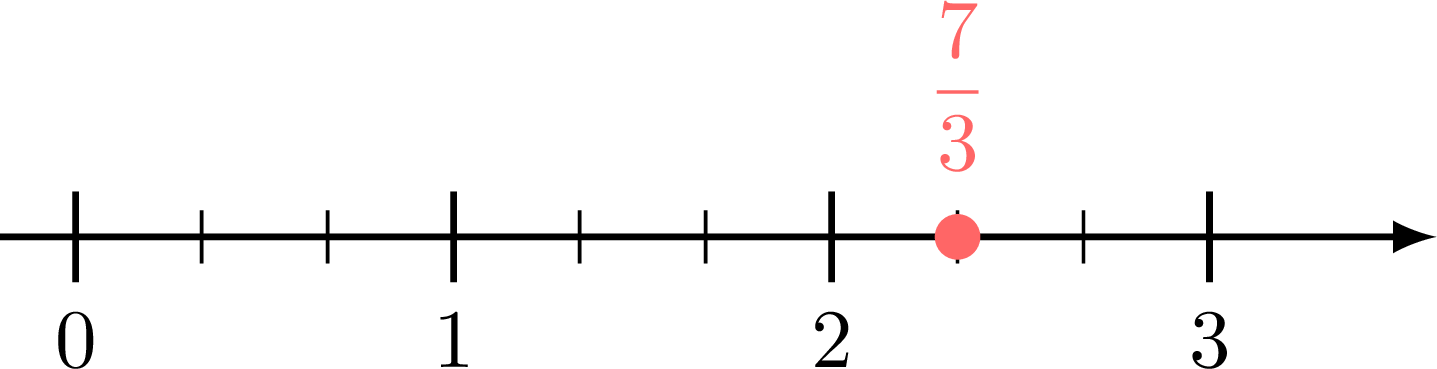
Example
Place \(\dfrac{29}{4}\) between two consecutive whole numbers.
$$\begin{aligned}[t] 29 &= 7 \times 4 + 1 && \text{(division with remainder by the denominator)} \\
\dfrac{29}{4} &= 7 + \dfrac{1}{4} && \text{(the 7 whole units, then the remaining part)} \\
7 &< \dfrac{29}{4} < 8 && \text{(the remainder is not zero)} \end{aligned}$$
Skills to practice
- Decomposing Fractions in Everyday Situations
- Solving Problems with Whole Numbers Plus Fractions
II
Equivalent Fractions
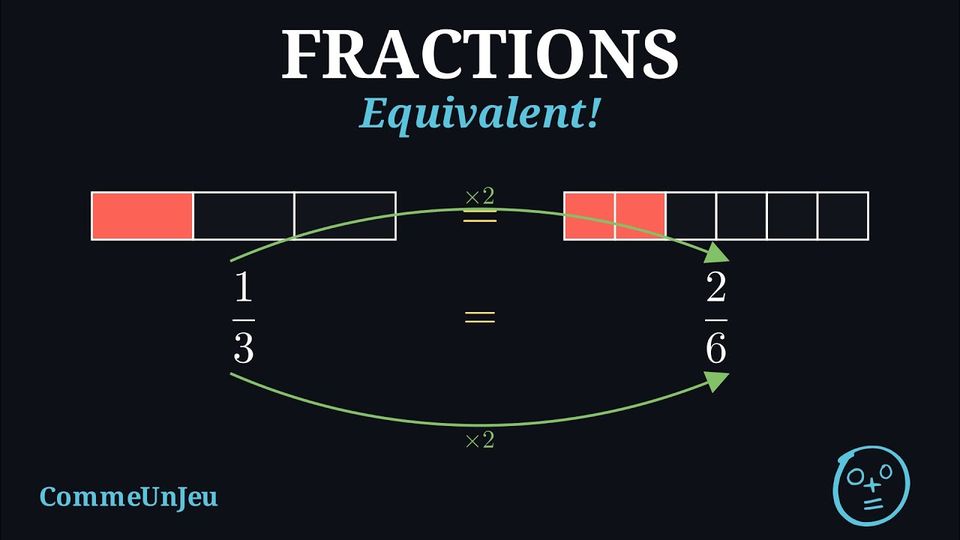
A cake is cut into 3 equal parts. One part, representing \(\dfrac{1}{3}\) of the cake, is set aside. 
Then each of the three parts is cut in half. Now the cake is divided into 6 equal parts. The same amount of cake as before is now 2 of these parts. 
Even though the number of pieces changed, did the shaded amount of cake change?
No—the amount of cake did not change. The models show that the shaded portion is the same in both cases. \(\quad=\quad\) Therefore, the fractions \(\dfrac{1}{3}\) and \(\dfrac{2}{6}\) represent the same value.
\(\quad=\quad\)Definition — Equivalent Fractions
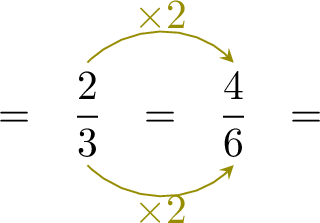
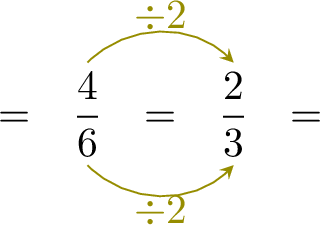
Two fractions are equivalent if they represent the same amount. You get an equivalent fraction by cutting every part into the same number of smaller parts: the numerator and the denominator are multiplied by that number. Grouping the parts back does the opposite: both are divided by the same number, which must divide the numerator and the denominator exactly. 

Method — Recognising Equivalent Fractions
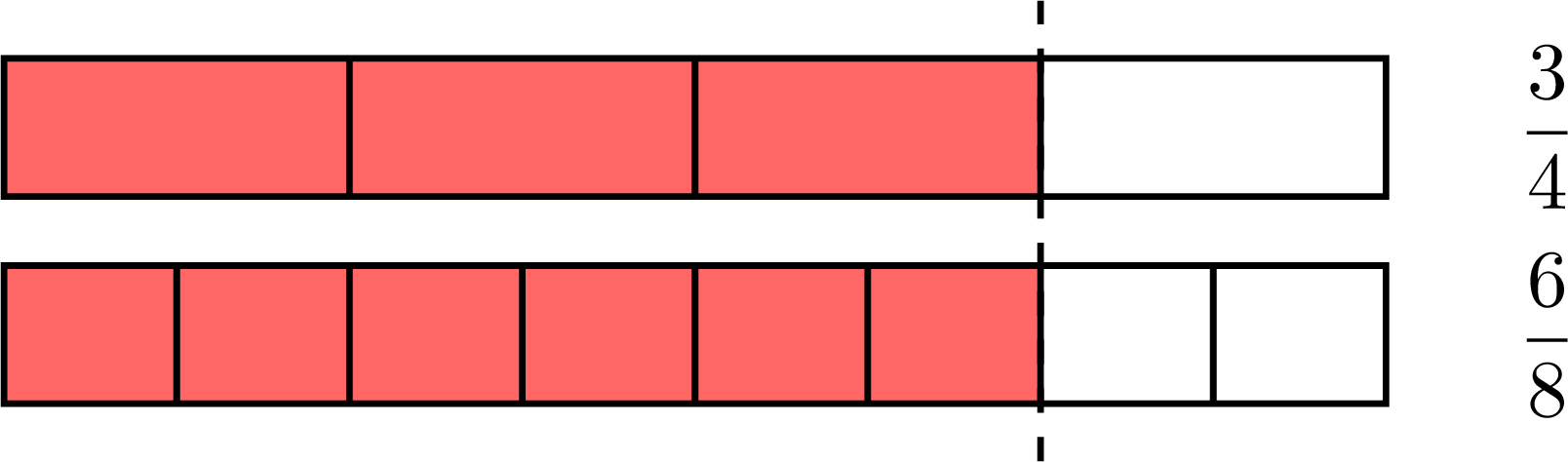
Two fractions are equivalent when they are the same amount of the same unit: on two identical bars, they cover the same length. - Say it. “If, for the same unit, I make parts twice as small and I take twice as many parts, then I take the same amount.” Quarters cut in two give eighths: \(\dfrac{3}{4} = \dfrac{6}{8}\).
- See it on two identical bars. The first bar is cut into quarters, the second into eighths: \(\dfrac{3}{4}\) and \(\dfrac{6}{8}\) cover the same length.
- Find a missing numerator. \(\dfrac{?}{8} = \dfrac{1}{2}\): eighths are \(4\) times smaller than halves, so take \(4\) times more parts: \(\dfrac{4}{8} = \dfrac{1}{2}\).
- Find a missing denominator. \(\dfrac{2}{3} = \dfrac{4}{?}\): twice as many parts are taken, so the parts are twice as small: sixths, \(\dfrac{2}{3} = \dfrac{4}{6}\).
Method — Usual Equalities to Know
Some equalities come back so often that they are known, not recomputed. Cutting each part into the same number of equal smaller parts multiplies the number of parts and the number taken by that same number — the value does not change. Cut each half into two equal parts and you get quarters; cut it into five equal parts and you get tenths.  | \(=\) |  | \(=\) |  |
| \(\dfrac{1}{2}\) | \(\dfrac{2}{4}\) | \(\dfrac{5}{10}\) |
Example
Marie and Paul have two identical strips, divided into ten and into two equal parts. Marie has coloured \(5\) parts out of \(10\) of her strip. Paul has coloured \(1\) part out of \(2\) of his strip. Have they coloured the same length?
Cut each half of Paul's strip into \(5\) equal parts: his strip is then cut into \(10\) equal parts, like Marie's. $$\begin{aligned}[t] \dfrac{1}{2} &= \dfrac{1 \times 5}{2 \times 5} && \text{(each half cut into 5 tenths)}\\
&= \dfrac{5}{10} \end{aligned}$$  \(\;=\;\)

Paul's half and Marie's five tenths cover the same length: they have coloured the same length.
\(\;=\;\) Skills to practice
- Recognising Equal Fractions
- Finding the Missing Numerator (by Dividing)
- Finding the Missing Denominator (by Dividing)
- Finding the Missing Numerator (by Multiplying)
- Finding the Missing Denominator (by Multiplying)
- Recognising a Usual Equality
III
Simplification
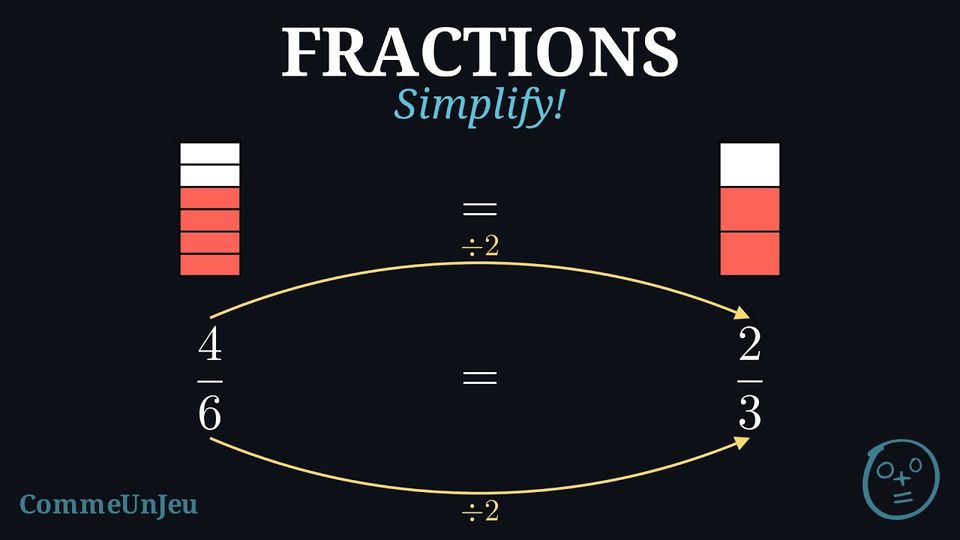
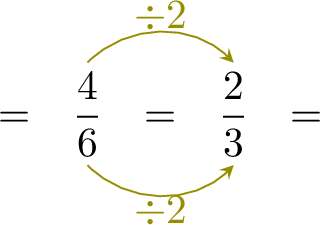
Consider the fraction \(\dfrac{4}{6}\):  . While this is a valid representation of a quantity, it is not the most efficient. Among all possible equivalent fractions, there is one that uses the smallest possible integers for the numerator and denominator (no whole number greater than \(1\) divides both).
The process of finding this simplest form is known as simplifying or reducing a fraction.
. While this is a valid representation of a quantity, it is not the most efficient. Among all possible equivalent fractions, there is one that uses the smallest possible integers for the numerator and denominator (no whole number greater than \(1\) divides both).The process of finding this simplest form is known as simplifying or reducing a fraction.
Method — Simplifying a fraction
To simplify a fraction is to find an equivalent fraction that uses the smallest possible whole numbers for its numerator and denominator.The procedure is to divide both the numerator and the denominator by the same number (a common factor). This process may need to be repeated until no whole number greater than \(1\) divides both the numerator and the denominator.


Skills to practice
- Simplifying Fractions
- Simplifying Fractions as Much as Possible
IV
Comparing Fractions
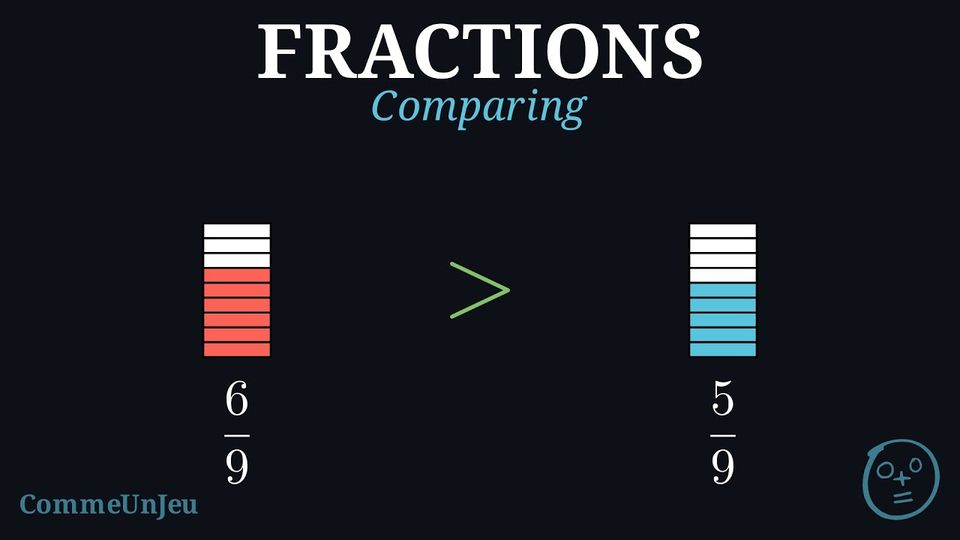
Which is larger: \(\dfrac{3}{4}\) or \(\dfrac{5}{8}\)?  \(\;\)

Visually, it is difficult to compare them because one is divided into quarters and the other into eighths. One sure way to compare them precisely is to first express them with a common denominator.
\(\;\)
To compare \(\dfrac{3}{4}\) and \(\dfrac{5}{8}\), write them with a common denominator. \(8\) is a multiple of \(4\): each quarter is cut into \(2\) eighths, so the numerator and the denominator of \(\dfrac{3}{4}\) are both multiplied by \(2\). $$\begin{aligned}[t] \dfrac{3}{4} &= \dfrac{3 \times 2}{4 \times 2} && \text{(each quarter cut into 2 eighths)}\\
&= \dfrac{6}{8} \end{aligned}$$ \(\;=\;\)  \(\;>\;\)
Both fractions now count eighths. With the same denominator, the larger numerator gives the larger fraction: \(6 > 5\), so \(\dfrac{6}{8} > \dfrac{5}{8}\). Therefore \(\dfrac{3}{4} > \dfrac{5}{8}\): \(\dfrac{3}{4}\) is the larger.
\(\;=\;\) \(\;>\;\) Proposition — Ordering Fractions with the Same Denominator
For two fractions with the same denominator, the fraction with the larger numerator is larger. Method — Comparing Fractions with Different Denominators
The standard procedure for comparing two fractions with different denominators is as follows: - Find a common denominator: Identify a common multiple of both denominators. A simple method is to multiply the denominators together.
- Create equivalent fractions: Convert each fraction into an equivalent fraction with the chosen common denominator.
- Compare the numerators: Once the denominators are the same, the fraction with the larger numerator is the greater fraction.
Example
Compare \(\dfrac{3}{4}\) and \(\dfrac{5}{8}\).
We will apply the three-step procedure.
- 1. Find a common denominator: The denominators are 4 and 8. A common multiple is 8.
- 2. Create equivalent fractions:
- The fraction \(\dfrac{5}{8}\) already has the common denominator.
- Convert \(\dfrac{3}{4}\) to an equivalent fraction with a denominator of 8. To change the denominator from 4 to 8, we multiply by 2. Therefore, we must also multiply the numerator by 2.

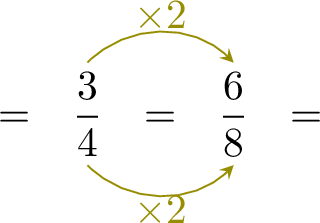

- 3. Compare the numerators: We now compare the equivalent fractions. \(= \dfrac{6}{8} > \dfrac{5}{8} = \)

- Conclusion: Therefore, it is concluded that \(\dfrac{3}{4} > \dfrac{5}{8}\).
Skills to practice
- Comparing with Same Denominator with Bar Models
- Comparing With Same Denominator
- Comparing Fractions with Different Denominators
- Comparing When Neither Denominator Is a Multiple of the Other
- Comparing Fractions in Real-World Problems
V
Comparing to 1 and Ordering Fractions
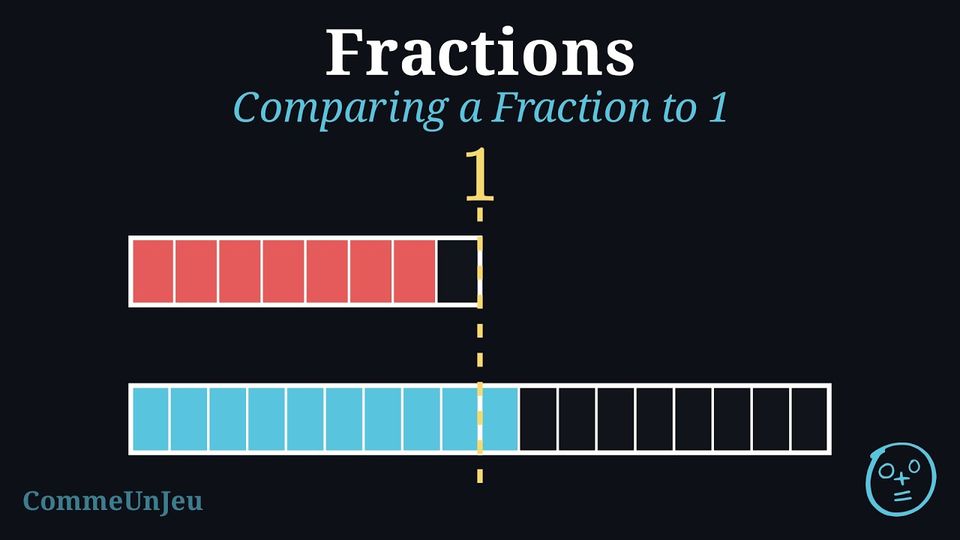
Proposition — Comparing a Fraction to 1
A fraction is compared to \(1\) by comparing its numerator to its denominator: - if the numerator is smaller than the denominator, the fraction is smaller than \(1\): \(\dfrac{13}{21} < 1\);
- if they are equal, the fraction equals \(1\): \(\dfrac{21}{21} = 1\);
- if the numerator is larger, the fraction is larger than \(1\): \(\dfrac{16}{12} > 1\).
Proposition — Same Numerator
Two fractions with the same non-zero numerator are ordered the other way round from their denominators: the larger the denominator, the smaller the parts, so the smaller the fraction. $$\dfrac{3}{5} > \dfrac{3}{8} \qquad \text{because a fifth is larger than an eighth, and there are three of each.}$$ Example
Compare, without any computation: \(\dfrac{7}{8}\) and \(\dfrac{10}{9}\); \(\dfrac{4}{7}\) and \(\dfrac{4}{11}\); \(\dfrac{5}{12}\) and \(\dfrac{6}{11}\). - \(\dfrac{7}{8} < 1\) (numerator smaller than denominator) and \(\dfrac{10}{9} > 1\): so \(\dfrac{7}{8} < \dfrac{10}{9}\) — the number \(1\) sits between them.
- Same numerator \(4\): sevenths are larger than elevenths, so \(\dfrac{4}{7} > \dfrac{4}{11}\).
- Compare both to \(\dfrac{1}{2}\): \(\dfrac{5}{12} < \dfrac{6}{12} = \dfrac{1}{2}\), and \(\dfrac{6}{11} > \dfrac{6}{12} = \dfrac{1}{2}\) (same numerator, smaller denominator). So \(\dfrac{5}{12} < \dfrac{1}{2} < \dfrac{6}{11}\).
Method — Ordering Several Fractions
- Write all the fractions with the same denominator (a common multiple of the denominators).
- Order the numerators: with equal denominators, the larger the numerator, the larger the fraction.
- Write the chain with the original fractions, in increasing or decreasing order.
Example
Order from smallest to largest: \(\dfrac{2}{3}\), \(\dfrac{3}{4}\) and \(\dfrac{7}{12}\).
A common denominator of \(3\), \(4\) and \(12\) is \(12\): $$\dfrac{2}{3} = \dfrac{8}{12}, \qquad \dfrac{3}{4} = \dfrac{9}{12}, \qquad \dfrac{7}{12}.$$ Ordering the numerators: \(7 < 8 < 9\), so $$\dfrac{7}{12} < \dfrac{2}{3} < \dfrac{3}{4}.$$
Skills to practice
- Comparing a Fraction to 1
- Comparing Fractions with the Same Numerator
- Ordering Fractions and Justifying
VI
Going further
Skills to practice
- Reasoning and Problem-Solving
- Quiz
Jump to section