International Baccalaureate · PYP 1
Halves and Quarters
I
One Half and One Quarter
Léa and Tom want to share one pizza fairly. Here are two ways to cut it into two parts. 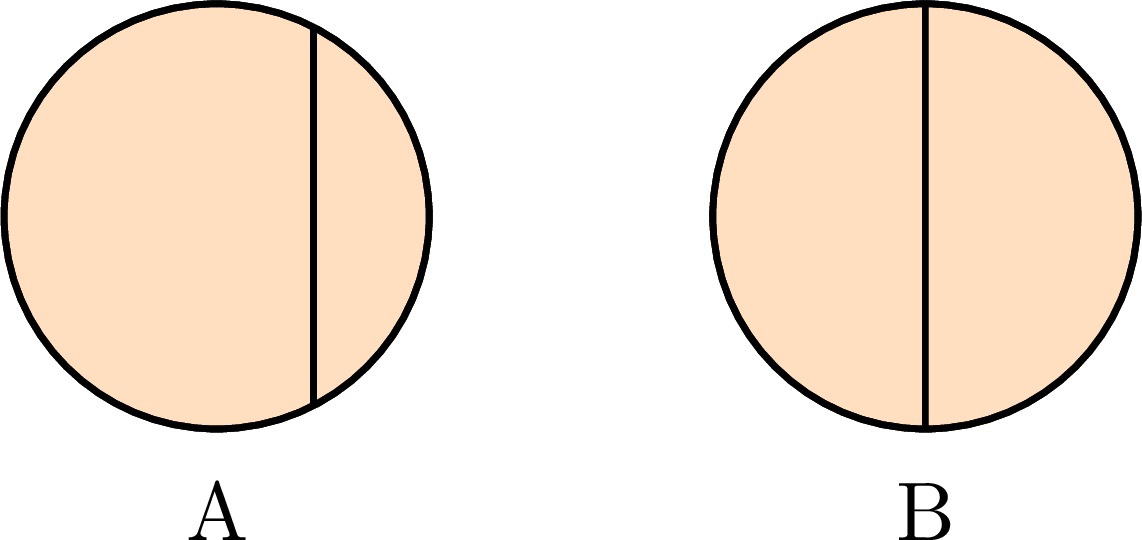
Which cut is fair for Léa and Tom?
Cut B is fair: its two parts are the same size. They are equal parts.
With cut A, one part is bigger than the other: the child who gets it has more pizza.
With cut A, one part is bigger than the other: the child who gets it has more pizza.
Hugo has 1 unit, which is one complete cake:  . He cuts the unit into 2 equal parts to share. Hugo takes 1 part out of 2 equal parts:
 . We write this as \(\displaystyle \dfrac{1}{2}\). What part of the cake is left for his sister?
. He cuts the unit into 2 equal parts to share. Hugo takes 1 part out of 2 equal parts: . We write this as \(\displaystyle \dfrac{1}{2}\). What part of the cake is left for his sister? Definition — Half and Quarter
When a unit (one cake, one strip, one shape) is cut into 2 equal parts, each part is one half of the unit. We write \(\dfrac{1}{2}\) and read it “one half”. 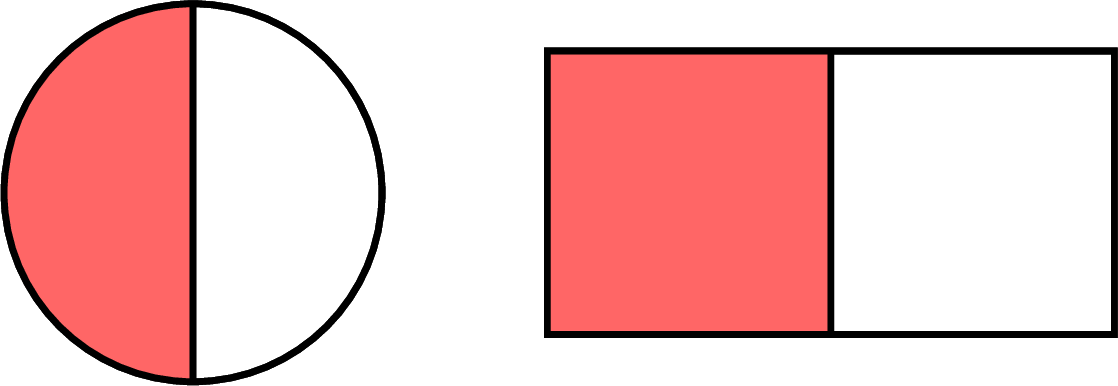
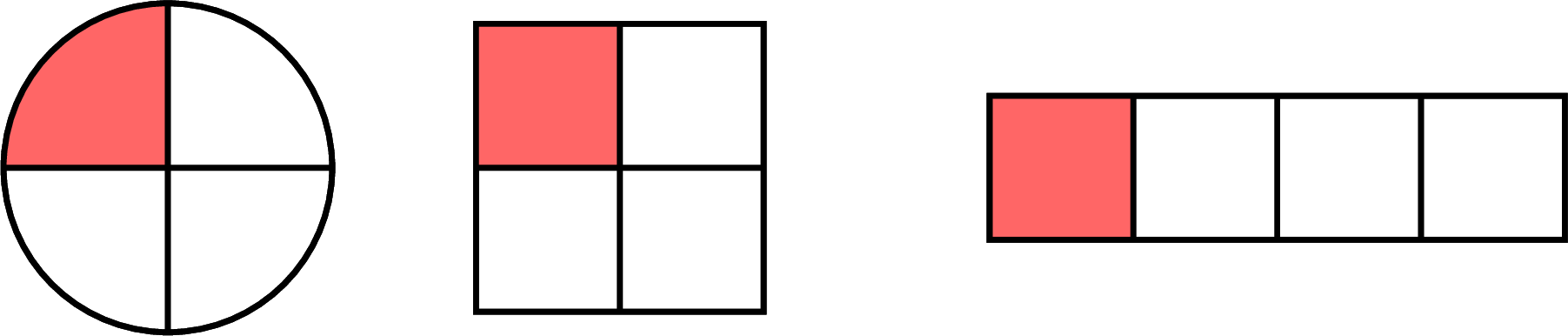
When the parts are not equal, the unit is not cut into halves, nor into quarters.
Two Quarters Make a Half
Two identical strips: the first is cut into \(2\) equal parts, the second into \(4\) equal parts. 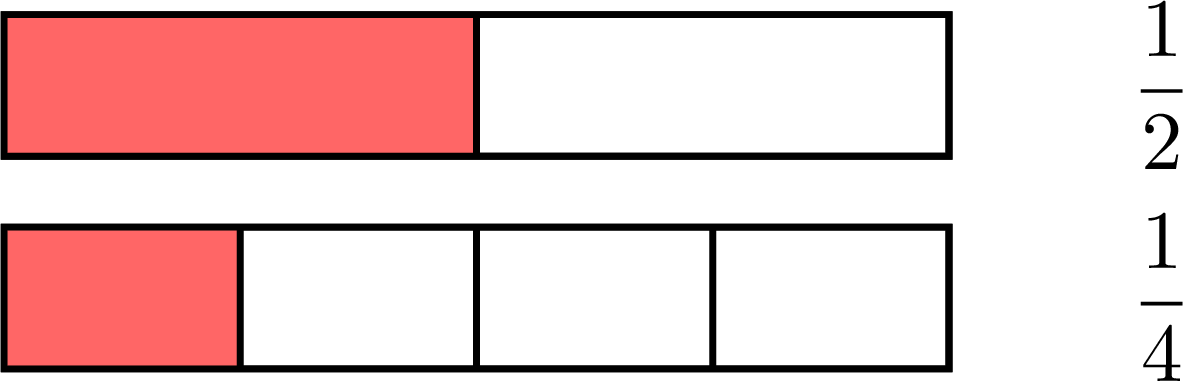
The more equal parts a unit is cut into, the smaller each part. One half of a unit is bigger than one quarter of the same unit. 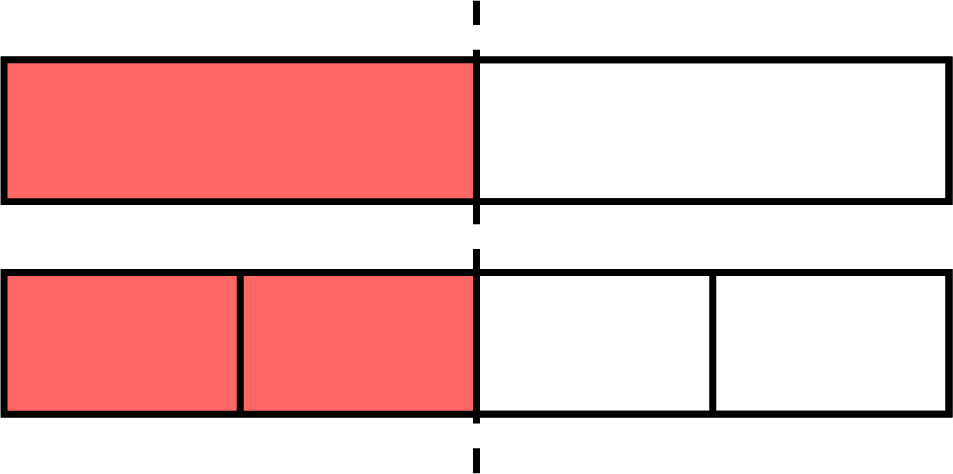
Two quarters cover exactly one half: two quarters make one half.
Method — Folding a Strip into Halves and Quarters
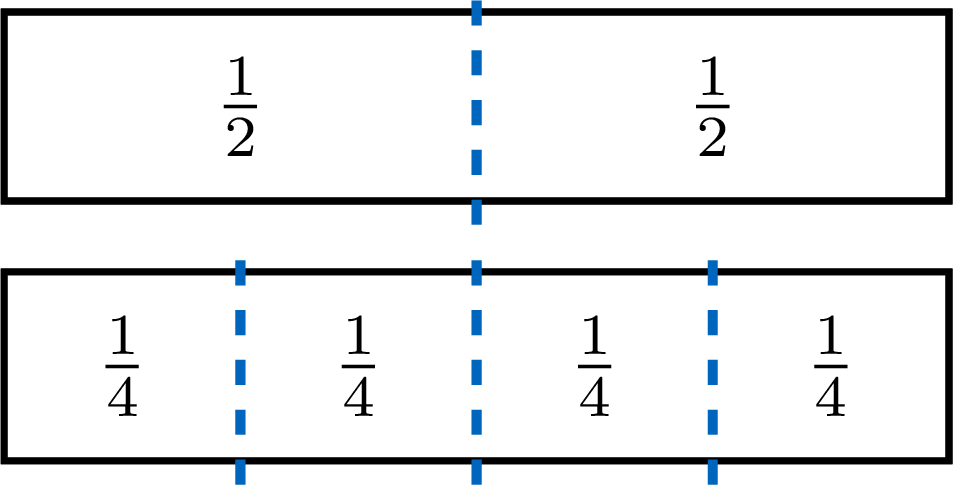
To cut a strip of paper or a ribbon into halves or into quarters, without measuring: - Fold the strip in two, end on end. The fold is in the middle: the \(2\) parts are equal, each part is one half.
- Without unfolding it, fold it in two again. Unfolded, the strip shows \(3\) folds and \(4\) equal parts: each part is one quarter.
Example
A ribbon has \(8\) equal squares. 
Folded in two, the ribbon makes \(2\) equal parts of \(4\) squares: one half of the ribbon has 4 squares, because \(4 + 4 = 8\).
Folded in two again, it makes \(4\) equal parts of \(2\) squares: one quarter of the ribbon has 2 squares, because \(2 + 2 + 2 + 2 = 8\). 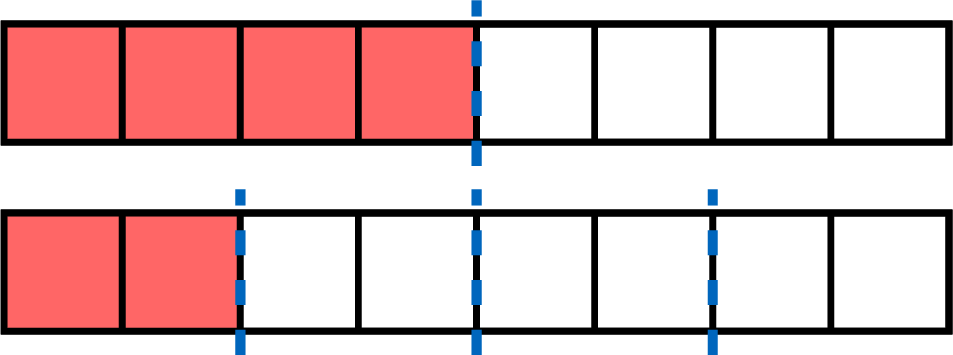
Folded in two again, it makes \(4\) equal parts of \(2\) squares: one quarter of the ribbon has 2 squares, because \(2 + 2 + 2 + 2 = 8\).
Method — A Half or a Quarter of a Collection
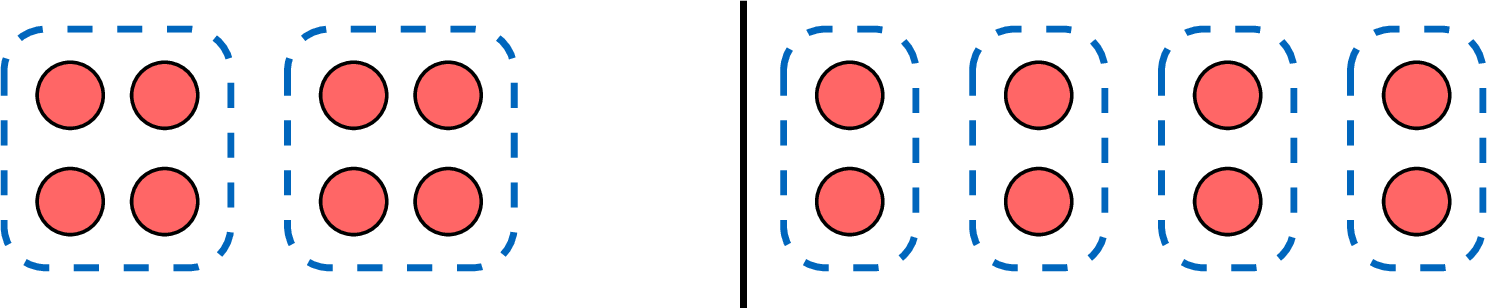
A collection of objects can be shared in the same way. - To find one half of a collection, share the objects into \(2\) equal groups, one by one, until none is left. One group is one half of the collection.
- To find one quarter, share the objects into \(4\) equal groups. One group is one quarter of the collection.
This works only when no object is left over: \(7\) counters cannot be shared into \(2\) equal groups.
Example
Hugo has \(12\) strawberries. 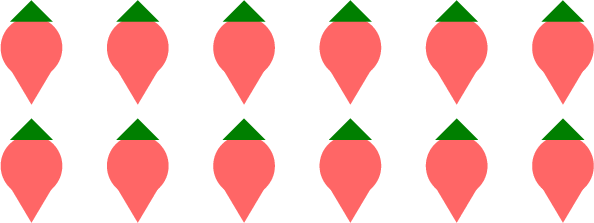
Shared into \(2\) equal groups: \(6\) and \(6\). One half of \(12\) strawberries is 6 strawberries.
Shared into \(4\) equal groups: \(3\), \(3\), \(3\) and \(3\). One quarter of \(12\) strawberries is 3 strawberries.
Check: \(6 + 6 = 12\) and \(3 + 3 + 3 + 3 = 12\). 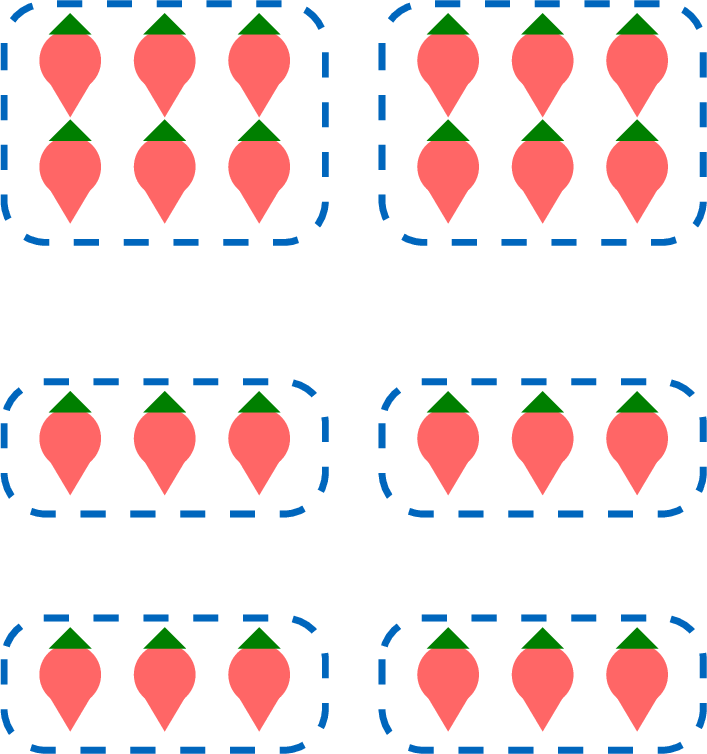
Shared into \(4\) equal groups: \(3\), \(3\), \(3\) and \(3\). One quarter of \(12\) strawberries is 3 strawberries.
Check: \(6 + 6 = 12\) and \(3 + 3 + 3 + 3 = 12\).
Example
For each shape, say whether the coloured part is one half, one quarter, or neither. 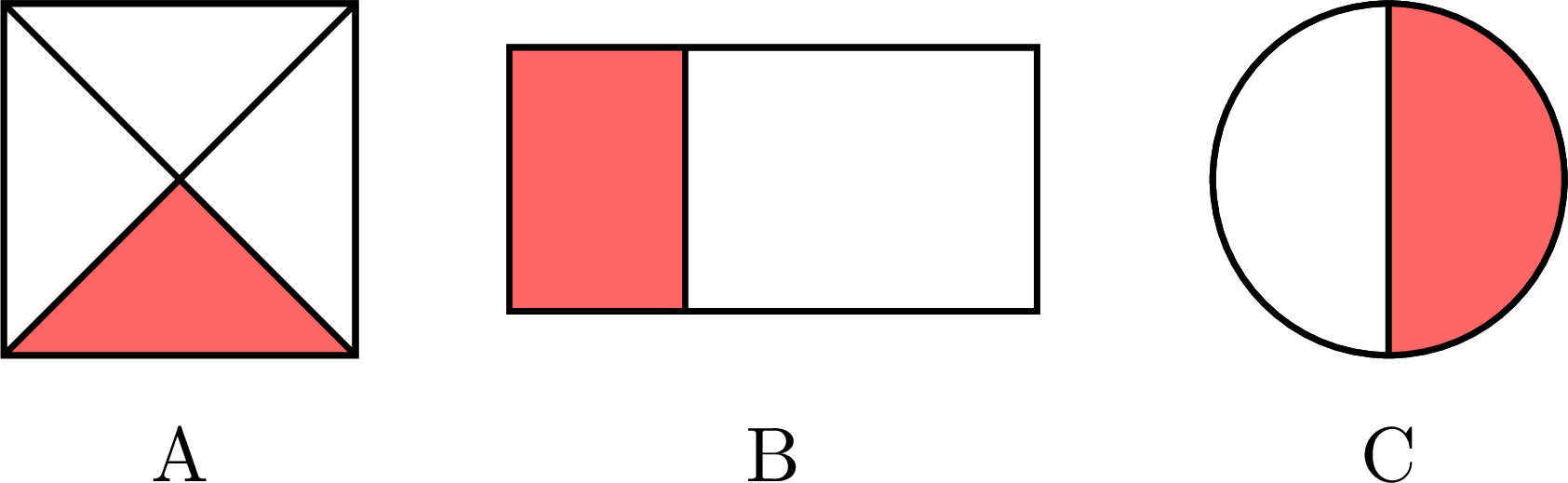
- A: the square is cut into \(4\) equal parts and \(1\) part is coloured: one quarter. The parts are triangles, but they are equal, so they are quarters.
- B: the \(2\) parts are not equal: the coloured part is neither one half nor one quarter.
- C: the circle is cut into \(2\) equal parts and \(1\) part is coloured: one half.
Skills to practice
- Telling Whether the Parts Are Equal
- Recognising Halves and Quarters
- Naming the Part
- Colouring a Half or a Quarter
- Finding a Half or a Quarter of a Collection
II
Review & Quizz
Skills to practice
- Quiz
Jump to section