International Baccalaureate · MYP 4
Direct and Inverse Proportion
I
Direct Proportion
I.1
Directly Proportional Quantities
Two situations. Table A gives the price \(y\), in dollars, of \(x\) kilograms of apples. Table B gives the time \(y\), in hours, needed to drive \(120\) km at a constant speed of \(x\) km/h. Table A:
Table B:
| \(x\) | \(1\) | \(2\) | \(4\) | \(8\) |
| \(y\) | \(3\) | \(6\) | \(12\) | \(24\) |
| \(x\) | \(30\) | \(40\) | \(60\) | \(120\) |
| \(y\) | \(4\) | \(3\) | \(2\) | \(1\) |
- In each table, what happens to \(y\) when \(x\) is doubled?
- In each table, find a calculation on \(x\) and \(y\) that gives the same result in every column.
- In table A, when \(x\) goes from \(1\) to \(2\), from \(2\) to \(4\) and from \(4\) to \(8\), \(y\) goes from \(3\) to \(6\), from \(6\) to \(12\) and from \(12\) to \(24\): doubling \(x\) doubles \(y\). In table B, when \(x\) goes from \(30\) to \(60\) and from \(60\) to \(120\), \(y\) goes from \(4\) to \(2\) and from \(2\) to \(1\): doubling \(x\) halves \(y\).
- In table A the quotient \(\dfrac{y}{x}\) is always \(3\): \(\dfrac{3}{1} = \dfrac{6}{2} = \dfrac{12}{4} = \dfrac{24}{8} = 3\), the price of one kilogram. In table B the product \(xy\) is always \(120\): \(30 \times 4 = 40 \times 3 = 60 \times 2 = 120 \times 1 = 120\), the length of the trip.
Definition — Direct Proportion
A quantity \(y\) is directly proportional to a quantity \(x\) (one also says that \(y\) varies directly as \(x\)) when there is a nonzero number \(k\) such that $$y = kx$$ for every pair of matching values. The number \(k\) is the constant of proportionality. We write \(y \propto x\), read “\(y\) is proportional to \(x\)”. When \(x \neq 0\), \(k = \dfrac{y}{x}\): the quotient of matching values is the same for every pair. Proposition — Scaling in a Direct Proportion
\(\)If \(y \propto x\), then multiplying \(x\) by a number \(m\) multiplies \(y\) by the same number \(m\). For instance, doubling \(x\) doubles \(y\), and dividing \(x\) by \(3\) divides \(y\) by \(3\).
Let \(y = kx\). When \(x\) is replaced by \(mx\), the quantity \(y\) takes the value $$\begin{aligned}[t] k \times (mx) &= (k \times m) \times x && \text{(associativity)}\\
&= (m \times k) \times x && \text{(commutativity)}\\
&= m \times (kx) && \text{(associativity)}\\
&= m \times y. \end{aligned}$$ So \(y\) is multiplied by \(m\).
Example
The mass \(M\), in grams, of a copper wire is directly proportional to its length \(L\), in metres. A piece \(5\) m long has a mass of \(180\) g. - Find the constant of proportionality and write \(M\) in terms of \(L\).
- Find the mass of \(12\) m of this wire.
- What length of wire has a mass of \(450\) g?
- The length of a piece is multiplied by \(4\). What happens to its mass?
- Since \(M \propto L\), \(M = kL\). The pair \(L = 5\), \(M = 180\) gives $$\begin{aligned}[t] 180 &= k \times 5 && \text{(the known pair)}\\ k &= \frac{180}{5} && \text{(divide both sides by } 5\text{)}\\ &= 36. \end{aligned}$$ So \(M = 36L\): the wire has a mass of \(36\) g per metre.
- \(M = 36 \times 12 = 432\) g.
- We look for \(L\) such that \(36L = 450\): $$L = \frac{450}{36} = 12.5 \text{ m}.$$ Check: \(36 \times 12.5 = 450\).
- By the Proposition “Scaling in a Direct Proportion”, the mass is multiplied by \(4\). For instance, \(5\) m weigh \(180\) g and \(20\) m weigh \(36 \times 20 = 720 = 4 \times 180\) g.
Skills to practice
- Recognising Direct Proportion
- Finding and Using the Constant of Proportionality
- Justifying Direct Proportion
I.2
Proportionality on a Graph
Method — From a Table to a Graph
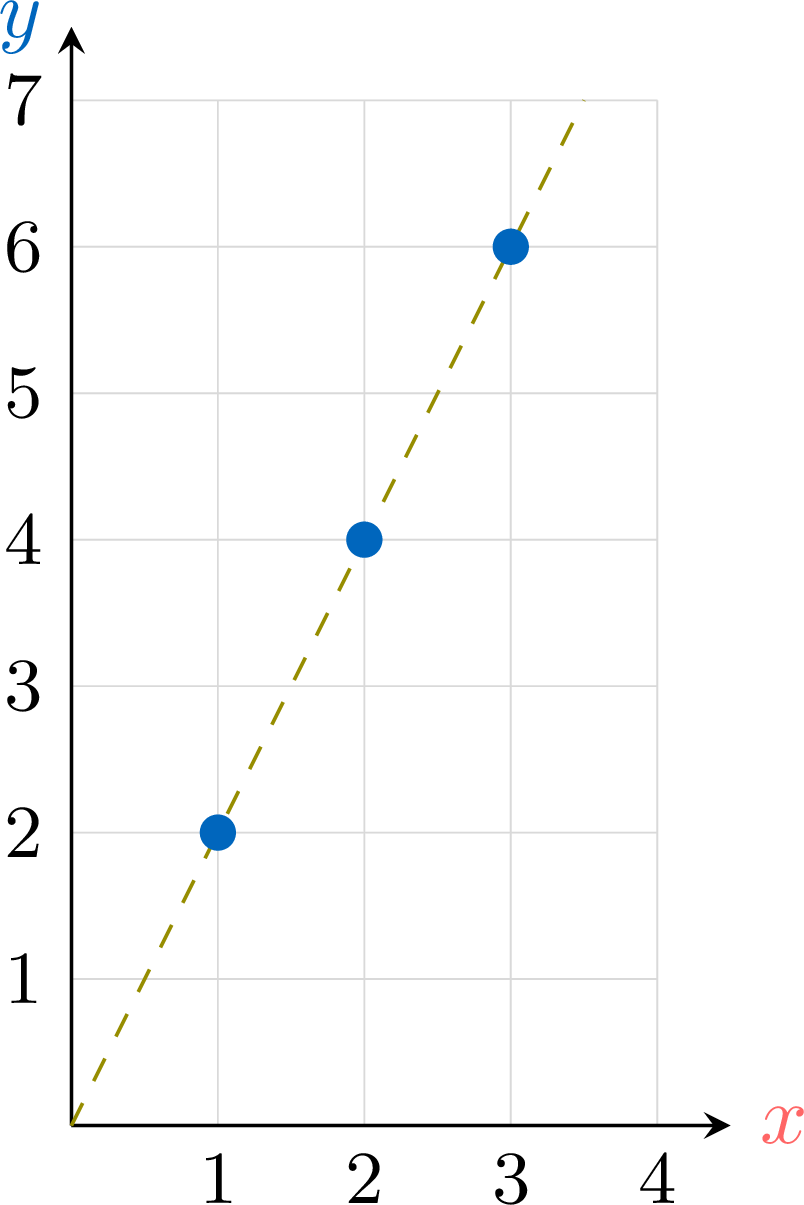
Each column of the table becomes a point: the first quantity on the horizontal axis, the second on the vertical axis.Example. The proportional table \(\textcolor{colordef}{1}, \textcolor{colordef}{2}, \textcolor{colordef}{3} \to \textcolor{colorprop}{2}, \textcolor{colorprop}{4}, \textcolor{colorprop}{6}\) gives the points below.
Proposition — Graphical Characterisation of Proportionality
A situation is proportional exactly when the points of its graph are aligned with the origin. 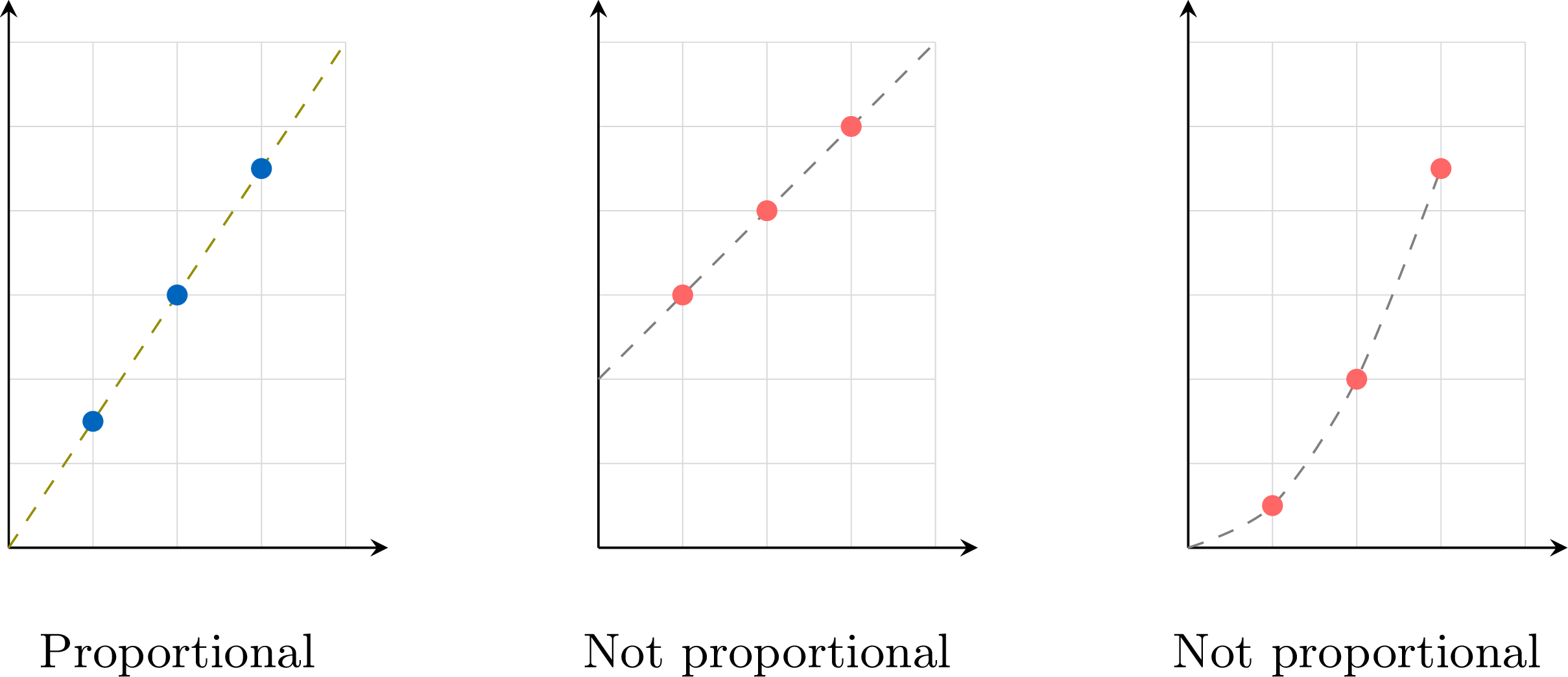
Example
This graph shows the price of cherries depending on the mass. Is the price proportional to the mass? Read the price of \(\textcolor{colordef}{3}\) kg. 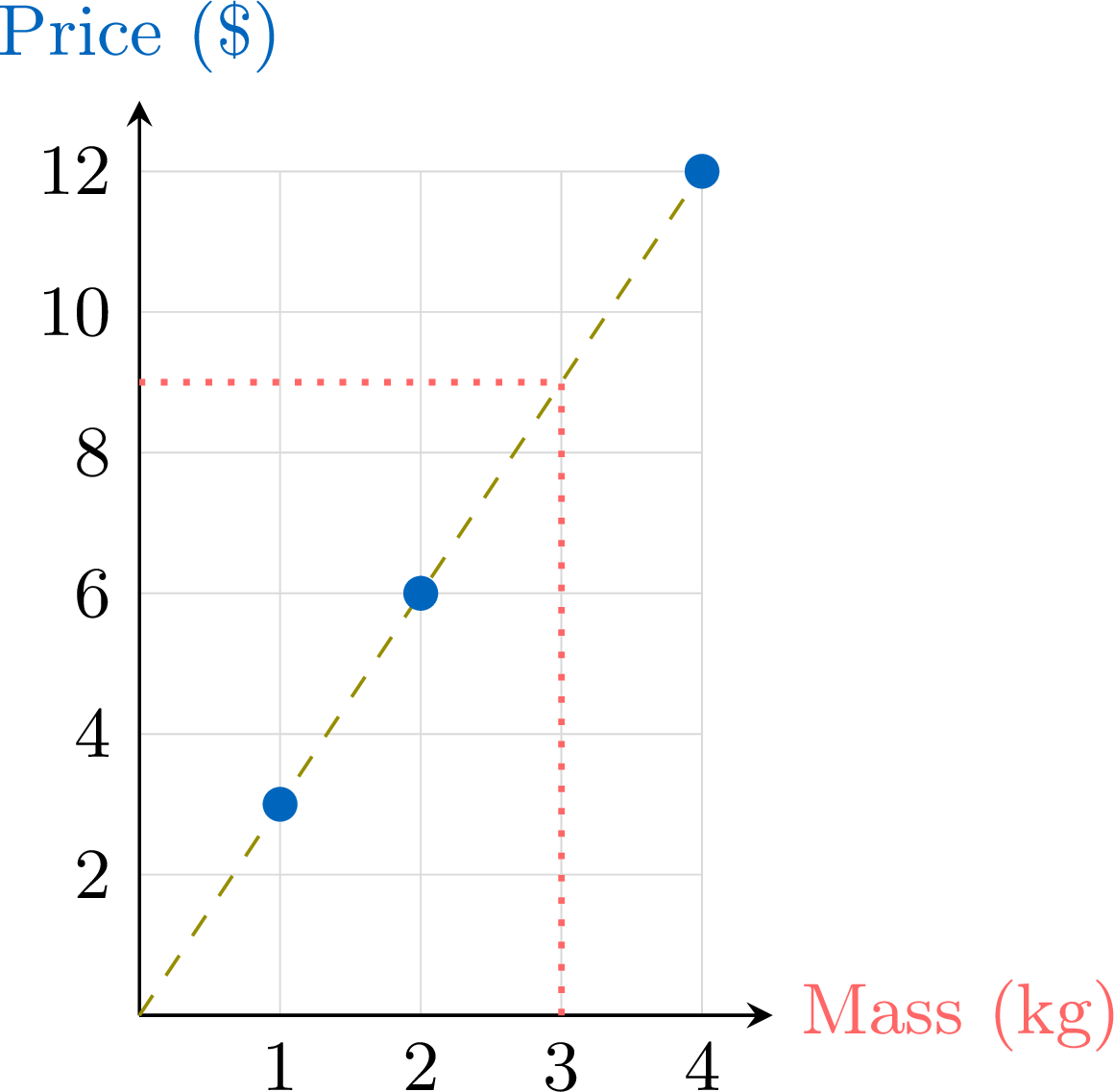
- The points are aligned with the origin, so the price is proportional to the mass.
- Following the dotted lines from \(\textcolor{colordef}{3}\) kg up to the graph and across to the vertical axis: \(\textcolor{colordef}{3}\) kg cost \(\textcolor{colorprop}{9}\) dollars.
Proposition — The Graph of Proportionality and the Intercept Theorem
The points of a proportional situation are aligned with the origin \(O\). Let \(A\) and \(B\) be two of them, and let \(H\) and \(K\) be the points of the horizontal axis below them. 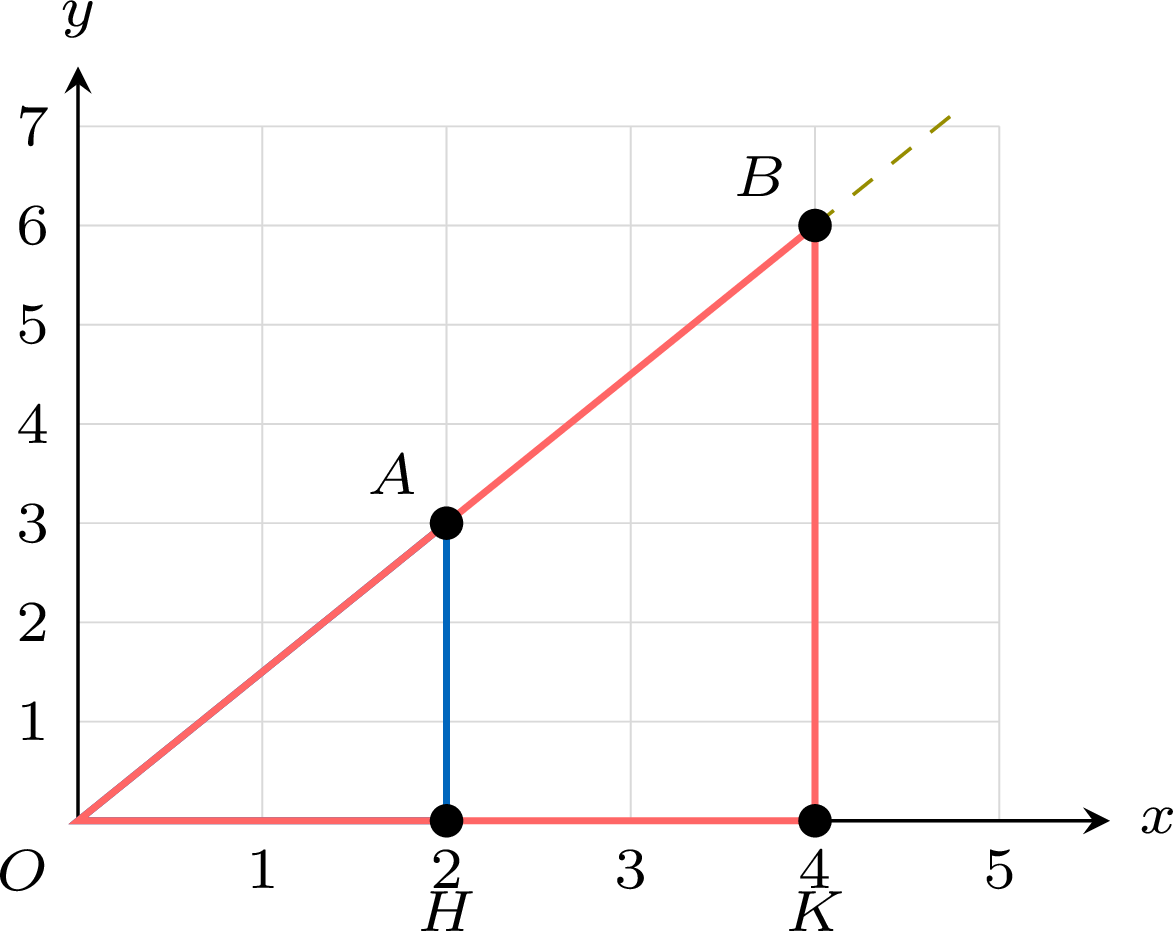
Example
A shop sells cherries at a fixed price per kilogram. On the graph, the point \(A\) says that \(2\) kg cost \(5\) dollars, and the point \(B\) is the point with \(x\)-coordinate \(6\). Write the equality that the intercept theorem gives in the triangles \(OHA\) and \(OKB\), then deduce the price of \(6\) kg. 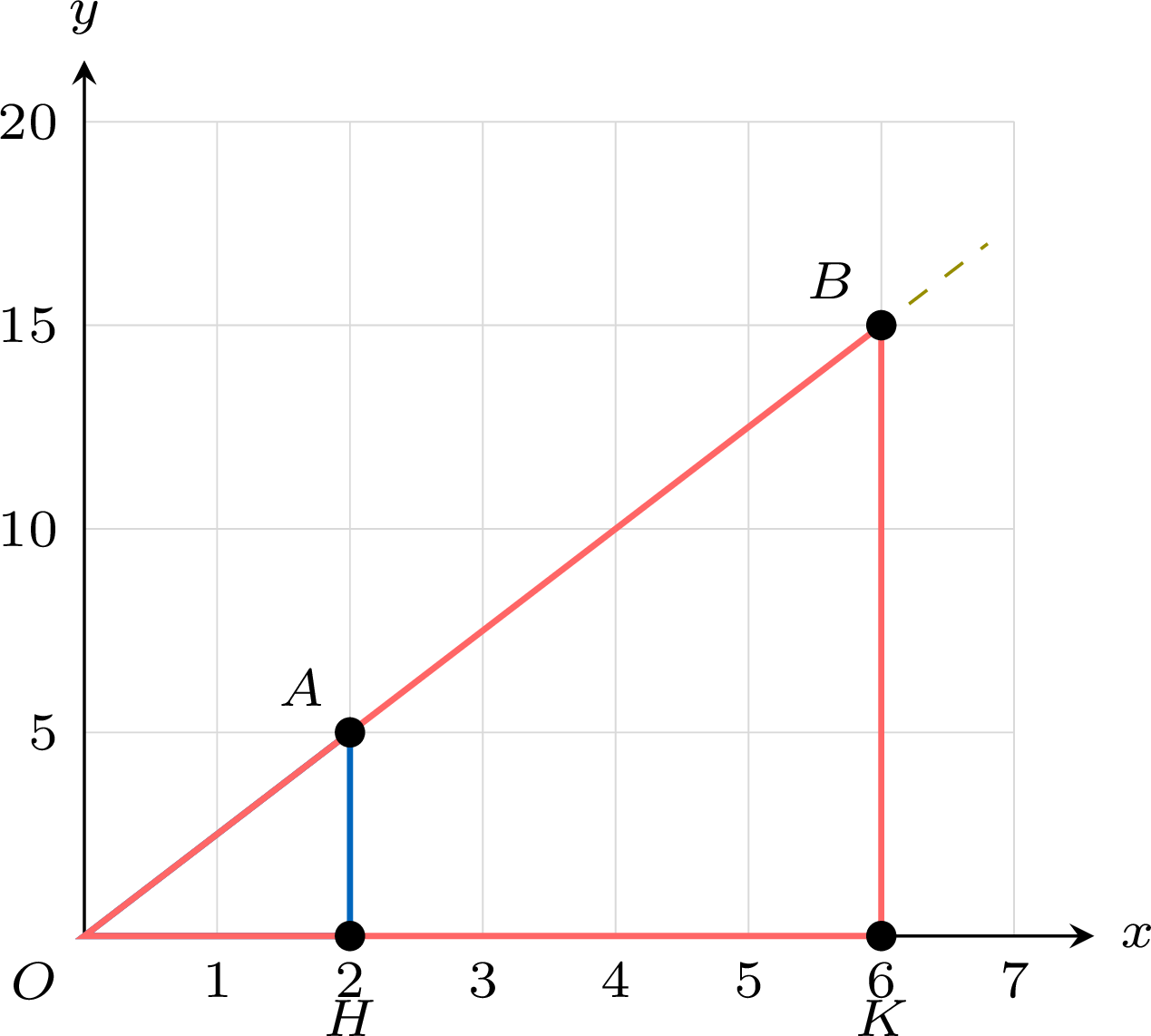
Here \(OH = 2\), \(HA = 5\) and \(OK = 6\); the price of \(6\) kg is the length \(KB\). $$\begin{aligned}[t] \dfrac{OH}{OK} &= \dfrac{HA}{KB} && \text{(intercept theorem)} \\
\dfrac{2}{6} &= \dfrac{5}{KB} \\
2 \times KB &= 6 \times 5 && \text{(cross products)} \\
KB &= \dfrac{30}{2} = 15 \end{aligned}$$ So \(6\) kg cost \(15\) dollars. The two quotients of coordinates agree: $$\dfrac{5}{2} = 2.5 \qquad \text{and} \qquad \dfrac{15}{6} = 2.5,$$ and \(2.5\) dollars per kilogram is the coefficient of proportionality.
Skills to practice
- Recognising Proportionality on a Graph
- Justifying Proportionality with the Intercept Theorem
I.3
The Direct-Proportion Function
A proportional situation is often given as a table: each value in the second row is obtained from the first by multiplying by the same number. Nothing forces us to stop at a table — that same rule can be read as a machine that takes any number and multiplies it by the coefficient. Written as a function, a proportional situation becomes the simplest function of all.
Definition — Direct-Proportion Function
Let \(a\) be a nonzero number. The function that maps every number \(x\) to the number \(ax\) is called the direct-proportion function of coefficient \(a\). It is written $$f : x \longmapsto ax, \qquad\text{that is}\qquad f(x) = ax.$$ The number \(a\) is the coefficient of the function: it is exactly the proportionality coefficient of the situation being modelled. Proposition — Graph of a Direct-Proportion Function
The graph of the direct-proportion function \(f(x) = ax\) is a \textcolor{colorprop}{straight line passing through the origin}. Conversely, any non-vertical straight line passing through the origin, other than the \(x\)-axis, is the graph of a direct-proportion function — a vertical line is the graph of no function at all, since it would give one input several outputs, and the \(x\)-axis is the graph of \(x \longmapsto 0\), whose coefficient \(0\) is excluded. 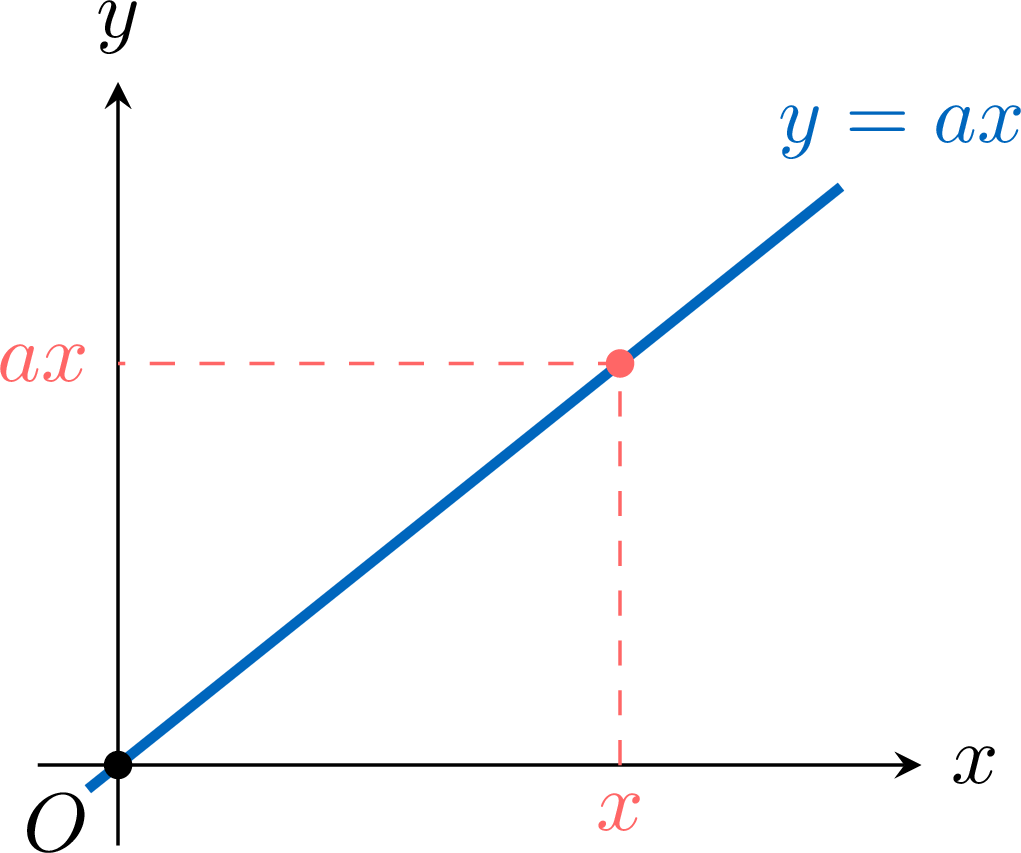
Method — Modelling a Situation with a Direct-Proportion Function
- Name the two quantities and choose which one is the input \(x\): the other one is then \(f(x)\).
- Check that the situation is proportional: every pair of matching values with a nonzero input must give the same quotient output/input — and an input of \(0\) must give an output of \(0\).
- Compute the coefficient \(a\) by dividing one output by the matching input — any pair with a nonzero input gives the same \(a\).
- Write the function \(f(x) = ax\), then use it: an input gives its output by multiplication and, since \(a\) is not zero, an output gives its input by division.
Example
A tap fills an empty tank at a steady rate. After \(4\) minutes, the tank holds \(18\) litres. - Justify that the volume is proportional to the time, and model the situation by a direct-proportion function \(V\).
- How many litres are in the tank after \(10\) minutes?
- After how long does the tank hold \(27\) litres?
- The rate is steady, so twice the time gives twice the volume, and no time at all gives no water: the situation is proportional. The coefficient is obtained from the pair of matching values \((4, 18)\): $$a = \dfrac{18}{4} = 4.5,$$ so the tap delivers \(4.5\) litres per minute and $$V(x) = 4.5\,x,$$ where \(x\) is the time in minutes and \(V(x)\) the volume in litres.
- After \(10\) minutes, $$V(10) = 4.5 \times 10 = 45 \text{ litres}.$$
- We look for the input whose output is \(27\), so we divide by the coefficient: $$x = \dfrac{27}{4.5} = 6 \text{ minutes}.$$ Check: \(4.5 \times 6 = 27\).
Skills to practice
- Recognising a Direct-Proportion Function
- Computing with a Direct-Proportion Function
- Solving Problems with a Direct-Proportion Function
II
Inverse Proportion
II.1
Inversely Proportional Quantities
Definition — Inverse Proportion
A quantity \(y\) is inversely proportional to a quantity \(x\) (one also says that \(y\) varies inversely as \(x\)) when there is a nonzero number \(k\) such that $$y = \frac{k}{x}, \qquad\text{that is}\qquad xy = k,$$ for every pair of matching values, with \(x \neq 0\). The number \(k\) is the constant of proportionality: the product of matching values is the same for every pair. We write \(y \propto \dfrac{1}{x}\). Proposition — Scaling in an Inverse Proportion
\(\)If \(y \propto \dfrac{1}{x}\), then multiplying \(x\) by a nonzero number \(m\) divides \(y\) by \(m\). For instance, doubling \(x\) halves \(y\), and dividing \(x\) by \(3\) multiplies \(y\) by \(3\).
Let \(y = \dfrac{k}{x}\). When \(x\) is replaced by \(mx\), with \(m \neq 0\), the quantity \(y\) takes the value $$\begin{aligned}[t] \frac{k}{mx} &= \frac{1}{m} \times \frac{k}{x} && \text{(product of fractions)}\\
&= \frac{y}{m}. \end{aligned}$$ So \(y\) is divided by \(m\). Dividing \(x\) by \(3\) is multiplying it by \(m = \dfrac{1}{3}\), so \(y\) is divided by \(\dfrac{1}{3}\), that is multiplied by \(3\).
Proposition — Graph of an Inverse Proportion
Let \(k > 0\). For \(x > 0\), the graph of \(y = \dfrac{k}{x}\) is a curve that goes down as \(x\) increases and that comes as close as we like to each axis without ever meeting it: it is not a straight line. Each point \((x, y)\) of the curve is a corner of a rectangle drawn with the two axes, whose area is \(xy = k\) — the same for every point. Here is the graph of \(y = \dfrac{12}{x}\), with the rectangles of the points \((2, 6)\) and \((6, 2)\): their areas are \(2 \times 6 = 12\) and \(6 \times 2 = 12\). 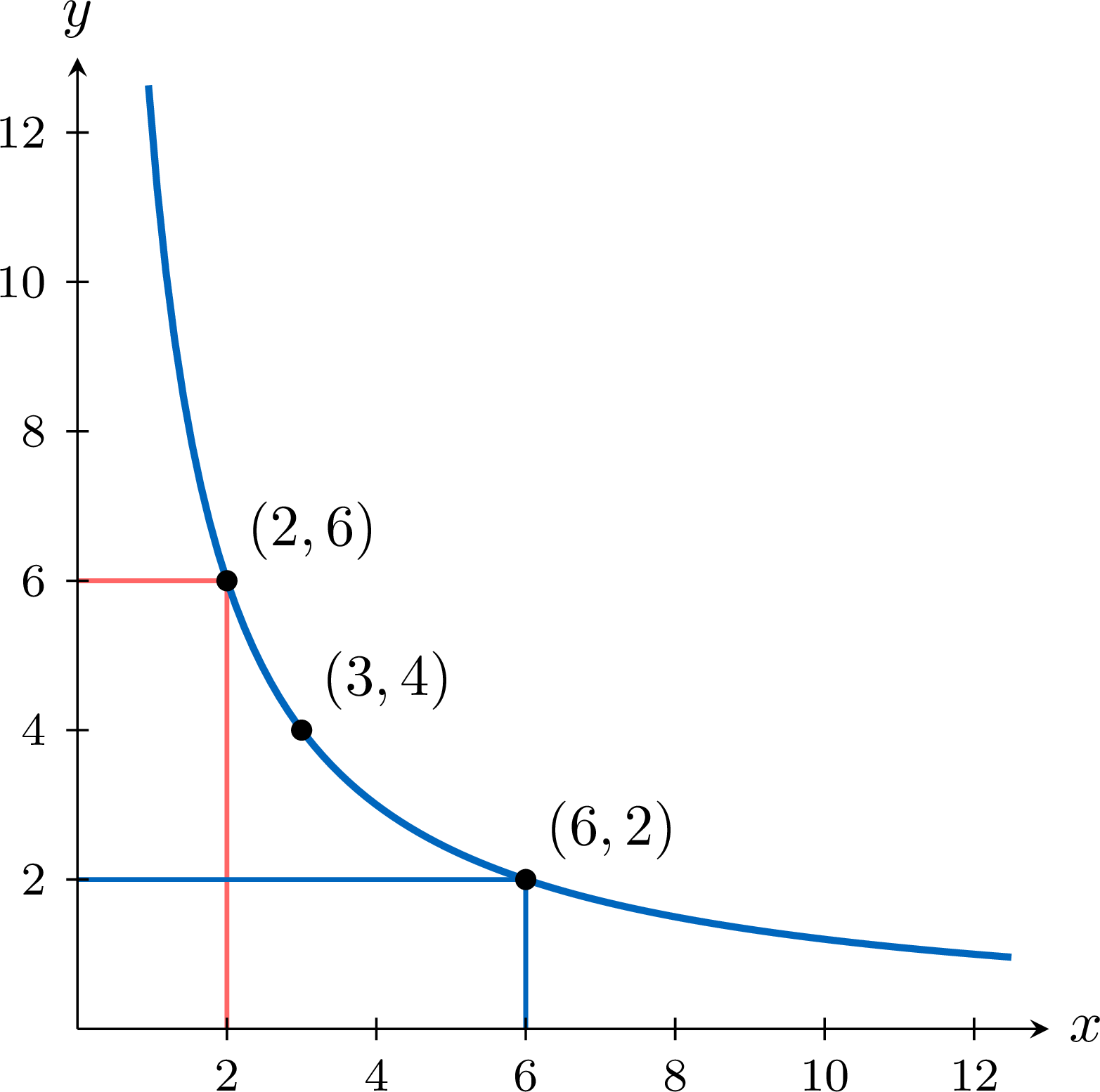
Let \(0 < x_1 < x_2\). The same positive number \(k\) is divided by a larger positive number, so \(\dfrac{k}{x_2} < \dfrac{k}{x_1}\): the curve goes down. The value \(y = \dfrac{k}{x}\) is never \(0\), because \(k \neq 0\), so the curve never meets the \(x\)-axis; and \(x = 0\) is excluded, so it never meets the \(y\)-axis. As \(x\) grows, \(\dfrac{k}{x}\) becomes as small as we like, and as \(x\) gets close to \(0\), it becomes as large as we like. The curve is not a straight line: a straight line that goes down meets the \(x\)-axis, which the curve never does. Finally, the rectangle with corners \((0, 0)\) and \((x, y)\) has sides \(x\) and \(y\), so its area is \(xy = k\).
Decreasing Is Not Enough
Two quantities can vary in opposite directions without being inversely proportional. A \(50\) L tank empties at \(5\) L per minute: after \(x\) minutes it holds \(y = 50 - 5x\) litres. The volume \(y\) goes down when \(x\) goes up, but the product \(xy\) is not constant: \(2 \times 40 = 80\) and \(4 \times 30 = 120\). Doubling \(x\) from \(2\) to \(4\) does not halve \(y\): it goes from \(40\) to \(30\), not to \(20\). Only a constant product \(xy\) shows an inverse proportion.
Method — Solving an Inverse Proportion Problem
- Check that the product \(xy\) is the same for the known pairs, or read in the statement that \(y\) is inversely proportional to \(x\).
- Compute the constant \(k = xy\) from one known pair.
- Write the formula \(y = \dfrac{k}{x}\).
- Use it: a value of \(x\) gives \(y = \dfrac{k}{x}\), and a value of \(y\) gives \(x = \dfrac{k}{y}\). Check the result with the constant product.
Example
Working at the same rate, \(6\) workers build a wall in \(10\) days. The time \(T\), in days, is inversely proportional to the number \(n\) of workers. - Find the constant of proportionality and write \(T\) in terms of \(n\).
- How long do \(4\) workers take? And \(15\) workers?
- How many workers are needed to build the wall in \(5\) days?
- The constant is the product of the known pair: \(k = nT = 6 \times 10 = 60\) (the wall takes \(60\) days of work for one worker). So $$T = \frac{60}{n}.$$
- For \(4\) workers, \(T = \dfrac{60}{4} = 15\) days; for \(15\) workers, \(T = \dfrac{60}{15} = 4\) days.
- We look for \(n\) such that \(\dfrac{60}{n} = 5\): $$n = \frac{60}{5} = 12 \text{ workers}.$$ Check: \(12 \times 5 = 60\). As expected, \(12\) workers, twice as many as \(6\), take \(5\) days, half of \(10\) days.
Example
\(y\) is inversely proportional to \(x\), and \(y = 8\) when \(x = 3\). Complete the table, then plot the points and join them with a smooth curve. | \(x\) | \(1\) | \(2\) | \(3\) | \(4\) | \(6\) | \(12\) |
| \(y\) | \(?\) | \(?\) | \(8\) | \(?\) | \(?\) | \(?\) |
The constant is \(k = xy = 3 \times 8 = 24\), so \(y = \dfrac{24}{x}\):
In every column the product is \(24\). The points lie on a curve, not on a straight line: 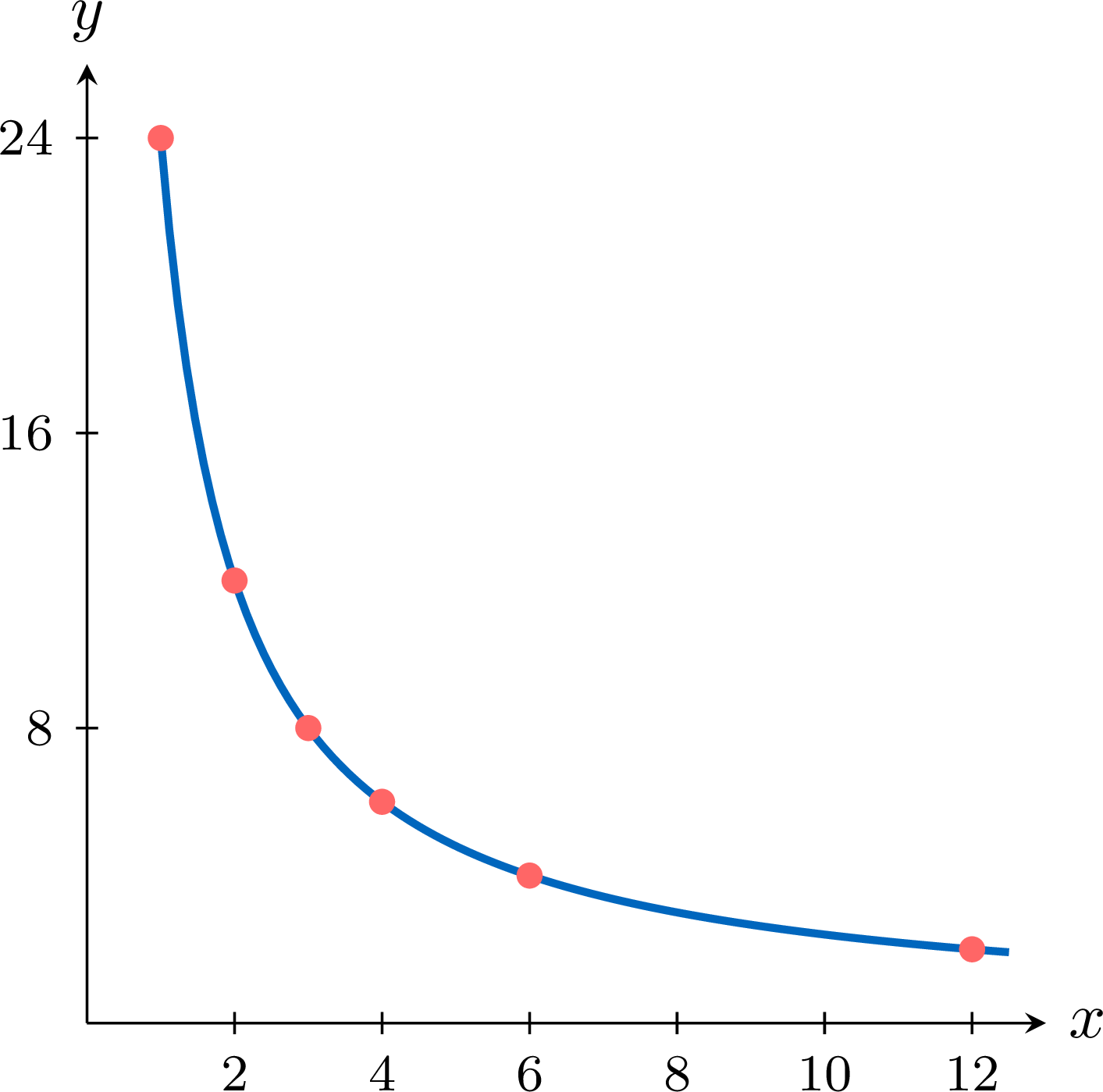
| \(x\) | \(1\) | \(2\) | \(3\) | \(4\) | \(6\) | \(12\) |
| \(y\) | \(24\) | \(12\) | \(8\) | \(6\) | \(4\) | \(2\) |
From Inverse Proportion to the Reciprocal Function
The reciprocal function \(x \mapsto \dfrac{1}{x}\) is the inverse proportion \(y = \dfrac{k}{x}\) with \(k = 1\), now taken for every non-zero number \(x\), negative numbers included.
Definition — Reciprocal Function
The reciprocal function is defined on \(\mathbb{R} \setminus \{0\}\) (all real numbers except \(0\)) by \(f(x) = \frac{1}{x}\). 
- Domain: \(\mathbb{R} \setminus \{0\}\), also written \((-\infty, 0) \cup (0, +\infty)\).
- Shape: A curve called a hyperbola.
Skills to practice
- Recognising Inverse Proportion
- Solving Inverse Proportion Problems
- Finding Images and Inputs
- Justifying Inverse Proportion
III
Proportion with a Power
III.1
Direct and Inverse Proportion with a Power
Definition — Proportion with a Power
Let \(n\) be a positive whole number and \(k\) a nonzero number. - \(y\) is directly proportional to \(x^n\) when \(y = kx^n\) for every pair of matching values. We write \(y \propto x^n\). For \(n = 2\), \(y\) is proportional to the square of \(x\); for \(n = 3\), to the cube of \(x\).
- \(y\) is inversely proportional to \(x^n\) when \(y = \dfrac{k}{x^n}\) for every pair of matching values, with \(x \neq 0\). We write \(y \propto \dfrac{1}{x^n}\). For \(n = 2\), this is the inverse-square law.
Proposition — Scaling with a Power
\(\)Let \(m\) be a nonzero number. - If \(y \propto x^n\), multiplying \(x\) by \(m\) multiplies \(y\) by \(m^n\).
- If \(y \propto \dfrac{1}{x^n}\), multiplying \(x\) by \(m\) divides \(y\) by \(m^n\).
If \(y = kx^n\), replacing \(x\) by \(mx\) gives $$\begin{aligned}[t] k(mx)^n &= k \times m^n x^n && \text{(Exponent Law 4)}\\
&= m^n \times kx^n && \text{(commutativity and associativity)}\\
&= m^n \times y. \end{aligned}$$ If \(y = \dfrac{k}{x^n}\), replacing \(x\) by \(mx\) gives $$\begin{aligned}[t] \frac{k}{(mx)^n} &= \frac{k}{m^n x^n} && \text{(Exponent Law 4)}\\
&= \frac{1}{m^n} \times \frac{k}{x^n} && \text{(product of fractions)}\\
&= \frac{y}{m^n}. \end{aligned}$$ So \(y\) is multiplied by \(m^n\) in the first case and divided by \(m^n\) in the second.
Telling the Laws Apart
Doubling \(x\) is a quick way to guess the law that links \(y\) to \(x\), or to rule one out:
In particular, an inverse-square law is not an inverse proportion: when the distance to a lamp doubles, the light received is divided by \(4\), not by \(2\). Likewise, a quantity proportional to the square of \(x\) is not proportional to \(x\).
| law | \(y \propto x\) | \(y \propto x^2\) | \(y \propto x^3\) | \(y \propto \frac{1}{x}\) | \(y \propto \frac{1}{x^2}\) |
| \(x\) doubled: \(y\) is | \(\times 2\) | \(\times 4\) | \(\times 8\) | \(\div 2\) | \(\div 4\) |
Example
On a dry road, the braking distance \(d\), in metres, of a car is proportional to the square of its speed \(v\), in km/h. At \(40\) km/h, the braking distance is \(8\) m. - Find the constant \(k\) and write \(d\) in terms of \(v\).
- Find the braking distance at \(80\) km/h and at \(100\) km/h.
- At what speed is the braking distance \(18\) m?
- Since \(d \propto v^2\), \(d = kv^2\). The pair \(v = 40\), \(d = 8\) gives $$\begin{aligned}[t] 8 &= k \times 40^2 && \text{(the known pair)}\\ 8 &= 1600k\\ k &= \frac{8}{1600} && \text{(divide both sides by } 1600\text{)}\\ &= 0.005. \end{aligned}$$ So \(d = 0.005v^2\).
- At \(80\) km/h, \(d = 0.005 \times 80^2 = 0.005 \times 6400 = 32\) m: the speed is doubled, so the distance is multiplied by \(4\) (\(4 \times 8 = 32\)). At \(100\) km/h, \(d = 0.005 \times 100^2 = 0.005 \times 10\,000 = 50\) m.
- We look for \(v > 0\) such that \(0.005v^2 = 18\): $$\begin{aligned}[t] v^2 &= \frac{18}{0.005} && \text{(divide both sides by } 0.005\text{)}\\ &= 3600, \end{aligned}$$ so \(v = 60\) km/h, the negative solution \(-60\) being rejected, since a speed here is positive. Check: \(0.005 \times 3600 = 18\).
Method — Recognising the Law from a Table
For each column of the table (with \(x \neq 0\)): - compute \(\dfrac{y}{x}\) and \(xy\), then, if neither is constant, \(\dfrac{y}{x^2}\) and \(x^2y\), then \(\dfrac{y}{x^3}\) and \(x^3y\);
- keep the calculation that gives the same number in every column: if \(\dfrac{y}{x^n}\) is constant, \(y \propto x^n\); if \(x^ny\) is constant, \(y \propto \dfrac{1}{x^n}\); that number is the constant \(k\);
- if no calculation is constant, the table shows none of the laws tested here (\(n = 1\), \(2\) or \(3\)) — one column that breaks the pattern is enough.
Example
Each table comes from an experiment. For each one, find which law of this section links \(y\) to \(x\), if any, and the constant \(k\). - The mass \(y\), in grams, of a metal cube of edge \(x\) cm.
\(x\) \(1\) \(2\) \(3\) \(4\) \(y\) \(5\) \(40\) \(135\) \(320\) - The illuminance \(y\), in lux, at \(x\) metres from a small lamp.
\(x\) \(1\) \(2\) \(4\) \(5\) \(y\) \(100\) \(25\) \(6.25\) \(4\) - The height \(y\), in cm, of a plant \(x\) weeks after it was measured for the first time.
\(x\) \(1\) \(2\) \(3\) \(4\) \(y\) \(6\) \(8\) \(10\) \(12\)
- From \(x = 1\) to \(x = 2\), \(y\) is multiplied by \(8\): a first guess is \(y \propto x^3\). The calculation confirms it: \(\dfrac{y}{x^3}\) is \(\dfrac{5}{1} = 5\), \(\dfrac{40}{8} = 5\), \(\dfrac{135}{27} = 5\) and \(\dfrac{320}{64} = 5\). So \(y \propto x^3\), with \(k = 5\): \(y = 5x^3\).
- From \(x = 1\) to \(x = 2\), \(y\) is divided by \(4\): a first guess is \(y \propto \dfrac{1}{x^2}\). The product \(xy\) is not constant (\(1 \times 100 = 100\), \(2 \times 25 = 50\)), but \(x^2y\) is: \(1 \times 100 = 100\), \(4 \times 25 = 100\), \(16 \times 6.25 = 100\) and \(25 \times 4 = 100\). So \(y \propto \dfrac{1}{x^2}\) with \(k = 100\): \(y = \dfrac{100}{x^2}\), an inverse-square law.
- \(\dfrac{y}{x}\) is \(6\) then \(4\); \(xy\) is \(6\) then \(16\); \(\dfrac{y}{x^2}\) is \(6\) then \(2\); \(x^2y\) is \(6\) then \(32\); \(\dfrac{y}{x^3}\) is \(6\) then \(1\); \(x^3y\) is \(6\) then \(64\): from the second column on, no calculation stays the same. The height goes up by \(2\) cm each week, \(y = 2x + 4\): the table shows none of these laws (the points lie on a straight line that does not pass through the origin).
Skills to practice
- Identifying the Effect of a Power
- Using Proportion with a Power
- Choosing a Law from Data
IV
Going further
Skills to practice
- Solving Problems with Proportion
- Investigating Patterns in Proportion
- Quiz
Jump to section