International Baccalaureate · MYP 3
Ratio, Rates and Speed
I
Ratios
I.1
Ratios and Equalities of Ratios
Method — Comparing with a Quotient
To compare two numbers or two quantities of the same kind, compute their quotient (their ratio, given as one number).Example. A rope measures \(\textcolor{colorprop}{18}\) m and another \(\textcolor{colordef}{12}\) m: $$\begin{aligned}[t] \text{Ratio} &=\textcolor{colorprop}{18} \div \textcolor{colordef}{12} = \textcolor{olive}{1.5} && \text{(quotient of the lengths)} \end{aligned}$$ The first rope is \(\textcolor{olive}{1.5}\) times as long as the second.
Definition — Being in a Ratio
Let \(p\), \(q\), \(r\) be non-zero numbers. Three numbers \(a\), \(b\), \(c\) are in the ratio \(p:q:r\), written \(a:b:c = p:q:r\), when $$\dfrac{a}{p} = \dfrac{b}{q} = \dfrac{c}{r}.$$ The equal quotients express that \(a\), \(b\), \(c\) are proportional to \(p\), \(q\), \(r\). Multiplying or dividing every term of a ratio by the same non-zero number does not change the ratio.For two numbers, \(a:b = p:q\) when \(\dfrac{a}{p} = \dfrac{b}{q}\); when \(b\) is not zero, this means \(\dfrac{a}{b} = \dfrac{p}{q}\): the ratio \(a:b\) is given by the quotient \(\dfrac{a}{b}\). French says rapport for the quotient of two quantities.
Example
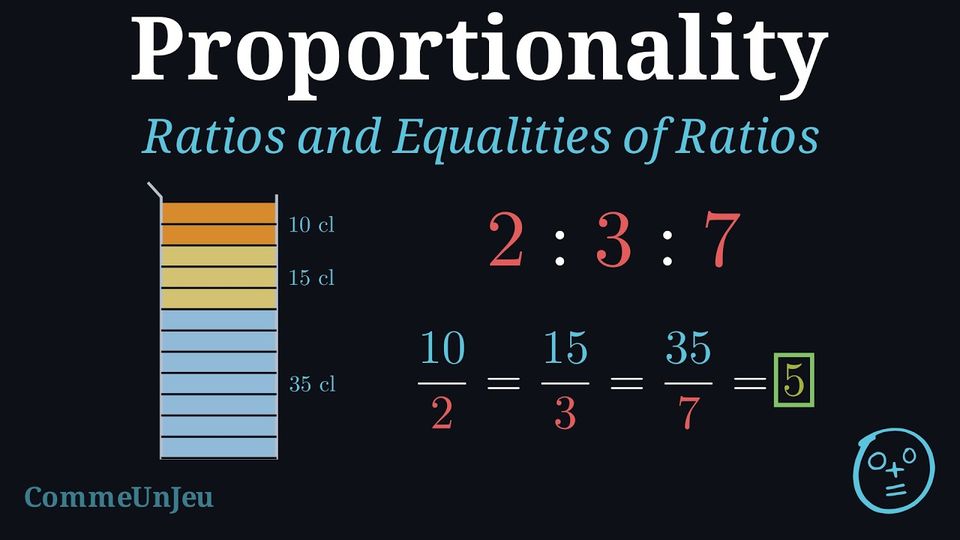
Are \(10\), \(15\) and \(35\) in the ratio \(2:3:7\)?
Compute the three quotients: $$\dfrac{10}{2} = 5 \qquad \dfrac{15}{3} = 5 \qquad \dfrac{35}{7} = 5.$$ The quotients are equal, so \(10\), \(15\) and \(35\) are in the ratio \(2:3:7\).
Example
Write each ratio in simplest form, with whole numbers. - \(0.5 : 1.25 : 2\)
- \(\dfrac{2}{3} : \dfrac{1}{2} : \dfrac{5}{6}\)
Multiplying or dividing every term of a ratio by the same non-zero number does not change the ratio: the three quotients of the definition stay equal. First clear the decimals or the fractions, then divide by the highest common factor (HCF) of the terms.
- $$\begin{aligned}[t] 0.5 : 1.25 : 2 &= 50 : 125 : 200 && \text{(multiply every term by } 100 \text{)} \\ &= \textcolor{olive}{2 : 5 : 8} && \text{(divide every term by the HCF } 25 \text{)} \end{aligned}$$
- The denominators \(3\), \(2\) and \(6\) all divide \(6\): $$\begin{aligned}[t] \dfrac{2}{3} : \dfrac{1}{2} : \dfrac{5}{6} &= \dfrac{2}{3} \times 6 : \dfrac{1}{2} \times 6 : \dfrac{5}{6} \times 6 && \text{(multiply every term by } 6 \text{)} \\ &= \textcolor{olive}{4 : 3 : 5} && \text{(the HCF of } 4\text{, } 3 \text{ and } 5 \text{ is } 1 \text{)} \end{aligned}$$
Skills to practice
- Comparing with a Quotient
- Using the Ratio Notation
- Simplifying Ratios with Decimals and Fractions
I.2
Sharing in a Ratio of Three Parts
Method — Sharing Proportionally
To share an amount proportionally to given numbers: count the parts, find the value of one part, then multiply.Example. Share \(\textcolor{colorprop}{100}\) dollars between two people proportionally to their ages, \(\textcolor{colordef}{20}\) and \(\textcolor{colordef}{30}\) years: $$\begin{aligned}[t] \text{Number of parts} &= \textcolor{colordef}{20} + \textcolor{colordef}{30} = \textcolor{colordef}{50} && \text{(add the numbers)} \\ \text{Value of one part} &= \textcolor{colorprop}{100} \div \textcolor{colordef}{50} = \textcolor{olive}{2} && \text{(divide the amount)} \\ \text{Shares} &= \textcolor{colordef}{20} \times \textcolor{olive}{2} = \textcolor{colorprop}{40} \text{ and } \textcolor{colordef}{30} \times \textcolor{olive}{2} = \textcolor{colorprop}{60} && \text{(multiply)} \end{aligned}$$ The shares \(\textcolor{colorprop}{40}\) and \(\textcolor{colorprop}{60}\) are in the ratio \(20:30 = 2:3\).
Example
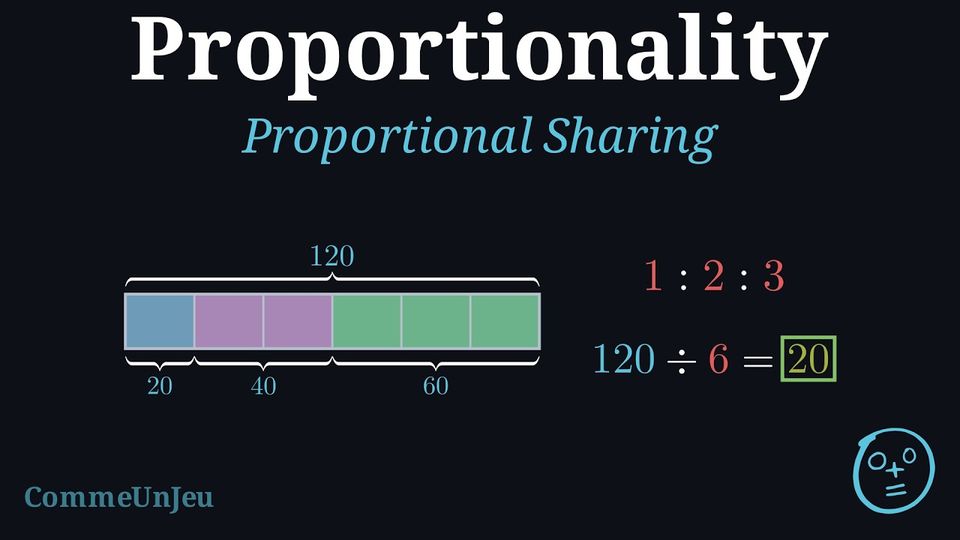
Share \(\textcolor{colorprop}{120}\) sweets between three children in the ratio \(1:2:3\).
$$\begin{aligned}[t] \text{Number of parts} &= 1 + 2 + 3 = \textcolor{colordef}{6} && \text{(add the numbers)} \\
\text{Value of one part} &= \textcolor{colorprop}{120} \div \textcolor{colordef}{6} = \textcolor{olive}{20} && \text{(divide the amount)} \\
\text{Shares} &= \textcolor{colorprop}{20}\text{, } \textcolor{colorprop}{40} \text{ and } \textcolor{colorprop}{60} && (1 \times 20\text{, } 2 \times 20\text{, } 3 \times 20) \end{aligned}$$ Check: \(20 + 40 + 60 = 120\).
Skills to practice
- Sharing a Quantity in a Ratio of Three Parts
I.3
The Fourth Proportional
Proposition — Cross Products
For numbers \(a\), \(b\), \(c\), \(d\) with \(b \neq 0\) and \(d \neq 0\): $$\dfrac{a}{b} = \dfrac{c}{d} \quad \text{exactly when} \quad \textcolor{colordef}{a} \times \textcolor{colorprop}{d} = \textcolor{colorprop}{b} \times \textcolor{colordef}{c}.$$ The products \(a \times d\) and \(b \times c\) are called the cross products. Method — Finding a Fourth Proportional
Write the proportion, apply the cross products, then divide.Example. \(\textcolor{colordef}{4}\) notebooks cost \(\textcolor{colorprop}{7}\) dollars. Price \(\textcolor{colorprop}{x}\) of \(\textcolor{colordef}{10}\) notebooks: $$\begin{aligned}[t] \dfrac{\textcolor{colorprop}{7}}{\textcolor{colordef}{4}} &= \dfrac{\textcolor{colorprop}{x}}{\textcolor{colordef}{10}} \\ \textcolor{colordef}{4} \times \textcolor{colorprop}{x} &= \textcolor{colorprop}{7} \times \textcolor{colordef}{10} && \text{(cross products)} \\ \textcolor{colorprop}{x} &= 70 \div \textcolor{colordef}{4} = \textcolor{colorprop}{17.5} && \text{(divide by }\textcolor{colordef}{4}) \end{aligned}$$ The cross products must not become automatic: when a coefficient or a multiple is visible, the simpler procedures remain the best path.
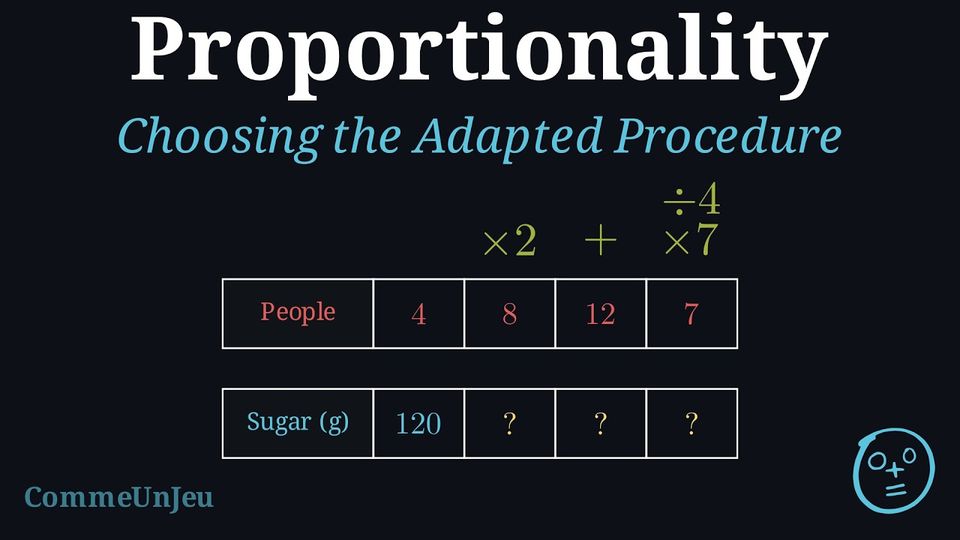
Method — Choosing the Adapted Procedure
To solve a proportionality problem, look at the numbers and choose the quickest path. - Multiply a column when the target is a multiple of a known column.
- Add two columns when the target is the sum of two known columns.
- Return to the unit (the coefficient), or use the cross products, when nothing simpler works.
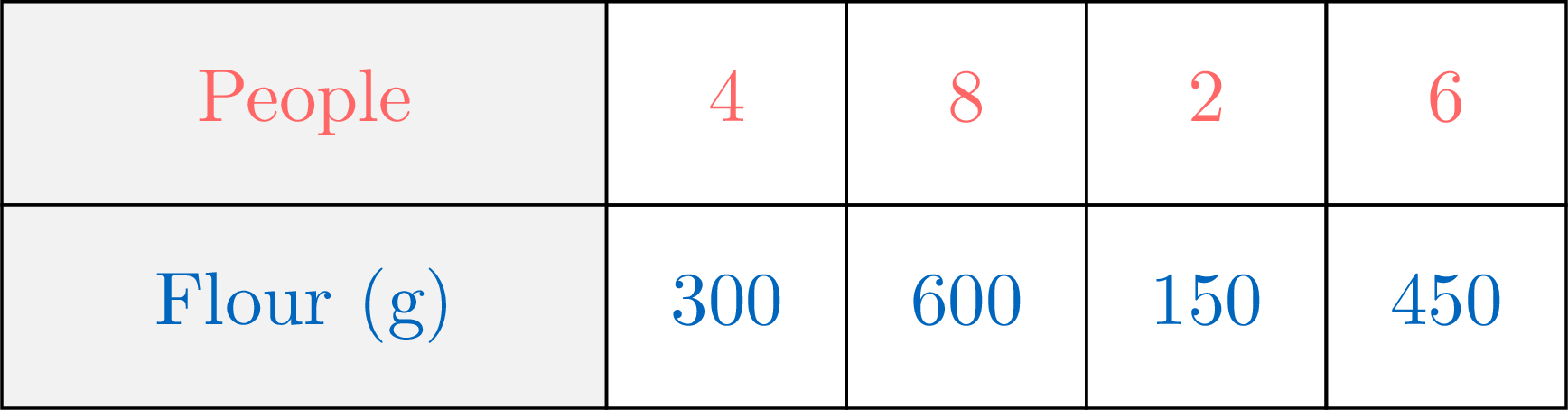
- For \(\textcolor{colordef}{8}\) people (\(8 = 4 \times 2\)): \(\textcolor{colorprop}{300} \times 2 = \textcolor{colorprop}{600}\) g.
- For \(\textcolor{colordef}{2}\) people (\(2 = 4 \div 2\)): \(\textcolor{colorprop}{300} \div 2 = \textcolor{colorprop}{150}\) g.
- For \(\textcolor{colordef}{6}\) people (\(6 = 4 + 2\)): \(\textcolor{colorprop}{300} + \textcolor{colorprop}{150} = \textcolor{colorprop}{450}\) g.
Proposition — Formulae
Because the scale is \(\textcolor{colorprop}{1}:\textcolor{colordef}{N}\), a drawn length and its real length are always in that ratio: \((\text{drawn}):(\text{real}) = 1:N\). Finding a missing length means scaling this ratio up or down, which gives three useful formulae: $$\begin{aligned}\text{Actual Length} &= \text{Drawn Length} \times \text{Scale Factor}\\
\text{Drawn Length} &= \frac{\text{Actual Length}}{\text{Scale Factor}}\\
\text{Scale Factor} &= \frac{\text{Actual Length}}{\text{Drawn Length}}\end{aligned}$$ Note: To calculate the scale factor, both lengths must be in the same unit. 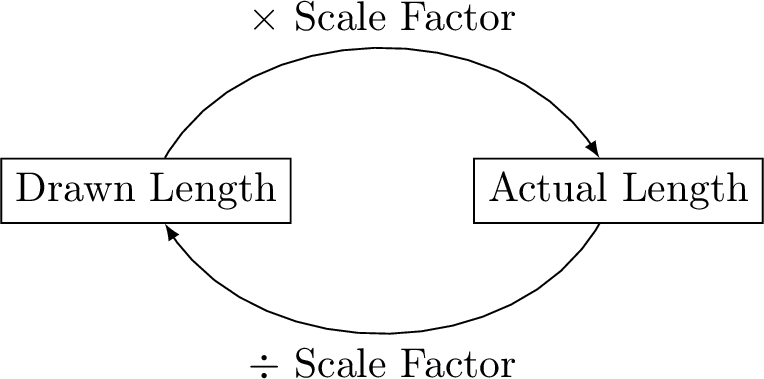
Starting with the main proportion: $$\frac{\textcolor{colorprop}{1}}{\textcolor{colordef}{\text{Scale Factor}}}= \frac{\textcolor{colorprop}{\text{Drawn Length}}}{\textcolor{colordef}{\text{Actual Length}}}$$ By cross-multiplication, we get: $$\textcolor{colorprop}{1} \times \textcolor{colordef}{\text{Actual Length}} = \textcolor{colorprop}{\text{Drawn Length}} \times \textcolor{colordef}{\text{Scale Factor}}$$ This simplifies to our main formula: $$\textcolor{colordef}{\text{Actual Length}} = \textcolor{colorprop}{\text{Drawn Length}} \times \textcolor{colordef}{\text{Scale Factor}}$$
Skills to practice
- Solving Proportions with Decimals
- Choosing Between the Procedures
II
Rates and Speed
II.1
Average and Instantaneous Speed
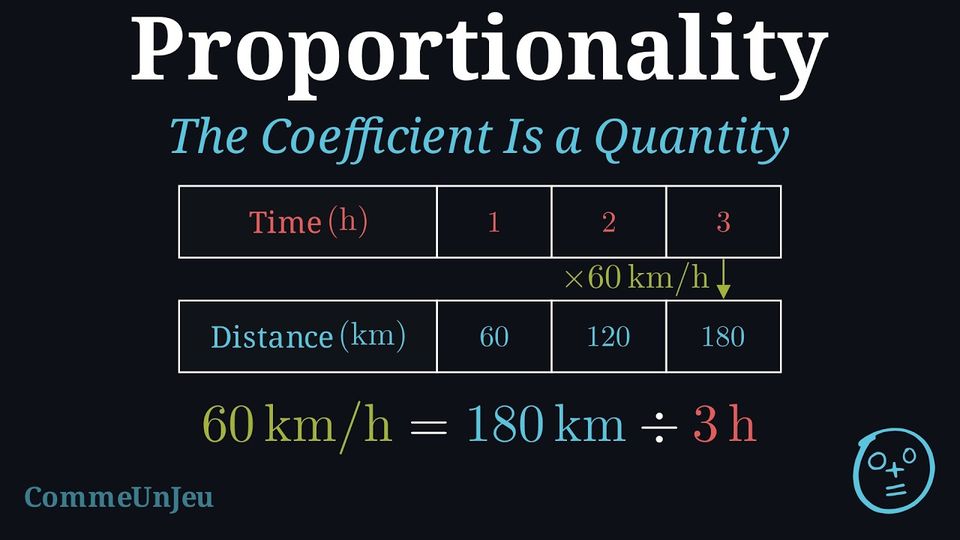
A car drives at a constant speed: the distance covered is proportional to the time. 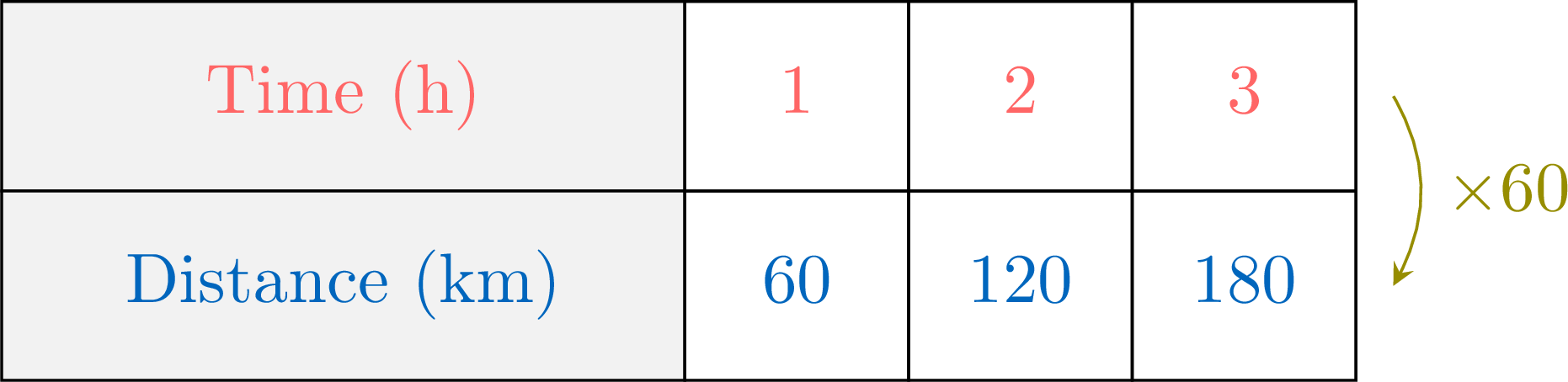
The coefficient \(\textcolor{olive}{60}\) is not just a number: it means \(\textcolor{olive}{60}\) km covered each hour. It is a quantity with a unit — a speed, written \(\textcolor{olive}{60}\) km/h.
Definition — Average Speed
The average speed of a journey is the total distance covered divided by the total time taken: $$\textcolor{olive}{\text{average speed}} = \textcolor{colorprop}{\text{total distance}} \div \textcolor{colordef}{\text{total time}}$$ When the distance covered is proportional to the time, the average speed is the coefficient of proportionality: it is the distance covered in one unit of time.It is written with its unit: km/h (kilometres per hour).
Method — Keeping the Units
The coefficient of proportionality links two quantities: keep the units in the calculations.Example. \(\textcolor{colordef}{3}\) kg of pears cost \(\textcolor{colorprop}{12}\) dollars: $$\begin{aligned}[t] \text{Coefficient} &= \textcolor{colorprop}{12} \div \textcolor{colordef}{3} = \textcolor{olive}{4}\text{ \dollar{}/kg} && \text{(dollars per kilogram)} \\ \text{Price of }5\text{ kg} &= \textcolor{olive}{4} \times \textcolor{colordef}{5} = \textcolor{colorprop}{20}\text{ \dollar{}} && \text{(multiply by the mass)} \end{aligned}$$
Example
A cyclist covers \(\textcolor{colorprop}{45}\) km in \(\textcolor{colordef}{3}\) hours at a constant speed. - What is her average speed?
- How far does she go in \(\textcolor{colordef}{5}\) hours?
- $$\begin{aligned}[t] \text{Speed} &= \textcolor{colorprop}{45} \div \textcolor{colordef}{3} = \textcolor{olive}{15}\text{ km/h} && \text{(distance} \div \text{time)} \end{aligned}$$
- $$\begin{aligned}[t] \text{Distance in }5\text{ h} &= \textcolor{olive}{15} \times \textcolor{colordef}{5} = \textcolor{colorprop}{75}\text{ km} && \text{(multiply by the time)} \end{aligned}$$
Average Speed and Instantaneous Speed
An average speed describes a whole journey: total distance \(\div\) total time. It does not say how fast the moving object goes at each moment. A car that covers \(150\) km in \(2\) h has an average speed of \(75\) km/h, yet it may have stopped at traffic lights and driven at \(110\) km/h on the motorway.
The speed at one given instant is the instantaneous speed: it is the speed a speedometer shows. To estimate it, compute the average speed over a very short time interval that starts at this instant: for a motion whose speed changes smoothly, a shorter interval usually gives a closer estimate.
On a graph of the distance travelled against time (for a motion that does not turn back, the distance from the start), the average speed between two instants is the steepness of the segment joining the two points of the graph; the instantaneous speed is the steepness of the graph at one point.
Example
A stone is dropped from the top of a cliff. The table gives the distance \(d\) it has fallen after \(t\) seconds. | Time \(t\) (s) | \(0\) | \(1\) | \(2\) | \(2.01\) | \(2.1\) | \(3\) |
| Distance \(d\) (m) | \(0\) | \(5\) | \(20\) | \(20.2005\) | \(22.05\) | \(45\) |
- Calculate the average speed of the stone over the first \(3\) seconds.
- Calculate its average speed from \(t = 2\) s to \(t = 3\) s, from \(t = 2\) s to \(t = 2.1\) s, then from \(t = 2\) s to \(t = 2.01\) s.
- Estimate the instantaneous speed of the stone at \(t = 2\) s.
- $$\begin{aligned}[t] \text{Average speed} &= 45 \div 3 && \text{(total distance} \div \text{total time)} \\ &= \textcolor{olive}{15}\text{ m/s} \end{aligned}$$
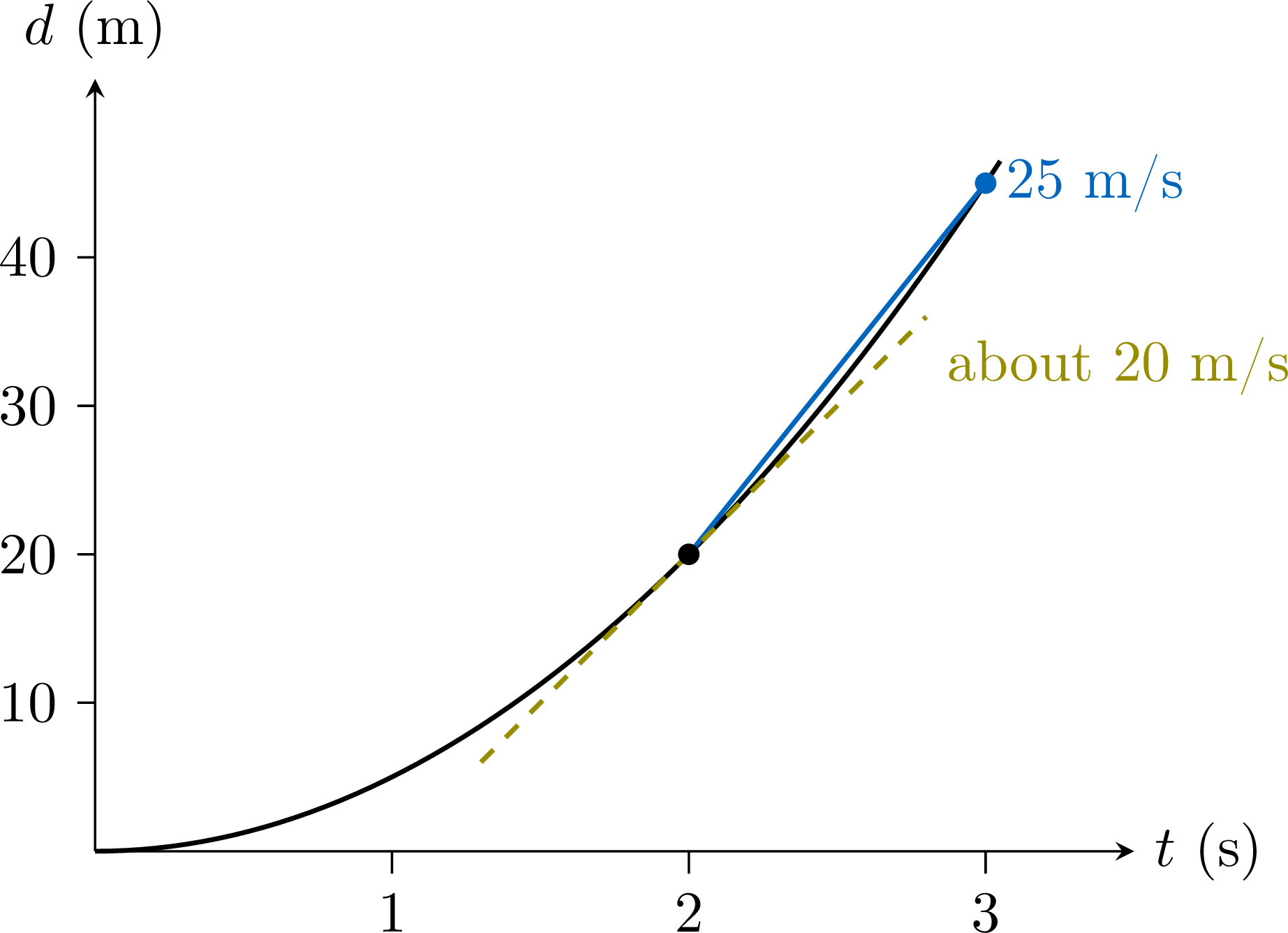
- Over each interval, the average speed is the distance gained divided by the time taken: $$\begin{aligned}[t] \text{from } 2 \text{ s to } 3 \text{ s:}\quad \dfrac{45 - 20}{3 - 2} &= \dfrac{25}{1} = \textcolor{colorprop}{25}\text{ m/s} \\ \text{from } 2 \text{ s to } 2.1 \text{ s:}\quad \dfrac{22.05 - 20}{2.1 - 2} &= \dfrac{2.05}{0.1} = 20.5\text{ m/s} \\ \text{from } 2 \text{ s to } 2.01 \text{ s:}\quad \dfrac{20.2005 - 20}{2.01 - 2} &= \dfrac{0.2005}{0.01} = 20.05\text{ m/s} \end{aligned}$$
- The shorter the interval, the closer the average speeds get to \(20\) m/s: the instantaneous speed of the stone at \(t = 2\) s is about \(\textcolor{olive}{20}\) m/s. It is more than the average speed of \(15\) m/s over the first \(3\) seconds: the stone goes faster and faster, as its average speeds over the successive seconds show (\(5\), then \(15\), then \(25\) m/s). On the graph, the curve joins the points of the table; the dashed line, drawn with the estimated steepness of \(20\) m/s (it rises \(20\) m for each second), touches the curve at the point of \(t = 2\) s and shows the steepness of the graph there; the segment from \(t = 2\) s to \(t = 3\) s is steeper.
Skills to practice
- Calculating an Average Speed
- Using the Coefficient with Units
- Estimating a Speed at an Instant
II.2
Converting Rates
Definition — Quotient Quantity
A quotient quantity is the quotient of two quantities of different natures. Its unit combines the two units: km/h for a speed, \dollar{}/kg for a unit price, L/min for a flow rate, kg/m\(^3\) for a density.When the two quantities are proportional, the quotient quantity is their coefficient of proportionality.
Rates
A quotient quantity is also called a rate. It tells how much of one quantity goes with one unit of the other, and it is read with the word “per”: \(90\) kilometres per hour, \(\dollar 4.50\) per kilogram, \(12\) litres per minute. A unit price (a price per kilogram, per litre, per item) is a rate: to compare two offers of the same product, compare their unit prices written for the same unit (both per kilogram, for example).
Method — Converting a Quotient Quantity
To express a quotient quantity in other units, convert the numerator and the denominator separately, then divide: $$72 \text{ km/h} = \frac{72 \text{ km}}{1 \text{ h}} = \frac{72\,000 \text{ m}}{3\,600 \text{ s}} = 20 \text{ m/s}.$$ Useful equalities: \(1\) h \(= 3\,600\) s, \(1\) min \(= 60\) s, \(1\) km \(= 1\,000\) m, \(1\) m\(^3 = 1\,000\) L. In particular, \(1\) m/s \(= \dfrac{3\,600 \text{ m}}{1 \text{ h}} = 3.6\) km/h: to go from m/s to km/h, multiply by \(3.6\). Example
A cheetah runs at \(\textcolor{colorprop}{30}\) m/s. Express this speed in km/h.
$$\begin{aligned} \textcolor{colorprop}{30} \text{ m/s} &= \frac{30 \text{ m}}{1 \text{ s}} &&\text{(a distance divided by a time)}\\
&= \frac{30 \times 3\,600 \text{ m}}{3\,600 \text{ s}} &&\text{(in } 3\,600 \text{ s, it covers } 3\,600 \text{ times as far)}\\
&= \frac{108\,000 \text{ m}}{1 \text{ h}} = \frac{108 \text{ km}}{1 \text{ h}} &&\text{(}3\,600 \text{ s} = 1 \text{ h and } 1\,000 \text{ m} = 1 \text{ km)}\\
&= \textcolor{olive}{108} \text{ km/h} \end{aligned}$$ Check with the rule of the method: \(30 \times 3.6 = 108\).
Example
The flow of a river is \(\textcolor{colorprop}{0.2}\) m\(^3\)/s. Express it in L/min.
$$\begin{aligned} \textcolor{colorprop}{0.2} \text{ m}^3\text{/s} &= \frac{0.2 \text{ m}^3}{1 \text{ s}} = \frac{200 \text{ L}}{1 \text{ s}} &&\text{(}1 \text{ m}^3 = 1\,000 \text{ L)}\\
&= \frac{200 \times 60 \text{ L}}{60 \text{ s}} &&\text{(in } 60 \text{ s, } 60 \text{ times as much water flows)}\\
&= \frac{12\,000 \text{ L}}{1 \text{ min}} = \textcolor{olive}{12\,000} \text{ L/min} &&\text{(}60 \text{ s} = 1 \text{ min)} \end{aligned}$$
Skills to practice
- Converting Speeds and Flow Rates
II.3
Density
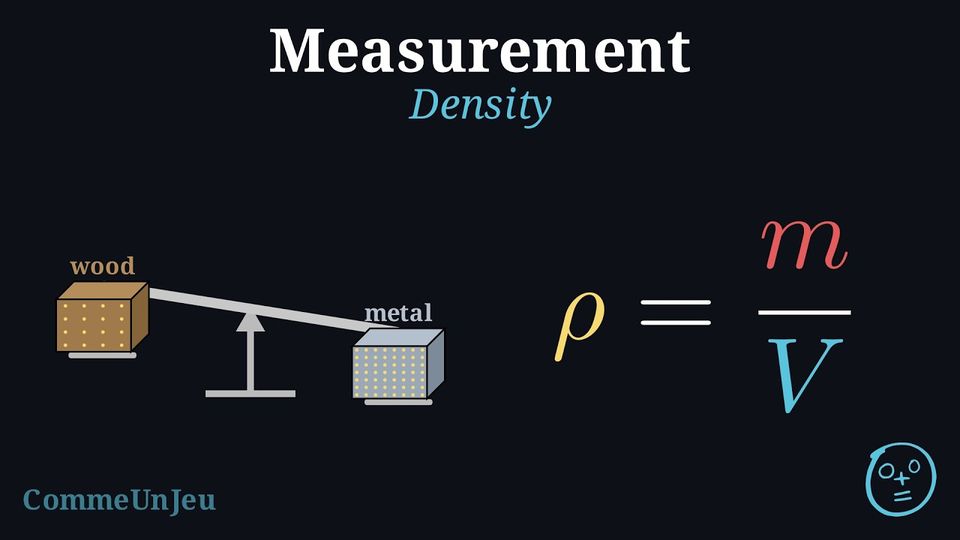
Two blocks are the same size, but one is wood and the other is metal. Why is one much heavier? The material itself matters—this is captured by density.
Definition — Density
The density \(\rho\) of a substance is its mass per unit volume:$$\rho=\dfrac{m}{V}.$$ Like a speed or a flow rate, density is a quotient quantity: it divides one quantity (mass) by another (volume). Common units: \(\text{kg}/\text{m}^3\) or \(\text{g}/\text{cm}^3\). Proposition — Rearranging the Density Formula
$$m=\rho V \qquad\text{and}\qquad V=\dfrac{m}{\rho}.$$ Method — Unit Conversions
$$1~\text{g}/\text{cm}^3=1\,000~\text{kg}/\text{m}^3 \qquad\text{and}\qquad 1~\text{kg}/\text{m}^3=0.001~\text{g}/\text{cm}^3.$$ Example
An aluminium block measures \(3\) cm \(\times\) \(2\) cm \(\times\) \(4\) cm. Aluminium has density \(\rho=2.7~\text{g}/\text{cm}^3\). Find its mass.
Volume \(V=3\cdot2\cdot4=24~\text{cm}^3\). Then$$m=\rho V=2.7\times 24=64.8~\text{g}.$$
Skills to practice
- Calculating a Density, a Mass or a Volume and Converting Units
II.4
Time Zones
Definition — Time Zones
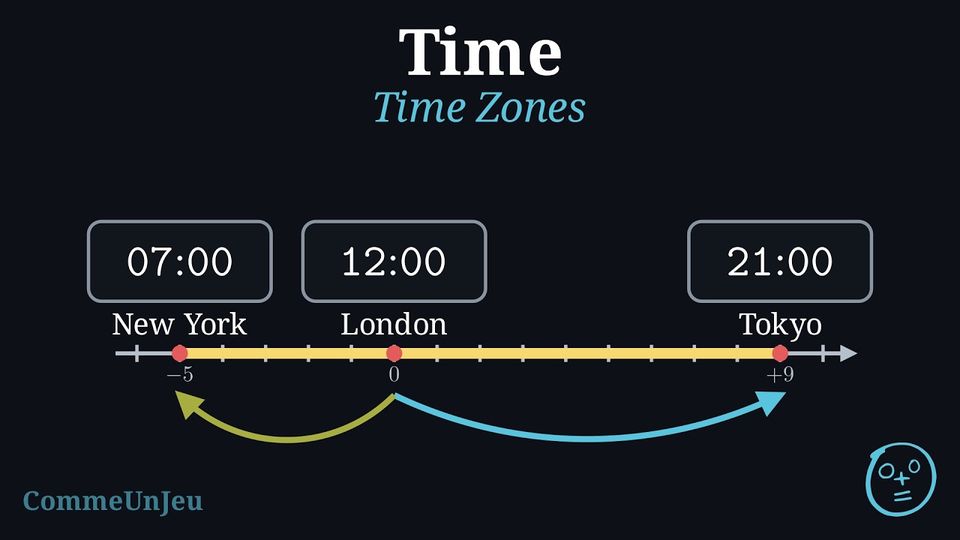
The local time of a place is the time shown by the clocks of that place. The Earth is divided into time zones: all the places of one time zone have the same local time.Each time zone is described by the number of hours it is ahead of or behind a reference time called UTC (Coordinated Universal Time), which is the local time of London in winter.
- UTC\(+3\) means \(3\) hours ahead of UTC: when it is 12:00 UTC, it is 15:00 in that time zone.
- UTC\(-5\) means \(5\) hours behind UTC: when it is 12:00 UTC, it is 07:00 in that time zone.
| City | Time zone | City | Time zone |
| Los Angeles | UTC\(-8\) | Cairo | UTC\(+2\) |
| New York | UTC\(-5\) | Moscow | UTC\(+3\) |
| Rio de Janeiro | UTC\(-3\) | Dubai | UTC\(+4\) |
| London | UTC\(+0\) | Beijing | UTC\(+8\) |
| Paris | UTC\(+1\) | Tokyo | UTC\(+9\) |
| Berlin | UTC\(+1\) | Sydney | UTC\(+10\) |
Method — Finding the Time in Another City
The time-zone line places each city at its time zone; each step of the line is one hour.  }
- Place the two cities on the time-zone line.
- Count the steps from one city to the other: this is the time difference, in hours.
- The city further to the right is ahead. Going from a city to a city further right, add the time difference; going to a city further left, subtract it.
- Check the day: a time past 24:00 is on the next day (subtract \(24\) h); a time before 00:00 is on the previous day (add \(24\) h before subtracting).
Skills to practice
- Time Zones
III
Going further
Skills to practice
- Comparing Mixtures and Sharing
- Choosing a Procedure and Solving Multi-Step Problems
- Solving Problems
- Solving Real-Life Problems with Density and Time Zones
- Investigating Average Speeds
- Quiz
Jump to section