International Baccalaureate · MYP 2
Ratios, Rates and Percentages
I
Ratios and Proportions
I.1
What a Ratio Is
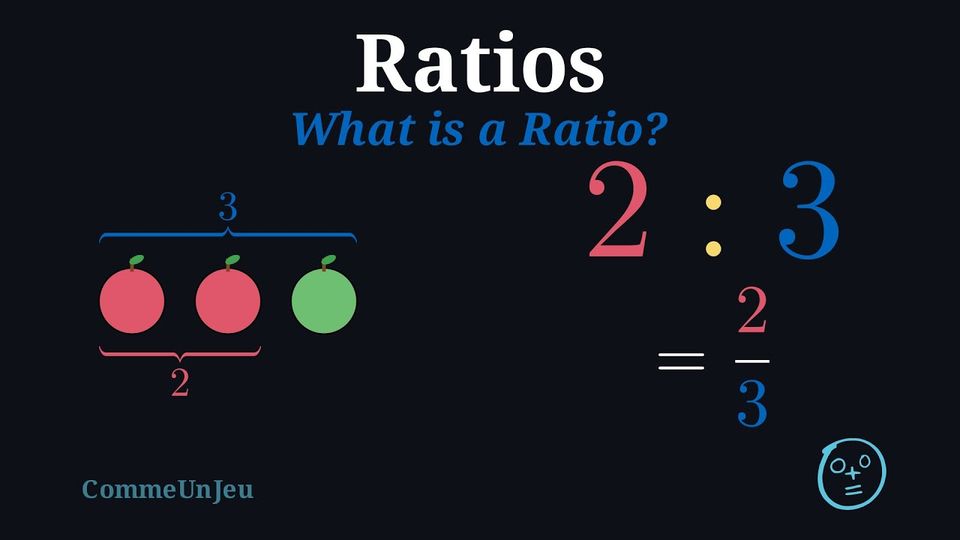
Definition — Ratio
A ratio is a comparison of two quantities. The ratio of \(\textcolor{colordef}{2}\) to \(\textcolor{colorprop}{3}\) is written \(\textcolor{colordef}{2}:\textcolor{colorprop}{3}\) (read “\(2\) to \(3\)”). 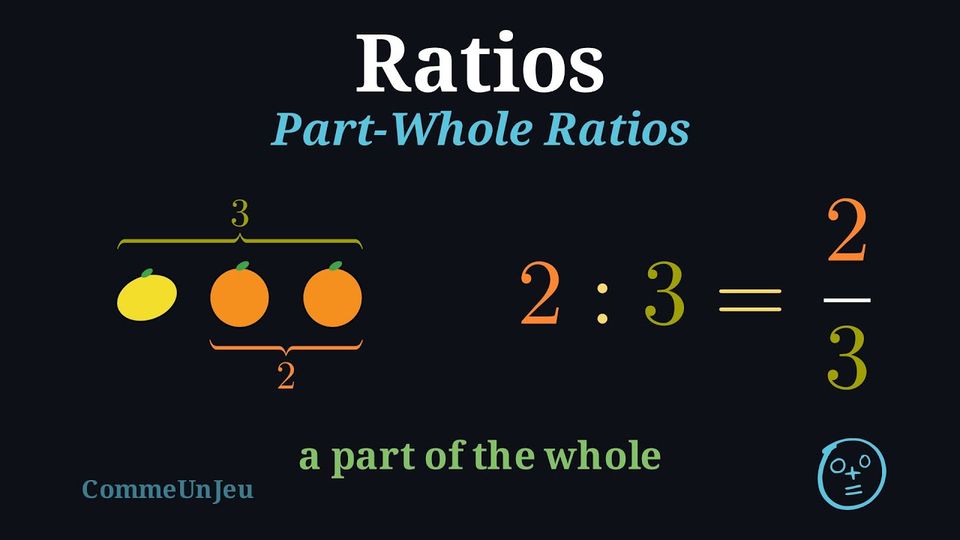
Definition — Part-Part Ratio
A part-part ratio compares two distinct parts of a whole.$$\textcolor{colordef}{\text{Part 1}}:\textcolor{colorprop}{\text{Part 2}}$$ 
Definition — Part-Whole Ratio
A part-whole ratio compares one part of a whole to the whole.$$\textcolor{colordef}{\text{Part 1}}:\textcolor{olive}{\text{Whole}}\text{ or }\textcolor{colorprop}{\text{Part 2}}:\textcolor{olive}{\text{Whole}}$$ 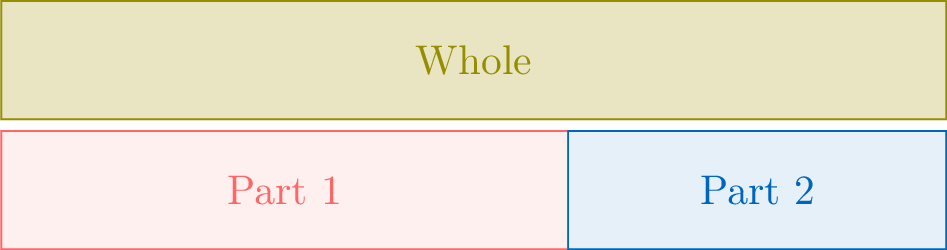
Skills to practice
- Finding Ratios in Part-Whole Relationships
I.2
Equal Ratios
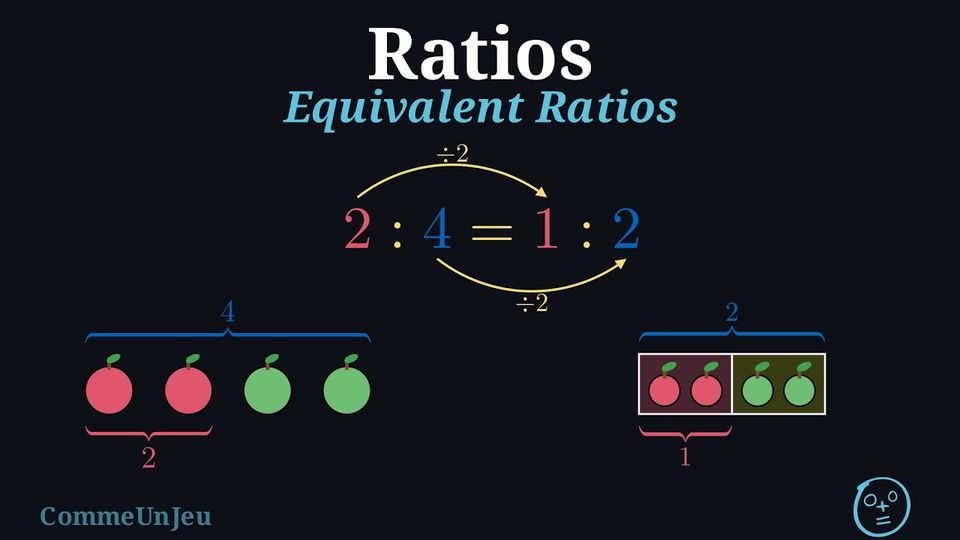
Definition — Equivalent Ratios
Two ratios are equivalent if they represent the same relationship. You can find equivalent ratios by multiplying or dividing both parts of the ratio by the same nonzero number. Example
The ratio of red apples to all apples is \(\dfrac{2}{4}\), which is equivalent to \(\dfrac{1}{2}\) (half of the apples are red). 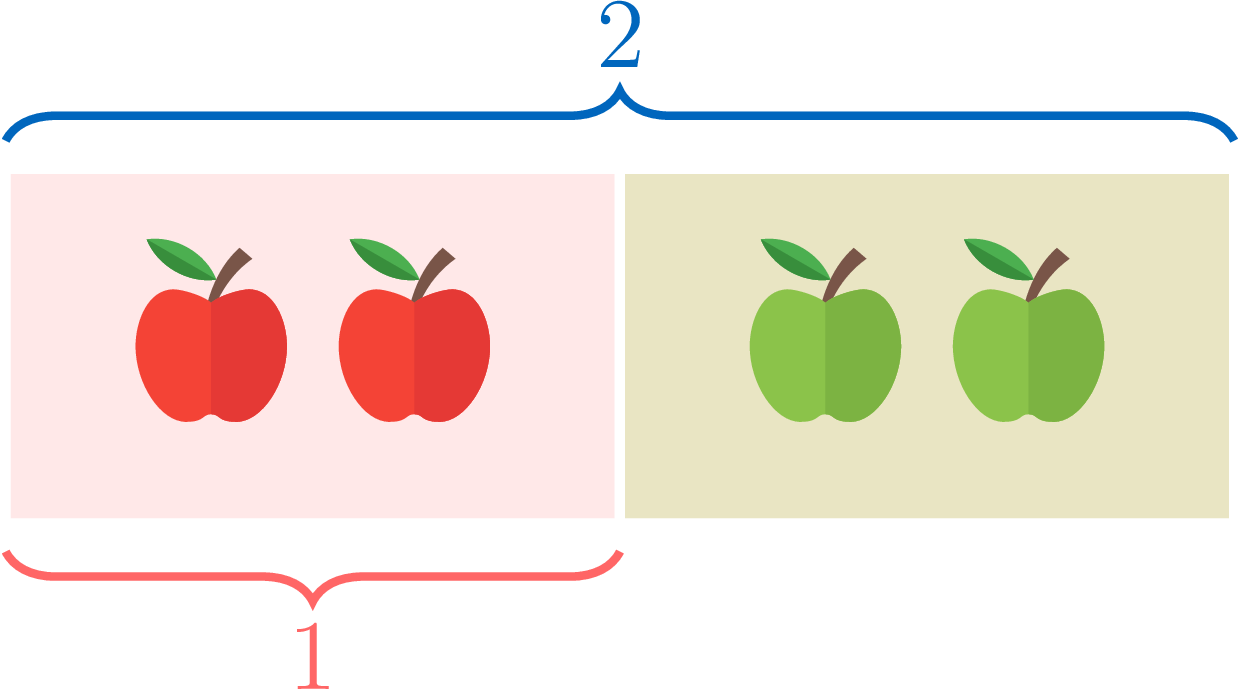
Method — Using Fractions
To check if two ratios are equivalent, we can compare their fractions. If the fractions are equivalent, then the ratios are equivalent. Example
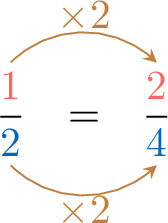 , the ratios are equivalent: \(\textcolor{colordef}{1}:\textcolor{colorprop}{2}=\textcolor{colordef}{2}:\textcolor{colorprop}{4}\)
Skills to practice
- Simplifying Ratios
I.3
Proportions
- For one glass of juice, you need \(\textcolor{colordef}{1}\) lemon and \(\textcolor{colorprop}{2}\) oranges. The ratio of lemons to oranges is \(\textcolor{colordef}{1}:\textcolor{colorprop}{2}\).

- To make two glasses of juice, you need to double the ingredients: \(\textcolor{colordef}{2}\) lemons and \(\textcolor{colorprop}{4}\) oranges. The new ratio is \(\textcolor{colordef}{2}:\textcolor{colorprop}{4}\).
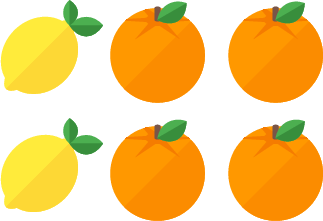
- The amount of fruit is proportional because the ratios are equivalent: \(\dfrac{\textcolor{colordef}{1}}{\textcolor{colorprop}{2}} = \dfrac{\textcolor{colordef}{2}}{\textcolor{colorprop}{4}}\). (Here \(\dfrac{1}{2}\) compares lemons to oranges — a part-part ratio — not lemons to the total.)
Definition — Proportion
A proportion is an equation stating that two ratios are equivalent. Example
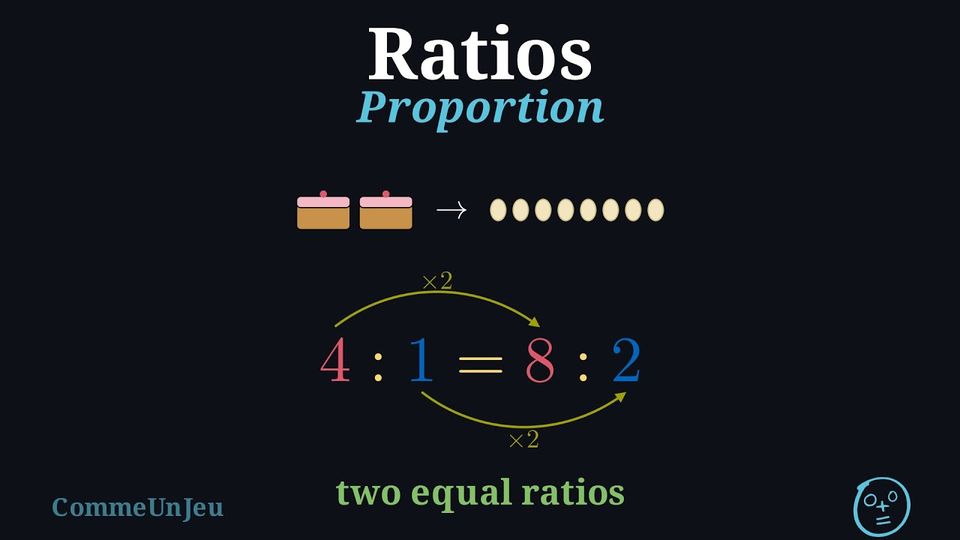
To make \(\textcolor{colorprop}{1}\) chocolate cake, you need \(\textcolor{colordef}{4}\) eggs. How many eggs are needed for \(\textcolor{colorprop}{2}\) cakes?
For \(\textcolor{colorprop}{1}\) cake, you need \(\textcolor{colordef}{4}\) eggs. To find the number of eggs for \(\textcolor{colorprop}{2}\) cakes, we set up a proportion: 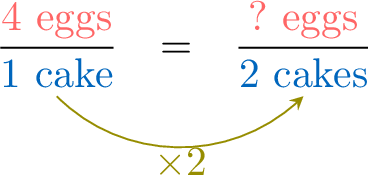
By multiplying both parts of the ratio by 2, we find you need \(\textcolor{colordef}{8}\) eggs. 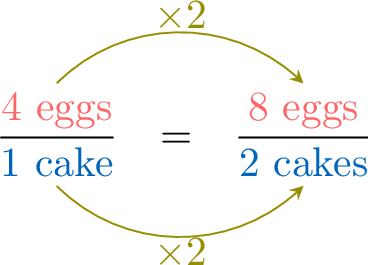
Skills to practice
- Identifying a Proportion
I.4
Dividing a Quantity in a Ratio
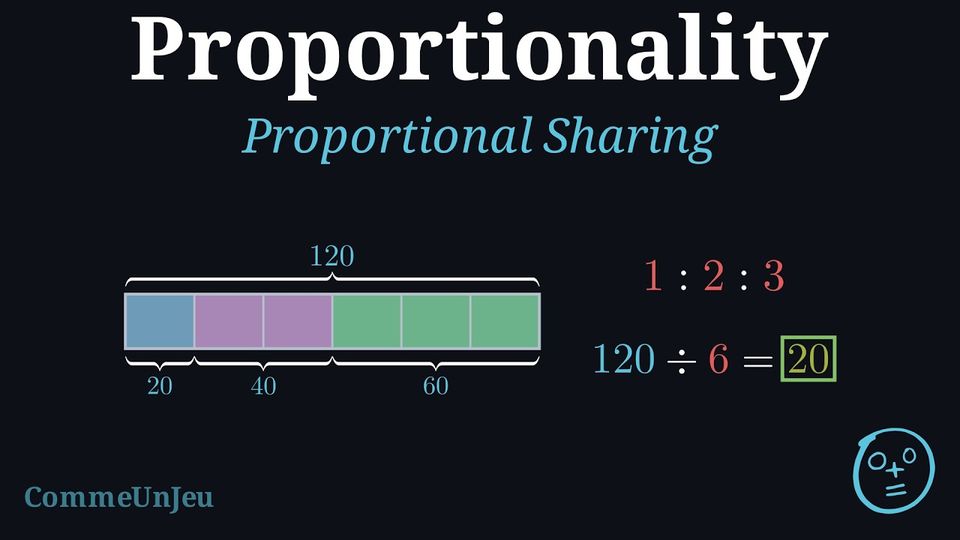
Method — Sharing Proportionally
To share an amount proportionally to given numbers: count the parts, find the value of one part, then multiply.Example. Share \(\textcolor{colorprop}{100}\) dollars between two people proportionally to their ages, \(\textcolor{colordef}{20}\) and \(\textcolor{colordef}{30}\) years: $$\begin{aligned}[t] \text{Number of parts} &= \textcolor{colordef}{20} + \textcolor{colordef}{30} = \textcolor{colordef}{50} && \text{(add the numbers)} \\ \text{Value of one part} &= \textcolor{colorprop}{100} \div \textcolor{colordef}{50} = \textcolor{olive}{2} && \text{(divide the amount)} \\ \text{Shares} &= \textcolor{colordef}{20} \times \textcolor{olive}{2} = \textcolor{colorprop}{40} \text{ and } \textcolor{colordef}{30} \times \textcolor{olive}{2} = \textcolor{colorprop}{60} && \text{(multiply)} \end{aligned}$$ The shares \(\textcolor{colorprop}{40}\) and \(\textcolor{colorprop}{60}\) are in the ratio \(20:30 = 2:3\).
Skills to practice
- Sharing Proportionally
II
Unit Rates and Rates
II.1
Proportional Quantities and the Unit Rate
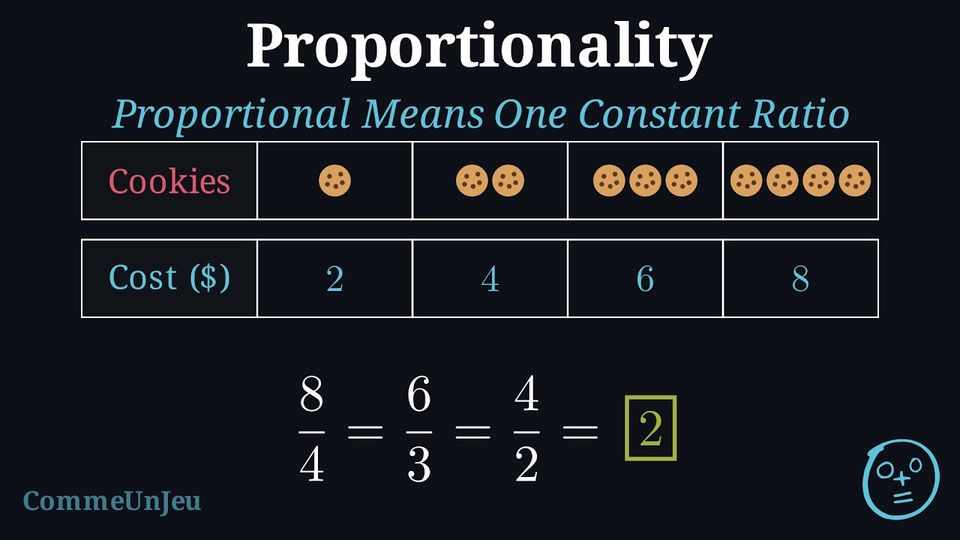
Imagine you are buying biscuits. Each biscuit costs \(\dollar 2\). The number of biscuits is \(\textcolor{colordef}{x}\) and the total cost is \(\textcolor{colorprop}{y}\). We have:

| \(\textcolor{colordef}{1}\) biscuit costs | \(\textcolor{colorprop}{2} = \textcolor{olive}{2} \times \textcolor{colordef}{1}\) |
| \(\textcolor{colordef}{2}\) biscuits cost | \(\textcolor{colorprop}{4} = \textcolor{olive}{2} \times \textcolor{colordef}{2}\) |
| \(\textcolor{colordef}{3}\) biscuits cost | \(\textcolor{colorprop}{6} = \textcolor{olive}{2} \times \textcolor{colordef}{3}\) |
| \(\textcolor{colordef}{4}\) biscuits cost | \(\textcolor{colorprop}{8} = \textcolor{olive}{2} \times \textcolor{colordef}{4}\) |
| \(\textcolor{colordef}{x}\) biscuits cost | \(\textcolor{colorprop}{y} = \textcolor{olive}{2} \times \textcolor{colordef}{x}\) |
- Ratio definition: No matter how many biscuits you buy, the ratio \(\dfrac{\textcolor{colorprop}{y}}{\textcolor{colordef}{x}}\) is always the same and equal to the price of one biscuit: $$\dfrac{\textcolor{colorprop}{8}}{\textcolor{colordef}{4}} =\dfrac{\textcolor{colorprop}{6}}{\textcolor{colordef}{3}} = \dfrac{\textcolor{colorprop}{4}}{\textcolor{colordef}{2}} = \dfrac{\textcolor{colorprop}{y}}{\textcolor{colordef}{x}} =\textcolor{olive}{2}.$$
- Linearity definition: The total cost can also be expressed with a formula (a linear function): $$\textcolor{colorprop}{y} = \textcolor{olive}{2} \times \textcolor{colordef}{x}.$$
Definition — Proportional
Two quantities \(\textcolor{colordef}{x}\) and \(\textcolor{colorprop}{y}\) are proportional if, for every pair of matching values with \(\textcolor{colordef}{x} \neq 0\), the quotient \(\dfrac{\textcolor{colorprop}{y}}{\textcolor{colordef}{x}}\) is always the same, equal to a value \(\textcolor{olive}{k}\) called the coefficient of proportionality: $$\dfrac{\textcolor{colorprop}{y}}{\textcolor{colordef}{x}} = \textcolor{olive}{k}.$$ Equivalently, \(\textcolor{colorprop}{y}\) is proportional to \(\textcolor{colordef}{x}\) if, for the same constant \(\textcolor{olive}{k}\), $$ \textcolor{colorprop}{y} = \textcolor{olive}{k}\times \textcolor{colordef}{x}.$$ Example
Does this table represent a proportional relationship? | \(\textcolor{colordef}{x}\) | \(\textcolor{colordef}{1}\) | \(\textcolor{colordef}{2}\) | \(\textcolor{colordef}{3}\) |
| \(\textcolor{colorprop}{y}\) | \(\textcolor{colorprop}{15}\) | \(\textcolor{colorprop}{30}\) | \(\textcolor{colorprop}{45}\) |
Yes. The table represents a proportional relationship because each ratio is equal: $$\dfrac{\textcolor{colorprop}{15}}{\textcolor{colordef}{1}} = \dfrac{\textcolor{colorprop}{30}}{\textcolor{colordef}{2}} = \dfrac{\textcolor{colorprop}{45}}{\textcolor{colordef}{3}} = \textcolor{olive}{15}.$$
Skills to practice
- Calculating a Unit Rate
- Using Unit Rates to Calculate a Total
- Using Unit Rates to Calculate a Missing Quantity
II.2
The Unitary Method and the Better Buy
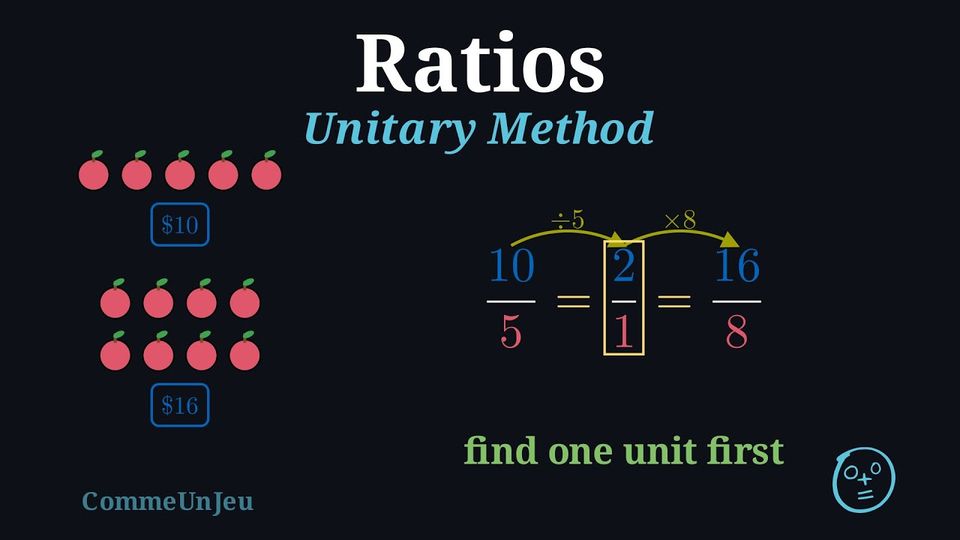
The unitary method is a great technique to solve proportion problems. The main idea is to first find the value of one unit, and then use that value to find the quantity you need.
Method — Unitary Method
If \(\textcolor{colordef}{5}\) apples cost \(\dollar\textcolor{colorprop}{10}\), how much do \(\textcolor{colordef}{8}\) apples cost? - Step 1: Find the cost of 1 apple (the unit cost).
Divide the total cost by the number of apples.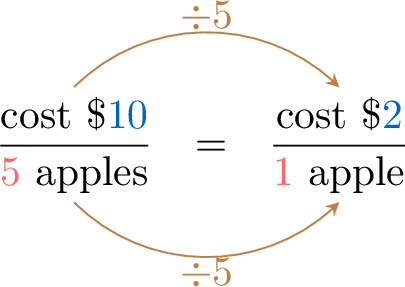
- Step 2: Find the cost of 8 apples.
Multiply the unit cost by the number of apples you want.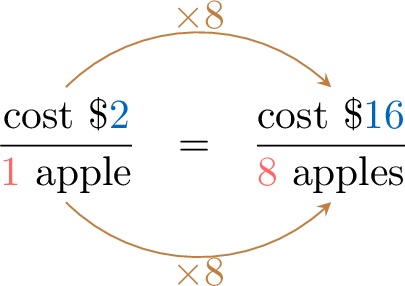
-

Example
Rice is sold in two packs: pack A holds \(500\)~g for \(\dollar 3.60\); pack B holds \(750\)~g for \(\dollar 5.10\). Which pack is the better buy?
The better buy is the pack with the lower unit price: compare the prices of the same mass, here \(1\)~kg.
- Pack A: \(1\)~kg is \(2\times500\)~g, so $$\text{price of }1\text{ kg}=2\times\dollar 3.60=\dollar 7.20.$$
- Pack B: \(750\)~g is \(3\times250\)~g, so $$\begin{aligned}[t] \text{price of }250\text{ g}&=\dollar 5.10\div3=\dollar 1.70 &&\text{(back to }250\text{ g)}\\ \text{price of }1\text{ kg}&=4\times\dollar 1.70=\dollar 6.80 &&\text{(}1\text{ kg}=4\times250\text{ g)} \end{aligned}$$
Skills to practice
- Comparing Prices by Unit Cost
- Bringing to the Unit and Back
- Converting to and from the Unit
II.3
Cross-Multiplication
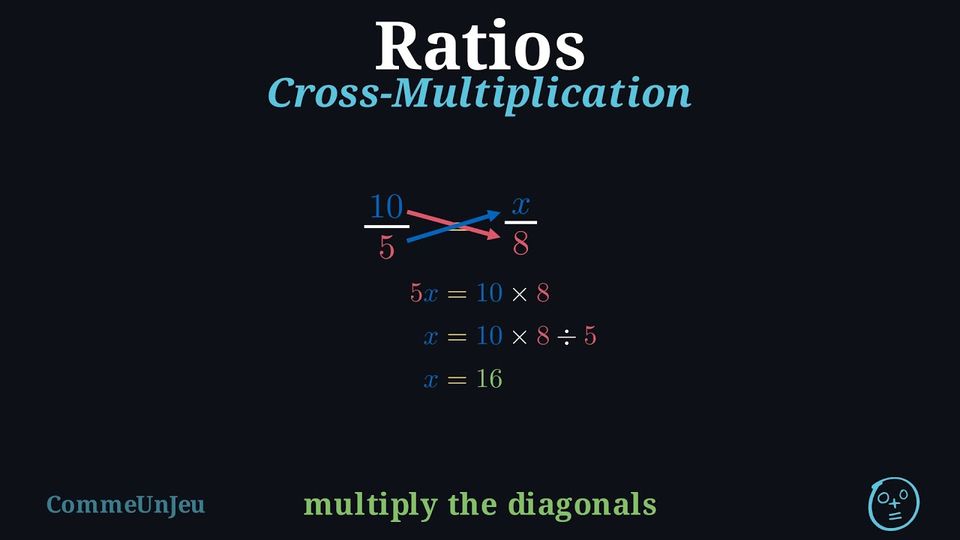
Cross-multiplication is a shortcut to solve proportion problems. It allows you to find a missing value by multiplying numbers diagonally.
Method — Cross-Multiplication
If \(\textcolor{colordef}{5}\) apples cost \(\dollar\textcolor{colorprop}{10}\), how much do \(\textcolor{colordef}{8}\) apples cost? - Step 1: Set up the proportion. Let \(x\) be the unknown cost.
\(\dfrac{\dollar\textcolor{colorprop}{10}}{\textcolor{colordef}{5} \text{ apples}} = \dfrac{\dollar\textcolor{colorprop}{x}}{\textcolor{colordef}{8} \text{ apples}}\) - Step 2: Cross-multiply and solve for \(x\). Multiply the numbers that are diagonal to each other.
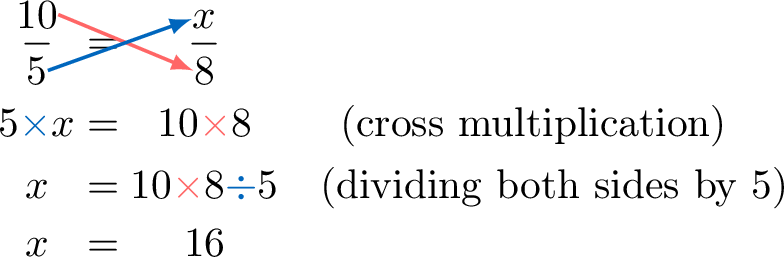
- So, \(\textcolor{colordef}{8}\) apples cost \(\dollar\textcolor{colorprop}{16}\).
Skills to practice
- Finding a Quantity
II.4
Rates
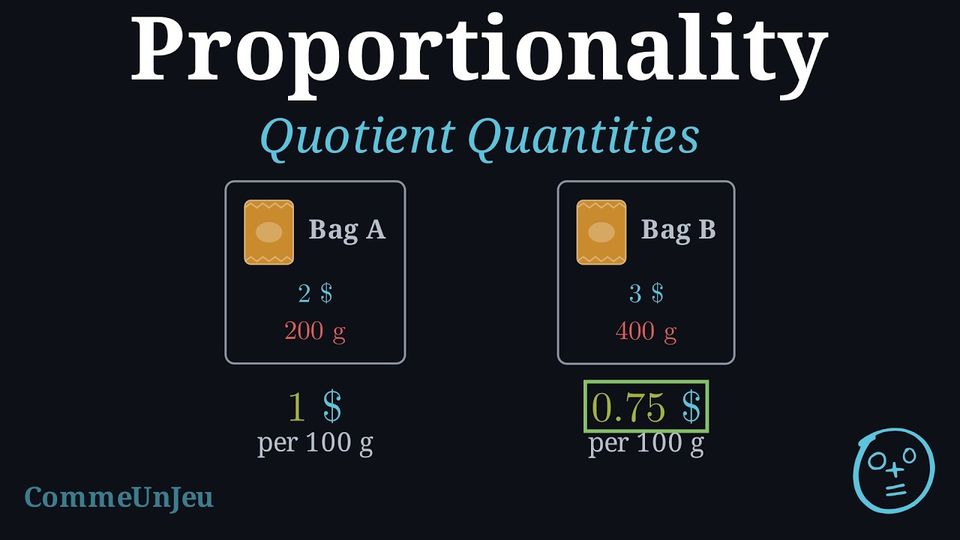
Two cars are compared. Car A uses \(\textcolor{colorprop}{30}\) L of fuel for \(\textcolor{colordef}{500}\) km; car B uses \(\textcolor{colorprop}{25}\) L for \(\textcolor{colordef}{400}\) km. Which one consumes less?
To compare, we compute the consumption for the same distance, \(100\) km: $$\begin{aligned}[t] \text{Consumption of A} &= \textcolor{colorprop}{30} \div 5 = \textcolor{olive}{6}\text{ L per }100\text{ km} && (500\text{ km} = 5 \times 100\text{ km}) \\ \text{Consumption of B} &= \textcolor{colorprop}{25} \div 4 = \textcolor{olive}{6.25}\text{ L per }100\text{ km} && (400\text{ km} = 4 \times 100\text{ km}) \end{aligned}$$ Car A consumes less. The number \(\textcolor{olive}{6}\) L per \(100\) km is a quotient quantity: it divides one quantity (a volume) by another (a distance).
To compare, we compute the consumption for the same distance, \(100\) km: $$\begin{aligned}[t] \text{Consumption of A} &= \textcolor{colorprop}{30} \div 5 = \textcolor{olive}{6}\text{ L per }100\text{ km} && (500\text{ km} = 5 \times 100\text{ km}) \\ \text{Consumption of B} &= \textcolor{colorprop}{25} \div 4 = \textcolor{olive}{6.25}\text{ L per }100\text{ km} && (400\text{ km} = 4 \times 100\text{ km}) \end{aligned}$$ Car A consumes less. The number \(\textcolor{olive}{6}\) L per \(100\) km is a quotient quantity: it divides one quantity (a volume) by another (a distance).
Definition — Quotient Quantity
A quotient quantity is the quotient of two quantities of different natures. Its unit combines the two units: km/h for a speed, \dollar{}/kg for a unit price, L/min for a flow rate, kg/m\(^3\) for a density.When the two quantities are proportional, the quotient quantity is their coefficient of proportionality.
Rates
A quotient quantity is also called a rate. It tells how much of one quantity goes with one unit of the other, and it is read with the word “per”: \(90\) kilometres per hour, \(\dollar 4.50\) per kilogram, \(12\) litres per minute. A unit price (a price per kilogram, per litre, per item) is a rate: to compare two offers of the same product, compare their unit prices written for the same unit (both per kilogram, for example).
Example
A shower uses \(\textcolor{colorprop}{90}\) L of water in \(\textcolor{colordef}{6}\) minutes. - What is the flow rate in L/min?
- At this steady flow rate, how much water is used in \(\textcolor{colordef}{10}\) minutes?
- $$\begin{aligned}[t] \text{Flow rate} &= \textcolor{colorprop}{90} \div \textcolor{colordef}{6} = \textcolor{olive}{15}\text{ L/min} && \text{(volume} \div \text{time)} \end{aligned}$$
- $$\begin{aligned}[t] \text{Water in }10\text{ min} &= \textcolor{olive}{15} \times \textcolor{colordef}{10} = \textcolor{colorprop}{150}\text{ L} && \text{(flow rate} \times \text{time)} \end{aligned}$$
Skills to practice
- Calculating and Using Rates
III
Percentages
III.1
Percentages, Fractions and Decimals
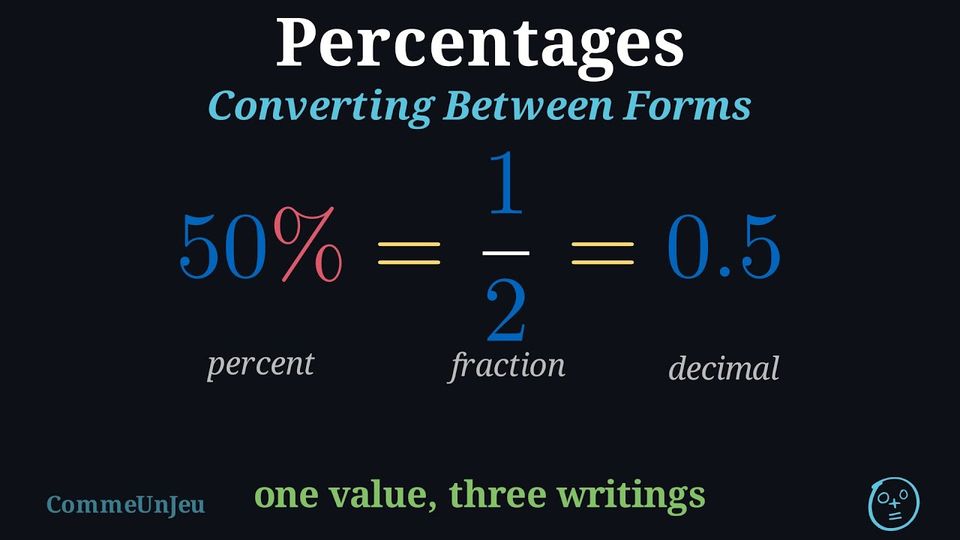
Method — Percentage to Fraction
To convert a percentage to a fraction, write it as a fraction over 100, then simplify if possible. 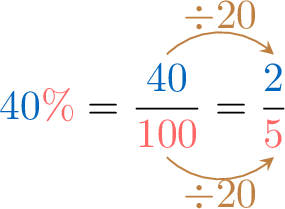
Method — Fraction to Percentage
To convert a fraction like \(\dfrac{\textcolor{colorprop}{3}}{\textcolor{colordef}{4}}\) to a percentage, you have two common methods: - Method 1: Equal Fractions. Find an equal fraction with denominator \(100\) (when possible, in particular when the denominator divides \(100\); it is not possible for \(\dfrac{1}{3}\)).
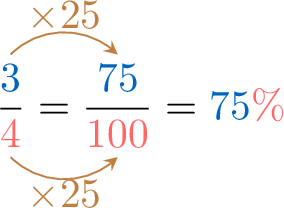
- Method 2: Multiply by \(100\pourcent\). This works because multiplying by \(100\pourcent\) is the same as multiplying by 1. $$ \begin{aligned} \dfrac{\textcolor{colorprop}{3}}{\textcolor{colordef}{4}} &= 0.75 \quad (\text{since } 3 \div 4 = 0.75) \\ &= 0.75 \times \textcolor{colordef}{100\pourcent} \\ &= \textcolor{colorprop}{75}\textcolor{colordef}{\pourcent} \end{aligned} $$
Method — Percentage to Decimal
To convert a percentage to a decimal, divide by 100. A quick way to do this is to move the decimal point two places to the left. $$ \textcolor{colorprop}{45}\textcolor{colordef}{\pourcent} = \textcolor{colorprop}{45} \div \textcolor{colordef}{100} = 0.45 $$ Method — Decimal to Percentage
To convert a decimal to a percentage, multiply by 100. A quick way to do this is to move the decimal point two places to the right and add the percent sign (\(\pourcent\)). $$ 0.68 = 0.68 \times 100\pourcent = \textcolor{colorprop}{68}\textcolor{colordef}{\pourcent} $$ Skills to practice
- Converting Decimals into Percentages
III.2
A Percentage of a Quantity
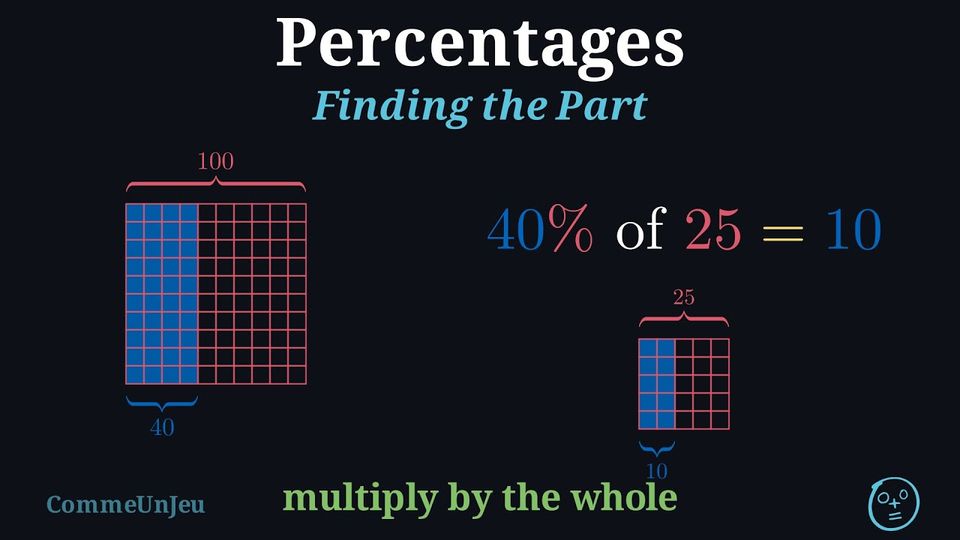
Method — Finding the Part
To find a part of a total, multiply the percentage by the whole. $$\textcolor{colorprop}{\text{Part}} = \text{Percentage} \times \textcolor{colordef}{\text{Whole}}$$ Taking \(x\pourcent\) of a number means taking the fraction \(\dfrac{x}{100}\) of it. Remember to convert the percentage to a decimal or fraction before calculating. Example
In a school with \(\textcolor{colordef}{200}\) students, \(\textcolor{colorprop}{60}\textcolor{colordef}{\pourcent}\) are girls. Calculate the number of girls.
Method 1: Using the formula $$\begin{aligned}\textcolor{colorprop}{\text{Number of girls}} &= \textcolor{colorprop}{60}\textcolor{colordef}{\pourcent} \times \textcolor{colordef}{200} \\
&= 0.60 \times \textcolor{colordef}{200} \\
&= \textcolor{colorprop}{120}\end{aligned}$$ There are \(\textcolor{colorprop}{120}\) girls in the school. Method 2: “for 100”
\(60\pourcent\) means \(60\) girls for every \(100\) pupils. Since \(200 = 2 \times 100\), there are \(2 \times 60 = 120\) girls.
\(60\pourcent\) means \(60\) girls for every \(100\) pupils. Since \(200 = 2 \times 100\), there are \(2 \times 60 = 120\) girls.
| \hline Pupils | \(100\) | \(200\) |
| Girls | \(60\) | \(120\) |
Skills to practice
- Calculating Decimal Percentages of a Quantity
III.3
Increase, Decrease and Discounts
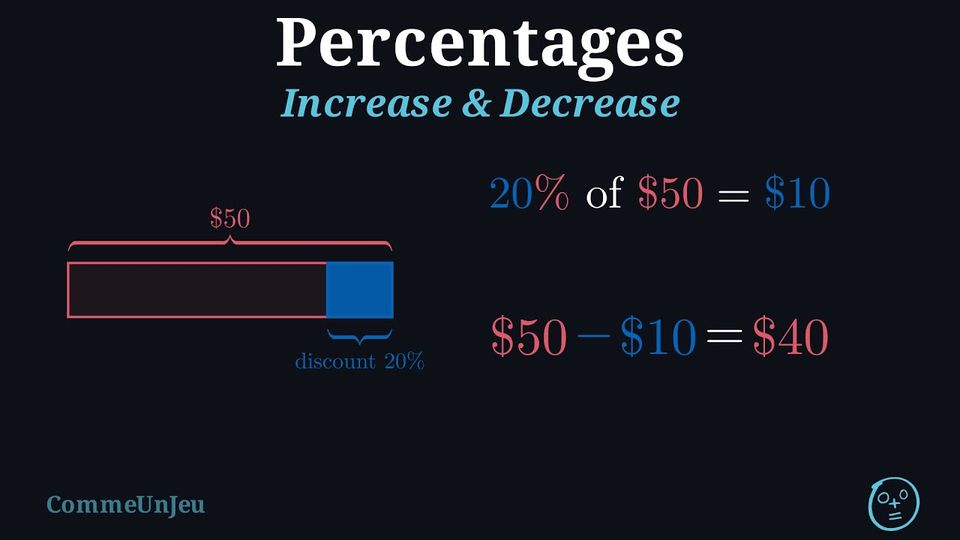
Method — Two-Step Method for Percentage Change
- Calculate the change amount: $$\text{Change} = \text{Percentage} \times \text{Original Value}$$
- Calculate the new value:
- For an increase: $$\text{New Value} = \text{Original Value} + \text{Change}$$
- For a decrease: $$\text{New Value} = \text{Original Value} - \text{Change}$$
Example
The original price of a shirt is \(\dollar\)50. Calculate the final price after a 20\(\pourcent\) discount. - Calculate the decrease amount: $$\begin{aligned} \text{Decrease} &= 20\pourcent \text{ of }\dollar 50\\ &= 20\pourcent \times \dollar 50\\ & = 0.20 \times \dollar 50 \\ &= \dollar 10\\ \end{aligned} $$
- Calculate the new price: $$\text{New Price} = \dollar 50 - \dollar 10 = \dollar 40$$
Discount Vocabulary
In a shop, the marked price is the price written on the label. A discount is a decrease of that price; it is given either as an amount (\(\dollar 10\) off) or as a percentage of the marked price (\(20\pourcent\) off). The sale price is the price paid: $$\text{sale price}=\text{marked price}-\text{amount of the discount}.$$ For example, a shirt marked at \(\dollar 50\) with a \(20\pourcent\) discount: the discount is \(20\pourcent\) of \(\dollar 50\), that is \(\dollar 10\), and the sale price is \(\dollar 40\).
Skills to practice
- Calculating Discounts and Sale Prices
III.4
Percentage Change
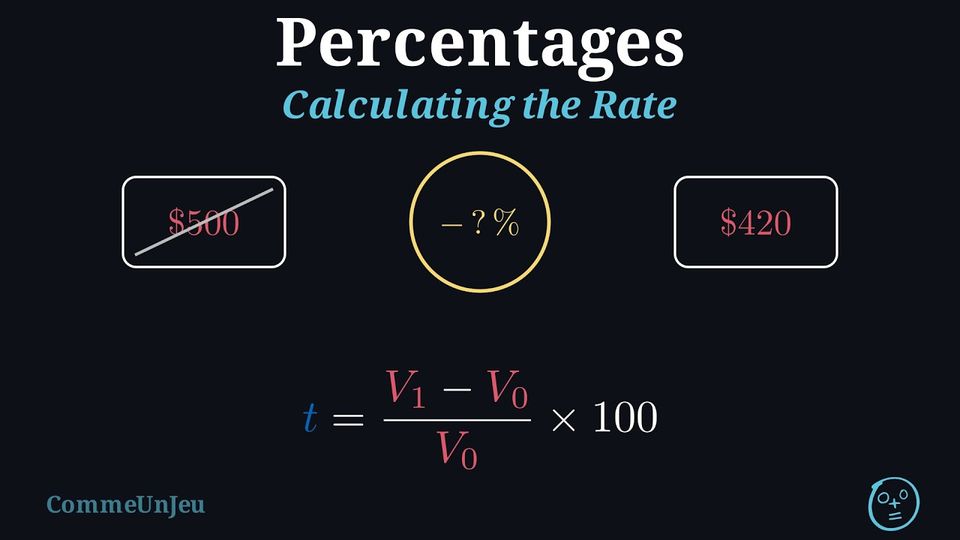
Method — Finding the Percentage Change from Two Values
When the starting value and the final value are both known, the starting value being strictly positive: - compute the change: final value \(-\) starting value;
- compare that change to the starting value, as a percentage:
Example
A weight increases from \(25\) kg to \(28\) kg. Find the percentage change.
The change is \(28 - 25 = 3\) kg, compared to the starting value \(25\): $$\frac{28-25}{25}\times 100\pourcent = \frac{3}{25}\times 100\pourcent = +12\pourcent.$$ The result is positive: this is an increase of \(12\pourcent\). Check: \(25 \times 1{.}12 = 28\). 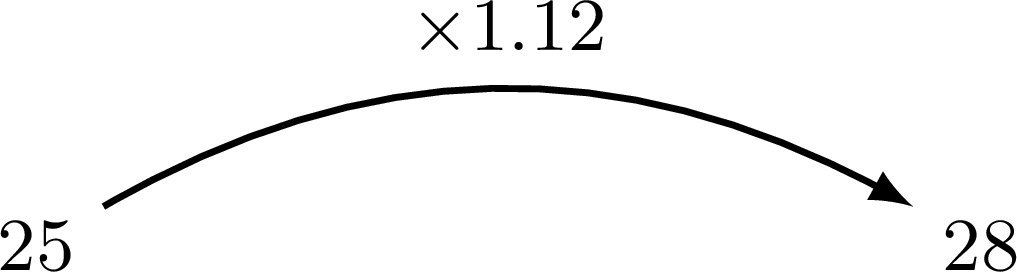
Example
A price drops from \(\dollar 500\) to \(\dollar 420\). Find the percentage change.
The change is \(420 - 500 = -80\), compared to the starting value \(500\): $$\frac{420-500}{500}\times 100\pourcent = \frac{-80}{500}\times 100\pourcent = -16\pourcent.$$ The result is negative: this is a decrease of \(16\pourcent\). Check: \(500 \times 0{.}84 = 420\). 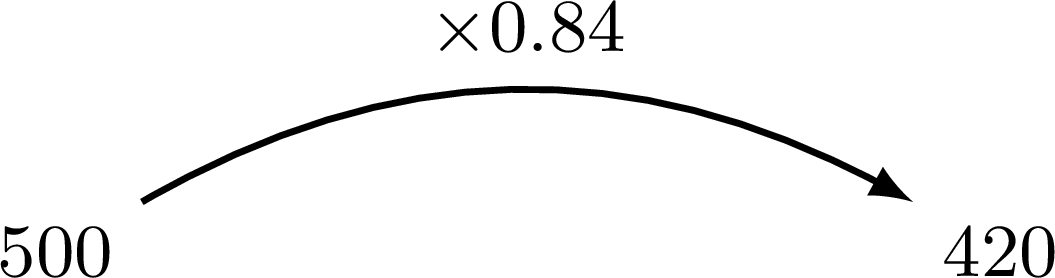
Skills to practice
- Finding the Percentage Change
IV
Going further
Skills to practice
- Reasoning with Ratios and the Unitary Method
- Solving Real-Life Problems with Ratios and Rates
- Investigating Patterns in Ratios and Unit Prices
- Quiz
Jump to section