International Baccalaureate · MYP 1
Percentage
I
Percentages and Their Forms
I.1
What a Percentage Is
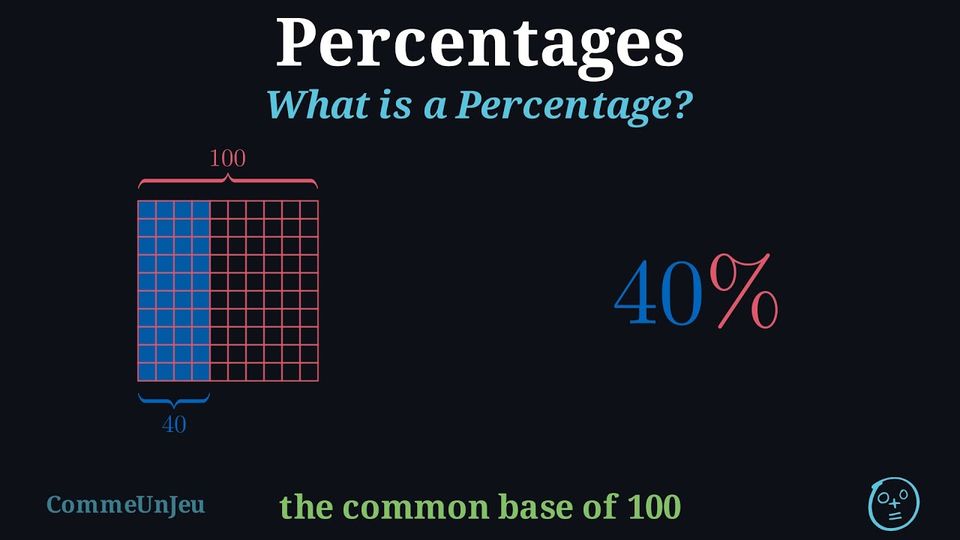
Definition — Percentage
A percentage is a way of writing a fraction with denominator \(100\): \(42\pourcent\) is \(\dfrac{42}{100}\), that is \(42\) out of \(100\).The symbol \(\pourcent\) means “percent”, which comes from the phrase “per centum”, meaning “out of one hundred”.
Example
This grid has 100 squares. Since \(\textcolor{colorprop}{23}\) out of \(\textcolor{colordef}{100}\) squares are coloured, we say that \(\textcolor{colorprop}{23}\textcolor{colordef}{\pourcent}\) of the grid is coloured. 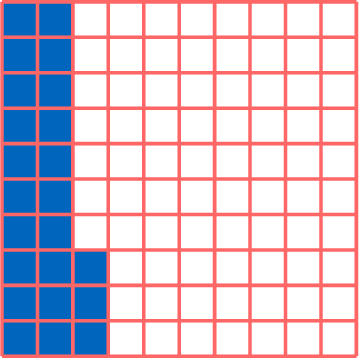
Example
A breakfast cereal contains \(42\pourcent\) of carbohydrates. What mass of carbohydrates is there in \(100\) g of cereal? In \(200\) g? In \(50\) g?
“\(42\pourcent\)” means “\(42\) for every \(100\)”: in \(100\) g of cereal there are \(42\) g of carbohydrates. The mass of carbohydrates is proportional to the mass of cereal:
| \hline Cereal (g) | \(100\) | \(200\) | \(50\) |
| Carbohydrates (g) | \(42\) | \(84\) | \(21\) |
Skills to practice
- Converting Fraction Models to Percentages
- Reading a Percentage as a Rate for 100
I.2
Converting Between Forms
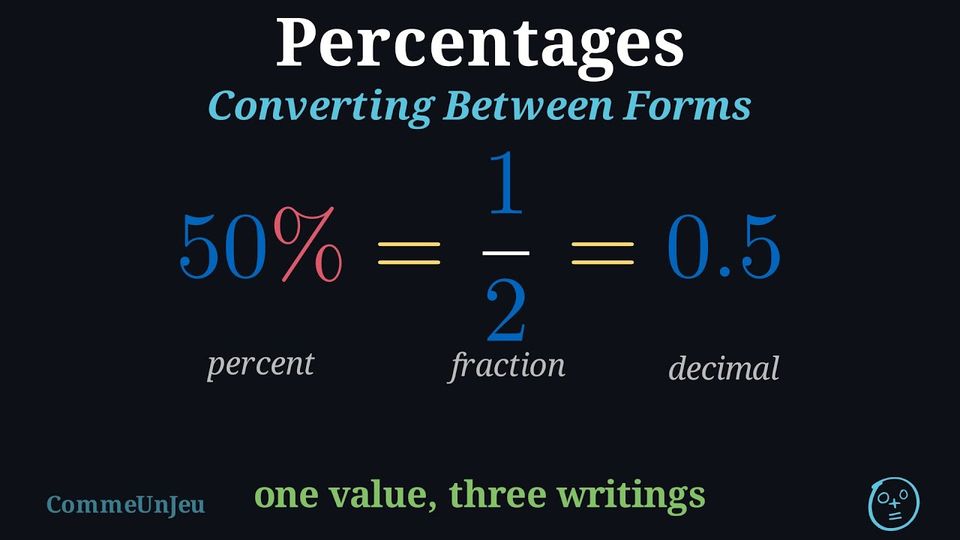
Percentages, fractions, and decimals are three different ways to talk about the same value. For example, \(\textcolor{colorprop}{50}\textcolor{colordef}{\pourcent}\), the fraction \(\dfrac{\textcolor{colorprop}{1}}{\textcolor{colordef}{2}}\), and the decimal \(0.5\) all mean “half”. Being able to convert between these forms is a very useful skill.
Remark: A very important idea is that \(100\pourcent = \dfrac{100}{100} = 1\).
Since \(100\pourcent\) is just another way of writing the number \(1\), you can multiply any number by \(100\pourcent\) without changing its value. This is a very useful trick for converting decimals and fractions into percentages.
Method — Percentage to Fraction
To convert a percentage to a fraction, write it as a fraction over 100, then simplify if possible. 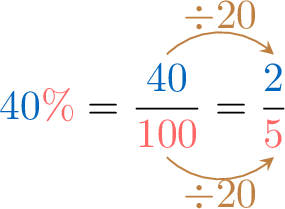
Method — Fraction to Percentage
To convert a fraction like \(\dfrac{\textcolor{colorprop}{3}}{\textcolor{colordef}{4}}\) to a percentage, you have two common methods: - Method 1: Equal Fractions. Find an equal fraction with denominator \(100\) (when possible, in particular when the denominator divides \(100\); it is not possible for \(\dfrac{1}{3}\)).
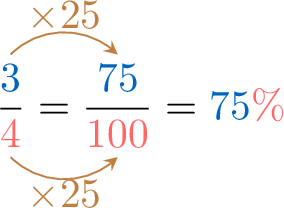
- Method 2: Multiply by \(100\pourcent\). This works because multiplying by \(100\pourcent\) is the same as multiplying by 1. $$ \begin{aligned} \dfrac{\textcolor{colorprop}{3}}{\textcolor{colordef}{4}} &= 0.75 \quad (\text{since } 3 \div 4 = 0.75) \\ &= 0.75 \times \textcolor{colordef}{100\pourcent} \\ &= \textcolor{colorprop}{75}\textcolor{colordef}{\pourcent} \end{aligned} $$
Method — Percentage to Decimal
To convert a percentage to a decimal, divide by 100. A quick way to do this is to move the decimal point two places to the left. $$ \textcolor{colorprop}{45}\textcolor{colordef}{\pourcent} = \textcolor{colorprop}{45} \div \textcolor{colordef}{100} = 0.45 $$ Method — Decimal to Percentage
To convert a decimal to a percentage, multiply by 100. A quick way to do this is to move the decimal point two places to the right and add the percent sign (\(\pourcent\)). $$ 0.68 = 0.68 \times 100\pourcent = \textcolor{colorprop}{68}\textcolor{colordef}{\pourcent} $$ Skills to practice
- Converting Percentages into Decimals
II
One Quantity as a Percentage of Another
II.1
Expressing a Part as a Percentage
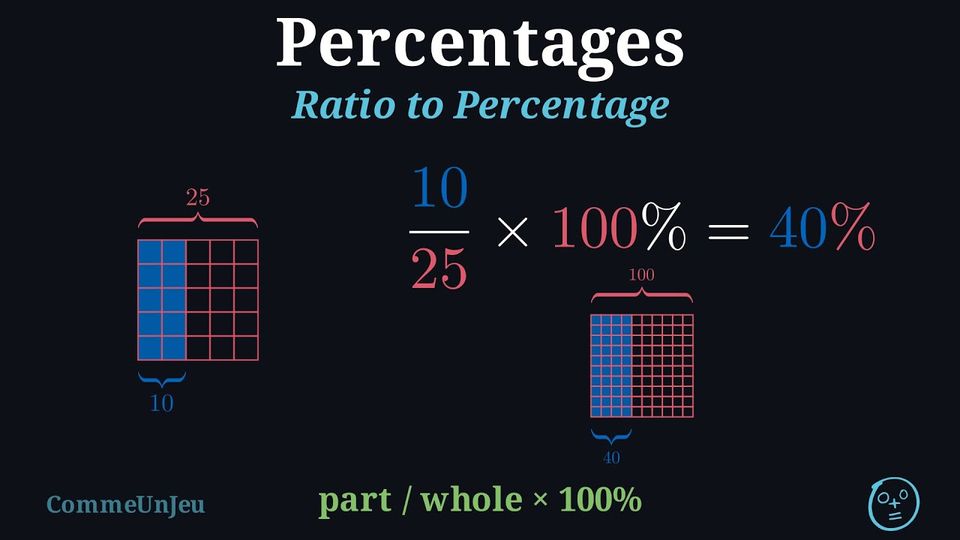
Percentages are one of the best ways to compare a part to a whole.
For example, if a class of \(\textcolor{colordef}{20}\) students has \(\textcolor{colorprop}{12}\) girls, what percentage of the class is female? To solve this, we look for an equal fraction with denominator \(100\): $$\frac{\text{part}}{\text{whole}} = \frac{\textcolor{colorprop}{12}}{\textcolor{colordef}{20}} = \frac{\textcolor{colorprop}{12} \times 5}{\textcolor{colordef}{20} \times 5} = \frac{\textcolor{colorprop}{60}}{\textcolor{colordef}{100}} \qquad \text{(equal fractions: numerator and denominator multiplied by } 5\text{)}$$ The percentage of girls in the class is \(\textcolor{colorprop}{60}\textcolor{colordef}{\pourcent}\). This means for every \(\textcolor{colordef}{100}\) students, \(\textcolor{colorprop}{60}\) would be girls.
For example, if a class of \(\textcolor{colordef}{20}\) students has \(\textcolor{colorprop}{12}\) girls, what percentage of the class is female? To solve this, we look for an equal fraction with denominator \(100\): $$\frac{\text{part}}{\text{whole}} = \frac{\textcolor{colorprop}{12}}{\textcolor{colordef}{20}} = \frac{\textcolor{colorprop}{12} \times 5}{\textcolor{colordef}{20} \times 5} = \frac{\textcolor{colorprop}{60}}{\textcolor{colordef}{100}} \qquad \text{(equal fractions: numerator and denominator multiplied by } 5\text{)}$$ The percentage of girls in the class is \(\textcolor{colorprop}{60}\textcolor{colordef}{\pourcent}\). This means for every \(\textcolor{colordef}{100}\) students, \(\textcolor{colorprop}{60}\) would be girls.
Method — Ratio to Percentage
To convert a part-to-whole ratio (the fraction part/whole) into a percentage, use the following formula: $$\text{Percentage}= \frac{\textcolor{colorprop}{\text{part}}}{\textcolor{colordef}{\text{whole}}} \times \textcolor{colordef}{100}\pourcent$$ Scaling the whole to \(\textcolor{colordef}{100}\) shows the percentage directly: for example, \(\textcolor{colorprop}{5}\) girls out of \(\textcolor{colordef}{25}\) scale up (\(\times 4\)) to \(\textcolor{colorprop}{20}\) out of \(\textcolor{colordef}{100}\). 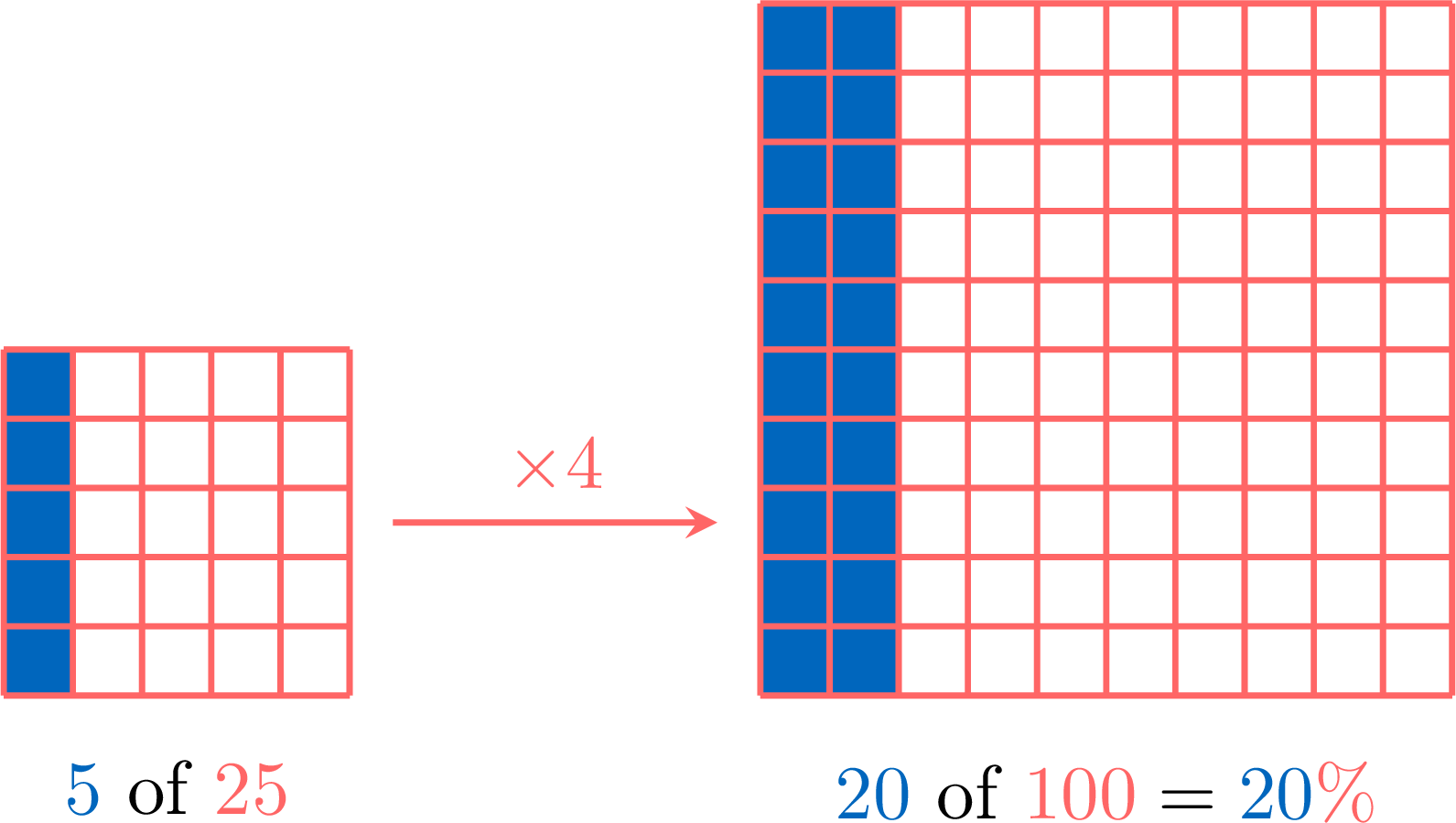
Example
At a maths quiz, Leo answered \(\textcolor{colorprop}{21}\) questions correctly out of a total of \(\textcolor{colordef}{25}\) questions. Calculate his percentage score. - The \(\textcolor{colorprop}{\text{part}}\) is the number of correct answers: \(\textcolor{colorprop}{21}\).
- The \(\textcolor{colordef}{\text{whole}}\) is the total number of questions: \(\textcolor{colordef}{25}\).
- \(\begin{aligned}[t]\text{Percentage Score} &= \frac{\textcolor{colorprop}{21}}{\textcolor{colordef}{25}} \times \textcolor{colordef}{100}\pourcent\\ &= 0.84 \times 100\pourcent \\ &= \textcolor{colorprop}{84}\textcolor{colordef}{\pourcent}\end{aligned}\)
A Proportion Never Exceeds 1
A proportion is the ratio of a part to the whole: \(\dfrac{\text{part}}{\text{whole}}\). Since the part is never bigger than the whole, a proportion is always smaller than or equal to \(1\), and, as a percentage, smaller than or equal to \(100\pourcent\). In a class of \(25\) pupils with \(11\) girls, the proportion of girls is \(\dfrac{11}{25} = \dfrac{44}{100} = 44\pourcent\).
Compare Like with Like
One quantity can be written as a percentage of another only when both are of the same kind (two lengths, two masses, two durations…) and written in the same unit: convert first, then divide. For example, to express \(35\)~cm as a percentage of \(7\)~m, write \(7\)~m \(=700\)~cm: $$\begin{aligned}[t] \text{Percentage}&=\dfrac{35\,\mathrm{cm}}{700\,\mathrm{cm}}\times100\pourcent &&\text{(same unit)}\\
&=\dfrac{5}{100}\times100\pourcent &&\text{(simplifying by }7\text{)}\\
&=5\pourcent. \end{aligned}$$ Without the conversion, \(\dfrac{35}{7}\times100\pourcent=500\pourcent\): impossible, since a part never exceeds its whole.
Skills to practice
- Expressing a Proportion as a Percentage
- Finding the Percentage of a Ratio
- Converting to the Same Unit First
II.2
Comparing with Percentages
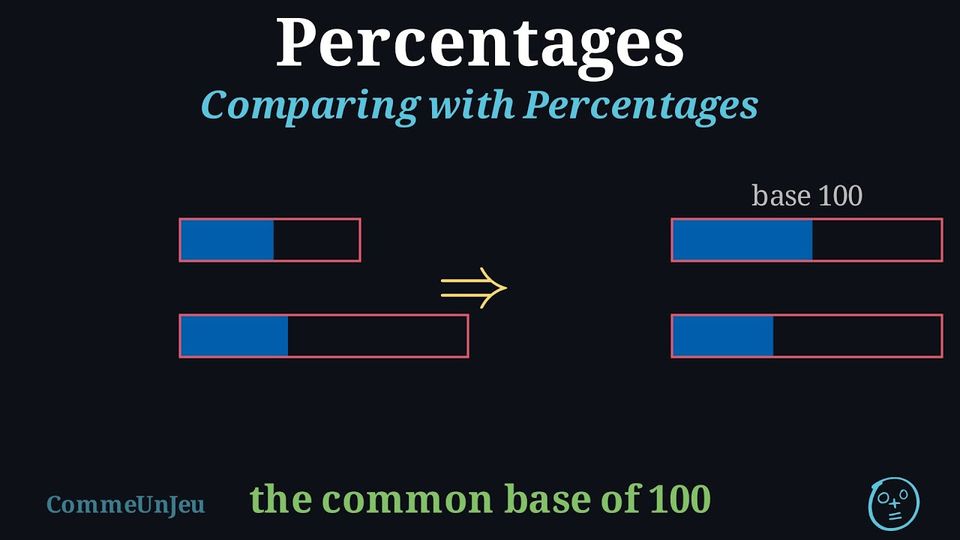
In Parliament A, there are \(\textcolor{colorprop}{26}\) women out of \(\textcolor{colordef}{50}\) members. In Parliament B, there are \(\textcolor{colorprop}{60}\) women out of \(\textcolor{colordef}{200}\) members. Hugo says, “Since there are more women in Parliament B, women have better representation there.”
Is this statement a fair comparison?
Is this statement a fair comparison?
To make a fair comparison, we must compare the percentages, not the absolute numbers.
- Parliament A:
\(\text{Percentage of women} = \frac{\textcolor{colorprop}{26}}{\textcolor{colordef}{50}} \times 100\pourcent = \textcolor{colorprop}{52}\textcolor{colordef}{\pourcent}\) - Parliament B:
\(\text{Percentage of women} = \frac{\textcolor{colorprop}{60}}{\textcolor{colordef}{200}} \times 100\pourcent = \textcolor{colorprop}{30}\textcolor{colordef}{\pourcent}\)
Method — Comparing with Percentages
When comparing different part-to-whole ratios, converting them to percentages provides a common baseline (out of 100), which allows for a fair and direct comparison. - Step 1: Calculate the percentage for each group.
- Step 2: Compare the percentages to draw a conclusion.
Skills to practice
- Comparing Effectiveness Using Percentages
III
A Percentage of a Quantity
III.1
Finding a Percentage of a Quantity
Method — Percentages to Know by Heart
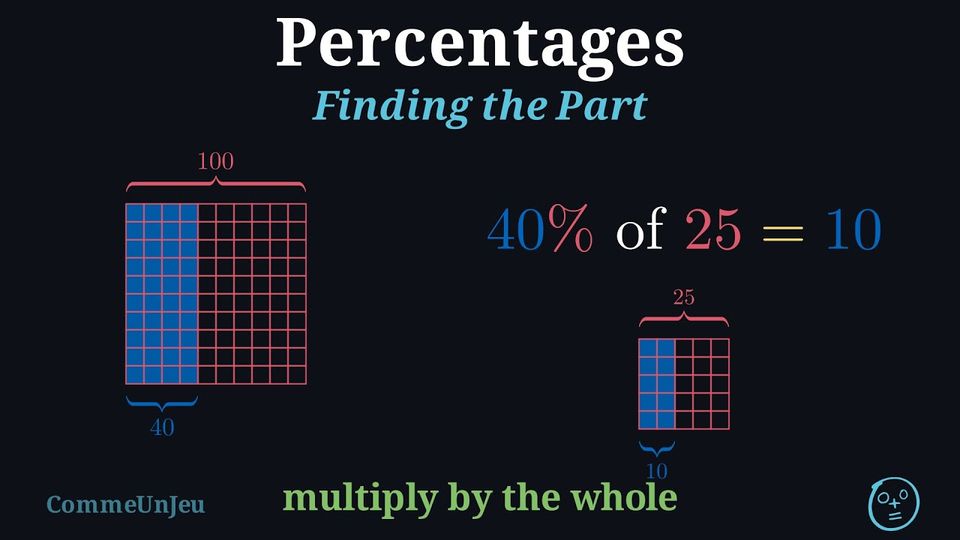
Some percentages are fractions in disguise, and their value is found by a division: - \(50\pourcent = \dfrac{50}{100} = \dfrac{1}{2}\): half — divide by \(2\);
- \(25\pourcent = \dfrac{1}{4}\): a quarter — divide by \(4\); \(75\pourcent = \dfrac{3}{4}\): three quarters;
- \(10\pourcent = \dfrac{1}{10}\): a tenth — divide by \(10\); \(20\pourcent = \dfrac{1}{5}\): a fifth — divide by \(5\);
- \(5\pourcent\) is half of \(10\pourcent\); \(100\pourcent\) is the whole quantity.
Example
Compute mentally: \(25\pourcent\) of \(32\), \(10\pourcent\) of \(250\), \(75\pourcent\) of \(4\), \(5\pourcent\) of \(60\).
$$\begin{aligned}[t] 25\pourcent \text{ of } 32 &= 32 \div 4 = 8 &&\text{(a quarter)}\\
10\pourcent \text{ of } 250 &= 250 \div 10 = 25 &&\text{(a tenth)}\\
75\pourcent \text{ of } 4 &= 3 \times (4 \div 4) = 3 &&\text{(three quarters)}\\
5\pourcent \text{ of } 60 &= 6 \div 2 = 3 &&\text{(half of } 10\pourcent \text{ of } 60\text{)} \end{aligned}$$
Method — Finding the Part
To find a part of a total, multiply the percentage by the whole. $$\textcolor{colorprop}{\text{Part}} = \text{Percentage} \times \textcolor{colordef}{\text{Whole}}$$ Taking \(x\pourcent\) of a number means taking the fraction \(\dfrac{x}{100}\) of it. Remember to convert the percentage to a decimal or fraction before calculating. Example
In a school with \(\textcolor{colordef}{200}\) students, \(\textcolor{colorprop}{60}\textcolor{colordef}{\pourcent}\) are girls. Calculate the number of girls.
Method 1: Using the formula $$\begin{aligned}\textcolor{colorprop}{\text{Number of girls}} &= \textcolor{colorprop}{60}\textcolor{colordef}{\pourcent} \times \textcolor{colordef}{200} \\
&= 0.60 \times \textcolor{colordef}{200} \\
&= \textcolor{colorprop}{120}\end{aligned}$$ There are \(\textcolor{colorprop}{120}\) girls in the school. Method 2: “for 100”
\(60\pourcent\) means \(60\) girls for every \(100\) pupils. Since \(200 = 2 \times 100\), there are \(2 \times 60 = 120\) girls.
\(60\pourcent\) means \(60\) girls for every \(100\) pupils. Since \(200 = 2 \times 100\), there are \(2 \times 60 = 120\) girls.
| \hline Pupils | \(100\) | \(200\) |
| Girls | \(60\) | \(120\) |
Skills to practice
- Calculating a Percentage Mentally
- Finding a Part Using Percentages
III.2
Percentage Increase and Decrease
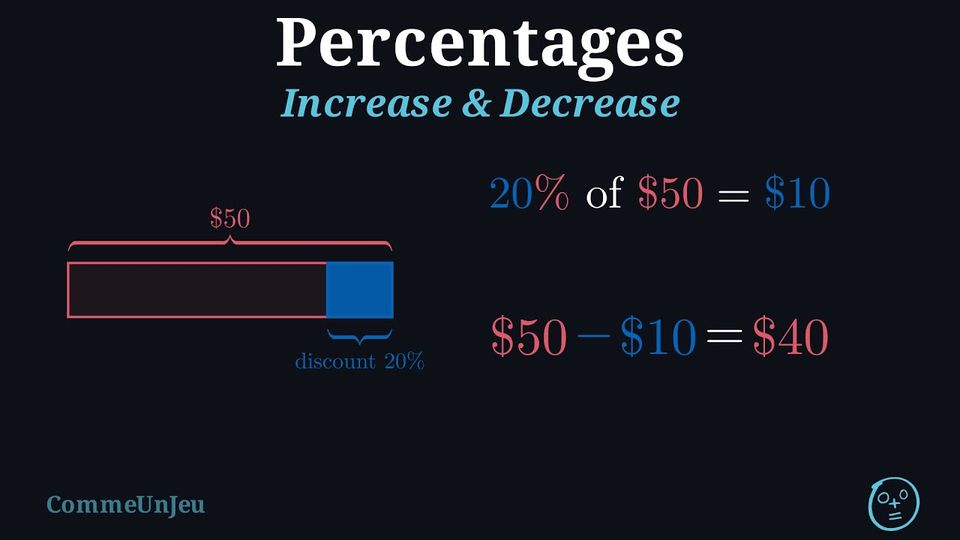
Quantities often change by a certain percentage. For example:
- A store offers a 20\(\pourcent\) discount (a decrease).
- A salary increases by 7\(\pourcent\).
- A city's population grows by 10\(\pourcent\).
Method — Two-Step Method for Percentage Change
- Calculate the change amount: $$\text{Change} = \text{Percentage} \times \text{Original Value}$$
- Calculate the new value:
- For an increase: $$\text{New Value} = \text{Original Value} + \text{Change}$$
- For a decrease: $$\text{New Value} = \text{Original Value} - \text{Change}$$
Example
The original price of a shirt is \(\dollar\)50. Calculate the final price after a 20\(\pourcent\) discount. - Calculate the decrease amount: $$\begin{aligned} \text{Decrease} &= 20\pourcent \text{ of }\dollar 50\\ &= 20\pourcent \times \dollar 50\\ & = 0.20 \times \dollar 50 \\ &= \dollar 10\\ \end{aligned} $$
- Calculate the new price: $$\text{New Price} = \dollar 50 - \dollar 10 = \dollar 40$$
Skills to practice
- Finding the New Quantity after an Increase
- Finding the New Quantity after a Decrease
IV
Going further
Skills to practice
- Solving Percentage Problems
- Investigating Patterns in Percentages
- Quiz
Jump to section