International Baccalaureate · PYP 5
Operations with fractions
I
Adding or Subtracting a Whole Number and a Fraction
Method — Adding or Subtracting a Whole Number and a Fraction
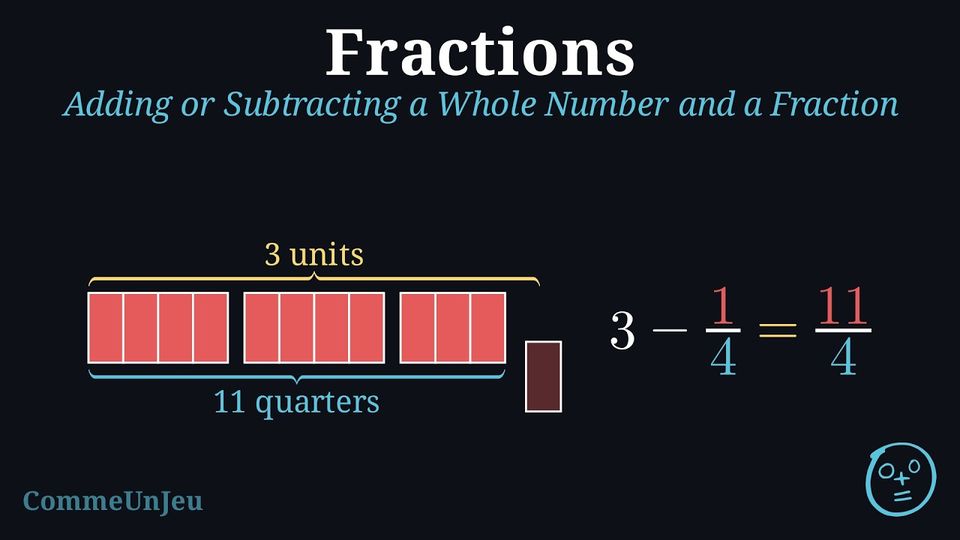
To add or subtract a whole number and a fraction: - Write the whole number as a fraction with the denominator of the fraction: each unit is made of as many parts as the denominator says.
- Add or subtract the numerators and keep the denominator.
Example
Write \(3 - \dfrac{1}{4}\) as a single fraction.
$$\begin{aligned}[t] 3 - \dfrac{1}{4} &= \dfrac{3 \times 4}{4} - \dfrac{1}{4} && \text{(each unit is four quarters)}\\
&= \dfrac{12 - 1}{4} && \text{(same denominator)}\\
&= \dfrac{11}{4} \end{aligned}$$ 
Three units cut into quarters make \(12\) quarters; one quarter is taken away: \(11\) quarters are left.
Skills to practice
- Adding or Subtracting a Whole Number and a Fraction
II
Adding and Subtracting with Different Denominators
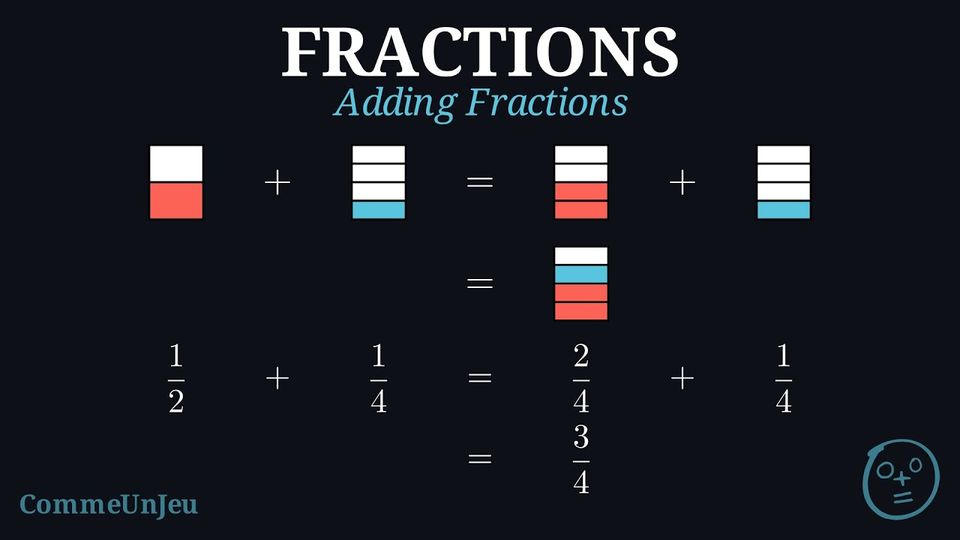
To add or subtract fractions by combining their numerators, the fractions must first represent parts of the same size, i.e., be written with a common denominator.
Consider the problem of adding \(\dfrac{1}{2}\) and \(\dfrac{1}{4}\).  \(+\)

Because the fractions have unlike denominators (2 and 4), the parts are of different sizes. A direct addition of the numerators is not possible. To solve this, we must first express the fractions with a common denominator.
Consider the problem of adding \(\dfrac{1}{2}\) and \(\dfrac{1}{4}\).
\(+\) Method — Procedure for Adding or Subtracting Fractions
To add or subtract fractions with unlike denominators, follow this three-step procedure: - Find a Common Denominator: Identify a common multiple of the denominators.
- Create Equivalent Fractions: Convert each fraction to an equivalent fraction with the common denominator.
- Add or Subtract the Numerators: With the denominators now the same, perform the operation on the numerators and keep the common denominator. For a subtraction, the first fraction must not be smaller than the second.
The Sum of Two Positive Numbers
Louis writes \(\dfrac{1}{2} + \dfrac{1}{4} = \dfrac{2}{6}\): he has added the numerators together and the denominators together. On two identical bars, \(\dfrac{2}{6}\) is shorter than \(\dfrac{1}{2}\) alone. 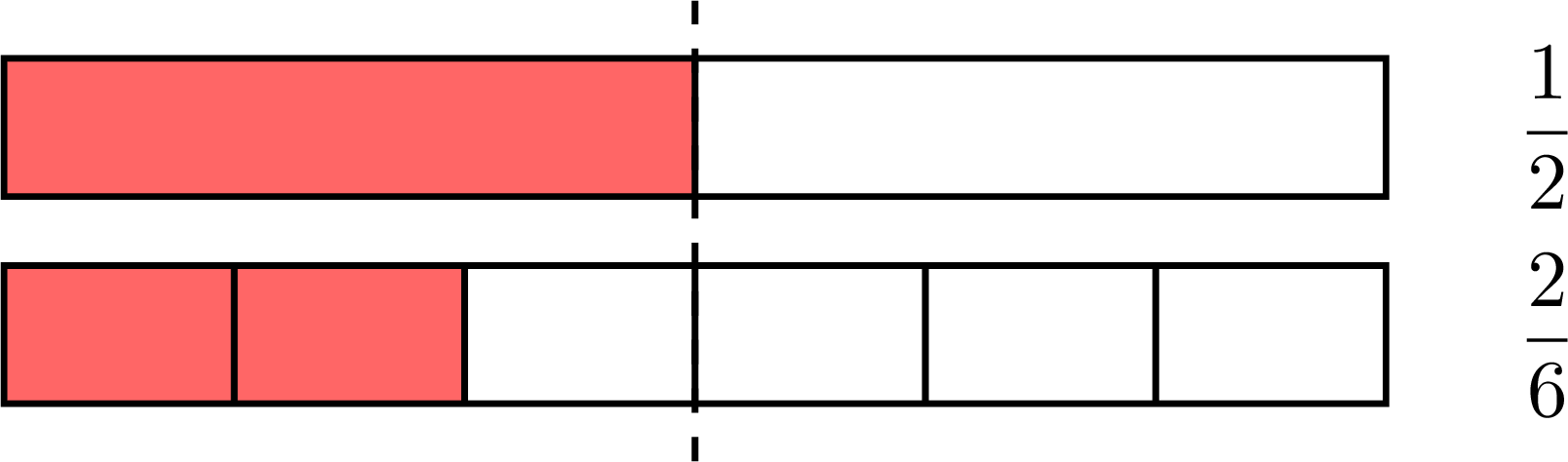
Yet the sum of two positive numbers is greater than each of them: put end to end, the lengths \(\dfrac{1}{2}\) and \(\dfrac{1}{4}\) make more than \(\dfrac{1}{2}\). Louis's answer is wrong. Only parts of the same size can be counted together: halves and quarters are not the same size, so the half is first cut into two quarters. $$\begin{aligned}\dfrac{1}{2} + \dfrac{1}{4} &= \dfrac{2}{4} + \dfrac{1}{4} && \text{(one half is two quarters)}\\
&= \dfrac{3}{4}\end{aligned}$$
When One Denominator Is a Multiple of the Other
When one of the two denominators is a multiple of the other, the common denominator is simply the bigger one, and only one fraction has to be rewritten.
Example
We will apply the procedure to calculate \(\dfrac{1}{2} + \dfrac{1}{4}\). - Step 1: Find a common denominator. The denominators are 2 and 4. A common multiple is 4.
- Step 2: Create equivalent fractions.
- The fraction \(\dfrac{1}{4}\) already has the common denominator.
- Convert \(\dfrac{1}{2}\) into an equivalent fraction with a denominator of 4:

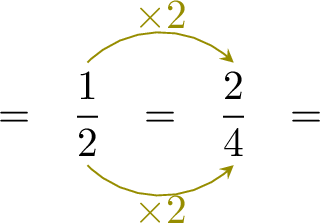

- Step 3: Add the numerators. Now that both fractions have the same denominator, we can add them: $$ \frac{2}{4} + \frac{1}{4} = \frac{2+1}{4} = \frac{3}{4} $$
| \(+\) | \(=\) |  \(+\) |
| \(=\) |  | |
| \(\dfrac{1}{2}+\dfrac{1}{4}\) | \(=\) | \(\dfrac{2}{4}+\dfrac{1}{4}\) |
| \(=\) | \(\dfrac{3}{4}\) |
Example
Compute \(\dfrac{3}{10} + \dfrac{2}{5}\) and \(\dfrac{5}{6} - \dfrac{1}{3}\). - \(10\) is a multiple of \(5\): the common denominator is \(10\). $$\begin{aligned}\dfrac{3}{10} + \dfrac{2}{5} &= \dfrac{3}{10} + \dfrac{4}{10} && \text{(each fifth is two tenths)}\\ &= \dfrac{7}{10}\end{aligned}$$
- \(6\) is a multiple of \(3\): the common denominator is \(6\). $$\begin{aligned}\dfrac{5}{6} - \dfrac{1}{3} &= \dfrac{5}{6} - \dfrac{2}{6} && \text{(each third is two sixths)}\\ &= \dfrac{3}{6}\end{aligned}$$ Three sixths is one half.

Skills to practice
- Finding a Common Denominator
- Adding Fractions Step by Step
- Adding Fractions
- Subtracting Fractions
- Adding Fractions with Unrelated Denominators
- Subtracting Fractions with Unrelated Denominators
- Solving Real-World Problems
III
Multiplication and Division with Fractions: Models
Each day, Inès waters her plant with \(\dfrac{2}{3}\) of a litre of water. How much water does she pour in \(3\) days? Adding \(\dfrac{2}{3}\) three times is written \(3 \times \dfrac{2}{3}\): what does a multiplication with a fraction mean, and how can a drawing calculate it?
Method — A Whole Number Times a Fraction
Multiplying a whole number by a fraction is a repeated addition, as with whole numbers: \(3 \times \dfrac{2}{3}\) is \(\dfrac{2}{3}\) taken \(3\) times. $$3 \times \dfrac{2}{3} = \dfrac{2}{3} + \dfrac{2}{3} + \dfrac{2}{3}$$ On a number line graduated in thirds, make \(3\) jumps of \(\dfrac{2}{3}\) from \(0\): 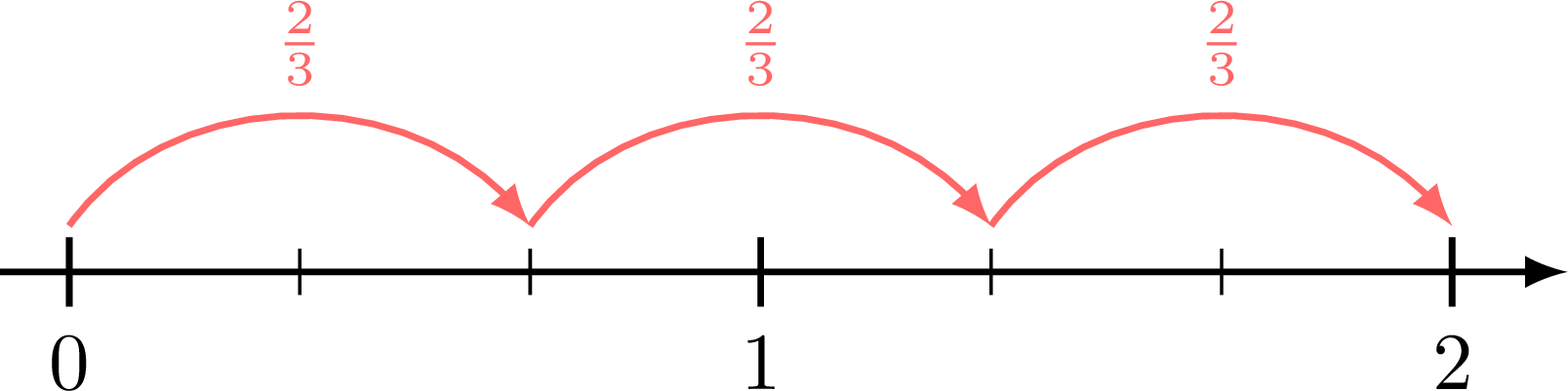
Example
Calculate \(5 \times \dfrac{3}{4}\) with a drawing, then write the result as a whole number plus a fraction less than \(1\). 
Method — A Fraction of a Fraction: the Area Model
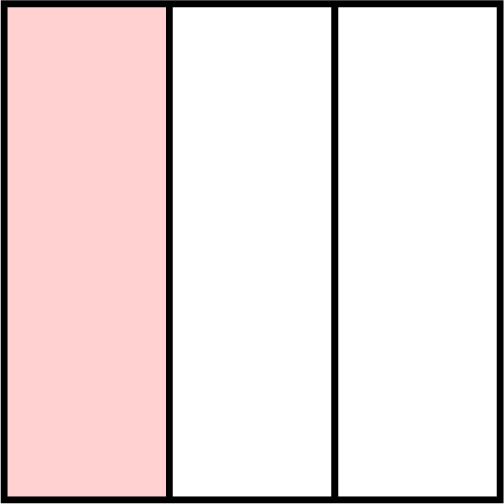
To take a fraction of a fraction less than \(1\), draw the unit as a square. - Cut the square into equal columns for the first fraction and colour it: \(\dfrac{1}{3}\) is \(1\) column out of \(3\).
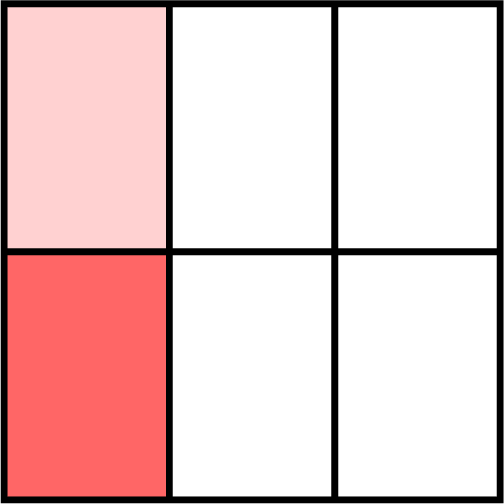
- Cut the square into equal rows for the fraction taken of it: half of the coloured column is \(1\) row out of \(2\) of that column, coloured dark.
- Count the small parts: the square now has \(6\) equal small parts, and \(1\) of them is dark.
Example
With an area model, find \(\dfrac{1}{3}\) of \(\dfrac{3}{4}\) of a square. 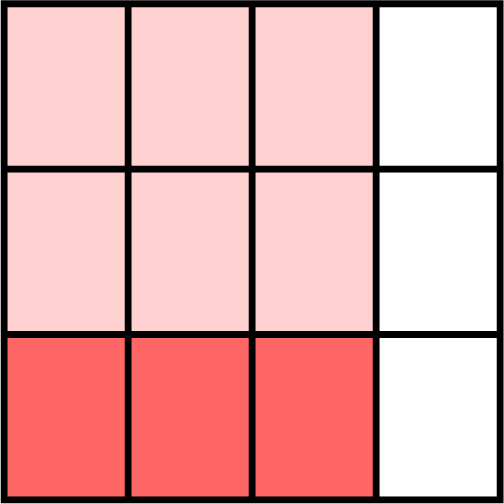
Method — How Many Halves in 3?
Dividing a whole number by a unit fraction answers the question how many of these parts fit in it? \(3 \div \dfrac{1}{2}\) asks: how many halves are there in \(3\)? On a number line graduated in halves, count the jumps of \(\dfrac{1}{2}\) from \(0\) to \(3\): 
Example
A ribbon \(2\) m long is cut into pieces of \(\dfrac{1}{4}\) m. How many pieces are there? 
Larger or Smaller?
Before calculating, predict the size of the result.
- \(3 \times \dfrac{2}{3} = 2\) is smaller than \(3\): less than a unit, taken \(3\) times, is less than \(3\).
- \(\dfrac{1}{2}\) of \(\dfrac{1}{3}\) is smaller than \(\dfrac{1}{3}\): half of a part is smaller than the part.
- \(3 \div \dfrac{1}{2} = 6\) is larger than \(3\): the pieces are smaller than a unit, so more than \(3\) of them fit.
Skills to practice
- Predicting the Size of the Result
- Multiplying a Whole Number by a Fraction
- Taking a Fraction of a Fraction
- Counting Unit Fractions in a Whole Number
- Explaining with a Model
IV
A Fraction of a Quantity
Method — Taking a Unit Fraction of a Quantity
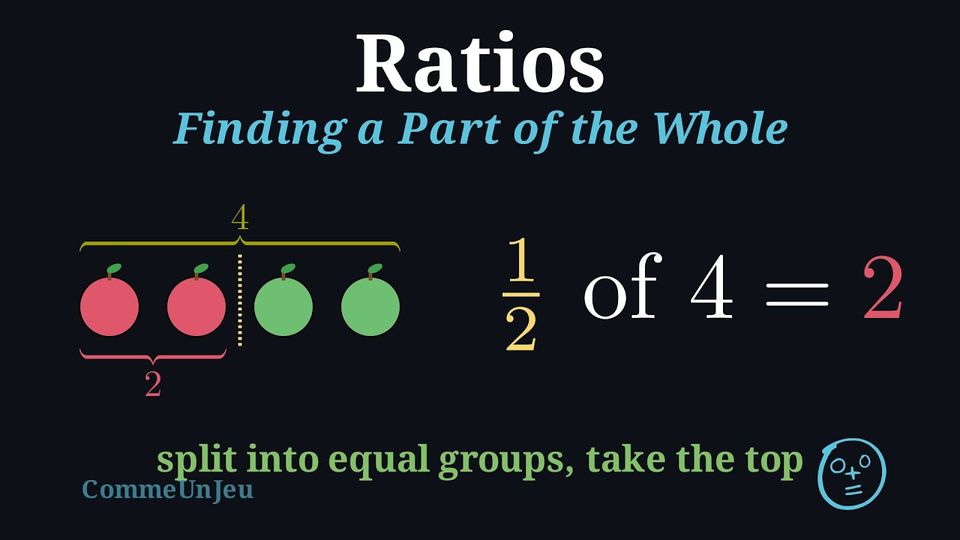
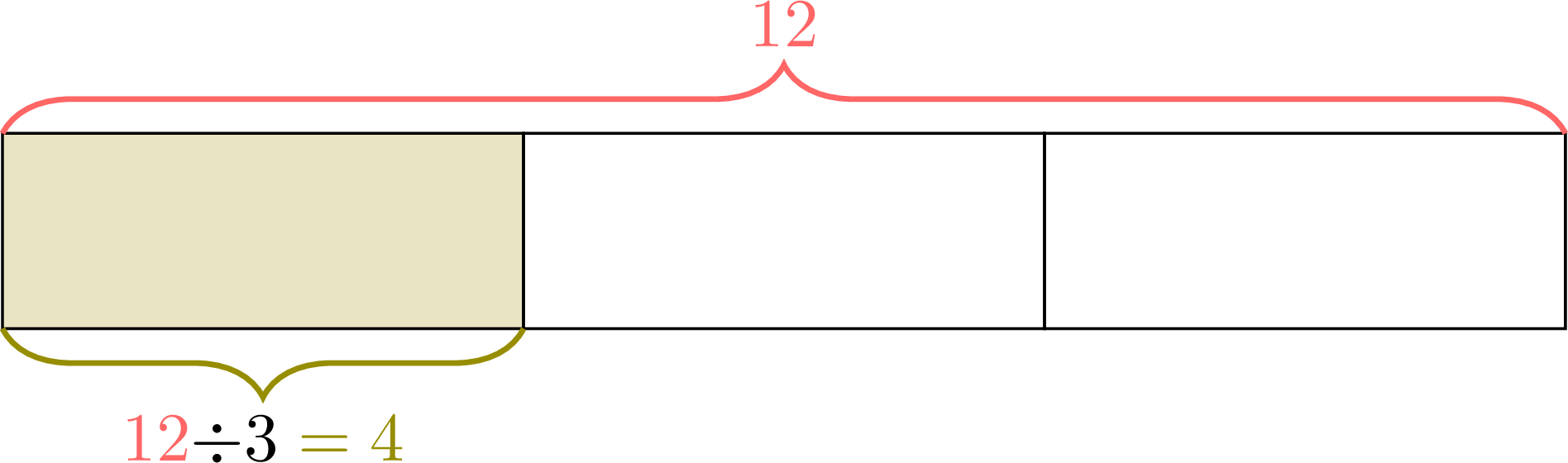
To take \(\dfrac{1}{b}\) of a quantity, split the quantity into \(b\) equal parts and take one part: $$\frac{1}{b}\,\text{of }N = N \div b$$ Example
- How many marbles is one third of \(12\) marbles?
- How many dollars is one quarter of \(\dollar 20\)?
- One third of \(12\): split \(12\) into \(3\) equal parts and take one part: \(12 \div 3 = 4\) marbles.
- One quarter of \(20\): split \(20\) into \(4\) equal parts and take one part: \(20 \div 4 = 5\) dollars.
Method — From “half of” to “multiply by”
Everyday language names these fractions before any calculation: half of, a third of, a quarter of. Taking such a part of a quantity can be read in two ways, and both give the same number. 
- As a sharing — cut the \(4\) apples into \(2\) equal parts and take one part: \(4 \div 2 = 2\).
- As a multiplication — half of \(4\) apples is written \(\dfrac{1}{2} \times 4 = 2\).
Example
A bottle holds \(750\) mL. Write “a third of the bottle” as a multiplication, then compute it.
$$\begin{aligned}[t] \text{a third of } 750 &= \dfrac{1}{3} \times 750 && \text{(taking a third is multiplying by } \dfrac{1}{3}\text{)} \\
&= 750 \div 3 && \text{(taking one part out of three is a sharing)} \\
&= 250 && \end{aligned}$$ A third of the bottle is \(250\) mL.
Example
Find two thirds of \(12\) apples, then write the calculation as a multiplication.
Two thirds are two parts of one third each: share the \(12\) apples into \(3\) equal parts (the denominator), then take \(2\) of these parts (the numerator). 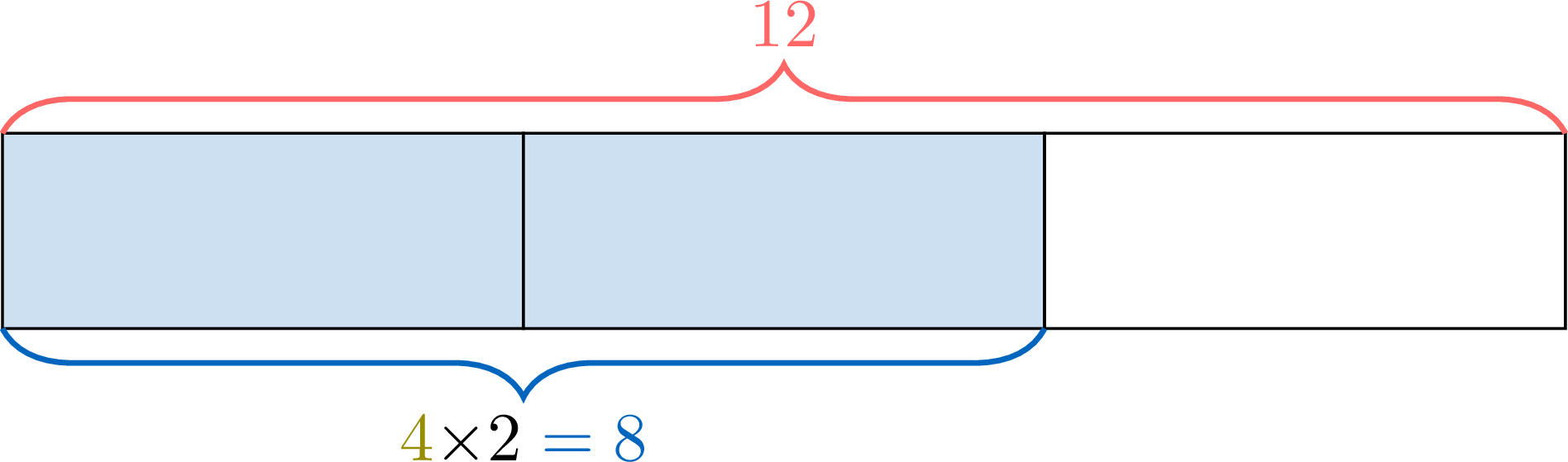
$$\begin{aligned}[t] \text{two thirds of } 12 &= (12 \div 3) \times 2 && \text{(3 equal parts, 2 of them taken)} \\
&= 4 \times 2 && \text{(one part, a third of } 12\text{, is } 4\text{)} \\
&= 8 \end{aligned}$$ Two thirds of \(12\) apples are \(8\) apples. Like “half of” and “a third of”, “two thirds of” is written as a multiplication, here by \(\dfrac{2}{3}\): $$\dfrac{2}{3} \times 12 = 8$$ Check: the part that is not taken is one third, \(4\) apples, and \(8 + 4 = 12\).
How much is \(\dfrac{2}{3}\) of \(18\)? Split \(18\) into \(3\) equal parts: one part is \(18\div 3 = 6\). Two parts make \(2\times 6 = 12\). So \(\dfrac{2}{3}\) of \(18\) is \(12\).
Taking \(\dfrac{a}{b}\) of a number always works this way: divide by the denominator, multiply by the numerator — which is exactly the multiplication \(\dfrac{a}{b}\times N\).
Taking \(\dfrac{a}{b}\) of a number always works this way: divide by the denominator, multiply by the numerator — which is exactly the multiplication \(\dfrac{a}{b}\times N\).
Method — Taking a Fraction of a Quantity
To find a fraction of a quantity, multiply that quantity by the fraction: $$\textcolor{colorprop}{\frac{a}{b}\,\text{of }N=\frac{a}{b}\times N}$$ Example
In a class of 30 students, \(\dfrac{2}{3}\) of the class are girls. How many girls are there?
The fraction \(\dfrac{2}{3}\) represents the part of the whole class that are girls. 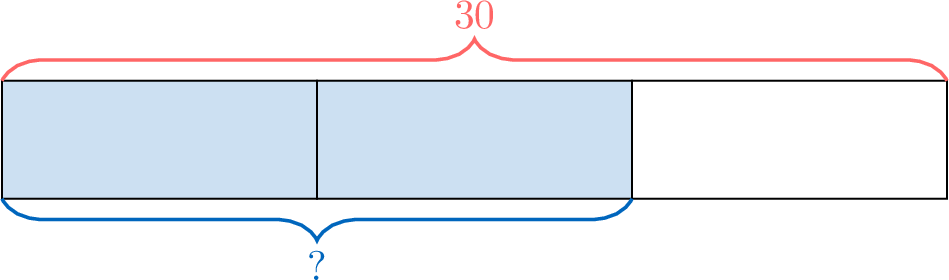
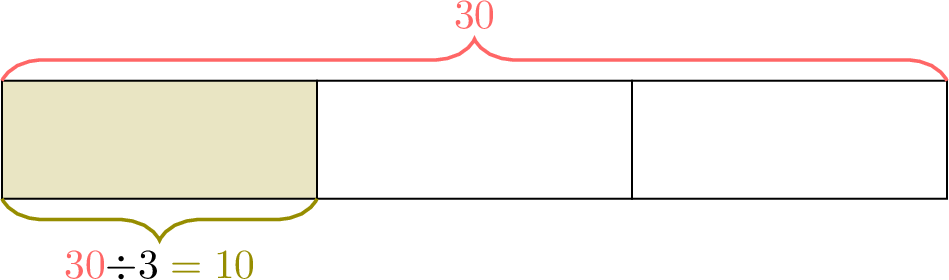
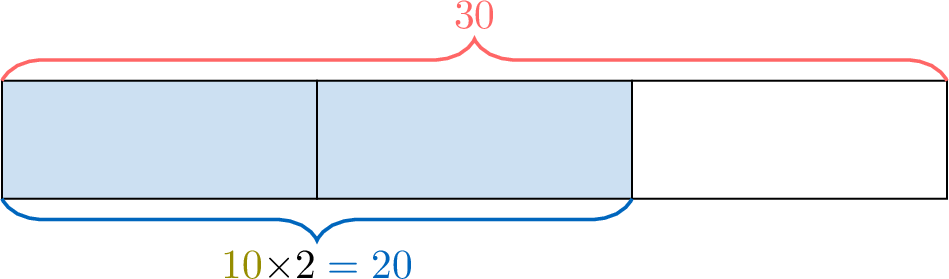
- Method 1 (unitary method). First find one part: \(30\div 3=10\). Then take two parts: \(10\times 2=\textcolor{colorprop}{20}\).
- Method 2 (formula).$$\begin{aligned}\textcolor{colorprop}{\text{Number of girls}}&=\frac{2}{3}\text{ of }\textcolor{colordef}{30}\\ &=\frac{2}{3}\times \textcolor{colordef}{30}\\ &=\frac{2\times 30}{3}\\ &=(2\times 30)\div 3\\ &=\textcolor{colorprop}{20}.\\ \end{aligned}$$
Skills to practice
- Recognising a Part as a Multiplication
- Taking a Unit Fraction of a Quantity
- Writing a Part as a Multiplication
- Finding a Part in Part-Whole Relationships
- Calculating Fractions of a Whole
- Identifying Fractions in Real-Life Contexts
- Solving Problems with a Unit Fraction
- Justifying a Part Written as a Multiplication
V
Going further
Skills to practice
- Reasoning and Problem-Solving
- Quiz
Jump to section