International Baccalaureate · PYP 3
Fractions
I
Equivalent Fractions
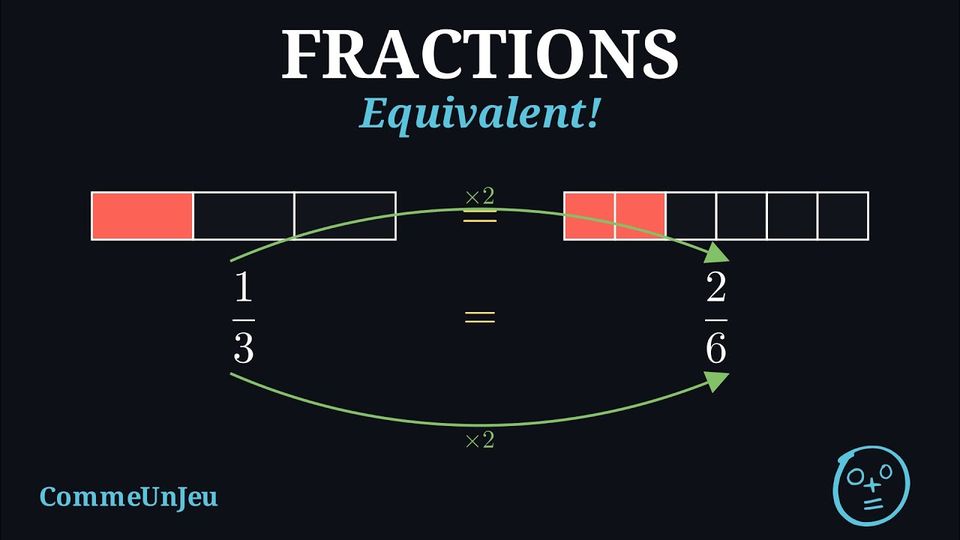
A cake is cut into 3 equal parts. One part, representing \(\dfrac{1}{3}\) of the cake, is set aside. 
Then each of the three parts is cut in half. Now the cake is divided into 6 equal parts. The same amount of cake as before is now 2 of these parts. 
Even though the number of pieces changed, did the shaded amount of cake change?
No—the amount of cake did not change. The models show that the shaded portion is the same in both cases. \(\quad=\quad\) Therefore, the fractions \(\dfrac{1}{3}\) and \(\dfrac{2}{6}\) represent the same value.
\(\quad=\quad\)Definition — Equivalent Fractions
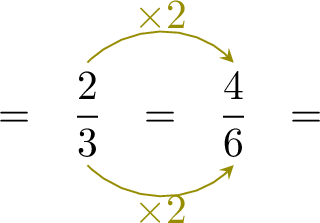
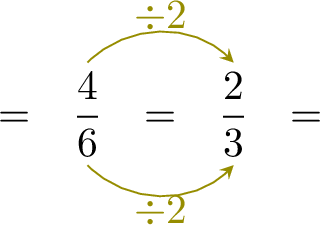
Two fractions are equivalent if they represent the same amount. You get an equivalent fraction by cutting every part into the same number of smaller parts: the numerator and the denominator are multiplied by that number. Grouping the parts back does the opposite: both are divided by the same number, which must divide the numerator and the denominator exactly. 

Method — Recognising Equivalent Fractions
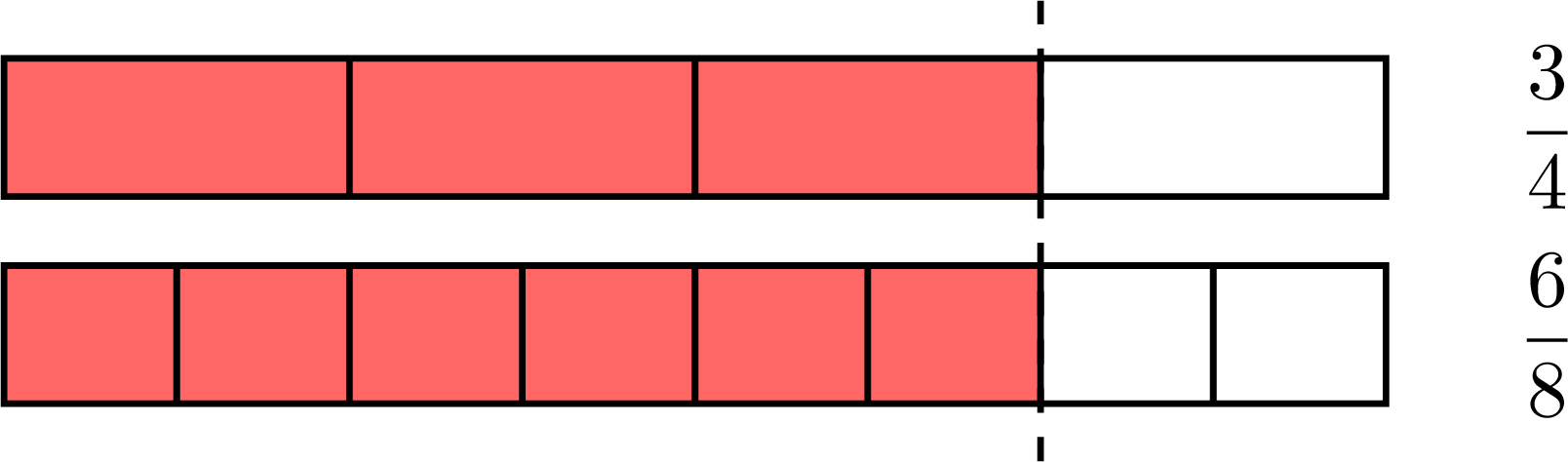
Two fractions are equivalent when they are the same amount of the same unit: on two identical bars, they cover the same length. - Say it. “If, for the same unit, I make parts twice as small and I take twice as many parts, then I take the same amount.” Quarters cut in two give eighths: \(\dfrac{3}{4} = \dfrac{6}{8}\).
- See it on two identical bars. The first bar is cut into quarters, the second into eighths: \(\dfrac{3}{4}\) and \(\dfrac{6}{8}\) cover the same length.
- Find a missing numerator. \(\dfrac{?}{8} = \dfrac{1}{2}\): eighths are \(4\) times smaller than halves, so take \(4\) times more parts: \(\dfrac{4}{8} = \dfrac{1}{2}\).
- Find a missing denominator. \(\dfrac{2}{3} = \dfrac{4}{?}\): twice as many parts are taken, so the parts are twice as small: sixths, \(\dfrac{2}{3} = \dfrac{4}{6}\).
Example
Among the fractions \(\dfrac{1}{3}\), \(\dfrac{2}{4}\), \(\dfrac{3}{4}\), \(\dfrac{2}{6}\) and \(\dfrac{3}{6}\), which are equivalent to \(\dfrac{1}{2}\)? Then find the missing numerator: \(\dfrac{?}{10} = \dfrac{2}{5}\).
\(\dfrac{1}{2}\) is one part out of two: half of the whole.
- \(\dfrac{2}{4}\): parts twice as small, twice as many taken: equivalent to \(\dfrac{1}{2}\).
- \(\dfrac{3}{6}\): parts three times as small, three times as many taken: equivalent to \(\dfrac{1}{2}\).
- \(\dfrac{1}{3}\) is less than a half (\(3\) parts, only \(1\) taken), \(\dfrac{3}{4}\) is more than a half, \(\dfrac{2}{6}\) is equivalent to \(\dfrac{1}{3}\), not to \(\dfrac{1}{2}\).
Skills to practice
- Shading a Fraction of the Bar
- Finding the Missing Numerator
- Finding the Missing Denominator
II
On the Number Line
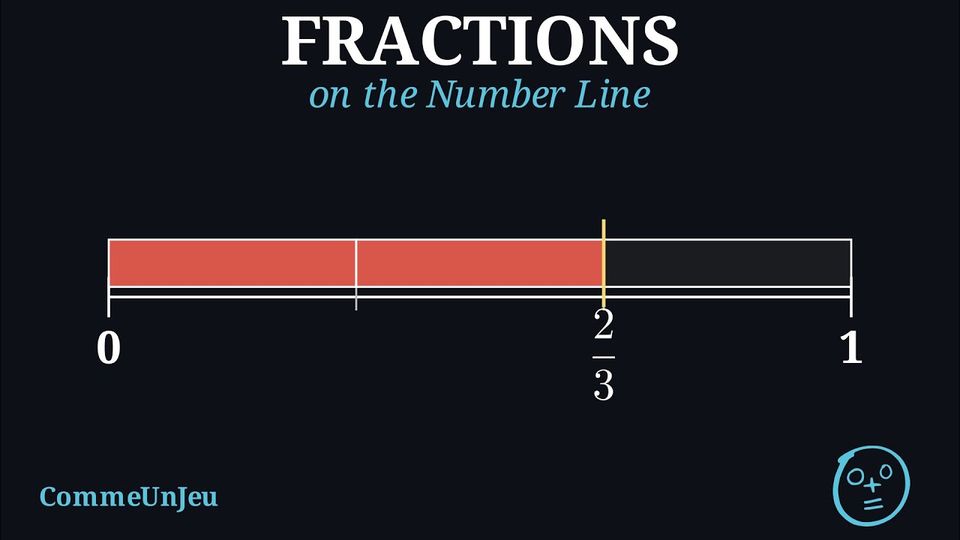
Fractions do not only represent parts of a shape; they can also represent points on a number line. The segment from 0 to 1 is one unit.
If we divide the unit into 2 equal parts, the point in the middle represents the fraction \(\dfrac{1}{2}\). 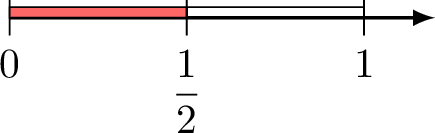
If we divide the unit into 2 equal parts, the point in the middle represents the fraction \(\dfrac{1}{2}\).
Method — Representing a Fraction on the Number Line
To represent the fraction \(\dfrac{\textcolor{colordef}{2}}{\textcolor{colorprop}{3}}\) on a number line: - Draw a straight line and mark the points \(0\) and \(1\).

- Divide the segment from \(0\) to \(1\) into \(\textcolor{colorprop}{3}\) equal parts (the denominator).

- Count \(\textcolor{colordef}{2}\) parts from \(0\) (the numerator) and mark the point at \(\dfrac{\textcolor{colordef}{2}}{\textcolor{colorprop}{3}}\).

Example — Equivalent Fractions
On a number line, two different fractions can mark the same point. Divide the unit from \(0\) to \(1\) into \(2\) equal parts: \(\dfrac{1}{2}\) is the middle point. Divide the same unit into \(4\) equal parts: \(\dfrac{2}{4}\) falls on that very same point. 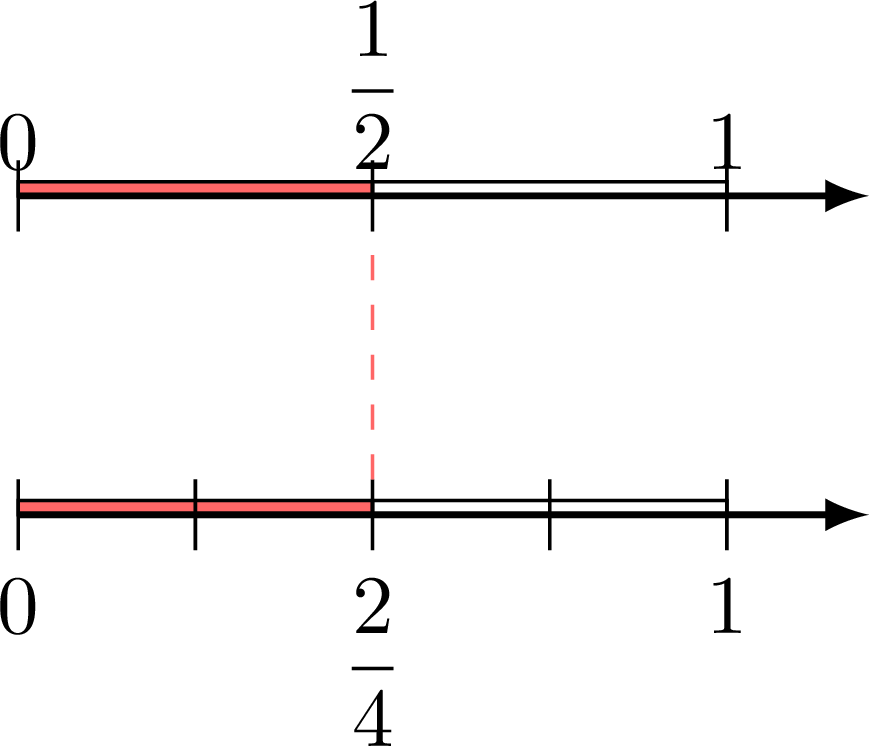
The Fraction Is a Length
On the number line, a fraction is not only a point: it is also a length. The segment from \(0\) to \(\dfrac{3}{4}\) is \(\dfrac{3}{4}\) of the unit long — three quarters of the way from \(0\) to \(1\). 
A strip of paper as long as the unit, folded into \(4\) equal parts, becomes a ruler graduated in quarters: laid along a segment, it measures the segment in quarters of a unit. With a grid, take a unit strip \(10\) squares long: each square is one part, a ruler graduated in tenths.
Method — Measuring with a Ruler Graduated in Fractions of a Unit
To measure a length that is not a whole number of units: - Graduate the unit. Fold the unit strip into \(4\) equal parts for quarters, or take a unit strip \(10\) squares long on a grid for tenths. For a length greater than the unit, lay the strip end to end as many times as needed, then read the remaining fraction.
- Lay the ruler with its \(0\) at one end of the segment.
- Read the graduation at the other end, and give the answer in one of three ways:
- a fraction of the unit: “the segment is \(\dfrac{3}{4}\) of a unit long”;
- a bound, when the end falls between two graduations: “the strip is between \(\dfrac{7}{10}\) and \(\dfrac{8}{10}\) of a unit long”;
- whole units and a fraction: “the segment is \(2\) units and \(\dfrac{1}{4}\) of a unit long”, also written \(2 + \dfrac{1}{4}\).

Method — Drawing a Segment of a Given Length
- Choose the ruler whose graduations fit the fraction: quarters for \(\dfrac{3}{4}\), tenths for \(\dfrac{3}{10}\).
- Start at \(0\) and count the intervals: \(3\) quarters for \(\dfrac{3}{4}\), that is \(3\) graduations after \(0\).
- If the fraction is not written in the ruler's graduations, use an equivalent fraction. On the tenths ruler, \(\dfrac{1}{2}\) is \(\dfrac{5}{10}\): count \(5\) tenths.
- For a length greater than the unit, such as \(1 + \dfrac{3}{10}\), draw the whole unit first, then \(3\) more tenths.

Skills to practice
- Graduating the Unit Strip
- Finding Fractions with the Bar Model
- Finding Fractions on the Number Line
- Placing Fractions on the Number Line
- Placing Equivalent Fractions on the Number Line
- Reading a Length on the Ruler
- Bounding a Length Between Two Graduations
- Drawing a Segment of a Given Length
III
Comparing Fractions
Léa and Tom each have a strip of paper. The two strips are identical, and both are cut into tenths. Léa has coloured \(\dfrac{3}{10}\) of hers, Tom \(\dfrac{7}{10}\) of his. Léa  Tom

Say who has coloured more.
Tom
Tom has. And nothing had to be counted twice: the two strips are identical, cut the same way, so every part is the same size.
When the parts are the same size, only how many are coloured decides. Tom has \(7\) coloured parts, Léa has \(3\), and \(3\) is smaller than \(7\). $$\dfrac{3}{10} \lt \dfrac{7}{10}$$
When the parts are the same size, only how many are coloured decides. Tom has \(7\) coloured parts, Léa has \(3\), and \(3\) is smaller than \(7\). $$\dfrac{3}{10} \lt \dfrac{7}{10}$$
Method — Comparing Fractions on the Number Line
Two fractions placed on the same line compare like lengths: the one further to the right is the greater. Three cases: - Same denominator. Same graduations: the greater numerator goes further. \(\dfrac{5}{12}\) is \(5\) twelfths, \(\dfrac{7}{12}\) is \(7\) twelfths: \(\dfrac{5}{12} < \dfrac{7}{12}\).

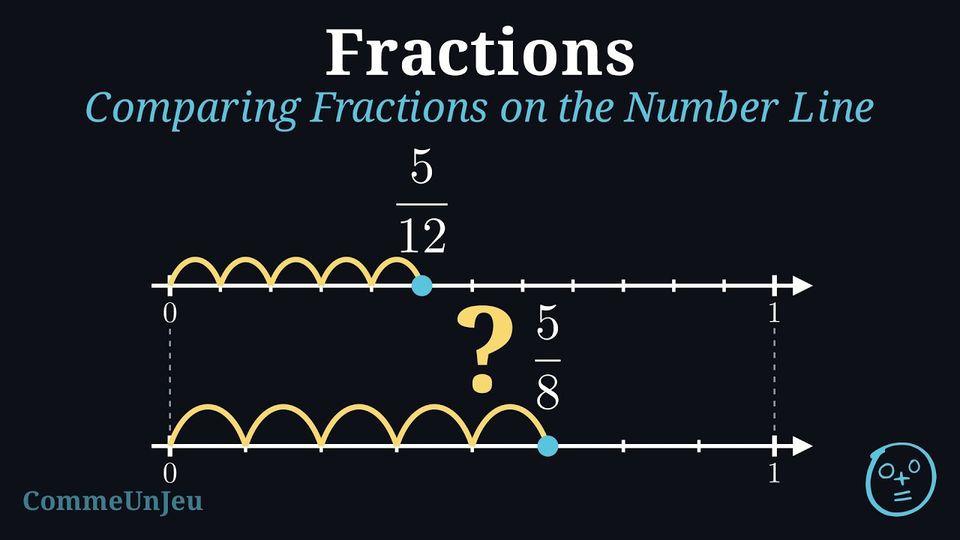
- Same numerator. The same number of steps, but the steps are smaller when the denominator is greater: \(5\) twelfths are \(5\) small steps, \(5\) eighths are \(5\) bigger steps. \(\dfrac{5}{12} < \dfrac{5}{8}\).


- One denominator is a multiple of the other. Write the fraction with the bigger parts in the finer graduations: \(\dfrac{5}{6} = \dfrac{10}{12}\) (each sixth is two twelfths). Then compare on the twelfths line: \(\dfrac{7}{12} < \dfrac{10}{12}\), so \(\dfrac{7}{12} < \dfrac{5}{6}\).

Example
Compare \(\dfrac{5}{12}\) and \(\dfrac{5}{8}\); then \(\dfrac{2}{3}\) and \(\dfrac{7}{12}\). Finally, order \(\dfrac{1}{2}\), \(\dfrac{5}{8}\) and \(\dfrac{3}{4}\) from the smallest to the largest using the line graduated in eighths. - Same numerator: \(5\) steps each time, but an eighth is a bigger step than a twelfth, so \(\dfrac{5}{12} < \dfrac{5}{8}\).
- \(12\) is a multiple of \(3\): each third is four twelfths, \(\dfrac{2}{3} = \dfrac{8}{12}\). On the twelfths line, \(\dfrac{7}{12} < \dfrac{8}{12}\), so \(\dfrac{7}{12} < \dfrac{2}{3}\).
- On the eighths line: \(\dfrac{1}{2} = \dfrac{4}{8}\) and \(\dfrac{3}{4} = \dfrac{6}{8}\). Reading from left to right: \(\dfrac{4}{8} < \dfrac{5}{8} < \dfrac{6}{8}\), that is \(\dfrac{1}{2} < \dfrac{5}{8} < \dfrac{3}{4}\).

Skills to practice
- Comparing Fractions on the Number Line
- Ordering Fractions on the Ruler
IV
Adding with the Same Denominator
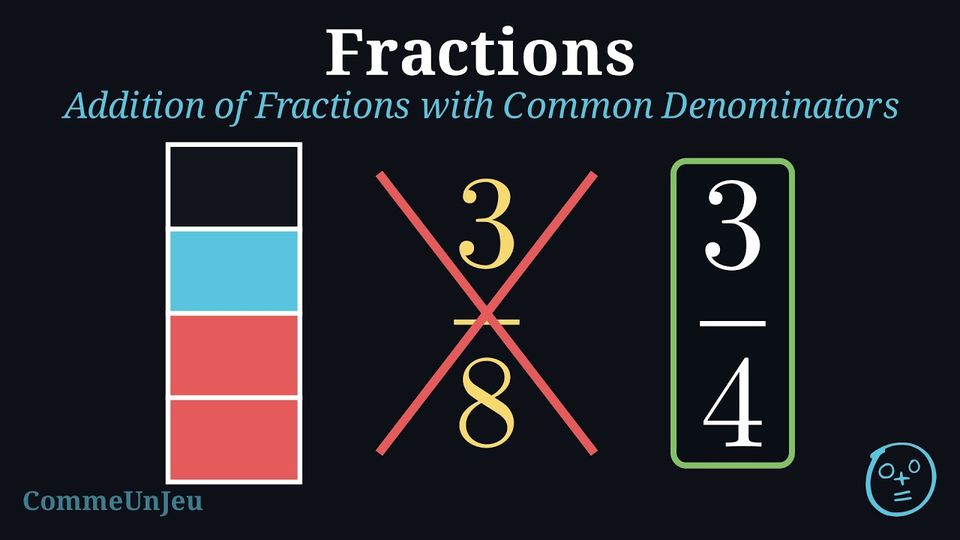
Hugo's cake is cut into \(4\) equal parts (quarters). Hugo eats \(\dfrac{2}{4}\) of the cake \(=\)  , then \(\dfrac{1}{4}\) more \(=\)
 .
What fraction of the cake has he eaten?
, then \(\dfrac{1}{4}\) more \(=\) .What fraction of the cake has he eaten?
The parts are all the same size (quarters), so the eaten parts can simply be counted together: \(2+1=3\) quarters. 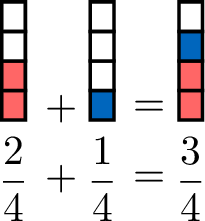
Hugo has eaten \(\dfrac{3}{4}\) of the cake.
Definition — Addition of Fractions with Common Denominators
To add fractions with the same denominator, add the numerators and keep the denominator the same: Skills to practice
- Adding Fractions with the Same Denominator
V
Subtracting with the Same Denominator
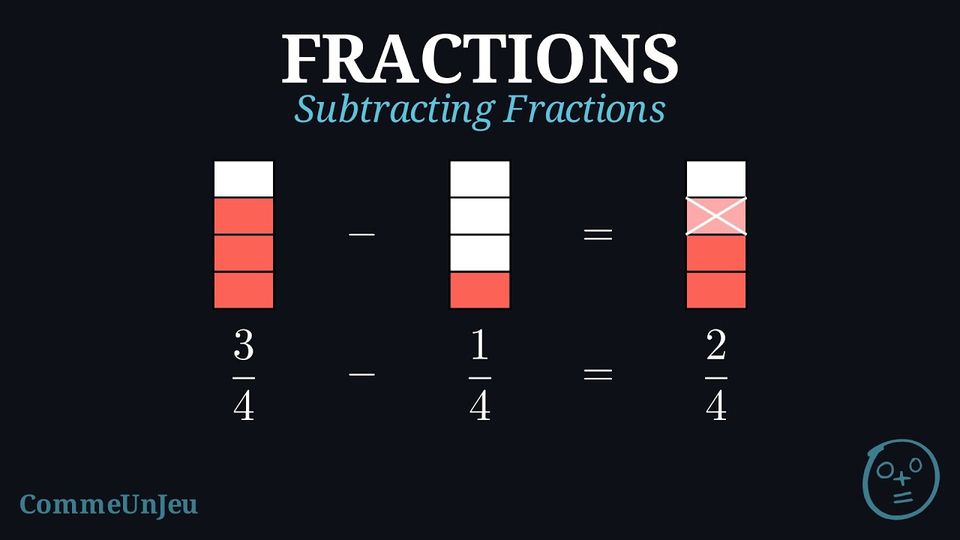
Another day, \(\dfrac{3}{4}\) of Hugo's cake is left \(=\)  . Hugo eats \(\dfrac{1}{4}\) more.
What fraction of the cake is left now?
. Hugo eats \(\dfrac{1}{4}\) more.What fraction of the cake is left now?
The parts are the same size (quarters), so subtract the counts: \(3-1=2\) quarters are left. 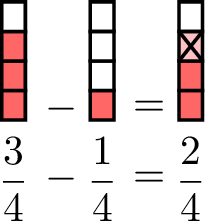
\(\dfrac{2}{4}\) of the cake is left.
Definition — Subtraction of Fractions with Common Denominators
To subtract fractions with the same denominator, subtract the numerators and keep the denominator the same:
The Whole Cake
Hugo cuts a cake into \(3\) equal parts — and eats them all:  . He has eaten \(3\) parts out of \(3\): the whole cake. $$\dfrac{3}{3} = 1$$ Before the first bite, it was the other way round — \(0\) parts out of \(3\), nothing of the cake:
 . $$\dfrac{0}{3} = 0$$
. He has eaten \(3\) parts out of \(3\): the whole cake. $$\dfrac{3}{3} = 1$$ Before the first bite, it was the other way round — \(0\) parts out of \(3\), nothing of the cake: . $$\dfrac{0}{3} = 0$$
Proposition — When the Fraction is Worth 1 or 0
When the two numbers are equal, every part is taken: the fraction is the whole unit. It is worth \(1\). 

Skills to practice
- Subtracting Fractions with the Same Denominator
VI
Addition and Subtraction with Unlike Denominators
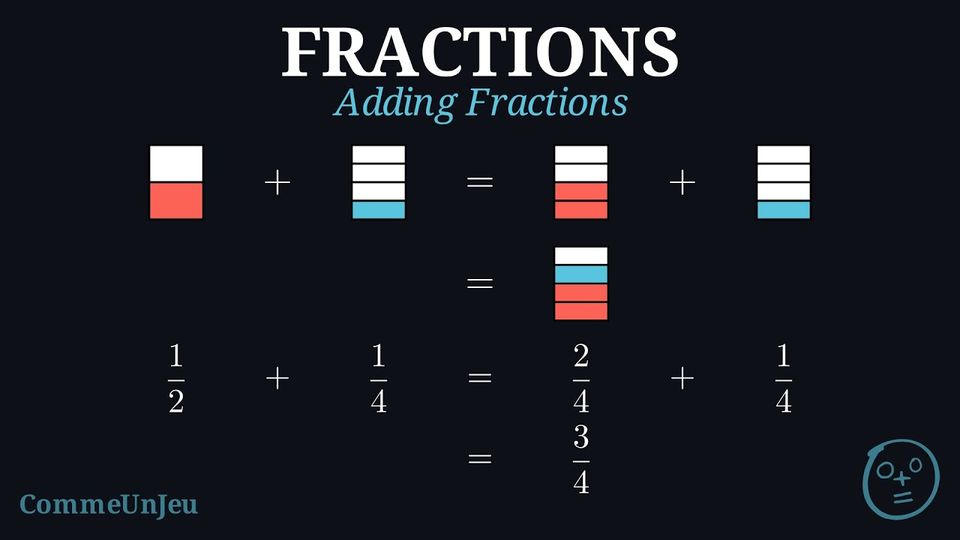
To add or subtract fractions by combining their numerators, the fractions must first represent parts of the same size, i.e., be written with a common denominator.
Consider the problem of adding \(\dfrac{1}{2}\) and \(\dfrac{1}{4}\).  \(+\)

Because the fractions have unlike denominators (2 and 4), the parts are of different sizes. A direct addition of the numerators is not possible. To solve this, we must first express the fractions with a common denominator.
Consider the problem of adding \(\dfrac{1}{2}\) and \(\dfrac{1}{4}\).
\(+\) Method — Procedure for Adding or Subtracting Fractions
To add or subtract fractions with unlike denominators, follow this three-step procedure: - Find a Common Denominator: Identify a common multiple of the denominators.
- Create Equivalent Fractions: Convert each fraction to an equivalent fraction with the common denominator.
- Add or Subtract the Numerators: With the denominators now the same, perform the operation on the numerators and keep the common denominator. For a subtraction, the first fraction must not be smaller than the second.
The Sum of Two Positive Numbers
Louis writes \(\dfrac{1}{2} + \dfrac{1}{4} = \dfrac{2}{6}\): he has added the numerators together and the denominators together. On two identical bars, \(\dfrac{2}{6}\) is shorter than \(\dfrac{1}{2}\) alone. 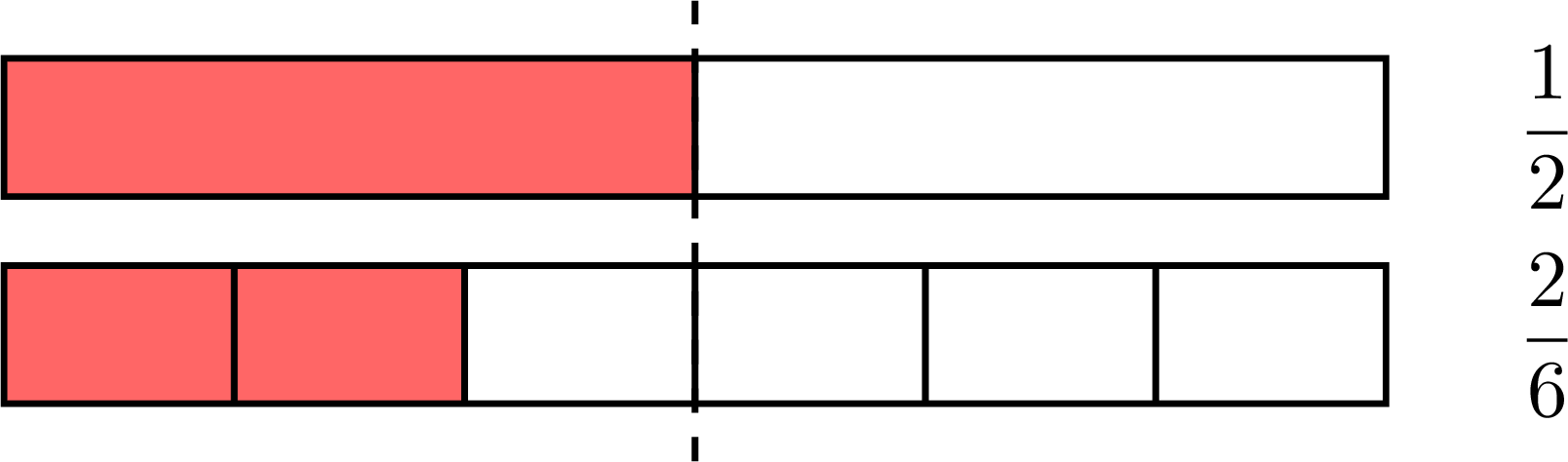
Yet the sum of two positive numbers is greater than each of them: put end to end, the lengths \(\dfrac{1}{2}\) and \(\dfrac{1}{4}\) make more than \(\dfrac{1}{2}\). Louis's answer is wrong. Only parts of the same size can be counted together: halves and quarters are not the same size, so the half is first cut into two quarters. $$\begin{aligned}\dfrac{1}{2} + \dfrac{1}{4} &= \dfrac{2}{4} + \dfrac{1}{4} && \text{(one half is two quarters)}\\
&= \dfrac{3}{4}\end{aligned}$$
When One Denominator Is a Multiple of the Other
When one of the two denominators is a multiple of the other, the common denominator is simply the bigger one, and only one fraction has to be rewritten.
Example
We will apply the procedure to calculate \(\dfrac{1}{2} + \dfrac{1}{4}\). - Step 1: Find a common denominator. The denominators are 2 and 4. A common multiple is 4.
- Step 2: Create equivalent fractions.
- The fraction \(\dfrac{1}{4}\) already has the common denominator.
- Convert \(\dfrac{1}{2}\) into an equivalent fraction with a denominator of 4:

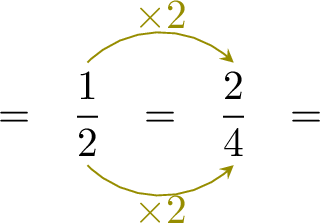

- Step 3: Add the numerators. Now that both fractions have the same denominator, we can add them: $$ \frac{2}{4} + \frac{1}{4} = \frac{2+1}{4} = \frac{3}{4} $$
| \(+\) | \(=\) |  \(+\) |
| \(=\) |  | |
| \(\dfrac{1}{2}+\dfrac{1}{4}\) | \(=\) | \(\dfrac{2}{4}+\dfrac{1}{4}\) |
| \(=\) | \(\dfrac{3}{4}\) |
Example
Compute \(\dfrac{3}{10} + \dfrac{2}{5}\) and \(\dfrac{5}{6} - \dfrac{1}{3}\). - \(10\) is a multiple of \(5\): the common denominator is \(10\). $$\begin{aligned}\dfrac{3}{10} + \dfrac{2}{5} &= \dfrac{3}{10} + \dfrac{4}{10} && \text{(each fifth is two tenths)}\\ &= \dfrac{7}{10}\end{aligned}$$
- \(6\) is a multiple of \(3\): the common denominator is \(6\). $$\begin{aligned}\dfrac{5}{6} - \dfrac{1}{3} &= \dfrac{5}{6} - \dfrac{2}{6} && \text{(each third is two sixths)}\\ &= \dfrac{3}{6}\end{aligned}$$ Three sixths is one half.

Skills to practice
- Placing the Sum on the Number Line
- Adding When One Denominator Is a Multiple of the Other
- Subtracting When One Denominator Is a Multiple of the Other
VII
Going further
Skills to practice
- Shaded Part and White Part
- From the Bar to the Ruler
- Quiz
Jump to section