International Baccalaureate · MYP 4
Algebraic Fractions
I
Numerical and Monomial Denominators
I.1
What an Algebraic Fraction Is
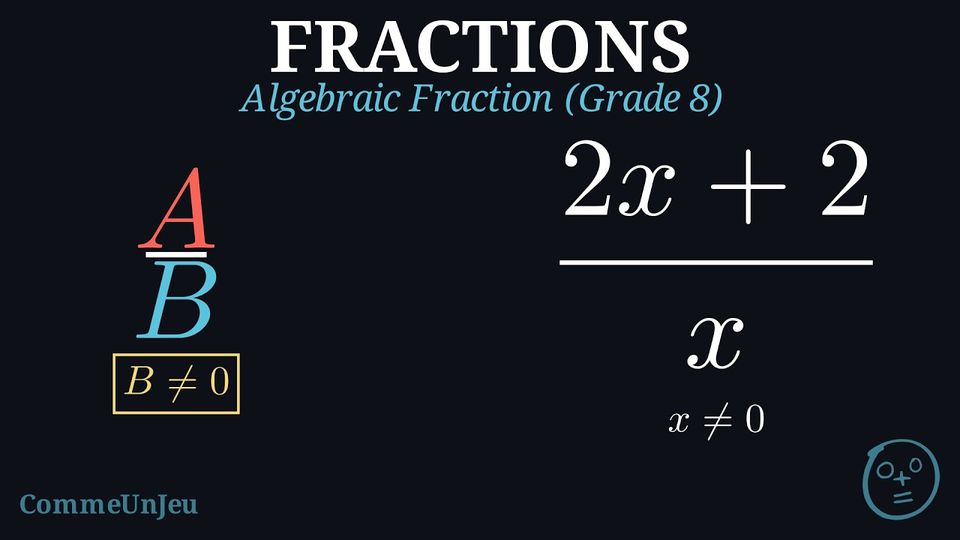
Before introducing letters, we recall what a fraction is. A numerical fraction is a number written as the ratio of two integers, like \(\dfrac{2}{3}\) or \(\dfrac{7}{4}\). The bottom number must never be zero. The same idea guides the definition of an algebraic fraction.
Definition — Algebraic Fraction
An algebraic fraction is a fraction whose numerator or denominator (or both) contains one or more letters representing unknown numbers. It has the form $$\dfrac{A}{B}$$ where \(A\) and \(B\) are algebraic expressions. The fraction is defined only for the values of the letters for which \(B \neq 0\). 
Example
Each of the following is an algebraic fraction: $$\dfrac{x}{2}, \qquad \dfrac{x^2}{6}, \qquad \dfrac{3}{x}, \qquad \dfrac{x+1}{2}, \qquad \dfrac{2x}{x-3}.$$ We read \(\dfrac{x}{2}\) as x over 2. For the fraction \(\dfrac{3}{x}\) to make sense, we need \(x \neq 0\); for \(\dfrac{2x}{x-3}\) to make sense, we need \(x \neq 3\). Method — Writing an algebraic fraction from words
To translate a sentence like A over B into a fraction, place \(A\) on top and \(B\) on the bottom of the fraction bar: $$A \text{ over } B \quad \longleftrightarrow \quad \dfrac{A}{B}.$$ Skills to practice
- Writing Fractions from Words
I.2
Equivalent Fractions and Simplifying
With numerical fractions, \(\dfrac{2}{3}\) and \(\dfrac{4}{6}\) represent the same number. The same phenomenon happens with letters: \(\dfrac{x}{2}\) and \(\dfrac{2x}{4}\) represent the same expression. The fundamental rule is unchanged.
Definition — Equivalent Algebraic Fractions
Two algebraic fractions are equivalent when one is obtained from the other by multiplying (or dividing) the numerator and the denominator by the same expression \(k\), with \(B \neq 0\) and \(k \neq 0\): 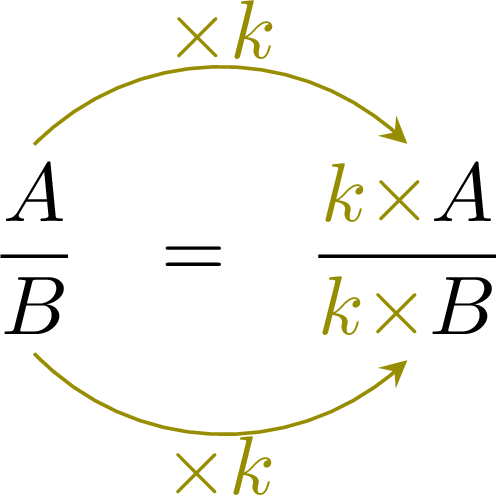
Example
Multiplying top and bottom by \(2\): $$\dfrac{x}{3} = \dfrac{\textcolor{olive}{2\times} x}{\textcolor{olive}{2\times} 3} = \dfrac{2x}{6}.$$ Dividing top and bottom by \(3\): $$\dfrac{6x}{9} = \dfrac{\textcolor{olive}{\cancel{3} \times} 2x}{\textcolor{olive}{\cancel{3} \times} 3} = \dfrac{2x}{3}.$$ The two fractions in each line are equivalent: they represent the same expression. Method — Simplifying an algebraic fraction
- Write the numerator and the denominator as products (factor out the numbers and the letters).
- Identify every factor that appears both on top and on bottom.
- Cancel each common factor (one cancellation at the top, one at the bottom, for each).
- Multiply what remains.
Example
Simplification when only a number is shared: $$\dfrac{10x^2}{4} = \dfrac{\cancel{2}\times 5x^2}{\cancel{2}\times 2} = \dfrac{5x^2}{2}.$$ Simplification when a letter is shared too (valid for \(x \neq 0\), since the original denominator contains \(30x\)): $$\dfrac{9x^3}{30x} = \dfrac{\cancel{3}\times 3 x^2 \times \cancel{x}}{\cancel{3}\times 10 \times \cancel{x}} = \dfrac{3x^2}{10}.$$
Note
A trap to avoid: cancellation only works on factors of a product, never on terms of a sum. The fraction \(\dfrac{x+2}{2}\) cannot be simplified to \(\dfrac{x+\cancel{2}}{\cancel{2}} = x\). The \(2\) on top is a term added to \(x\), not a factor multiplying everything.
By contrast, \(\dfrac{2x+4}{2} = \dfrac{2(x+2)}{2} = x+2\) does work, because \(2\) is a common factor of both terms in the numerator \(2x+4\) and of the denominator \(2\).
By contrast, \(\dfrac{2x+4}{2} = \dfrac{2(x+2)}{2} = x+2\) does work, because \(2\) is a common factor of both terms in the numerator \(2x+4\) and of the denominator \(2\).
Skills to practice
- Simplifying to Recognise Equivalent Fractions
I.3
Sign Rules
A negative sign in a fraction can be placed in three different positions: in front of the fraction, on the numerator, or on the denominator. The three writings represent the same number. Knowing this lets you choose the form that simplifies the calculation.
Proposition — Sign Rules in an Algebraic Fraction
For algebraic expressions \(A\) and \(B\) with \(B \neq 0\): $$-\dfrac{A}{B} = \dfrac{-A}{B} = \dfrac{A}{-B}.$$ Two minus signs cancel each other: $$\dfrac{-A}{-B} = \dfrac{A}{B}.$$ Example
Putting all the signs in front of the fraction: $$\dfrac{-5x}{3} = -\dfrac{5x}{3}, \qquad \dfrac{2x}{-7} = -\dfrac{2x}{7}, \qquad \dfrac{-4x}{-9} = \dfrac{4x}{9}.$$ Simplifying with negative numbers: $$\dfrac{-6x}{4} = \dfrac{\cancel{2}\times (-3x)}{\cancel{2}\times 2} = \dfrac{-3x}{2} = -\dfrac{3x}{2}.$$ Skills to practice
- Simplifying with Signed Numbers
I.4
A Fraction Times an Expression
Multiplying an algebraic fraction by an expression \(k\) amounts to multiplying only the numerator by \(k\) — the denominator is unchanged. This is the same shortcut as for numerical fractions.
Proposition — Multiplying a Fraction by an Expression
For algebraic expressions \(A\), \(B\), \(k\) with \(B \neq 0\): $$k \times \dfrac{A}{B} = \dfrac{k \times A}{B}.$$ Example
Multiplying by an integer: $$3 \times \dfrac{2x}{5} = \dfrac{3 \times 2x}{5} = \dfrac{6x}{5}.$$ Multiplying by a letter (here \(x\), with \(x \neq -1\) so that the fraction \(\dfrac{2}{x+1}\) is defined): $$x \times \dfrac{2}{x+1} = \dfrac{x \times 2}{x+1} = \dfrac{2x}{x+1}.$$ Skills to practice
- Multiplying a Fraction by an Expression
I.5
Adding and Subtracting
The rule for adding numerical fractions transfers without change to algebraic fractions: first bring both fractions to a common denominator, then add (or subtract) the numerators. If the denominators are already equal, the first step is skipped.
Proposition — Addition with a Common Denominator
For algebraic expressions \(A\), \(B\), \(C\) with \(C \neq 0\): $$\dfrac{A}{C} + \dfrac{B}{C} = \dfrac{A+B}{C}, \qquad \dfrac{A}{C} - \dfrac{B}{C} = \dfrac{A-B}{C}.$$ Example
Same denominator — add directly: $$ \begin{aligned} \dfrac{x}{6} + \dfrac{3x}{6} &= \dfrac{x+3x}{6} && \text{(combine numerators)} \\
&= \dfrac{4x}{6} \\
&= \dfrac{\cancel{2}\times 2x}{\cancel{2}\times 3} && \text{(simplify by 2)} \\
&= \dfrac{2x}{3}. \end{aligned} $$ Method — Addition with Different Denominators
- Find a common denominator for the two fractions — when the denominators are numbers, the lowest common multiple is the most economical choice; more generally, any common multiple of the denominators that is not zero where the fractions are defined will do.
- Rewrite each fraction with that common denominator (multiply top and bottom by the missing factor).
- Add or subtract the numerators.
- Simplify the result if possible.
Example
Different denominators — bring to a common denominator first. The common denominator of \(2\) and \(4\) is \(4\): $$ \begin{aligned} \dfrac{x}{2} + \dfrac{3x}{4} &= \dfrac{x\times 2}{2\times 2} + \dfrac{3x}{4} && \text{(common denominator 4)} \\
&= \dfrac{2x}{4} + \dfrac{3x}{4} \\
&= \dfrac{2x+3x}{4} \\
&= \dfrac{5x}{4}. \end{aligned} $$ Example
Variable denominators — bring to a common denominator first. The common denominator of \(x\) and \(2x\) is \(2x\) (here \(x\neq 0\)): $$ \begin{aligned} \dfrac{1}{x} + \dfrac{1}{2x} &= \dfrac{1\times 2}{x\times 2} + \dfrac{1}{2x} && \text{(common denominator } 2x\text{)} \\
&= \dfrac{2}{2x} + \dfrac{1}{2x} \\
&= \dfrac{3}{2x}. \end{aligned} $$ Skills to practice
- Adding and Subtracting Algebraic Fractions
I.6
The Fraction Bar; Evaluating
The fraction bar acts as an invisible pair of brackets: everything above it counts as one block, and everything below it as another. So before applying the order of operations (brackets, powers, multiplications and divisions, then additions and subtractions), evaluate each block separately.
Proposition — The Fraction Bar as a Grouping Symbol
The expression \(\dfrac{A}{B}\) should be read as \(\dfrac{(A)}{(B)}\): the numerator and the denominator are each evaluated as a whole before the division is performed. Example
First simplify what is above and below the bar, then divide: $$ \begin{aligned} \dfrac{x + 7x}{3 \times 4} &= \dfrac{8x}{12} && \text{(simplify each block)} \\
&= \dfrac{\cancel{4} \times 2x}{\cancel{4}\times 3} && \text{(common factor 4)} \\
&= \dfrac{2x}{3}. \end{aligned} $$ Example
For \(a = 4\), \(b = -2\) and \(c = -3\), evaluate: - \(\dfrac{a - b}{c}\)
- \(\dfrac{b - c}{a + b}\)
Each letter is replaced by its value, a negative value in brackets, so that no minus sign is lost; then the numerator and the denominator are evaluated separately, since the fraction bar groups each of them (Proposition “The Fraction Bar as a Grouping Symbol”), and the division comes last.
- $$\begin{aligned} \frac{a - b}{c} &= \frac{4 - (-2)}{(-3)} && \text{(substitute)} \\ &= \frac{6}{-3} && \text{(evaluate the numerator)} \\ &= -2. && \text{(divide)} \end{aligned}$$
- $$\begin{aligned} \frac{b - c}{a + b} &= \frac{(-2) - (-3)}{4 + (-2)} && \text{(substitute)} \\ &= \frac{-2 + 3}{4 - 2} && \text{(subtracting a negative number adds its opposite)} \\ &= \frac{1}{2}. && \text{(evaluate each block)} \end{aligned}$$
Skills to practice
- Evaluating Algebraic Fractions: Level 1
- Evaluating Algebraic Fractions: Level 2
- Calculating with Algebraic Fractions
II
Algebraic Denominators
II.1
Excluded Values; Simplifying by Factorising
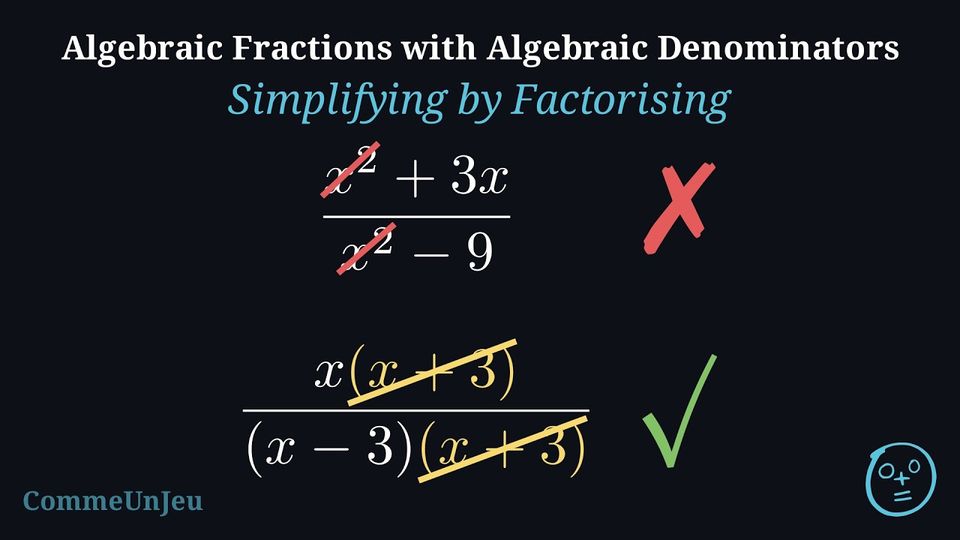
Ana and Ben must simplify the algebraic fraction \(F = \dfrac{x^2 + 3x}{x^2 - 9}\).
Ana cancels the two squares: \(\dfrac{x^2 + 3x}{x^2 - 9} = \dfrac{3x}{-9} = -\dfrac{x}{3}\).
Ben factorises first: \(\dfrac{x^2 + 3x}{x^2 - 9} = \dfrac{x(x + 3)}{(x - 3)(x + 3)} = \dfrac{x}{x - 3}\).
Ana cancels the two squares: \(\dfrac{x^2 + 3x}{x^2 - 9} = \dfrac{3x}{-9} = -\dfrac{x}{3}\).
Ben factorises first: \(\dfrac{x^2 + 3x}{x^2 - 9} = \dfrac{x(x + 3)}{(x - 3)(x + 3)} = \dfrac{x}{x - 3}\).
- Compute \(F\), Ana's result and Ben's result for \(x = 1\), then for \(x = 5\).
- Which simplification is correct? What is wrong with the other one?
- Can \(F\) be computed for \(x = 3\)? For \(x = -3\)? Can Ben's result be computed for \(x = -3\)?
- For \(x = 1\): \(F = \dfrac{1 + 3}{1 - 9} = \dfrac{4}{-8} = -\dfrac{1}{2}\); for \(x = 5\): \(F = \dfrac{25 + 15}{25 - 9} = \dfrac{40}{16} = \dfrac{5}{2}\). With the two results:
\(x\) \(F\) Ana Ben \(1\) \(-\frac{1}{2}\) \(-\frac{1}{3}\) \(-\frac{1}{2}\) \(5\) \(\frac{5}{2}\) \(-\frac{5}{3}\) \(\frac{5}{2}\) - Ana's result differs from \(F\) for \(x = 1\): one value is enough to show that her simplification is wrong. She cancelled \(x^2\), which is a term of the sums \(x^2 + 3x\) and \(x^2 - 9\), not a factor. Ben first wrote the numerator and the denominator as products; the bracket \((x + 3)\) is then a factor of both, and cancelling it is allowed.
- For \(x = 3\) and for \(x = -3\), the denominator is \(x^2 - 9 = 9 - 9 = 0\): \(F\) has no value. Ben's result has one for \(x = -3\): \(\dfrac{-3}{-3 - 3} = \dfrac{1}{2}\). So \(F\) and \(\dfrac{x}{x - 3}\) are equal for every \(x\) except \(3\) and \(-3\), and these two values must be written with the result: $$F = \frac{x}{x - 3} \quad \text{for } x \neq 3 \text{ and } x \neq -3.$$
Definition — Excluded Values
Let \(\dfrac{A}{B}\) be an algebraic fraction in the variable \(x\). The values of \(x\) for which the denominator \(B\) is equal to \(0\) are the excluded values of the fraction (also called forbidden values): for these values, the fraction has no value. An expression that contains several algebraic fractions has as excluded values those of all its denominators and, in a quotient, the values for which the dividing fraction is \(0\).For example, \(\dfrac{x}{x^2 - 9}\) has the excluded values \(3\) and \(-3\).
Method — Finding the Excluded Values
- Factorise the denominator completely (Propositions “Common Factor Laws”, “Difference of Squares”, “Sum and Product”).
- Set each factor equal to \(0\) and solve: a product is \(0\) exactly when one of its factors is \(0\).
- List the values found: they are the excluded values. A denominator that never takes the value \(0\), such as \(x^2 + 1\), gives none.
Example
Determine the excluded values of each algebraic fraction. - \(\dfrac{2x + 1}{x - 5}\)
- \(\dfrac{x}{x^2 - 16}\)
- \(\dfrac{3}{x^2 + 4x}\)
- \(\dfrac{x + 1}{x^2 + 1}\)
- \(x - 5 = 0\) for \(x = 5\): the excluded value is \(5\).
- $$\begin{aligned}[t] x^2 - 16 &= x^2 - 4^2 \\ &= (x - 4)(x + 4). && \text{(difference of squares)} \end{aligned}$$ Since a product is \(0\) exactly when one of its factors is \(0\), \((x - 4)(x + 4) = 0\) for \(x = 4\) or \(x = -4\): the excluded values are \(-4\) and \(4\).
- \(x^2 + 4x = x(x + 4)\) (common factor \(x\)), which is \(0\) for \(x = 0\) or \(x = -4\): the excluded values are \(-4\) and \(0\).
- A square is never negative, so \(x^2 + 1 \geq 1\): the denominator is never \(0\). The fraction has no excluded value.
Method — Simplifying by Factorising
To simplify an algebraic fraction whose numerator or denominator is a sum: - Factorise the denominator completely and write its excluded values.
- Factorise the numerator completely.
- Cancel each factor common to the numerator and the denominator — a whole bracket such as \((x + 3)\), never a term of a sum (Definition “Equivalent Algebraic Fractions”: the numerator and the denominator are divided by the same non-zero expression).
- Write the result followed by the excluded values of the original fraction: “for \(x \neq \ldots\)”.
Example
Simplify \(\dfrac{x^2-9}{x-3}\) for \(x \neq 3\).
The numerator is a difference of two squares: $$\dfrac{x^2-9}{x-3} = \dfrac{(x-3)(x+3)}{x-3} = x+3 \qquad (x \neq 3).$$ Factorising reveals the common bracket \((x-3)\) — factorise to simplify.
Example
Simplify each algebraic fraction, stating the excluded values. - \(\dfrac{x^2 - 4}{x^2 + 2x}\)
- \(\dfrac{x^2 + 5x + 6}{x^2 - x - 6}\)
- \(\dfrac{6 - 2x}{x^2 - 9}\)
- The denominator is \(x^2 + 2x = x(x + 2)\): the excluded values are \(0\) and \(-2\). Then: $$\begin{aligned}[t] \frac{x^2 - 4}{x^2 + 2x} &= \frac{(x - 2)(x + 2)}{x(x + 2)} && \text{(difference of squares; common factor } x\text{)} \\ &= \frac{x - 2}{x} && \text{(cancel the factor } x + 2\text{)} \end{aligned}$$ for \(x \neq 0\) and \(x \neq -2\).
- Two numbers with sum \(-1\) and product \(-6\) are \(-3\) and \(2\), so the denominator is \(x^2 - x - 6 = (x - 3)(x + 2)\) (Proposition “Sum and Product”): the excluded values are \(3\) and \(-2\). Two numbers with sum \(5\) and product \(6\) are \(2\) and \(3\), so: $$\begin{aligned}[t] \frac{x^2 + 5x + 6}{x^2 - x - 6} &= \frac{(x + 2)(x + 3)}{(x - 3)(x + 2)} && \text{(sum and product)} \\ &= \frac{x + 3}{x - 3} && \text{(cancel the factor } x + 2\text{)} \end{aligned}$$ for \(x \neq 3\) and \(x \neq -2\).
- The denominator is \(x^2 - 9 = (x - 3)(x + 3)\): the excluded values are \(3\) and \(-3\). In the numerator, taking out the common factor \(-2\) makes the bracket \(x - 3\) appear: $$\begin{aligned}[t] \frac{6 - 2x}{x^2 - 9} &= \frac{-2(x - 3)}{(x - 3)(x + 3)} && \text{(common factor } -2\text{; difference of squares)} \\ &= \frac{-2}{x + 3} && \text{(cancel the factor } x - 3\text{)} \end{aligned}$$ for \(x \neq 3\) and \(x \neq -3\).
Equal Only Where Both Are Defined
Simplifying never changes the value of a fraction at an allowed value of \(x\), but the simplified form may have a value where the original fraction has none. For example, \(\dfrac{x^2 - 4}{x^2 + 2x} = \dfrac{x - 2}{x}\) for \(x \neq 0\) and \(x \neq -2\): at \(x = -2\), the left-hand side has no value, since its denominator is \(4 - 4 = 0\), while the right-hand side is \(\dfrac{-4}{-2} = 2\). This is why the excluded values of the original fraction are always written with the result.
Skills to practice
- Checking Excluded Values and Simplest Forms
- Finding Excluded Values
- Simplifying by Factorising
II.2
Multiplying and Dividing
Proposition — Multiplication of Algebraic Fractions
For algebraic expressions \(A\), \(B\), \(C\), \(D\) with \(B \neq 0\) and \(D \neq 0\): $$\dfrac{A}{B} \times \dfrac{C}{D} = \dfrac{A \times C}{B \times D}.$$ Definition — Reciprocal of an Algebraic Fraction
The reciprocal of the fraction \(\dfrac{A}{B}\) (with \(A \neq 0\) and \(B \neq 0\)) is the fraction $$\dfrac{B}{A},$$ obtained by swapping the numerator and the denominator. Proposition — Division of Algebraic Fractions
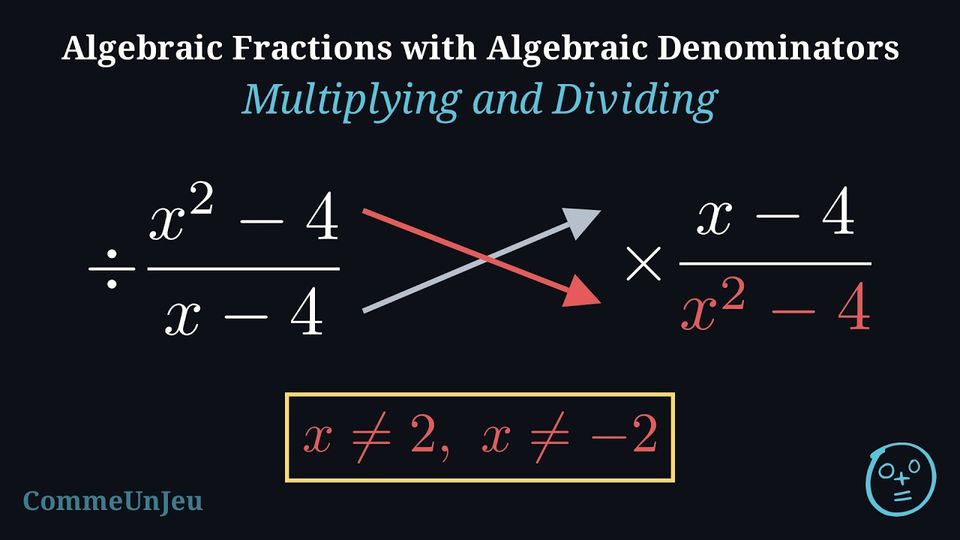
For algebraic expressions \(A\), \(B\), \(C\), \(D\) with \(B \neq 0\), \(C \neq 0\), \(D \neq 0\): $$\dfrac{A}{B} \div \dfrac{C}{D} = \dfrac{A}{B} \times \dfrac{D}{C} = \dfrac{A \times D}{B \times C}.$$ Method — Multiplying and Dividing Algebraic Fractions
- For a division, multiply by the reciprocal of the dividing fraction (Proposition “Division of Algebraic Fractions”).
- Factorise every numerator and every denominator completely.
- Write the excluded values: those of every denominator of the original expression and, for a division, the values for which the dividing fraction is \(0\) — one cannot divide by \(0\).
- Cancel each factor that appears in a numerator and in a denominator, even in two different fractions: the product is one single fraction (Proposition “Multiplication of Algebraic Fractions”).
- Multiply the remaining factors and write the conditions.
Example
Simplify, stating the excluded values. - \(\dfrac{x^2 - 1}{x^2 + 3x} \times \dfrac{x + 3}{x + 1}\)
- \(\dfrac{x + 2}{x^2 - 4x} \div \dfrac{x^2 - 4}{x - 4}\)
- The denominators are \(x^2 + 3x = x(x + 3)\) and \(x + 1\): the excluded values are \(0\), \(-3\) and \(-1\). $$\begin{aligned}[t] \frac{x^2 - 1}{x^2 + 3x} \times \frac{x + 3}{x + 1} &= \frac{(x - 1)(x + 1)}{x(x + 3)} \times \frac{x + 3}{x + 1} && \text{(factorise)} \\ &= \frac{(x - 1)(x + 1)(x + 3)}{x(x + 3)(x + 1)} && \text{(multiply the fractions)} \\ &= \frac{x - 1}{x} && \text{(cancel } x + 1 \text{ and } x + 3\text{)} \end{aligned}$$ for \(x \neq -3\), \(x \neq -1\) and \(x \neq 0\).
- The denominators are \(x^2 - 4x = x(x - 4)\) and \(x - 4\): they exclude \(0\) and \(4\). The dividing fraction \(\dfrac{x^2 - 4}{x - 4}\) is \(0\) when \(x^2 - 4 = (x - 2)(x + 2) = 0\): it also excludes \(2\) and \(-2\). $$\begin{aligned}[t] \frac{x + 2}{x^2 - 4x} \div \frac{x^2 - 4}{x - 4} &= \frac{x + 2}{x^2 - 4x} \times \frac{x - 4}{x^2 - 4} && \text{(multiply by the reciprocal)} \\ &= \frac{x + 2}{x(x - 4)} \times \frac{x - 4}{(x - 2)(x + 2)} && \text{(factorise)} \\ &= \frac{(x + 2)(x - 4)}{x(x - 4)(x - 2)(x + 2)} && \text{(multiply the fractions)} \\ &= \frac{1}{x(x - 2)} && \text{(cancel } x + 2 \text{ and } x - 4\text{)} \end{aligned}$$ for \(x \neq -2\), \(x \neq 0\), \(x \neq 2\) and \(x \neq 4\). When every factor of the numerator cancels, the numerator \(1\) remains.
Skills to practice
- Multiplying and Dividing Algebraic Fractions
- Simplifying and Checking
II.3
Adding and Subtracting with the Lowest Common Denominator
Definition — Lowest Common Denominator
Consider several algebraic fractions whose denominators are factorised completely. Their lowest common denominator (LCD) is the product of the lowest common multiple of their numerical coefficients and of all the different factors containing the variable, each one raised to the highest power with which it appears. For example, the LCD of \(4x\) and \(6x\) is \(12x\), not \(24x\). Two factors that differ only by their sign, such as \(x - 3\) and \(3 - x = -(x - 3)\), count as the same factor: write them in the same form first (Proposition “Sign Rules in an Algebraic Fraction”). The LCD is a multiple of every denominator, and the simplest one; for whole-number denominators, it is their lowest common multiple.Likewise, the LCD of \(x(x + 1)\) and \((x + 1)^2\) is \(x(x + 1)^2\); the LCD of \(x - 1\) and \(x + 2\), which have no common factor, is their product \((x - 1)(x + 2)\).
Method — Adding and Subtracting Algebraic Fractions
- Factorise every denominator and write the excluded values.
- Find the lowest common denominator.
- Rewrite each fraction over the LCD: multiply its numerator and its denominator by the factors that its denominator lacks (Definition “Equivalent Algebraic Fractions”).
- Add or subtract the numerators over the LCD (Proposition “Addition with a Common Denominator”), each numerator in brackets: a minus sign in front of a fraction applies to its whole numerator.
- Expand and collect the numerator; factorise it if possible, cancel a factor that it shares with the denominator, and write the conditions.
Example
Write as a single fraction. - \(\dfrac{x + 1}{2} - \dfrac{x - 3}{5}\)
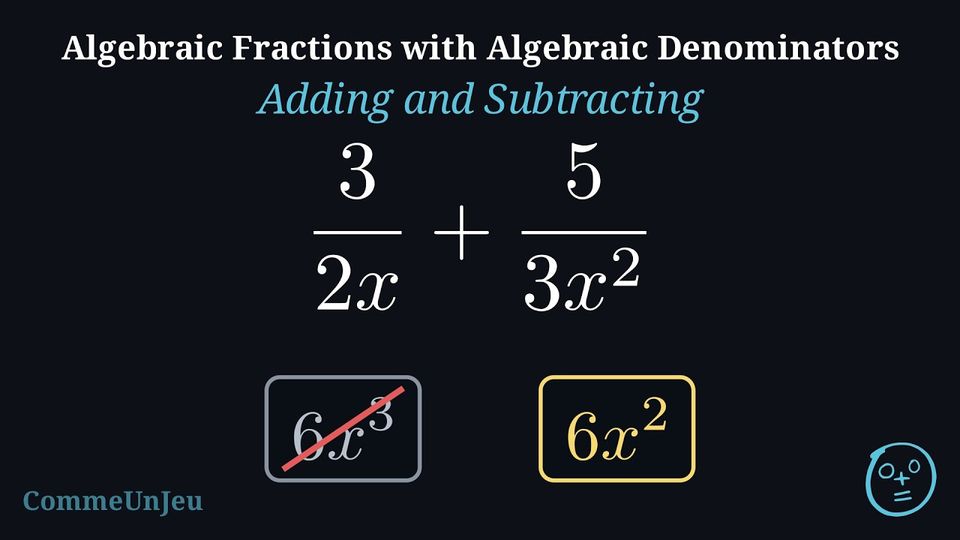
- \(\dfrac{3}{2x} + \dfrac{5}{3x^2}\)
- The denominators are numbers: there is no excluded value. The LCD of \(2\) and \(5\) is \(10\). $$\begin{aligned}[t] \frac{x + 1}{2} - \frac{x - 3}{5} &= \frac{5(x + 1)}{10} - \frac{2(x - 3)}{10} && \text{(LCD } 10\text{)} \\ &= \frac{5(x + 1) - 2(x - 3)}{10} && \text{(subtract the numerators)} \\ &= \frac{5x + 5 - 2x + 6}{10} && \text{(expand: } -2 \times (-3) = 6\text{)} \\ &= \frac{3x + 11}{10}. \end{aligned}$$
- The denominators are \(2x\) and \(3x^2 = 3 \times x \times x\): the excluded value is \(0\), and the LCD is \(2 \times 3 \times x^2 = 6x^2\). $$\begin{aligned}[t] \frac{3}{2x} + \frac{5}{3x^2} &= \frac{3 \times 3x}{2x \times 3x} + \frac{5 \times 2}{3x^2 \times 2} && \text{(LCD } 6x^2\text{)} \\ &= \frac{9x}{6x^2} + \frac{10}{6x^2} \\ &= \frac{9x + 10}{6x^2} \end{aligned}$$ for \(x \neq 0\).
Example
Write as a single fraction in simplest form, stating the excluded values. - \(\dfrac{2}{x - 1} - \dfrac{3}{x + 2}\)
- \(\dfrac{1}{x - 2} - \dfrac{4}{x^2 - 4}\)
- The excluded values are \(1\) and \(-2\). The denominators have no common factor, so the LCD is their product \((x - 1)(x + 2)\). $$\begin{aligned}[t] \frac{2}{x - 1} - \frac{3}{x + 2} &= \frac{2(x + 2)}{(x - 1)(x + 2)} - \frac{3(x - 1)}{(x - 1)(x + 2)} && \text{(LCD)} \\ &= \frac{2(x + 2) - 3(x - 1)}{(x - 1)(x + 2)} && \text{(subtract the numerators)} \\ &= \frac{2x + 4 - 3x + 3}{(x - 1)(x + 2)} && \text{(expand)} \\ &= \frac{7 - x}{(x - 1)(x + 2)} \end{aligned}$$ for \(x \neq 1\) and \(x \neq -2\). The numerator \(7 - x\) has no factor in common with the denominator: the fraction is in simplest form.
- \(x^2 - 4 = (x - 2)(x + 2)\): the excluded values are \(2\) and \(-2\), and the LCD is \((x - 2)(x + 2)\). $$\begin{aligned}[t] \frac{1}{x - 2} - \frac{4}{x^2 - 4} &= \frac{x + 2}{(x - 2)(x + 2)} - \frac{4}{(x - 2)(x + 2)} && \text{(LCD)} \\ &= \frac{(x + 2) - 4}{(x - 2)(x + 2)} && \text{(subtract the numerators)} \\ &= \frac{x - 2}{(x - 2)(x + 2)} && \text{(collect)} \\ &= \frac{1}{x + 2} && \text{(cancel the factor } x - 2\text{)} \end{aligned}$$ for \(x \neq 2\) and \(x \neq -2\). The value \(2\) stays excluded, although the factor \(x - 2\) no longer appears (Remark “Equal Only Where Both Are Defined”).
Skills to practice
- Recognising the Correct Sum or Difference
- Adding with Numerical and Monomial Denominators
- Writing as a Single Fraction
- Adding with Binomial Denominators
- Writing a Single Fraction and Checking
III
Going further
Skills to practice
- Finding a Pattern
- Proving a Pattern
- Solving Problems in Context
- Quiz
Jump to section