International Baccalaureate · PYP 4
Multiplication
I
Multiplying by Tens and Hundreds
Method — Multiplying by Tens and Hundreds
A factor such as \(30\) or \(200\) splits: \(30 = 3 \times 10\), \(200 = 2 \times 100\). To multiply by tens or hundreds, split this factor, multiply the small numbers first (the factors can be swapped and regrouped), then multiply by \(10\) or \(100\): $$30 \times 4 = 3 \times 4 \times 10 = 120 \qquad 6 \times 200 = 6 \times 2 \times 100 = 1\,200$$ Example
Compute mentally: \(40 \times 7\).
$$\begin{aligned}[t] 40 \times 7 &= 4 \times 7 \times 10\\
&= 28 \times 10\\
&= 280. \end{aligned}$$
Example
Compute mentally: \(7 \times 200\).
$$\begin{aligned}[t] 7 \times 200 &= 7 \times 2 \times 100\\
&= 14 \times 100\\
&= 1\,400. \end{aligned}$$
Skills to practice
- Multiplying by Tens and Hundreds in Your Head
- Multiplying a Two-Digit Number by a Multiple of 10
- Solving Problems by Multiplying by Tens and Hundreds
II
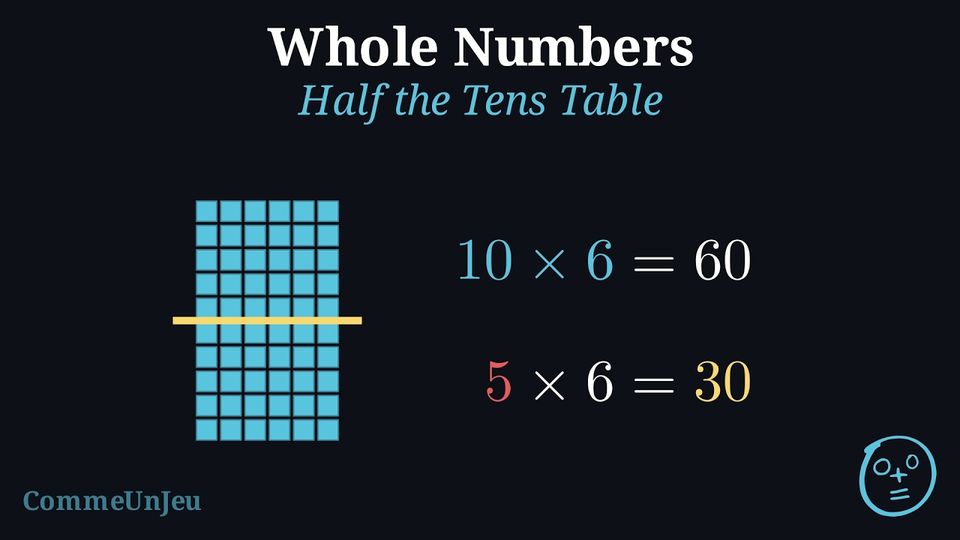
Multiplying by 5 in Your Head
Example
Compute mentally: \(17 \times 5\).
$$\begin{aligned}[t] 17 \times 5 &= (17 \times 10) \div 2\\
&= 170 \div 2\\
&= 85. \end{aligned}$$
Skills to practice
- Multiplying by 5
III
Doubling to Multiply: by 4 and by 8
Method — Doubles for Multiplying: by 4 and by 8
\(\times 4\) = double the double; \(\times 8\) = double three times in a row.Doubling, as in the 4s table, now works on big numbers. To double a number, double each part: \(52 = 50 + 2\), so its double is \(100 + 4 = 104\).
Example
Compute mentally: \(26 \times 4\).
Double the double: \(26 \to 52 \to 104\). $$26 \times 4 = 104.$$
Example
Compute mentally: \(13 \times 8\).
Three doubles in a row: \(13 \to 26 \to 52 \to 104\). $$13 \times 8 = 104.$$
Skills to practice
- Multiplying by 4: Double the Double
- Multiplying by 8: Three Doubles
- Multiplying 3-Digit Numbers by 4 and by 8
- Choosing Your Strategy
IV
Is It a Multiple?
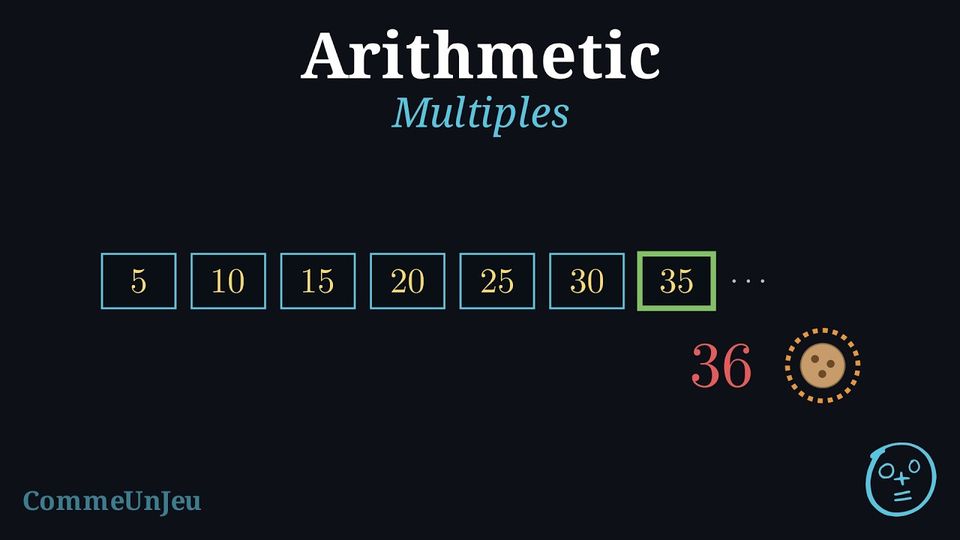
A baker puts her biscuits in packs of \(5\).
- With \(35\) biscuits, can she fill packs with nothing left over?
- With \(36\) biscuits, can she?
Example
- Is \(63\) a multiple of \(7\)?
- Is \(52\) a multiple of \(8\)?
- In the table of \(7\): \(9 \times 7 = 63\). So \(63\) is a multiple of \(7\).
- In the table of \(8\): \(6 \times 8 = 48\) and \(7 \times 8 = 56\). The number \(52\) is between them, so it is not in the table: \(52\) is not a multiple of \(8\).
Example
The table of \(7\) learned by heart stops at \(10 \times 7 = 70\), but the multiples of \(7\) go on. - Is \(98\) a multiple of \(7\)?
- Is \(100\) a multiple of \(7\)?
Beyond the table, split off a multiple that is known, \(70 = 10 \times 7\), and look at what is left.
- \(98 - 70 = 28\), and \(28 = 4 \times 7\) is in the table of \(7\). So $$\begin{aligned}[t] 98 &= 70 + 28 && \text{(split off } 70\text{)}\\ &= 10 \times 7 + 4 \times 7 && \text{(}70 = 10 \times 7 \text{ and } 28 = 4 \times 7\text{)}\\ &= 14 \times 7. \end{aligned}$$ \(10\) sevens and \(4\) more sevens make \(14\) sevens: \(98\) is a multiple of \(7\).
- \(100 - 70 = 30\), and \(30\) is not in the table of \(7\): it lies between \(28 = 4 \times 7\) and \(35 = 5 \times 7\). So \(100\) lies between \(70 + 28 = 98\) and \(70 + 35 = 105\), the two nearest multiples of \(7\): $$98 = 14 \times 7 \quad < \quad 100 \quad < \quad 105 = 15 \times 7.$$ \(100\) is not a multiple of \(7\): it is \(2\) more than \(98\).
Skills to practice
- Recognising Multiples
- Producing Multiples
- Deciding Beyond the Tables
V
Column Multiplication by a Two-Digit Number
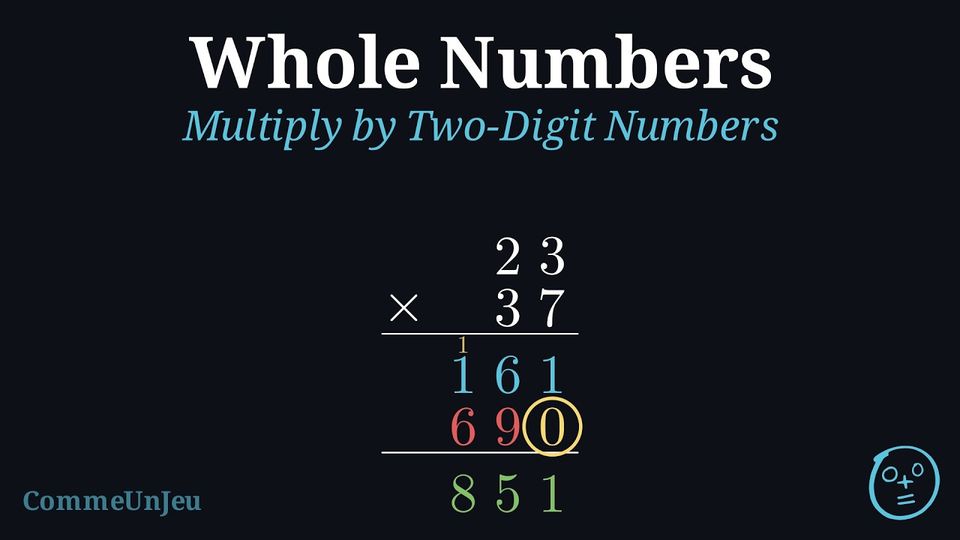
To calculate a product such as \(23 \times 37\), we split \(37\) into \(30 + 7\). The multiplication is broken into two simpler products:$$\begin{aligned}23 \times 37 &= 23 \times (7 + 30) \\
&= (23 \times 7) + (23 \times 30) \\
&= \textcolor{colorprop}{161} + \textcolor{colordef}{690} \\
&= 851 \end{aligned}$$ The column multiplication sets out these two products in rows. Note that when multiplying by the tens digit (3), the partial product (\(690\)) is shifted one place to the left. This is indicated by a placeholder zero. 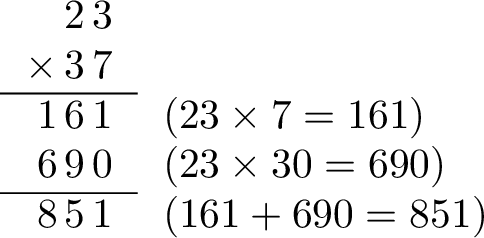
Method — Column Multiplication by a Two-Digit Number
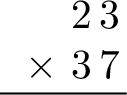
To calculate \(23 \times 37\): - Step 1: Align the numbers vertically by place value.
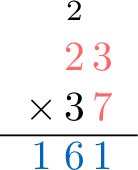
- Step 2: Multiply by the ones digit. Multiply the top number (\(\textcolor{colordef}{23}\)) by the ones digit of the bottom number (\(\textcolor{colordef}{7}\)): \(\textcolor{colordef}{23}\times\textcolor{colordef}{7}=\textcolor{colorprop}{161}\).
- Step 3: Multiply by the tens digit.
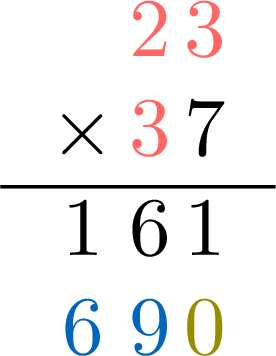
- First, place a placeholder \(\textcolor{olive}{0}\) in the ones column of the second row. This is because we are now multiplying by the tens digit (\(\textcolor{colordef}{3}\), which represents 30). This placeholder shifts the answer one place to the left.
- Next, multiply the top number (23) by the tens digit (\(\textcolor{colordef}{3}\)). Calculate \(\textcolor{colordef}{23}\times\textcolor{colordef}{3}=\textcolor{colorprop}{69}\) and write it to the left of the placeholder.
- Step 4: Sum the partial products. Add the results from Step 2 and Step 3: \(\textcolor{colordef}{161}+\textcolor{colordef}{690}=\textcolor{colorprop}{851}\)
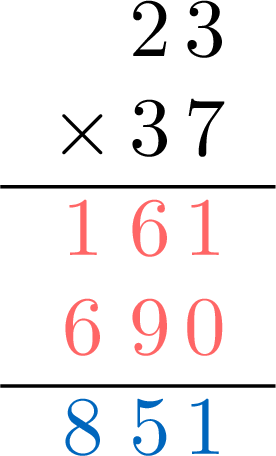
- Result: \(23 \times 37 = 851\).
Example
Compute \(16 \times 548\) in columns.
The order of the factors does not change the product, so we write the number with the fewest digits on the second line: \(548\) on top, \(16\) below. First row, \(548 \times 6\): \(8 \times 6 = 48\), write \(8\), carry \(4\); \(4 \times 6 = 24\), plus \(4\) is \(28\), write \(8\), carry \(2\); \(5 \times 6 = 30\), plus \(2\) is \(32\). So \(548 \times 6 = 3\,288\). Second row: a placeholder \(0\), then \(548 \times 1 = 548\). Sum: \(3\,288 + 5\,480 = 8\,768\). 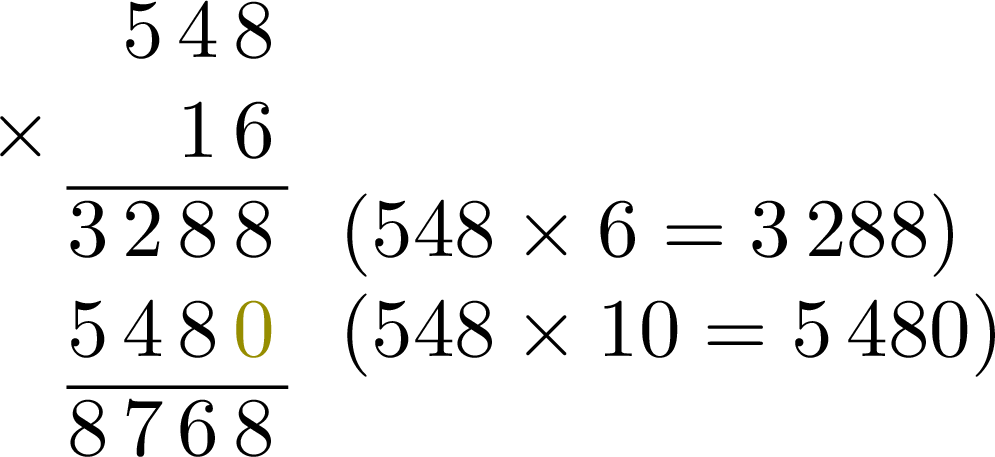
\(16 \times 548 = 8\,768\).
Skills to practice
- Multiplying 2-Digit Numbers by 2-Digit Numbers
- Multiplying 3-Digit Numbers by 2-Digit Numbers
- Setting Up a Multiplication by a Two-Digit Number
VI
Going further
Skills to practice
- Reasoning with Column Multiplication
- Larger Column Multiplications
- Quiz
Jump to section