International Baccalaureate · PYP 4
Volume and Capacity
I
Units of Volume
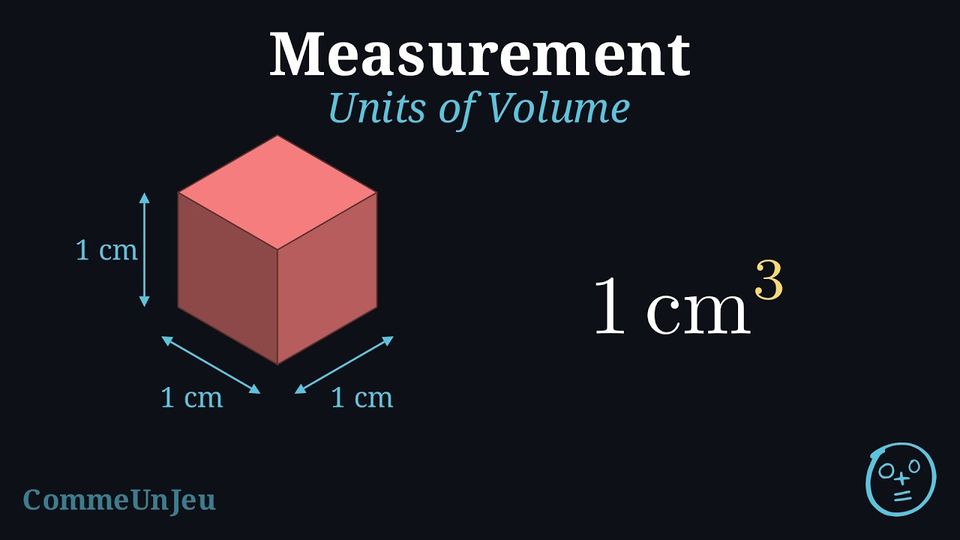
When we measure volume, it is important to use standard units so that everyone gets the same measurement. Non-standard units, like different-sized building blocks, can give different answers.
For volume, we use standard units like the cubic centimetre, written \(\text{cm}^3\), and the cubic metre, written \(\text{m}^3\).
For volume, we use standard units like the cubic centimetre, written \(\text{cm}^3\), and the cubic metre, written \(\text{m}^3\).
Definition — Units of Volume
- Cubic centimetre \(\left(\mathrm{cm}^3\right)\): The volume of a cube with sides \(1\ \text{cm}\) long. This is about the volume of a small ice cube.
 \(\quad\)

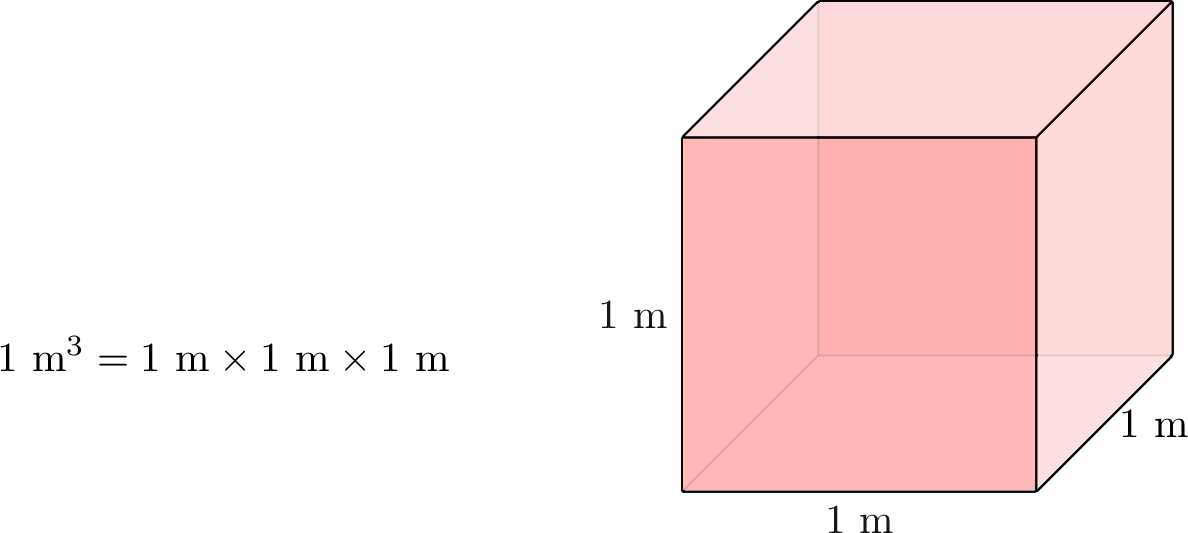
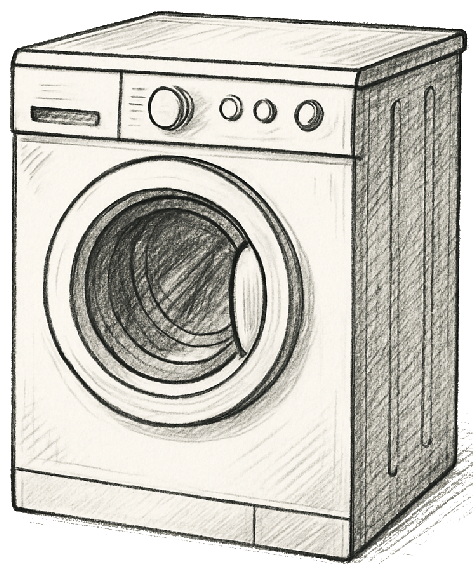
- Cubic metre \(\left(\mathrm{m}^3\right)\): The volume of a cube with sides \(1\ \text{m}\) long. Three washing machines together take up about \(1\) cubic metre.
 \(\quad\)
Skills to practice
- Choosing Units for Volume
- Finding the Volume in Cubic Units
II
Volume of a Rectangular Prism
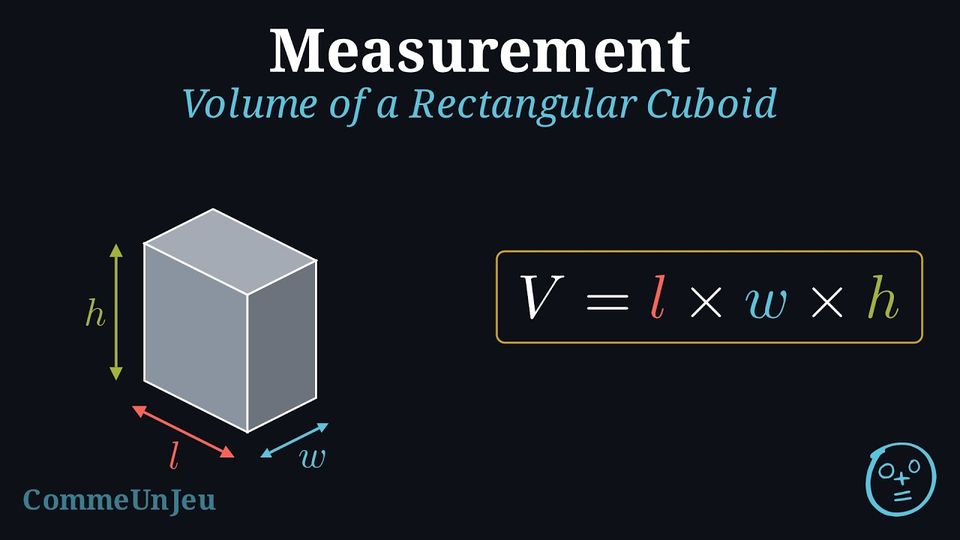
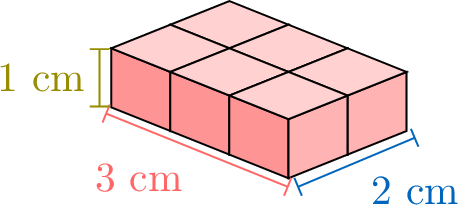
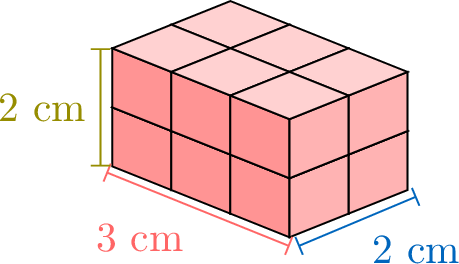
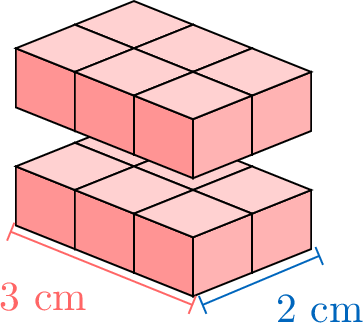
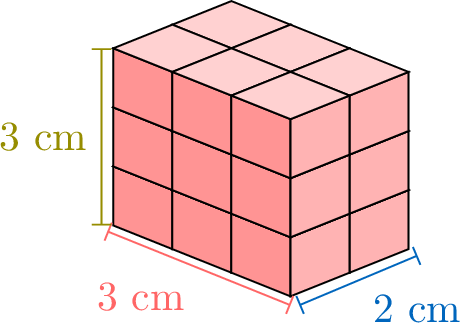
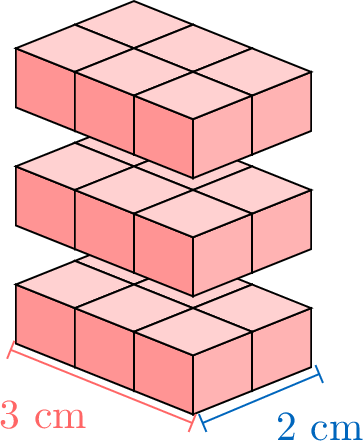
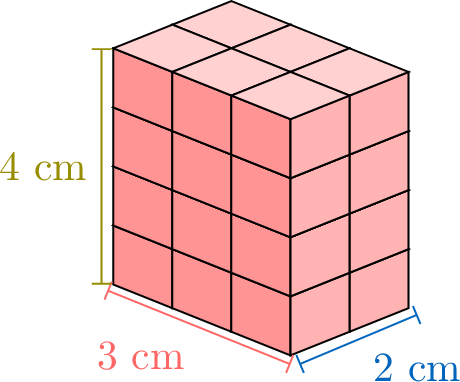
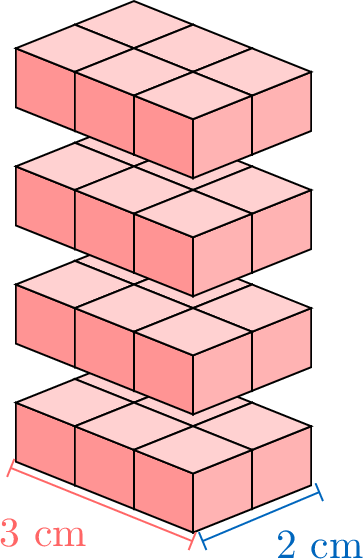
Counting every little cube inside a rectangular prism (a box) gives its volume, but that is slow. Instead, imagine making the box taller one layer at a time and watching how the volume grows.
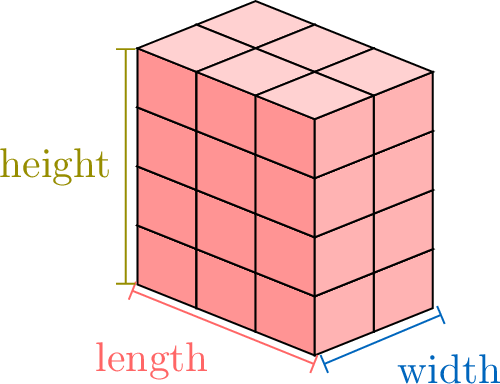
Each new layer adds the same number of cubes. By counting layer by layer, we spot a pattern and get a quick rule for volume: we can multiply the \(\textcolor{colordef}{length}\), the \(\textcolor{colorprop}{width}\), and the \(\textcolor{olive}{height}\).
Each new layer adds the same number of cubes. By counting layer by layer, we spot a pattern and get a quick rule for volume: we can multiply the \(\textcolor{colordef}{length}\), the \(\textcolor{colorprop}{width}\), and the \(\textcolor{olive}{height}\).
-
-
 \(\quad\quad\)
-
 \(\quad\quad\)
-
 \(\quad\quad\)
-
Proposition — Volume of a Rectangular Prism
The volume of a rectangular prism (also called a cuboid) is found by multiplying its length, width, and height: $$\text{Volume} = \textcolor{colordef}{\text{length}} \times \textcolor{colorprop}{\text{width}} \times \textcolor{olive}{\text{height}}$$ $$V = \textcolor{colordef}{l} \times \textcolor{colorprop}{w} \times \textcolor{olive}{h}$$ Example
Find the volume of this rectangular prism. 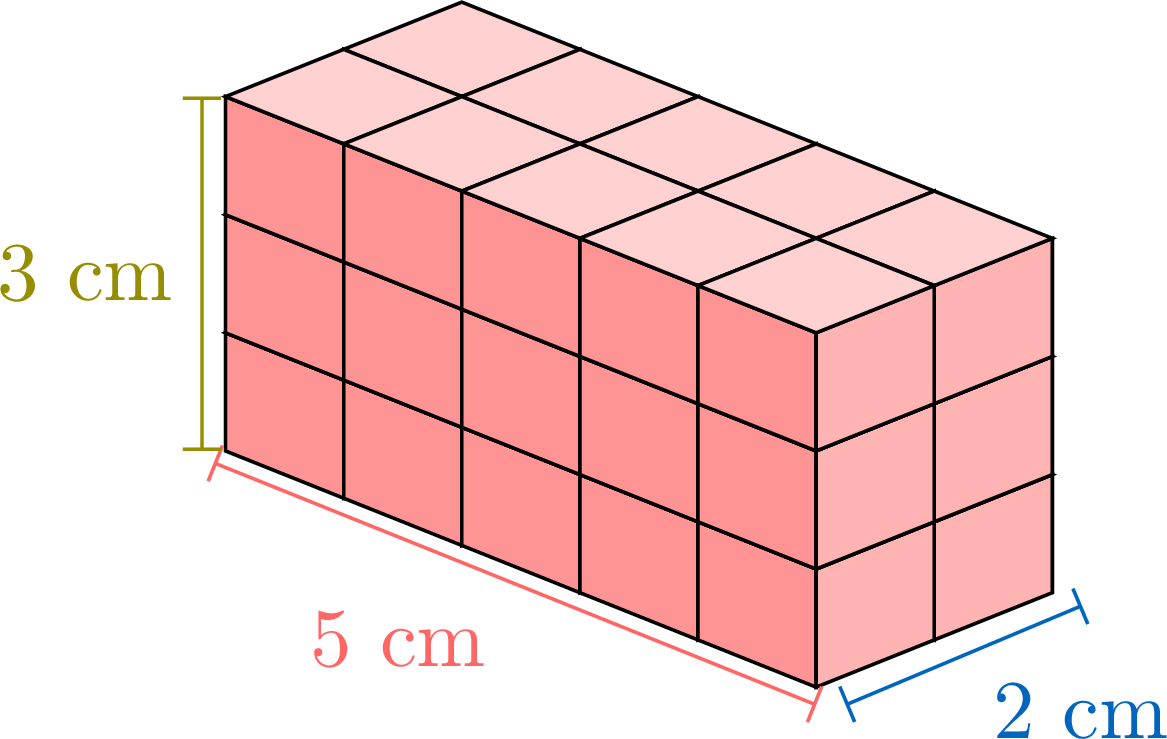
Using the formula for the volume of a rectangular prism: $$\begin{aligned} \text{Volume} &= \textcolor{colordef}{\text{length}} \times \textcolor{colorprop}{\text{width}} \times \textcolor{olive}{\text{height}}\\
&= 5\times 2 \times 3 \\
&= 10 \times 3 &&(5 \times 2 = 10)\\
&= 30 \, \text{cm}^3 \end{aligned}$$
Skills to practice
- Finding the Volumes of Rectangular Prisms
- Solving Problems
III
Reading Capacity Scales
Definition — The Millilitre
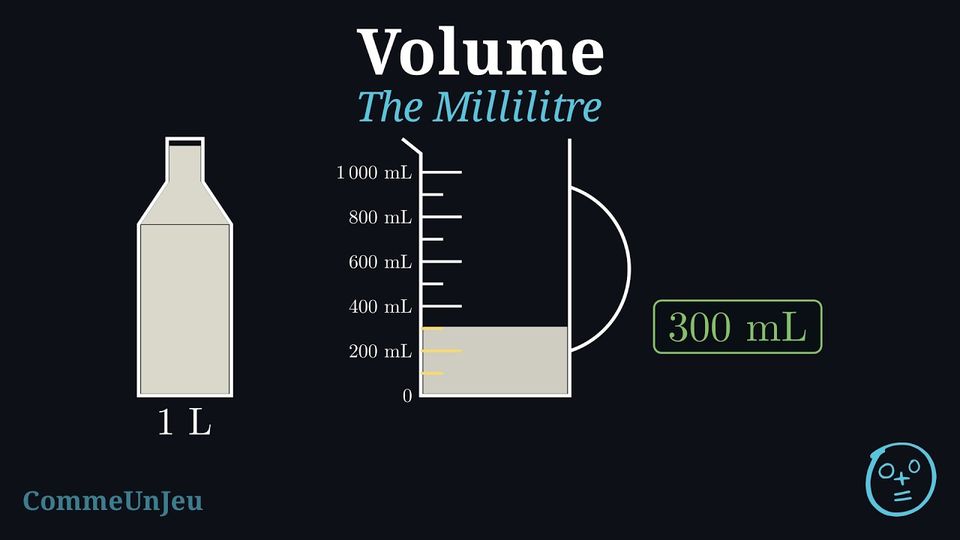
The millilitre is a very small unit of capacity, written mL. One litre is one thousand millilitres: $$1~\mathrm{L} = 1\,000~\mathrm{mL}$$ A few benchmarks (approximate values): | a teaspoon | \(5~\mathrm{mL}\) |
| a glass of water | \(200~\mathrm{mL}\) |
| a can of juice | \(330~\mathrm{mL}\) |
| a bottle of water | \(1\,000~\mathrm{mL}\), that is \(1~\mathrm{L}\) |
Method — Reading a Measuring Jug
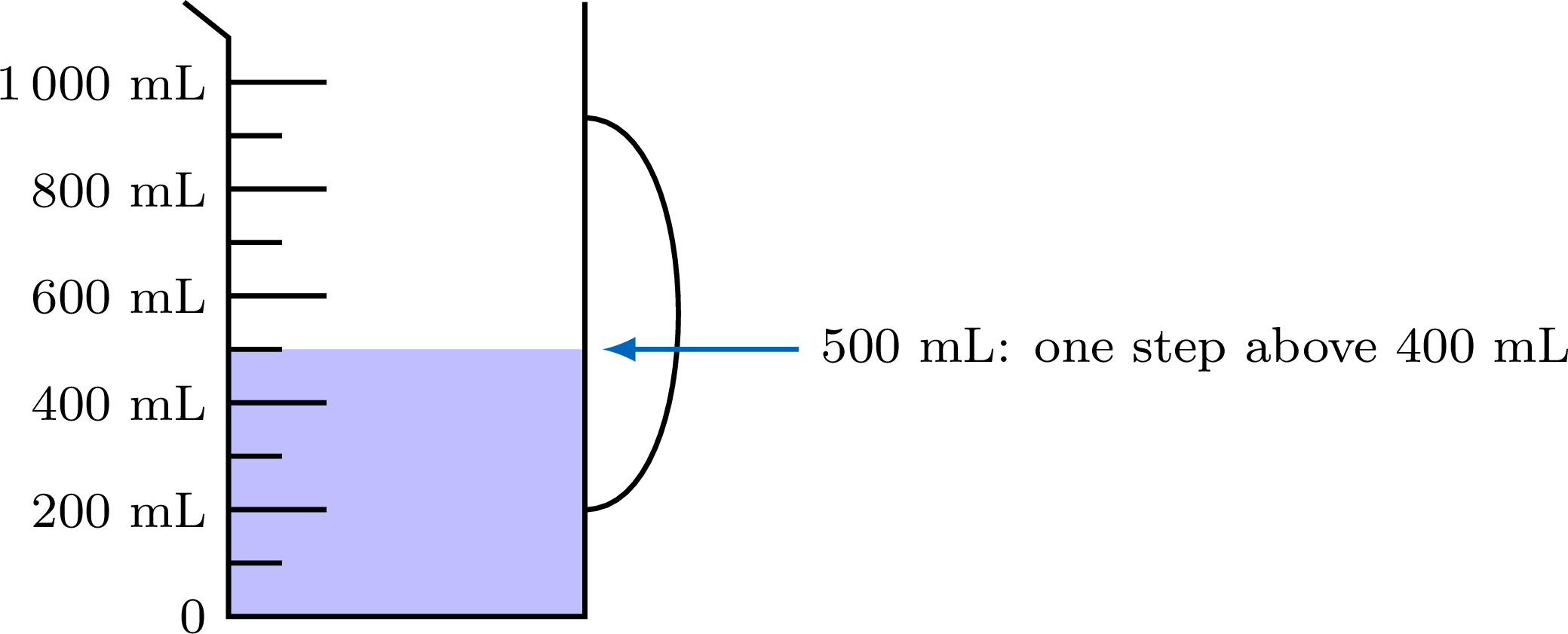
On a measuring jug, the marks go up by equal amounts (for example one mark every \(100~\mathrm{mL}\)), but only some of them carry a number. - Find what one step is worth: take two numbered marks that follow each other and count the steps between them. From \(200~\mathrm{mL}\) to \(400~\mathrm{mL}\), \(2\) equal steps make \(200~\mathrm{mL}\), so one step is \(100~\mathrm{mL}\).
- Start from the numbered mark just below the top of the liquid and add one step for each mark up to it: \(400~\mathrm{mL}\), then \(500~\mathrm{mL}\).
- Read at the top of the liquid, with the eyes level with it and the jug standing flat.
Example
Tom pours water into this measuring jug. 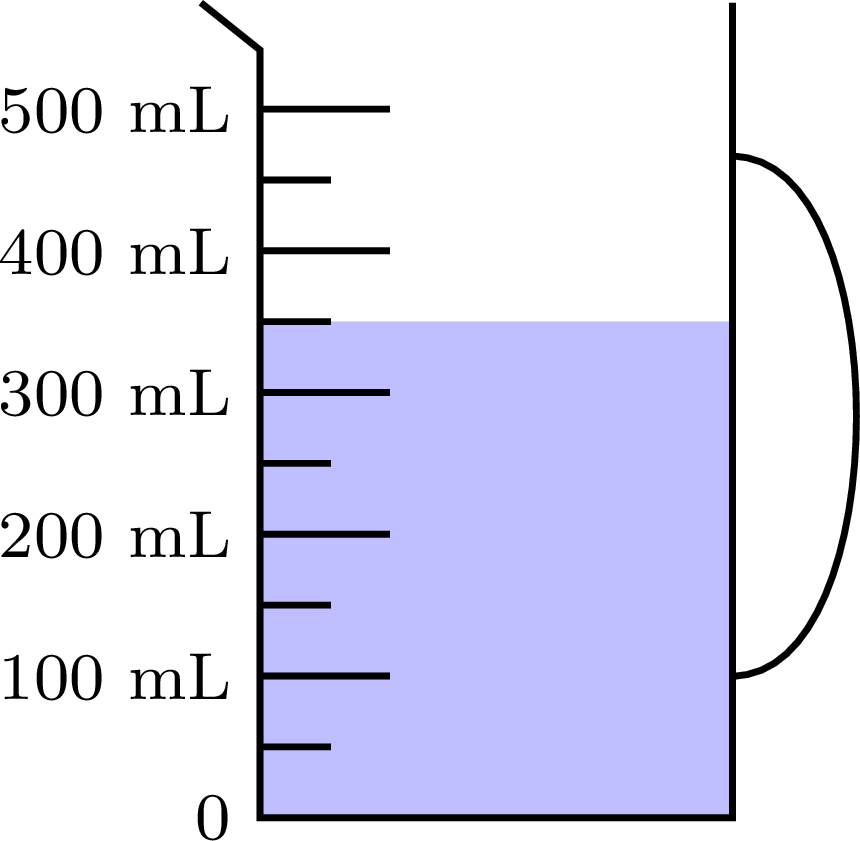
- One step: from \(100~\mathrm{mL}\) to \(200~\mathrm{mL}\), \(2\) equal steps make \(100~\mathrm{mL}\), so one step is \(50~\mathrm{mL}\).
- The level: the numbered mark just below the water is \(300~\mathrm{mL}\), and the water is one step higher.
Skills to practice
- Choosing a Reasonable Capacity
- Reading Scales with Different Steps
IV
Review & Quizz
Skills to practice
- Quiz
Jump to section