International Baccalaureate · PYP 5
Factors, multiples and primes
I
Divisors
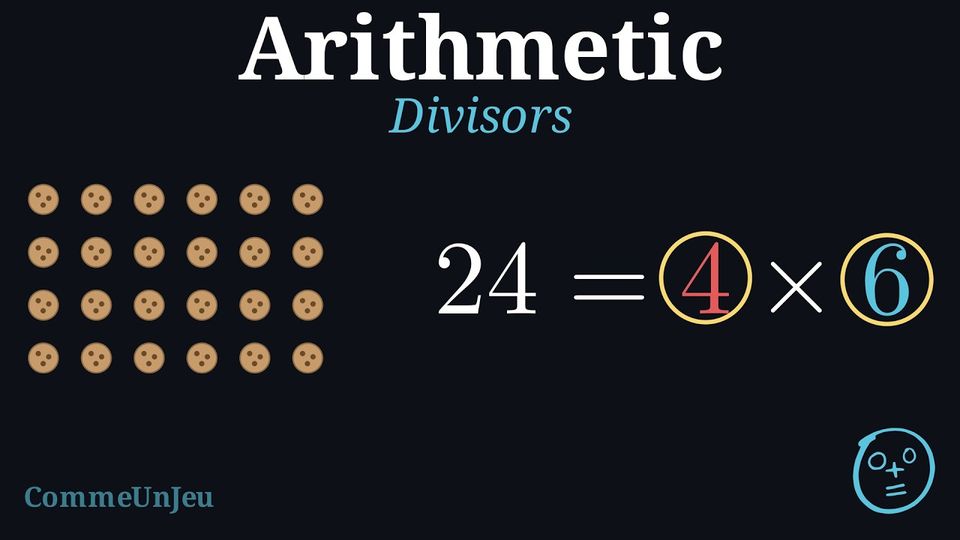
A baker has \(24\) biscuits. Can she split them into equal packs, with nothing left over?
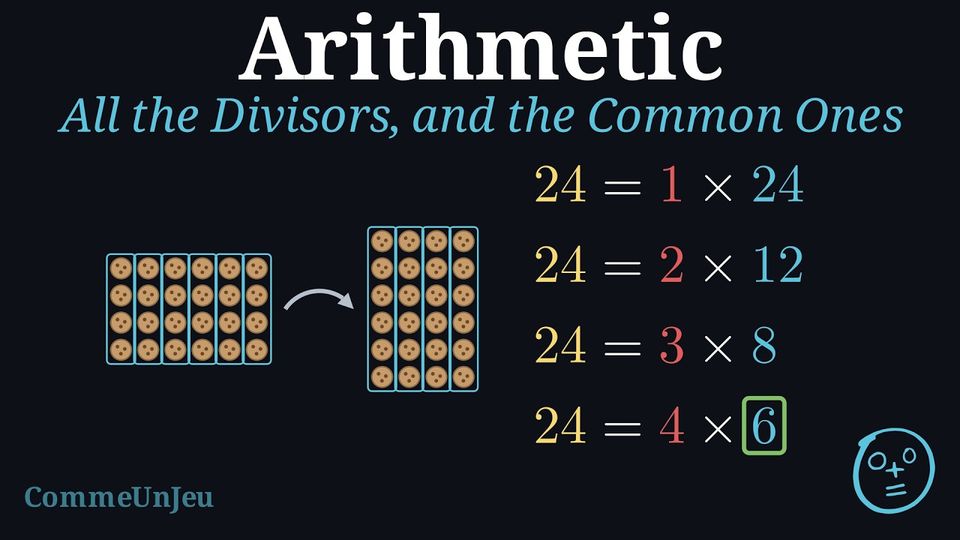
Yes, in several ways: \(4\) packs of \(6\), because \(24 = 4 \times 6\); or \(6\) packs of \(4\); or \(3\) packs of \(8\); or \(2\) packs of \(12\). The sizes that work — like \(6\), \(4\), \(8\) and \(12\) — are called the divisors of \(24\).
Yes, in several ways: \(4\) packs of \(6\), because \(24 = 4 \times 6\); or \(6\) packs of \(4\); or \(3\) packs of \(8\); or \(2\) packs of \(12\). The sizes that work — like \(6\), \(4\), \(8\) and \(12\) — are called the divisors of \(24\).
Definition — Divisor
When a number can be written as a multiplication of two whole numbers, the two factors are divisors of that number. For example: $$24 = 4 \times 6,$$ so \(4\) and \(6\) are divisors of \(24\) — and \(24\) is a multiple of \(4\) and a multiple of \(6\). Multiples and divisors are two ways of reading the same equality. Example
Among the numbers from \(1\) to \(10\), find all the divisors of \(18\).
We look for the tables that give \(18\) exactly: $$\begin{aligned}[t] 18 &= 1 \times 18 && \text{(\(1\) is a divisor)}\\
18 &= 2 \times 9 && \text{(\(2\) and \(9\) are divisors)}\\
18 &= 3 \times 6 && \text{(\(3\) and \(6\) are divisors)} \end{aligned}$$ The tables of \(4\), \(5\), \(7\), \(8\) and \(10\) skip over \(18\). So the divisors of \(18\) from \(1\) to \(10\) are: \(1\), \(2\), \(3\), \(6\) and \(9\).
Skills to practice
- Deciding if a Number Is a Divisor
- Completing Products
II
Divisibility
Definition — Divisibility Relationships
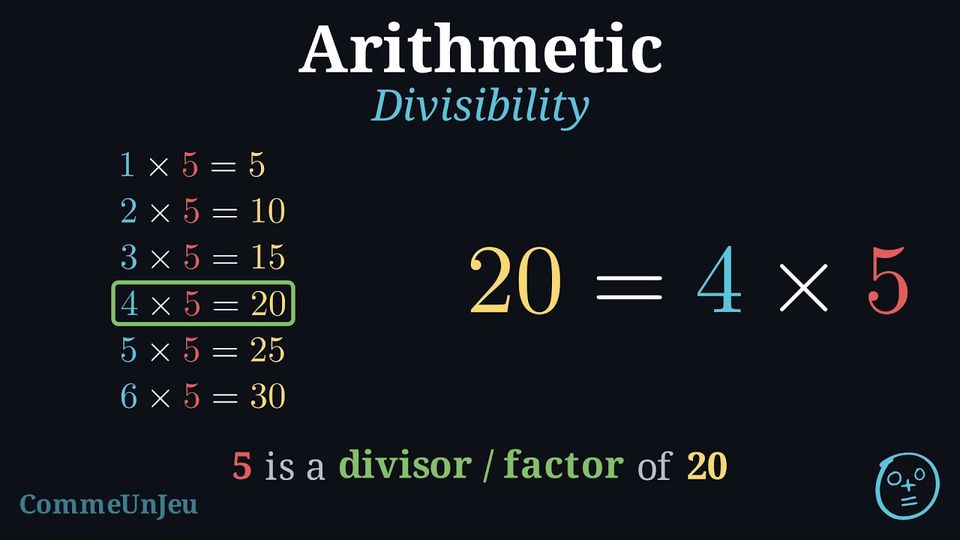
We say that a non-zero natural number \(b\) divides a natural number \(a\) if \(a\) can be obtained by multiplying \(b\) by a natural number \(k\): $$ a = k \times b $$ In other words, the number \(a\) appears in the multiplication table of \(b\).We can also use the following formulations:
- \(b\) is a divisor of \(a\)
- \(b\) is a factor of \(a\)
- \(a\) is divisible by \(b\)
- \(a\) is a multiple of \(b\)
Example
Consider the numbers \(10\) and \(5\).Since we can write \(\textcolor{olive}{10} = \textcolor{colorprop}{2} \times \textcolor{colordef}{5}\), we can say that:
- \(\textcolor{colordef}{5}\) divides \(\textcolor{olive}{10}\).
- \(\textcolor{colordef}{5}\) is a divisor (or factor) of \(\textcolor{olive}{10}\).
- \(\textcolor{olive}{10}\) is divisible by \(\textcolor{colordef}{5}\).
- \(\textcolor{olive}{10}\) is a multiple of \(\textcolor{colordef}{5}\).
Example
List the first five nonzero multiples of \(7\).
Multiply \(7\) by \(1, 2, 3, 4, 5\) in turn: $$7 \times 1 = 7 \qquad 7 \times 2 = 14 \qquad 7 \times 3 = 21 \qquad 7 \times 4 = 28 \qquad 7 \times 5 = 35$$ The first five nonzero multiples of \(7\) are \(7, 14, 21, 28, 35\) — and the list never ends: every non-zero number has infinitely many multiples.
Method — Check divisibility
To check if a number \(a\) is divisible by a non-zero number \(b\), perform the division with remainder of \(a\) by \(b\). - If the remainder is zero, then \(a\) is divisible by \(b\).
- If the remainder is not zero, then \(a\) is not divisible by \(b\).
Example
Is \(13\) divisible by \(5\)?
We perform the division of \(13\) by \(5\): $$\textcolor{olive}{13} = \textcolor{colordef}{5} \times \textcolor{colorprop}{2} + \textcolor{orange}{3}$$ The remainder is \(\textcolor{orange}{3}\) (which is not zero). Therefore, \(\textcolor{olive}{13}\) is not divisible by \(\textcolor{colordef}{5}\).
Skills to practice
- Deciding Whether a Number Is a Multiple
- Determining Divisibility
- Recognising Factors and Divisors
- Producing Multiples
III
Testing with the Last Digits
Divisibility tests are methods that allow us to quickly determine whether a whole number is divisible by another whole number without performing long division. These rules are useful for simplifying calculations and for understanding properties of numbers. Here are some common divisibility tests:
Definition — Even and Odd Numbers
A whole number is even if it is a multiple of \(2\); its ones digit is then \(0, 2, 4, 6\) or \(8\).A whole number that is not even is odd; its ones digit is \(1, 3, 5, 7\) or \(9\).
Example
Determine whether \(374\) and \(481\) are even or odd.
The ones digit of \(374\) is \(4\): the number \(374\) is even (indeed \(374 = 2 \times 187\)).
The ones digit of \(481\) is \(1\): the number \(481\) is odd.
The ones digit of \(481\) is \(1\): the number \(481\) is odd.
Method — Recognising Multiples of 2, 5 and 10
To recognise these multiples, look only at the ones digit: - a number is a multiple of \(2\) when it ends in \(0\), \(2\), \(4\), \(6\) or \(8\) (it is an even number);
- a number is a multiple of \(5\) when it ends in \(0\) or \(5\);
- a number is a multiple of \(10\) when it ends in \(0\).
Example
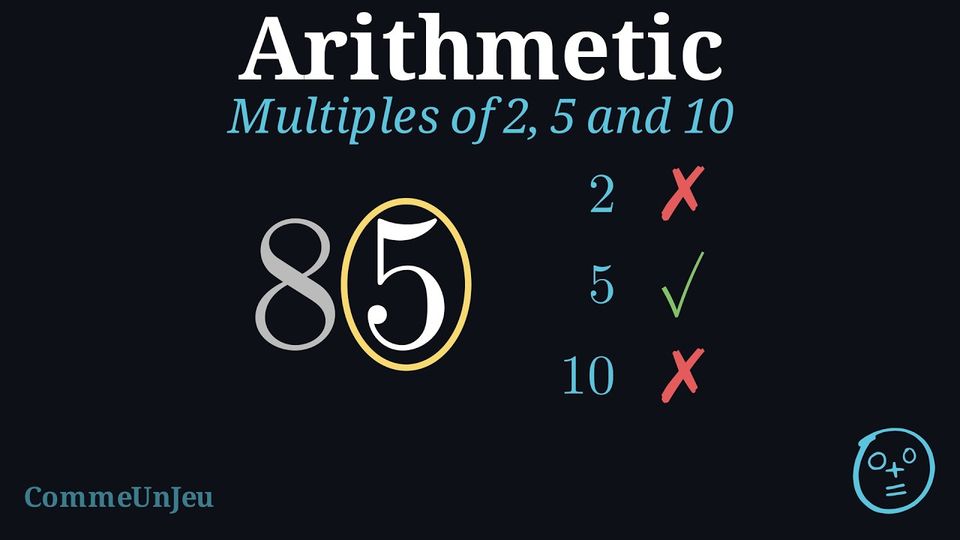
Among the numbers \(130\), \(85\), \(74\) and \(203\), which are multiples of \(2\)? of \(5\)? of \(10\)?
We look at the ones digits: \(0\), \(5\), \(4\) and \(3\).
- \(130\) ends in \(0\): it is a multiple of \(2\), of \(5\) and of \(10\).
- \(85\) ends in \(5\): it is a multiple of \(5\) only.
- \(74\) ends in \(4\): it is a multiple of \(2\) only.
- \(203\) ends in \(3\): it is a multiple of none of them.
Method — The Multiples of 25 and of 50
Some multiples come back everywhere — in money, in minutes, in measures — and are worth knowing by heart: - multiples of 25: \(25\), \(50\), \(75\), \(100\), \(125\), \(150\), \(175\), \(200\)…\ — four jumps of \(25\) make \(100\);
- multiples of 50: \(50\), \(100\), \(150\), \(200\), \(250\)…\ — two jumps of \(50\) make \(100\), so they end in \(00\) or \(50\).
Example
Which of the numbers \(325\), \(460\), \(875\) and \(1\,050\) are multiples of \(25\)? Which are multiples of \(50\)?
$$\begin{aligned}[t] 325 \rightarrow 25,\; 875 \rightarrow 75,\; 1\,050 \rightarrow 50 && \text{(last two digits: } 00, 25, 50 \text{ or } 75\text{)} \\
460 \rightarrow 60 && \text{(not a multiple of } 25\text{)} \end{aligned}$$ Multiples of \(25\): \(325\), \(875\), \(1\,050\). Multiples of \(50\) (ending in \(00\) or \(50\)): \(1\,050\) only.
Skills to practice
- Sorting with the Ones Digit
- Recognising Multiples of 25 and of 50
- Testing Divisibility by 2 and 5
- Explaining with the Ones Digit
IV
Testing for 3 and 9
Proposition — Divisibility Tests for 3 and 9
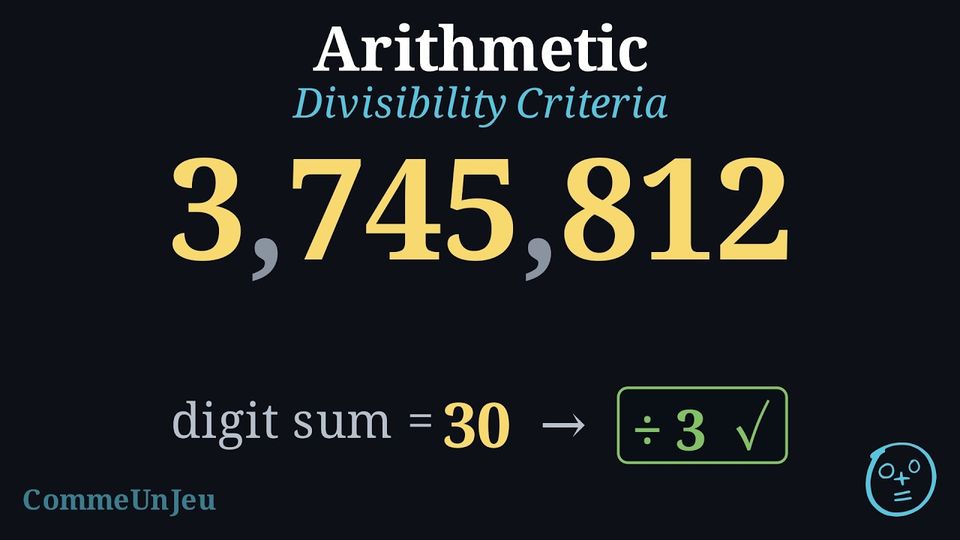
- A whole number is divisible by \(3\) exactly when the sum of its digits is divisible by \(3\).
- A whole number is divisible by \(9\) exactly when the sum of its digits is divisible by \(9\).
Example
Determine whether \(948\) is divisible by \(3\).
\(948\) is divisible by \(3\) because the sum of its digits, \(9 + 4 + 8 = 21\), is divisible by \(3\) (\(21 = 3 \times 7\)).
Example
Determine whether \(948\) is divisible by \(9\).
\(948\) is not divisible by \(9\) because the sum of its digits, \(9 + 4 + 8 = 21\), is not divisible by \(9\) (\(21 = 9 \times 2 + 3\)).
Example
Are \(7\,254\) and \(1\,372\) divisible by \(3\)? By \(9\)? - For \(7\,254\): the digit sum is \(7 + 2 + 5 + 4 = 18\), a multiple of \(9\) — so \(7\,254\) is divisible by \(9\), and therefore by \(3\) as well (every multiple of \(9\) is a multiple of \(3\)).
- For \(1\,372\): the digit sum is \(1 + 3 + 7 + 2 = 13\), which is a multiple of neither \(3\) nor \(9\) — so \(1\,372\) is divisible by neither.
Why do these two tests work? Because \(10\), \(100\), \(1\,000\) are each one more than a multiple of \(9\): $$10 = 9 + 1, \qquad 100 = 99 + 1, \qquad 1\,000 = 999 + 1.$$ Take \(253 = 2 \times 100 + 5 \times 10 + 3\) and replace \(100\) and \(10\): $$\begin{aligned} 253 &= 2 \times (99 + 1) + 5 \times (9 + 1) + 3 \\
&= \underbrace{2 \times 99 + 5 \times 9}_{\text{multiple of } 9} + \underbrace{(2 + 5 + 3)}_{\text{digit sum}}. \end{aligned}$$ So \(253\) and its digit sum differ by a multiple of \(9\): one is divisible by \(9\) exactly when the other is. The same holds for any whole number, since each of its digits is multiplied by \(10\), \(100\), \(1\,000\), … — all one more than a multiple of \(9\). And since \(99\), \(999\), … are also multiples of \(3\), the very same reasoning gives the test for \(3\).
Skills to practice
- Testing Divisibility by 3 and 9
V
Dividing Mentally
Method — Mental Division
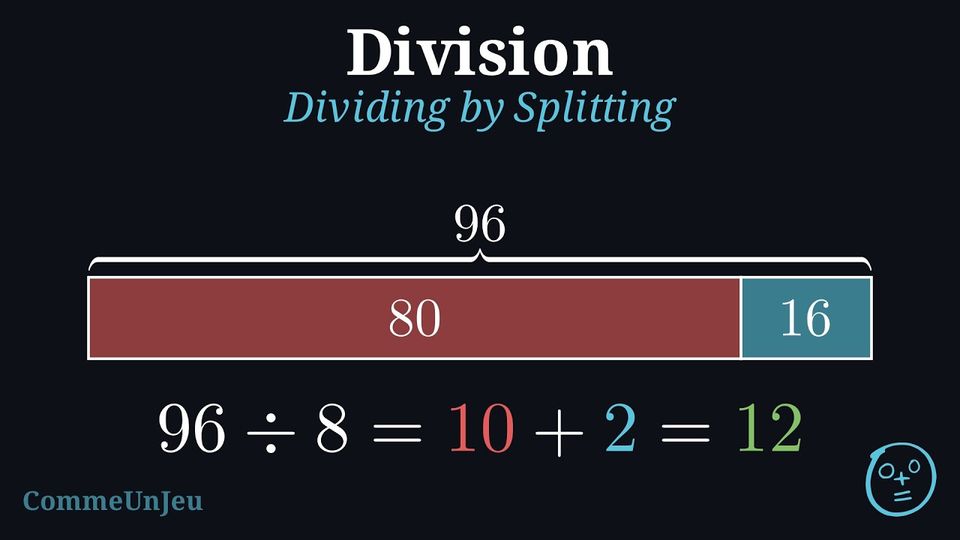
When the divisor is small, split the number into convenient parts and divide each part, starting from the largest: $$368 \div 2: \quad 300 \div 2 = 150, \quad 68 \div 2 = 34, \quad\text{so } 368 \div 2 = 184.$$ - Choose parts the divisor divides exactly: \(75 = 50 + 25\) works for \(\div 5\); \(927 = 900 + 27\), two parts that \(3\) divides exactly, so \(927 \div 3 = 300 + 9 = 309\); the same parts work for \(9\): \(927 \div 9 = 100 + 3 = 103\).
Example
Compute mentally: \(1\,400 \div 5\).
$$\begin{aligned}[t] 1\,400 \div 5 &= (1\,000 + 400) \div 5 && \text{(split into convenient parts)} \\
&= 200 + 80 && \\
&= 280 && \end{aligned}$$
Skills to practice
- Dividing Mentally
VI
All the Divisors and the Common Ones
Method — Finding All the Divisors of a Number
Knowing whether one number divides another is not enough: a number usually has several divisors, and they can all be found. - Try the numbers in order — \(1\), then \(2\), then \(3\), and so on.
- Each time one divides, write down the pair: the divisor found, and the number it is multiplied by.
- Stop as soon as the number being tried catches up with the last partner found — that is, as soon as it becomes equal to it, or larger. Everything has been found.
Example
Find all the divisors of \(28\).
$$\begin{aligned}[t] \textcolor{olive}{28} &= \textcolor{colordef}{1} \times \textcolor{colorprop}{28} \\
\textcolor{olive}{28} &= \textcolor{colordef}{2} \times \textcolor{colorprop}{14} \\
\textcolor{olive}{28} &= \textcolor{colordef}{4} \times \textcolor{colorprop}{7} \\
\end{aligned}$$ Along the way, \(3\) divides neither, and after \(4\) come \(5\) and \(6\), which do not divide \(28\) either. The next number to try is \(7\) — already the partner of \(4\): the search stops. The divisors of \(28\) are \(\mathbf{1}\), \(\mathbf{2}\), \(\mathbf{4}\), \(\mathbf{7}\), \(\mathbf{14}\) and \(\mathbf{28}\) — six of them.
Definition — Common Divisor
A number is a common divisor of two numbers when it divides both. To find them all: write the divisors of the first number, write those of the second, and keep the ones that appear in both lists. Example
Find the common divisors of \(12\) and \(18\). - Divisors of \(\textcolor{colordef}{12}\): \(\textcolor{olive}{1}\), \(\textcolor{olive}{2}\), \(\textcolor{olive}{3}\), \(4\), \(\textcolor{olive}{6}\), \(12\).
- Divisors of \(\textcolor{colorprop}{18}\): \(\textcolor{olive}{1}\), \(\textcolor{olive}{2}\), \(\textcolor{olive}{3}\), \(\textcolor{olive}{6}\), \(9\), \(18\).
Definition — Common Multiple
A number is a common multiple of two numbers when it is a multiple of both. Here the multiples counted are the non-zero ones. Unlike divisors, they never run out: two non-zero numbers always have infinitely many common multiples, so one looks for the first ones. Example
Find the first two common multiples of \(4\) and \(6\). - Multiples of \(\textcolor{colordef}{4}\): \(4\), \(8\), \(\textcolor{olive}{12}\), \(16\), \(20\), \(\textcolor{olive}{24}\), \(28\), …
- Multiples of \(\textcolor{colorprop}{6}\): \(6\), \(\textcolor{olive}{12}\), \(18\), \(\textcolor{olive}{24}\), \(30\), …
Skills to practice
- Recognising All the Divisors
- Recognising Common Divisors and Multiples
- Listing All the Divisors
- Finding Common Divisors and Multiples
VII
Prime and Composite Numbers
Nora has a necklace of \(91\) beads. She wants to lay all of them out as a full rectangle — at least two equal rows of at least two beads, nothing left over. Can she? And with \(97\) beads? For which numbers of beads is a single row the only possible layout?
With \(91\) beads: \(91 = 7 \times 13\), so a rectangle of \(7\) rows of \(13\) beads works. With \(97\) beads: \(97\) is odd, its digit sum \(16\) is not a multiple of \(3\), it does not end in \(0\) or \(5\), and \(97 = 7 \times 13 + 6\); so \(2\), \(3\), \(5\) and \(7\) rows do not work, nor \(4\), \(6\), \(8\) or \(9\) rows (they could be regrouped into \(2\) or \(3\) rows). Rows from \(2\) to \(9\) are enough to try, because \(10 \times 10 = 100 > 97\): with \(10\) rows or more, each row would hold fewer than \(10\) beads, and the rectangle turned a quarter turn would have fewer than \(10\) rows — no rectangle exists apart from the single row \(1 \times 97\). Among the numbers of beads greater than \(1\), those whose only layout is the single row are exactly the prime numbers (a single bead has nothing to arrange, and \(1\) is not prime).
Definition — Prime Number
A prime number is a whole number greater than \(1\) that has exactly two different divisors: \(1\) and itself.A whole number greater than \(1\) that is not prime is called a composite number.
Example
State whether \(6\) is a prime number.
As \(2 \times 3 = 6\), \(6\) is not a prime number because it is divisible by \(2\) and \(3\), in addition to \(1\) and \(6\). So \(6\) is a composite number.
Example
State whether \(5\) is a prime number.
\(5\) is a prime number because it is divisible (without remainder) only by \(1\) and \(5\). We cannot divide it exactly by \(2\), \(3\) or \(4\) (there would be a remainder).
Proposition — First 25 Prime Numbers
Here is the list of the first 25 prime numbers: $$2, 3, 5, 7, 11, 13, 17, 19, 23, 29, 31, 37, 41, 43, 47, 53, 59, 61, 67, 71, 73, 79, 83, 89, 97$$ Method — Testing Whether a Number Is Prime
To decide whether a whole number greater than \(1\) and smaller than \(121\) is prime, try only \(2\), \(3\), \(5\) and \(7\): - if one of them divides the number, the number is composite (unless it is \(2\), \(3\), \(5\) or \(7\) itself);
- if none of them divides it, the number is prime.
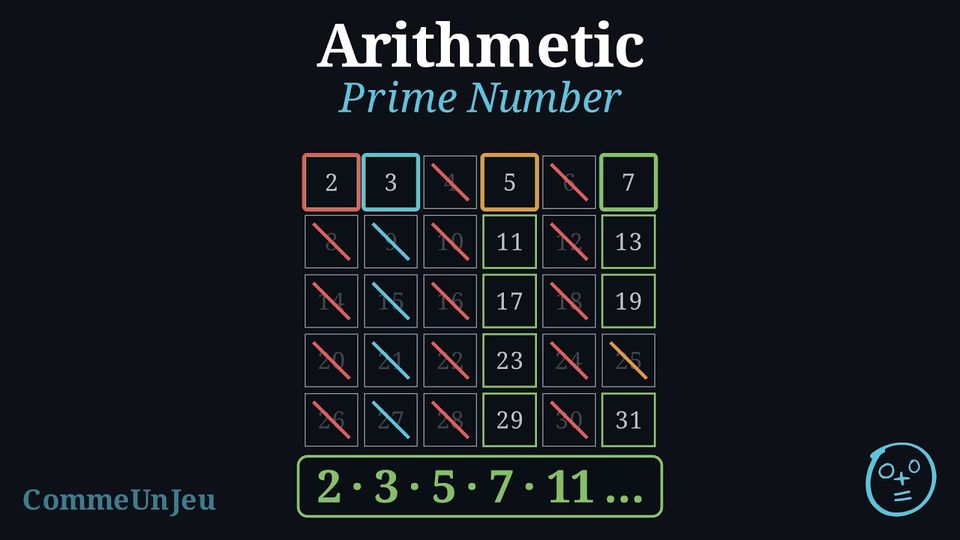
Below \(121\), trying \(2\), \(3\), \(5\) and \(7\) is enough, because \(11 \times 11 = 121\). If a number smaller than \(121\) is the product of two whole numbers greater than \(1\), the smaller of the two is at most \(10\): two numbers of \(11\) or more already give at least \(121\). And every number from \(2\) to \(10\) is a multiple of \(2\), \(3\), \(5\) or \(7\). So one of these four primes divides the number.
Example
Is \(101\) a prime number?
\(101\) is odd, its digit sum \(1 + 0 + 1 = 2\) is not a multiple of \(3\), and it does not end in \(0\) or \(5\): neither \(2\), \(3\) nor \(5\) divides it. Testing the next primes: \(101 = 7 \times 14 + 3\), so \(7\) does not divide it. The next prime is \(11\), and \(11 \times 11 = 121 > 101\): we stop. No prime up to the stopping point divides \(101\): the number \(101\) is prime.
Culture: the sieve of Eratosthenes. More than two thousand years ago, the Greek scholar Eratosthenes described a method to find all the prime numbers up to a chosen bound: write down the numbers from \(2\) up to the bound, keep \(2\) and strike out its larger multiples, keep the next remaining number (\(3\)) and strike out its larger multiples, and so on. The numbers never struck out are exactly the primes. Euclid, a little earlier, proved that the list of prime numbers never ends: there are infinitely many primes. 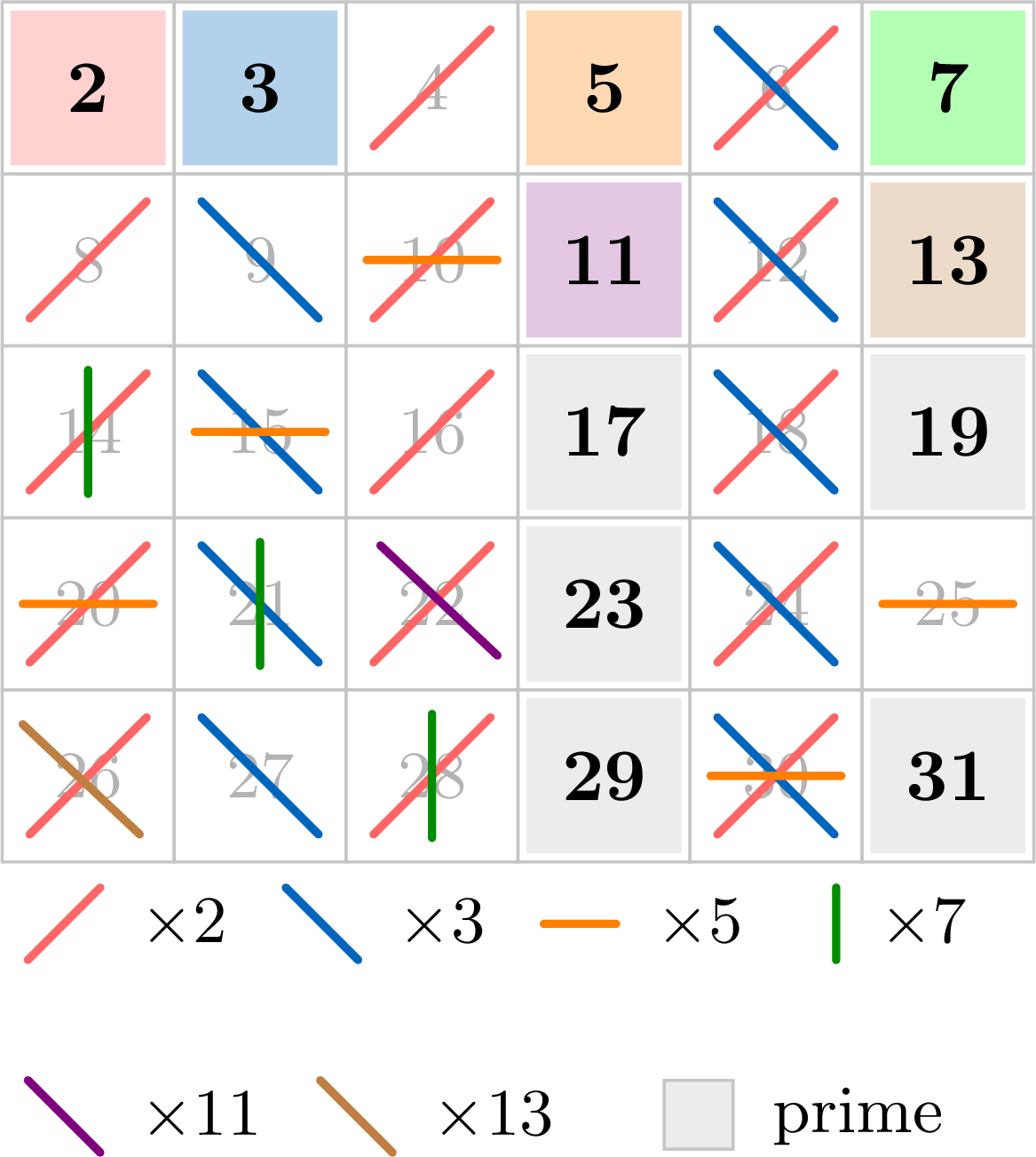
Skills to practice
- Checking if a Number Is Prime
- Testing Whether a Number Below 121 Is Prime
VIII
Going further
Skills to practice
- Solving Problems with Multiples and Divisors
- Solving Problems with Common Divisors and Multiples
- Quiz
Jump to section