International Baccalaureate · PYP 5
Operations with Whole Numbers
I
Adding and Subtracting Large Numbers
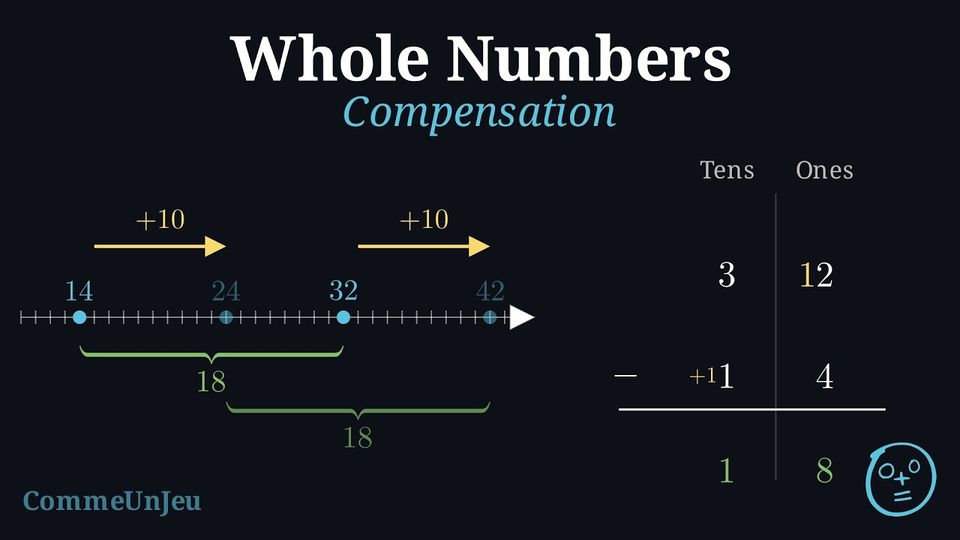
Example
Calculate \(2\,486\,357+1\,795\,648\) in columns.
Numbers in the millions are added like smaller ones: ones under ones, from right to left, with a carry to the next column whenever a column makes \(10\) or more. 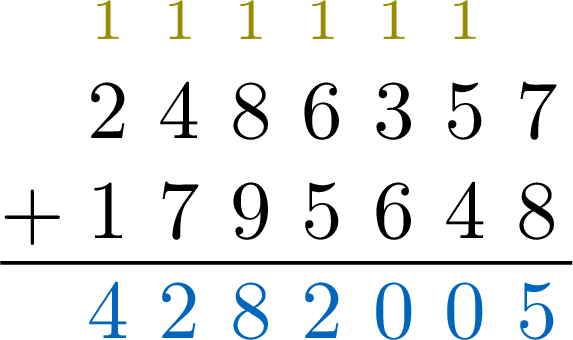
So \(2\,486\,357+1\,795\,648=4\,282\,005\).
Order of magnitude: \(2\,500\,000+1\,800\,000=4\,300\,000\). The result \(4\,282\,005\) is close to it.
- Ones: \(7 + 8 = 15\). Write \(5\) and carry \(1\) ten.
- Tens: \(1 + 5 + 4 = 10\). Write \(0\) and carry \(1\) hundred.
- Hundreds: \(1 + 3 + 6 = 10\). Write \(0\) and carry \(1\) thousand.
- Thousands: \(1 + 6 + 5 = 12\). Write \(2\) and carry \(1\) ten thousand.
- Ten thousands: \(1 + 8 + 9 = 18\). Write \(8\) and carry \(1\) hundred thousand.
- Hundred thousands: \(1 + 4 + 7 = 12\). Write \(2\) and carry \(1\) million.
- Millions: \(1 + 2 + 1 = 4\).
Order of magnitude: \(2\,500\,000+1\,800\,000=4\,300\,000\). The result \(4\,282\,005\) is close to it.
Example
Calculate \(6\,004\,210-2\,576\,385\) in columns.
We subtract column by column, from right to left, by compensation. 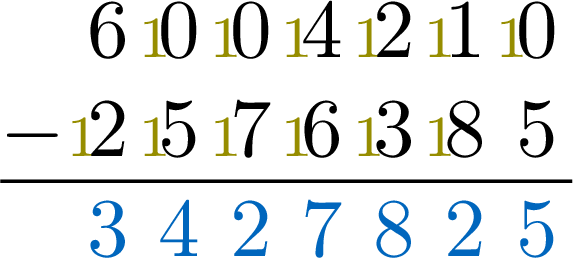
So \(6\,004\,210-2\,576\,385=3\,427\,825\).
Check with an addition, the result plus the number taken away: \(3\,427\,825+2\,576\,385=6\,004\,210\), the starting number.
- Ones: \(0-5\) is not possible. Add \(10\) ones to the top number, making \(\textcolor{olive}{1}0\) ones, and \(1\) ten to the bottom number: \(\textcolor{olive}{1}0-5=5\).
- Tens: \(1-8-\textcolor{olive}{1}\) is not possible. Add \(10\) tens to the top number, making \(\textcolor{olive}{1}1\) tens, and \(1\) hundred to the bottom number: \(\textcolor{olive}{1}1-8-\textcolor{olive}{1}=2\).
- Hundreds: \(2-3-\textcolor{olive}{1}\) is not possible. Add \(10\) hundreds to the top number, making \(\textcolor{olive}{1}2\) hundreds, and \(1\) thousand to the bottom number: \(\textcolor{olive}{1}2-3-\textcolor{olive}{1}=8\).
- Thousands: \(4-6-\textcolor{olive}{1}\) is not possible. Add \(10\) thousands to the top number, making \(\textcolor{olive}{1}4\) thousands, and \(1\) ten thousand to the bottom number: \(\textcolor{olive}{1}4-6-\textcolor{olive}{1}=7\).
- Ten thousands: \(0-7-\textcolor{olive}{1}\) is not possible. Add \(10\) ten thousands to the top number, making \(\textcolor{olive}{1}0\) ten thousands, and \(1\) hundred thousand to the bottom number: \(\textcolor{olive}{1}0-7-\textcolor{olive}{1}=2\).
- Hundred thousands: \(0-5-\textcolor{olive}{1}\) is not possible. Add \(10\) hundred thousands to the top number, making \(\textcolor{olive}{1}0\) hundred thousands, and \(1\) million to the bottom number: \(\textcolor{olive}{1}0-5-\textcolor{olive}{1}=4\).
- Millions: \(6-2-\textcolor{olive}{1}=3\).
Check with an addition, the result plus the number taken away: \(3\,427\,825+2\,576\,385=6\,004\,210\), the starting number.
Skills to practice
- Adding and Subtracting Numbers in the Millions
II
Multiplying by a Two- or Three-Digit Number
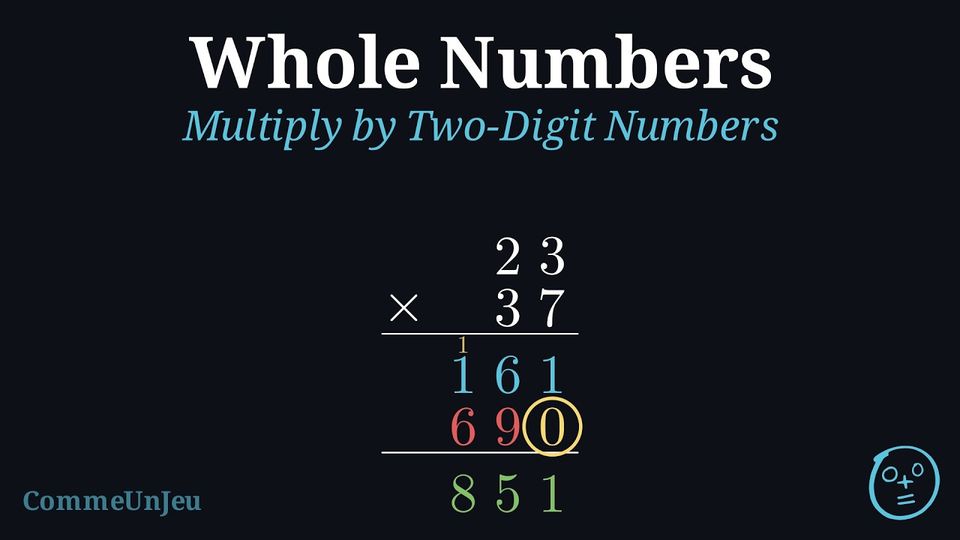
Method — Column Multiplication by a Two-Digit Number
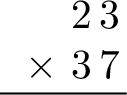
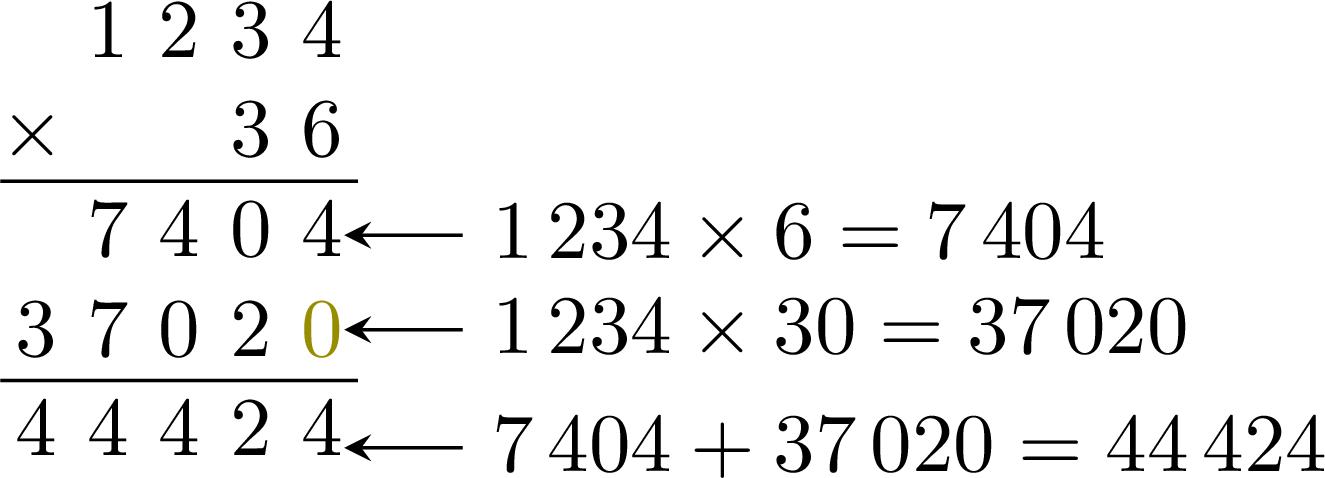
To calculate \(23 \times 37\): - Step 1: Align the numbers vertically by place value.
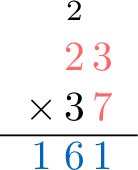
- Step 2: Multiply by the ones digit. Multiply the top number (\(\textcolor{colordef}{23}\)) by the ones digit of the bottom number (\(\textcolor{colordef}{7}\)): \(\textcolor{colordef}{23}\times\textcolor{colordef}{7}=\textcolor{colorprop}{161}\).
- Step 3: Multiply by the tens digit.
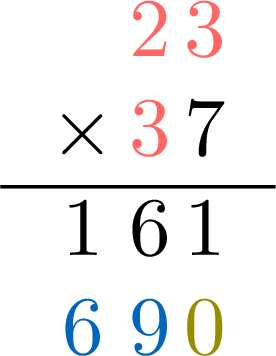
- First, place a placeholder \(\textcolor{olive}{0}\) in the ones column of the second row. This is because we are now multiplying by the tens digit (\(\textcolor{colordef}{3}\), which represents 30). This placeholder shifts the answer one place to the left.
- Next, multiply the top number (23) by the tens digit (\(\textcolor{colordef}{3}\)). Calculate \(\textcolor{colordef}{23}\times\textcolor{colordef}{3}=\textcolor{colorprop}{69}\) and write it to the left of the placeholder.
- Step 4: Sum the partial products. Add the results from Step 2 and Step 3: \(\textcolor{colordef}{161}+\textcolor{colordef}{690}=\textcolor{colorprop}{851}\)
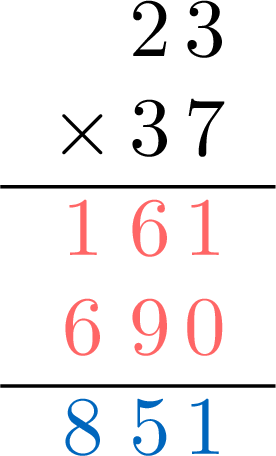
- Result: \(23 \times 37 = 851\).
Example — Multiplying by a Three-Digit Number
Compute \(326\times 254\) in columns.
Multiply \(326\) by each digit of \(254\), one row per digit, then add the rows. 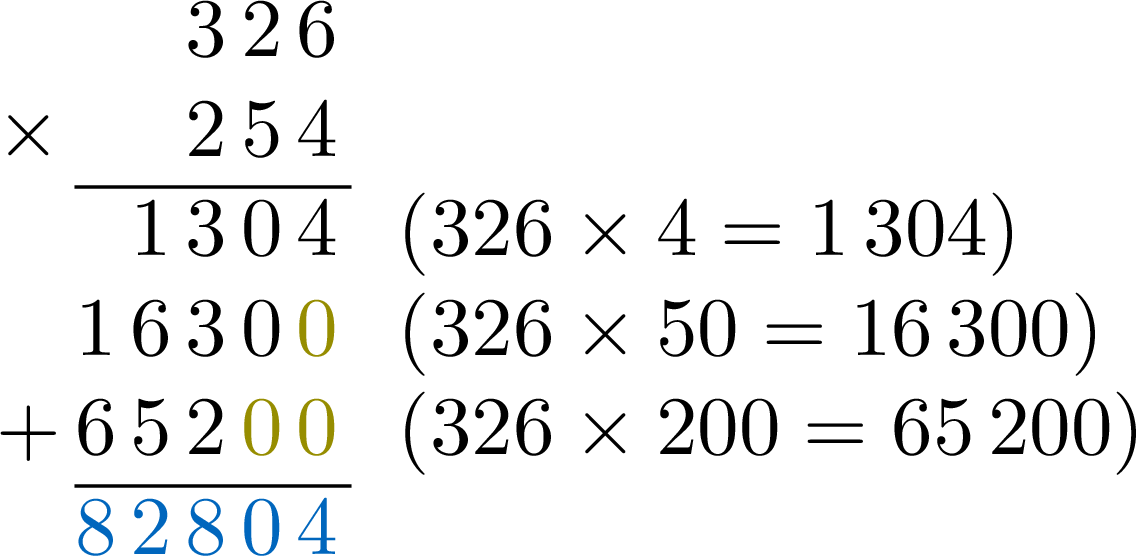
$$\begin{aligned}[t] 326\times 254 &= 326\times 4+326\times 50+326\times 200 && {\scriptstyle\left(254=4+50+200\right)} \\
&= 1\,304+16\,300+65\,200 \\
&= 82\,804 \end{aligned}$$ Order of magnitude: \(326\) is close to \(300\) and \(254\) is close to \(250\), and \(300\times 250=75\,000\). The result \(82\,804\) is of the same order.
So \(326\times 254=82\,804\).
- The ones digit \(4\): \(326\times 4=1\,304\). This is the first row.
- The tens digit \(5\) stands for \(50\): place one placeholder \(\textcolor{olive}{0}\), then write \(326\times 5=1\,630\) to its left. The second row is \(326\times 50=16\,300\).
- The hundreds digit \(2\) stands for \(200\): place two placeholder zeros \(\textcolor{olive}{00}\), then write \(326\times 2=652\) to their left. The third row is \(326\times 200=65\,200\).
- Add the three partial products, aligned by place value.
So \(326\times 254=82\,804\).
Skills to practice
- Multiplying by a Three-Digit Number
- Solving Multiplication Problems
III
Dividing by a Two-Digit Number
Method — The Long Division Algorithm: Multi-Steps
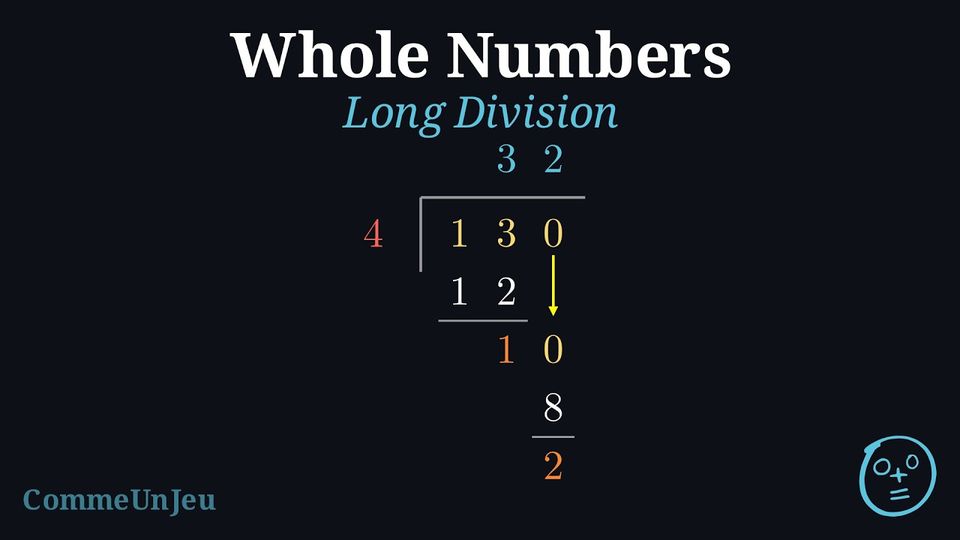
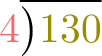
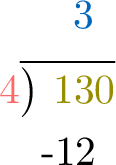
To divide with a remainder, like \(\textcolor{olive}{130} \div \textcolor{colordef}{4}\), follow these steps: - Set up: Write the dividend (\(\textcolor{olive}{130}\)) inside the bracket and the divisor (\(\textcolor{colordef}{4}\)) outside.
- Divide the first part (13): \(1\) is smaller than \(4\): we start with \(13\) tens. “How many times does \(4\) go into \(13\)?”$$\textcolor{colordef}{4}\times \textcolor{colorprop}{3}=\boxed{12}\ (\le \textcolor{olive}{13}),\qquad\textcolor{colordef}{4}\times \textcolor{colorprop}{4}=\cancel{16}\ (> \textcolor{olive}{13}).$$ Write \(\textcolor{colorprop}{3}\) above and \(12\) under \(13\); then subtract.
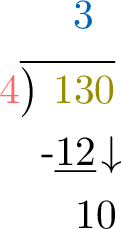
- Subtract and Bring down the next digit: \(\textcolor{olive}{13}-12=\textcolor{orange}{1}\); bring down \(0\) to make \(\textcolor{olive}{10}\).
- Divide the new number (10): “How many times does \(4\) go into \(10\)?”$$\textcolor{colordef}{4}\times \textcolor{colorprop}{2}=\boxed{8}\ (\le \textcolor{olive}{10}),\qquad\textcolor{colordef}{4}\times \textcolor{colorprop}{3}=\cancel{12}\ (> \textcolor{olive}{10}).$$ Write \(\textcolor{colorprop}{2}\) above, put \(8\) under \(10\), and subtract to get the remainder.
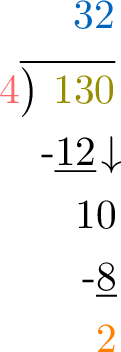
- Repeat: bring down, divide, subtract, until every digit of the dividend has been used. Here no digit is left after the \(0\): \(\textcolor{orange}{2}\) is the remainder.
- Final answer: \(\textcolor{olive}{130} \div \textcolor{colordef}{4}= \divionRemainder{\textcolor{colorprop}{32}}{\textcolor{orange}{2}}\), and \(\textcolor{olive}{130}=\textcolor{colordef}{4}\times\textcolor{colorprop}{32}+\textcolor{orange}{2}\).
Example
Calculate \(7\,354 \div 6\).
Using long division, 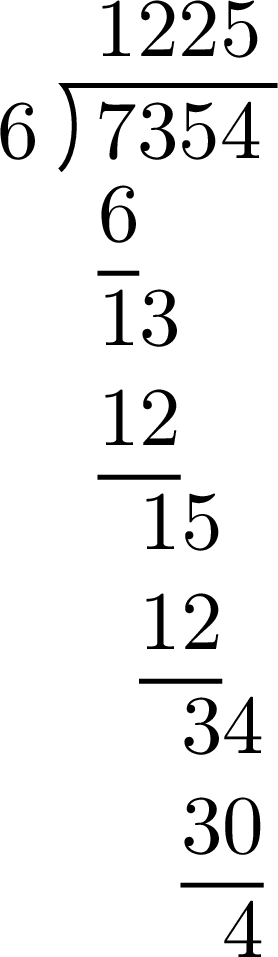
we find:$$7\,354 \div 6 = \divionRemainder{1\,225}{4}.$$ Check: \(6\times 1\,225=7\,350\) and \(7\,350+4=7\,354\), with \(4<6\).
Method — Dividing by a Two-Digit Divisor
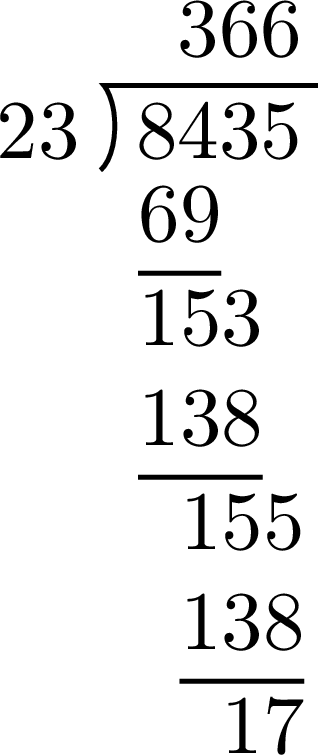
To divide \(8\,435\) by \(23\): - Prepare the multiples of the divisor, once and for all: \(23\), \(46\), \(69\), \(92\), \(115\), \(138\), \(161\), \(184\), \(207\).
- Take the shortest starting block that is at least the divisor: \(8 < 23\), so start with \(84\) (with \(2\,769 \div 58\), since \(2 < 58\) and \(27 < 58\), the starting block would be \(276\)). The largest multiple not exceeding \(84\) is \(69 = 23 \times 3\): write \(3\) in the quotient and the remainder \(84 - 69 = 15\).
- Bring down the next digit and start again: \(153\): \(138 = 23 \times 6 \le 153 < 161\), write \(6\), remainder \(153 - 138 = 15\). Then \(155\): \(138 \le 155 < 161\), write \(6\), remainder \(155 - 138 = 17\).
- Conclude and check: \(8\,435 = 23 \times 366 + 17\) with \(17 < 23\). Indeed \(23 \times 366 = 8\,418\) and \(8\,418 + 17 = 8\,435\).
Example
Divide \(4\,917\) by \(38\), then check.
Multiples of \(38\): \(38\), \(76\), \(114\), \(152\), \(190\), \(228\), \(266\), \(304\), \(342\). 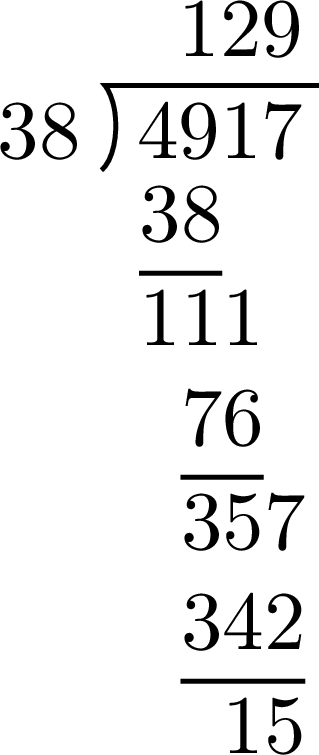
- \(49\): \(38 \le 49 < 76\), write \(1\), remainder \(49 - 38 = 11\).
- \(111\): \(76 \le 111 < 114\), write \(2\), remainder \(111 - 76 = 35\).
- \(357\): \(342 \le 357 < 380\), write \(9\), remainder \(357 - 342 = 15\).
Skills to practice
- Dividing by a Two-Digit Divisor
- Solving Division Problems with a Remainder
IV
Going further
Skills to practice
- Solving Multi-Step Problems with Large Numbers
- Quiz
Jump to section