International Baccalaureate · PYP 3
Times Tables to 10 × 10
I
Decompose with Addition
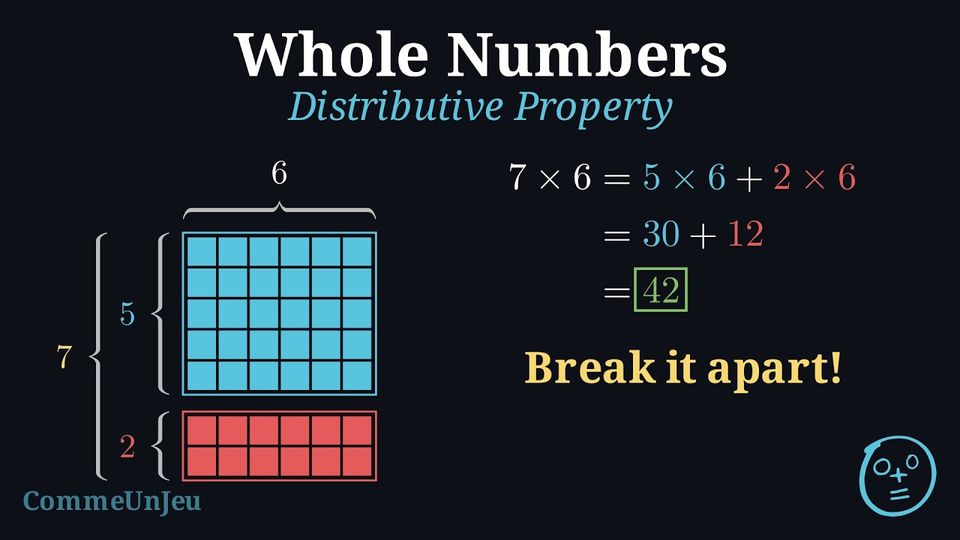
We need to find the total for 7 groups of 6 cubes, which is \(7 \times 6\).
Multiplying by 7 directly can be difficult; multiplying by 5 is easier. We know that: 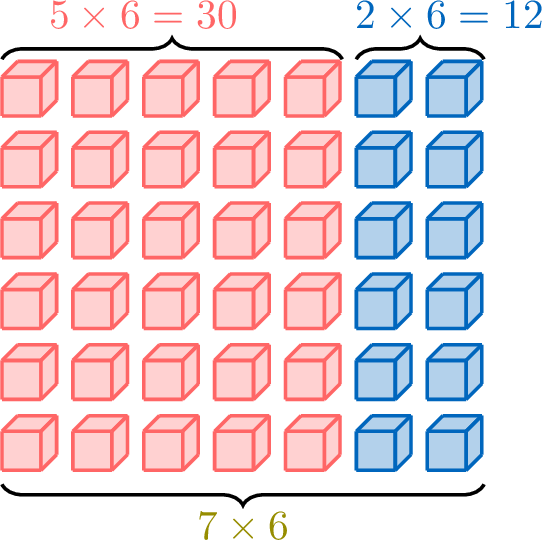
Multiplying by 7 directly can be difficult; multiplying by 5 is easier. We know that:
- 5 groups of 6 cubes have 30 cubes (\(5 \times 6 = 30\)).
- 2 groups of 6 cubes have 12 cubes (\(2 \times 6 = 12\)).
Since 7 groups is 5 groups plus 2 more groups, we can add their totals together. $$\begin{aligned}[t] \text{Total for 7 groups} &= (\text{Total for 5 groups}) + (\text{Total for 2 groups})\\
7 \times 6&= (5 \times 6) + (2 \times 6)\\
&=30+12\\
&=42\end{aligned} $$ So, there are 42 cubes in total.
Method — The “Break Apart” Strategy
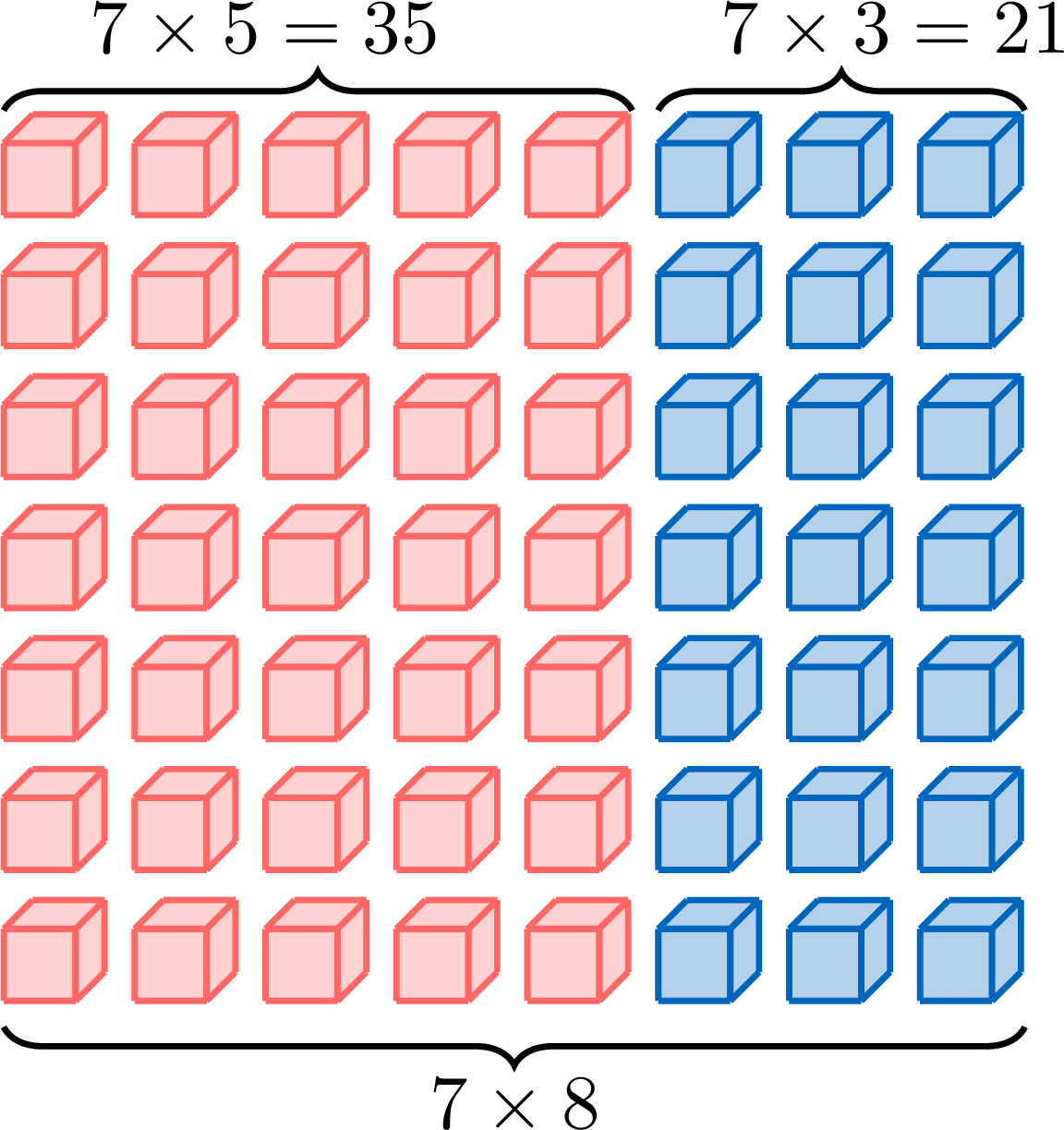
This strategy uses the distributive property: a difficult multiplication can be “broken apart” into two easier ones, and the results added.For example, to solve \(7 \times 6\), we can break the 7 into a 5 and a 2: $$\begin{aligned}[t] \text{Total for 7 groups} &= (\text{Total for 5 groups}) + (\text{Total for 2 groups})\\ 7 \times 6&= (5 \times 6) + (2 \times 6)\\ &=30+12\\ &=42\end{aligned} $$
Skills to practice
- Breaking Apart the First Number
- Breaking Apart the Second Number
II
The 6s Times Table
How many dots are there in total on these 4 dominoes? 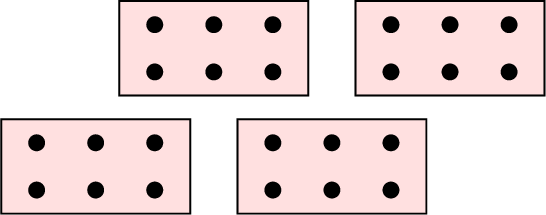
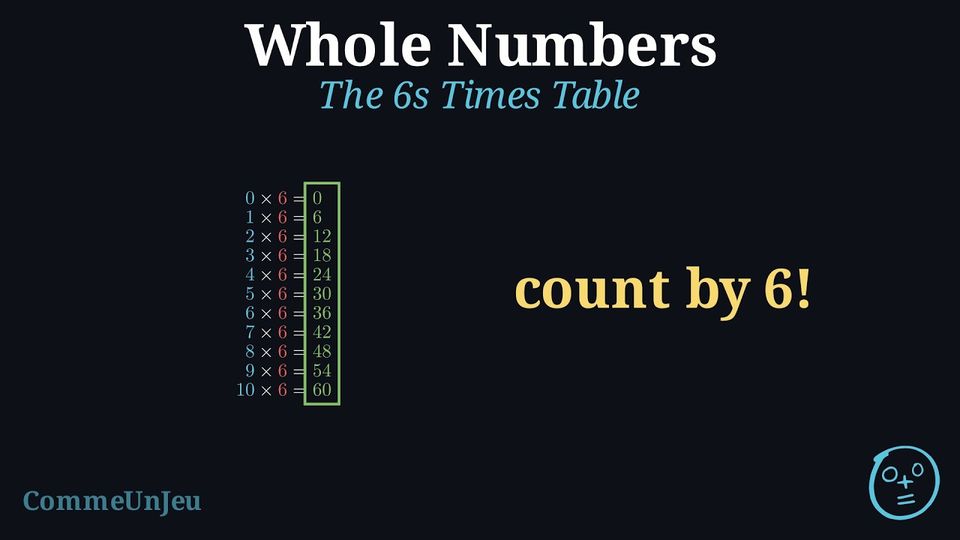
We have 4 groups of 6. We can skip-count by 6s: 6, 12, 18, 24. 
$$\begin{aligned}[t]4 \times 6 &= 6 + 6 + 6 + 6 && \text{(counting by 6s: }6, 12, 18, 24\text{)}\\
&= 24\end{aligned}$$ There are \(24\) dots.
Proposition — Times Table of 6
The two columns give the same results: the order of the two numbers does not change the result. Skills to practice
- Counting by 6s
- Multiplying by 6 using Decomposition
- Multiplying by 6
III
The 7s Times Table
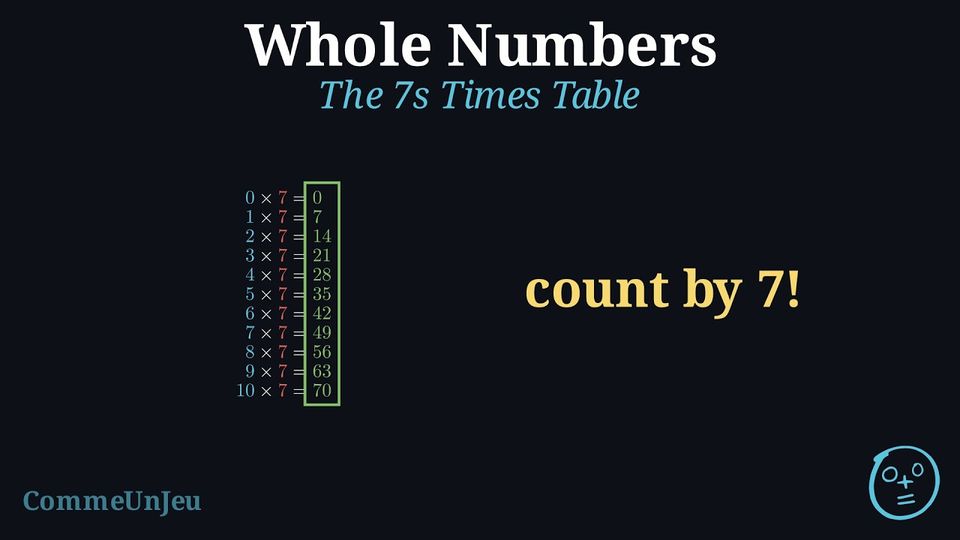
There are 7 days in a week. How many days are there in 4 weeks?
We have 4 groups of 7. We can skip-count by 7s: 7, 14, 21, 28 days. 
$$\begin{aligned}[t]4 \times 7 &= 7 + 7 + 7 + 7 && \text{(counting by 7s: }7, 14, 21, 28\text{)}\\
&= 28\end{aligned}$$ There are \(28\) days.
Proposition — Times Table of 7
The two columns give the same results: the order of the two numbers does not change the result. Skills to practice
- Counting by 7s
- Multiplying by 7 using Decomposition
- Multiplying by 7
IV
The 8s Times Table
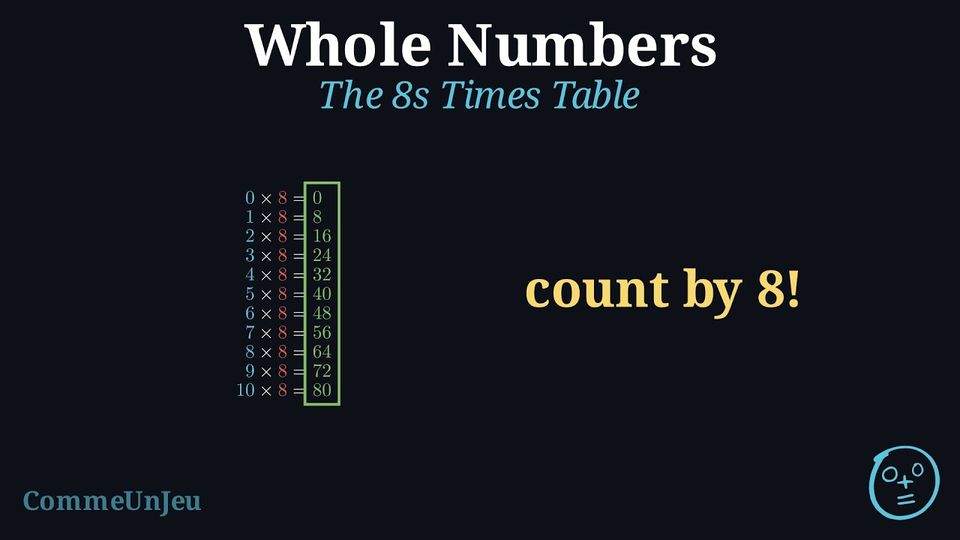
A spider has 8 legs. How many legs do 4 spiders have altogether? 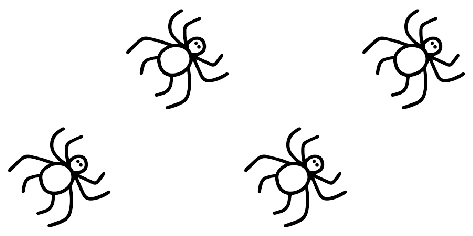
We have 4 groups of 8. We can skip-count by 8s: 8, 16, 24, 32 legs. 
$$\begin{aligned}[t]4 \times 8 &= 8 + 8 + 8 + 8 && \text{(counting by 8s: }8, 16, 24, 32\text{)}\\
&= 32\end{aligned}$$ There are \(32\) legs.
Proposition — Times Table of 8
The two columns give the same results: the order of the two numbers does not change the result. Skills to practice
- Counting by 8s
- Multiplying by 8 using Decomposition
- Multiplying by 8
V
Decompose with Subtraction
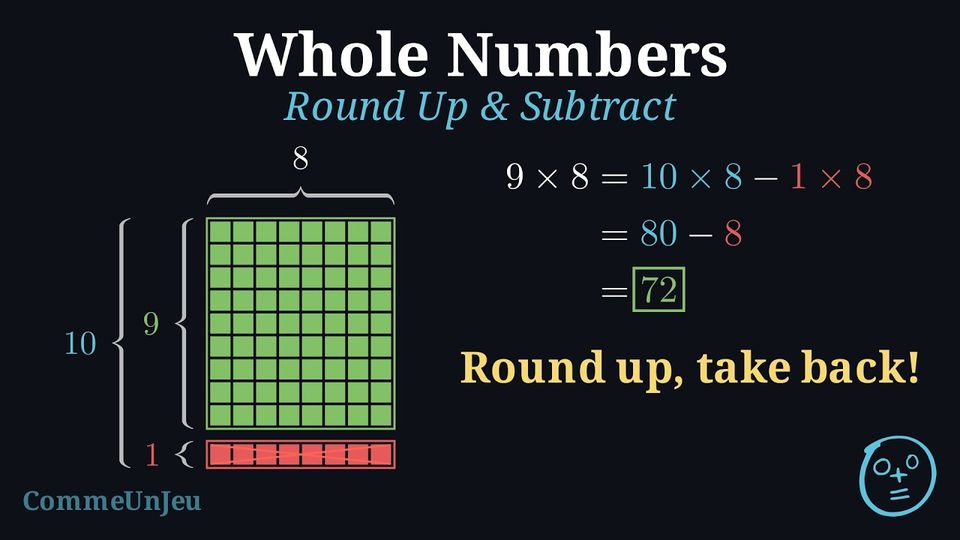
Now consider \(9 \times 8\). Multiplying by 9 directly can be difficult; multiplying by 10 is easier. We know that: 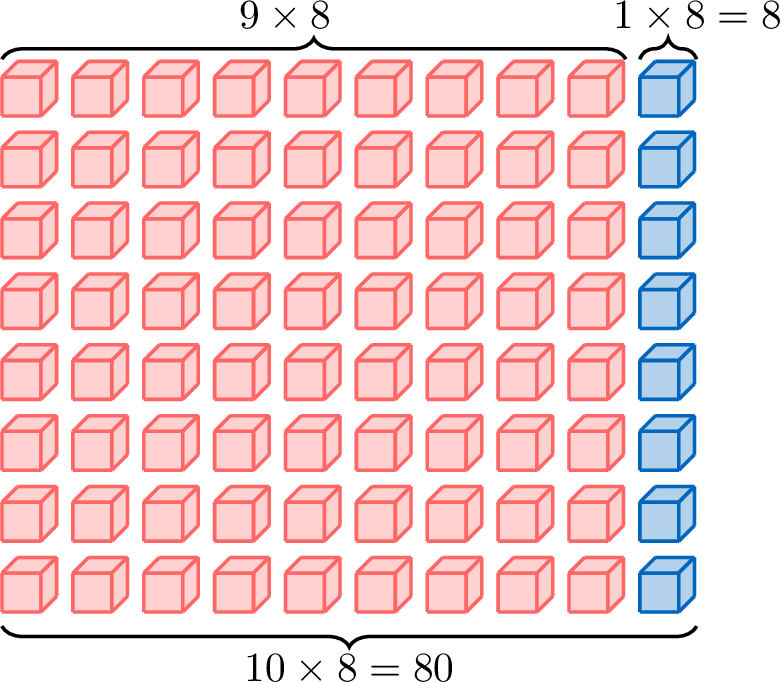
- 10 groups of 8 cubes have 80 cubes (\(10 \times 8 = 80\)).
- 1 group of 8 cubes has 8 cubes (\(1 \times 8 = 8\)).
Since 9 groups is just 1 group less than 10 groups, we can start with the total for 10 groups and simply subtract the one extra group. $$\begin{aligned}[t]\text{Total for 9 groups} &= (\text{Total for 10 groups}) - (\text{Total for 1 group})\\
9 \times 8 &= (10 \times 8) - (1 \times 8) \\
&= 80 - 8 \\
&= 72 \end{aligned}$$ So, there are 72 cubes in total.
Method — Using Subtraction to Break Apart
This is another way to use the distributive property. It is useful when multiplying by numbers that are close to a multiple of ten (like 8 or 9). To solve \(9 \times 8\), you can think of 9 as \((10 - 1)\): $$\begin{aligned}[t] \text{Total for 9 groups} &= (\text{Total for 10 groups}) - (\text{Total for 1 group})\\
9 \times 8 &= (10 \times 8) - (1 \times 8) \\
&= 80 - 8 \\
&= 72\end{aligned}$$ Skills to practice
- Breaking Apart with a Subtraction
VI
The 9s Times Table
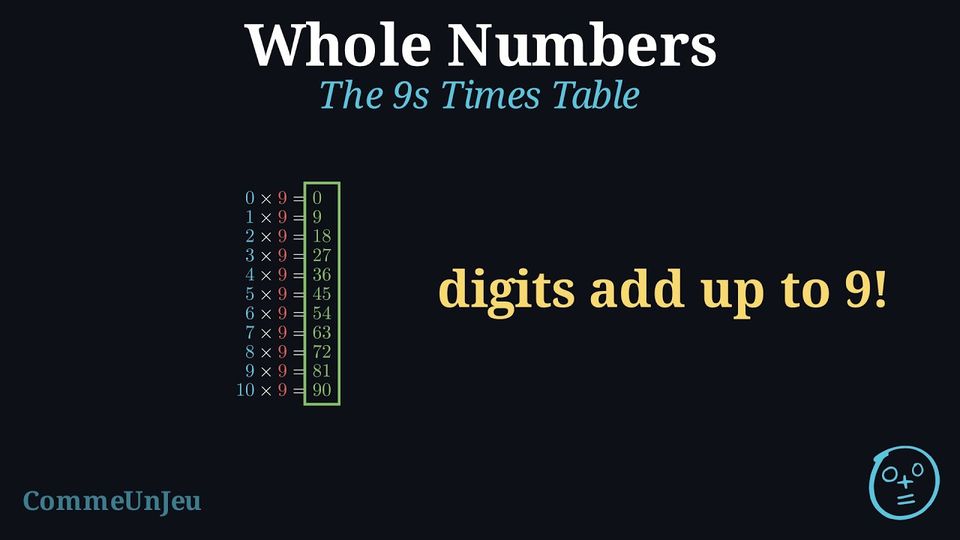
There are 9 players on a baseball team. How many players are in 4 teams?
We have 4 groups of 9. We can skip-count by 9s: 9, 18, 27, 36 players. 
$$\begin{aligned}[t]4 \times 9 &= 9 + 9 + 9 + 9 && \text{(counting by 9s: }9, 18, 27, 36\text{)}\\
&= 36\end{aligned}$$ There are \(36\) players.
Proposition — Times Table of 9
The two columns give the same results: the order of the two numbers does not change the result. Skills to practice
- Counting by 9s
- Multiplying by 9 using Decomposition
- Multiplying by 9
VII
The Full Multiplication Grid
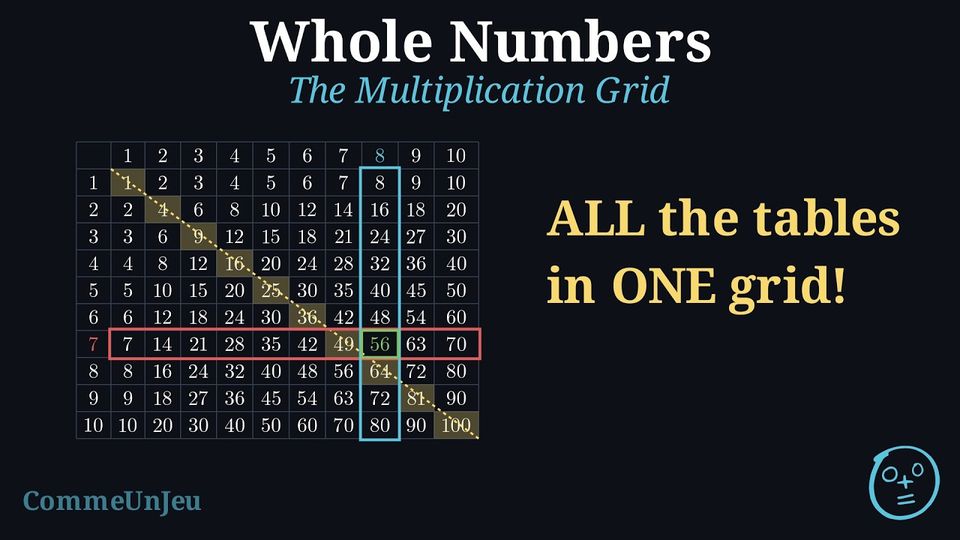
Proposition — All Times Tables from 1 to 10
This grid shows all the times tables from 1 to 10 in one place. To find a product such as \(7 \times 8\), find the row for 7 and the column for 8: the result is in the cell where they meet. The grid can also be read backwards: for \(7 \times \square = 42\), go along the row for 7 to \(42\), then up to the top of its column: \(6\). So \(7 \times 6 = 42\). | \(\times\) | \(\textcolor{colorprop}{1}\) | \(\textcolor{colorprop}{2}\) | \(\textcolor{colorprop}{3}\) | \(\textcolor{colorprop}{4}\) | \(\textcolor{colorprop}{5}\) | \(\textcolor{colorprop}{6}\) | \(\textcolor{colorprop}{7}\) | \(\textcolor{colorprop}{8}\) | \(\textcolor{colorprop}{9}\) | \(\textcolor{colorprop}{10}\) |
| \(\textcolor{colordef}{1}\) | \(\textcolor{olive}{1}\) | \(\textcolor{olive}{2}\) | \(\textcolor{olive}{3}\) | \(\textcolor{olive}{4}\) | \(\textcolor{olive}{5}\) | \(\textcolor{olive}{6}\) | \(\textcolor{olive}{7}\) | \(\textcolor{olive}{8}\) | \(\textcolor{olive}{9}\) | \(\textcolor{olive}{10}\) |
| \(\textcolor{colordef}{2}\) | \(\textcolor{olive}{2}\) | \(\textcolor{olive}{4}\) | \(\textcolor{olive}{6}\) | \(\textcolor{olive}{8}\) | \(\textcolor{olive}{10}\) | \(\textcolor{olive}{12}\) | \(\textcolor{olive}{14}\) | \(\textcolor{olive}{16}\) | \(\textcolor{olive}{18}\) | \(\textcolor{olive}{20}\) |
| \(\textcolor{colordef}{3}\) | \(\textcolor{olive}{3}\) | \(\textcolor{olive}{6}\) | \(\textcolor{olive}{9}\) | \(\textcolor{olive}{12}\) | \(\textcolor{olive}{15}\) | \(\textcolor{olive}{18}\) | \(\textcolor{olive}{21}\) | \(\textcolor{olive}{24}\) | \(\textcolor{olive}{27}\) | \(\textcolor{olive}{30}\) |
| \(\textcolor{colordef}{4}\) | \(\textcolor{olive}{4}\) | \(\textcolor{olive}{8}\) | \(\textcolor{olive}{12}\) | \(\textcolor{olive}{16}\) | \(\textcolor{olive}{20}\) | \(\textcolor{olive}{24}\) | \(\textcolor{olive}{28}\) | \(\textcolor{olive}{32}\) | \(\textcolor{olive}{36}\) | \(\textcolor{olive}{40}\) |
| \(\textcolor{colordef}{5}\) | \(\textcolor{olive}{5}\) | \(\textcolor{olive}{10}\) | \(\textcolor{olive}{15}\) | \(\textcolor{olive}{20}\) | \(\textcolor{olive}{25}\) | \(\textcolor{olive}{30}\) | \(\textcolor{olive}{35}\) | \(\textcolor{olive}{40}\) | \(\textcolor{olive}{45}\) | \(\textcolor{olive}{50}\) |
| \(\textcolor{colordef}{6}\) | \(\textcolor{olive}{6}\) | \(\textcolor{olive}{12}\) | \(\textcolor{olive}{18}\) | \(\textcolor{olive}{24}\) | \(\textcolor{olive}{30}\) | \(\textcolor{olive}{36}\) | \(\textcolor{olive}{42}\) | \(\textcolor{olive}{48}\) | \(\textcolor{olive}{54}\) | \(\textcolor{olive}{60}\) |
| \(\textcolor{colordef}{7}\) | \(\textcolor{olive}{7}\) | \(\textcolor{olive}{14}\) | \(\textcolor{olive}{21}\) | \(\textcolor{olive}{28}\) | \(\textcolor{olive}{35}\) | \(\textcolor{olive}{42}\) | \(\textcolor{olive}{49}\) | \(\textcolor{olive}{56}\) | \(\textcolor{olive}{63}\) | \(\textcolor{olive}{70}\) |
| \(\textcolor{colordef}{8}\) | \(\textcolor{olive}{8}\) | \(\textcolor{olive}{16}\) | \(\textcolor{olive}{24}\) | \(\textcolor{olive}{32}\) | \(\textcolor{olive}{40}\) | \(\textcolor{olive}{48}\) | \(\textcolor{olive}{56}\) | \(\textcolor{olive}{64}\) | \(\textcolor{olive}{72}\) | \(\textcolor{olive}{80}\) |
| \(\textcolor{colordef}{9}\) | \(\textcolor{olive}{9}\) | \(\textcolor{olive}{18}\) | \(\textcolor{olive}{27}\) | \(\textcolor{olive}{36}\) | \(\textcolor{olive}{45}\) | \(\textcolor{olive}{54}\) | \(\textcolor{olive}{63}\) | \(\textcolor{olive}{72}\) | \(\textcolor{olive}{81}\) | \(\textcolor{olive}{90}\) |
| \(\textcolor{colordef}{10}\) | \(\textcolor{olive}{10}\) | \(\textcolor{olive}{20}\) | \(\textcolor{olive}{30}\) | \(\textcolor{olive}{40}\) | \(\textcolor{olive}{50}\) | \(\textcolor{olive}{60}\) | \(\textcolor{olive}{70}\) | \(\textcolor{olive}{80}\) | \(\textcolor{olive}{90}\) | \(\textcolor{olive}{100}\) |
Skills to practice
- Multiplying by 1 to 10
- Reading the Tables Both Ways
VIII
Going further
Skills to practice
- Completing Times Tables
- Quiz
Jump to section