International Baccalaureate · PYP 3
Multiplication Strategies
I
A Pattern with Tens
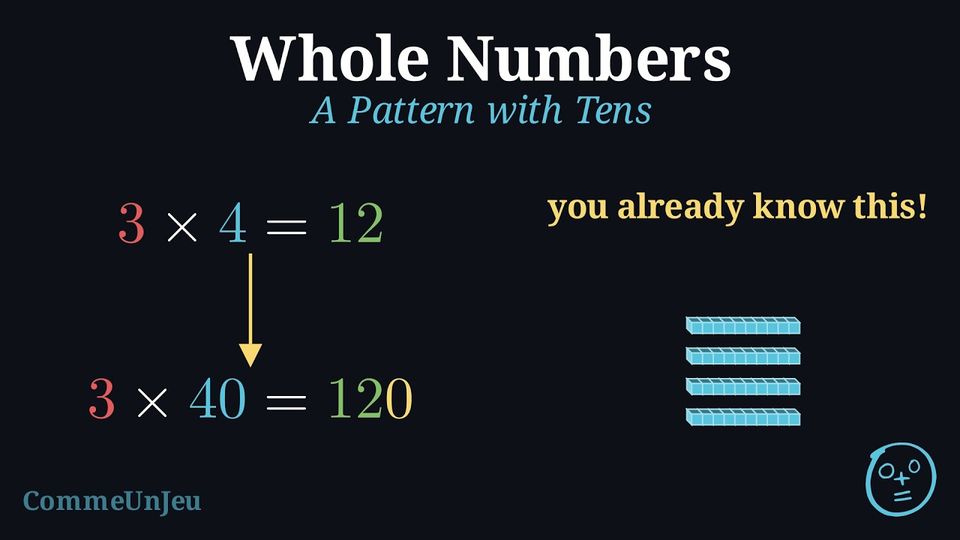
What happens when a number is multiplied by 10, 20, 30, or another multiple of 10 (a result of the table of 10)?
- 3 groups of 10 (\(3 \times 10\)):
\(\textcolor{colordef}{3}\times \textcolor{colorprop}{1}0\) \(=\) \(\textcolor{colordef}{3}\times\) 
\(=\) \(+\) \(+\) \(=\) \(\textcolor{olive}{3}0\) - 3 groups of 20 (\(3 \times 20\)):
\(\textcolor{colordef}{3}\times \textcolor{colorprop}{2}0\) \(=\) \(\textcolor{colordef}{3}\times\) 
\(=\) \(+\) \(+\) \(=\) \(\textcolor{olive}{6}0\)
- \(3 \times 4 = 12 \quad \rightarrow \quad 3 \times 40 = 120\)
- \(3 \times 5 = 15 \quad \rightarrow \quad 3 \times 50 = 150\)
- \(3 \times 6 = 18 \quad \rightarrow \quad 3 \times 60 = 180\)
Proposition — The Place-a-Zero Rule
To multiply a one-digit number by a multiple of 10 between 10 and 90, multiply it by the tens digit, then place a zero at the end of the result. Method — Multiplying by 10 and by 100
When a number is multiplied by \(10\), each one becomes a ten, each ten becomes a hundred and each hundred becomes a thousand: every digit moves one place to the left, and a \(0\) fills the ones place. | Th | H | T | O | |
| \(724\) | \textcolor{colordef}{7} | \textcolor{colordef}{2} | \textcolor{colordef}{4} | |
| \(724 \times 10\) | \textcolor{colordef}{7} | \textcolor{colordef}{2} | \textcolor{colordef}{4} | \textcolor{colorprop}{0} |
Multiplying by \(100\) moves every digit two places to the left: \(35 \times 100 = 3\,500\), and two zeros fill the ones and tens places.
To multiply by \(30\), multiply by \(3\), then by \(10\): \(25 \times 30 = 75 \times 10 = 750\).
Example
Compute \(10 \times 305\) and \(100 \times 45\).
The order of the two numbers does not matter. \(305 \times 10\): every digit moves one place to the left, \(305 \times 10 = 3\,050\) (the \(0\) of \(305\) stays, another \(0\) appears). \(45 \times 100\): two places to the left, \(45 \times 100 = 4\,500\).
To multiply by a multiple of 100, multiply by the number of hundreds, then place two zeros at the end: for \(9\times200\), \(9 \times 2 = 18\), so \(9\times200=1\,800\).
Skills to practice
- Multiplying by Multiples of 10
- Multiplying with the Multiple of 10 First
- Multiplying by 10 and by 100
- Multiplying by Multiples of 100
- Multiplying by Tens
II
Splitting to Multiply
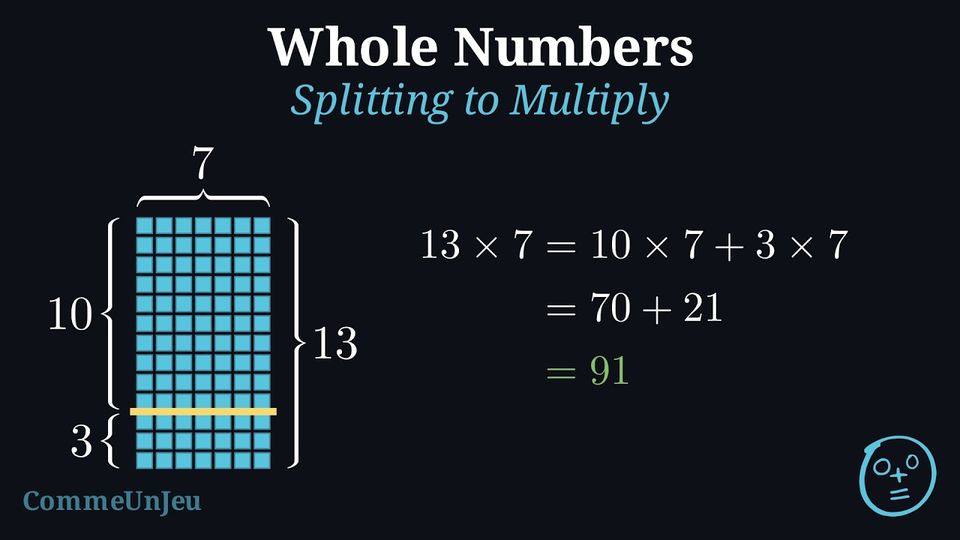
Method — Splitting to Multiply
The times tables go up to \(10 \times 10\). To multiply a two-digit number by a number from the tables, split it into tens and ones.To find \(13 \times 7\): split \(13\) into \(10 + 3\).
Multiply each part: \(10 \times 7 = 70\) and \(3 \times 7 = 21\).
Add the two results: \(70 + 21 = 91\). So \(13 \times 7 = 91\).
Example
Find \(12 \times 6\) by splitting.
Split \(12\) into \(10 + 2\). Then \(10 \times 6 = 60\) and \(2 \times 6 = 12\), and \(60 + 12 = 72\). $$12 \times 6 = \textbf{72}$$
Example
Find \(6 \times 14\) by splitting.
The bigger number can be split, even if it is the second one. Split \(14\) into \(10 + 4\). Then \(6 \times 10 = 60\) and \(6 \times 4 = 24\), and \(60 + 24 = 84\). $$6 \times 14 = \textbf{84}$$
Skills to practice
- Splitting into Tens and Ones
- Splitting Step by Step
- Multiplying Beyond the Tables
- Explaining the Splitting
III
Factors, Product and Multiples
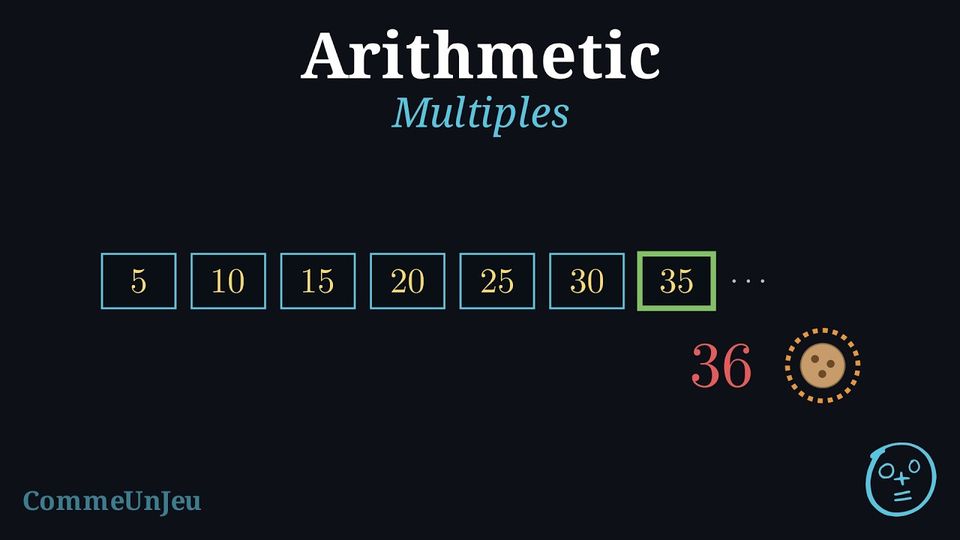
Stickers are sold in packs of \(25\). Léa buys \(3\) packs and Tom buys \(4\) packs.
- How many stickers does each of them have?
- Can someone get exactly \(80\) stickers by buying whole packs?
- Léa: \(\textcolor{colordef}{3} \times \textcolor{colorprop}{25} = \textcolor{olive}{75}\) stickers. Tom: \(\textcolor{colordef}{4} \times \textcolor{colorprop}{25} = \textcolor{olive}{100}\) stickers.
- With whole packs, the totals are the results of the table of \(25\): \(25\), \(50\), \(75\), \(100\), \(125\), …\ The number \(80\) is not in this list (\(3\) packs give \(75\), \(4\) packs give \(100\)), so nobody can get exactly \(80\) stickers.
Definition — Factors, Product and Multiple
In the multiplication \(\textcolor{colordef}{3} \times \textcolor{colorprop}{25} = \textcolor{olive}{75}\): - the numbers that are multiplied, \(\textcolor{colordef}{3}\) and \(\textcolor{colorprop}{25}\), are the factors;
- the result, \(\textcolor{olive}{75}\), is the product: the product of \(3\) and \(25\) is \(75\);
- \(\textcolor{olive}{75}\) is a multiple of \(25\): it is a result of the table of \(25\) (\(25\), \(50\), \(75\), \(100\), …), which can be continued as far as we want. It is also a multiple of \(3\).
Example
An hour has \(60\) minutes. Find all the ways to write \(60\) as a product of two whole numbers.
We try the factors in order: \(1 \times 60\), \(2 \times 30\), \(3 \times 20\), \(4 \times 15\), \(5 \times 12\), \(6 \times 10\). \(7\), \(8\) and \(9\) give nothing: \(7 \times 8 = 56\) and \(7 \times 9 = 63\), \(8 \times 7 = 56\) and \(8 \times 8 = 64\), \(9 \times 6 = 54\) and \(9 \times 7 = 63\) — \(60\) is never reached. After that, the factors repeat the other way round (\(10 \times 6\) is \(6 \times 10\) again). So \(60\) has six decompositions, without counting the order of the factors: this is why an hour splits so easily into 2, 3, 4, 5 or 6 equal parts.
Example
Is \(42\) a multiple of \(6\)? Is \(50\) a multiple of \(6\)?
In the table of \(6\): \(6 \times 7 = 42\), so \(42\) is a multiple of \(6\) (in \(6 \times 7 = 42\), the factors are \(6\) and \(7\)). Then \(6 \times 8 = 48\) and \(6 \times 9 = 54\): the table jumps over \(50\), so \(50\) is not a multiple of \(6\).
Skills to practice
- Using the Words Factor, Product and Multiple
- Writing a Number as a Product
IV
Grouping Factors
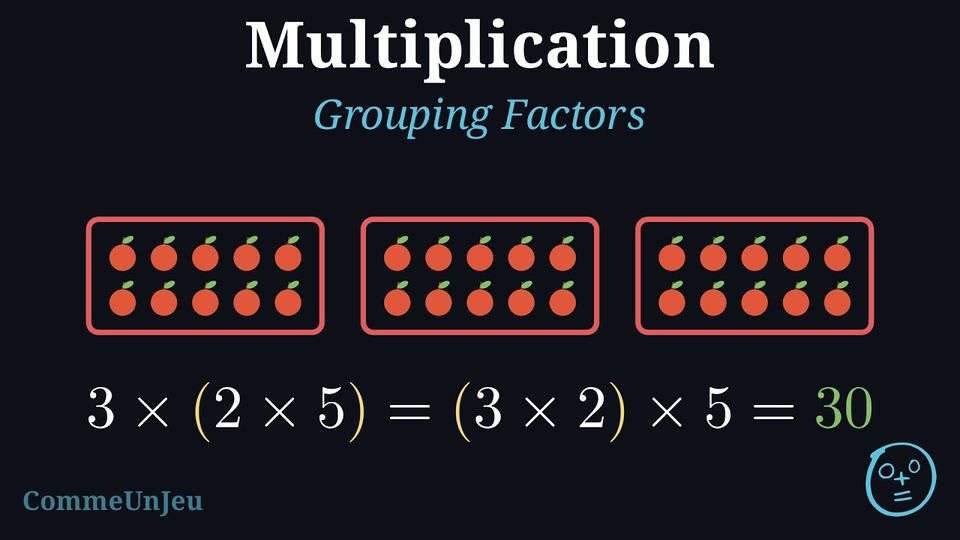
Léa packs apples into trays. A tray holds \(2\) rows of \(5\) apples, and Léa fills \(3\) trays. 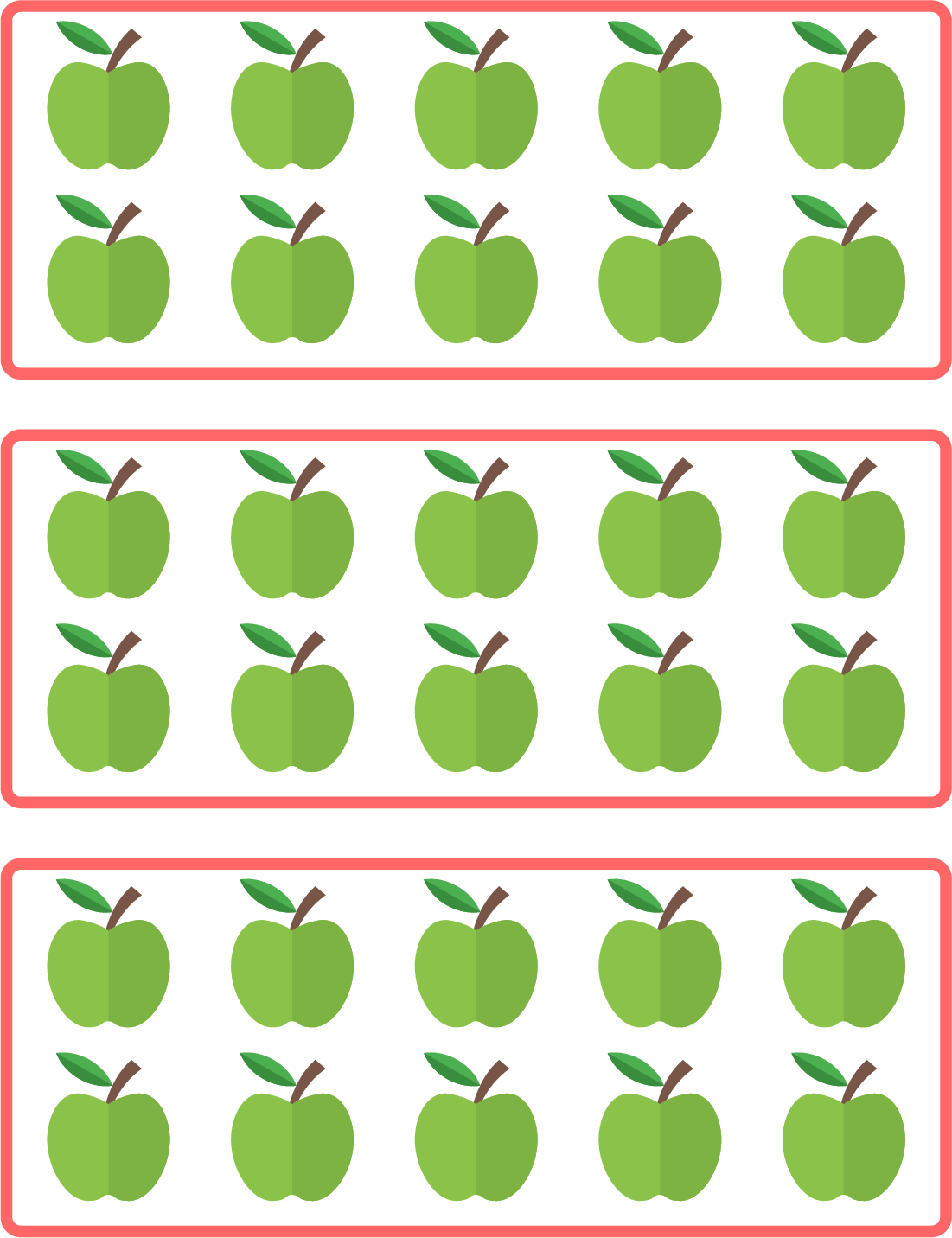
How many apples are there? Find two different ways to count them.
Tray by tray. One tray holds \(2 \times 5 = 10\) apples, and there are \(3\) trays. $$\begin{aligned}[t] 3 \times (2 \times 5) &= 3 \times 10 && {\scriptstyle\left(\text{the apples of one tray first}\right)} \\
&= 30 \end{aligned}$$ Row by row. The \(3\) trays have \(3 \times 2 = 6\) rows, and each row has \(5\) apples. $$\begin{aligned}[t] (3 \times 2) \times 5 &= 6 \times 5 && {\scriptstyle\left(\text{the number of rows first}\right)} \\
&= 30 \end{aligned}$$ The two ways count the same apples, so they give the same number: there are \(30\) apples. The brackets show which multiplication is done first.
Proposition — Grouping Factors
To multiply three numbers, any two of them can be multiplied first: the product does not change. The brackets show the multiplication done first: $$(3 \times 2) \times 5 = 3 \times (2 \times 5) = 30$$ The order of two factors does not matter either (\(2 \times 5 = 5 \times 2\)). So three factors can be taken in any order and grouped in any way. To calculate quickly, look first for two factors whose product is \(10\), \(20\) or \(100\).This is also why, to multiply by \(30\), we can multiply by \(3\), then by \(10\): $$4 \times 30 = 4 \times (3 \times 10) = (4 \times 3) \times 10 = 12 \times 10 = 120$$
Example
Calculate \(2 \times 7 \times 5\) in the quickest way.
The product \(2 \times 5 = 10\) is easy: take \(2\) and \(5\) together first. $$\begin{aligned}[t] 2 \times 7 \times 5 &= 7 \times (2 \times 5) && {\scriptstyle\left(\text{any order, any grouping}\right)} \\
&= 7 \times 10 && {\scriptstyle\left(2 \times 5 = 10\right)} \\
&= 70 \end{aligned}$$ From left to right, \(2 \times 7 = 14\), then \(14 \times 5 = 70\): the same product, but a harder calculation.
Example
Calculate \(4 \times 9 \times 25\).
Four \(25\)s make \(100\): \(4 \times 25 = 100\). Take \(4\) and \(25\) together first. $$\begin{aligned}[t] 4 \times 9 \times 25 &= 9 \times (4 \times 25) && {\scriptstyle\left(\text{any order, any grouping}\right)} \\
&= 9 \times 100 && {\scriptstyle\left(4 \times 25 = 100\right)} \\
&= 900 \end{aligned}$$
Skills to practice
- Choosing the Two Factors to Group
- Grouping Factors to Calculate
V
Going further
Skills to practice
- Writing and Explaining Multiplications
- Choosing a Smart Decomposition
- Quiz
Jump to section