International Baccalaureate · PYP 4
Numbers to 999 999
I
Place Value
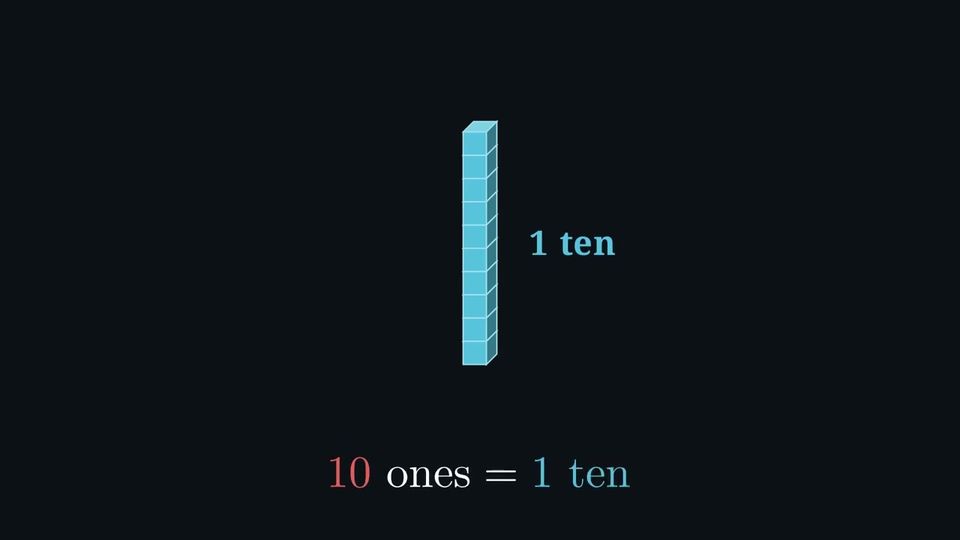
Ones, tens and hundreds are grouped by ten: \(10\) ones make \(1\) ten, \(10\) tens make \(1\) hundred, \(10\) hundreds make \(1\) thousand. To build larger numbers, thousands are grouped in the same way.
We group 10 thousands together to make 1 ten thousand:  = \(10\) thousands = \(1\) ten thousand =

Our place value table now needs a new, larger column for Ten Thousands.
This table shows we have 1 ten thousand, 2 thousands, 4 hundreds, 3 tens, and 5 ones. This makes the number \(\mathbf{12\,435}\). In the same way, \(10\) ten thousands are grouped to form 1 hundred thousand.
We group 10 thousands together to make 1 ten thousand:
= \(10\) thousands = \(1\) ten thousand = | Ten Thousands | Thousands | Hundreds | Tens | Ones |
| 1 | 2 | 4 | 3 | 5 |
| |  |  |  |  |
Definition — 5-Digit Number
A 5-digit number is a whole number written with five digits; it ranges from \(10\,000\) to \(99\,999\). The place of a digit gives its value. We can show a number like \(12\,435\) in many different ways: - With digits: $$12\,435$$
- In expanded form: $$\begin{aligned}[t] 1\text{ ten thousand }&+& 2\text{ thousands }&+& 4\text{ hundreds }&+& 3\text{ tens }&+& 5\text{ ones }\\ 10\,000 &+& 2\,000 &+& 400 &+& 30 &+& 5 \\ 1\times 10\,000 &+& 2\times 1\,000 &+& 4\times 100 &+& 3\times 10 &+& 5\times 1 \\ \end{aligned}$$
- With words: twelve thousand, four hundred thirty-five
- In a place value table:
Ten Thousands Thousands Hundreds Tens Ones 1 2 4 3 5 - With cubes:

Extending to 6-Digit Numbers
The place value table can always be extended: adding a new column for the hundred thousands lets us write 6-digit numbers, from \(100\,000\) to \(999\,999\). For example, the number \(214\,365\):
$$214\,365 = 2\times 100\,000 + 1\times 10\,000 + 4\times 1\,000 + 3\times 100 + 6\times 10 + 5\times 1$$ In words: two hundred fourteen thousand, three hundred sixty-five.
| Hundred Thousands | Ten Thousands | Thousands | Hundreds | Tens | Ones |
| 2 | 1 | 4 | 3 | 6 | 5 |
Skills to practice
- Counting Cubes in a Table
- Counting Cubes
- Counting Cubes from a Table
- Finding the Digit
- Writing Numbers from Ten Thousands, Thousands, Hundreds, Tens, and Ones
- Writing Numbers from Hundred Thousands to Ones
- Writing Numbers from Expanded Form
- Writing Numbers from Expanded Form with Multiplication
- Writing Numbers in Figures from Words
- Converting Between Units
- Writing Numbers in Words
- Organising and Counting Collections
II
On the Number Line
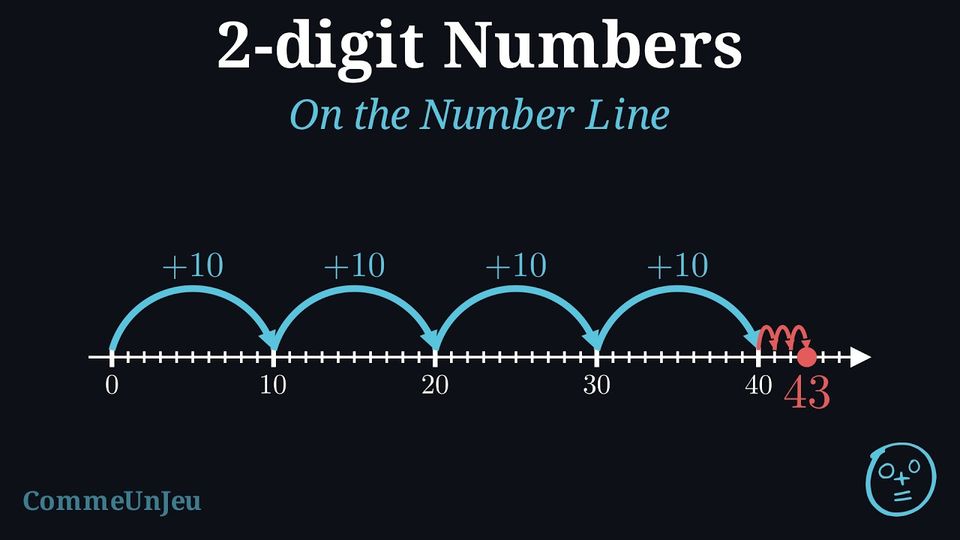
A number line helps us see numbers in order. We can use it to count by ones, or we can make bigger jumps to count faster: from one mark to the next, the jump is always the same. With large numbers, the number line can jump by thousands, by ten thousands or by hundred thousands at a time.
- Counting by tens: \(0\), \(10\), \(20\), \(30\), …
- Counting by hundreds: \(0\), \(100\), \(200\), \(300\), …
- Counting by thousands: \(0\), \(1\,000\), \(2\,000\), \(3\,000\), …
- Counting by ten thousands: \(0\), \(10\,000\), \(20\,000\), \(30\,000\), …
- Counting by hundred thousands: \(0\), \(100\,000\), \(200\,000\), \(300\,000\), …
Definition — Number Line
A number line starts at an origin, marked \(0\), and goes to the right. Its marks are equally spaced: from one mark to the next, the same number is always added. 
Skills to practice
- Finding Numbers
- Continuing Number Sequences
- Placing Numbers on a Number Line
III
Comparing and Ordering
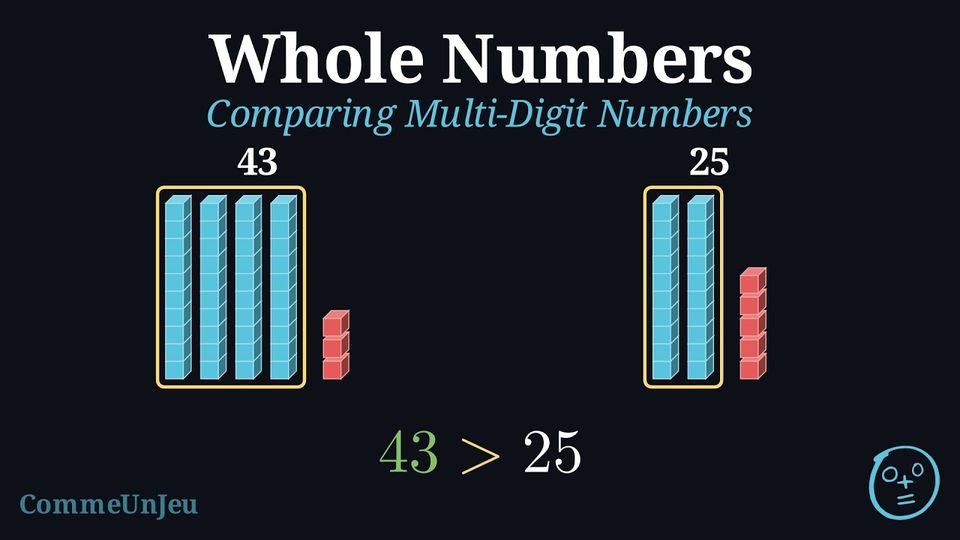
Method — Comparing Two Whole Numbers
To compare two whole numbers: - Count the digits: the number with more digits is the greater one.
- If both numbers have the same number of digits, compare the digits from left to right, place by place: the first different digit decides.
Example
Compare the numbers, using \(<\) or \(>\): - \(98\,765\) and \(123\,456\)
- \(214\,365\) and \(214\,635\)
- \(98\,765\) has \(5\) digits and \(123\,456\) has \(6\) digits. The number with more digits is the greater one: $$98\,765 < 123\,456.$$
- Both numbers have \(6\) digits. Comparing the digits from left to right: the hundred-thousands digits are the same (\(2\)), so are the ten-thousands digits (\(1\)) and the thousands digits (\(4\)), but the hundreds digits differ: \(3 < 6\). So: $$214\,365 < 214\,635.$$
Skills to practice
- Comparing Two Numbers
- Finding a Number Between Two Numbers
- Ordering Numbers
IV
Placing a Number Between Two Consecutive Multiples
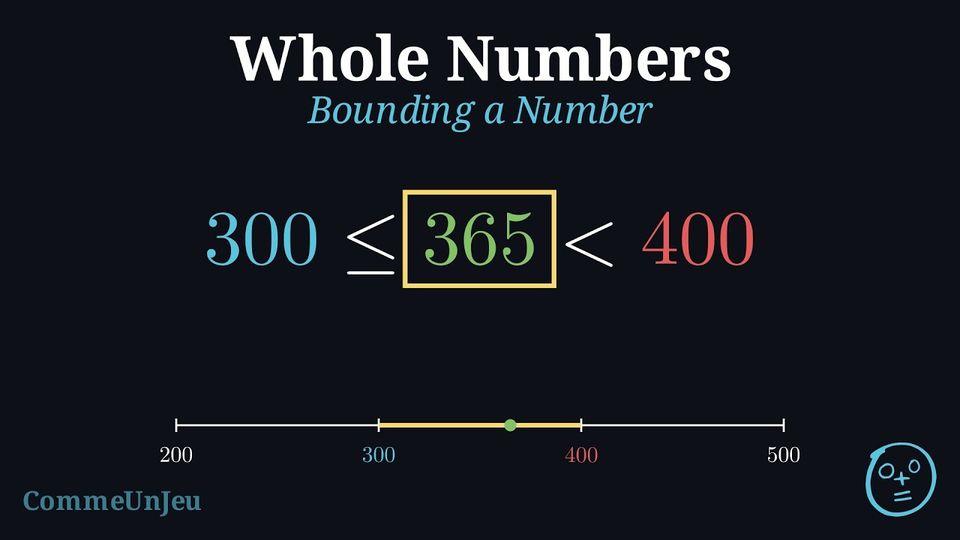
Method — Placing a Number Between Two Thousands, Hundreds or Tens
To place a number between two thousands next to each other, read how many whole thousands it contains: the number lies between that many thousands and one more. It is written with two symbols at once, and read with the words between … and …: \(4\,000 < 4\,635 < 5\,000\), read: \(4\,635\) is between \(4\,000\) and \(5\,000\). Between two hundreds or two tens, it works the same way, with whole hundreds or whole tens. | Between two | It contains | Writing |
| thousands | \(4\) whole thousands | \(4\,000 < 4\,635 < 5\,000\) |
| hundreds | \(46\) whole hundreds | \(4\,600 < 4\,635 < 4\,700\) |
| tens | \(463\) whole tens | \(4\,630 < 4\,635 < 4\,640\) |
| neighbours | — | \(4\,634 < 4\,635 < 4\,636\) |
This only works if the number is not exactly a number of thousands (or of hundreds, or of tens, for those marks). \(4\,000\) is exactly \(4\) thousands: it sits on the mark, not between two marks.
Do not confuse the digit with the number of hundreds. The hundreds digit of \(4\,635\) is \(6\), but \(4\,635\) contains \(46\) hundreds: the digit says what sits in that place, the number of hundreds says how many there are altogether.
Example
Write \(214\,365\) between two consecutive hundred thousands.
\(214\,365\) contains \(2\) whole hundred thousands, so it lies between \(2\) and \(3\) hundred thousands: $$200\,000 < 214\,365 < 300\,000.$$
Definition — Placing a Number Between Two Consecutive Multiples
Placing a number between two consecutive multiples of \(10\) (of \(100\), of \(1\,000\)…) means giving the two consecutive multiples between which it lies: the smaller one is the lower bound, the larger one the upper bound. The lower bound can be the number itself: to the hundred, \(365\) lies between \(300\) and \(400\), and \(300\) between \(300\) and \(400\). Method — Finding the Lower and Upper Bounds
To place a number between two consecutive multiples of a place (ten, hundred, thousand…): - Determine the lower bound. Keep the target digit and all digits to its left, and replace all digits to its right with zeros.
- Determine the upper bound. Keep the digits to the left of the target place value, add one to the target digit, and replace all digits to its right with zeros. (If the target digit is \(9\), adding one carries over to the digit on its left.)
Example
Write the number \(365\) between two consecutive hundreds. - The target place value is the hundreds. The digit is 3.
- Lower Bound: Keep the 3, replace subsequent digits with zeros. The lower bound is 300.
- Upper Bound: Add 1 to the hundreds digit (\(3+1=4\)), replace subsequent digits with zeros. The upper bound is 400.
- Therefore, 365 lies between 300 and 400. This can be written as \(300 \leq 365 < 400\). The sign \(\leq\) reads “is less than or equal to”: the lower bound can be the number itself, as in \(300 \leq 300 < 400\).
Skills to practice
- Placing a Number Between Two Hundred Thousands
- Placing a Number Between Two Consecutive Multiples
V
Rounding Numbers
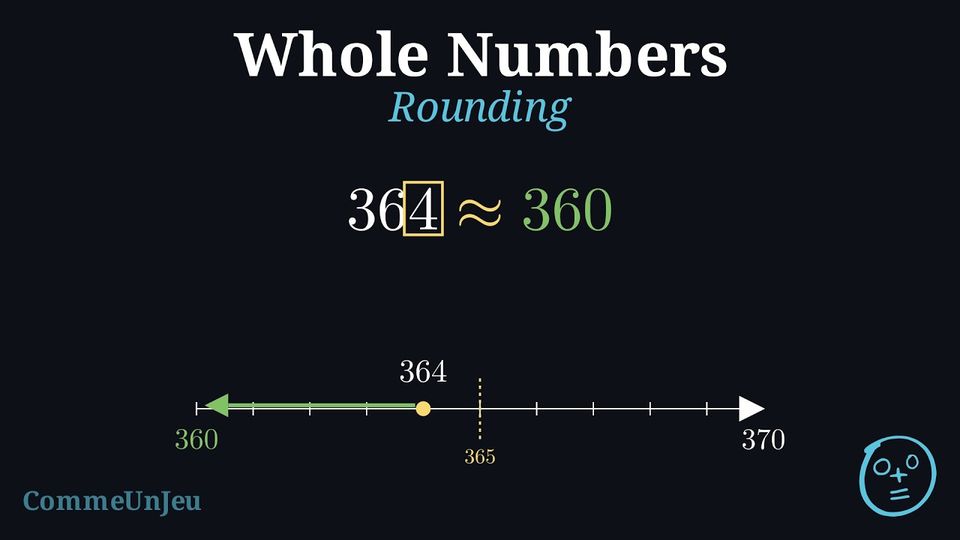
Proposition — Rounding Means Taking the Nearest Bound
To round a number to the ten (to the hundred, to the thousand…), place it between two consecutive multiples of \(10\) (of \(100\), of \(1\,000\)…): its rounding is the bound nearer to it. A number exactly in the middle of the two bounds is rounded to the upper bound, by convention. 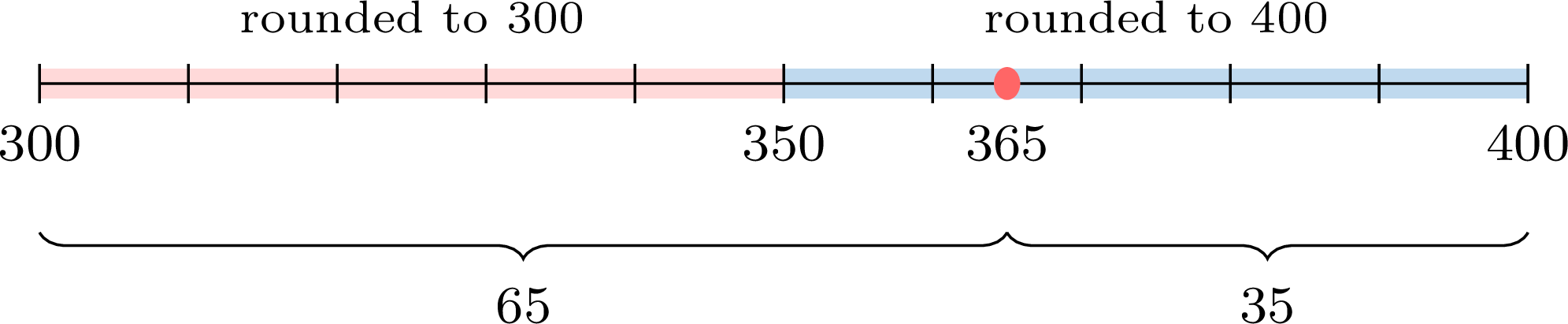
Method — Standard Procedure for Rounding
To round a number to a given place (the ten, the hundred, the thousand…): - Find the target digit: the digit in the place the number is rounded to.
- Look at the digit just to its right.
- Apply the rule:
- If that digit is 5 or more (5, 6, 7, 8, 9), round up: add 1 to the target digit.
- If that digit is 4 or less (0, 1, 2, 3, 4), round down: the target digit stays the same.
- Replace the digits after it by zeros: every digit to the right of the target digit becomes \(0\).
Example
Round the number \(365\) to the nearest hundred.
The procedure is executed as follows:$$\begin{aligned}[t]&\textcolor{colordef}{\underline{3}}65 && \text{1. The target digit in the hundreds place is } \textcolor{colordef}{3}.\\
&\textcolor{colordef}{3}\textcolor{colorprop}{\underline{6}}5 && \text{2. The digit to its right is } \textcolor{colorprop}{6}.\\
&&&\text{3. As } \textcolor{colorprop}{6} \ge 5, \text{ the target digit is rounded up: } \textcolor{colordef}{3}+1 = \textcolor{olive}{4}.\\
&\textcolor{olive}{4}\textcolor{purple}{00} && \text{4. Subsequent digits are replaced with zeros.}\end{aligned}$$ Therefore, \(365\) rounded to the nearest hundred is \(400\).
Skills to practice
- Rounding to the Nearest Ten
- Rounding to the Nearest Hundred
- Rounding to the Nearest Thousand
VI
Going further
Skills to practice
- Solving Problems with 6-Digit Numbers
- Problems
- Rounding and Bounding in Problems
- Quiz
Jump to section