International Baccalaureate · PYP 3
Written Multiplication
I
Multiplying Step-by-Step
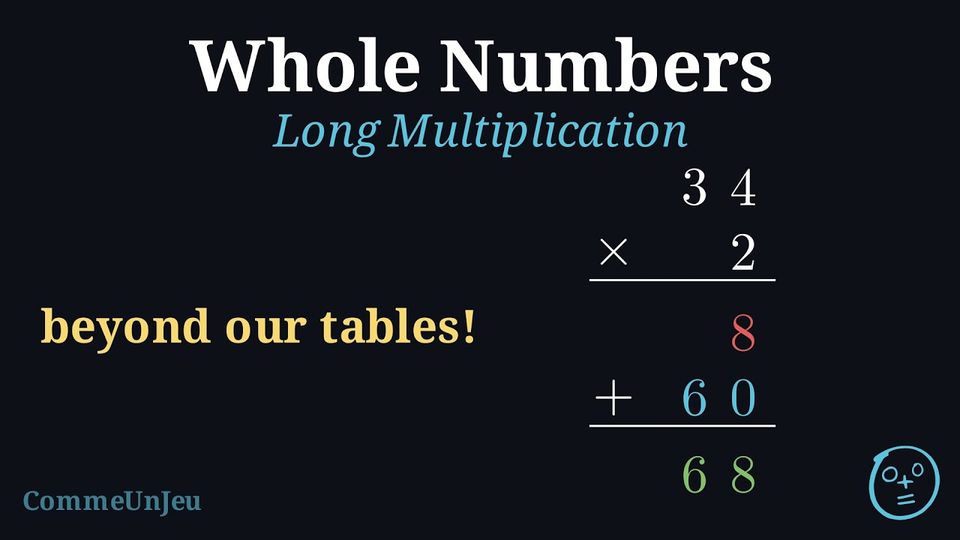
How can we solve \(2 \times 34\)? The key is to break 34 into its place values: 30 (tens) and 4 (ones).
\(\quad \rightarrow \quad\) \(\begin{aligned}[t]2 \times 34&=2 \times (30 + 4) \\ &=(2 \times 30) + (2 \times 4) \\ &=60 + 8\\ &=68\\ \end{aligned}\) The column method organises this process neatly.
| \(2 \times 34\) | \(=\) | \(2 \times\) 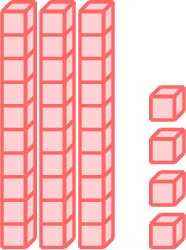 |
| \(=\) | \(2 \times\)  \(+ 2 \times\)  | |
| \(=\) | 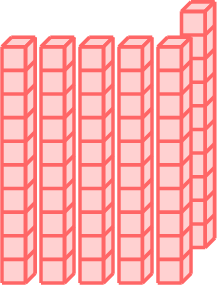 \(+\)  | |
| \(=\) | 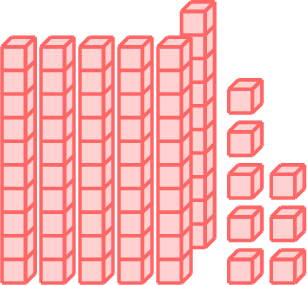 |
Example
Compute \(34 \times 6\) in your head, saying what you do.
“\(34\) times \(6\), that is \(30\) times \(6\) plus \(4\) times \(6\).” \(30 \times 6 = 180\) and \(4 \times 6 = 24\), so \(34 \times 6 = 180 + 24 = 204\).
Method — The Expanded Column: Partial Products
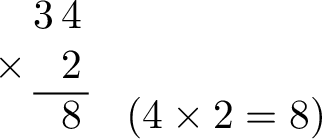
Calculate: $$34\times 2 $$ - Step 1: Set up the problem. Write the number with more digits on top and the other number below, lining up the place values.

- Step 2: Multiply the ones. Multiply the ones digit of the top number by the bottom number. (\(4 \times 2 = 8\))
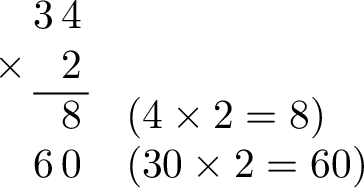
- Step 3: Multiply the tens. Multiply the tens digit of the top number by the bottom number. (\(3 \text{ tens} \times 2 = 6 \text{ tens}\), which is 60).
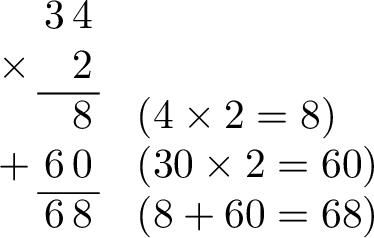
- Step 4: Add the results together. Sum the partial products to find the final answer. (\(8 + 60 = 68\))
Skills to practice
- Multiplying Step-by-Step in Your Head
- Writing the Partial Products
II
Long Multiplication with Carrying
The expanded method of multiplication involves calculating partial products for each place value and then summing them. For example, to calculate \(764 \times 2\): 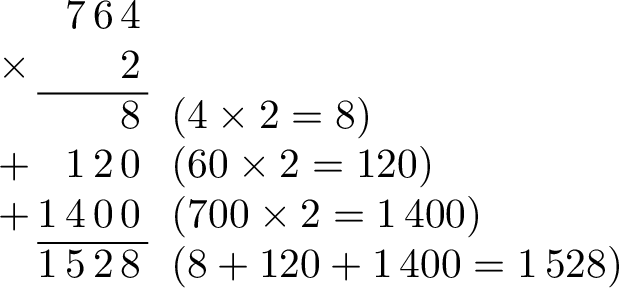
This works, but it is long to write. Column multiplication keeps the same idea and writes the carries, as in column addition.
Method — The Column with Carries
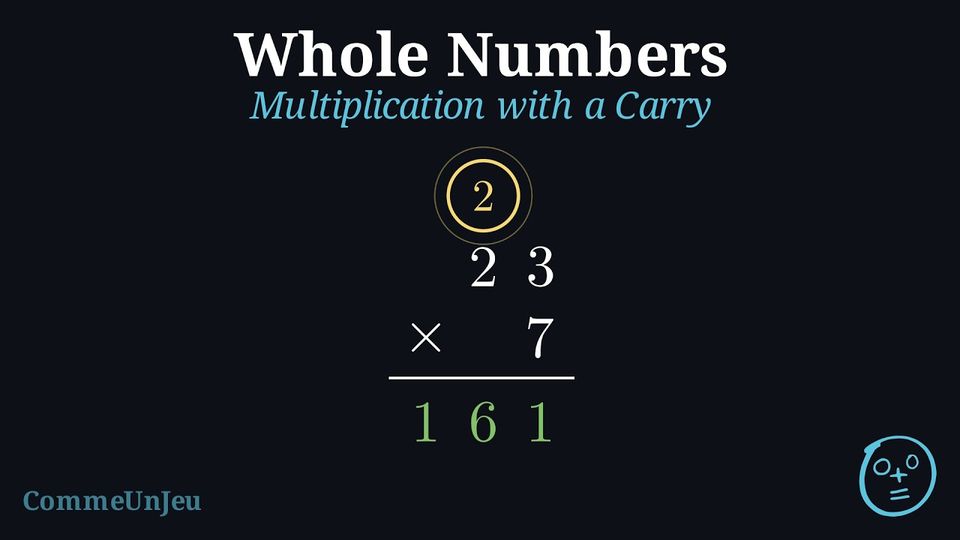
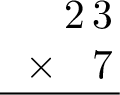
To calculate \(23 \times 7\), the procedure is as follows: - Step 1: Align the numbers. Position the numbers vertically, aligning them by place value.
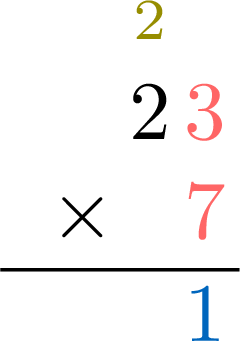
- Step 2: Multiply the ones digit. $$\textcolor{colordef}{3} \text{ ones} \times \textcolor{colordef}{7} = 21 \text{ ones} = \textcolor{olive}{2} \text{ tens} + \textcolor{colorprop}{1} \text{ one}$$ This result is composed of \(\textcolor{colorprop}{1}\) one and \(\textcolor{olive}{2}\) tens. Write the \(\textcolor{colorprop}{1}\) in the ones column of the result. Carry over the \(\textcolor{olive}{2}\) to the tens column.
- Step 3: Multiply the tens digit and add the carry-over. $$\textcolor{colordef}{2} \text{ tens} \times \textcolor{colordef}{7} + \textcolor{olive}{2} \text{ tens (carry-over)} = 14 \text{ tens} + \textcolor{olive}{2} \text{ tens} = \textcolor{colorprop}{16} \text{ tens}$$ Write \(\textcolor{colorprop}{16}\) tens — the \(\textcolor{colorprop}{6}\) in the tens column and the \(\textcolor{colorprop}{1}\) in the hundreds column (no carry-over: there is no further digit to multiply).
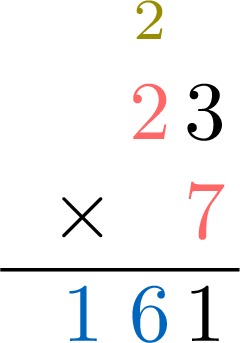
- Result: \(23 \times 7 = 161\).
Example
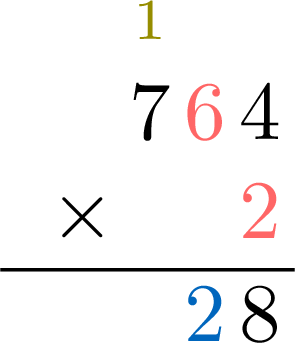
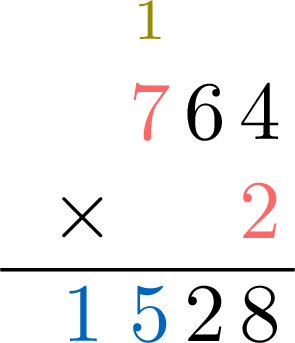
Compute \(764 \times 2\) in the column with carries.
The column with carries, step by step:
- Ones: \(4 \times 2 = 8\). Write \(8\) in the ones column, with no carry.
- Tens: $$\textcolor{colordef}{6} \text{ tens} \times \textcolor{colordef}{2} = 12 \text{ tens} = \textcolor{olive}{1} \text{ hundred} + \textcolor{colorprop}{2} \text{ tens}$$ Write the \(\textcolor{colorprop}{2}\) in the tens column. Carry the \(\textcolor{olive}{1}\) to the hundreds column.
- Hundreds: $$\textcolor{colordef}{7} \text{ hundreds} \times \textcolor{colordef}{2} + \textcolor{olive}{1} \text{ hundred (carry)} = 14 \text{ hundreds} + \textcolor{olive}{1} \text{ hundred} = \textcolor{colorprop}{15} \text{ hundreds}$$ Write the \(\textcolor{colorprop}{5}\) in the hundreds column and the \(\textcolor{colorprop}{1}\) in the thousands column.
Skills to practice
- Setting Out with Carries and Typing the Result
- Multiplying a Two-Digit Number with Carrying
- Multiplying a Three-Digit Number with Carrying
III
Going further
Skills to practice
- Explaining and Using the Column Method
- Quiz
Jump to section