International Baccalaureate · PYP 4
Division
I
Dividend, Divisor and Quotient
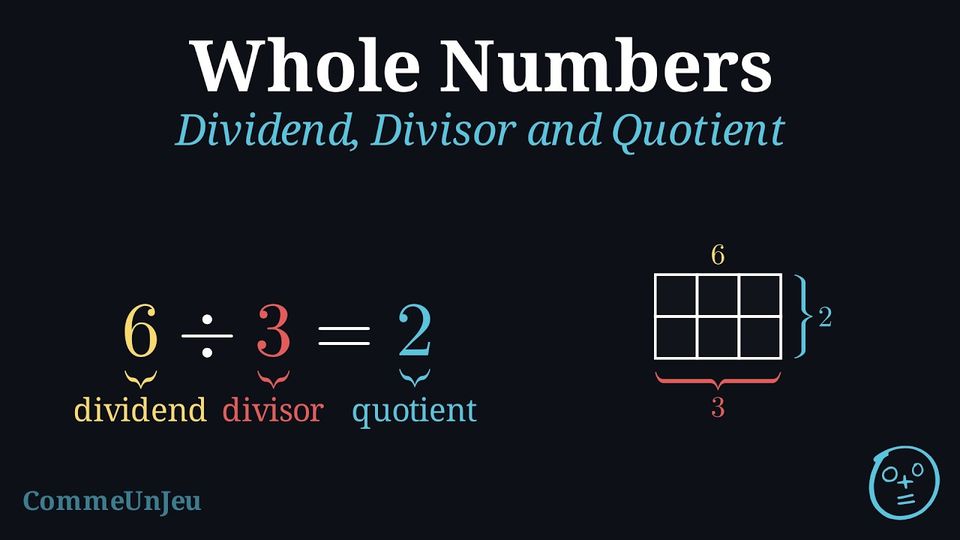
Definition — Dividend, Divisor and Quotient
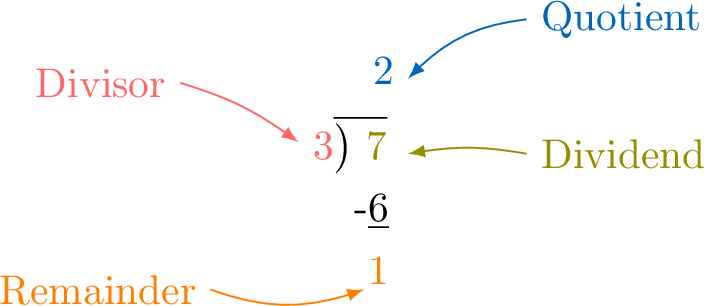
In a division — the inverse operation of multiplication, which finds how many times one number is contained within another — the three numbers have names: - The dividend: the number that is being divided.
- The divisor: the number by which the dividend is divided.
- The quotient: the result of the division.
- Numerical Form: $$\textcolor{olive}{6}\div \textcolor{colordef}{3}=\textcolor{colorprop}{2}$$
- Word Form:
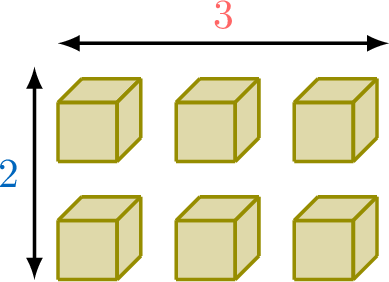
\(\textcolor{olive}{\text{Six}}\) divided by \(\textcolor{colordef}{\text{three}}\) equals \(\textcolor{colorprop}{\text{two}}\). - Grid Model:
Skills to practice
- Naming the Terms of a Division
II
Division with Remainders
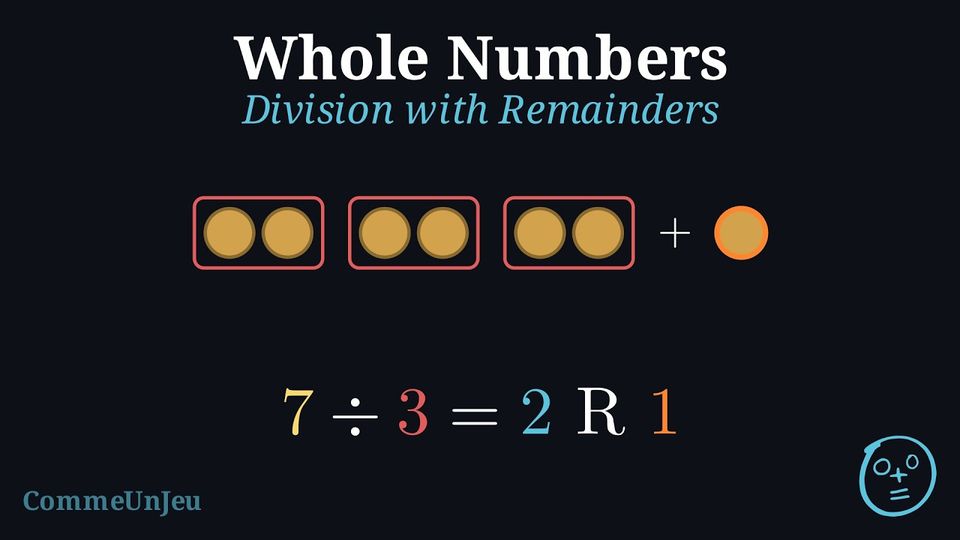
In mathematics, division is used for equal sharing or grouping. Sometimes, a number cannot be shared perfectly into equal groups. The amount that is left over after sharing is called the remainder.
Definition — Division with a Remainder
In a division of one whole number by another (not \(0\)), the remainder is what is left over once the equal groups are made. - The remainder is \(0\) or more, and always smaller than the divisor: otherwise another group could still be made.
- If the remainder is \(0\), the division is exact (no remainder).
- Word Form:
\(\textcolor{olive}{\text{Seven}}\) divided by \(\textcolor{colordef}{\text{three}}\) equals \(\textcolor{colorprop}{\text{two}}\), with a remainder of \(\textcolor{orange}{\text{one}}\) - Division Sentence:$$\underbrace{\textcolor{olive}{7}}_{\textcolor{olive}{\text{Dividend}}} \div \underbrace{\textcolor{colordef}{3}}_{\textcolor{colordef}{\text{Divisor}}} = \divionRemainder{\underbrace{\textcolor{colorprop}{2}}_{\textcolor{colorprop}{\text{Quotient}}}}{\underbrace{\textcolor{orange}{1}}_{\textcolor{orange}{\text{Remainder}}}}$$
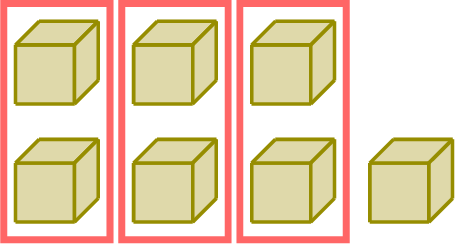
- The Check:$$\underbrace{\textcolor{olive}{7}}_{\textcolor{olive}{\text{Dividend}}}= \underbrace{\textcolor{colordef}{3}}_{\textcolor{colordef}{\text{Divisor}}} \times \underbrace{\textcolor{colorprop}{2}}_{\textcolor{colorprop}{\text{Quotient}}} +\underbrace{\textcolor{orange}{1}}_{\textcolor{orange}{\text{Remainder}}}$$
- Group Model:
- Long Division Algorithm:
Skills to practice
- Dividing Cubes with Remainders
- Dividing Numbers with Remainders
- Writing the Multiplication and the Remainder for Cubes
- Writing the Multiplication and the Remainder
III
Long Division
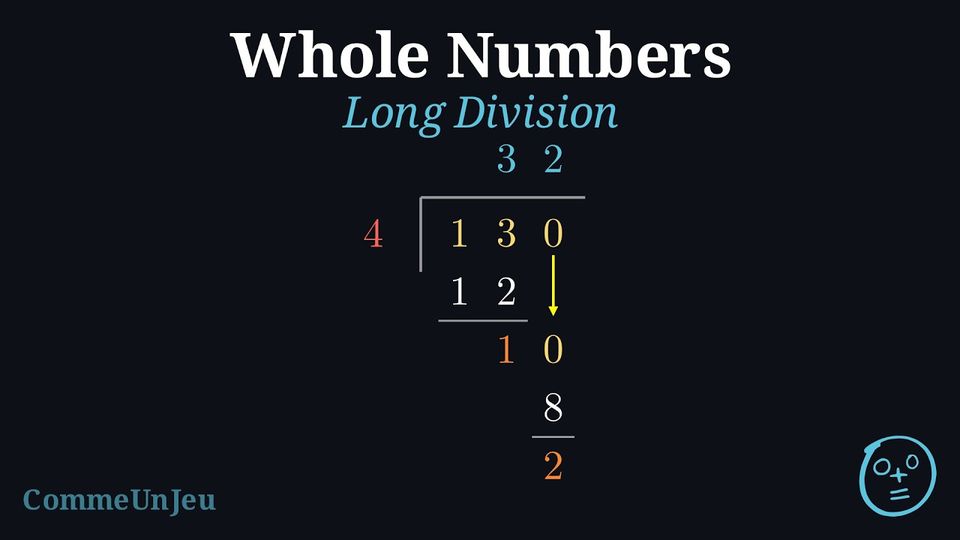
Long division is an organized method for solving division problems. The main idea is to find how many times one number fits into another.
- Case 1: An Exact Fit
To solve \(\textcolor{olive}{12} \div \textcolor{colordef}{4}\), we ask: “How many times does \(\textcolor{colordef}{4}\) fit into \(\textcolor{olive}{12}\)?”
By knowing our multiplication facts, we know that \(\textcolor{colordef}{4} \times \textcolor{colorprop}{3} = \textcolor{olive}{12}\). It fits exactly \(\textcolor{colorprop}{3}\) times.
The answer is \(\textcolor{colorprop}{3}\). - Case 2: A Fit with a Remainder
To solve \(\textcolor{olive}{13} \div \textcolor{colordef}{4}\), we ask: “How many times does \(\textcolor{colordef}{4}\) fit into 13 without going over?”- \(\textcolor{colordef}{4} \times \textcolor{colorprop}{3} = 12\) (This fits)
- \(\textcolor{colordef}{4} \times \textcolor{colorprop}{4} = 16\) (This is too large)
The answer is \(\textcolor{colorprop}{3}\) with a remainder of \(\textcolor{orange}{1}\).
Method — The Long Division Algorithm: Single-Step
To divide with a remainder, like \(\textcolor{olive}{13} \div \textcolor{colordef}{4}\), follow these steps: - Set up: Write the dividend (\(\textcolor{olive}{13}\)) inside the division bracket and the divisor (\(\textcolor{colordef}{4}\)) on the outside.

- Divide: Ask “How many times does 4 go into 13?”\(\begin{aligned}\textcolor{colordef}{4}\times \textcolor{colorprop}{3}&=\boxed{12}\ \ (\leq\,\textcolor{olive}{13}),\\\textcolor{colordef}{4}\times \textcolor{colorprop}{4}&=\cancel{16}\ \ (> \textcolor{olive}{13}).\end{aligned}\)
The answer is \(\textcolor{colorprop}{3}\). Write \(\textcolor{colorprop}{3}\) above the line and \(12\) under \(\textcolor{olive}{13}\).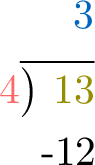
- Subtract: Subtract 12 from 13 to find the remainder. \(\textcolor{olive}{13} - 12 = \textcolor{orange}{1}\).
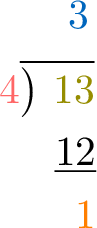
- Final answer: \(\textcolor{olive}{13} \div \textcolor{colordef}{4} = \divionRemainder{\textcolor{colorprop}{3}}{\textcolor{orange}{1}}\), and \(\textcolor{olive}{13} = \textcolor{colordef}{4}\times \textcolor{colorprop}{3}+\textcolor{orange}{1}\).
Method — The Long Division Algorithm: Multi-Steps
To divide with a remainder, like \(\textcolor{olive}{130} \div \textcolor{colordef}{4}\), follow these steps: - Set up: Write the dividend (\(\textcolor{olive}{130}\)) inside the bracket and the divisor (\(\textcolor{colordef}{4}\)) outside.
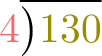
- Divide the first part (13): \(1\) is smaller than \(4\): we start with \(13\) tens. “How many times does \(4\) go into \(13\)?”$$\textcolor{colordef}{4}\times \textcolor{colorprop}{3}=\boxed{12}\ (\le \textcolor{olive}{13}),\qquad\textcolor{colordef}{4}\times \textcolor{colorprop}{4}=\cancel{16}\ (> \textcolor{olive}{13}).$$ Write \(\textcolor{colorprop}{3}\) above and \(12\) under \(13\); then subtract.
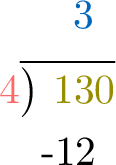
- Subtract and Bring down the next digit: \(\textcolor{olive}{13}-12=\textcolor{orange}{1}\); bring down \(0\) to make \(\textcolor{olive}{10}\).
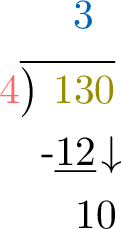
- Divide the new number (10): “How many times does \(4\) go into \(10\)?”$$\textcolor{colordef}{4}\times \textcolor{colorprop}{2}=\boxed{8}\ (\le \textcolor{olive}{10}),\qquad\textcolor{colordef}{4}\times \textcolor{colorprop}{3}=\cancel{12}\ (> \textcolor{olive}{10}).$$ Write \(\textcolor{colorprop}{2}\) above, put \(8\) under \(10\), and subtract to get the remainder.
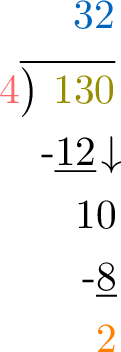
- Repeat: bring down, divide, subtract, until every digit of the dividend has been used. Here no digit is left after the \(0\): \(\textcolor{orange}{2}\) is the remainder.
- Final answer: \(\textcolor{olive}{130} \div \textcolor{colordef}{4}= \divionRemainder{\textcolor{colorprop}{32}}{\textcolor{orange}{2}}\), and \(\textcolor{olive}{130}=\textcolor{colordef}{4}\times\textcolor{colorprop}{32}+\textcolor{orange}{2}\).
Example
Compute \(823\div 4\) with a long division.
Before dividing: \(4\times 200=800\le 823\) and \(4\times 300=1\,200>823\), so the quotient lies between \(200\) and \(300\): it has three digits. 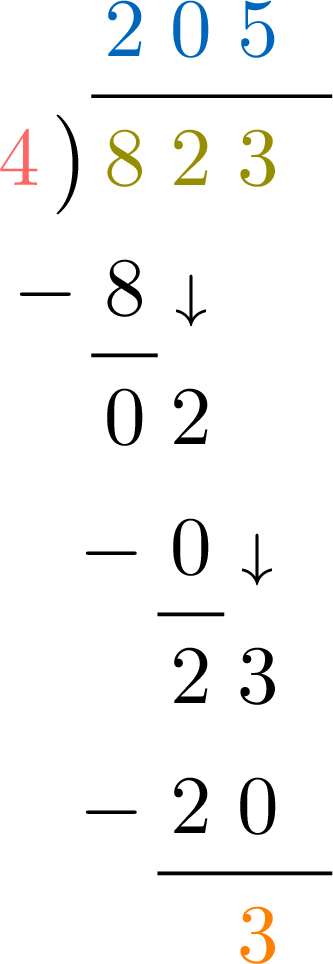
So \(823\div 4=\divionRemainder{205}{3}\), and \(823=4\times 205+3\). The \(0\) holds the tens place: without it, the quotient would read \(25\), and \(4\times 25+3=103\), not \(823\).
Each time the new number is smaller than the divisor, write \(0\) in the quotient, then bring down the next digit; if no digit is left, that number is the remainder (\(843\div 4=\divionRemainder{210}{3}\)).
- How many times does \(4\) go into \(8\)? \(4\times 2=8\): write \(2\) in the quotient, then \(8-8=0\).
- Bring down the \(2\): the new number is \(2\), smaller than the divisor \(4\), so \(4\) goes into \(2\) zero times: write \(0\) in the quotient, above the \(2\), then \(2-0=2\).
- Bring down the \(3\): the new number is \(23\). \(4\times 5=20\le 23\) and \(4\times 6=24>23\): write \(5\) in the quotient, then \(23-20=3\).
Each time the new number is smaller than the divisor, write \(0\) in the quotient, then bring down the next digit; if no digit is left, that number is the remainder (\(843\div 4=\divionRemainder{210}{3}\)).
Skills to practice
- Setting Out a Division and Typing the Quotient and the Remainder
- Calculating One-Step Long Division
- Calculating Two-Step Long Division
- Calculating Three-Step Long Division
- Calculating Long Division with a Zero in the Quotient
IV
Two Ways to Think About Division
Method — The Two Models of Division
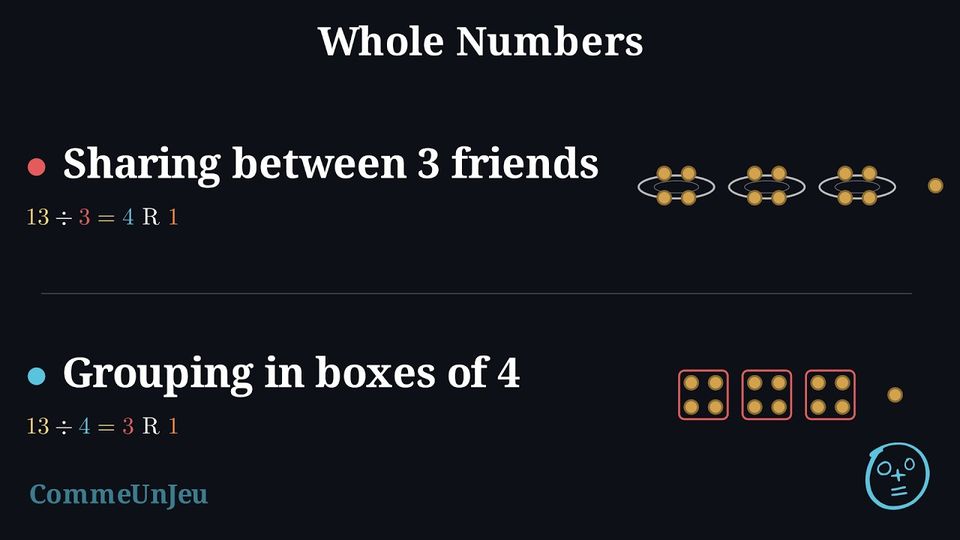
Division answers two kinds of questions. When the total does not split evenly, we record a remainder. - Sharing. The number of groups is known; find the size of each group (and any leftover).$$\textcolor{olive}{\text{total}} \div \textcolor{colordef}{\text{number of groups}}= \textcolor{colorprop}{\text{size of each group}} \text{ with } \textcolor{orange}{\text{a remainder}}.$$ Example: 13 biscuits are shared among 3 friends.$$\textcolor{olive}{\text{13 biscuits}} \div \textcolor{colordef}{\text{3 friends}}= \textcolor{colorprop}{\text{4 biscuits per friend}} \text{ with remainder } \textcolor{orange}{\text{1 biscuit}}.$$
- Grouping. The size of each group is known; find how many full groups can be made (and what remains).$$\textcolor{olive}{\text{total}} \div \textcolor{colorprop}{\text{size of each group}}= \textcolor{colordef}{\text{number of groups}} \text{ with } \textcolor{orange}{\text{a remainder}}.$$ Example: 13 biscuits are packed in bags of 4 biscuits each.$$\textcolor{olive}{\text{13 biscuits}} \div \textcolor{colorprop}{\text{4 biscuits per bag}}= \textcolor{colordef}{\text{3 bags}} \text{ with remainder } \textcolor{orange}{\text{1 biscuit}}.$$
Interpreting the Remainder
The question decides what the remainder means.
- Sometimes the remainder is left over: \(13\) biscuits are packed in bags of \(4\), and \(13=4\times 3+1\), so there are \(3\) full bags and \(1\) biscuit left.
- Sometimes the remainder needs one more group: \(45\) pupils travel by minibus, \(8\) per minibus, and \(45=8\times 5+5\). Five minibuses are full, and the \(5\) other pupils need one more minibus: \(6\) minibuses are needed.
Skills to practice
- Sharing and Grouping with a Remainder
V
Going further
Skills to practice
- Checking a Division
- Reasoning About Remainders
- Quiz
Jump to section