International Baccalaureate · PYP 4
Mass
I
The Milligram and Reference Masses
Definition — Milligram and Tonne
One more unit is used for very light things: the milligram. At the other end of the family, the tonne is used for very heavy things. - Milligram (\(\mathrm{mg}\)) — a very small unit: \(1\) g \(= 1\,000\) mg. We use milligrams for very light things, like a grain of sand.
- Tonne (\(\mathrm{t}\)) — a very big unit: \(1\) t \(= 1\,000\) kg. We use tonnes for very heavy things, like a car.
Proposition — Reference Masses
To estimate a mass without weighing, keep a few reference masses in mind (approximate values): | \(30\) mg | a grain of rice |
| \(1\) g | a paper clip |
| \(1\) kg | a full one-litre bottle of water |
| \(1\) t | a small car |
Method — Estimating with a Reference
To estimate a mass: - Choose the reference suited to the object.
- Estimate how many reference objects together would have the same mass.
- Give the estimate with a suitable unit.
Example
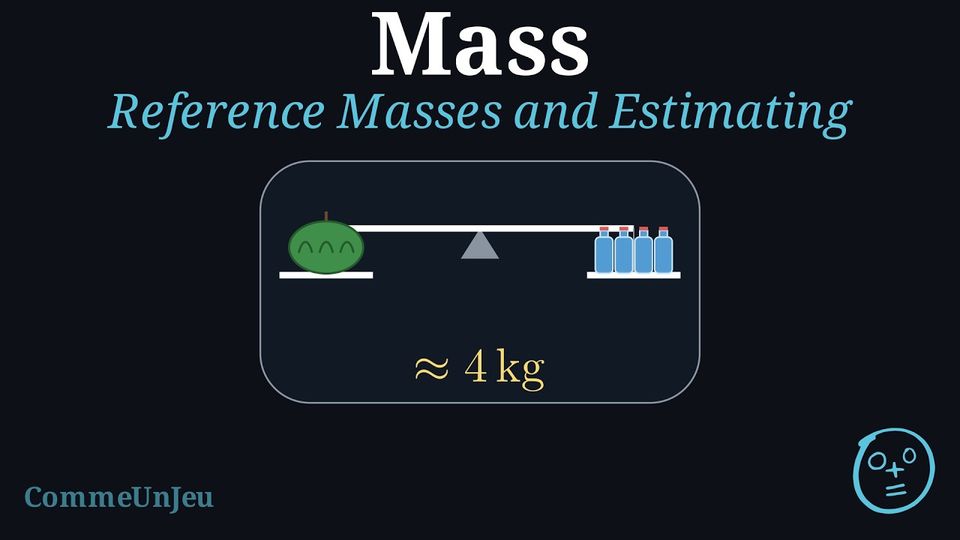
A watermelon feels as heavy as \(4\) one-litre bottles of water. Estimate its mass.
One bottle is about \(1\) kg, and the watermelon is as heavy as \(4\) bottles: the watermelon has a mass of about \(\textbf{4}\) kg.
Example
Estimate the mass of \(20\) paper clips.
One paper clip is about \(1\) g, so \(20\) paper clips have a mass of about \(20 \times 1 = \textbf{20}\) g.
Skills to practice
- Choosing a Reasonable Estimate
II
Masses Written with a Decimal
Method — Converting a Decimal Mass with Tenths and Hundredths
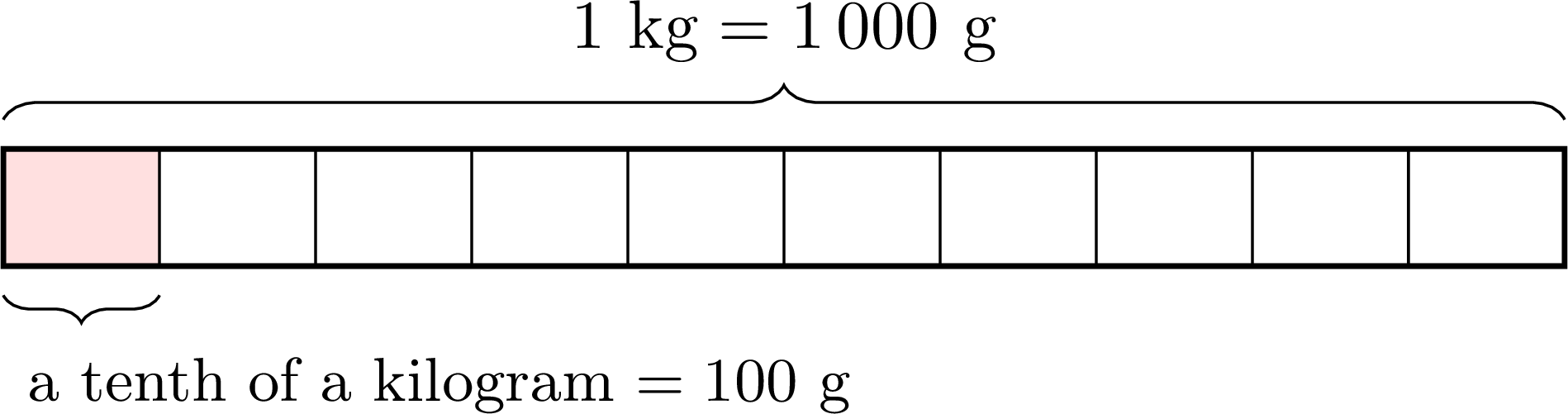
A mass such as \(3.4~\mathrm{kg}\) is a whole number of kilograms and a part of a kilogram: \(3\) kilograms and \(4\) tenths of a kilogram. Since \(1~\mathrm{kg}=1\,000~\mathrm{g}\): - a tenth of a kilogram is \(100~\mathrm{g}\): the \(1\,000~\mathrm{g}\) of one kilogram are cut into \(10\) equal parts;
- a hundredth of a kilogram is \(10~\mathrm{g}\): the \(1\,000~\mathrm{g}\) are cut into \(100\) equal parts.
- Towards the smaller unit: split the mass into its whole units and its tenths (or hundredths), then change each part. $$\begin{aligned}[t] 3.4~\mathrm{kg} &= 3~\mathrm{kg} + 4 \text{ tenths of a kilogram} &&\text{(3 units and 4 tenths)}\\ &= 3\,000~\mathrm{g} + 4 \times 100~\mathrm{g} &&\text{(1 kg = 1 000 g; a tenth = 100 g)}\\ &= 3\,000~\mathrm{g} + 400~\mathrm{g} &&\text{(multiplication)}\\ &= 3\,400~\mathrm{g} \end{aligned}$$ $$\begin{aligned}[t] 1.25~\mathrm{kg} &= 1~\mathrm{kg} + 2 \text{ tenths} + 5 \text{ hundredths of a kilogram} &&\text{(the digits after the point)}\\ &= 1\,000~\mathrm{g} + 200~\mathrm{g} + 50~\mathrm{g} &&\text{(a tenth = 100 g; a hundredth = 10 g)}\\ &= 1\,250~\mathrm{g} \end{aligned}$$
- Towards the bigger unit: group the whole units first, then write what is left as tenths (or hundredths). $$\begin{aligned}[t] 2\,700~\mathrm{g} &= 2\,000~\mathrm{g} + 700~\mathrm{g} &&\text{(the thousands first)}\\ &= 2~\mathrm{kg} + 7 \text{ tenths of a kilogram} &&\text{(1 000 g = 1 kg; 700 g is 7 tenths)}\\ &= 2.7~\mathrm{kg} \end{aligned}$$ $$\begin{aligned}[t] 2\,750~\mathrm{g} &= 2\,000~\mathrm{g} + 700~\mathrm{g} + 50~\mathrm{g} &&\text{(thousands, hundreds, tens)}\\ &= 2~\mathrm{kg} + 7 \text{ tenths} + 5 \text{ hundredths of a kilogram} &&\text{(100 g is a tenth; 10 g is a hundredth)}\\ &= 2.75~\mathrm{kg} \end{aligned}$$ Here the part left is always a whole number of tenths or hundredths of the bigger unit.
- The same with the other units: \(1~\mathrm{t}=1\,000~\mathrm{kg}\), so a tenth of a tonne is \(100~\mathrm{kg}\): \(2.3~\mathrm{t} = 2\,000~\mathrm{kg} + 300~\mathrm{kg} = 2\,300~\mathrm{kg}\). And \(1~\mathrm{g}=1\,000~\mathrm{mg}\), so a tenth of a gram is \(100~\mathrm{mg}\): \(0.4~\mathrm{g} = 4 \times 100~\mathrm{mg} = 400~\mathrm{mg}\).
- Check: \(3.4~\mathrm{kg}\) lies between \(3~\mathrm{kg}\) and \(4~\mathrm{kg}\), so the answer lies between \(3\,000~\mathrm{g}\) and \(4\,000~\mathrm{g}\).
Method — Converting with Multiplication or Division
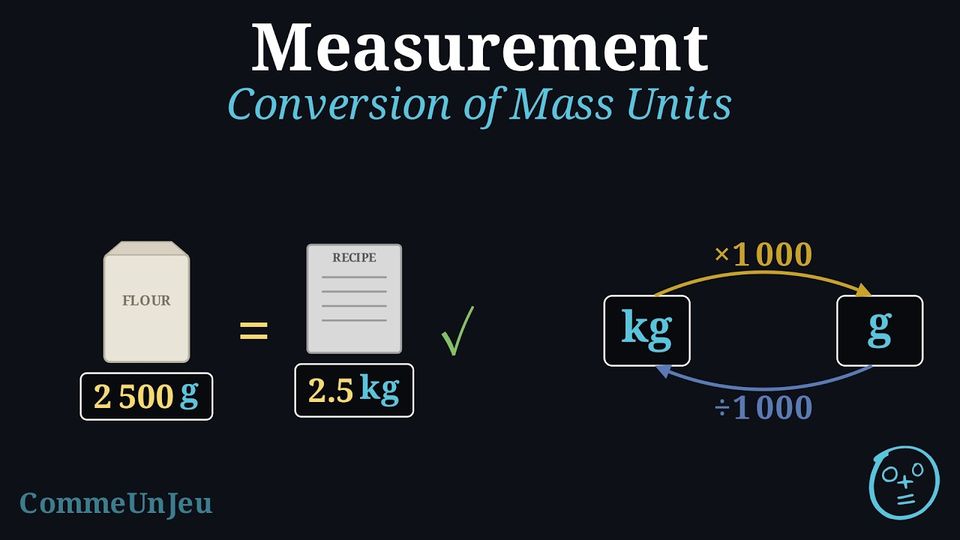
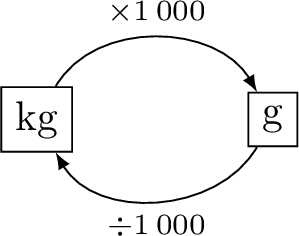
- To convert from a bigger unit to a smaller one (kg \(\to\) g), you multiply by \(1\,000\).
Example: \(3 \,\text{kg} = 3 \times 1\,000 \,\text{g} = 3\,000 \,\text{g}\). - To convert from a smaller unit to a bigger one (g \(\to\) kg), you divide by \(1\,000\).
Example: \(2\,500 \div 1\,000 = 2.5\), so \(2\,500 \,\text{g} = 2.5 \,\text{kg}\).
Method — Converting Using a Place Value Table
Convert 2 kilograms to grams. - Draw the metric place value table. Each unit has its own column; the two empty columns are for other units.
\(\mathrm{kg}\) \(\quad\;\) \(\quad\;\) \(\;\mathrm{g}\;\) - Place the ones digit of your number in the starting unit's column. Here, place the 2 in the kg column.
\(\mathrm{kg}\) \(\quad\;\) \(\quad\;\) \(\;\mathrm{g}\;\) 2 - Fill with zeros in each column until you reach the column of the target unit. We want to convert to grams (g).
\(\mathrm{kg}\) \(\quad\;\) \(\quad\;\) \(\;\mathrm{g}\;\) 2 0 0 0 - Read the number to find the converted value.
\(2 \,\text{kg} = 2\,000 \,\text{g}\).
Skills to practice
- Converting Mixed Mass Units
- Converting Masses Using Decimals
III
Going further
Skills to practice
- Calculating Prices of Fruits with Unit Conversion
- Solving Mass Problems
- Estimating and Explaining
- Quiz
Jump to section