International Baccalaureate · PYP 4
Subtraction
I
Subtracting Large Numbers
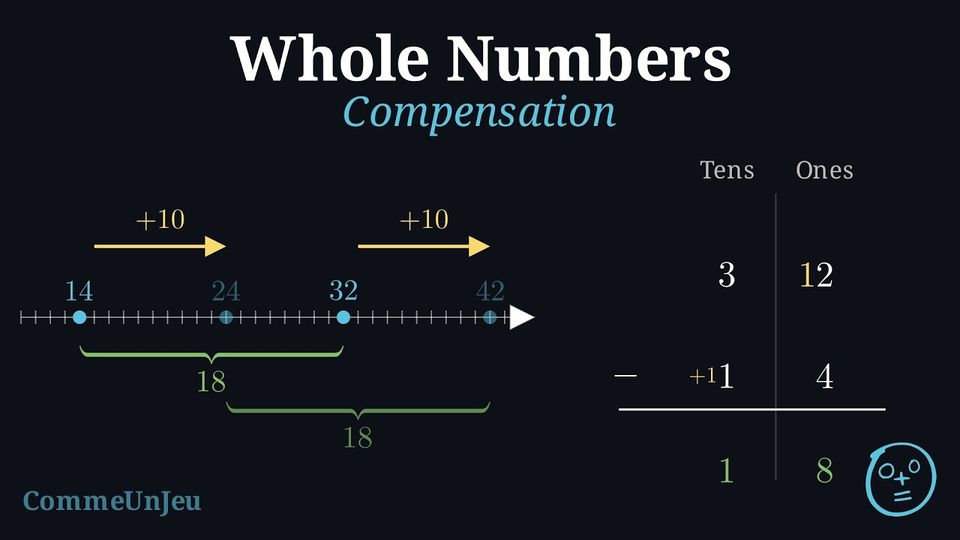
Example
Compute \(7\,012 - 4\,875\) in columns.
Compensation works with thousands too. Ones: \(2 - 5\) is not possible, add \(10\) ones on top and compensate with \(1\) ten below: \(12 - 5 = 7\). Tens: \(1 - 7 - 1\) is not possible, add \(10\) tens on top, compensate with \(1\) hundred below: \(11 - 7 - 1 = 3\). Hundreds: \(0 - 8 - 1\) is not possible, add \(10\) hundreds on top, compensate with \(1\) thousand below: \(10 - 8 - 1 = 1\). Thousands: \(7 - 4 - 1 = 2\). 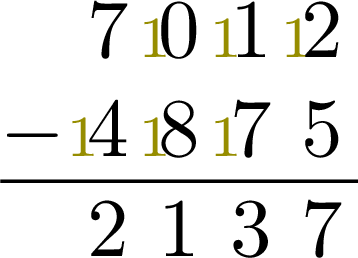
\(7\,012 - 4\,875 = 2\,137\). Check: \(2\,137 + 4\,875 = 7\,012\).
Example
Compute \(60\,403 - 27\,568\) in columns, then check the result with an addition.
A zero in the top number is treated like any digit that is too small: \(10\) is added to it, and \(1\) is added to the next digit of the bottom number. 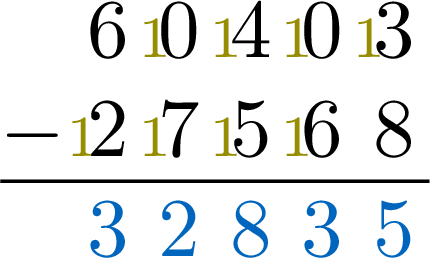
So \(60\,403 - 27\,568 = 32\,835\).
Check with an addition, the result plus the number taken away: 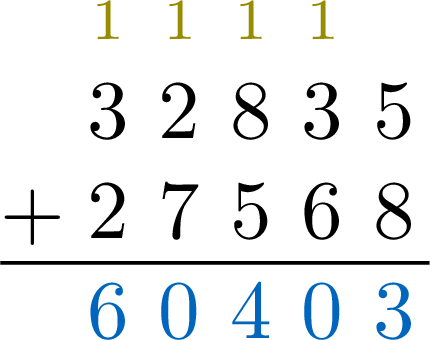
\(32\,835 + 27\,568 = 60\,403\), the starting number.
- Ones: \(3 - 8\) is not possible. Add \(10\) ones to the top number, making \(13\) ones, and \(1\) ten to the bottom number: \(13 - 8 = 5\).
- Tens: \(0 - 6 - 1\) is not possible. Add \(10\) tens to the top number, making \(10\) tens, and \(1\) hundred to the bottom number: \(10 - 6 - 1 = 3\).
- Hundreds: \(4 - 5 - 1\) is not possible. Add \(10\) hundreds to the top number, making \(14\) hundreds, and \(1\) thousand to the bottom number: \(14 - 5 - 1 = 8\).
- Thousands: \(0 - 7 - 1\) is not possible. Add \(10\) thousands to the top number, making \(10\) thousands, and \(1\) ten thousand to the bottom number: \(10 - 7 - 1 = 2\).
- Ten thousands: \(6 - 2 - 1 = 3\).
Check with an addition, the result plus the number taken away:
Checking a Subtraction with an Addition
Addition and subtraction undo each other. So a subtraction is checked with an addition: the result plus the number taken away must give the starting number. 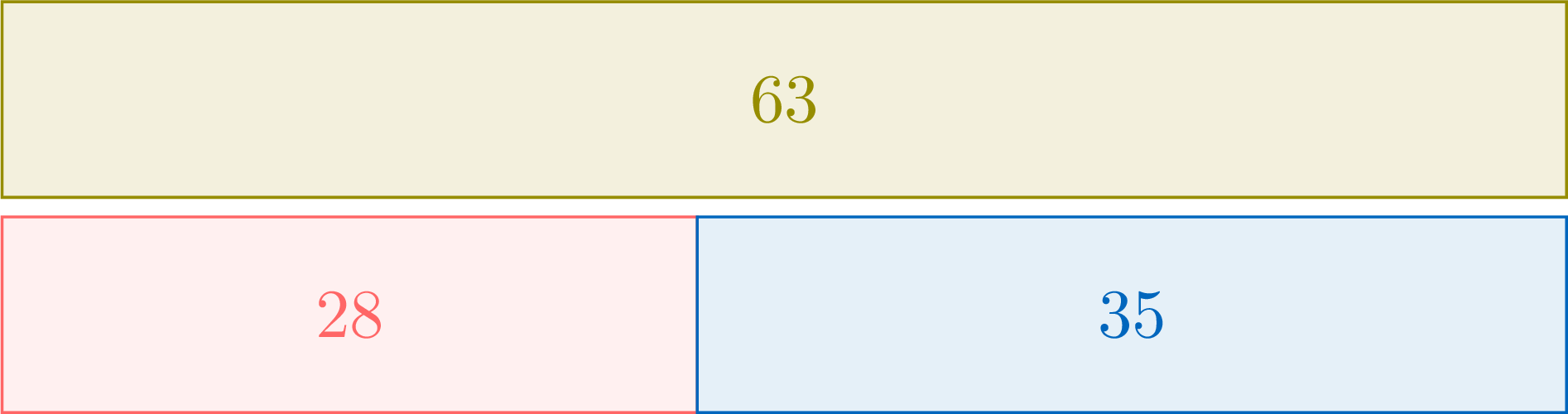
- \(63 - 28 = 35\)? Check: \(35 + 28 = 63\). We find the starting number \(63\): the subtraction is correct.
- \(72 - 38 = 44\)? Check: \(44 + 38 = 82\), not \(72\): the subtraction is wrong. Computed again: \(72 - 38 = 34\), and \(34 + 38 = 72\).
Skills to practice
- Subtracting in Columns beyond 10 000
- Comparing with More or Fewer
- Solving Problems with Several Questions
II
Going further
Skills to practice
- Choosing and Explaining a Subtraction Strategy
- Finding Missing Digits and Checking with an Addition
- Solving Multi-Step Problems
Jump to section