International Baccalaureate · PYP 4
Patterns and functions
I
Terms and Their Positions
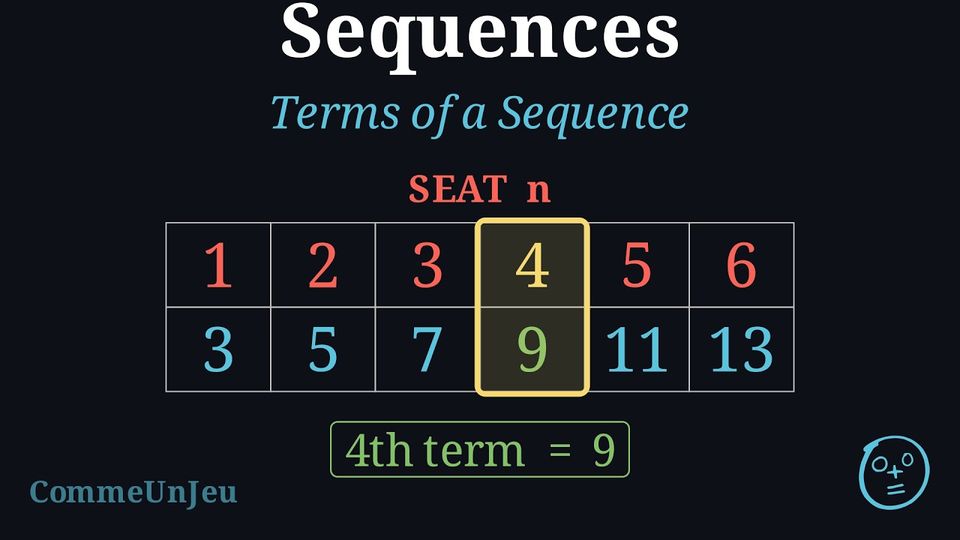
Definition — Numerical Sequence
A numerical sequence is a list of numbers that follows a specific rule. - The first number is called the 1\(^{\text{st}}\) term.
- The second number is called the 2\(^{\text{nd}}\) term.
- The third number is called the 3\(^{\text{rd}}\) term.
- And so on.
Example
What is the 6\(^{\text{th}}\) term of this sequence? | position | 1 | 2 | 3 | 4 | 5 | 6 |
| term | 3 | 5 | 7 | 9 | 11 | 13 |
The 6\(^{\text{th}}\) term is \(13\).
Skills to practice
- Finding Terms from a Table
- Finding Missing Terms
II
Finding a Term by the Rule
Method — Formulating the Rule of a Sequence
To formulate the rule of a number sequence: - compute the jumps (the steps) from each term to the next, and write them on arrows;
- if all the jumps are equal, the rule is “add (or subtract) that number”;
- if the jumps come back in the same order (\(+5\), \(-2\), \(+5\), \(-2\), …), the rule chains them: “add \(5\), then subtract \(2\), and start again”;
- if the jumps keep growing, look for one same multiplier: “multiply by …”; if there is none, look for the rule of the jumps themselves, as in a sequence whose step changes.
Example
Find the rule of the sequence \(80\), \(85\), \(83\), \(88\), \(86\), … then write the next two terms.
The jumps from each term to the next: \(80 \xrightarrow{\;+5\;} 85 \xrightarrow{\;-2\;} 83 \xrightarrow{\;+5\;} 88 \xrightarrow{\;-2\;} 86\) The jumps are not all equal, and they do not keep growing: they come back in the same order, \(+5\), \(-2\), \(+5\), \(-2\). The rule is: add \(5\), then subtract \(2\), and start again. It gives every term given: \(80 + 5 = 85\), \(85 - 2 = 83\), \(83 + 5 = 88\), \(88 - 2 = 86\). $$\begin{aligned}[t] 86 + 5 &= 91 && \text{(add \(5\))} \\
91 - 2 &= 89 && \text{(subtract \(2\))} \end{aligned}$$ The next two terms are \(91\) and \(89\).
Example
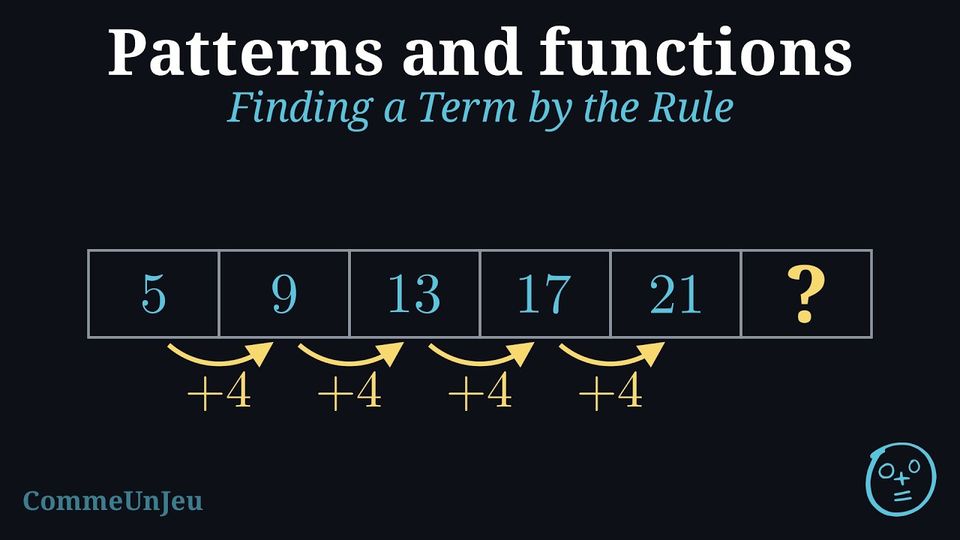
What is the 6\(^{\text{th}}\) term of this sequence? | position | 1 | 2 | 3 | 4 | 5 | 6 |
| term | 5 | 9 | 13 | 17 | 21 | ? |
The 6\(^{\text{th}}\) term is \(25\), because each term increases by \(4\): \(21 + 4 = 25\). 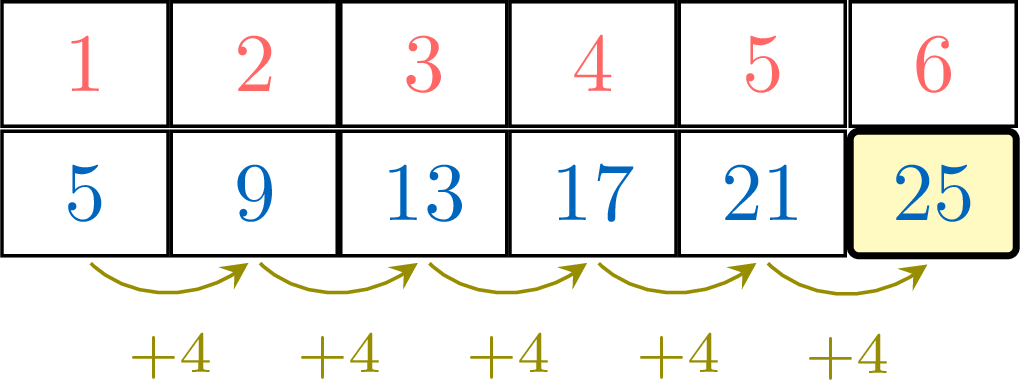
Skills to practice
- Formulating the Rule
- Finding the Next Term by Adding or Subtracting
- Finding a Term Further On
- Finding the Next Term by Multiplying or Dividing
III
Growing Patterns
Method — Continuing a Growing Pattern
To continue a growing pattern: - count the elements of the first diagrams and write them in a table (diagram \(1\), diagram \(2\), diagram \(3\), …);
- look at what each new diagram brings: where the new elements land, and how many there are;
- say the rule in words: “start with …, then add … at each diagram”;
- continue: draw the next diagram, or add step by step up to the diagram asked, and check on the drawing.
Example
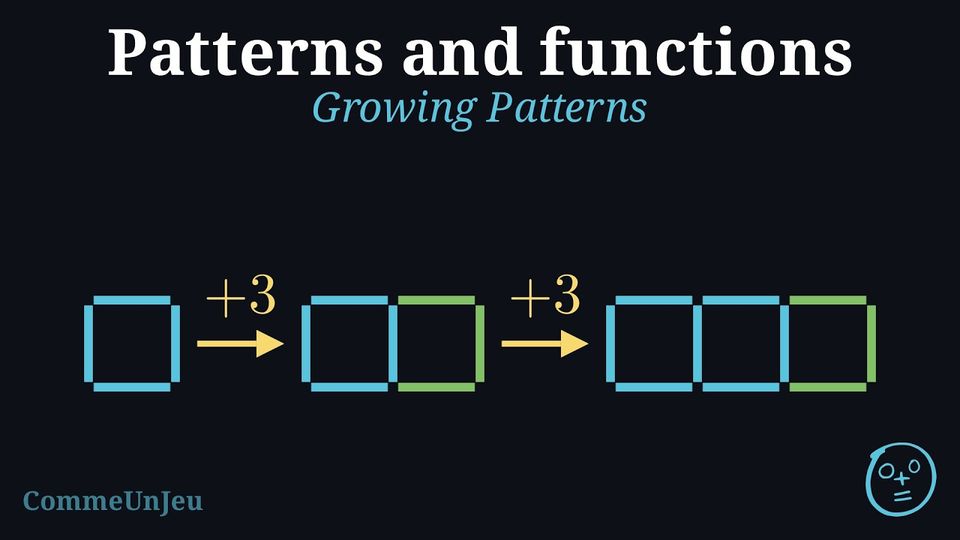
Here is a growing pattern of squares made with sticks.  \(\;,\quad\)
 \(\;,\quad\)
 \(\;,\;\dots\)
| Diagram | \(1\) | \(2\) | \(3\) |
| Sticks | \(4\) | \(7\) | \(10\) |

Skills to practice
- Continuing a Growing Pattern
IV
Function Machines
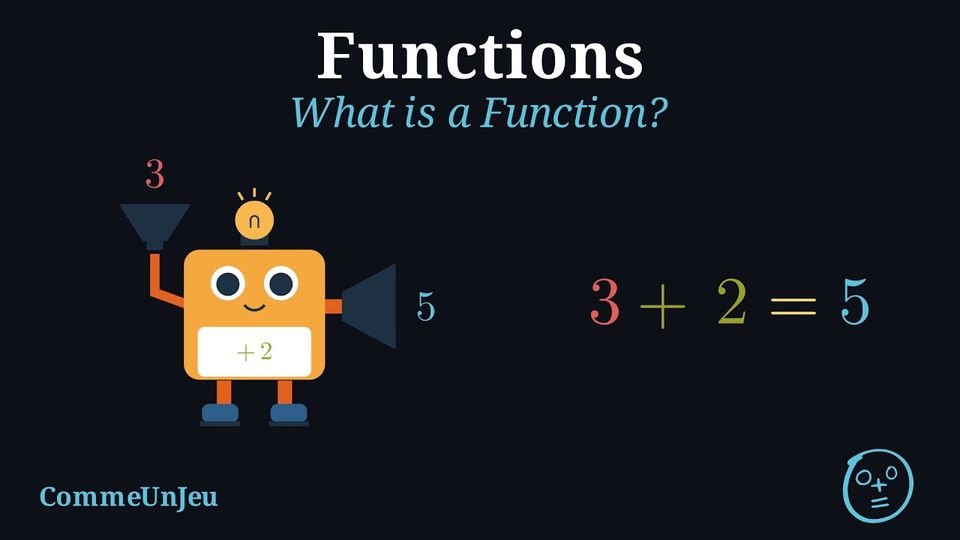
Some quantities depend on others in a regular way. For example, the number of wheels is always the number of bicycles multiplied by 2. In mathematics, a rule that gives one number from another has a special name: a function.
A function works like a machine: a number goes in (the input), the machine applies its rule, and one number comes out (the output). The same input always gives the same output.
The In/Out tables of number patterns work in the same way, and so does a table of positions and terms: a position table is an In/Out table, where the position goes in and the term comes out.
Definition — Function
A function is a rule that takes an input number and gives back exactly one output number. For each input, the function machine always gives the same output and follows the same rule every time. Example
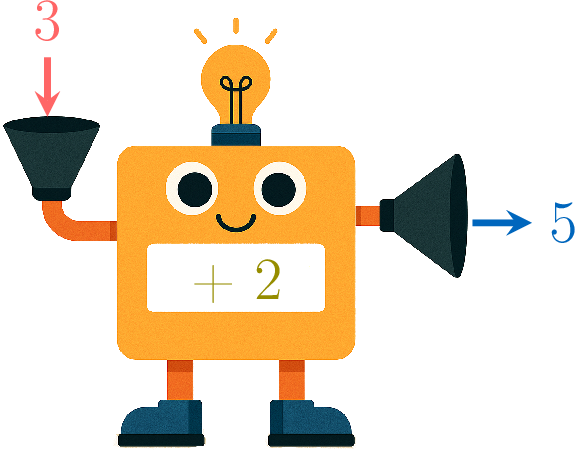
A function machine works as follows. - The rule of the function is: \(\textcolor{olive}{\text{add 2}}\).
- The input is: \(\textcolor{colordef}{3}\).
- The output is: \(\textcolor{colordef}{3}\textcolor{olive}{+2} = \textcolor{colorprop}{5}\).
Skills to practice
- Calculating the Output of a Function
- Finding the Rule of a Function
V
Going further
Skills to practice
- Reasoning and Problem-Solving
- Problems
- Quiz
Jump to section