International Baccalaureate · PYP 4
Length and Perimeter
I
Reference Lengths and Estimating
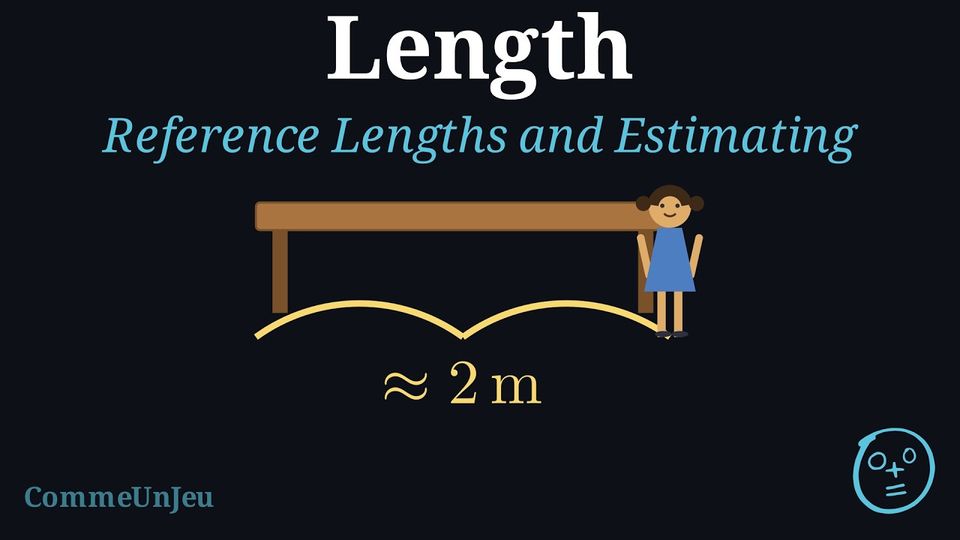
Proposition — Reference Lengths
To estimate a length without measuring, keep a few reference lengths in mind: | \(1\) to \(2\) mm | the thickness of a coin |
| \(1\) cm | the width of a finger |
| \(1\) m | one big step |
| \(1\) km | a \(15\)-minute walk |
Method — Estimating with a Reference
To estimate a length: - Choose the reference suited to the size of the object.
- Count how many times the reference fits.
- Give the estimate with a suitable unit.
Example
Estimate the length of the walk from home to school, if it takes half an hour.
The reference is the \(15\)-minute walk (\(1\) km): half an hour is \(2\) times \(15\) minutes. The walk is about \(\textbf{2}\) km long.
Skills to practice
- Choosing a Reasonable Estimate
- Estimating and Explaining
II
Lengths Written with a Decimal
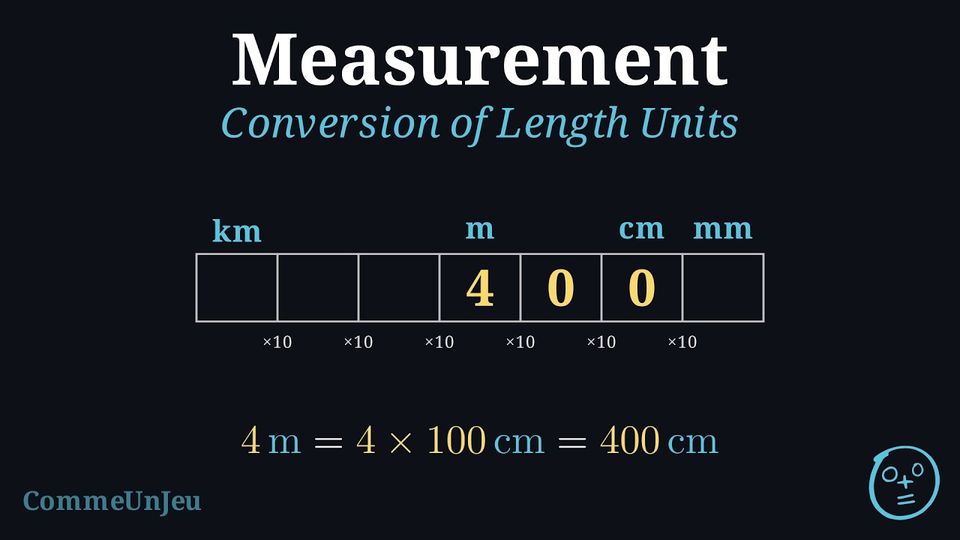
Method — Converting a Decimal Length with Tenths and Hundredths
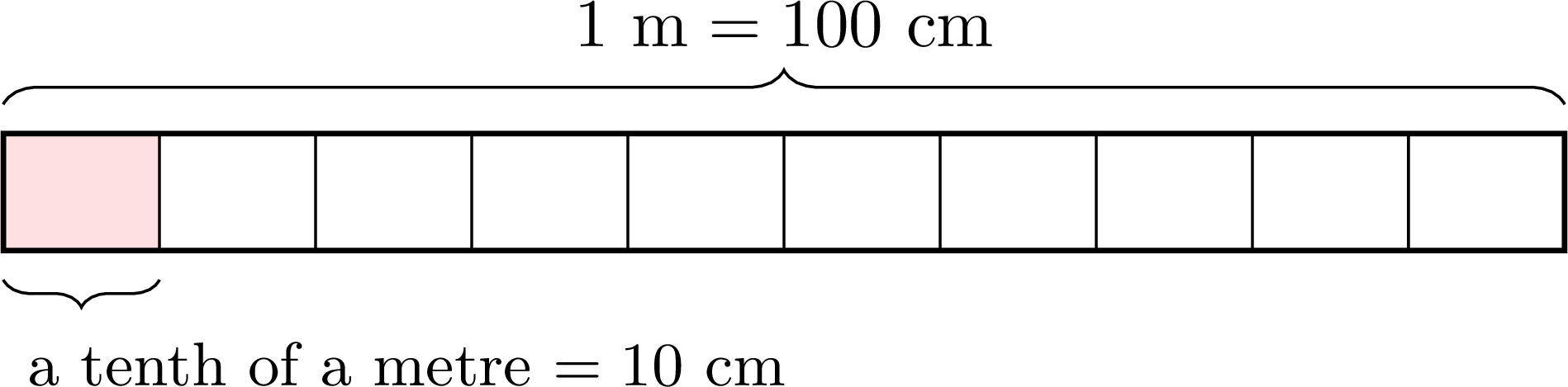
A length such as \(4.6~\mathrm{m}\) is a whole number of metres and a part of a metre: \(4\) metres and \(6\) tenths of a metre. Since \(1~\mathrm{m}=100~\mathrm{cm}\): - a tenth of a metre is \(10~\mathrm{cm}\): the \(100~\mathrm{cm}\) of one metre are cut into \(10\) equal parts;
- a hundredth of a metre is \(1~\mathrm{cm}\): the \(100~\mathrm{cm}\) are cut into \(100\) equal parts.
- Towards the smaller unit: split the length into its whole units and its tenths (or hundredths), then change each part. $$\begin{aligned}[t] 4.6~\mathrm{m} &= 4~\mathrm{m} + 6 \text{ tenths of a metre} &&\text{(4 units and 6 tenths)}\\ &= 400~\mathrm{cm} + 6 \times 10~\mathrm{cm} &&\text{(1 m = 100 cm; a tenth = 10 cm)}\\ &= 400~\mathrm{cm} + 60~\mathrm{cm} &&\text{(multiplication)}\\ &= 460~\mathrm{cm} \end{aligned}$$ $$\begin{aligned}[t] 3.75~\mathrm{m} &= 3~\mathrm{m} + 75 \text{ hundredths of a metre} &&\text{(3 units and 75 hundredths)}\\ &= 300~\mathrm{cm} + 75 \times 1~\mathrm{cm} &&\text{(a hundredth = 1 cm)}\\ &= 375~\mathrm{cm} \end{aligned}$$
- Towards the bigger unit: group the whole units first, then write what is left as tenths (or hundredths). $$\begin{aligned}[t] 280~\mathrm{cm} &= 200~\mathrm{cm} + 80~\mathrm{cm} &&\text{(the hundreds first)}\\ &= 2~\mathrm{m} + 8 \text{ tenths of a metre} &&\text{(100 cm = 1 m; 80 cm is 8 tenths)}\\ &= 2.8~\mathrm{m} \end{aligned}$$ $$\begin{aligned}[t] 275~\mathrm{cm} &= 200~\mathrm{cm} + 75~\mathrm{cm} &&\text{(the hundreds first)}\\ &= 2~\mathrm{m} + 75 \text{ hundredths of a metre} &&\text{(100 cm = 1 m; 75 cm is 75 hundredths)}\\ &= 2.75~\mathrm{m} \end{aligned}$$ Here the part left is always a whole number of tenths or hundredths of the bigger unit.
- The same with the other units: \(1~\mathrm{km}=1\,000~\mathrm{m}\), so a tenth of a kilometre is \(100~\mathrm{m}\) and a hundredth is \(10~\mathrm{m}\): \(3.4~\mathrm{km} = 3\,000~\mathrm{m} + 400~\mathrm{m} = 3\,400~\mathrm{m}\). And \(1~\mathrm{cm}=10~\mathrm{mm}\), so a tenth of a centimetre is \(1~\mathrm{mm}\): \(6.8~\mathrm{cm} = 60~\mathrm{mm} + 8~\mathrm{mm} = 68~\mathrm{mm}\).
- Check: \(4.6~\mathrm{m}\) lies between \(4~\mathrm{m}\) and \(5~\mathrm{m}\), so the answer lies between \(400~\mathrm{cm}\) and \(500~\mathrm{cm}\).
Example
Convert \(3.5\) m to centimetres.
\(1~\mathrm{m}=100~\mathrm{cm}\), so a tenth of a metre is \(10~\mathrm{cm}\): $$\begin{aligned}[t] 3.5~\mathrm{m} &= 3~\mathrm{m} + 5 \text{ tenths of a metre} &&\text{(3 units and 5 tenths)}\\
&= 300~\mathrm{cm} + 5 \times 10~\mathrm{cm} &&\text{(1 m = 100 cm; a tenth = 10 cm)}\\
&= 300~\mathrm{cm} + 50~\mathrm{cm} &&\text{(multiplication)}\\
&= 350~\mathrm{cm} \end{aligned}$$ So \(3.5\) m \(= \textbf{350}\) cm. Check with the shortcut: from a bigger unit to a smaller one, we multiply by \(100\), and \(3.5 \times 100 = 350\).
Skills to practice
- Converting with Decimals
III
Perimeter Formulas
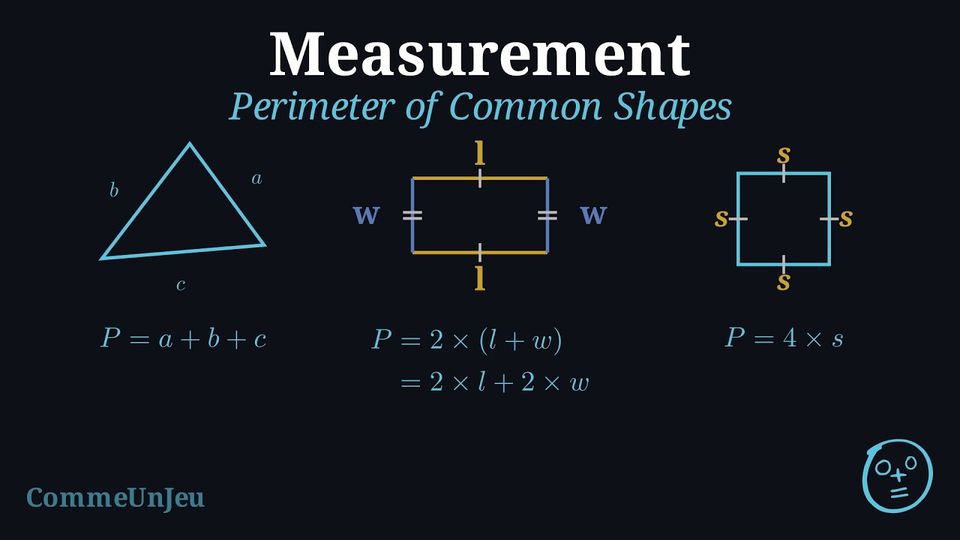
Method — Fewer Measurements for the Square and the Rectangle
The perimeter of a polygon is always the sum of the lengths of its sides. For two shapes, not every side has to be measured. - The square: its four sides have the same length. One measurement is enough, and the length is added four times. A square of side \(9~\mathrm{cm}\): \(9+9+9+9=36~\mathrm{cm}\).
- The rectangle: the opposite sides have the same length. Two measurements are enough, a long side and a short one, each added twice. A rectangle of \(12~\mathrm{m}\) and \(7~\mathrm{m}\): \(12+7+12+7=38~\mathrm{m}\).
- Careful with the units: if the sides are not written in the same unit, convert before adding.
- For any other polygon, the length of every side has to be known, and all of them are added.
Example
Find the perimeter of a square with sides of \(3\) cm. What do you notice?
Add the four sides: \(P = 3 + 3 + 3 + 3 = \textbf{12} \text{ \textbf{cm}}\).
The four sides are equal, so adding them is the same as computing \(4 \times 3\): the perimeter of a square is four times its side.
The four sides are equal, so adding them is the same as computing \(4 \times 3\): the perimeter of a square is four times its side.
Proposition — Perimeter Formulas
| Shape | Diagram | Perimeter formula |
| Triangle |  | \(P = a + b + c\) |
| Rectangle |  | \(\begin{aligned}[t] P &= l + w + l + w\\ &= 2 \times l + 2 \times w \\ &= 2 \times (l + w) \end{aligned}\) |
| Square |  | \(P = s + s + s + s = 4 \times s\) |
Example
Find the perimeter of the rectangle: 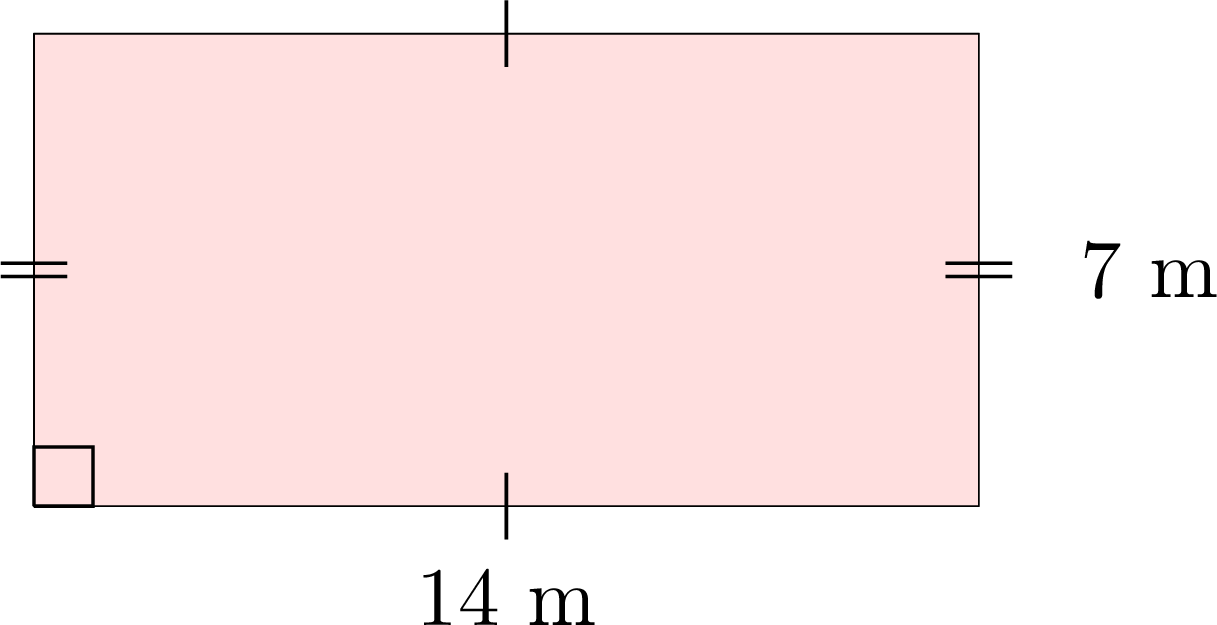
The rectangle has a length \(l = 14\) m and a width \(w = 7\) m. We can use either perimeter formula.
- Method 1 (add both pairs of equal sides): $$\begin{aligned}[t] P &= 2 \times l + 2 \times w \\ &= 2 \times 14 + 2 \times 7 \\ &= 28 + 14 \\ &= 42 \,\mathrm{m} \end{aligned}$$
- Method 2 (multiply the sum of the two sides by 2): $$\begin{aligned}[t] P &= 2 \times (l + w) \\ &= 2 \times (14 + 7) \\ &= 2 \times 21 \\ &= 42 \,\mathrm{m} \end{aligned}$$
Skills to practice
- Finding Perimeters of Squares and Rectangles
- Finding a Perimeter with Sides in Different Units
- Solving Problems
IV
Going further
Skills to practice
- Solving Problems with Several Questions
- Quiz
Jump to section