International Baccalaureate · PYP 4
Addition
I
Calculating in Your Head with Large Numbers
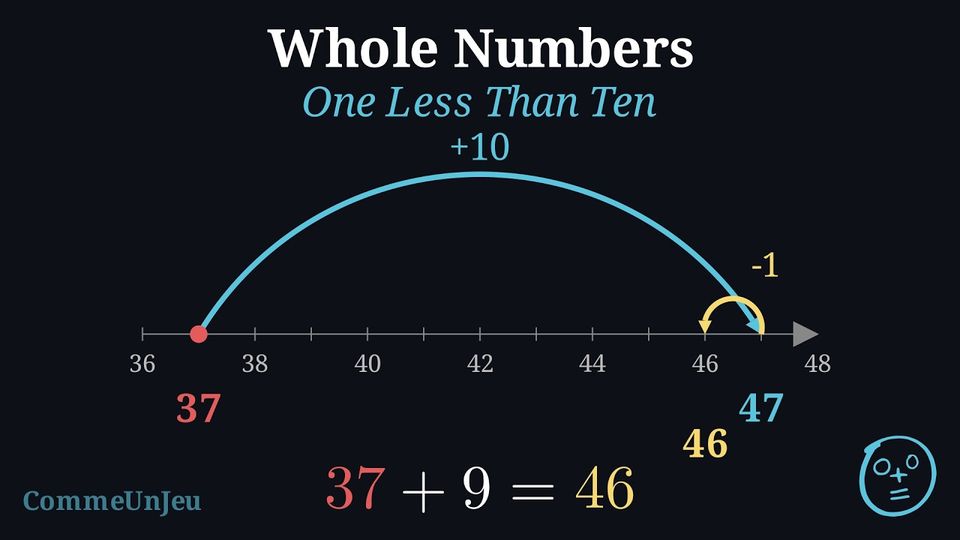
At the market, Hugo must pay \(47 + 9\) dollars. No paper, no column addition: it would be too slow. He thinks: \(47 + 10 = 57\), and \(9\) is one less than \(10\), so \(57 - 1 = 56\).
Mental calculation is the art of finding the clever path: using whole tens, doubles and simple decompositions instead of writing the calculation down. The gestures learned before now work on big numbers.
Mental calculation is the art of finding the clever path: using whole tens, doubles and simple decompositions instead of writing the calculation down. The gestures learned before now work on big numbers.
Method — Adding or Subtracting a Near-Ten
A near-ten is a number close to a whole ten: \(8\), \(9\), \(18\), \(19\), \(28\), \(29\), \(38\), \(39\). We go through the whole ten, then we correct. - Adding 9, 19, 29, 39: add \(10\), \(20\), \(30\), \(40\), then take \(1\) away. \(456 + 29 = 486 - 1 = 485\).
- Adding 8, 18, 28, 38: add \(10\), \(20\), \(30\), \(40\), then take \(2\) away. \(456 + 38 = 496 - 2 = 494\).
- Subtracting 9, 19, 29, 39: take \(10\), \(20\), \(30\), \(40\) away, then add \(1\) back. \(456 - 29 = 426 + 1 = 427\).
- Subtracting 8, 18, 28, 38: take \(10\), \(20\), \(30\), \(40\) away, then add \(2\) back. \(456 - 38 = 416 + 2 = 418\).
Example
Compute mentally: (a) \(24\,536 + 29\), (b) \(18\,342 - 19\), (c) \(39\,985 + 28\), (d) \(70\,312 - 39\).
Only the near-ten is replaced by its whole ten; the large number is not changed. The gesture is the same as with small numbers.
- (a) \(29\) is \(30\) minus \(1\): \(24\,536 + 30 = 24\,566\), then \(24\,566 - 1 = \mathbf{24\,565}\).
- (b) \(19\) is \(20\) minus \(1\): \(18\,342 - 20 = 18\,322\), then \(18\,322 + 1 = \mathbf{18\,323}\) (one too many was taken away, it is given back).
- (c) \(28\) is \(30\) minus \(2\): \(39\,985 + 30 = 40\,015\), then \(40\,015 - 2 = \mathbf{40\,013}\). Adding \(30\) goes past \(40\,000\): every digit changes, except the ones digit.
- (d) \(39\) is \(40\) minus \(1\): \(70\,312 - 40 = 70\,272\), then \(70\,272 + 1 = \mathbf{70\,273}\).
Skills to practice
- Adding and Subtracting Near-Tens
II
Adding in Columns up to 100 000
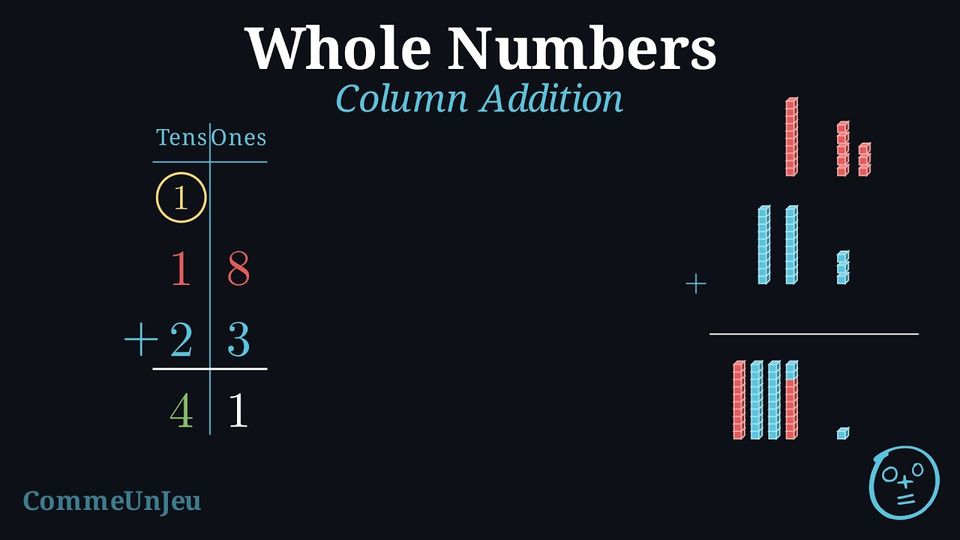
On Saturday the stadium welcomed \(4\,738\) spectators, on Sunday \(2\,589\). The manager wants the total for the weekend. There are far too many people to count with cubes, and the numbers are bigger than \(1\,000\). Say how to find the total.
The column addition works exactly as with three digits: one more column on the left, the thousands. Ones: \(8 + 9 = 17\), write \(7\), carry \(1\) ten. Tens: \(1 + 3 + 8 = 12\), write \(2\), carry \(1\) hundred. Hundreds: \(1 + 7 + 5 = 13\), write \(3\), carry \(1\) thousand. Thousands: \(1 + 4 + 2 = 7\). 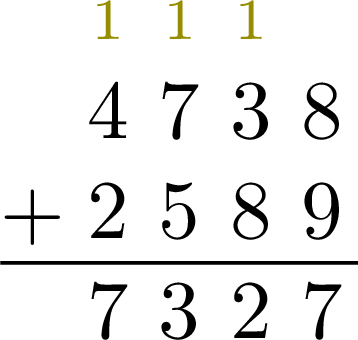
\(4\,738 + 2\,589 = 7\,327\): the stadium welcomed \(7\,327\) spectators.
Example
Compute \(68\,457 + 47\,896\) in columns.
Five-digit numbers are added like smaller ones: ones under ones, from right to left, with a carry to the next column whenever a column makes \(10\) or more. 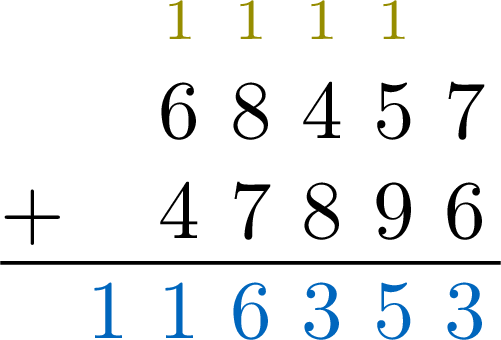
So \(68\,457 + 47\,896 = 116\,353\). The result has six digits: two numbers smaller than \(100\,000\) can have a sum larger than \(100\,000\).
- Ones: \(7 + 6 = 13\). Write \(3\) and carry \(1\) ten.
- Tens: \(1 + 5 + 9 = 15\). Write \(5\) and carry \(1\) hundred.
- Hundreds: \(1 + 4 + 8 = 13\). Write \(3\) and carry \(1\) thousand.
- Thousands: \(1 + 8 + 7 = 16\). Write \(6\) and carry \(1\) ten thousand.
- Ten thousands: \(1 + 6 + 4 = 11\). Write \(1\) and carry \(1\) hundred thousand. There is no hundred thousands column yet: the carry opens a new column on the left.
Skills to practice
- Solving Real-World Problems
- Adding Numbers up to 100 000
III
Estimating a Sum or a Difference
Example — Estimating a Sum by Rounding
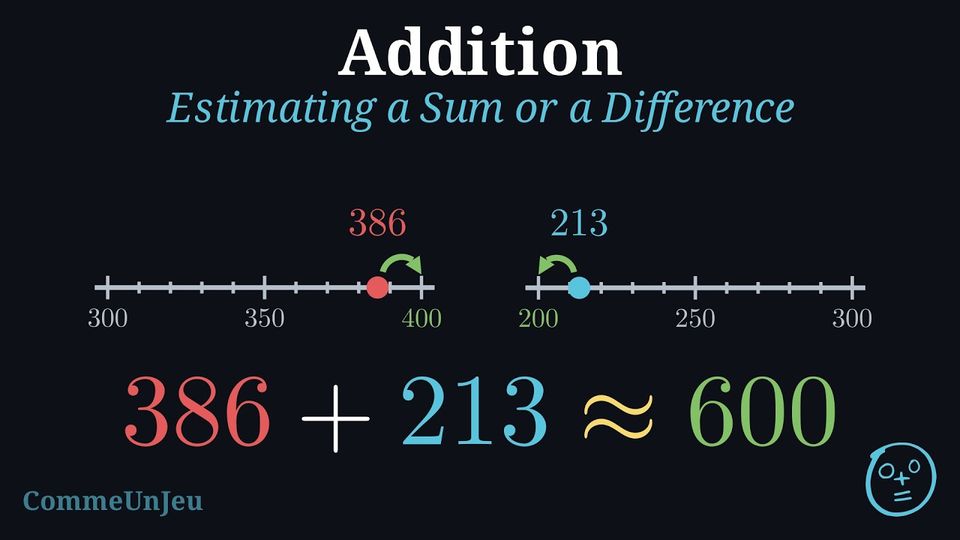
A library lends \(386\) books in March and \(213\) books in April. Estimate how many books it lends in the two months, by rounding each number to the nearest hundred.
The tens digit of \(386\) is \(8\), so \(386\) rounded to the nearest hundred is \(400\). The tens digit of \(213\) is \(1\), so \(213\) rounded to the nearest hundred is \(200\). $$\begin{aligned}[t] 386 + 213 &\approx 400 + 200 && \text{(each number rounded to the nearest hundred)}\\
&= 600 \end{aligned}$$ The sign \(\approx\) is read “is about”: \(386 + 213 \approx 600\) is read “\(386 + 213\) is about \(600\)”. The library lends about \(600\) books in the two months.
The estimate is quick, and it is close: the exact sum is \(386 + 213 = 599\).
The estimate is quick, and it is close: the exact sum is \(386 + 213 = 599\).
Example — Estimating a Difference
A school library owns \(6\,482\) books. \(2\,715\) of them are lent out. Estimate how many books are left on the shelves, by rounding each number to the nearest hundred.
The tens digit of \(6\,482\) is \(8\), so \(6\,482\) rounded to the nearest hundred is \(6\,500\). The tens digit of \(2\,715\) is \(1\), so \(2\,715\) rounded to the nearest hundred is \(2\,700\). $$\begin{aligned}[t] 6\,482 - 2\,715 &\approx 6\,500 - 2\,700 && \text{(each number rounded to the nearest hundred)}\\
&= 3\,800 \end{aligned}$$ The sign \(\approx\) is read “is about”: \(6\,482 - 2\,715 \approx 3\,800\) is read “\(6\,482 - 2\,715\) is about \(3\,800\)”. About \(3\,800\) books are left on the shelves.
The estimate is quick, and it is close: the exact difference is \(6\,482 - 2\,715 = 3\,767\).
The estimate is quick, and it is close: the exact difference is \(6\,482 - 2\,715 = 3\,767\).
Skills to practice
- Estimating a Sum or a Difference
- Estimating Sums and Differences by Rounding
IV
Odd and Even Numbers
Definition — Even and Odd Numbers
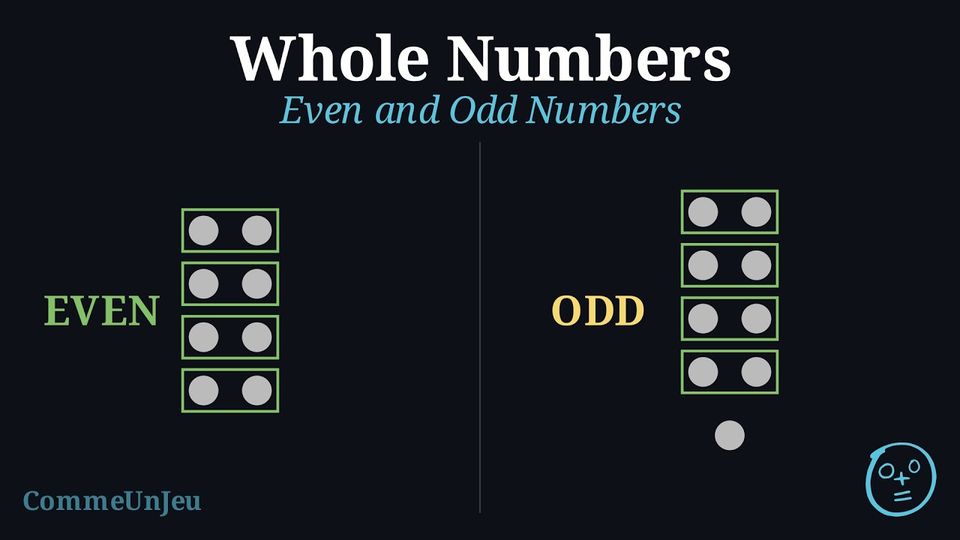
- An even number is a number of whole items that can be split into two equal groups: every item has a partner and nothing is left over.
Examples: \(0, 2, 4, 6, 8, 10, 12, \dots\)
\(0\) is even too: with \(0\) objects, the two groups are empty and nothing is left over. - An odd number is a number of whole items that cannot be split into two equal groups: one item is always left without a partner.
Examples: \(1, 3, 5, 7, 9, 11, 13, \dots\)
Skills to practice
- Investigating Odd and Even Sums and Products
V
Going further
Skills to practice
- Reasoning about Sums
- Quiz
Jump to section