International Baccalaureate · PYP 4
Number sentences and problem solving
I
Representing a Hidden Number
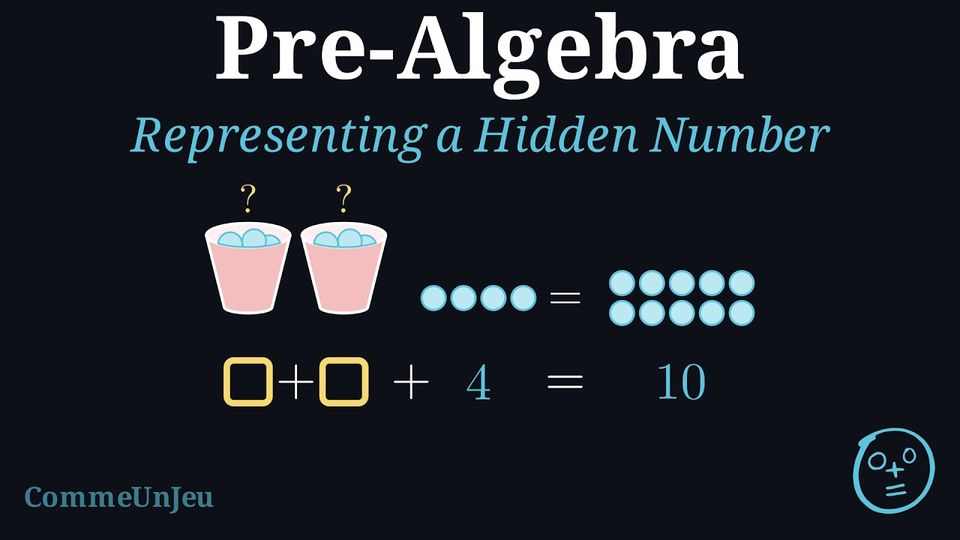
Two identical cups hide the same number of marbles. Next to them, there are \(4\) loose marbles. In all, there are \(10\) marbles. 
How many marbles are hidden in each cup?
Without the \(4\) loose marbles, the two cups hide \(10 - 4 = 6\) marbles. The two cups hide the same number, so each cup hides \(6 \div 2 = \textbf{3}\) marbles.
Check: \(3 + 3 + 4 = 10\). \(\checkmark\)
Check: \(3 + 3 + 4 = 10\). \(\checkmark\)
Definition — Representing a Hidden Number
A hidden number can be represented by a symbol like \(\square\), or by a letter like \(N\). In one equality, the same symbol always hides the same number. The story of the cups can be written as an equality: $$\square + \square + 4 = 10$$ Example
Find the number hidden by the letter: \(N \times 3 = 27\).
The inverse of multiplying by \(3\) is dividing by \(3\): \(N = 27 \div 3 = \textbf{9}\).
Check: \(9 \times 3 = 27\). \(\checkmark\)
Check: \(9 \times 3 = 27\). \(\checkmark\)
Example
\(N\) boxes contain \(12\) eggs each, and there are \(5\) loose eggs. The total number of eggs is written \((N \times 12) + 5\). Compute the total for \(N = 3\) boxes.
Replace the letter \(N\) by \(3\): $$(3 \times 12) + 5 = 36 + 5 = \textbf{41}$$ There are \(41\) eggs in all.
Skills to practice
- Finding the Hidden Number
- Using a Letter Formula
II
Problems with Bar Models
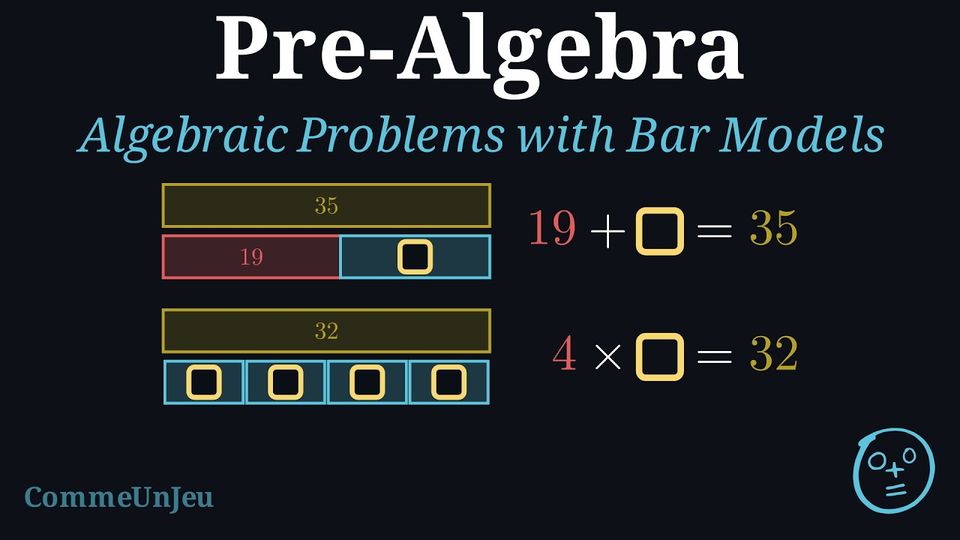
Method — Drawing the Hidden Number
To solve a problem with a hidden number, draw a bar model: - Draw the whole as one bar, and cut it into its parts.
- Write what you know in the parts, and \(\square\) in the hidden part.
- Read the operation from the drawing, compute, and check.
Example
Léa has \(35\) picture cards. She gives some away; she has \(19\) left. How many cards did she give away? 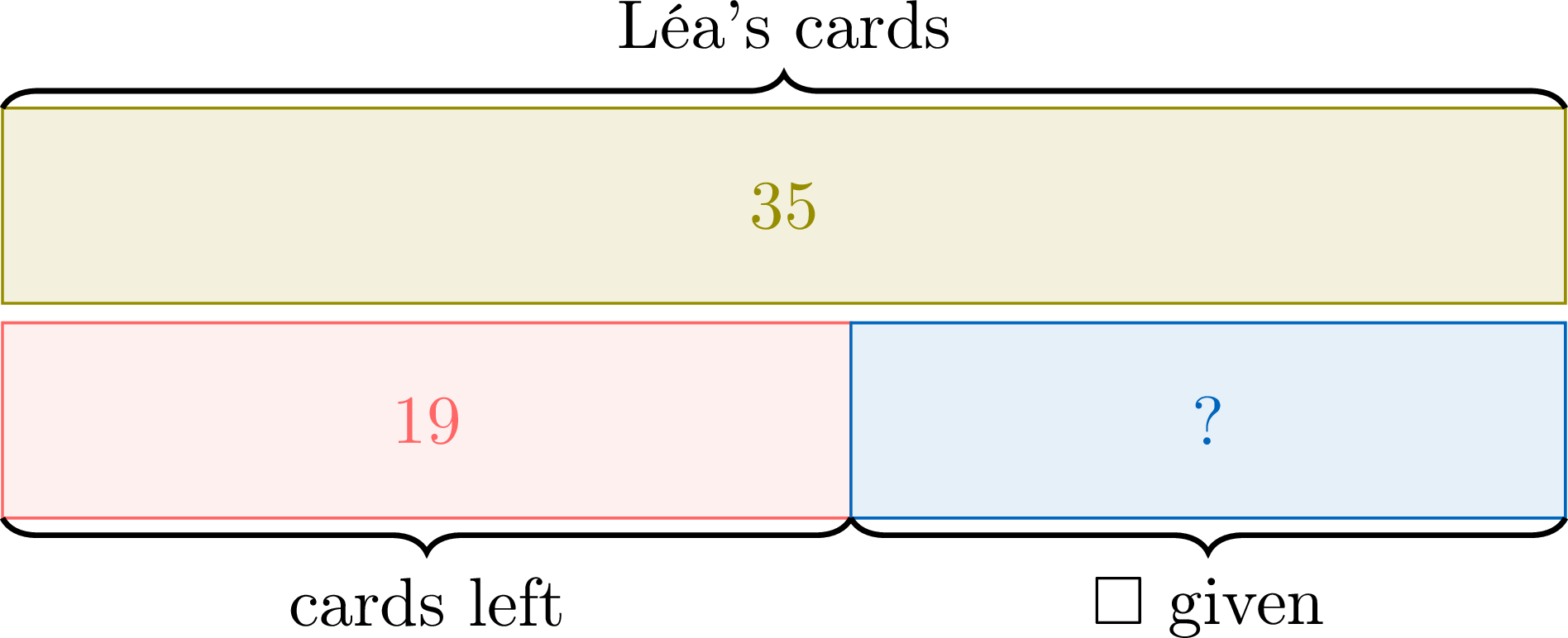
The whole is \(35\); one part is \(19\), the other part is hidden: \(19 + \square = 35\). So \(\square = 35 - 19 = \textbf{16}\). Léa gave away \(16\) cards.
Check: \(19 + 16 = 35\). \(\checkmark\)
Check: \(19 + 16 = 35\). \(\checkmark\)
Example
\(4\) identical packets contain \(32\) stickers in all. How many stickers are in each packet? 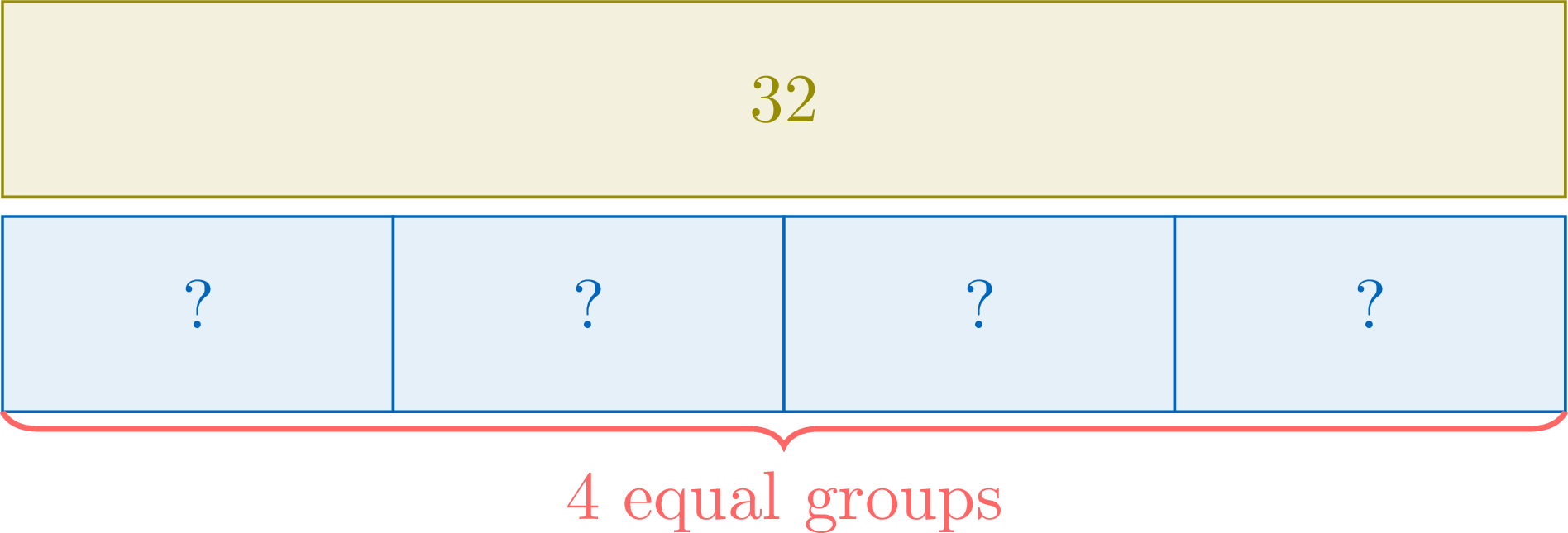
The whole is \(32\), cut into \(4\) equal parts: \(4 \times \square = 32\). So \(\square = 32 \div 4 = \textbf{8}\) stickers in each packet.
Check: \(8 \times 4 = 32\). \(\checkmark\)
Check: \(8 \times 4 = 32\). \(\checkmark\)
Skills to practice
- Reading Bar Models
- Writing the Equality and Drawing the Bar Model
III
Listing All the Possibilities
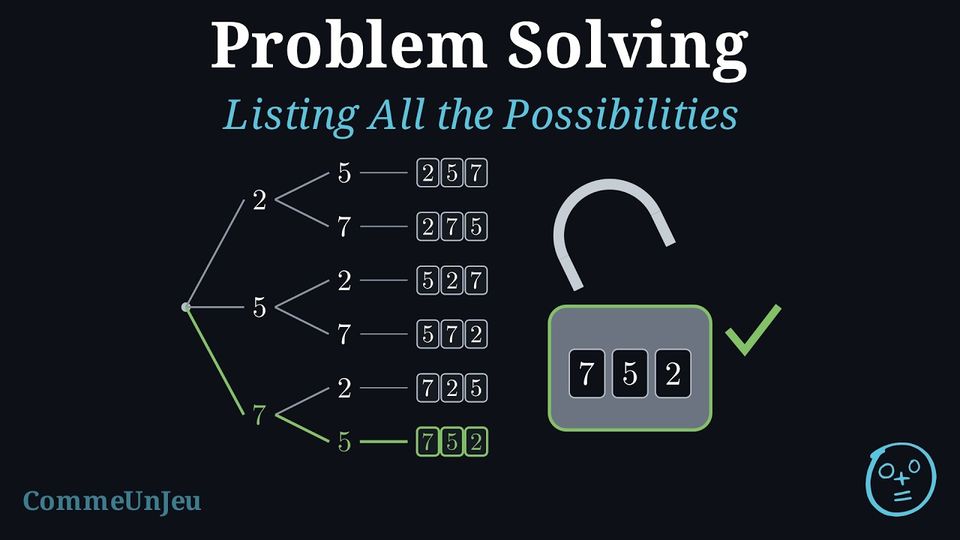
With the three digits \(2\), \(5\) and \(7\), how many three-digit numbers can be written, using each digit once? The list is asked, not only the count.
- Understand: each number uses the three digits once. Two numbers written with the same digits in a different order are two different numbers.
- Model: an order is chosen — the smallest digit first. The first digit is fixed, then the two that remain are placed in both orders.
- Calculate: starting with \(2\): \(257\), \(275\). Starting with \(5\): \(527\), \(572\). Starting with \(7\): \(725\), \(752\). That is \(3\) starts of \(2\) numbers each: \(3 \times 2 = 6\).
- Answer and check: there are \(\mathbf{6}\) numbers. No number appears twice, and none is missing: every start has been taken, and for each start the two remaining digits have been swapped.
Method — Listing Without Forgetting or Repeating
Counting the cases tells how many there are. Here the cases themselves are asked, and counting is no longer enough: they must be listed. - Choose an order and never leave it: the smallest first, or alphabetical, or the biggest coin first. Any order works; changing it half-way is what most often loses a case.
- Fix the first choice, then write every case it allows: with the first choice held, write all its cases. Only then move to the next first choice.
- Keep a record: a tree, one branch per first choice, or a table, one row per first choice.
- Check twice: at every level, all the choices allowed have been written — that is what makes the list complete; and no case appears twice.
Example — Paying with Coins
In how many ways can \(\dollar 7\) be paid with coins of \(\dollar 2\) and coins of \(\dollar 1\)? List the ways. - Understand: a way is a number of \(\dollar 2\) coins and a number of \(\dollar 1\) coins making \(\dollar 7\) together.
- Model: the order chosen is the number of \(\dollar 2\) coins, from the largest. Three \(\dollar 2\) coins make \(\dollar 6\), and four would make \(\dollar 8\): too much. So that number goes from \(3\) down to \(0\).
Coins of \(\dollar 2\) Coins of \(\dollar 1\) Total \(3\) \(1\) \(\dollar 7\) \(2\) \(3\) \(\dollar 7\) \(1\) \(5\) \(\dollar 7\) \(0\) \(7\) \(\dollar 7\) - Calculate: each row is one way, and the table has \(4\) rows.
- Answer and check: there are \(\mathbf{4}\) ways. Each row really makes \(\dollar 7\), the number of \(\dollar 2\) coins drops by one at each row without ever skipping one: nothing is missing, nothing is repeated.
Example — A Digit That Cannot Start
With the digits \(0\), \(4\) and \(9\), each used once, list the three-digit numbers that can be written. - Understand: a three-digit number cannot start with \(0\) — \(049\) is \(49\), a two-digit number.
- Model: the order chosen is the first digit, and only \(4\) and \(9\) may start.
- Calculate: starting with \(4\): \(409\), \(490\). Starting with \(9\): \(904\), \(940\).
- Answer and check: there are \(\mathbf{4}\) numbers. Six were expected with three free digits, and the two that start with \(0\) have been removed: \(6 - 2 = 4\). The two counts agree.
Skills to practice
- Listing Every Case
IV
Choosing the Best
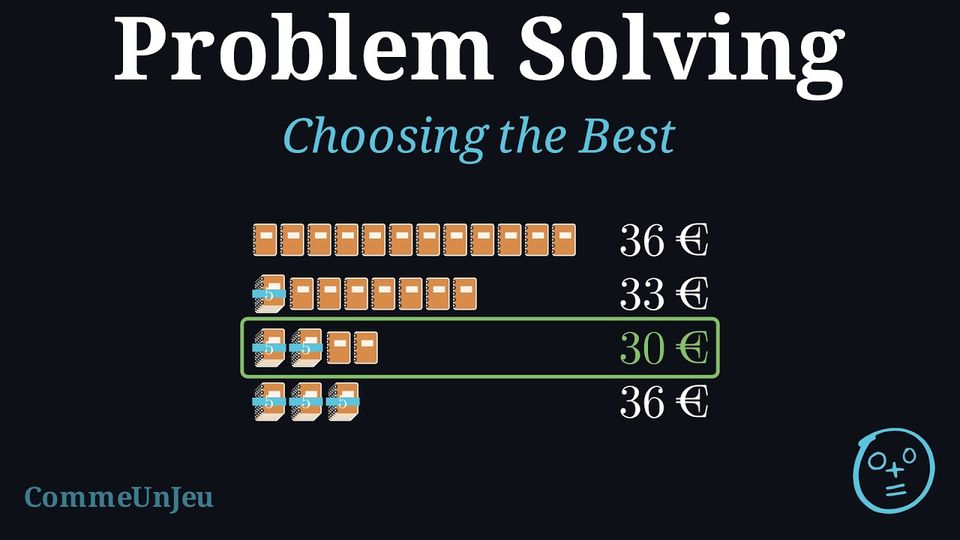
A notebook costs \(\dollar 3\), and a pack of five notebooks costs \(\dollar 12\). A class needs \(12\) notebooks. What is the lowest price to pay, and why can no other way do better?
- Understand: the constraint is at least \(12\) notebooks; the criterion is the lowest price. Buying more than \(12\) is allowed if it costs less.
- Model: the cases are listed in the order of the number of packs, from \(0\) to \(3\) — three packs already give \(15\) notebooks, so a fourth is useless.
Packs Single Notebooks Price \(0\) \(12\) \(12\) \(\dollar 36\) \(1\) \(7\) \(12\) \(\dollar 12 + \dollar 21 = \dollar 33\) \(2\) \(2\) \(12\) \(\dollar 24 + \dollar 6 = \dollar 30\) \(3\) \(0\) \(15\) \(\dollar 36\) - Calculate: the four prices are \(\dollar 36\), \(\dollar 33\), \(\dollar 30\) and \(\dollar 36\).
- Answer and check: the lowest price is \(\mathbf{\dollar 30}\), with two packs and two single notebooks. No other way does better. From four packs on, \(\dollar 48\) is paid for notebooks that are not needed: the price only grows. And for each number of packs kept, buying one more single notebook only adds \(\dollar 3\), so the row already holds the cheapest way of reaching twelve.
Method — Finding the Best Choice
Some problems do not ask for a solution but for the best one. The answer is not found by trying at random: it is found by leaving no case out. - Name the constraint and the criterion: what must be respected (at least \(12\) notebooks, all the pupils carried) and what must be made as small or as large as possible (the price, the number of buses).
- List every possible case, in order: this is the organised search. One choice is varied from its smallest value to its largest, and the rest follows.
- Stop the list where it becomes useless: beyond a certain value the constraint is already exceeded and the criterion only gets worse. Saying why it gets worse is part of the answer — one more bus carries more and costs more, so trying five is pointless once four are enough.
- Compare, then justify: announce the best case, and say why no other does better — because every useful case has been examined, and because the cases left aside can only be worse.
Example — How Many Buses?
A bus carries \(50\) pupils. The school takes \(180\) pupils on a trip. How many buses are needed at least? - Understand: the constraint is every pupil is carried; the criterion is as few buses as possible.
- Model: the number of buses is tried in order, from the smallest: \(3\) buses carry \(150\) pupils, \(4\) buses carry \(200\).
- Calculate: \(3 \times 50 = 150\), and \(150 < 180\): three buses leave \(30\) pupils behind. \(4 \times 50 = 200\), and \(200\) is more than \(180\).
- Answer and check: \(\mathbf{4}\) buses are needed. No smaller number does it, since three are already not enough — and the fourth bus carries only \(30\) pupils, which is normal: it is the last one.
Skills to practice
- Finding the Lowest Price or the Fewest Needed
V
Going further
Skills to practice
- Carrying the Search Through
- Quiz
Jump to section