International Baccalaureate · PYP 3
Addition
I
Adding or Subtracting a Near-Ten
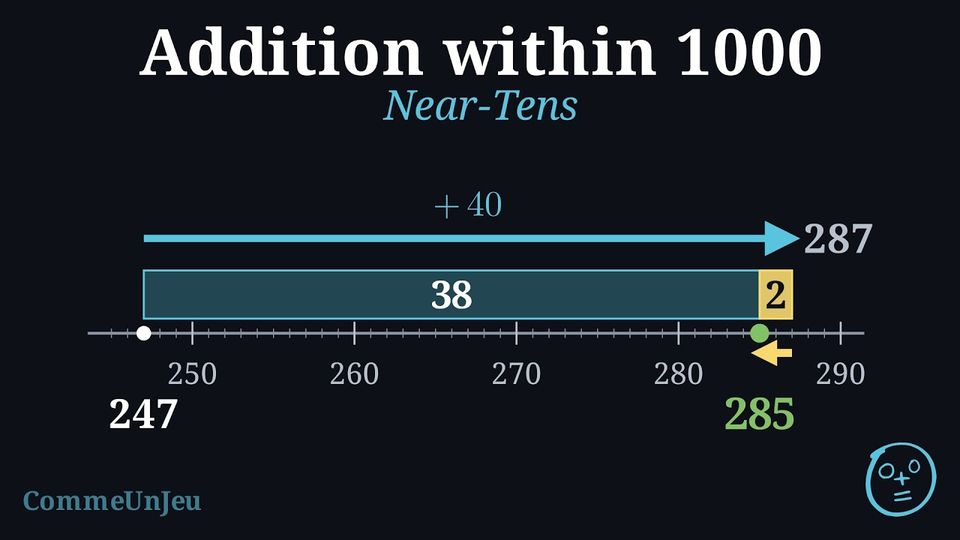
Léa has \(247\) stickers and wins \(38\) more. Tom says: “Add \(40\), that makes \(287\), then give back \(2\): \(285\).” Why does Tom add \(40\) and not \(38\)?
Adding \(40\) is easy: only the tens change, \(247 + 40 = 287\). But \(40\) is \(2\) more than \(38\): Tom has added \(2\) too many, so he gives them back: \(287 - 2 = 285\). Adding \(38\) is “adding \(40\), then taking \(2\) away”.
Method — Adding or Subtracting a Near-Ten
A near-ten is a number close to a whole ten: \(8\), \(9\), \(18\), \(19\), \(28\), \(29\), \(38\), \(39\). We go through the whole ten, then we correct. - Adding 9, 19, 29, 39: add \(10\), \(20\), \(30\), \(40\), then take \(1\) away. \(456 + 29 = 486 - 1 = 485\).
- Adding 8, 18, 28, 38: add \(10\), \(20\), \(30\), \(40\), then take \(2\) away. \(456 + 38 = 496 - 2 = 494\).
- Subtracting 9, 19, 29, 39: take \(10\), \(20\), \(30\), \(40\) away, then add \(1\) back. \(456 - 29 = 426 + 1 = 427\).
- Subtracting 8, 18, 28, 38: take \(10\), \(20\), \(30\), \(40\) away, then add \(2\) back. \(456 - 38 = 416 + 2 = 418\).
Example
Compute mentally: (a) \(1\,235 + 19\), (b) \(672 + 28\), (c) \(3\,504 - 39\), (d) \(896 + 8\).
(a) \(1\,235 + 20 = 1\,255\), then \(- 1\): \(1\,254\). (b) \(672 + 30 = 702\), then \(- 2\): \(700\). (c) \(3\,504 - 40 = 3\,464\), then \(+ 1\): \(3\,465\). (d) \(896 + 10 = 906\), then \(- 2\): \(904\).
Skills to practice
- Adding 8, 18, 28 or 38
- Subtracting 9, 19, 29 or 39
II
Adding in Columns up to 1 000
Louis has two boxes of cubes. One contains 218 cubes, and the other contains 123 cubes. 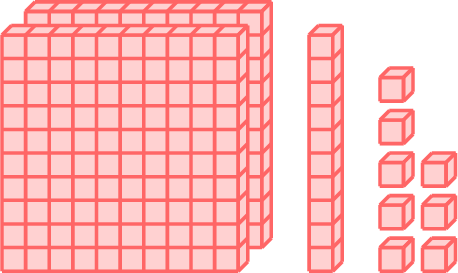 \(+\)
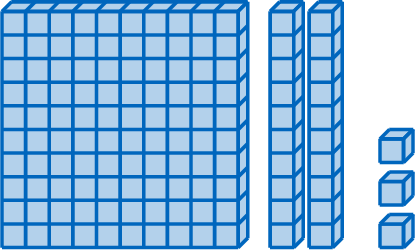
How can we find out how many cubes Louis has altogether?
\(+\)
To find the total, we need to add the two amounts together: $$\textcolor{colordef}{218} + \textcolor{colorprop}{123}$$ If we combine all the cubes, we can see the total sum.  \(+\)
 \(=\)
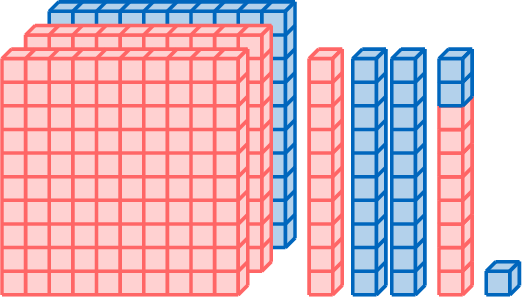
The total is \(\textcolor{olive}{341}\) cubes.
Counting all those cubes would take a long time. A faster and more organized way to add bigger numbers is to use column addition. 
\(+\)\(=\) Counting all those cubes would take a long time. A faster and more organized way to add bigger numbers is to use column addition.
Method — Column Addition with Carrying up to 1 000
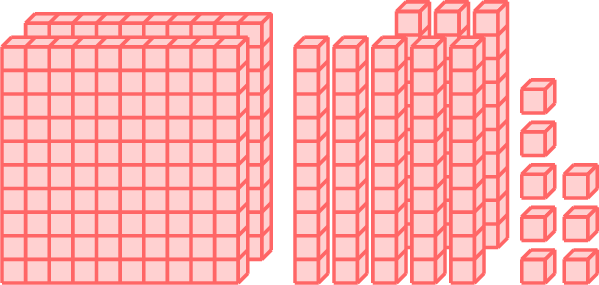
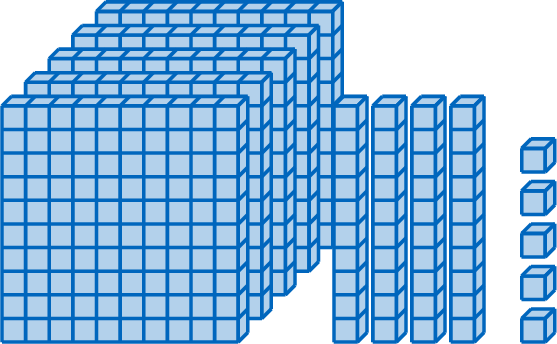
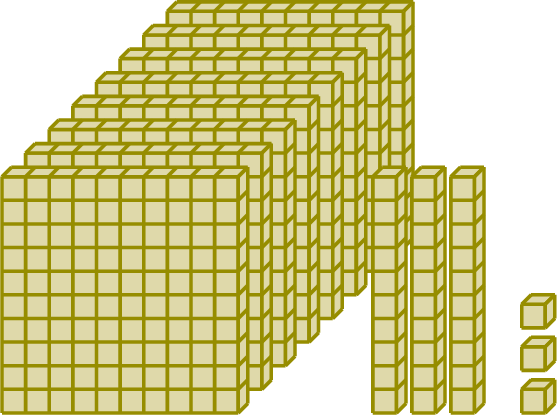
We calculate: $$\textcolor{colordef}{288} + \textcolor{colorprop}{545}$$ - Step 1: Line up the numbers by place value.
Write the numbers one on top of the other. Make sure the ones, tens, and hundreds are in straight columns.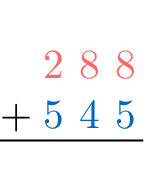
- Step 2: Add the ones. $$\textcolor{colordef}{8} \text{ ones} + \textcolor{colorprop}{5} \text{ ones} = 13 \text{ ones}$$ 13 ones is the same as 1 ten and 3 ones. We write the \(\textcolor{olive}{3}\) in the ones place and carry the 1 ten over to the tens column.
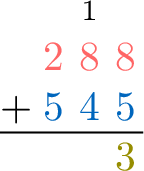
- Step 3: Add the tens. $$1 \text{ ten (carried)} + \textcolor{colordef}{8} \text{ tens} + \textcolor{colorprop}{4} \text{ tens} = 13 \text{ tens}$$ 13 tens is the same as 1 hundred and 3 tens. We write the \(\textcolor{olive}{3}\) in the tens place and carry the 1 hundred over to the hundreds column.
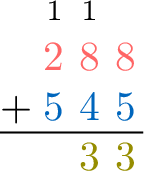
- Step 4: Add the hundreds. $$1 \text{ hundred (carried)} + \textcolor{colordef}{2} \text{ hundreds} + \textcolor{colorprop}{5} \text{ hundreds} = \textcolor{olive}{8} \text{ hundreds}$$ Write the \(\textcolor{olive}{8}\) in the hundreds place.
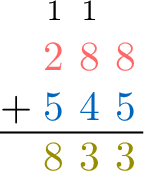
- The Result: $$\textcolor{colordef}{288} + \textcolor{colorprop}{545} = \textcolor{olive}{833}$$
 \(+\)
 \(=\)
Method — Adding Three Numbers in Columns
Three numbers can be set out in columns too, even with different lengths. We calculate: - Step 1: Set up the addition Ones under ones, tens under tens, hundreds under hundreds — the \(7\) goes in the ones column.
\(\begin{array}{r@{\;}r@{\;}r@{\;}r} & \phantom{\scriptstyle 1} & \phantom{\scriptstyle 2} & \\ & & 7 & 6 \\ & & & 7 \\ + & 5 & 6 & 8 \\ \hline & \textcolor{white}{6} & \textcolor{white}{5} & \textcolor{white}{1} \\ \end{array}\) - Step 2: Add the ones $$6 + 7 + 8 = 21$$ Write \(1\), and the carry is worth \(\mathbf{2}\) tens.
\(\begin{array}{r@{\;}r@{\;}r@{\;}r} & \phantom{\scriptstyle 1} & \scriptstyle\textcolor{olive}{2} & \\ & & 7 & 6 \\ & & & 7 \\ + & 5 & 6 & 8 \\ \hline & \textcolor{white}{6} & \textcolor{white}{5} & \textcolor{olive}{1} \\ \end{array}\) - Step 3: Add the tens $$7 + 6 + 2 = 15$$ Write \(5\), carry \(1\) hundred.
\(\begin{array}{r@{\;}r@{\;}r@{\;}r} & \scriptstyle\textcolor{olive}{1} & \scriptstyle\textcolor{olive}{2} & \\ & & 7 & 6 \\ & & & 7 \\ + & 5 & 6 & 8 \\ \hline & \textcolor{white}{6} & \textcolor{olive}{5} & \textcolor{olive}{1} \\ \end{array}\) - Step 4: Add the hundreds $$5 + 1 = 6$$
\(\begin{array}{r@{\;}r@{\;}r@{\;}r} & \scriptstyle\textcolor{olive}{1} & \scriptstyle\textcolor{olive}{2} & \\ & & 7 & 6 \\ & & & 7 \\ + & 5 & 6 & 8 \\ \hline & \textcolor{olive}{6} & \textcolor{olive}{5} & \textcolor{olive}{1} \\ \end{array}\) - The Result: $$76 + 7 + 568 = 651$$
Skills to practice
- Solving Real-World Problems
- Adding up to 1 000 Without Carrying
- Adding up to 1 000 with One Carry
- Adding up to 1 000 with Two Carries
- Setting Up a Three-Number Addition to 1 000
III
Adding in Columns up to 10 000
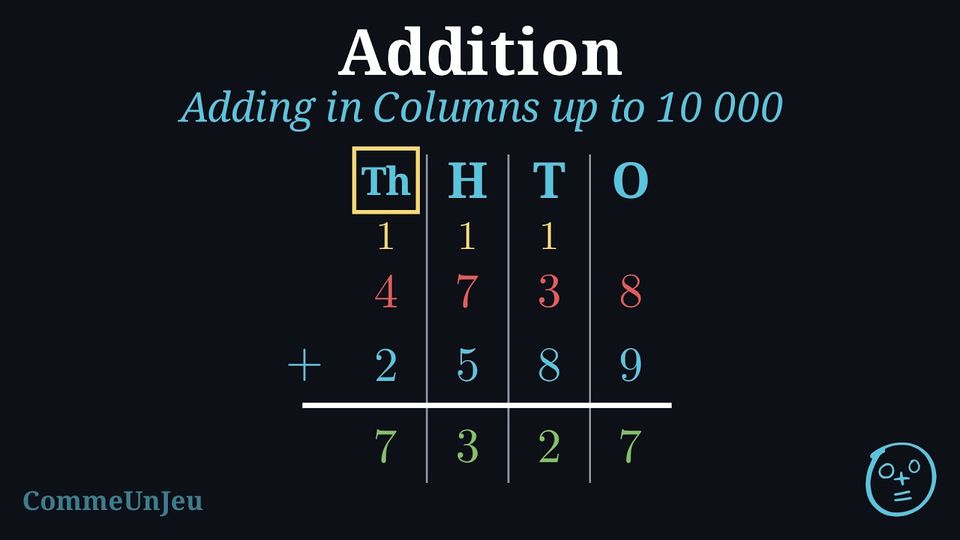
On Saturday the stadium welcomed \(4\,738\) spectators, on Sunday \(2\,589\). The manager wants the total for the weekend. There are far too many people to count with cubes, and the numbers are bigger than \(1\,000\). Say how to find the total.
The column addition works exactly as with three digits: one more column on the left, the thousands. Ones: \(8 + 9 = 17\), write \(7\), carry \(1\) ten. Tens: \(1 + 3 + 8 = 12\), write \(2\), carry \(1\) hundred. Hundreds: \(1 + 7 + 5 = 13\), write \(3\), carry \(1\) thousand. Thousands: \(1 + 4 + 2 = 7\). 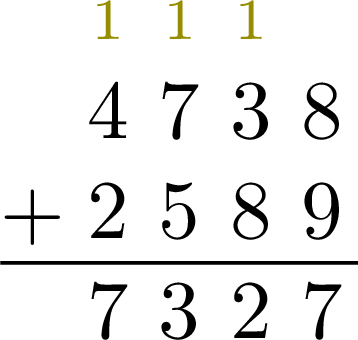
\(4\,738 + 2\,589 = 7\,327\): the stadium welcomed \(7\,327\) spectators.
Skills to practice
- Adding Thousands
- Adding Numbers up to 10 000
IV
Going further
Skills to practice
- Finding Missing Digits and Correcting Carry Errors
- Quiz
Jump to section