International Baccalaureate · PYP 3
Money
I
Bills and Coins
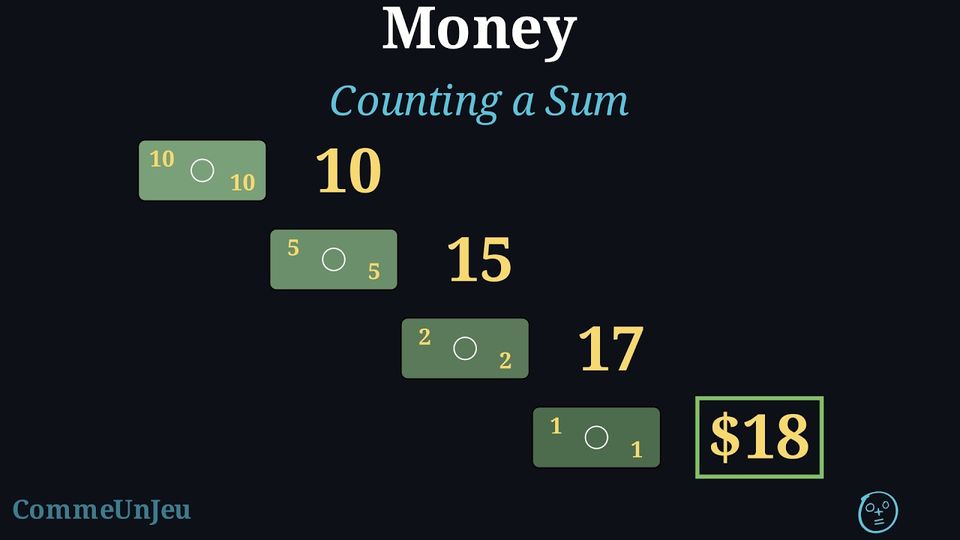
Definition — Coins and Bills
Money comes as coins and bills. Here is what can be used to pay in dollars. The bills: | 1 dollar | 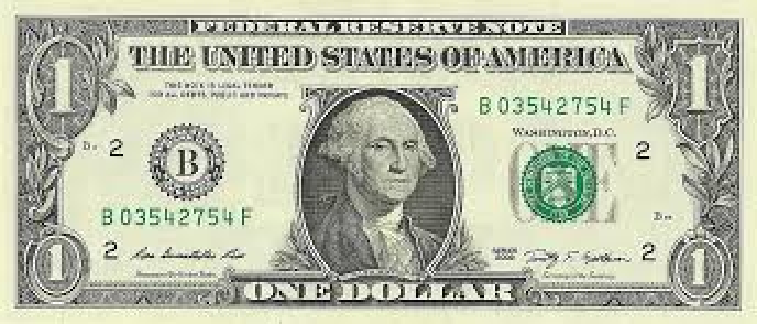 |
| 2 dollars | 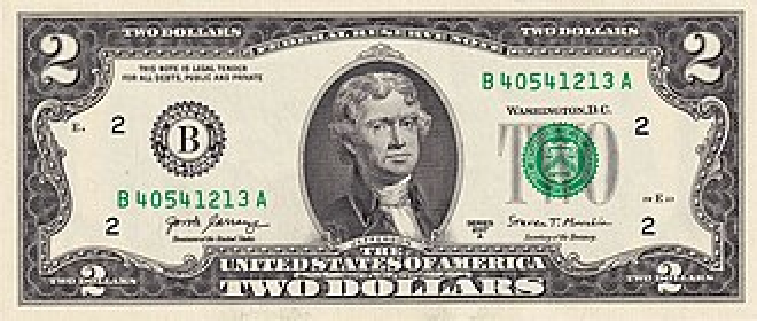 |
| 5 dollars | 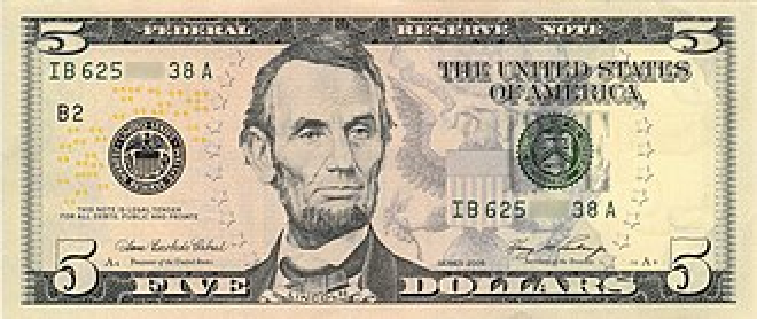 |
| 10 dollars | 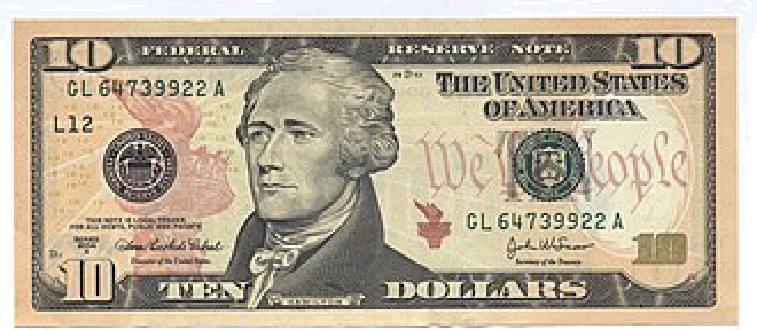 |
| 20 dollars | 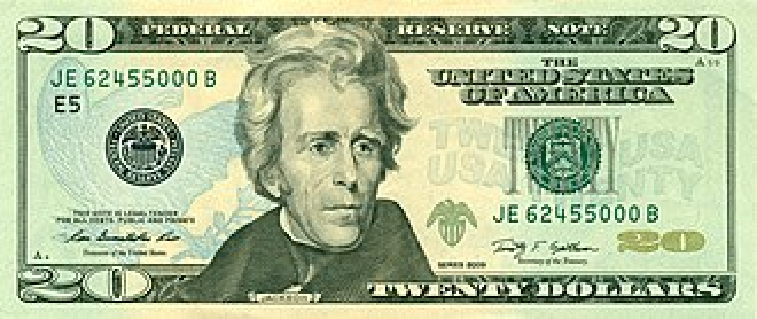 |
| 50 dollars | 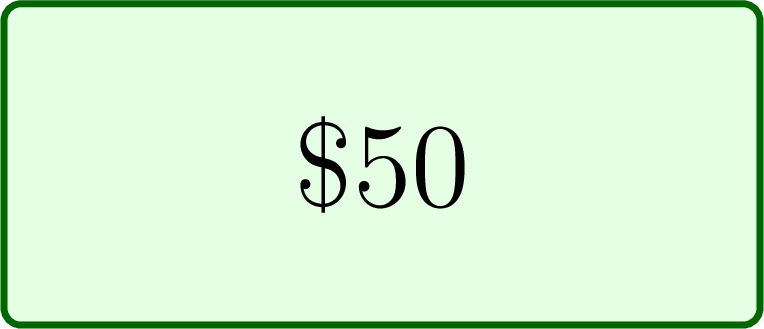 |
| 1 dollar (coin) | 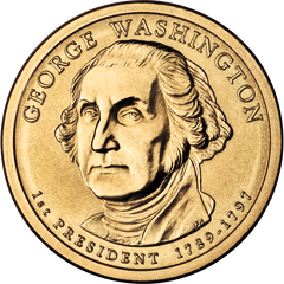 |
Method — Making a Sum with the Fewest Coins and Bills
To make an amount with the fewest bills and coins — taken from the list above, up to the \(\dollar 50\) bill — always start with the biggest value that still fits. - Take as many \(\dollar 50\) bills as possible, then as many \(\dollar 20\) bills, then \(\dollar 10\), then \(\dollar 5\).
- Finish the dollars with the \(\dollar 2\) bill and the \(\dollar 1\) bill (or the \(\dollar 1\) coin).
- If the amount has cents, do the same with the coins: as many half dollars (\(50\) c) as possible, then quarters (\(25\) c), then dimes (\(10\) c), nickels (\(5\) c), pennies (\(1\) c).
- Check: add everything back and compare with the amount asked.
Example
Make \(\dollar 87\) with the fewest bills and coins.
Start with the biggest: one \(\dollar 50\) bill, then \(87-50=37\) left. One \(\dollar 20\) bill: \(17\) left. One \(\dollar 10\) bill: \(7\) left. One \(\dollar 5\) bill: \(2\) left. One \(\dollar 2\) bill. 
Five bills — five pieces of money in all. Check: \(50+20+10+5+2=\textcolor{olive}{87}\).
Example
Make \(2\) dollars \(45\) c with the fewest bills and coins.
One \(\dollar 2\) bill, then the cents from the biggest coin: one quarter and two dimes, \(25+10+10=45\). 
Four pieces in all: one bill and three coins.
Method — Counting a Sum of Bills and Coins
To find how much a big heap of money is worth, do not count piece by piece: group. - Group what is the same: all the \(\dollar 50\) bills together, all the \(\dollar 20\) bills together, and so on.
- Multiply each group: \(3\) bills of \(\dollar 50\) make \(3 \times 50 = 150\) dollars.
- Add the dollars, then add the cents separately.
- Exchange \(100\) cents for \(1\) dollar as long as the cents reach \(100\).
Example
Find how much this is worth: \(3\) bills of \(\dollar 50\), \(2\) of \(\dollar 20\), \(4\) of \(\dollar 10\), \(4\) of \(\dollar 5\), \(3\) of \(\dollar 2\), \(5\) half dollars (\(50\) c), \(3\) quarters (\(25\) c), \(1\) nickel (\(5\) c) and \(4\) pennies (\(1\) c).
Each group is multiplied, the dollars on one side, the cents on the other. $$3 \times 50 = 150 \qquad 2 \times 20 = 40 \qquad 4 \times 10 = 40 \qquad 4 \times 5 = 20 \qquad 3 \times 2 = 6$$ Dollars: \(150+40+40+20+6=\textcolor{colordef}{256}\) dollars. $$5 \times 50 = 250 \qquad 3 \times 25 = 75 \qquad 1 \times 5 = 5 \qquad 4 \times 1 = 4$$ Cents: \(250+75+5+4=\textcolor{colorprop}{334}\) c. Three hundred cents make \(3\) dollars, and \(34\) c are left. The heap is worth \(\textcolor{olive}{259}\) dollars and \(\textcolor{olive}{34}\) cents.
Method — Exchanging
Several bills or coins can be exchanged for a single one of the same total value, and the other way round — when such a bill or coin exists: a \(\dollar 1\) bill and a \(\dollar 2\) bill cannot become a single one, since no \(\dollar 3\) bill exists. - \(5\) bills of \(\dollar 10\) \(=\) one bill of \(\dollar 50\), because \(5 \times 10 = 50\).
- One bill of \(\dollar 20\) \(=\) two bills of \(\dollar 10\), or four bills of \(\dollar 5\).
Example
Léa has four bills of \(\dollar 5\) and wants a single bill. Say which one, and why.
\(4 \times 5 = 20\): she exchanges them for one bill of \(\dollar 20\). The amount is the same, she carries one bill instead of four.
Skills to practice
- Counting a Sum of Bills and Coins
- Exchanging
- Making a Sum with the Fewest Pieces
II
Adding Dollars and Cents
Method — Adding Dollars and Cents
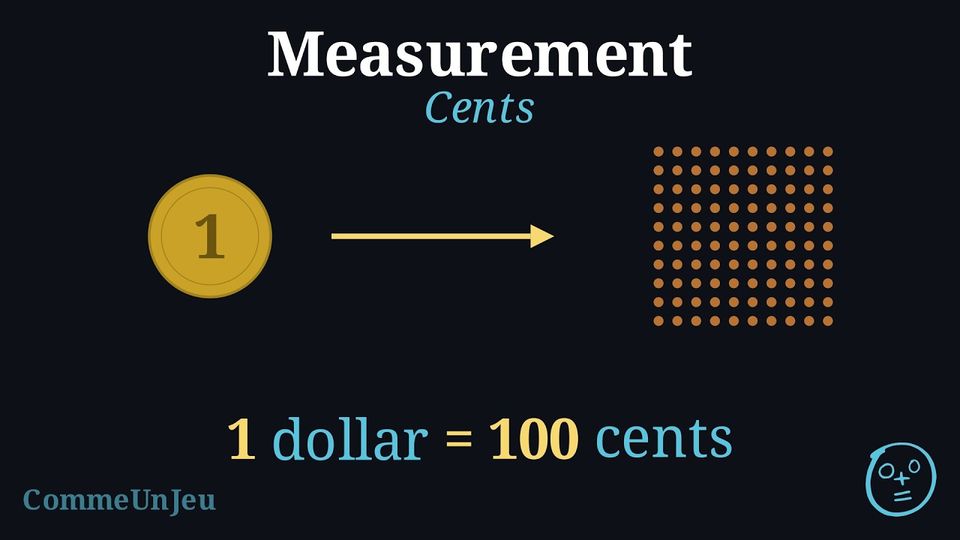
Dollars are added with dollars, cents with cents — then the cents are looked at. - Add the dollars on one side, the cents on the other.
- As long as the cents reach \(100\), exchange \(100\) cents for \(1\) dollar and keep what is left. With three amounts of \(80\) c, \(240\) c give \(2\) dollars and \(40\) c left.
- Check: what is left in cents is always smaller than \(100\).
Example
Léa buys a book at \(3\) dollars \(60\) c and a pen at \(2\) dollars \(70\) c. Find the total.
Dollars with dollars, cents with cents: \(3+2=\textcolor{colordef}{5}\) dollars and \(60+70=\textcolor{colorprop}{130}\) cents. \(130\) cents is more than \(100\): \(100\) cents are exchanged for \(1\) dollar, and \(30\) cents are left. $$\textcolor{colordef}{5}~\text{dollars}+\textcolor{colorprop}{130}~\text{c}=\textcolor{olive}{6}~\text{dollars}~\textcolor{olive}{30}~\text{c}$$ Check: \(30\) is smaller than \(100\).
Skills to practice
- Adding Dollars and Cents
III
Writing Amounts with a Decimal Point
At the bakery, the label on the chocolate bun reads “\(\dollar 1.20\)”. Zoé has a \(1\)-dollar coin and two dimes. Does she have enough? And what does the point mean? 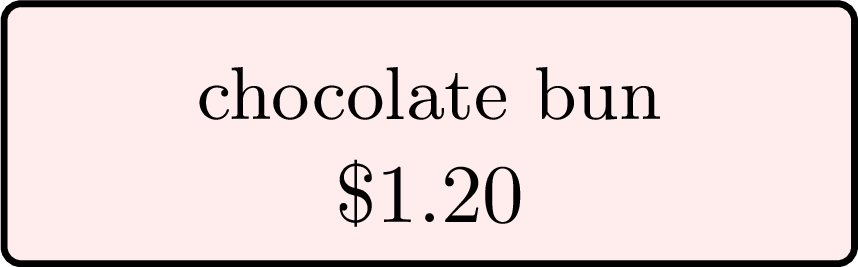
The decimal point separates the dollars, on its left, from the cents, on its right: \(\dollar 1.20\) means \(1\) dollar and \(20\) cents. Zoé has exactly \(1\) dollar and \(20\) cents (two dimes make \(20\) cents): she has exactly enough.
Definition — Writing an Amount with a Decimal Point
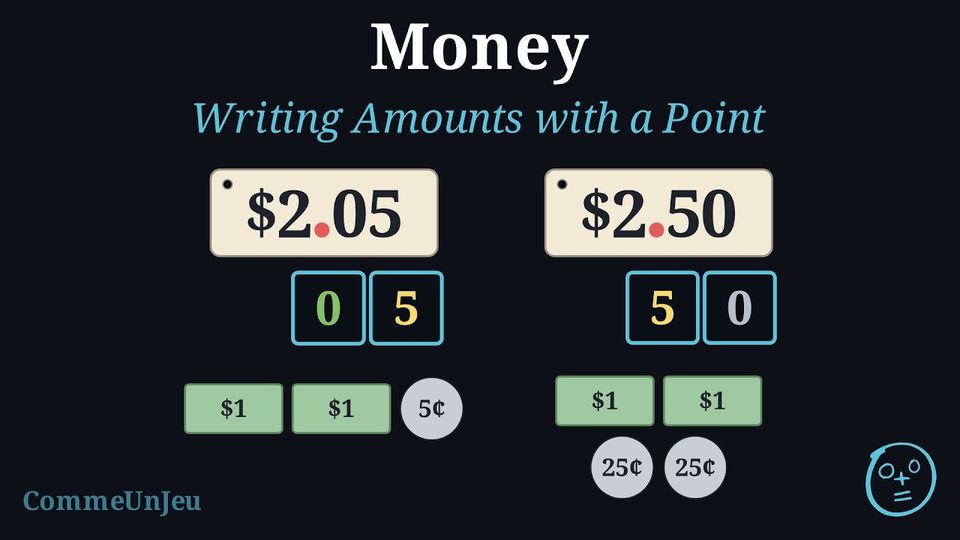
An amount of dollars and cents can be written with a decimal point: the dollar sign first, the dollars on the left of the point, the cents on the right — always two digits for the cents, because \(\dollar 1 = 100\) c. - \(3\) dollars and \(45\) cents is written \(\dollar 3.45\).
- \(3\) dollars and \(5\) cents is written \(\dollar 3.05\): the zero holds the place — \(5\) cents are not \(50\) cents.
- \(3\) dollars exactly is written \(\dollar 3.00\), or simply \(\dollar 3\).
- \(50\) cents on their own is written \(\dollar 0.50\): zero dollars and \(50\) cents.
Method — Reading and Writing an Amount
- Read: the digits before the point are dollars, the two digits after are cents. \(\dollar 4.60\): \(4\) dollars and \(60\) cents.
- Write: put the dollar sign, the dollars, the point, then the cents on two digits — write a zero first if the cents are under \(10\). \(2\) dollars and \(5\) cents: \(\dollar 2.05\).
- Make it: make the dollars with bills or \(\dollar 1\) coins, then the cents with cent coins.
Example
The croissant costs \(\dollar 1.05\). How many dollars and how many cents is that?
Before the point, \(1\): one dollar. After the point, \(05\): five cents — not fifty, the zero holds the tens place. The croissant costs \(1\) dollar and \(5\) cents.
Example
Malo buys a brioche for \(2\) dollars and \(60\) cents. Write the price with a decimal point, then make it with the fewest bills and coins. - Write: the dollar sign, \(2\) dollars, the point, \(60\) cents: \(\dollar 2.60\).
- Make it: the dollars with one \(\dollar 2\) bill; the \(60\) cents with a half dollar (\(50\) c) and a dime (\(10\) c). Three pieces.
Example — Ordering Four Prices
Order these four prices from the cheapest to the most expensive: \(\dollar 3\) and \(50\) cents, \(95\) cents, \(\dollar 3.05\) and \(\dollar 12\).
Write every price with a decimal point: \(\dollar 3.50\), \(\dollar 0.95\), \(\dollar 3.05\) and \(\dollar 12.00\). Compare the dollars first (\(0\), \(3\), \(3\), \(12\)), then the cents when the dollars are equal (\(5\) c \(< 50\) c). Order: \(95\) c \(<\) \(\dollar 3.05\) \(<\) \(\dollar 3.50\) \(<\) \(\dollar 12\).
Skills to practice
- Writing Prices with a Decimal Point
- Reading and Ordering Prices
IV
Giving Change with Cents
Method — Counting Up to the Next Dollar
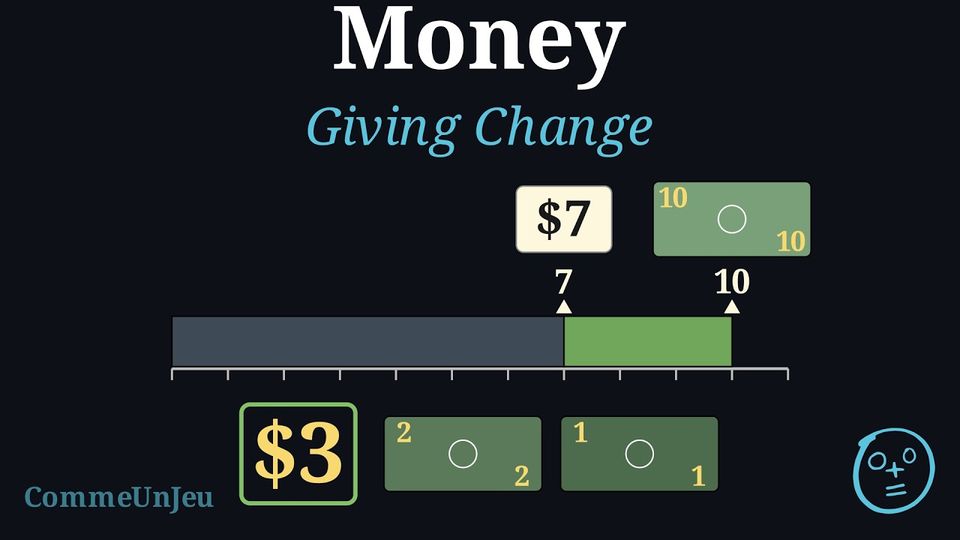
To give change when the price has cents and the customer pays with bills or dollar coins, the seller counts up from the price: - To the next dollar: add the cents that are missing to make \(100\).
- Then in dollars: add dollars until the money given is reached.
- The change is the cents and the dollars counted on the way.
Example
Back at the bakery: the chocolate bun costs \(\dollar 1.20\), and Zoé pays with a \(\dollar 2\) bill. How much does the seller give back? - To the next dollar: from \(1.20\) to \(2\), \(80\) cents are missing, because \(20+80=100\).
- The money given, \(2\) dollars, is reached: we stop.
- The seller gives back \(80\) cents: a half dollar, a quarter and a nickel.
- Check: \(\dollar 1.20\) plus \(80\) cents makes \(\dollar 2\).
Example
The book costs \(\dollar 3.60\). Malo pays with a \(\dollar 5\) bill. How much does the seller give back? 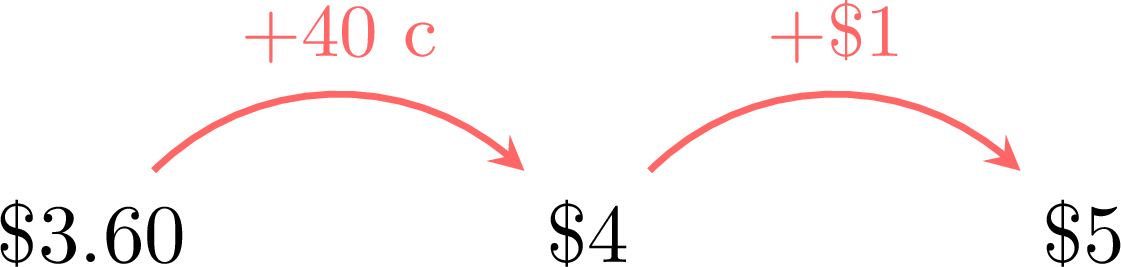
- To the next dollar: from \(3.60\) to \(4\), \(40\) cents are missing (\(60+40=100\)).
- Then in dollars: from \(4\) to \(5\), \(1\) dollar.
- Change: \(40\) cents and \(1\) dollar, that is \(1\) dollar and \(40\) cents: \(\dollar 1.40\).
Example
Léo buys a watch at \(\dollar 167.95\). He pays with four \(\dollar 50\) bills. Find the change.
Four \(\dollar 50\) bills make \(4 \times 50 = \textcolor{colordef}{200}\) dollars. The seller counts up from the price: 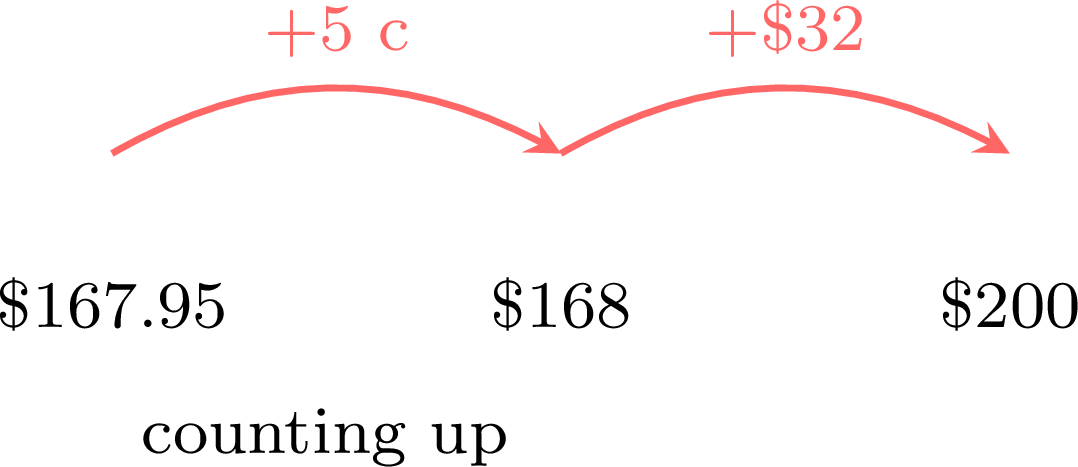
The change is \(\textcolor{olive}{32}\) dollars and \(\textcolor{olive}{5}\) cents, that is \(\dollar 32.05\). Check: \(\dollar 167.95 + \dollar 32.05 = \dollar 200\).
Skills to practice
- Giving Change by Counting Up
- Giving Change on a Large Amount
V
Setting Out an Addition and a Subtraction of Amounts
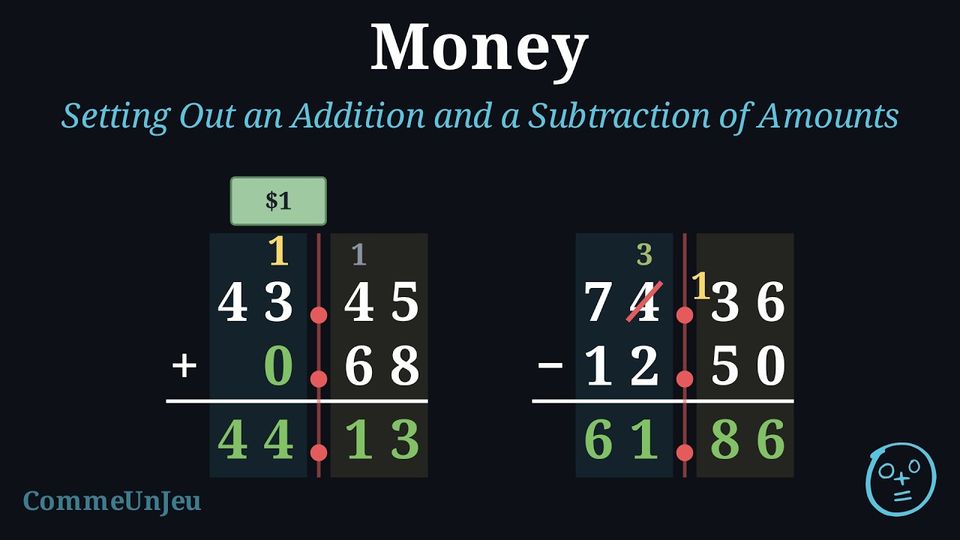
Adèle buys a book for \(\dollar 4.56\) and a game for \(\dollar 15.30\). She computes in her head: “\(4 + 15 = 19\) dollars, \(56 + 30 = 86\) cents: \(\dollar 19.86\).” Then she sets the addition out in columns, “to check”. How does she set it out?
She writes the dollars under the dollars and the cents under the cents, so the point is under the point. Then she adds column by column, from the right, exactly as with whole numbers. \(\begin{array}{r@{\;}r@{\;}r@{\;}r@{}l@{}r@{\;}r} & & & 4 & . & 5 & 6 \\ + & & 1 & 5 & . & 3 & 0 \\ \hline & & 1 & 9 & . & 8 & 6 \\ \end{array}\) The column result is \(\dollar 19.86\), the same as in her head. Setting out is a way to organise the calculation and to check it; it becomes necessary when the numbers are heavier.
Method — Setting Out an Addition of Amounts
- Line up: dollars under dollars, cents under cents — the point is under the point.
- Complete with two digits of cents: an amount without cents is written with “.00” (\(\dollar 68 = \dollar 68.00\)); cents alone are written after “\(0.\)” with two digits (\(68\) cents \(= \dollar 0.68\); \(5\) cents \(= \dollar 0.05\)).
- Add from the right, column by column, as with whole numbers.
- Carry: each full hundred of cents becomes one dollar. \(45 + 68 = 113\) cents \(= 1\) dollar and \(13\) c: carry \(1\). \(80 + 80 + 80 = 240\) cents \(= 2\) dollars and \(40\) c: carry \(2\).
- Put the point back in the result, under the others.
Example
Set out and compute: (a) \(\dollar 43.45 + \dollar 68\); (b) \(\dollar 43.45 + 68\) cents; (c) \(\dollar 143 + \dollar 3.67 + 54\) cents.
(a) \(\dollar 68\) is written \(\dollar 68.00\). Cents: \(45 + 0 = 45\). Dollars: \(43 + 68 = 111\), with the usual carries of whole numbers. Result \(\dollar 111.45\). \(\begin{array}{r@{\;}r@{\;}r@{\;}r@{}l@{}r@{\;}r} & \scriptstyle 1 & \scriptstyle 1 & & & & \\ & & 4 & 3 & . & 4 & 5 \\ + & & 6 & 8 & . & 0 & 0 \\ \hline & 1 & 1 & 1 & . & 4 & 5 \\ \end{array}\) (b) \(68\) cents is written \(\dollar 0.68\). Cents: \(45 + 68 = 113\) c, that is \(1\) dollar and \(13\) c: carry \(1\) dollar. Result \(\dollar 44.13\). \(\begin{array}{r@{\;}r@{\;}r@{\;}r@{}l@{}r@{\;}r} & & & \scriptstyle 1 & & \scriptstyle 1 & \\ & & 4 & 3 & . & 4 & 5 \\ + & & & 0 & . & 6 & 8 \\ \hline & & 4 & 4 & . & 1 & 3 \\ \end{array}\) (c) Three lines: \(143.00\), \(3.67\) and \(0.54\). Cents: \(0 + 67 + 54 = 121\) c, that is \(1\) dollar and \(21\) c: carry \(1\). Dollars: \(143 + 3 + 0 + 1 = 147\). Result \(\dollar 147.21\). \(\begin{array}{r@{\;}r@{\;}r@{\;}r@{}l@{}r@{\;}r} & & & \scriptstyle 1 & & \scriptstyle 1 & \\ & 1 & 4 & 3 & . & 0 & 0 \\ + & & & 3 & . & 6 & 7 \\ + & & & 0 & . & 5 & 4 \\ \hline & 1 & 4 & 7 & . & 2 & 1 \\ \end{array}\)
Method — Setting Out a Subtraction of Amounts
- Line up and complete exactly as for the addition: point under point, two digits of cents (\(\dollar 68 = \dollar 68.00\)).
- Subtract from the right, column by column, as with whole numbers.
- Exchange: when the cents on top are too small, exchange one dollar for \(100\) cents (we also say we borrow a dollar): the cents on top gain \(100\), and the dollars on top lose \(1\). For \(74.36 - 12.50\): \(36 < 50\), so \(136 - 50 = 86\) cents, and the dollars become \(73 - 12 = 61\). In the columns, the \(4\) of the dollars is crossed out and becomes \(3\), and a small \(1\) is written in front of the \(36\).
- Put the point back in the result.
Example
Set out and compute: (a) \(\dollar 74.56 - \dollar 15.30\); (b) \(\dollar 143.45 - \dollar 68\); (c) \(\dollar 74.36 - \dollar 12.50\).
(a) Cents: \(56 - 30 = 26\): no dollar is exchanged for the cents. Dollars: \(74 - 15 = 59\), subtracted as whole numbers (with their own exchange of a ten). Result \(\dollar 59.26\). \(\begin{array}{r@{\;}r@{\;}r@{\;}r@{}l@{}r@{\;}r} & & \scriptstyle 6 & \scriptstyle 14 & & & \\ & & 7 & 4 & . & 5 & 6 \\ - & & 1 & 5 & . & 3 & 0 \\ \hline & & 5 & 9 & . & 2 & 6 \\ \end{array}\) (b) \(\dollar 68\) is written \(\dollar 68.00\). Cents: \(45 - 0 = 45\). Dollars: \(143 - 68 = 75\). Result \(\dollar 75.45\). \(\begin{array}{r@{\;}r@{\;}r@{\;}r@{}l@{}r@{\;}r} & \scriptstyle 0 & \scriptstyle 13 & \scriptstyle 13 & & & \\ & 1 & 4 & 3 & . & 4 & 5 \\ - & & 6 & 8 & . & 0 & 0 \\ \hline & & 7 & 5 & . & 4 & 5 \\ \end{array}\) (c) Cents: \(36 < 50\), we exchange one dollar for \(100\) cents (the \(4\) becomes \(3\), the \(36\) becomes \(136\)): \(136 - 50 = 86\) cents. Dollars: \(73 - 12 = 61\). Result \(\dollar 61.86\). \(\begin{array}{r@{\;}r@{\;}r@{\;}r@{}l@{}r@{\;}r} & & & \scriptstyle 3 & & & \\ & & 7 & 4 & .{\scriptstyle 1} & 3 & 6 \\ - & & 1 & 2 & . & 5 & 0 \\ \hline & & 6 & 1 & . & 8 & 6 \\ \end{array}\) Check by adding: \(\dollar 61.86 + \dollar 12.50 = \dollar 74.36\).
Skills to practice
- Adding and Subtracting Amounts in Columns
- Setting Out an Addition: Receipts
- Setting Out a Subtraction: Change
VI
Price Problems
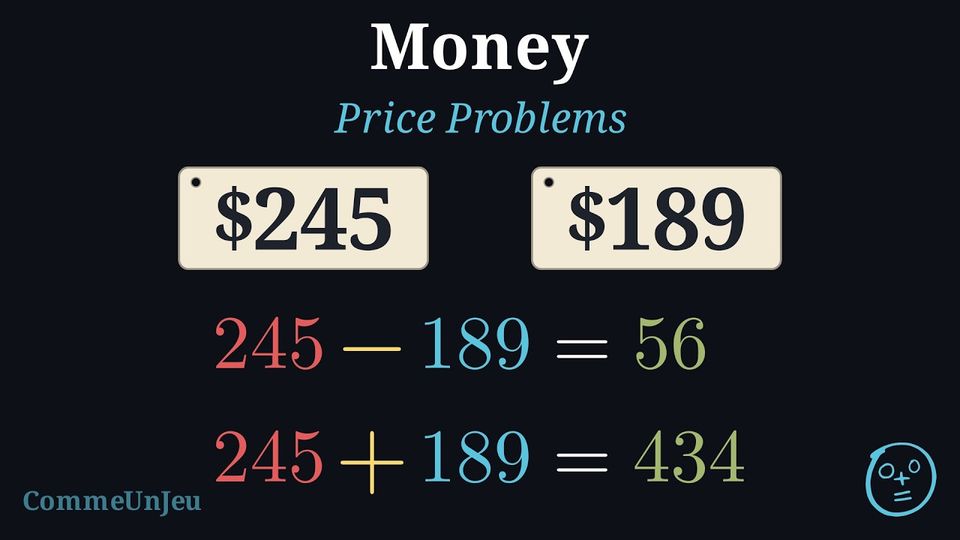
In a shop, a bicycle costs \(\dollar 245\) and a scooter costs \(\dollar 189\). Tom wants to know how much more the bicycle costs, and how much the two together would cost. Say which operation answers each of the two questions.
“How much more” compares two prices: it is a difference, so a subtraction. $$\textcolor{colordef}{245}-\textcolor{colorprop}{189}=\textcolor{olive}{56}$$ The bicycle costs \(\dollar 56\) more — it is the more expensive one.
“The two together” gathers two prices: it is a sum, so an addition. $$\textcolor{colordef}{245}+\textcolor{colorprop}{189}=\textcolor{olive}{434}$$ The two together cost \(\dollar 434\).
“The two together” gathers two prices: it is a sum, so an addition. $$\textcolor{colordef}{245}+\textcolor{colorprop}{189}=\textcolor{olive}{434}$$ The two together cost \(\dollar 434\).
Method — Choosing the Operation in a Price Problem
- Together, in all, the total \(\rightarrow\) an addition.
- How much more, how much less, what is left \(\rightarrow\) a subtraction.
- The same article several times \(\rightarrow\) a multiplication.
- The double is twice the price; the half is the price shared in two.
- Two steps: sometimes the answer needs an intermediate number that the statement does not give — the price of the three notebooks, the total of two purchases. That number is computed first, and only then the question is answered.
Example
A game costs \(\dollar 36\). Find the double of this price, then its half.
The double is twice the price: \(36 \times 2 = \textcolor{olive}{72}\), so \(\dollar 72\). The half is the price shared in two: \(36 = 18+18\), so the half is \(\dollar \textcolor{olive}{18}\).
For a bigger price, the number is broken first: half of \(\dollar 150\) is half of \(100\) plus half of \(50\), that is \(50+25=75\), so \(\dollar 75\).
For a bigger price, the number is broken first: half of \(\dollar 150\) is half of \(100\) plus half of \(50\), that is \(50+25=75\), so \(\dollar 75\).
Example
Sam has \(\dollar 80\). He buys three notebooks at \(\dollar 7\) each. How much is left?
The statement does not give the price of the three notebooks: that is the first step. $$\textcolor{colordef}{3} \times \textcolor{colorprop}{7}=\textcolor{colordef}{21}~\text{dollars}$$ Then what is left is a subtraction. $$\textcolor{olive}{80}-\textcolor{colordef}{21}=\textcolor{olive}{59}~\text{dollars}$$ \(\dollar 59\) is left.
Example
Adèle pays \(\dollar 3.50\) and Victor pays \(\dollar 2\). Find what they pay together.
The two writings say the same thing: \(\dollar 3.50\) is \(3\) dollars and \(50\) cents. The dollars are added, the cents stay: $$\textcolor{colordef}{3}~\text{dollars}~\textcolor{colorprop}{50}~\text{c}+\textcolor{colordef}{2}~\text{dollars}=\textcolor{olive}{5}~\text{dollars}~\textcolor{colorprop}{50}~\text{c}$$ Together they pay \(5\) dollars and \(50\) cents, that is \(\dollar \textcolor{olive}{5.50}\).
Example — Sharing an Amount
Enzo wants to share \(\dollar 9.60\) with his two sisters so that all three children get the same amount. How much must he give each sister?
\(\dollar 9.60\) is \(\dollar 9\) and \(60\) cents. Share the dollars: \(3 \times 3 = 9\), \(\dollar 3\) each. Share the cents: \(3 \times 20 = 60\), \(20\) cents each. Each child gets \(\dollar 3\) and \(20\) cents, that is \(\dollar 3.20\): Enzo gives \(\dollar 3.20\) to each sister. Check: \(3 \times \dollar 3 = \dollar 9\) and \(3 \times 20\) cents \(= 60\) cents.
Skills to practice
- Finding the Difference Between Two Prices
- Finding the Double and the Half
- Two-Step Problems and Sharing
VII
Going further
Skills to practice
- Writing Amounts and Giving Change
- Solving Problems with Several Questions
- Quiz
Jump to section