International Baccalaureate · PYP 3
Number sentences and word problems
I
The Two Sides of the Equals Sign
Hugo writes \(6 + 2 = 5 + 3\). Louis protests: “That is wrong! After the equals sign, you must write the answer, \(8\)!” Who is correct?
Hugo is correct. The left side is worth \(6 + 2 = 8\), and the right side is worth \(5 + 3 = 8\): both sides are worth the same number, so the equality is true. The equals sign does not mean “here comes the answer”: it means “both sides are worth the same”.
Definition — Equality
An equality (also called a number sentence) is a statement with an equals sign \(=\) between two sides. It is true when the two sides are worth the same number, like the two pans of a balanced scale: $$\textcolor{colordef}{6 + 2} = \textcolor{colorprop}{5 + 3}$$ because \(\textcolor{colordef}{6 + 2} = \textcolor{olive}{8}\) and \(\textcolor{colorprop}{5 + 3} = \textcolor{olive}{8}\). Example
Is the equality \(7 + 5 = 10 + 2\) true or false?
The left side is worth \(7 + 5 = 12\) and the right side is worth \(10 + 2 = 12\). Both sides are worth \(12\): the equality is true.
Example
Is the equality \(4 \times 6 = 30 - 5\) true or false?
The left side is worth \(4 \times 6 = 24\) and the right side is worth \(30 - 5 = 25\). The two sides are not worth the same number (\(24 \neq 25\)): the equality is false.
Skills to practice
- Computing Both Sides
II
Missing-Number Equalities
Method — Finding the Missing Number
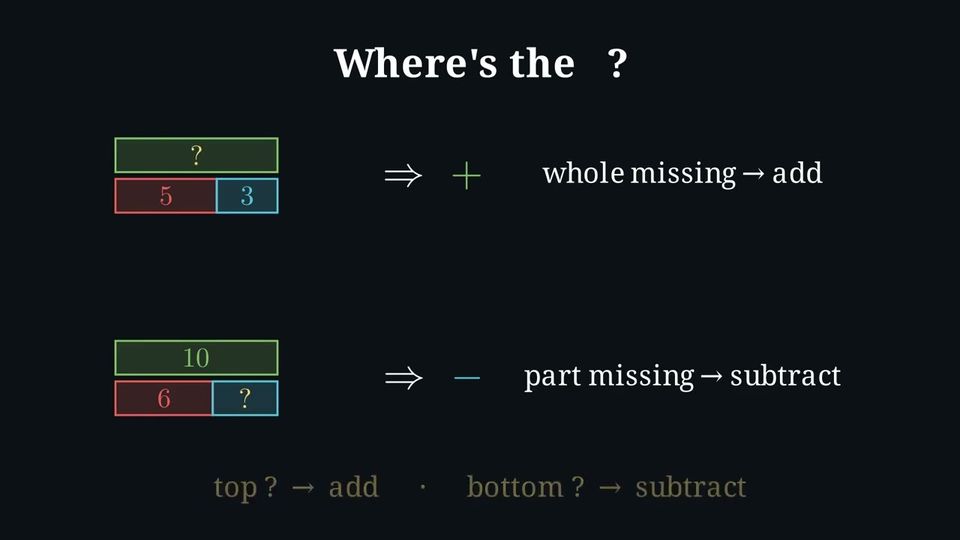
To find the missing number in an equality: - Compute the side you know completely: both sides must be worth the same number.
- Find the missing number with the inverse operation (an addition is undone by a subtraction, a multiplication by a division), or by trying numbers.
- Check: replace the box by the number found and compute both sides.
Example
Find the missing number: \(25 + \square = 40\).
The two sides must be worth \(40\). The inverse of adding \(25\) is subtracting \(25\): \(\square = 40 - 25 = \textbf{15}\).
Check: \(25 + 15 = 40\). \(\checkmark\)
Check: \(25 + 15 = 40\). \(\checkmark\)
Example
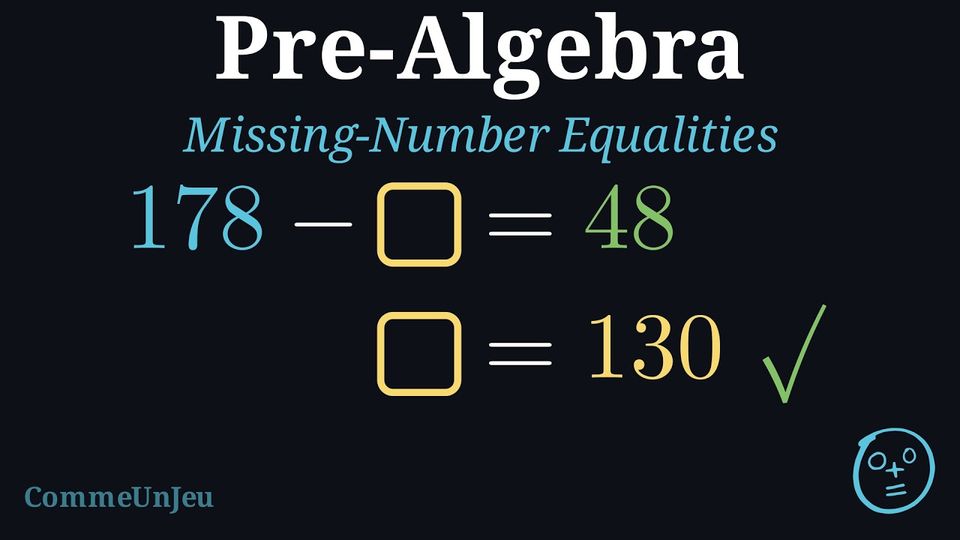
Find the missing number: \(178 - \square = 6 \times 8\).
First compute the right side: \(6 \times 8 = 48\). So \(178 - \square = 48\): the missing number is what must be taken away from \(178\) to reach \(48\), that is \(\square = 178 - 48 = \textbf{130}\).
Check: \(178 - 130 = 48\) and \(6 \times 8 = 48\). \(\checkmark\)
Check: \(178 - 130 = 48\) and \(6 \times 8 = 48\). \(\checkmark\)
Example
Find the missing number: \(\square \times 6 = 42\).
The two sides must be worth \(42\). The inverse of multiplying by \(6\) is dividing by \(6\): \(\square = 42 \div 6 = \textbf{7}\).
Check: \(7 \times 6 = 42\). \(\checkmark\)
Check: \(7 \times 6 = 42\). \(\checkmark\)
Skills to practice
- Finding the Missing Number
- Completing Two-Sided Equalities
- Explaining in Writing
III
The Four Steps of a Problem
A school orders \(1\,250\) notebooks. It hands out \(870\) of them on the first day. How many notebooks are left?
One pupil answers \(2\,120\). Another answers \(380\). Without doing the calculation again, which answer is certainly wrong?
One pupil answers \(2\,120\). Another answers \(380\). Without doing the calculation again, which answer is certainly wrong?
- \(2\,120\) is bigger than the \(1\,250\) notebooks the school had. What is left cannot be more than the whole: this answer is impossible.
- \(380\) is smaller than \(1\,250\): it is possible. Checking confirms it: \(870+380=1\,250\).
- Looking at the answer before believing it is called checking. It is the last step of every problem.
Method — The Four Steps of a Problem
These are the steps already known (understand the story, draw the model, choose the operation, solve and check); here they get short names. Every problem is solved in the same four steps. - Understand: tell the story again in your own words. What is known? What is asked?
- Model: choose the drawing the story calls for — a bar model (parts and a whole, two bars for a comparison, equal groups for a multiplication), or a table or a tree when the cases are to be counted or listed.
- Calculate: the model shows the operation. Mental calculation when the numbers allow it, otherwise the operation is set up in columns.
- Answer and check: write the answer with its word (notebooks, dollars, rows), then ask: is this possible? A part never exceeds the whole; a difference never exceeds the bigger quantity; the whole is never smaller than one of its parts.
Example
A cinema has \(845\) seats. \(617\) are taken. How many seats are free? - Understand: the whole is \(845\) seats; one part is taken, the other part is free.
- Model:
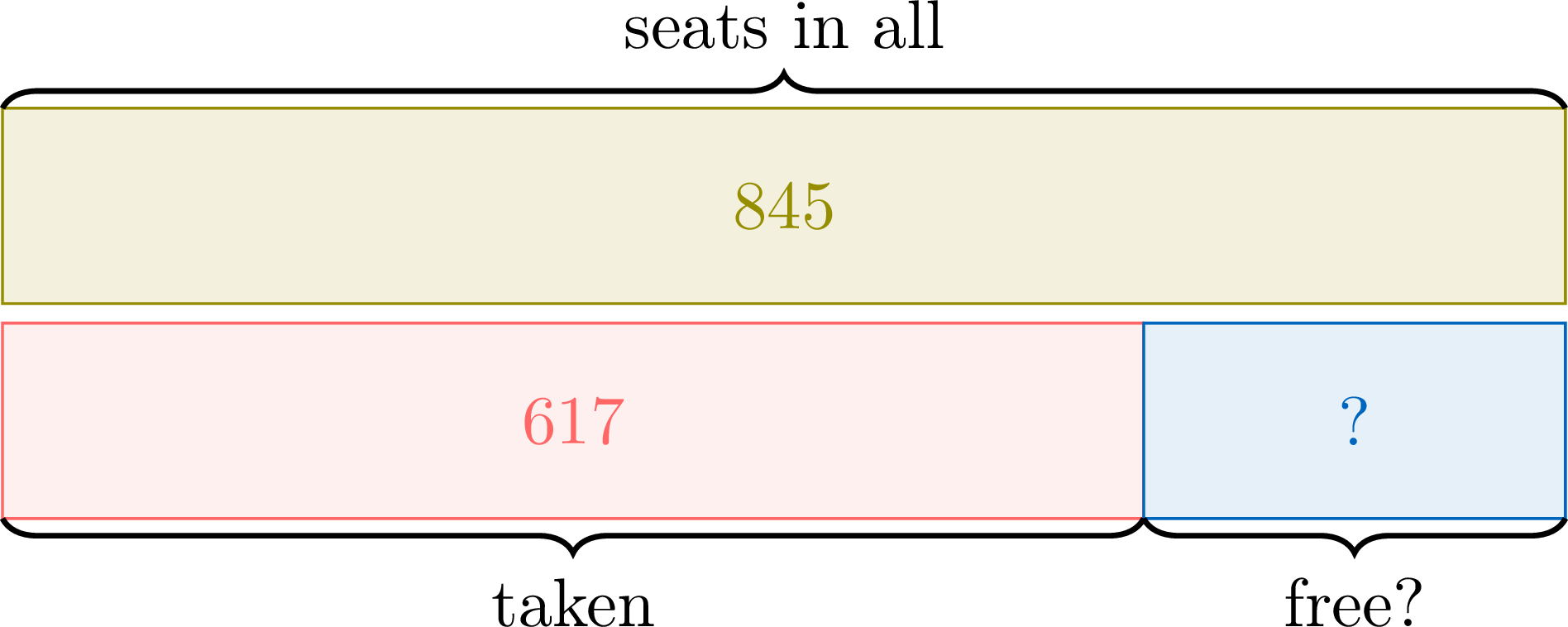
- Calculate: a part is unknown, so we subtract: \(\textcolor{olive}{845}-\textcolor{colordef}{617}=\textcolor{colorprop}{228}\).
- Answer and check: \(228\) seats are free. Is it possible? \(228\) does not exceed \(845\), and \(617+228=845\): yes.
Skills to practice
- Checking Whether an Answer Is Possible
IV
One-Step Problems up to 10 000
This year the library lent \(7\,320\) items: \(4\,815\) books, the rest were DVDs. How many DVDs were lent?
The numbers have four digits. Does the model change?
The numbers have four digits. Does the model change?
- Understand: the whole is the \(7\,320\) items; one part is known (the books), the other part is unknown (the DVDs).
- Model: the bar model is the same as with small numbers.
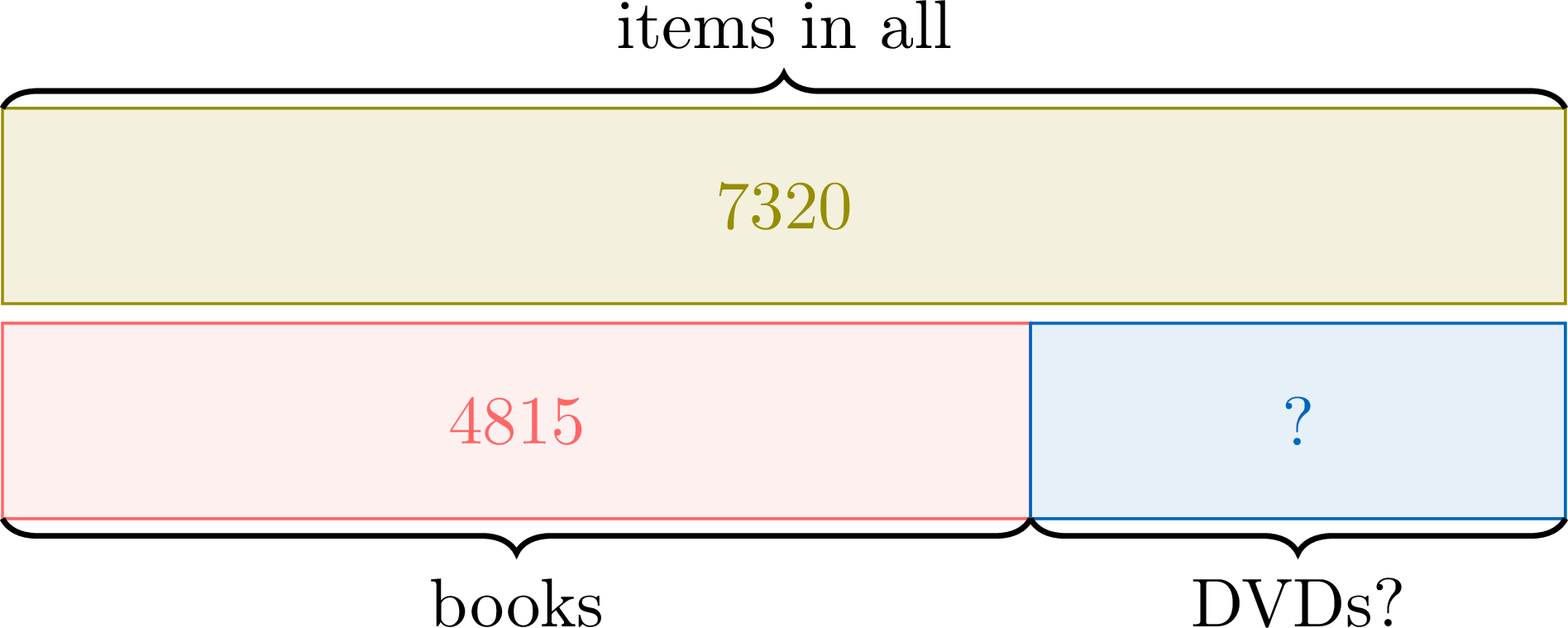
- Calculate: a part is unknown, so we subtract. The numbers are big: the subtraction is set up in columns. $$\textcolor{olive}{7\,320}-\textcolor{colordef}{4\,815}=\textcolor{colorprop}{2\,505}$$
- Answer and check: \(2\,505\) DVDs were lent. Is it possible? \(2\,505\) does not exceed the whole \(7\,320\), and \(4\,815+2\,505=7\,320\): yes.
Method — The Model Does Not Change, the Numbers Grow
With numbers up to \(10\,000\), a one-step problem is read exactly as with smaller numbers. - Part-whole: if the whole is unknown, add the parts; if a part is unknown, subtract.
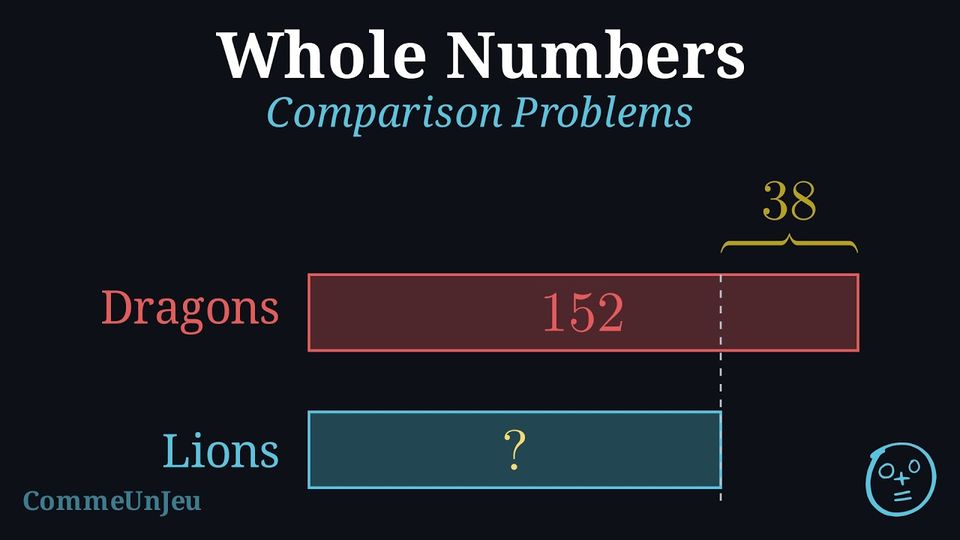
- Comparison: two quantities are compared. To find the bigger, add the difference; to find the smaller, subtract it; to find the difference, subtract the smaller from the bigger.
- Read the model, not the words: “more than” in the story does not mean “add”. The model shows who has more, and the operation follows from the model.
- What changes is only the calculation: mental calculation when the numbers allow it, otherwise the operation is set up in columns.
Example
A cycling club has \(3\,148\) members in the north of the town and \(2\,976\) in the south. How many members does the club have? - Understand: two parts are known, the whole is unknown.
- Model:
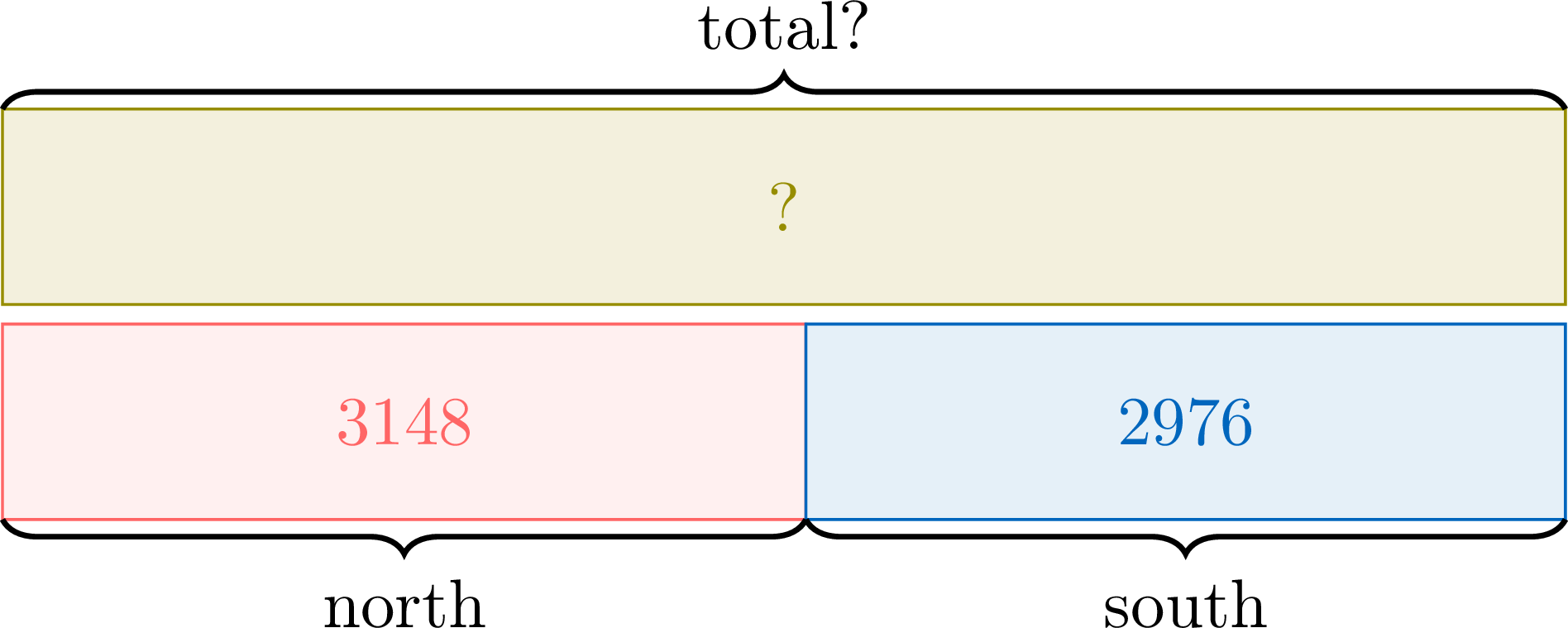
- Calculate: \(\textcolor{colordef}{3\,148}+\textcolor{colorprop}{2\,976}=\textcolor{olive}{6\,124}\).
- Answer and check: the club has \(6\,124\) members. Is it possible? The whole exceeds each part, and \(6\,124-2\,976=3\,148\): yes.
Example
The Nour club has \(4\,205\) members, which is \(1\,380\) more than the Sacha club. How many members does the Sacha club have? - Understand: two clubs are compared. Nour's club has more, so Sacha's club has fewer members: its bar is the shorter one.
- Model:
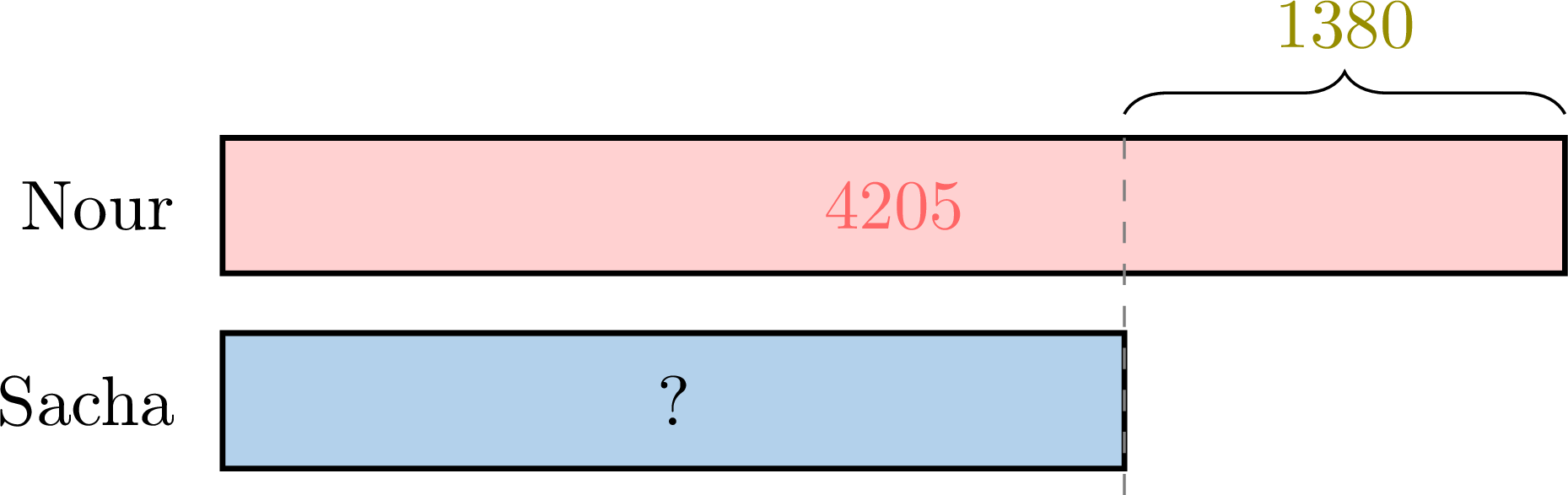
- Calculate: the model shows it: we subtract, even though the story says “more”. $$\textcolor{colordef}{4\,205}-\textcolor{olive}{1\,380}=\textcolor{colorprop}{2\,825}$$
- Answer and check: the Sacha club has \(2\,825\) members. Is it possible? \(2\,825\) is smaller than \(4\,205\), and \(2\,825+1\,380=4\,205\): yes.
Skills to practice
- Finding the Whole
- Finding a Part or the Starting Number
- Finding the Bigger Quantity
- Finding the Smaller Quantity or the Difference
V
Two-Step Problems
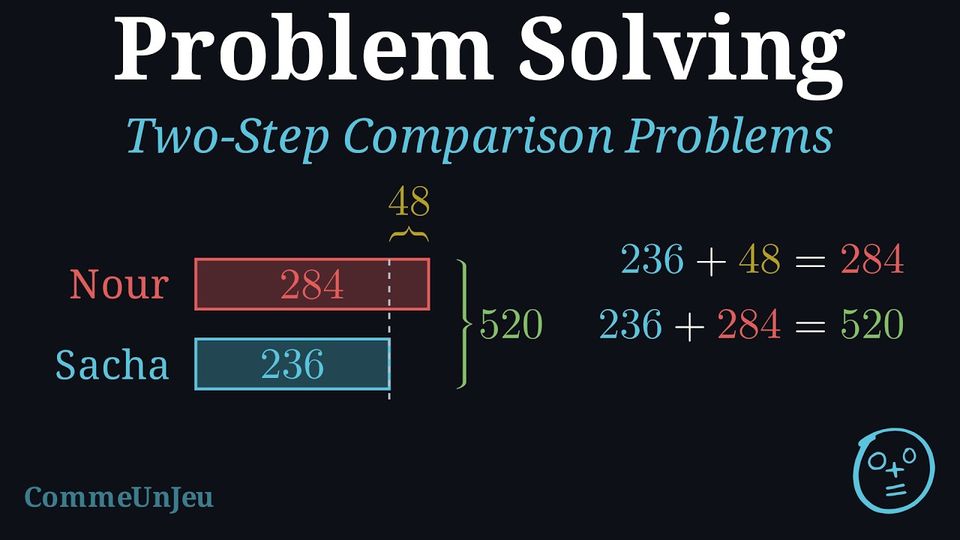
Sacha has \(236\) picture cards. Nour has \(48\) more than Sacha. How many cards do the two children have altogether?
Careful: the question is not about Nour alone.
Careful: the question is not about Nour alone.
- Understand: two children are compared, and the question asks for the whole: the two quantities put together. Nour's number is not given.
- Model: one bar per child, and a brace on the right for the whole.
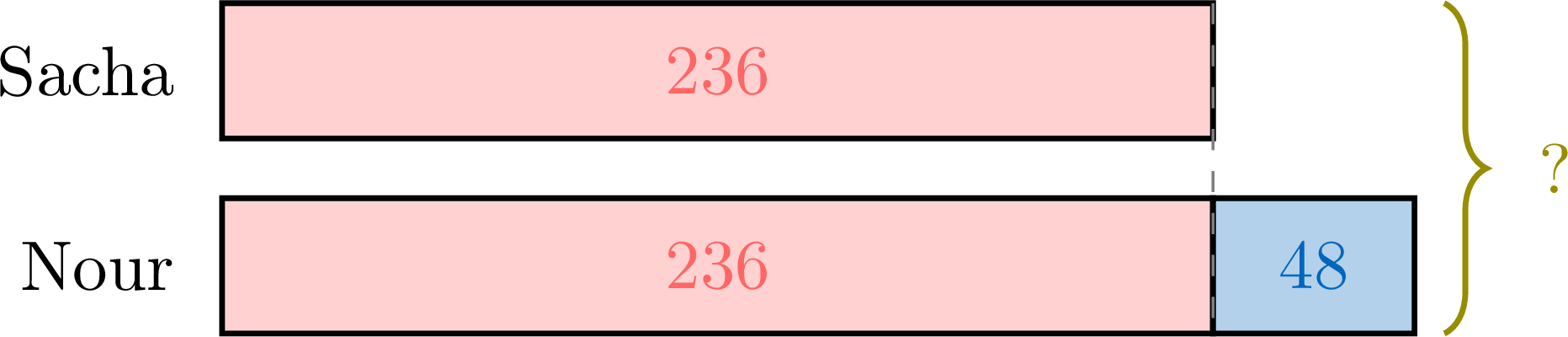
- Step 1: the model shows that Nour's bar is the longer one, so we add the difference. $$\textcolor{colordef}{236}+\textcolor{colorprop}{48}=\textcolor{colorprop}{284} \text{ cards for Nour}$$
- Step 2: the whole is the two bars together. $$\textcolor{colordef}{236}+\textcolor{colorprop}{284}=\textcolor{olive}{520}$$
- Answer and check: the two children have \(520\) cards. Is it possible? The whole exceeds each child's number: yes. Adding \(236+48\) would have given Nour's cards, not the whole.
Method — First the Missing Quantity, Then the Whole
When a comparison problem asks for the whole, one step is not enough: the second quantity is missing. - Step 1 — find the missing quantity. Draw the two bars and look at the model, not at the words: if the missing quantity is the bigger one, add the difference; if it is the smaller one, subtract it.
- Step 2 — add the two quantities to get the whole.
- The brace on the right of the model shows what is being asked: it covers both bars.
- The trap: the difference is never added to the whole. It only serves to build the second bar.
Example
Malo has \(415\) stamps. Iris has \(78\) fewer than Malo. How many stamps do they have altogether? - Understand: Iris has fewer: her bar is the shorter one. The whole is asked.
- Model:
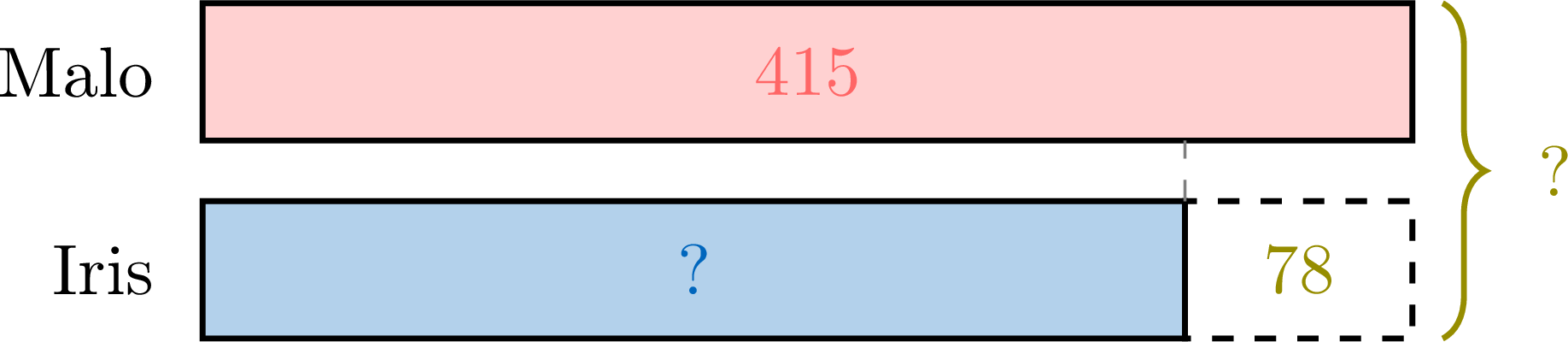
- Step 1: \(\textcolor{colordef}{415}-\textcolor{olive}{78}=\textcolor{colorprop}{337}\) stamps for Iris.
- Step 2: \(\textcolor{colordef}{415}+\textcolor{colorprop}{337}=\textcolor{olive}{752}\).
- Answer and check: they have \(752\) stamps. The whole exceeds \(415\): it is possible.
Example
A shop sold \(1\,250\) books. It sold \(320\) fewer books than magazines. How many items did it sell in all? - Understand: the books are compared to the magazines. The story says “fewer”, and it is the books that are fewer: the magazines are the bigger quantity.
- Model:

- Step 1: the missing quantity is the bigger one, so we add: \(\textcolor{colordef}{1\,250}+\textcolor{colorprop}{320}=\textcolor{colorprop}{1\,570}\) magazines.
- Step 2: \(\textcolor{colordef}{1\,250}+\textcolor{colorprop}{1\,570}=\textcolor{olive}{2\,820}\).
- Answer and check: the shop sold \(2\,820\) items. The whole exceeds each quantity: it is possible.
Skills to practice
- Adding Twice
- Adding Then Subtracting
- Subtracting Twice
- Finding the Whole When the Other Has More
- Finding the Whole When the Other Has Fewer
VI
Multiplicative Problems
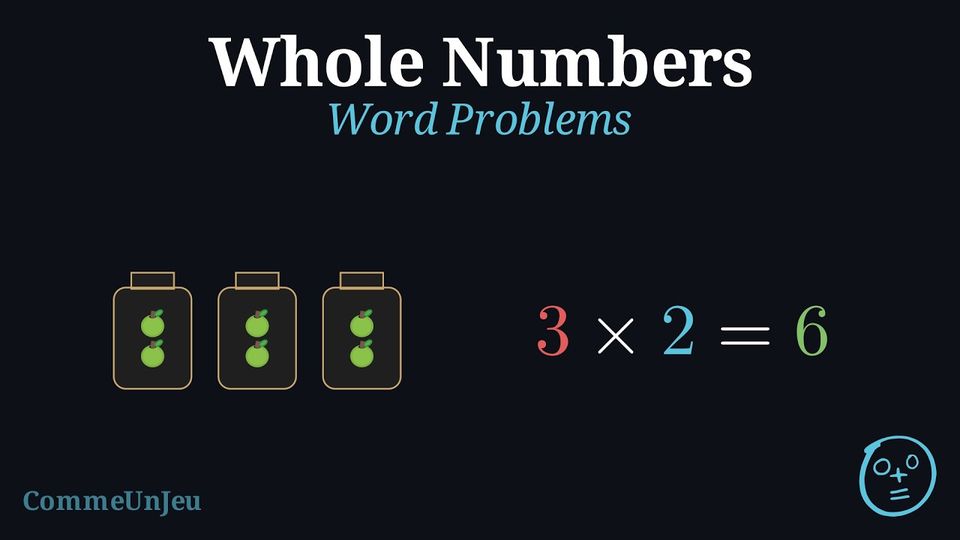
The teacher bought \(6\) identical atlases for the class. She paid \(\dollar 72\). What is the price of one atlas?
- Understand: the \(\dollar 72\) is shared into \(6\) equal parts, one per atlas. The whole is known, the value of one part is unknown.
- Model: one bar for the whole, cut into \(6\) equal groups.
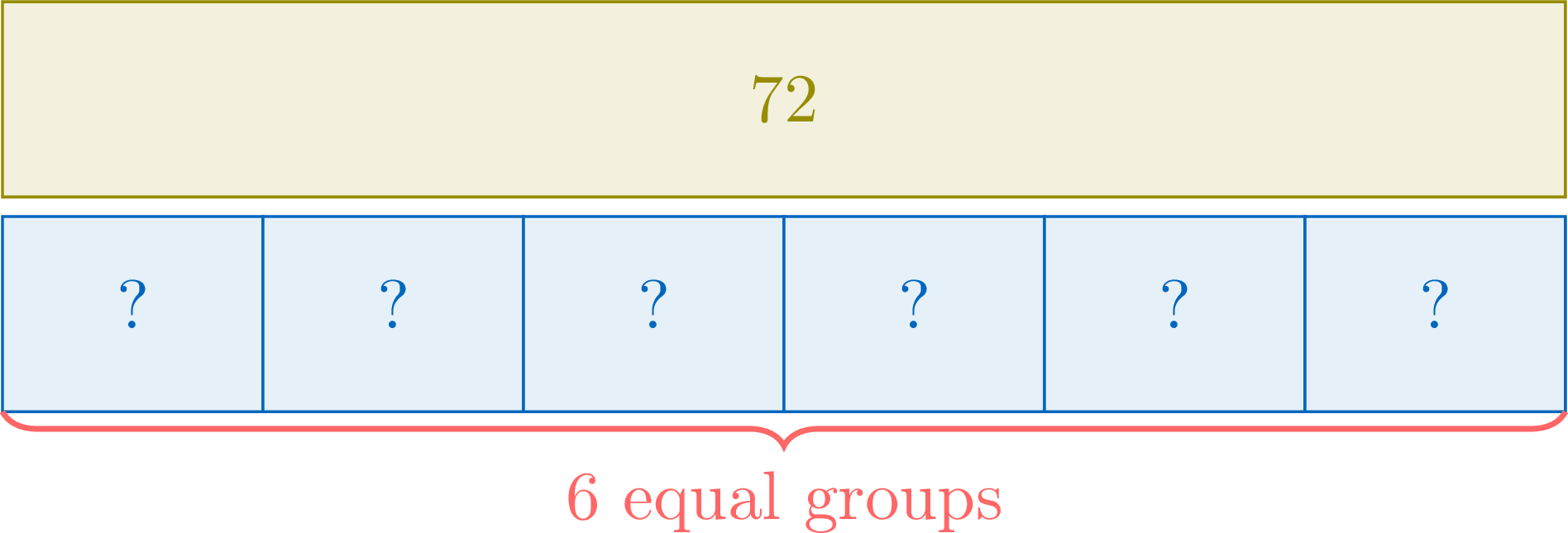
- Calculate: the value of one part is found by dividing. $$\textcolor{olive}{72}\div \textcolor{colordef}{6}=\textcolor{colorprop}{12}$$
- Answer and check: one atlas costs \(\dollar 12\). Is it possible? One part does not exceed the whole, and \(6 \times 12 = 72\): yes.
Method — Three Questions, One Model
In a problem with equal groups, three numbers meet: the number of groups, the value of one group and the whole. Two of them are given, the third is asked. The bar model always shows the same picture — a whole cut into equal groups — and only the place of the “?” changes. - The whole is unknown: multiply the number of groups by the value of one group.
- The value of one group is unknown: divide the whole by the number of groups.
- The number of groups is unknown: divide the whole by the value of one group.
- The two divisions come from the same multiplication: \(\textcolor{colordef}{6} \times \textcolor{colorprop}{12}=\textcolor{olive}{72}\) gives both \(72 \div 6 = 12\) and \(72 \div 12 = 6\).
Example
A delivery holds \(8\) boxes of \(125\) bottles. How many bottles are delivered? - Understand: \(8\) equal groups of \(125\); the whole is unknown.
- Model:
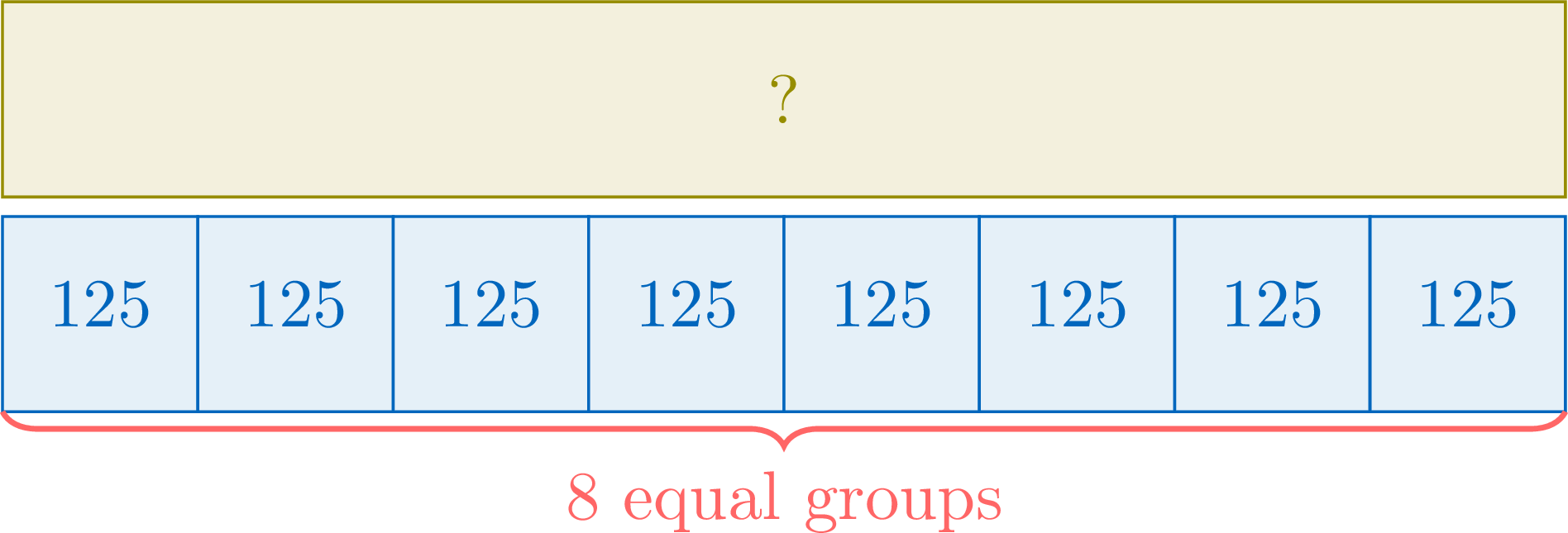
- Calculate: \(\textcolor{colordef}{8} \times \textcolor{colorprop}{125}=\textcolor{olive}{1\,000}\) (the multiplication is set up in columns).
- Answer and check: \(1\,000\) bottles are delivered. The whole exceeds one group: it is possible.
Example
A hall has \(56\) chairs, set out in rows of \(8\). How many rows are there? - Understand: the whole (\(56\)) and the value of one group (\(8\)) are known; the number of groups is unknown.
- Model:
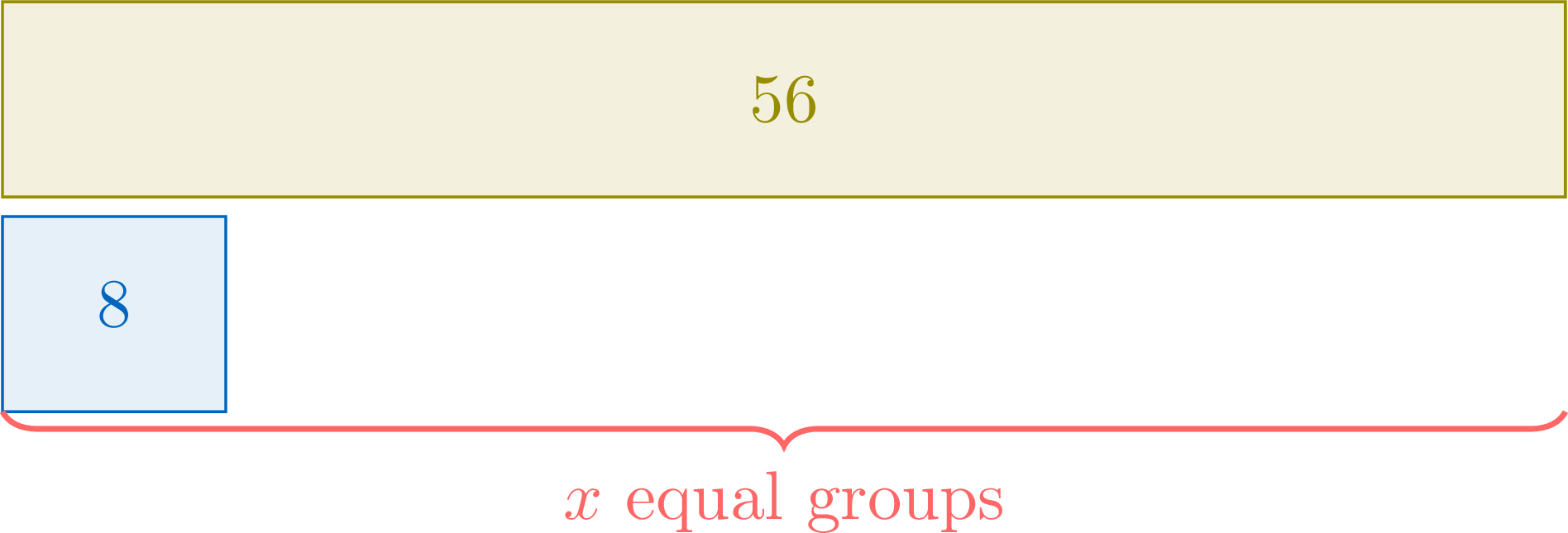
- Calculate: \(\textcolor{olive}{56}\div \textcolor{colorprop}{8}=\textcolor{colordef}{7}\), because \(8 \times 7 = 56\).
- Answer and check: there are \(7\) rows. Fewer rows than chairs: it is possible.
Skills to practice
- Finding the Value of One Part
VII
Times as Many
A helmet costs \(\dollar 32\). A bicycle costs four times as much as the helmet. How much does the bicycle cost?
Careful: “four times as much” is not “four dollars more”.
Careful: “four times as much” is not “four dollars more”.
- Understand: the price of the bicycle is the price of the helmet taken four times. It is not \(\dollar 32\) plus four.
- Model: four equal bars of \(\dollar 32\).
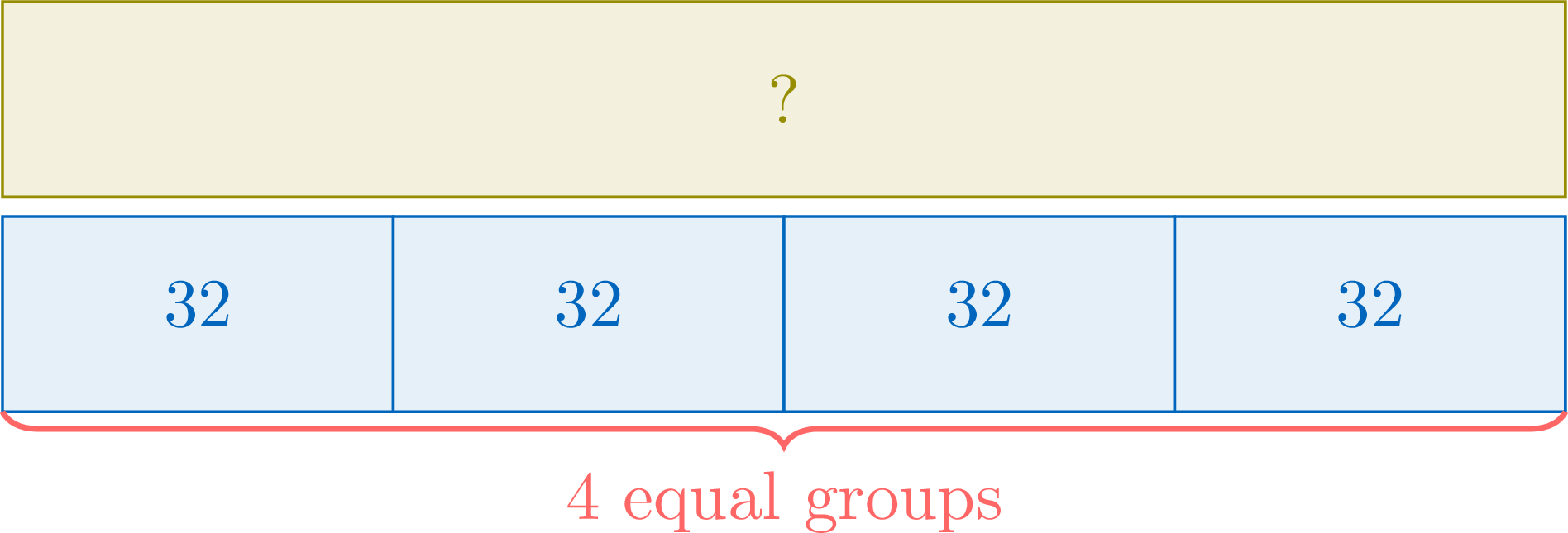
- Calculate: \(\textcolor{colordef}{4} \times \textcolor{colorprop}{32}=\textcolor{olive}{128}\).
- Answer and check: the bicycle costs \(\dollar 128\). Is it possible? It is much more than the helmet, and \(128 \div 4 = 32\): yes. With “four dollars more” the answer would have been \(\dollar 36\), a completely different price.
Method — Four More or Four Times as Many?
Two little words change everything in a comparison. - “four more” adds: the quantity grows by four. This is an addition, and the model shows two bars with a small difference.
- “four times as many” (“four times as much” for a price) repeats: the quantity is taken four times. This is a multiplication, and the model shows four equal bars.
- “a quarter as many” shares: the quantity is cut into four equal parts. This is a division.
- To choose, ask: does the story add something, or does it repeat the quantity? With \(32\): four more gives \(36\), four times as many gives \(128\), a quarter as many gives \(8\).
Example
Léa has \(7\) marbles. Sacha has \(5\) more than Léa. Nour has \(5\) times as many as Léa. How many marbles does each of Sacha and Nour have? - Sacha: “\(5\) more” adds: \(\textcolor{colordef}{7}+\textcolor{olive}{5}=\textcolor{colorprop}{12}\) marbles.
- Nour: “\(5\) times as many” repeats: \(\textcolor{olive}{5} \times \textcolor{colordef}{7}=\textcolor{colorprop}{35}\) marbles.
- Check: the same two numbers \(7\) and \(5\) give \(12\) or \(35\) depending on the two words: it is the story that decides, not the numbers.
Example
A game costs \(\dollar 45\): three times as much as a book. How much does the book cost? - Understand: the game costs three times as much as the book, so the price of the book is the \(\dollar 45\) shared into three equal parts.
- Model:
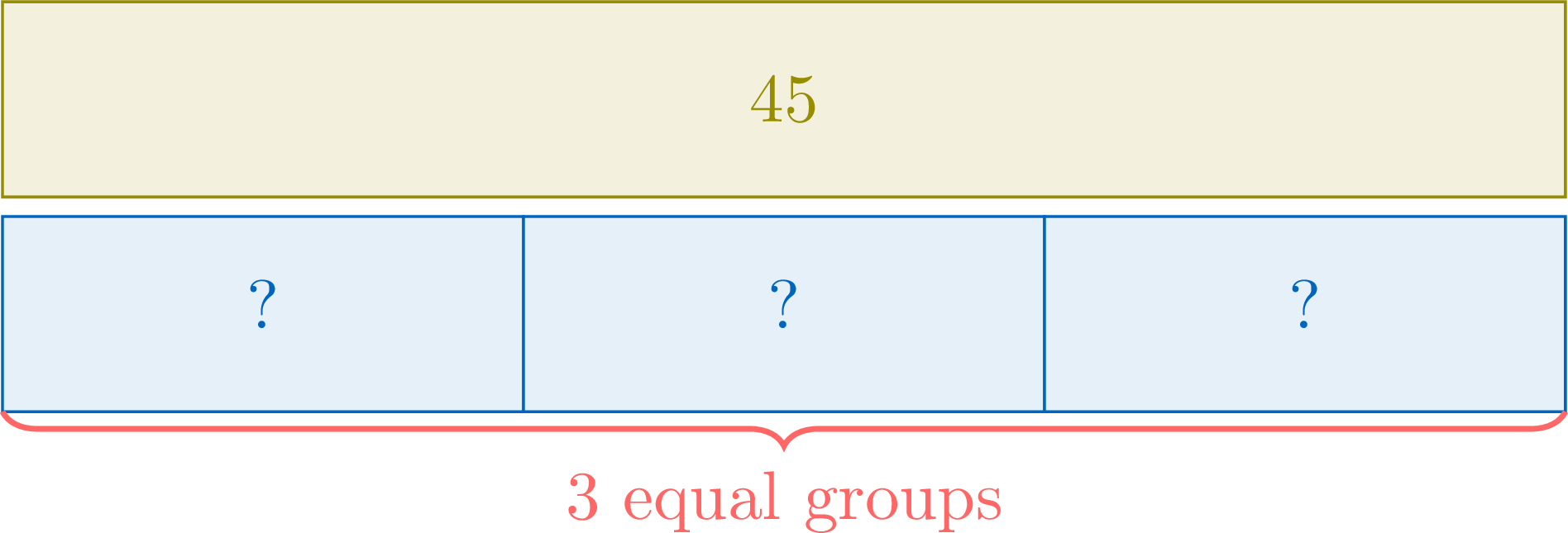
- Calculate: \(\textcolor{olive}{45}\div \textcolor{colordef}{3}=\textcolor{colorprop}{15}\).
- Answer and check: the book costs \(\dollar 15\). It is cheaper than the game, and \(3 \times 15 = 45\): it is possible.
Skills to practice
- Choosing Between More and Times as Many
- Using Times as Many
VIII
Counting Pairs with a Table or a Tree
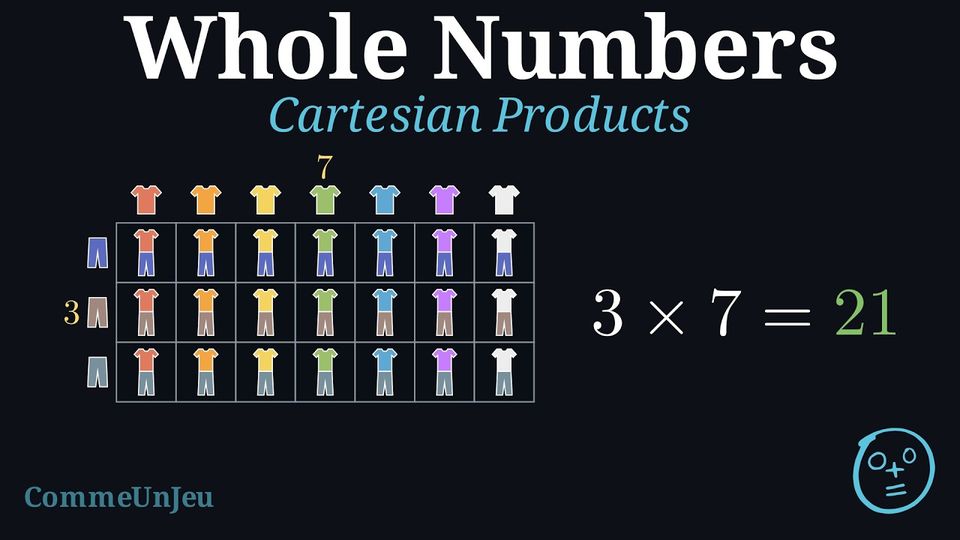
A doll comes with \(3\) pairs of trousers and \(7\) T-shirts. In how many different ways can the doll be dressed?
Each outfit is one pair of trousers and one T-shirt.
Each outfit is one pair of trousers and one T-shirt.
- Understand: nothing is added and nothing is shared: we must count the pairs, one pair of trousers with one T-shirt.
- Model: a table, one row per pair of trousers (Tr1 to Tr3), one column per T-shirt (T1 to T7). Each cell is one outfit.
\textcolor{colorprop}{T1} \textcolor{colorprop}{T2} \textcolor{colorprop}{T3} \textcolor{colorprop}{T4} \textcolor{colorprop}{T5} \textcolor{colorprop}{T6} \textcolor{colorprop}{T7} \textcolor{colordef}{Tr1} \(\textcolor{olive}{\checkmark}\) \(\textcolor{olive}{\checkmark}\) \(\textcolor{olive}{\checkmark}\) \(\textcolor{olive}{\checkmark}\) \(\textcolor{olive}{\checkmark}\) \(\textcolor{olive}{\checkmark}\) \(\textcolor{olive}{\checkmark}\) \textcolor{colordef}{Tr2} \(\textcolor{olive}{\checkmark}\) \(\textcolor{olive}{\checkmark}\) \(\textcolor{olive}{\checkmark}\) \(\textcolor{olive}{\checkmark}\) \(\textcolor{olive}{\checkmark}\) \(\textcolor{olive}{\checkmark}\) \(\textcolor{olive}{\checkmark}\) \textcolor{colordef}{Tr3} \(\textcolor{olive}{\checkmark}\) \(\textcolor{olive}{\checkmark}\) \(\textcolor{olive}{\checkmark}\) \(\textcolor{olive}{\checkmark}\) \(\textcolor{olive}{\checkmark}\) \(\textcolor{olive}{\checkmark}\) \(\textcolor{olive}{\checkmark}\) - Calculate: the table has \(\textcolor{colordef}{3}\) rows of \(\textcolor{colorprop}{7}\) cells: \(\textcolor{colordef}{3} \times \textcolor{colorprop}{7}=\textcolor{olive}{21}\) outfits.
- Answer and check: there are \(21\) outfits. Is it possible? Each pair of trousers gives \(7\) outfits, and \(7+7+7=21\): yes.
Method — A Table for Two Sets, a Tree for Three
Some problems ask how many pairs can be formed, without adding or sharing anything. - Two sets: draw a table, one row per object of the first set, one column per object of the second. Each cell is one possible choice, and the number of cells is the product of the two numbers.
- Three sets: draw a tree. From each branch of the first set, draw one branch per object of the second set, then one branch per object of the third. The number of final branches is the product of the three numbers.
- The table and the tree do not only give the number: they show all the solutions, which is how the answer is checked.
Example
A bakery offers \(4\) kinds of bread and \(5\) kinds of jam. How many bread-and-jam pairs can be made? - Model: a table with \(4\) rows and \(5\) columns.
\textcolor{colorprop}{J1} \textcolor{colorprop}{J2} \textcolor{colorprop}{J3} \textcolor{colorprop}{J4} \textcolor{colorprop}{J5} \textcolor{colordef}{B1} \(\textcolor{olive}{\checkmark}\) \(\textcolor{olive}{\checkmark}\) \(\textcolor{olive}{\checkmark}\) \(\textcolor{olive}{\checkmark}\) \(\textcolor{olive}{\checkmark}\) \textcolor{colordef}{B2} \(\textcolor{olive}{\checkmark}\) \(\textcolor{olive}{\checkmark}\) \(\textcolor{olive}{\checkmark}\) \(\textcolor{olive}{\checkmark}\) \(\textcolor{olive}{\checkmark}\) \textcolor{colordef}{B3} \(\textcolor{olive}{\checkmark}\) \(\textcolor{olive}{\checkmark}\) \(\textcolor{olive}{\checkmark}\) \(\textcolor{olive}{\checkmark}\) \(\textcolor{olive}{\checkmark}\) \textcolor{colordef}{B4} \(\textcolor{olive}{\checkmark}\) \(\textcolor{olive}{\checkmark}\) \(\textcolor{olive}{\checkmark}\) \(\textcolor{olive}{\checkmark}\) \(\textcolor{olive}{\checkmark}\) - Calculate: \(\textcolor{colordef}{4} \times \textcolor{colorprop}{5}=\textcolor{olive}{20}\) cells.
- Answer and check: \(20\) pairs can be made. Each bread gives \(5\) pairs: \(5+5+5+5=20\): it is possible.
Example
To dress up, a clown has \(2\) hats (red and blue), \(3\) T-shirts (purple, black and yellow) and \(2\) pairs of trousers (grey and green). How many complete costumes can the clown make? - Understand: a costume is a hat, a T-shirt and a pair of trousers: three sets, so a tree.
- Model:
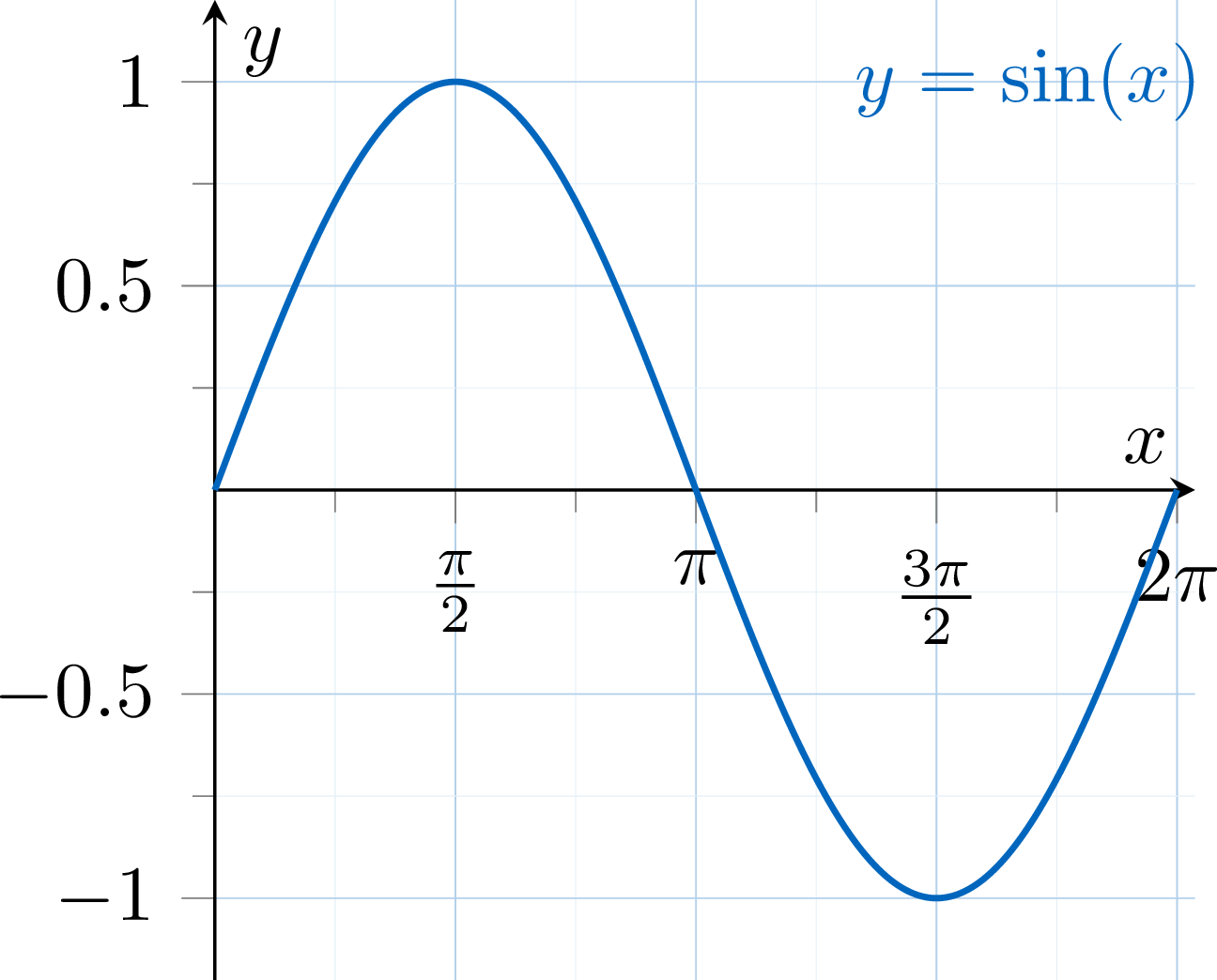
- Calculate: \(\textcolor{colordef}{2} \times \textcolor{colorprop}{3} \times \textcolor{olive}{2}=12\) final branches.
- Answer and check: the clown can make \(12\) costumes. The tree shows the twelve of them, one per final branch: it is possible.
Skills to practice
- Counting with a Table
- Counting with a Tree
IX
Mixed Problems in Two or Three Steps
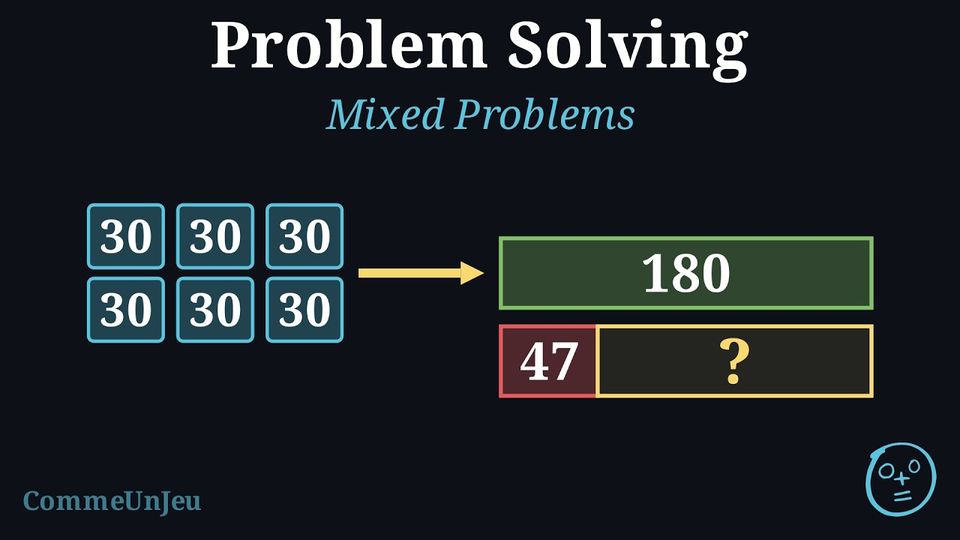
In a restaurant there are \(4\) tables of \(6\) people and \(7\) tables of \(4\) people. How many customers can the restaurant seat?
- Understand: two kinds of tables. The question asks for the whole, but neither number of seats is given: each one has to be found first.
- Model: equal groups twice, then a part-whole.
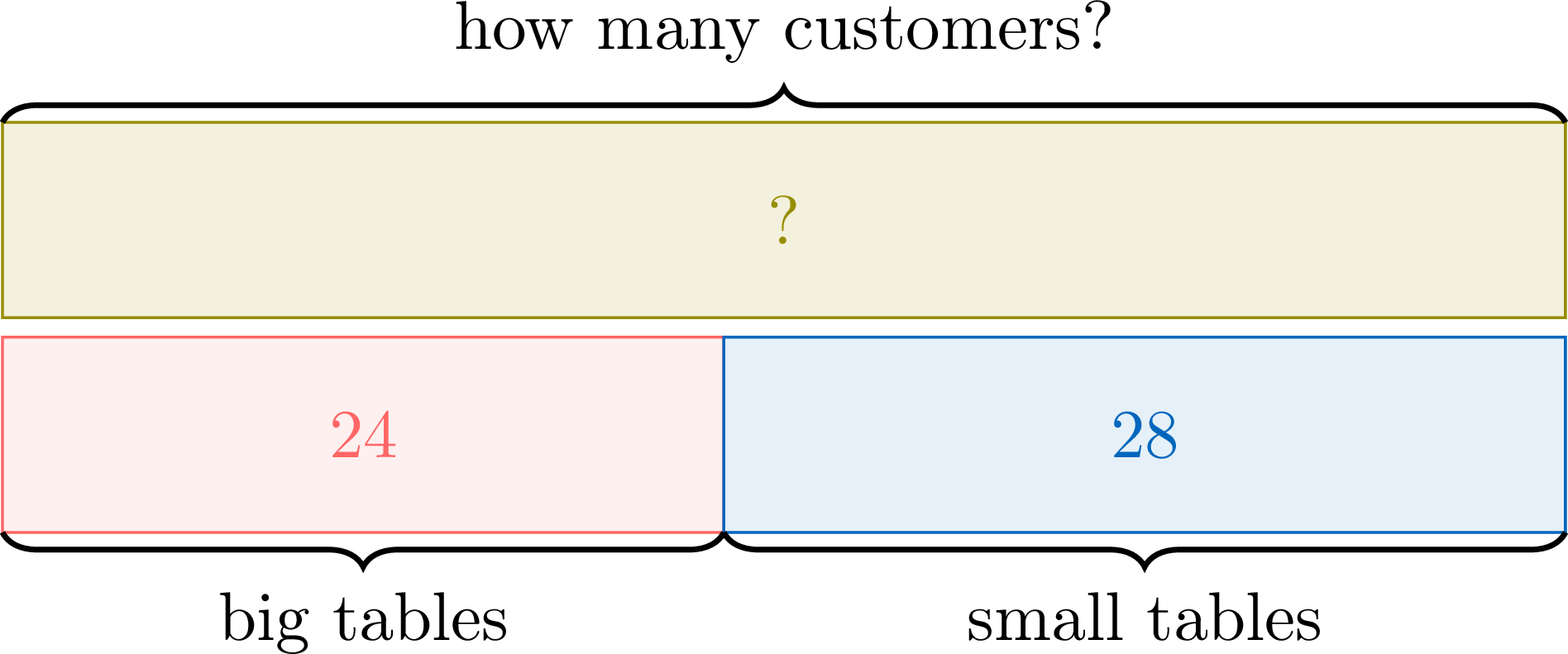
- Step 1: \(\textcolor{colordef}{4} \times \textcolor{colordef}{6}=\textcolor{colorprop}{24}\) seats at the big tables.
- Step 2: \(\textcolor{colordef}{7} \times \textcolor{colordef}{4}=\textcolor{colorprop}{28}\) seats at the small tables.
- Step 3: \(\textcolor{colorprop}{24}+\textcolor{colorprop}{28}=\textcolor{olive}{52}\).
- Answer and check: the restaurant can seat \(52\) customers. Is it possible? There are \(11\) tables of at most \(6\) people, so fewer than \(66\) seats: yes.
Method — One Step at a Time
A mixed problem needs several operations, and they are not of the same kind. - Find the hidden numbers first. Every number the question needs but the story does not give is a step of its own.
- Write each step with its word: “\(24\) seats at the big tables”, not just “\(24\)”. That is how a step is checked before the next one is started.
- Then combine: the last step is read in the story like the first — add if the quantities are put together, subtract if one is taken from the other, multiply if a quantity is repeated, divide if it is shared.
- Check at the end: the answer must be possible for the whole story, not only for the last calculation.
Example
A school orders \(8\) packs of \(25\) notebooks. It hands out \(145\) notebooks to the pupils. How many notebooks are left? - Step 1: the total number of notebooks is hidden: \(\textcolor{colordef}{8} \times \textcolor{colordef}{25}=\textcolor{colorprop}{200}\) notebooks.
- Step 2: \(\textcolor{colorprop}{200}-\textcolor{colordef}{145}=\textcolor{olive}{55}\).
- Answer and check: \(55\) notebooks are left. What is left does not exceed the \(200\) ordered: it is possible.
Skills to practice
- Multiplying Then Adding or Subtracting
- Solving Problems in Three Steps
X
Going further
Skills to practice
- Multi-Step Problems
- Quiz
Jump to section