International Baccalaureate · PYP 3
Numbers to 10 000
I
Place Value
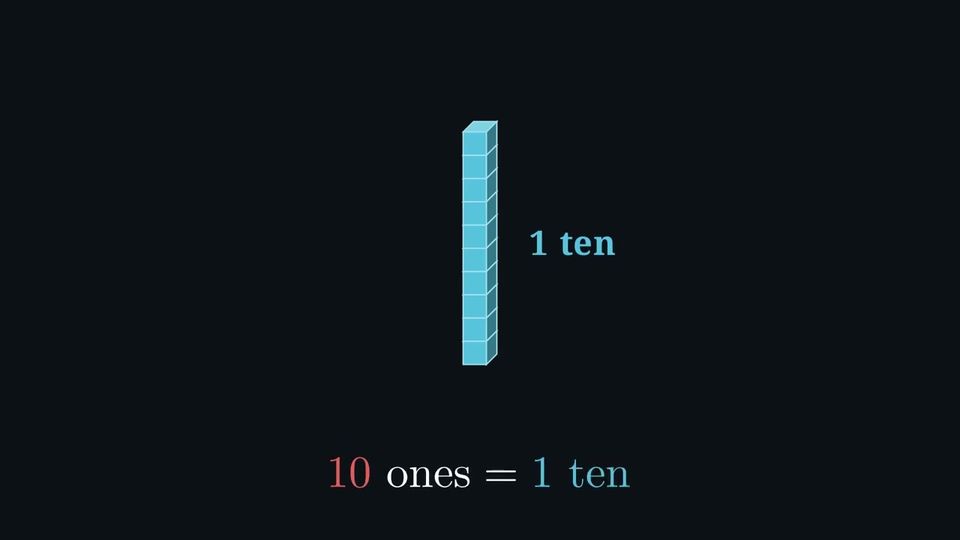
We already know how to group ones into tens, and tens into hundreds. To build larger numbers, we follow the same pattern.
This table shows we have 1 thousand, 2 hundreds, 4 tens, and 3 ones. This makes the number \(\mathbf{1\,243}\).
- We group 10 hundreds together to make 1 thousand:
 = \(10\) hundreds = \(1\) thousand =

| Thousands | Hundreds | Tens | Ones |
| 1 | 2 | 4 | 3 |
| |  |  |  |
Definition — 4-Digit Number
A 4-digit number is a whole number written with four digits; it ranges from \(1\,000\) to \(9\,999\). In the base-10 system, the place of a digit tells us its value. We can show a number like \(1\,243\) in many different ways: - With digits: $$1\,243$$
- In expanded form: $$\begin{aligned}[t] 1\text{ thousand }&+& 2\text{ hundreds }&+& 4\text{ tens }&+& 3\text{ ones }\\ 1\,000 &+& 200 &+& 40 &+& 3 \end{aligned}$$
- With words:
one thousand two hundred forty-three - In a place value table:
Thousands Hundreds Tens Ones 1 2 4 3 - With cubes:

Definition — Ten Thousand
We know how to group \(10\) hundreds into one thousand. We group one step further: \(10\) thousands make one ten thousand.  = \(10\) thousands = \(1\) ten thousand
| Ten thousands | Thousands | Hundreds | Tens | Ones |
| \(1\) | \(0\) | \(0\) | \(0\) | \(0\) |
Method — The Number Just After 9 999
In \(9\,999\), every place is full: \(9\) thousands, \(9\) hundreds, \(9\) tens and \(9\) ones. We count one step forward and regroup each time a place reaches ten. - The ones overflow. \(9\) ones and \(1\) more make \(10\) ones: \(1\) ten and \(0\) ones.
- The tens overflow. That new ten joins the \(9\) tens: \(10\) tens, that is \(1\) hundred and \(0\) tens.
- The hundreds overflow. That new hundred joins the \(9\) hundreds: \(10\) hundreds, that is \(1\) thousand and \(0\) hundreds.
- The thousands overflow in turn. That new thousand joins the \(9\) thousands: \(10\) thousands, that is \(1\) ten thousand and \(0\) thousands.
| Ten thousands | Thousands | Hundreds | Tens | Ones | |
| \(9\,999\) | \(9\) | \(9\) | \(9\) | \(9\) | |
| \(10\,000\) | \(1\) | \(0\) | \(0\) | \(0\) | \(0\) |
Method — Writing a Number in Many Ways
The same number \(4\,635\) can be written in many ways. Going from one to another is the point. - In digits: \(4\,635\).
- In thousands, hundreds, tens and ones: \(4\) thousands, \(6\) hundreds, \(3\) tens and \(5\) ones.
- In tens and ones: hide the ones digit, what is left counts the tens: \(463\) tens and \(5\) ones. In the same way, hide the last two digits: \(46\) hundreds and \(35\) ones.
- As a sum of products: \((4 \times 1\,000) + (6 \times 100) + (3 \times 10) + (5 \times 1)\).
- As a sum: \(4\,000 + 600 + 30 + 5\).
- In words: four thousand six hundred thirty-five.
Method — Counting When a Unit Overflows
A collection is not always sorted neatly: it may hold more than nine of one unit. Then we regroup, from the ones upwards, before writing the number. - Ones: \(17\) ones are \(1\) ten and \(7\) ones. The ones digit is \(7\); the ten is carried to the tens.
- Tens: \(8\) tens and \(1\) carried make \(9\) tens. The tens digit is \(9\).
- Hundreds: \(32\) hundreds are \(3\) thousands and \(2\) hundreds. The hundreds digit is \(2\); the \(3\) thousands are carried.
- Thousands: \(2\) thousands and \(3\) carried make \(5\) thousands.
Example
A company needs \(1\,235\) air filters. To get a good price, it only buys lots of one hundred filters. How many lots must it buy to have enough?
Hide the last two digits of \(1\,235\): it holds \(12\) complete hundreds, and \(35\) filters more. With \(12\) lots the company would have \(1\,200\) filters — not enough. It needs one more lot: \(13\) lots, that is \(1\,300\) filters, and \(65\) will be left over.
Skills to practice
- Counting Cubes in a Table
- Counting from a Table
- Finding the Digit
- Writing Numbers from Thousands, Hundreds, Tens and Ones
- Regrouping Hundreds into Thousands
- Reaching Ten Thousand
- Converting Between Units
- Counting When a Unit Overflows
- Going from Products to Digits and Back
- Counting Lots of a Hundred
II
Number Names
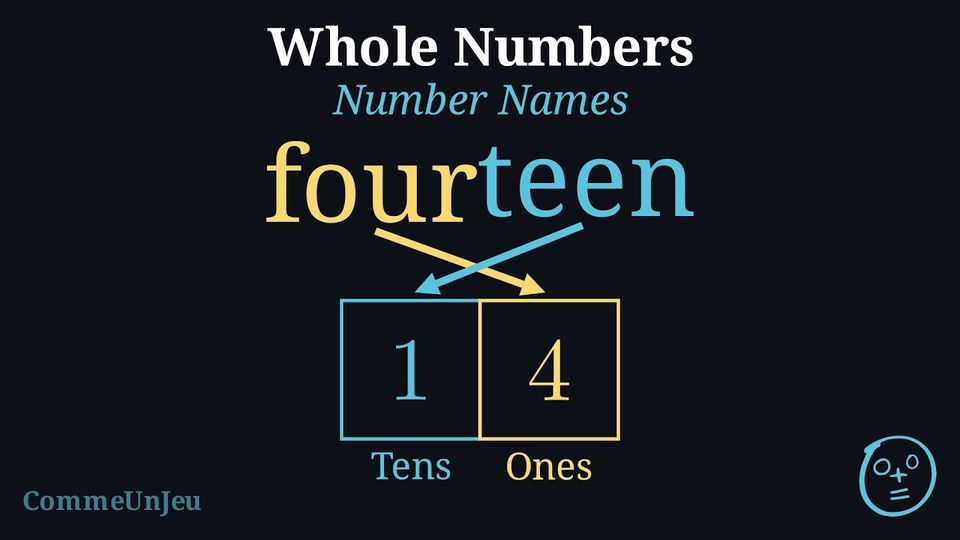
Definition — The Names of the Thousands
Past nine hundred ninety-nine, the names of the numbers use the word thousand: we say how many thousands, then the rest of the number as before. | Number | Name |
| \(1\,000\) | one thousand |
| \(2\,000\) | two thousand |
| \(3\,000\) | three thousand |
| \(4\,000\) | four thousand |
| \(5\,000\) | five thousand |
| \(6\,000\) | six thousand |
| \(7\,000\) | seven thousand |
| \(8\,000\) | eight thousand |
| \(9\,000\) | nine thousand |
| \(10\,000\) | ten thousand |
Writing Numbers in Words
To write a number in words, say it and write what you say, place by place: four thousand, six hundred, thirty-five. In English the tens and the ones are joined by a hyphen: thirty-five, forty-two.
Skills to practice
- Writing Numbers from Their Names
- Writing Numbers in Words
III
On the Number Line
Example
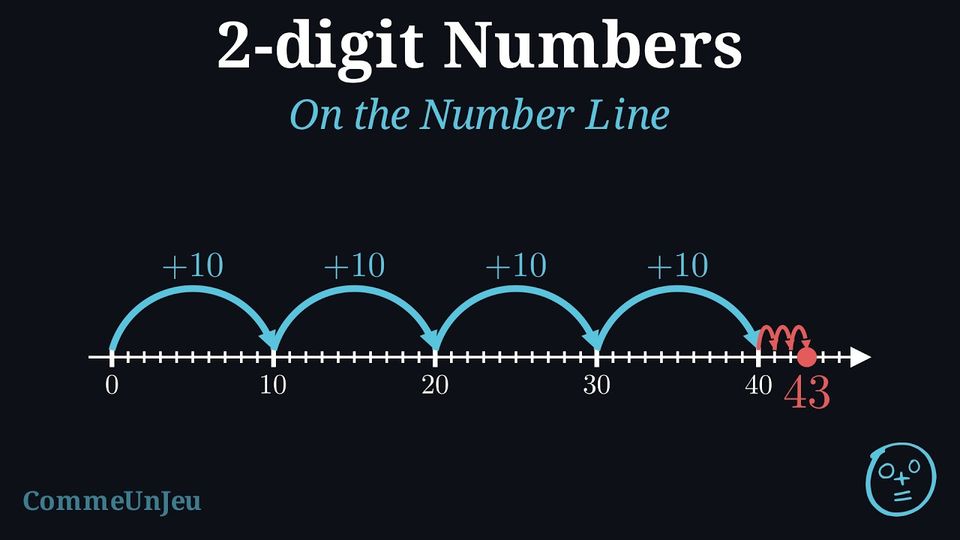
On this number line, the marks do not go up one by one. What number does \(x\) stand for? 
- First, read the step. From one mark to the next, the number goes up by \(1\,000\): \(0\), then \(1\,000\), then \(2\,000\), then \(3\,000\). The step is \(1\,000\), not \(1\).
- Then, take one more step. After \(3\,000\) comes \(3\,000 + 1\,000\).
- So \(x = 4\,000\).
Method — Placing a 4-Digit Number on the Number Line
A number line starts at \(0\) and goes to the right; its marks are evenly spaced, and from one mark to the next we always add the same number, the step. Often only a part of it is drawn, which starts at another number. To place a number on it: - Read the step. Between two written numbers, count the steps and share the difference: from \(2\,000\) to \(2\,200\) there are \(2\) steps, so the step is \(100\).
- Find the two written numbers around the number. \(2\,700\) is between \(2\,600\) and \(2\,800\).
- Count the marks from the nearest written number. From \(2\,600\), one step of \(100\): \(2\,700\) is the very next mark.
- Mark the point on the line.
 {\small In green: \(2\,700\), one mark after \(2\,600\).}
Skills to practice
- Reading a Number on the Number Line
- Completing the Number Strip
- Placing a Number on the Number Line
IV
Going further
Skills to practice
- Finding the Step of a Number Line
- Problems
- Quiz
Jump to section