International Baccalaureate · PYP 3
Turns and Angles
I
Turning to Face North, East, South or West
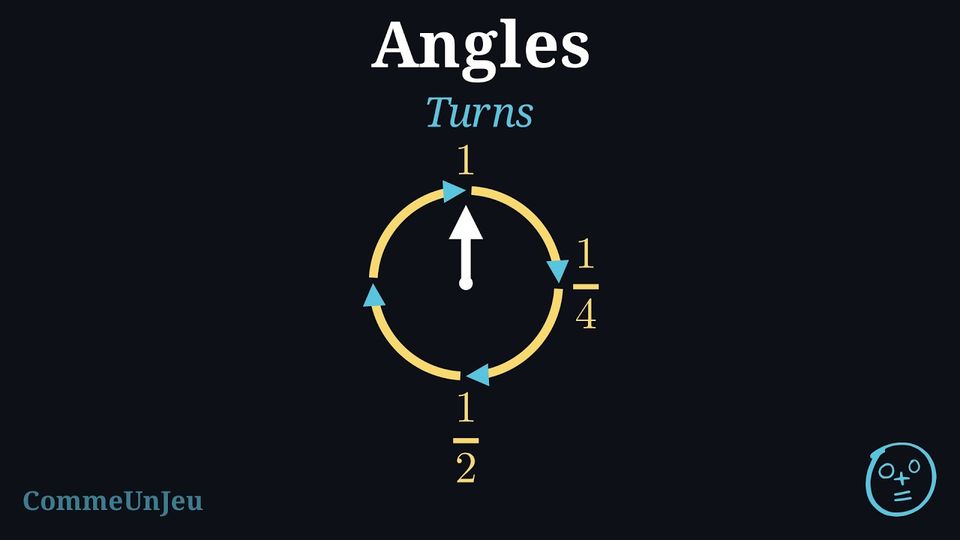
Definition — Three-Quarter Turn
Three quarter turns in a row, in the same direction: only one quarter turn is missing to make a whole turn. This is called a three-quarter turn. 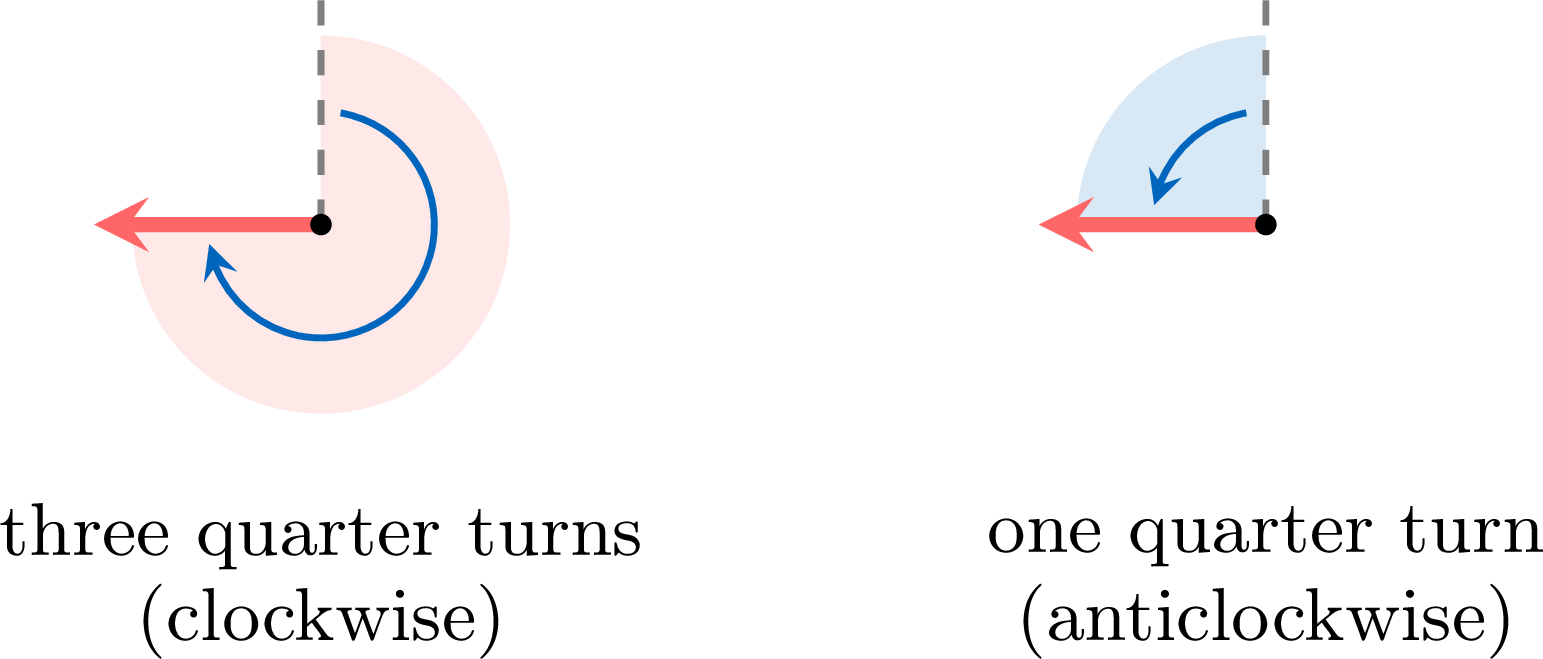
Method — Turning to Face a Compass Direction
On a compass rose, the four directions come one after the other in the clockwise order North, East, South, West, then North again. 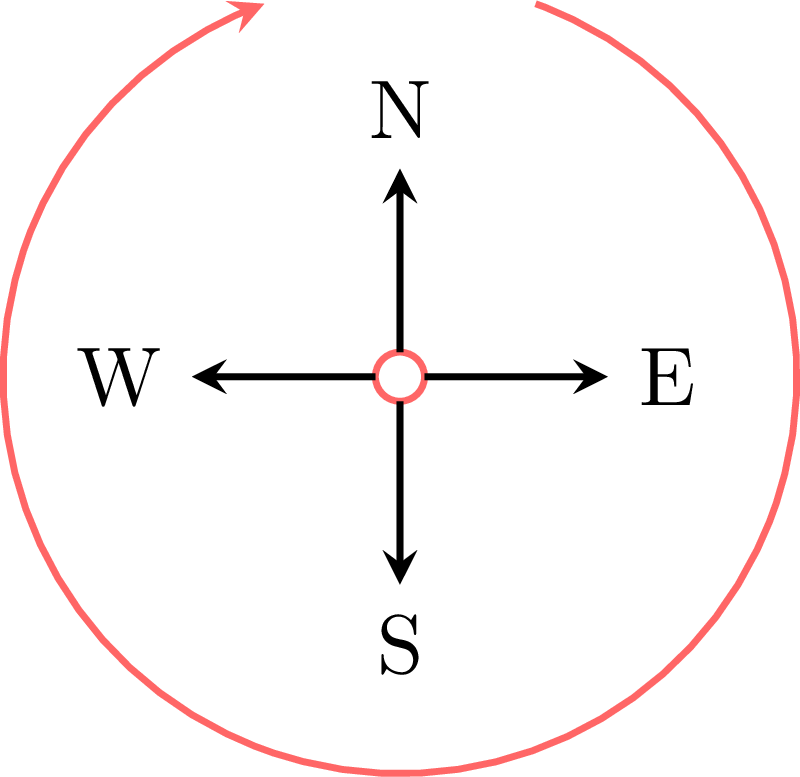
- Start: find on the compass rose the direction we face.
- Count the quarter turns: \(1\) for a quarter turn, \(2\) for a half turn, \(3\) for a three-quarter turn.
- Move round the compass rose, one direction for each quarter turn: clockwise in the order N, E, S, W; anticlockwise in the order N, W, S, E.
Example
Mia stands facing North. Which direction does she face after: - [(a)] a quarter turn clockwise?
- [(b)] a half turn?
- [(c)] a three-quarter turn clockwise?
- [(d)] a quarter turn anticlockwise?
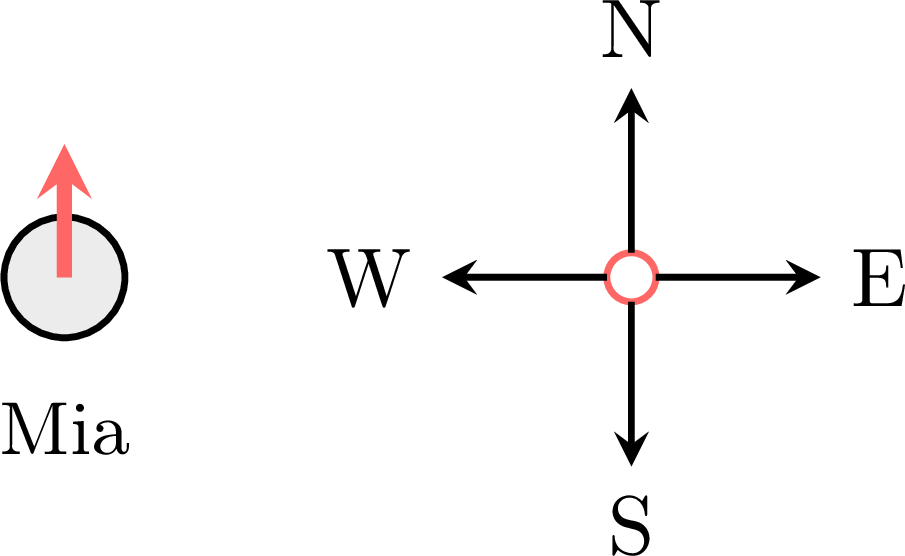
- [(a)] One step clockwise round the compass rose: from North to East.
- [(b)] Two steps: North, East, then South — the opposite of North.
- [(c)] Three steps clockwise: North, East, South, then West.
- [(d)] One step anticlockwise: from North to West.
Skills to practice
- Facing a Compass Direction After a Turn
II
What is an Angle?
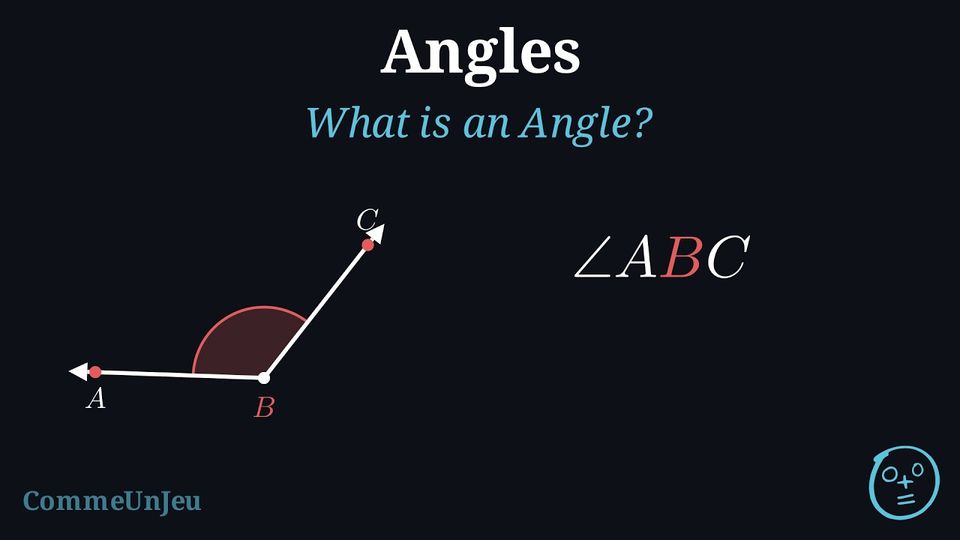
Definition — Angle
An angle is made of two rays that start from the same point, the vertex; they are its arms (or sides). Its size is its opening: the amount of turn that brings one arm onto the other. The length of the arms drawn makes no difference. 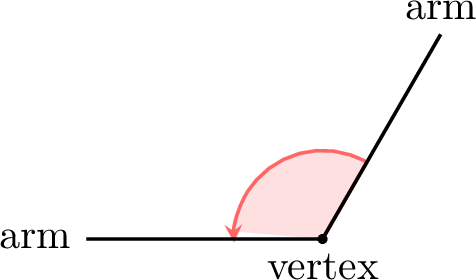
Method — Comparing Two Angles with a Template
To decide which of two angles is more open, without measuring anything: - Copy the first angle on tracing paper, or cut it out of card: that is the template.
- Lay the template on the second angle: its vertex on the vertex, one of its sides along one side.
- Look at the other side: if it stays inside, the first angle is less open; if it goes past, the first is more open; if the two sides match, the angles have the same opening.
Example
Compare the angles \(\Angle{ABC}\) and \(\Angle{DEF}\) with tracing paper. 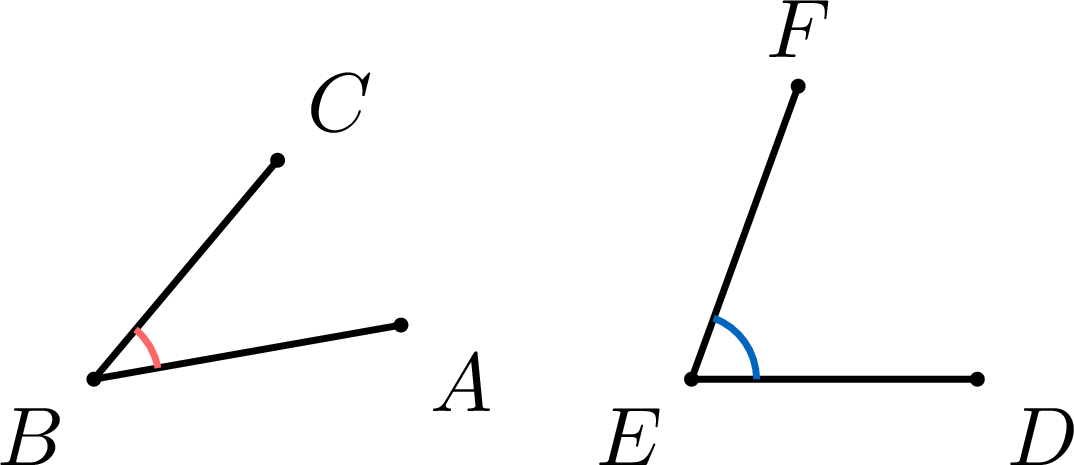
Trace \(\Angle{ABC}\) and place the tracing on \(\Angle{DEF}\): vertex \(B\) on vertex \(E\), the side through \(C\) on the side through \(F\). The other side of \(\Angle{ABC}\) falls inside \(\Angle{DEF}\), so \(\Angle{ABC}\) is less open than \(\Angle{DEF}\).
Skills to practice
- Comparing Angles
- Explaining the Comparison
III
The Right Angle: a Special Angle
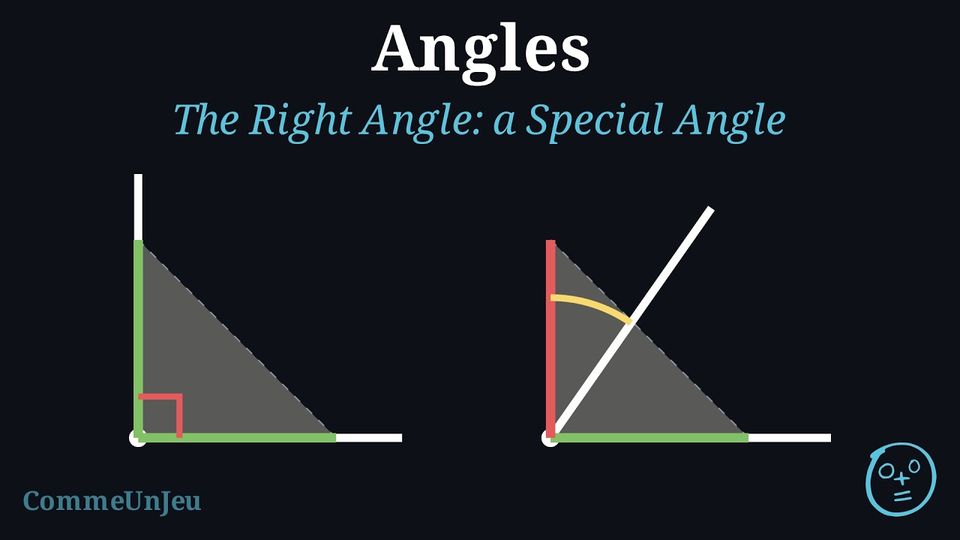
Léa cuts out a corner of her sheet of paper and keeps it as a template. She lays it on the corners around her: the corner of the table, the corner of the door, the corner of a book. Every time, the template fits exactly. Then she lays it on the corner of a slice of cake: it does not fit. What do all these corners that fit have in common? 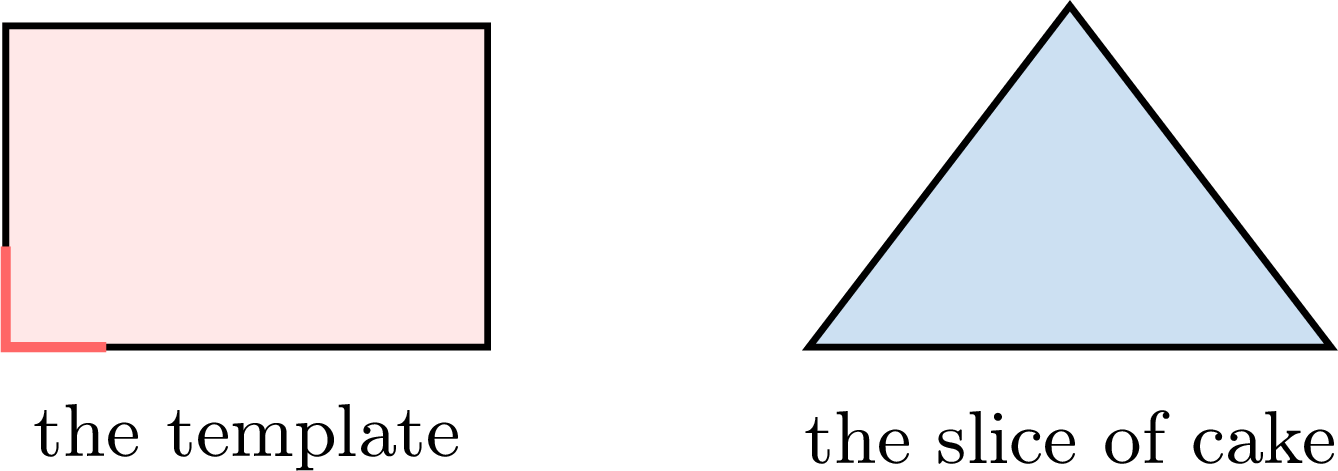
All these corners have the same opening as the corner of the sheet. That opening has a name: it is a right angle. The corner of the cake is more closed: it is not a right angle.
Definition — Right Angle
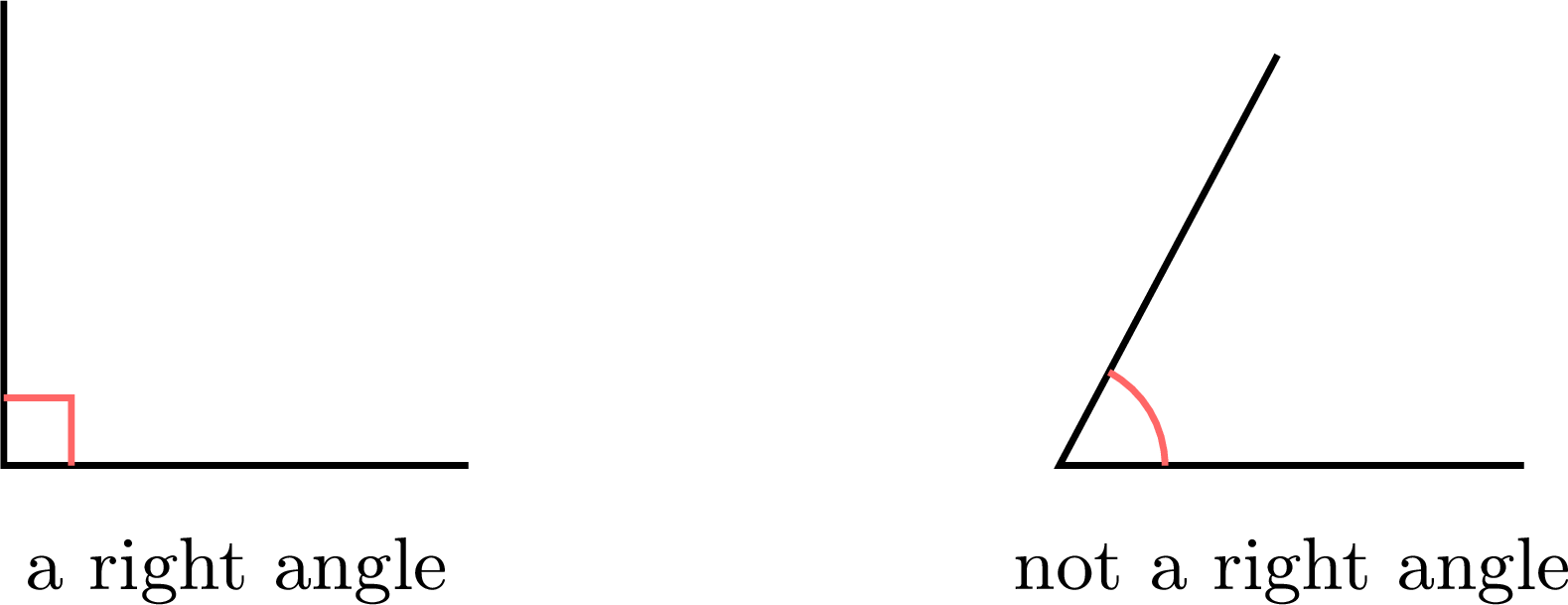
Among all angles, one is special: the right angle. It is the angle of the corner of a sheet of paper — the corner of the table, the corner of a book, the corner of a window. To recognise one, we place a template (a corner cut out of card) or the corner of a set square on the angle: - the two sides run along the two edges of the corner: the angle is a right angle;
- they do not: the angle is not a right angle.
A Quarter Turn Makes a Square Corner
Mia faces North, then makes a quarter turn clockwise to face East. The direction before the turn and the direction after it make a square corner, exactly like the corner of a sheet of paper. 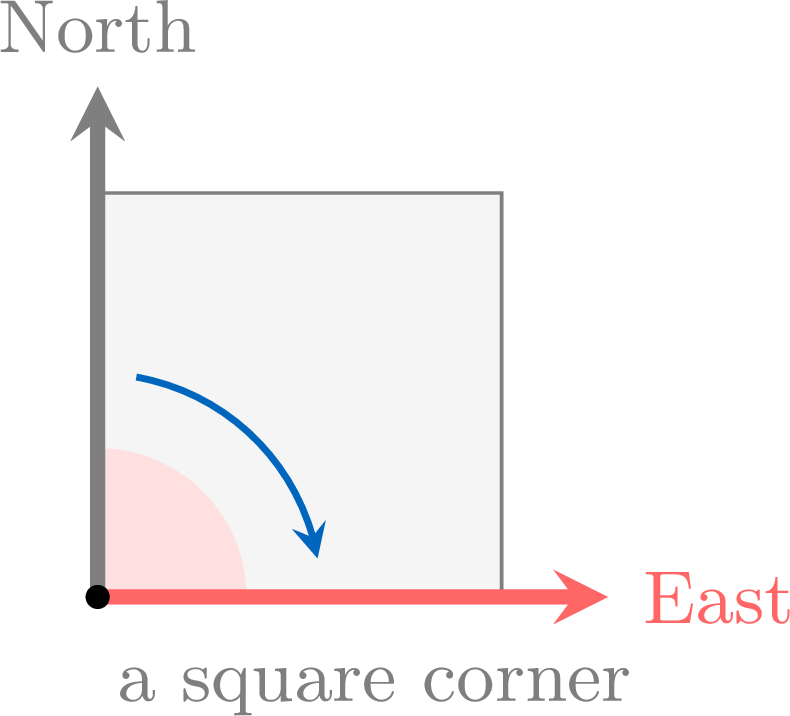
This square corner is called a right angle: a right angle is a quarter turn. Two right angles make a half turn, and four right angles make a whole turn.
Proposition — The Code for the Right Angle
On a figure, a right angle is shown by a small square drawn in the corner: it is the code for the right angle. When the small square is there, the angle is a right angle — there is no need to check it again with the set square. 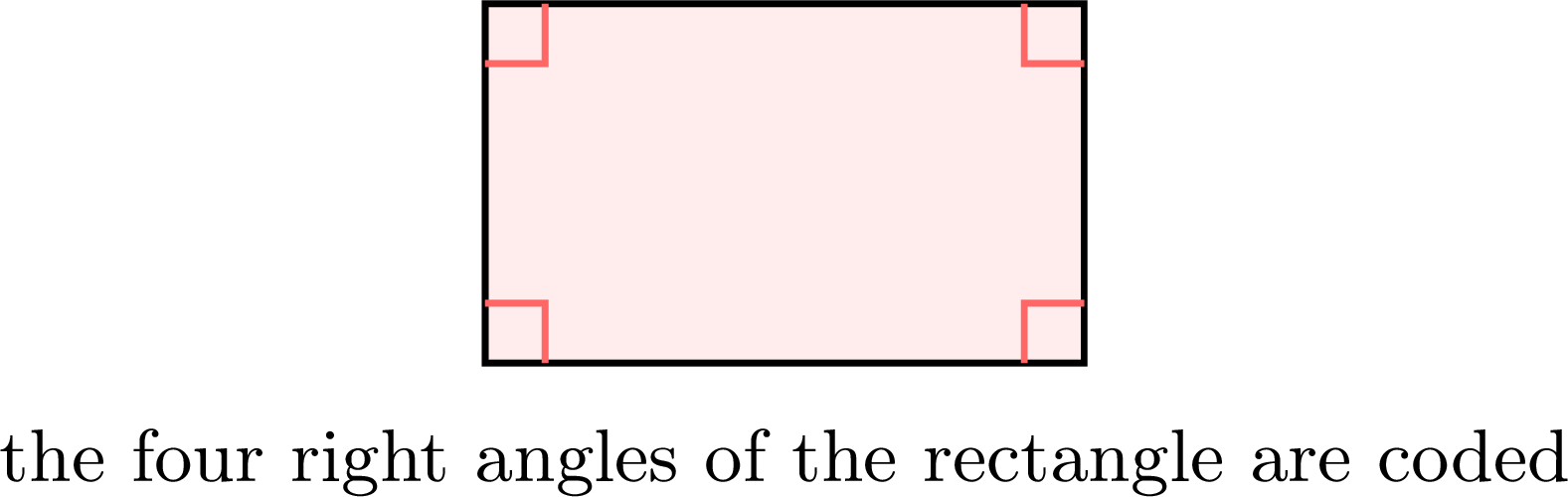
Method — Drawing a Right Angle
On squared paper: from the vertex, draw the two sides along the lines of the grid, one horizontal, the other vertical. On plain paper: draw a first side with the ruler; place the corner of the set square on the vertex and one of its edges along that side; draw the second side along the other edge of the set square. Then mark the right angle with its small square. 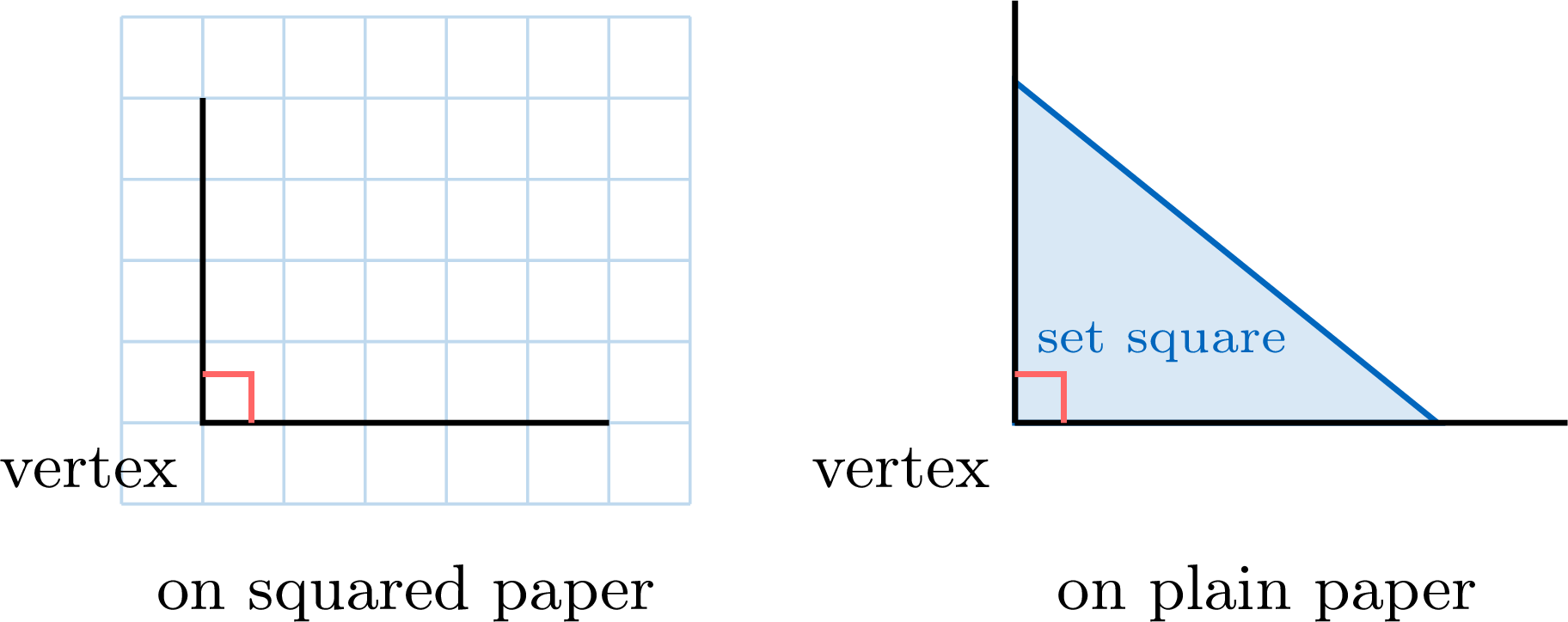
Example
Which of these two corners is a right angle? Check with a template, then code the right angle. 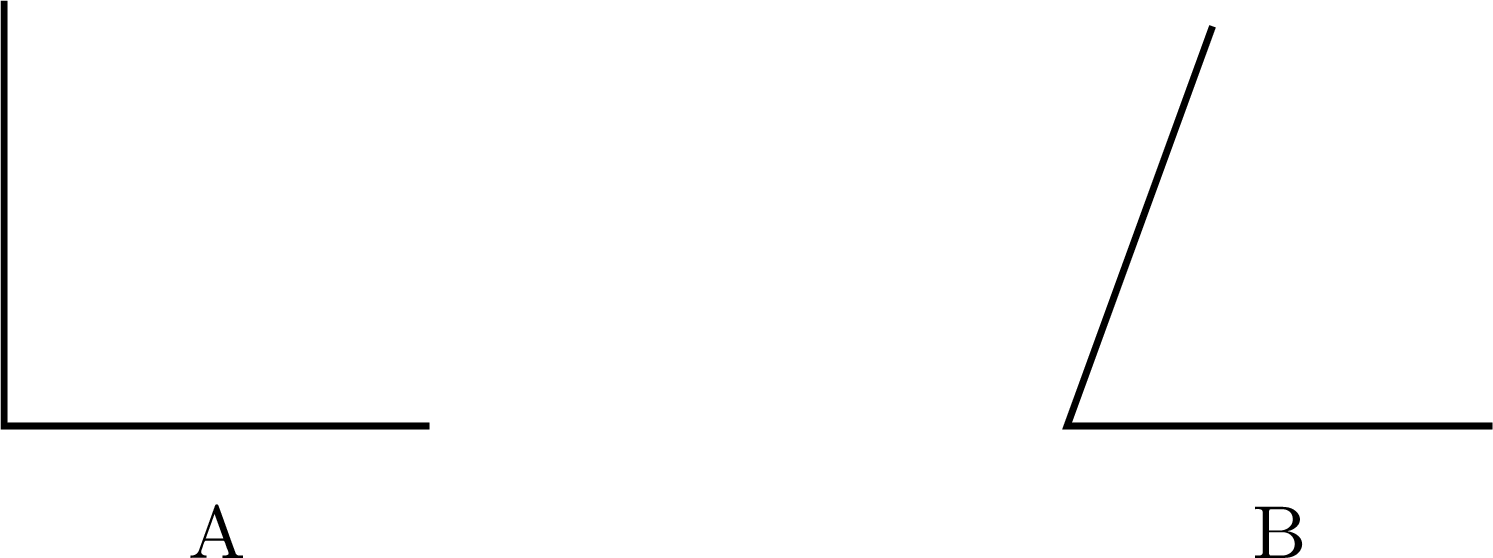
Place the template on A: its two edges run along the two sides. A is a right angle, and we draw the small square in its corner. On B, the second side stays inside the corner of the template: B is not a right angle — it is more closed. 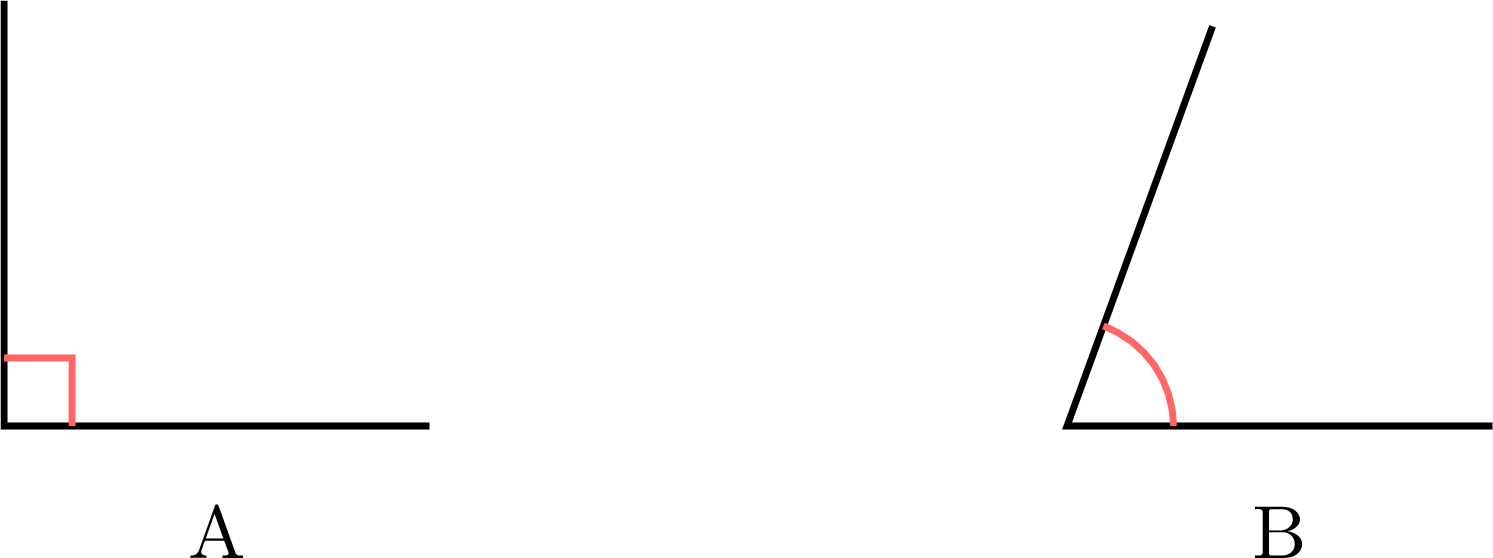
Skills to practice
- Recognising a Right Angle
- Reading the Code
- Counting the Right Angles of a Figure
- Drawing a Right Angle
- Coding the Right Angles
IV
Acute Angles and Obtuse Angles
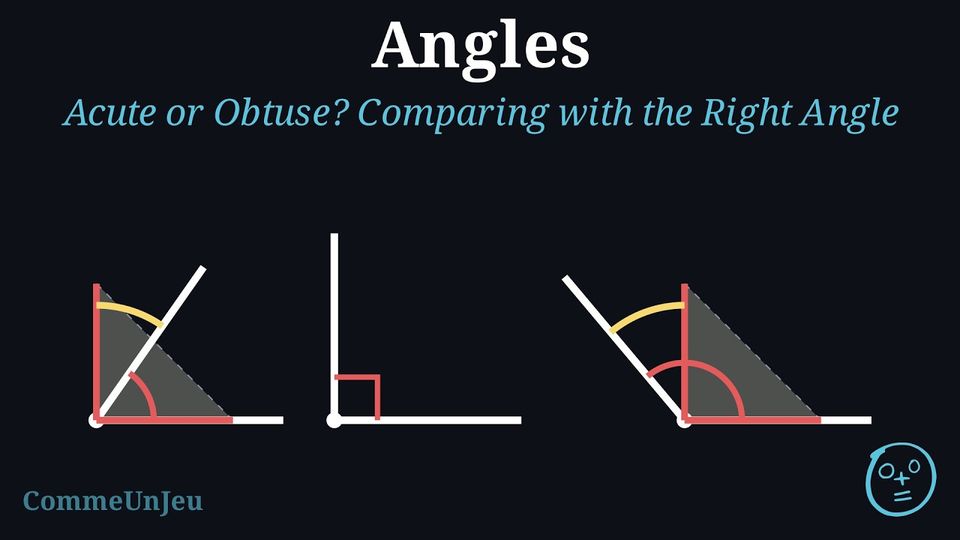
Definition — Acute Angle and Obtuse Angle
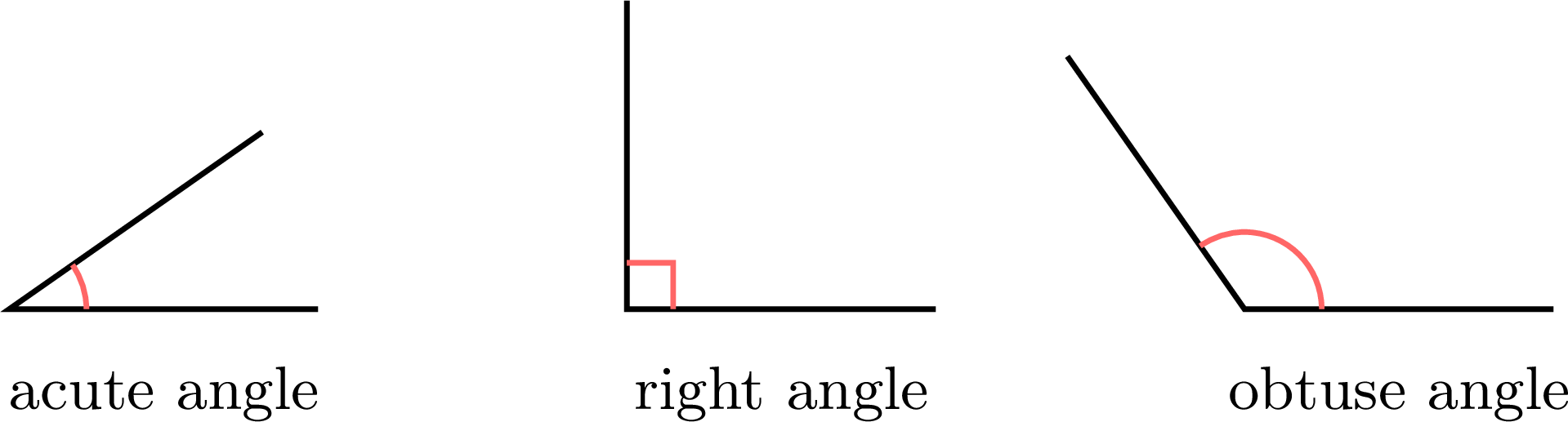
Every angle is compared to the right angle: - an angle more closed than a right angle is an acute angle;
- an angle more open than a right angle, without its two sides forming a straight line, is an obtuse angle.
Method — Checking an Angle with a Set Square
First estimate by eye: does the angle look more closed or more open than a right angle? Then check with the set square: place its corner on the vertex, one edge along one arm of the angle. - The other arm lines up with the set square's edge: the angle is right.
- The other arm is inside the corner: the angle is acute.
- The other arm goes past the corner, without making a straight line with the first arm: the angle is obtuse.
Example
Estimate, then check with the set square: what is the nature of this angle? 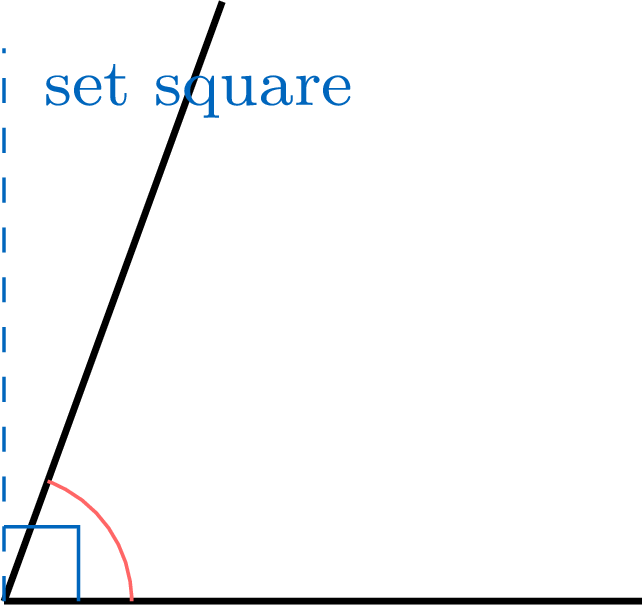
By eye, the angle looks more closed than a right angle. The set square confirms it: its corner placed on the vertex, the second arm of the angle stays inside the corner. The angle is acute.
Example
Without a set square, say whether each angle is acute or obtuse. There is no doubt here. 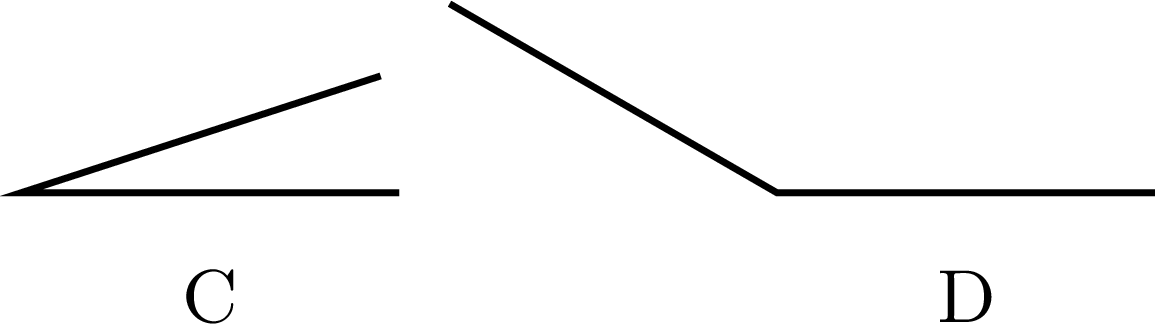
C is much more closed than the corner of a sheet: it is acute. D is much more open: it is obtuse. When the angle is close to a right angle, the eye is not enough: then the set square must be used.
Skills to practice
- Classifying an Angle: Acute, Right or Obtuse
- Counting the Angles by Type
- Drawing and Checking with the Set Square
V
Going further
Skills to practice
- Problems
- Quiz
Jump to section