International Baccalaureate · PYP 1
Addition Within 20
I
What is Addition?
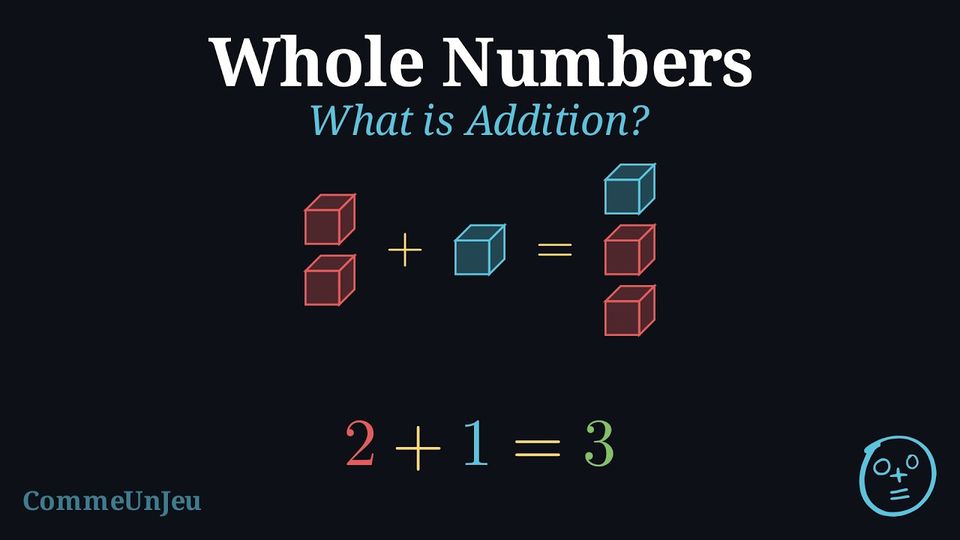
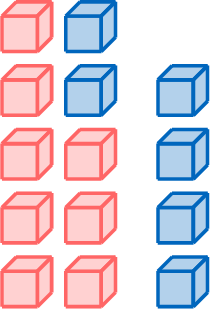
Léa has 8 red cubes and a friend gives her 6 blue cubes.  \(\quad\) and \(\quad\)

How many cubes does Léa have now?
\(\quad\) and \(\quad\)
We put the two groups together and count all the cubes one by one: there are fourteen. 
Léa has 14 cubes in total. Joining two separate groups together to find the total is called addition.
Definition — Addition
Addition is joining separate groups together to find the total, called the sum.In mathematics, we use symbols to write this down:
- The plus sign (\(+\)) means to add.
- The equals sign (\(=\)) shows that what is on one side is the same amount as what is on the other side.
- With numbers: $$\textcolor{colordef}{8} + \textcolor{colorprop}{6} = \textcolor{olive}{14}$$
- With Cubes: \(+\) \(=\)
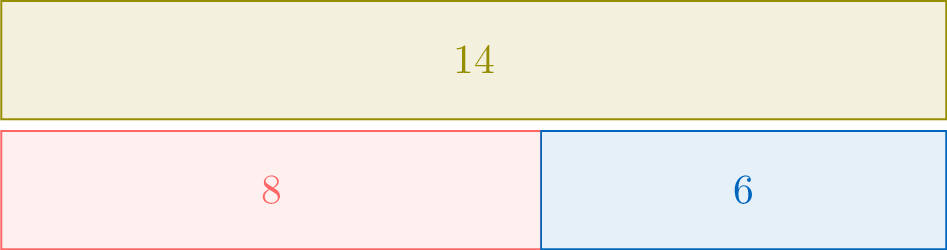
- With a part-whole model:
Method — Counting On
Compute \(8 + 6\). - Step 1: Start from the bigger number. The bigger number is 8: the count starts from 8.
- Step 2: Show the other number on your fingers. The other number is 6: it is the number of steps to count on. Raising 6 fingers keeps track of these steps.

- Step 3: Count on from 8. Touching one finger at each step, the count continues from 8: nine, ten, eleven, twelve, thirteen, fourteen.
Skills to practice
- Adding Numbers Within 10
- Adding in the Ten-Frames Within 20
- Adding Cubes Within 20
- Adding Multiple Numbers
II
The Order of the Terms
Proposition — The Order of the Terms
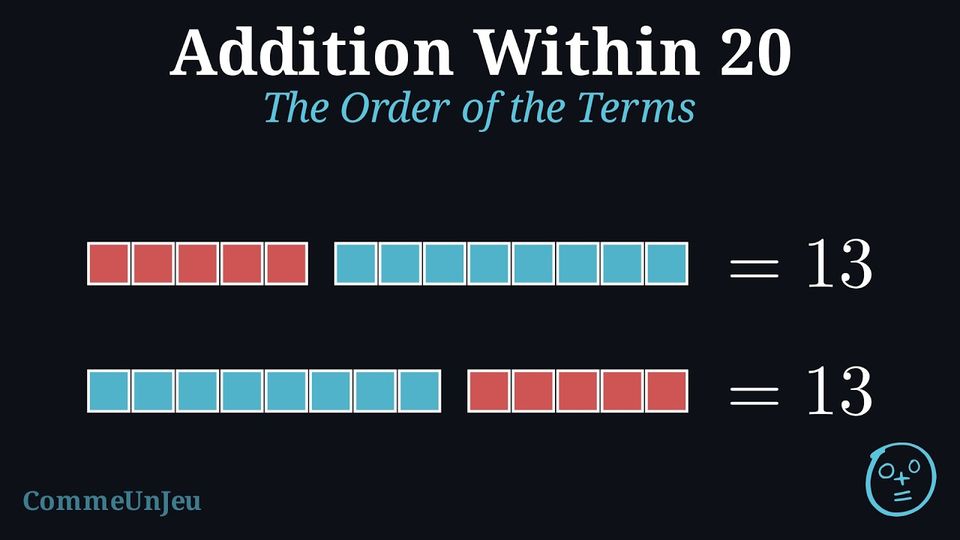
- For an addition, the order does not matter: \(5 + 8\) and \(8 + 5\) both make \(13\). It is often easier to start from the bigger number.
- For a subtraction, it does: \(8 - 5 = 3\) can be computed, but \(5 - 8\) cannot with the numbers we know — we cannot take \(8\) away from \(5\) objects.
Example
Which is easier to compute: \(2 + 9\) or \(9 + 2\)? And can we compute \(3 - 7\)?
Both make \(11\), but starting from \(9\) we only count \(2\) more: \(9 + 2\) is easier. \(3 - 7\) cannot be computed with the numbers we know: we cannot take \(7\) away from \(3\) objects; \(7 - 3 = 4\) can.
Adding Three Numbers
With three numbers too, the order does not matter: we can add any two of the numbers first, and the total stays the same. It is often easier to start with two numbers that make \(10\).
Compute \(\textcolor{colordef}{7}+\textcolor{colorprop}{5}+\textcolor{olive}{3}\).
\(\textcolor{colordef}{7}\) and \(\textcolor{olive}{3}\) make \(10\): they fill one ten-frame. The \(\textcolor{colorprop}{5}\) is added next. 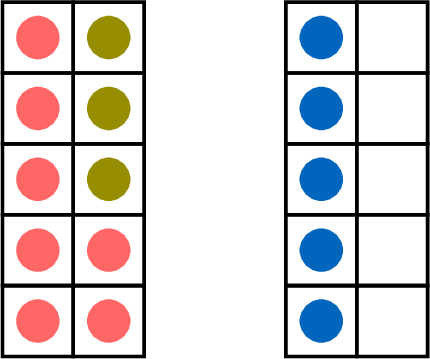
$$\begin{aligned}[t]\textcolor{colordef}{7}+\textcolor{colorprop}{5}+\textcolor{olive}{3} &= \textcolor{colordef}{7}+\textcolor{olive}{3}+\textcolor{colorprop}{5} && \text{(the order does not matter)}\\
&=10+\textcolor{colorprop}{5} && \text{(\(\textcolor{colordef}{7}+\textcolor{olive}{3}=10\))}\\
&=15\end{aligned}$$
Compute \(\textcolor{colordef}{7}+\textcolor{colorprop}{5}+\textcolor{olive}{3}\).
\(\textcolor{colordef}{7}\) and \(\textcolor{olive}{3}\) make \(10\): they fill one ten-frame. The \(\textcolor{colorprop}{5}\) is added next.
Skills to practice
- Thinking About the Order
- Changing the Order of the Terms
III
Adding on the Number Line
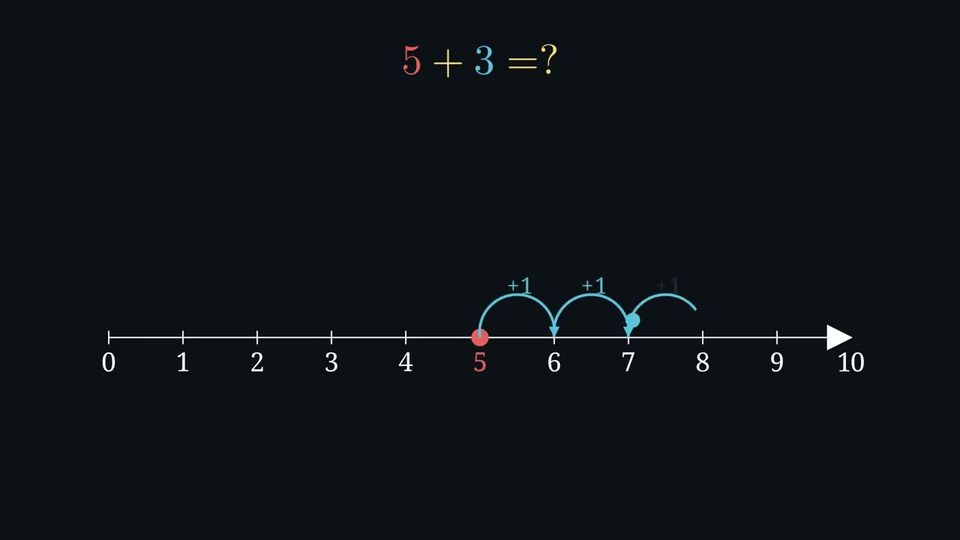
Method — Using a Number Line to Add
A number line shows addition as jumps to the right.Solve: \(5 + 3\)
- Start at the first number. Find the number 5 on the number line. This is your starting point.
- Jump forward. The second number, 3, tells you how many jumps to make. Since we are adding, we move to the right, where the numbers get bigger. Make 3 jumps.
- Find your landing spot. The number you land on is the answer.

Skills to practice
- Adding Numbers Using the Number Line
IV
Making a Ten to Add
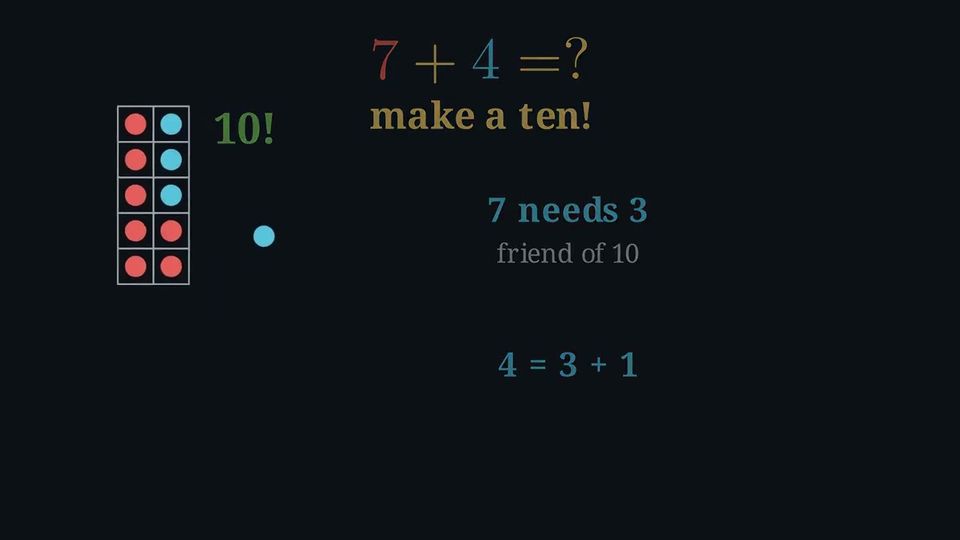
Method — Making a Ten to Add
The “Make a Ten” strategy builds a group of 10 first; the rest is then added to 10.Compute \(\textcolor{colordef}{7}+\textcolor{colorprop}{4}\).
- Start with the first number. We have 7 cubes.
- Find the complement to 10. How many more cubes do we need to make a full ten? We need 3 more.
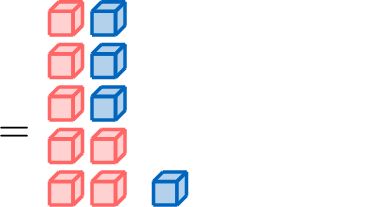
- Break apart the second number. We can break the 4 cubes into a group of 3 (to complete our ten) and a group of 1 (which is left over).
- Make a ten and add the rest. We join the 7 and 3 to make 10, and then add the leftover 1.

\(\quad\)
Skills to practice
- Breaking Down Numbers
- Breaking Down Numbers to Make Ten
- Making 10 after Breaking Down Numbers
- Adding Numbers Within 20
V
The Equals Sign Both Ways
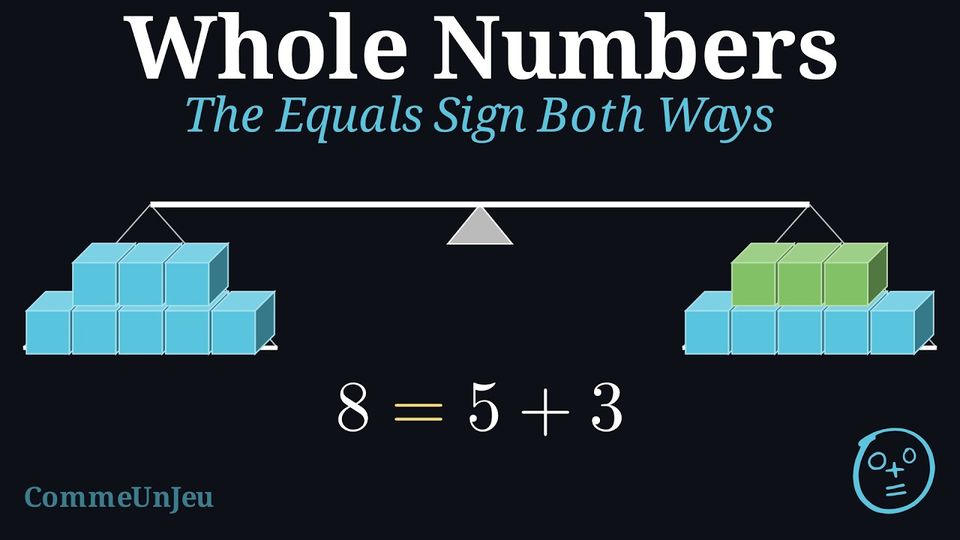
Hugo writes: \(5 + 3 = 8\). Aisha writes: \(8 = 5 + 3\). Who is correct?
Both are correct. The sign \(=\) does not mean “here comes the result”. It means: what is on one side is the same amount as what is on the other side. \(5 + 3\) makes \(8\), so we can write it in both directions.
Definition — The Equals Sign
The sign \(=\) works like a balanced scale: it says that what is on one side is the same amount as what is on the other side. An equality is true when both sides really make the same number — and false when they do not. 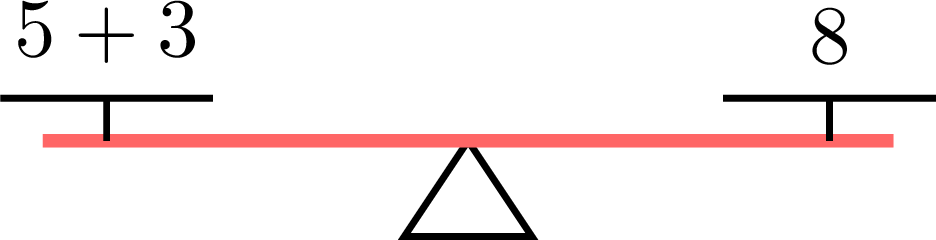
Example
True or false? \(6 + 2 = 7 + 1\).
\(6 + 2\) makes \(8\), and \(7 + 1\) makes \(8\) too. The same amount on both sides: true.
Example
True or false? \(5 + 4 = 10\).
\(5 + 4\) makes \(9\), not \(10\). The two sides are different: false. Writing \(=\) is not enough — both sides must really match.
Example
Write the missing number: \(9 = \ldots + 4\).
The right side must make \(9\) too: \(9 = 5 + 4\). The missing number is \(5\).
Skills to practice
- Telling True from False
- Completing Equalities
- Finding the Hidden Number on the Scale
VI
Going further
Skills to practice
- Completing Addition Equations with Pictures
- Quiz
Jump to section