International Baccalaureate · PYP 3
Mass
I
Grams, Kilograms and Tonnes
In class, Léa weighs a small sweet: the scale shows \(1~\mathrm{g}\). Then a big book: \(1~\mathrm{kg}\). The teacher finishes with a photograph of a small car: its mass is \(1~\mathrm{t}\). 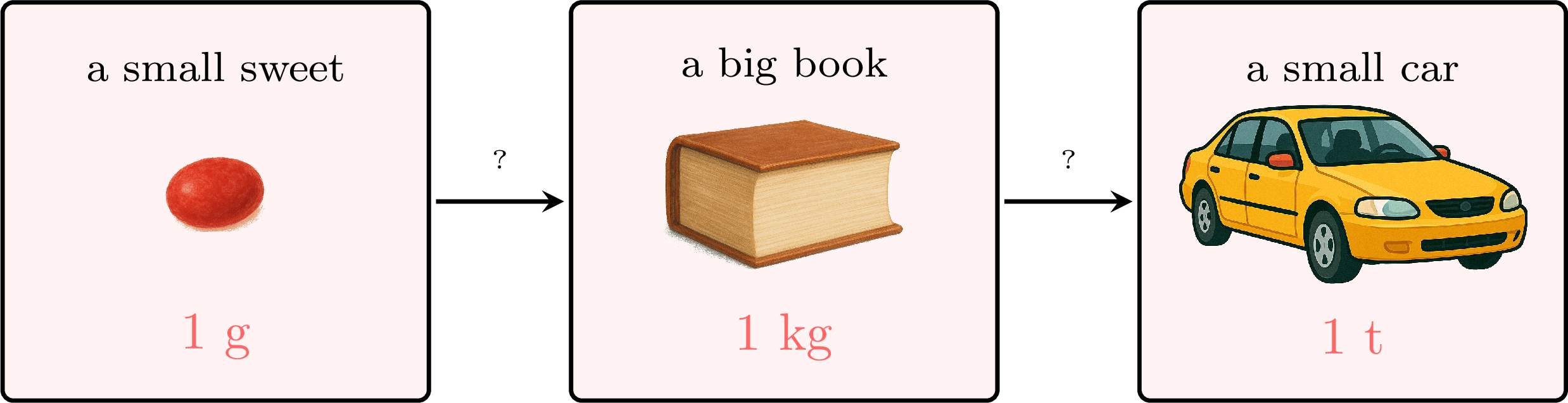
Say why three different units are used, and how they are linked.
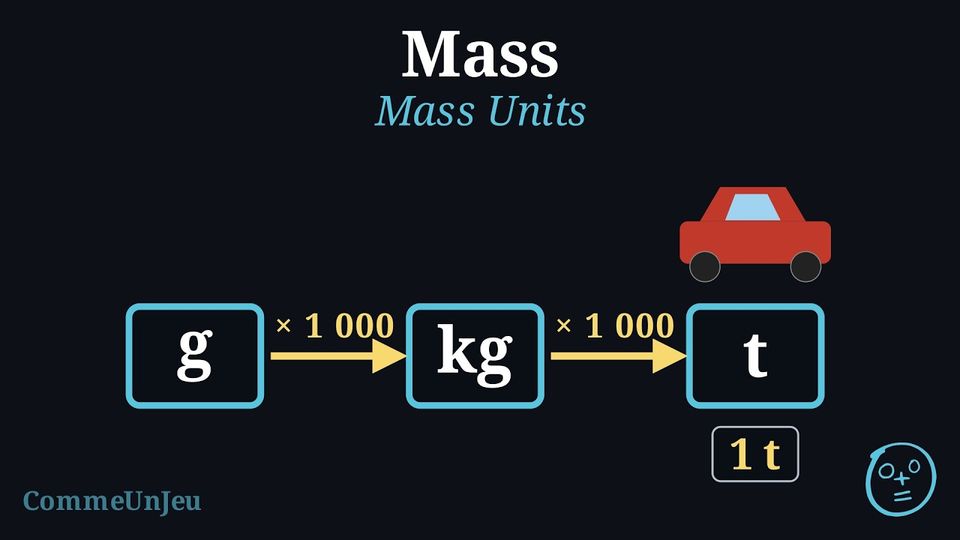
The mass of the car does not change with the unit, but the number written does: in grams the number for the car would be so long that it could no longer be read, and the sweet is far too light to be counted in tonnes. Each unit keeps the writing simple for one size of object. The three units follow one another, each one a thousand times the one before: $$\textcolor{colordef}{1}~\mathrm{kg}=\textcolor{colordef}{1\,000}~\mathrm{g} \qquad \textcolor{olive}{1}~\mathrm{t}=\textcolor{olive}{1\,000}~\mathrm{kg}$$ So the gram is for very light objects, the kilogram for everyday ones, and the tonne for very heavy loads.
Definition — Units of Mass
Three units measure a mass, from the lightest object to the heaviest load. - Gram \(\left(\mathrm{g}\right)\) — for light objects: a small sweet has a mass of about \(1~\mathrm{g}\), a letter about \(20~\mathrm{g}\).

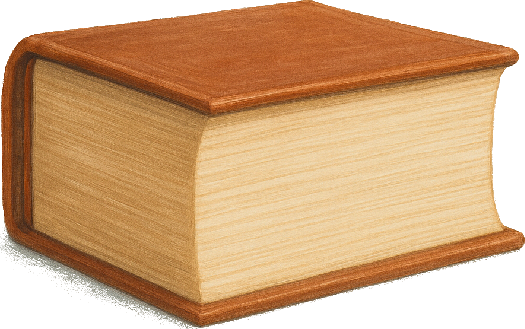
- Kilogram \(\left(\mathrm{kg}\right)\) — for everyday objects: a big book has a mass of about \(1~\mathrm{kg}\), a school bag about \(4~\mathrm{kg}\).
- Tonne \(\left(\mathrm{t}\right)\) — for very heavy loads: a small car has a mass of about \(1~\mathrm{t}\), a lorry about \(10~\mathrm{t}\).

Example
Choose the best unit for each mass: a letter, a bag of potatoes, a bus.
A letter is very light: the gram (\(20~\mathrm{g}\)). A bag of potatoes is a few kilograms: the kilogram (\(5~\mathrm{kg}\)). A bus is very heavy: the tonne (\(12~\mathrm{t}\)).
The unit is well chosen when the number stays small and easy to say: nobody weighs a bus in grams.
The unit is well chosen when the number stays small and easy to say: nobody weighs a bus in grams.
Skills to practice
- Choosing Between Gram, Kilogram and Tonne
- Writing One Kilogram in Grams
- Changing Tonnes and Kilograms
- Finding the Mass of One Item
II
Decomposing a Mass
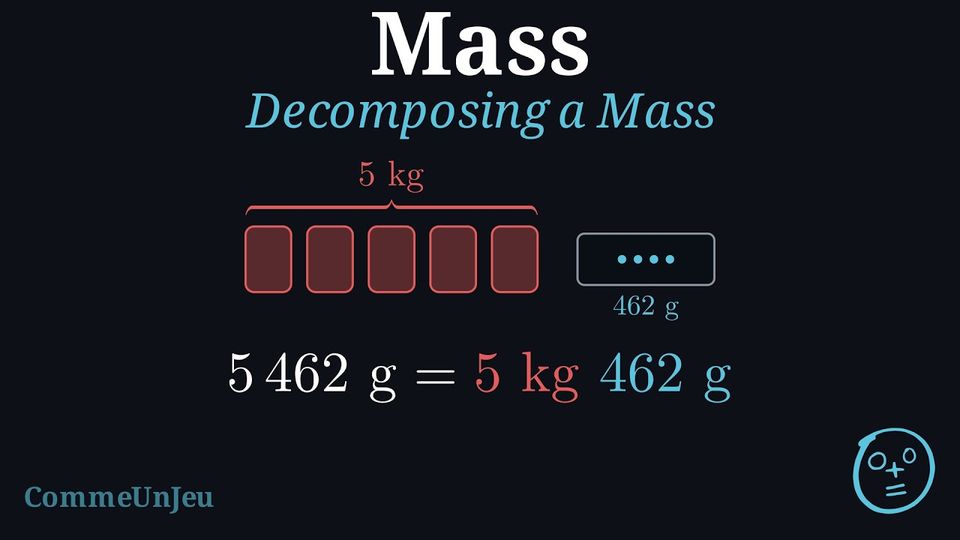
A digital scale shows the mass of a watermelon: \(5\,462~\mathrm{g}\). Léa wants to say this mass out loud, with kilograms. 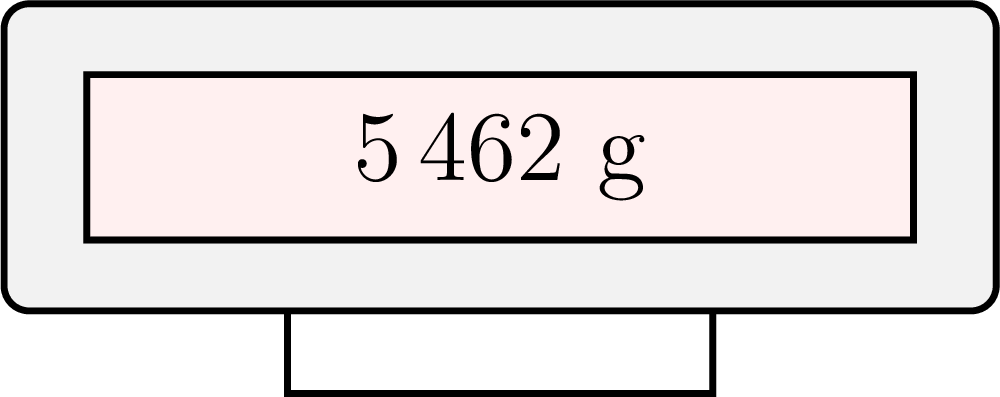
Say the mass of the watermelon with kilograms and grams.
One kilogram is \(1\,000\) grams, so the grams are gathered by thousands: in \(5\,462\) there are \(5\) thousands, and \(462\) grams are left. $$\textcolor{olive}{5\,462}~\mathrm{g}=\textcolor{colordef}{5\,000}~\mathrm{g}+\textcolor{colorprop}{462}~\mathrm{g}=\textcolor{colordef}{5}~\mathrm{kg}+\textcolor{colorprop}{462}~\mathrm{g}$$ The watermelon has a mass of \(5~\mathrm{kg}\) and \(462~\mathrm{g}\). Check: \(5\,000+462=5\,462\).
Method — Grouping by Thousands, Splitting by Thousands
The three units follow one another by thousands: \(1~\mathrm{kg}=1\,000~\mathrm{g}\) and \(1~\mathrm{t}=1\,000~\mathrm{kg}\). Grouping by thousands is enough to pass from one to the other. - Towards a smaller unit, the number grows. Each kilogram becomes \(1\,000\) grams: \(3~\mathrm{kg}=3\,000~\mathrm{g}\). Each tonne becomes \(1\,000\) kilograms: \(2~\mathrm{t}=2\,000~\mathrm{kg}\).
- Towards a bigger unit, the number shrinks. Every thousand grams makes one kilogram: \(5\,000~\mathrm{g}=5~\mathrm{kg}\).
- When something is left, the mass is written with two units. \(5\,462~\mathrm{g}=5\,000~\mathrm{g}+462~\mathrm{g}=5~\mathrm{kg}+462~\mathrm{g}\), and in the same way \(5\,350~\mathrm{kg}=5~\mathrm{t}+350~\mathrm{kg}\).
- Check: the number of thousands gives the big unit, what is left stays in the small one — and it is always smaller than \(1\,000\).
Example
Write \(5\,350~\mathrm{kg}\) with tonnes and kilograms.
In \(5\,350\) there are \(5\) thousands and \(350\) left: $$\textcolor{olive}{5\,350}~\mathrm{kg}=\textcolor{colordef}{5\,000}~\mathrm{kg}+\textcolor{colorprop}{350}~\mathrm{kg}=\textcolor{colordef}{5}~\mathrm{t}+\textcolor{colorprop}{350}~\mathrm{kg}$$ Check: \(350\) is smaller than \(1\,000\), so no other tonne can be made.
Example
A parcel has a mass of \(2~\mathrm{kg}\) and \(700~\mathrm{g}\). Write this mass in grams.
Everything goes into the smaller unit: \(2~\mathrm{kg}=\textcolor{colordef}{2\,000}~\mathrm{g}\), then \(\textcolor{colordef}{2\,000}+\textcolor{colorprop}{700}=\textcolor{olive}{2\,700}\). The parcel has a mass of \(2\,700~\mathrm{g}\).
Skills to practice
- Changing Kilograms and Grams
- Splitting Grams into Kilograms and Grams
- Splitting Kilograms into Tonnes and Kilograms
- Writing a Mass in a Single Unit
III
Comparing and Ordering Masses
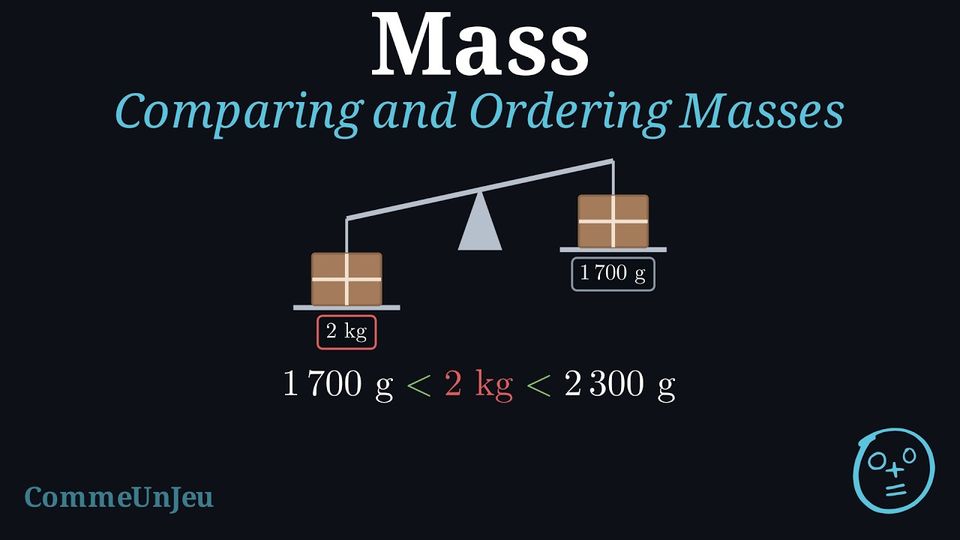
Three parcels are on the counter: one of \(2~\mathrm{kg}\), one of \(1\,700~\mathrm{g}\) and one of \(2\,300~\mathrm{g}\). The clerk has to put them in order, from the lightest to the heaviest. Say how to order them, then give the order.
The masses are not written in the same unit: their numbers cannot be compared as they stand. The smallest unit here is the gram. $$\textcolor{colordef}{2}~\mathrm{kg}=\textcolor{colordef}{2\,000}~\mathrm{g}$$ Now the three numbers can be compared: \(\textcolor{colorprop}{1\,700} < \textcolor{colordef}{2\,000} < \textcolor{olive}{2\,300}\). From the lightest to the heaviest: the parcel of \(1\,700~\mathrm{g}\), then the one of \(2~\mathrm{kg}\), then the one of \(2\,300~\mathrm{g}\).
Method — Same Unit Before Comparing
Two masses are compared like two numbers — but only once they are written in the same unit. - With a balance: the heavier pan goes down, the less heavy one goes up. No number is needed, the balance answers by itself.
- With numbers: first write every mass in the same unit — the one that keeps the numbers simple: grams when the list mixes kilograms and grams, kilograms when it mixes tonnes and kilograms. Then compare the numbers and order them.
- The trap: a big number is not always a big mass. \(1\,700~\mathrm{g}\) is lighter than \(2~\mathrm{kg}\), even though \(1\,700\) is bigger than \(2\).
- Check: the order does not change when everything is written in another unit.
Example
On this balance, which object is the heavier one? 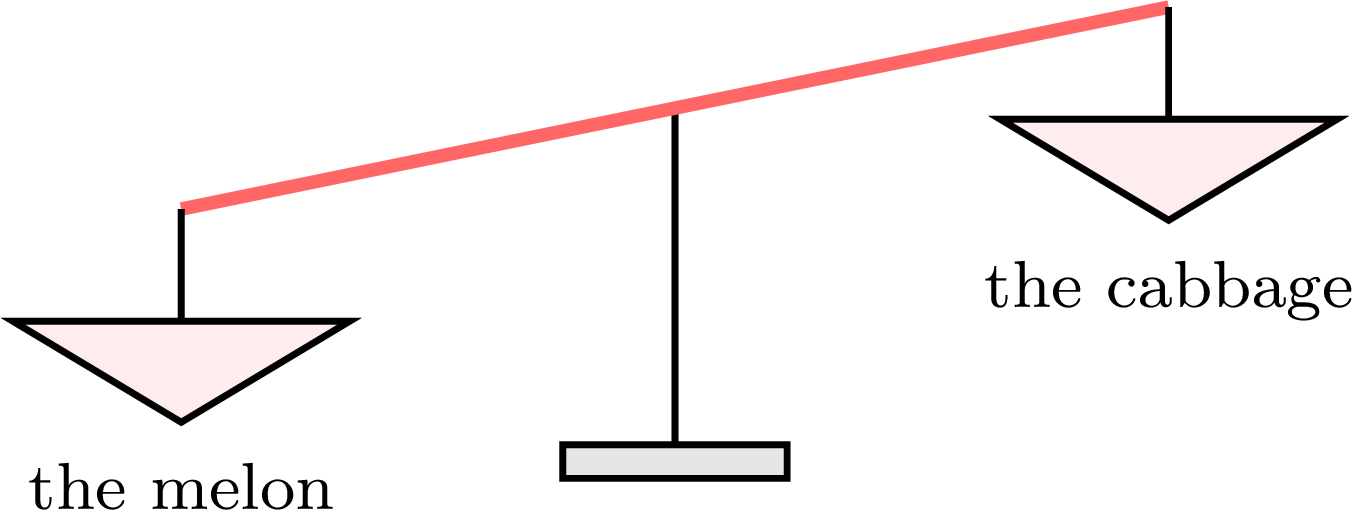
The left pan goes down: the melon is the heavier one. The balance compares without giving any number.
Example
Order each list from the heaviest to the lightest: - \(3~\mathrm{kg}\), \(2\,500~\mathrm{g}\), \(900~\mathrm{g}\)
- \(2~\mathrm{t}\), \(1\,500~\mathrm{kg}\), \(800~\mathrm{kg}\)
- The list mixes kilograms and grams: everything goes into grams. \(3~\mathrm{kg}=3\,000~\mathrm{g}\), so $$3\,000 > 2\,500 > 900$$ From the heaviest to the lightest: \(3~\mathrm{kg}\), \(2\,500~\mathrm{g}\), \(900~\mathrm{g}\).
- The list mixes tonnes and kilograms: everything goes into kilograms. \(2~\mathrm{t}=2\,000~\mathrm{kg}\), so $$2\,000 > 1\,500 > 800$$ From the heaviest to the lightest: \(2~\mathrm{t}\), \(1\,500~\mathrm{kg}\), \(800~\mathrm{kg}\).
Skills to practice
- Comparing Two Masses
- Ordering Masses
IV
Going further
Skills to practice
- Calculating Prices of Fruits
- Grams, Kilograms and Balances
- Solving Problems with Several Questions
- Quiz
Jump to section