International Baccalaureate · PYP 3
Length
I
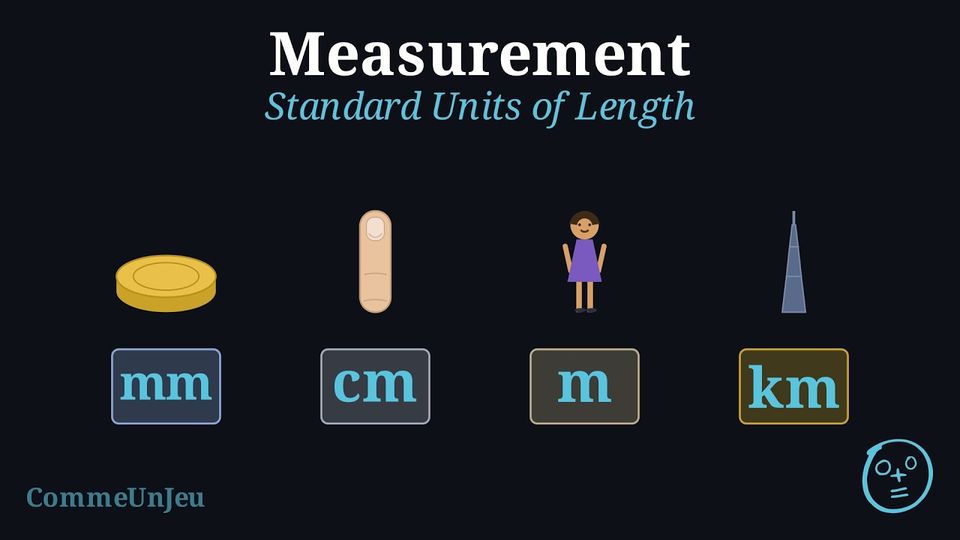
Units of Length from the Millimetre to the Kilometre
Today, the class walks to the lake. At the school gate, a sign reads: “Lake — \(1\) km”. Zoé asks: “Is it far, \(1\) km? How many metres is that?” 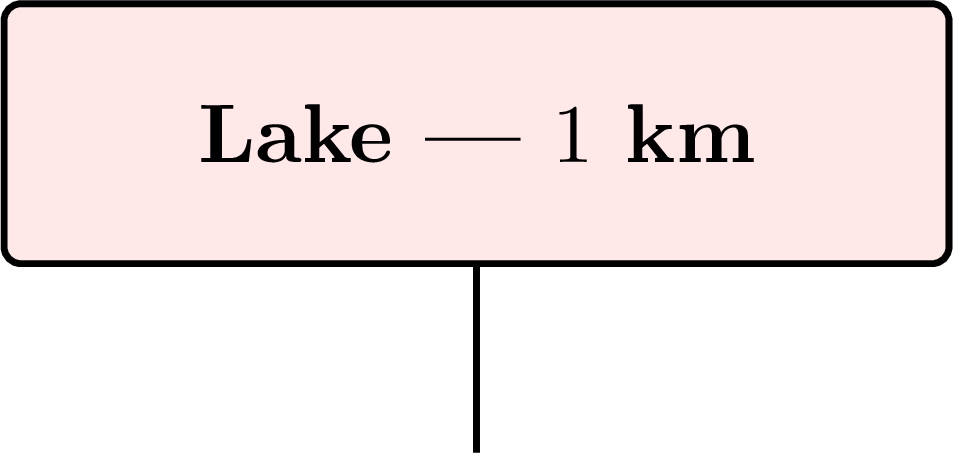
For a long distance, counting in metres would give a very big number, so we use a bigger unit: the kilometre. One kilometre is exactly \(1\,000\) metres. Walking \(1\) km takes about a quarter of an hour: the lake is about fifteen minutes away on foot.
Definition — The Kilometre
The kilometre \(\left(\mathrm{km}\right)\) is a unit suited to long distances: the way to school, the road between two villages, a hike. - \(1~\text{km} = 1\,000~\text{m}\)
- Reference: walking \(1\) km takes about \(15\) minutes.
Example
On the way, the class passes a bench after \(400\) m. How many metres are left before the lake?
The lake is \(1\) km away, that is \(1\,000\) m. The \(400\) m already walked are one part of the whole: \(1\,000 - 400 = 600\). There are \(600\) m left.
Example
At the lake, Sam runs along the shore with a running watch that counts the metres. It shows \(990\) m. Zoé says: “Ten more metres and you will have run \(1\) km.” Is she correct?
\(990 + 10 = 1\,000\) m, and \(1\,000\) m is exactly \(1\) km. Zoé is correct.
Example
Choose the best unit to express the distance between two towns.
The distance between two towns is very long: the best unit is the kilometre. Between two neighbouring villages, it is about \(5~\mathrm{km}\).
The unit is well chosen when the number stays simple: \(5~\mathrm{km}\) is easier to read and to say than \(5\,000~\mathrm{m}\).
The unit is well chosen when the number stays simple: \(5~\mathrm{km}\) is easier to read and to say than \(5\,000~\mathrm{m}\).
Example
Léa measures a screw with her ruler. Its end falls between \(2~\mathrm{cm}\) and \(3~\mathrm{cm}\): the screw is longer than \(2~\mathrm{cm}\), but shorter than \(3~\mathrm{cm}\). 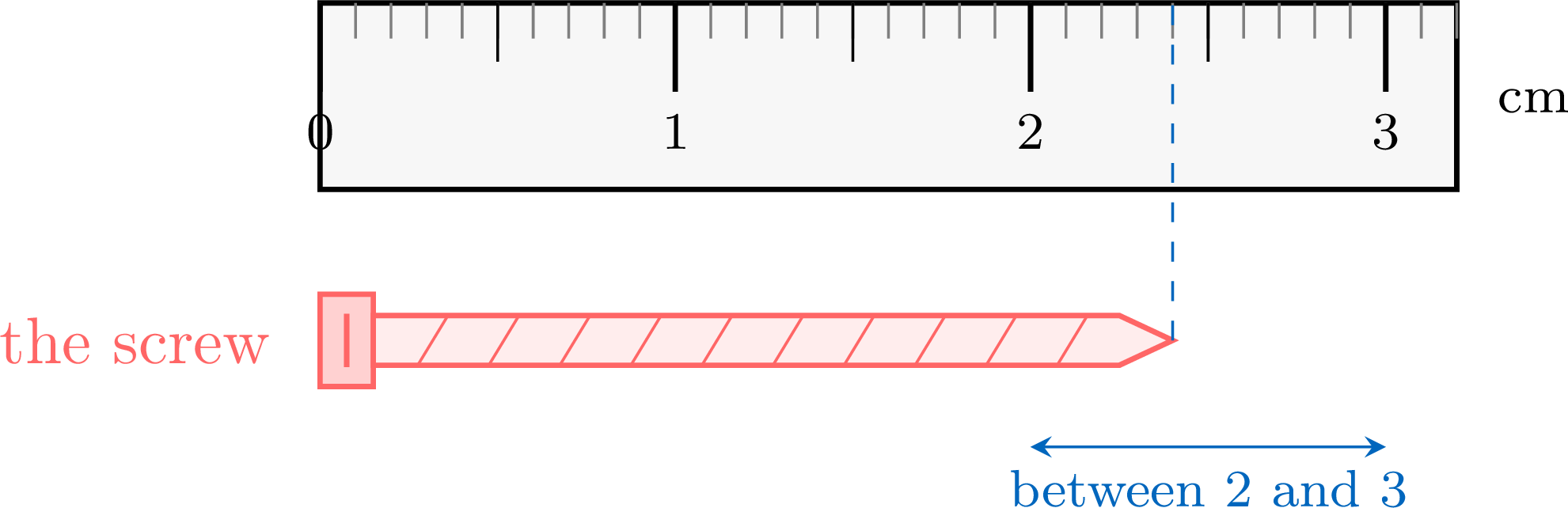
Between two centimetre marks the ruler shows smaller marks: they cut each centimetre into \(10\) equal parts. Each part is a millimetre. The screw reaches the fourth small mark after \(2~\mathrm{cm}\): it measures \(2~\mathrm{cm}\) and \(4~\mathrm{mm}\), that is \(24~\mathrm{mm}\).
For lengths smaller than a centimetre, a new unit is needed. For very long distances, the kilometre is used.
For lengths smaller than a centimetre, a new unit is needed. For very long distances, the kilometre is used.
Skills to practice
- Writing Kilometres in Metres
- Reading Millimetres on the Ruler
- Drawing a Segment to the Millimetre
II
Reference Lengths
Proposition — Reference Lengths
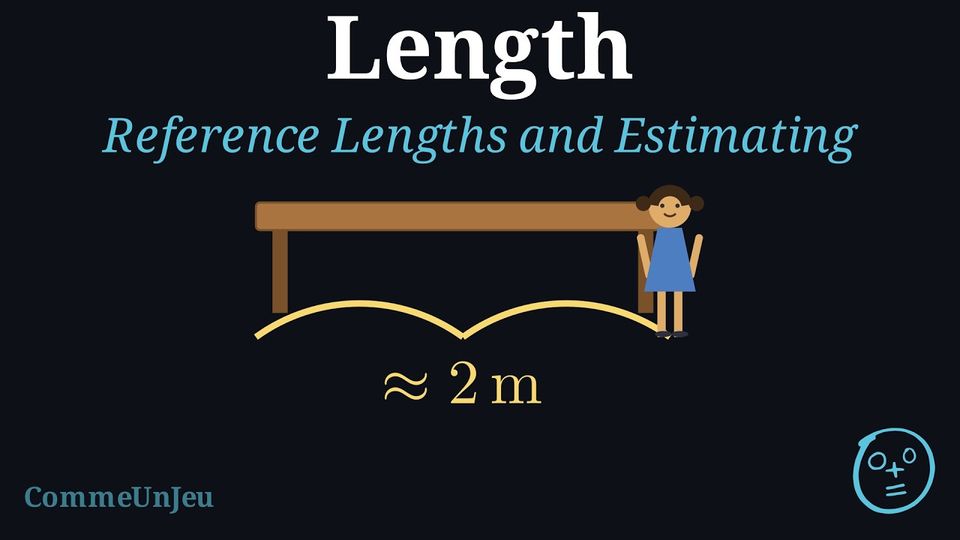
To estimate a length without measuring, keep three reference lengths in mind — they are always with you: | \(1\) cm | the width of a finger |
| \(1\) m | one big step |
| \(1\) km | a \(15\)-minute walk |
Example
Back at school, Zoé wants to know the length of the playground without a ruler. She walks across it in \(30\) big steps. About how long is the playground?
One big step is about \(1\) m, and \(30\) big steps fit across the playground: the playground is about \(30\) m long.
Skills to practice
- Choosing the Unit
- Estimating with a Reference
III
Converting Length Units
The sign at the school gate reads: “Stadium — \(2~\mathrm{km}\)”. The class has already walked \(750~\mathrm{m}\). 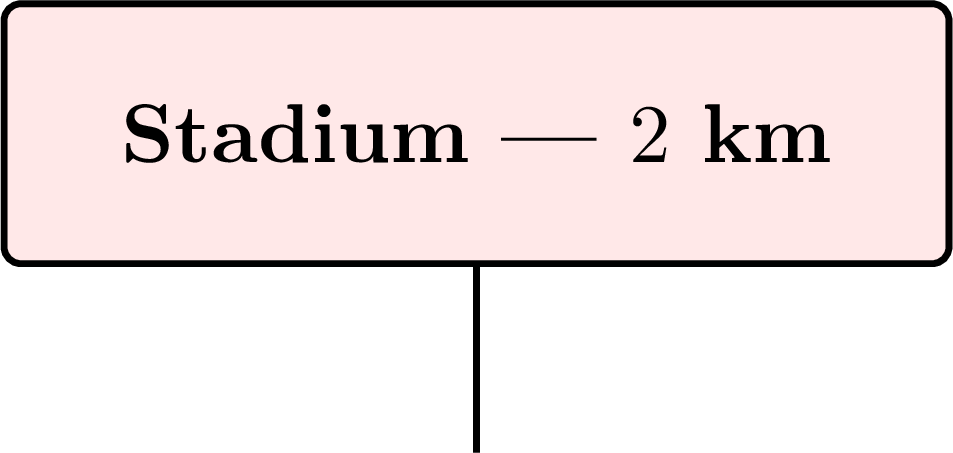
Say how many metres are left, and explain what has to be done first.
The two lengths are not in the same unit: the sign is in kilometres, the walk in metres. Nothing can be subtracted before they are written in the same unit. The smaller one is the metre. $$\textcolor{colordef}{2}~\mathrm{km}=\textcolor{colordef}{2\,000}~\mathrm{m} \quad \text{because } 1~\mathrm{km}=1\,000~\mathrm{m}$$ $$\textcolor{colordef}{2\,000}~\mathrm{m}-\textcolor{colorprop}{750}~\mathrm{m}=\textcolor{olive}{1\,250}~\mathrm{m}$$ There are \(1\,250~\mathrm{m}\) left. Check: what is left is smaller than the whole walk, and \(750+1\,250=2\,000\): it is possible.
Method — Changing the Unit of a Length
Three relations link the four units, from the millimetre to the kilometre: $$1~\mathrm{cm}=10~\mathrm{mm} \qquad 1~\mathrm{m}=100~\mathrm{cm}=1\,000~\mathrm{mm} \qquad 1~\mathrm{km}=1\,000~\mathrm{m}$$ - Towards a smaller unit, the number grows: each big unit is replaced by the small units it holds. \(4~\mathrm{m}=4 \times 100~\mathrm{cm}=400~\mathrm{cm}\).
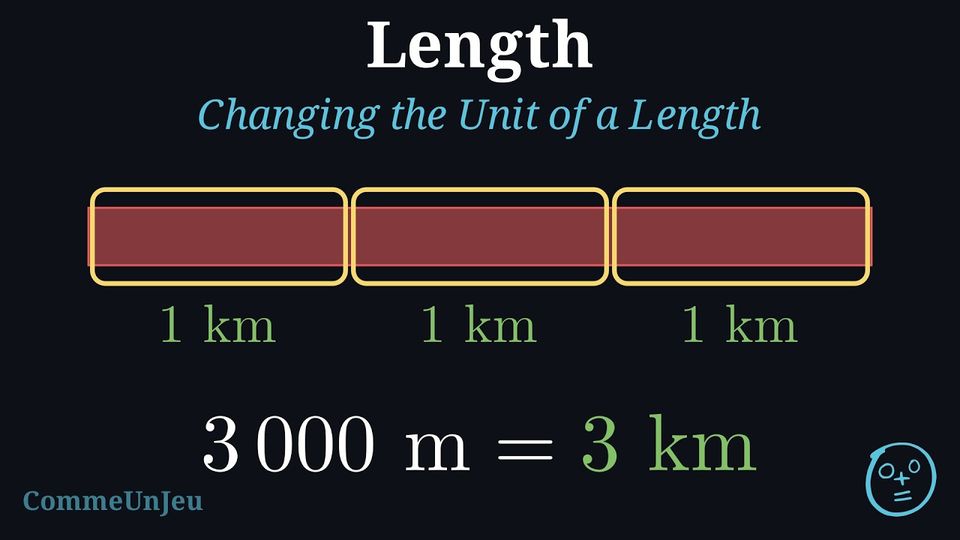
- Towards a bigger unit, the number shrinks: the small units are grouped. Every \(10~\mathrm{mm}\) make \(1~\mathrm{cm}\), every \(100~\mathrm{cm}\) make \(1~\mathrm{m}\), every \(1\,000~\mathrm{m}\) make \(1~\mathrm{km}\). In \(3\,000\) there are \(3\) thousands: \(3\,000~\mathrm{m}=3~\mathrm{km}\).
- When something is left, the length is written with two units: \(1\,250~\mathrm{m}=1\,000~\mathrm{m}+250~\mathrm{m}=1~\mathrm{km}~250~\mathrm{m}\).
- Check: written in a bigger unit, the same length is written with a smaller number; converting back gives the length we started from.
Example
Write each length in the bigger unit given. - \(60~\mathrm{mm}\) in centimetres.
- \(500~\mathrm{cm}\) in metres.
- \(2\,400~\mathrm{m}\) in kilometres and metres.
Towards a bigger unit, the small units are grouped.
- \(10~\mathrm{mm}\) make \(1~\mathrm{cm}\), so the millimetres are grouped by tens: $$\begin{aligned} 60~\mathrm{mm} &= 6 \times 10~\mathrm{mm} &&\text{(}60 \text{ is } 6 \text{ tens)}\\ &= 6 \times 1~\mathrm{cm} &&\text{(}10~\mathrm{mm}=1~\mathrm{cm}\text{)}\\ &= \textcolor{colorprop}{6~\mathrm{cm}} \end{aligned}$$
- \(100~\mathrm{cm}\) make \(1~\mathrm{m}\), so the centimetres are grouped by hundreds: $$\begin{aligned} 500~\mathrm{cm} &= 5 \times 100~\mathrm{cm} &&\text{(}500 \text{ is } 5 \text{ hundreds)}\\ &= 5 \times 1~\mathrm{m} &&\text{(}100~\mathrm{cm}=1~\mathrm{m}\text{)}\\ &= \textcolor{colorprop}{5~\mathrm{m}} \end{aligned}$$
- \(1\,000~\mathrm{m}\) make \(1~\mathrm{km}\), so the metres are grouped by thousands, and what is left stays in metres: $$\begin{aligned} 2\,400~\mathrm{m} &= 2\,000~\mathrm{m}+400~\mathrm{m} &&\text{(the thousands first)}\\ &= 2~\mathrm{km}+400~\mathrm{m} &&\text{(}1\,000~\mathrm{m}=1~\mathrm{km}\text{)}\\ &= \textcolor{colorprop}{2~\mathrm{km}~400~\mathrm{m}} \end{aligned}$$
Example
A shelf is \(3~\mathrm{cm}\) and \(4~\mathrm{mm}\) thick. Write this thickness with a single number.
The smaller unit is the millimetre: \(3~\mathrm{cm}=30~\mathrm{mm}\), then \(30+4=34\). The shelf is \(34~\mathrm{mm}\) thick, which is between \(3~\mathrm{cm}\) and \(4~\mathrm{cm}\).
Example
A path is \(2~\mathrm{km}\) and \(300~\mathrm{m}\) long. A second path is \(2\,500~\mathrm{m}\) long. Which path is the longer one?
The two lengths are not written in the same unit: everything goes into metres. $$2~\mathrm{km}+300~\mathrm{m}=2\,000~\mathrm{m}+300~\mathrm{m}=\textcolor{olive}{2\,300}~\mathrm{m}$$ \(2\,300 < 2\,500\): the second path is the longer one.
Skills to practice
- Converting Towards a Smaller or a Bigger Unit
- Adding Lengths in Two Units
IV
Going further
Skills to practice
- The Map of the Outing
- Solving Problems with Several Questions
- Quiz
Jump to section