International Baccalaureate · PYP 3
Subtraction
I
Subtracting in Columns up to 1 000
A collection contains 237 cubes. If 114 of them are given to a friend, how many cubes are left? 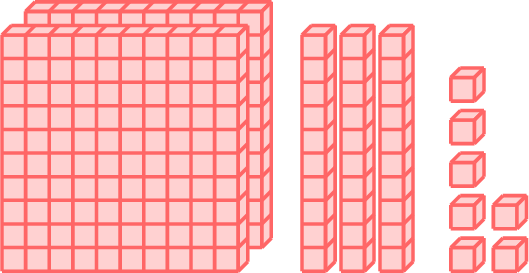 \(-\)
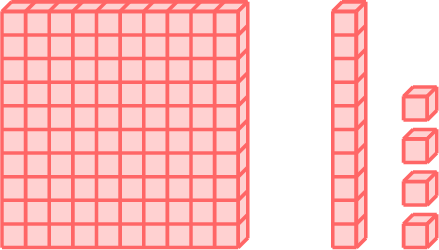 \(=\)
\(-\) \(=\)
To find what is left, we subtract: $$237-114$$ Visually, we can see that when we take 114 cubes away from 237, we are left with 123. \(-\) \(=\)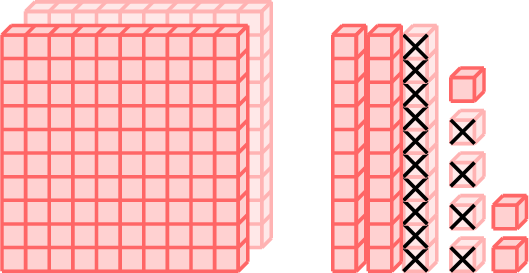
So 123 cubes are left. For big numbers like this, counting cubes is slow. A much faster strategy is to use column subtraction. 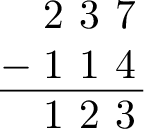
\(-\) \(=\) Skills to practice
- Subtracting in Columns up to 1 000 Without an Exchange
II
An Alternative Strategy: Compensation
The Difference Is Also a Gap
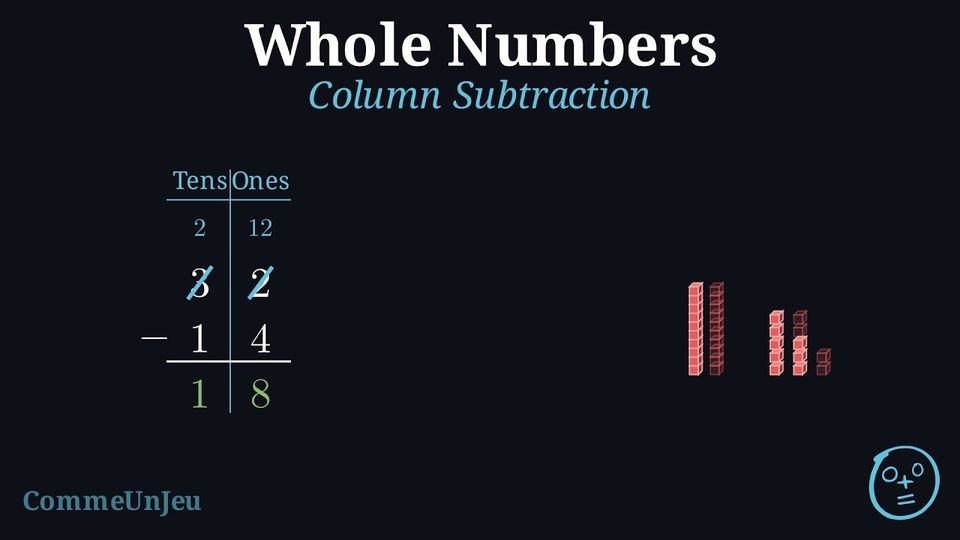
Subtracting is not only taking away. On the number line, \(32 - 14\) is also the gap between \(14\) and \(32\): the distance to go from \(14\) to \(32\). 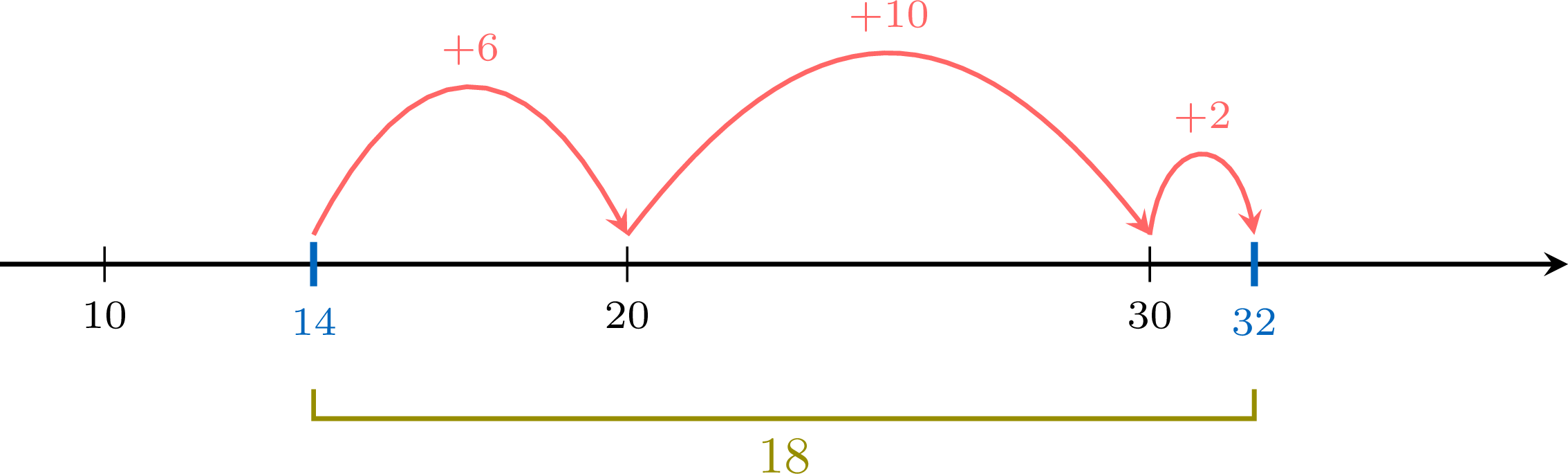
From \(14\), go up to the whole ten \(20\) (\(+6\)), then to \(30\) (\(+10\)), then to \(32\) (\(+2\)). The gap is \(6 + 10 + 2 = 18\), so \(32 - 14 = 18\).
- Finding the gap means completing the addition \(14 + \ldots = 32\): \(32 - 14 = 18\) because \(14 + 18 = 32\).
- This way is quick when the two numbers are close: from \(48\) to \(52\) the gap is \(4\), so \(52 - 48 = 4\).
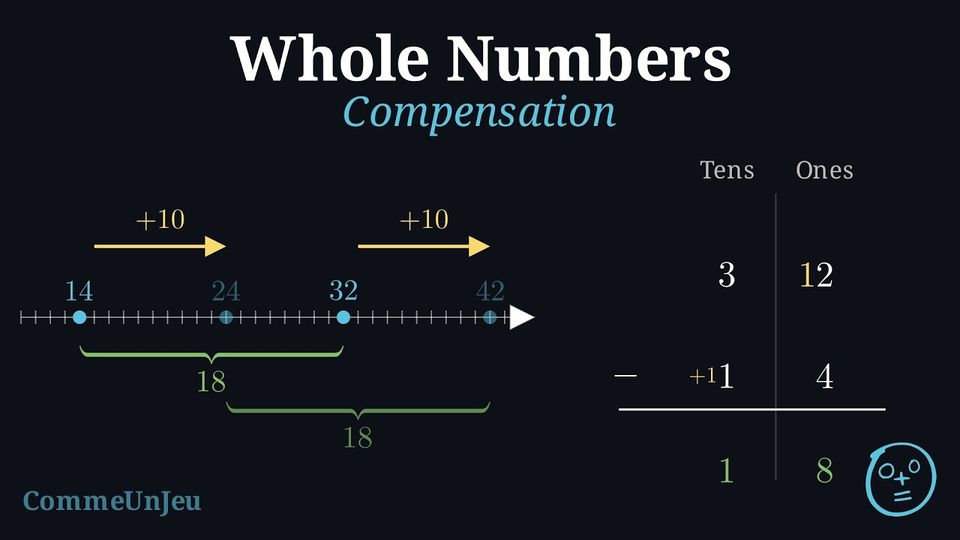
Léa must calculate \(32 - 14\) — a calculation we already know — but she does not want to break — exchange — a ten. She says: “I add \(6\) to both numbers: \(38 - 20\) is easy!”
Is she allowed to? Does she get the correct answer?
Is she allowed to? Does she get the correct answer?
Yes. On the number line, \(32 - 14\) is the gap from \(14\) to \(32\): it is \(18\). Slide both numbers up by \(6\): the gap slides with them — \(38 - 20\) is still \(18\), and taking away \(20\) is easy. 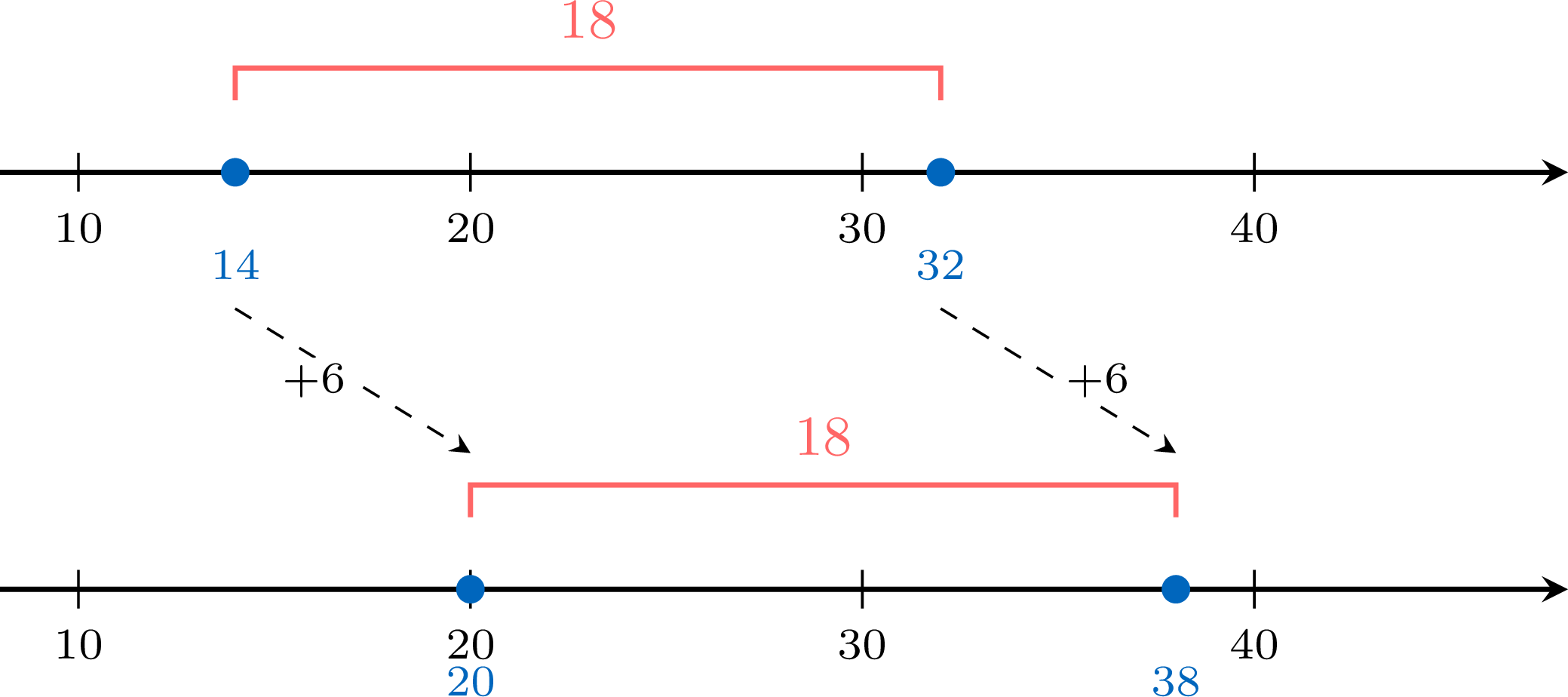
Proposition — The Difference Does Not Change
If the same amount is added to both numbers, the difference stays the same. The two numbers slide together, so the gap between them does not move. $$32 - 14 = 38 - 20 = 42 - 24 = 18$$ Method — Subtraction by Compensation
We calculate: - Step 1: Set up the subtraction.
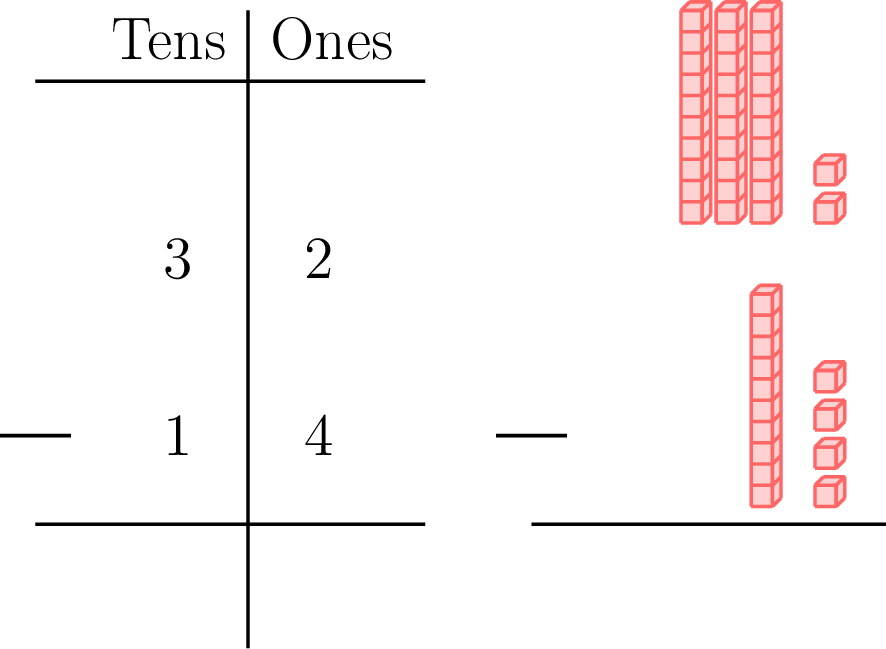
- Step 2: Check the ones place. We need to do \(2 - 4\), but we don't have enough ones.
- Step 3: Compensate. Add 10 to both numbers: 10 ones to the top number (giving 12 ones) and 1 ten to the bottom number (giving 2 tens).
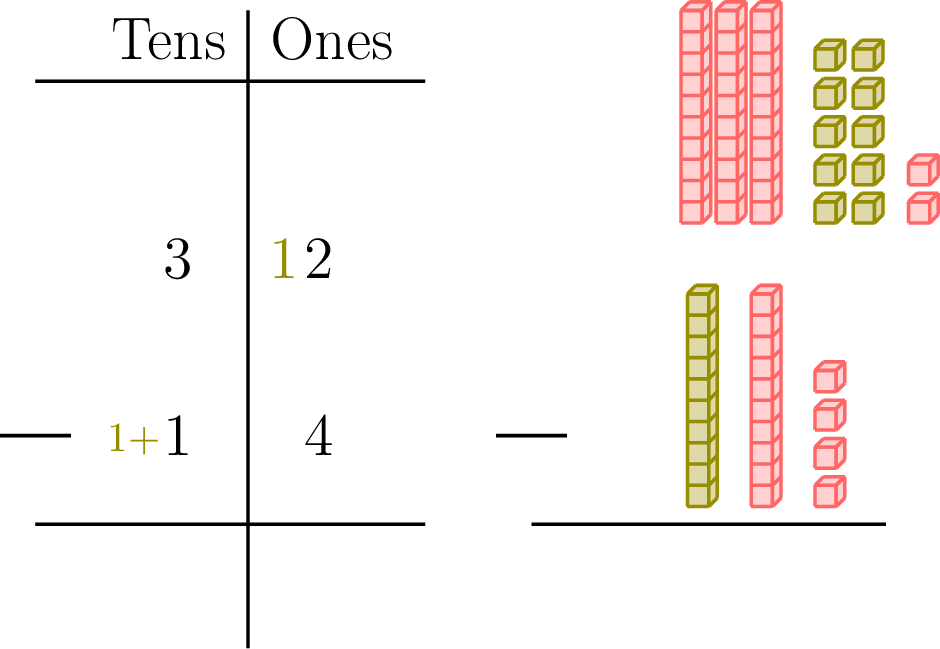
- Step 4: Subtract the ones. Now it's easy: $$12 \text{ ones} - 4 \text{ ones} = 8 \text{ ones}$$
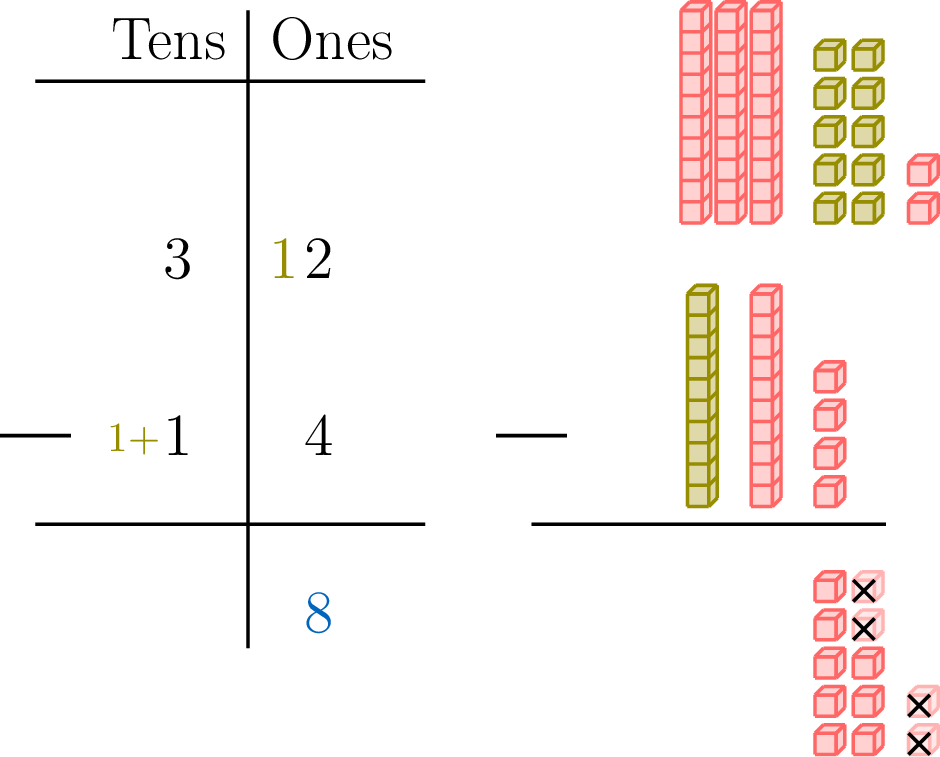
- Step 5: Subtract the tens. $$3 \text{ tens (from 32)} - 1 \text{ ten (from 14)} - 1 \text{ ten (compensated)} = 1 \text{ ten}$$
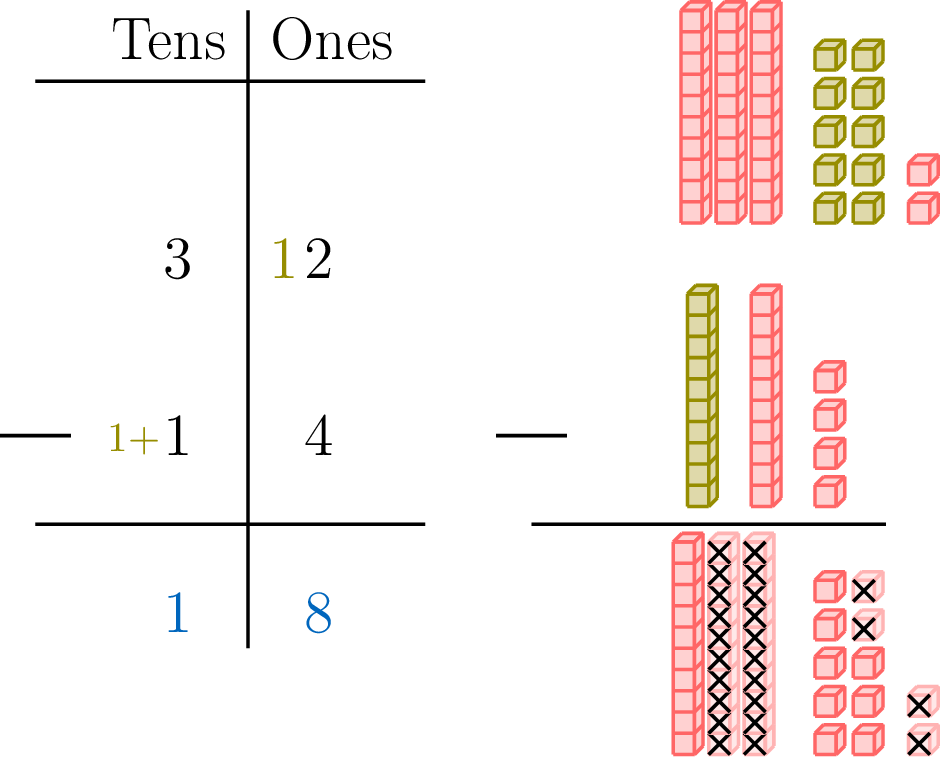
- Result: The difference is 1 ten and 8 ones. So, $$32 - 14 = 18$$
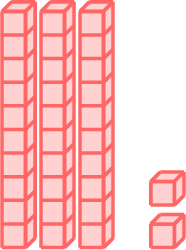 \(-\)
 \(=\)
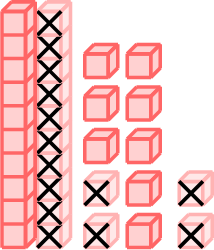
Method — Column Subtraction up to 1 000 by Compensation
Compensation works the same way with hundreds. We calculate: - Step 1: Set up the subtraction
Hundreds under hundreds, tens under tens, ones under ones.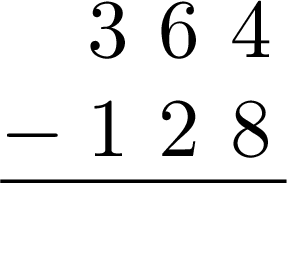
- Step 2: Subtract the ones $$4 - 8 \text{ is not possible.}$$ Add \(10\) ones on top — the small \(1\) before the \(4\) — and compensate with \(1\) ten below: \(14 - 8 = 6\).
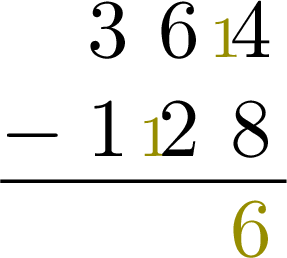
- Step 3: Subtract the tens $$6 - 2 - 1 = 3$$
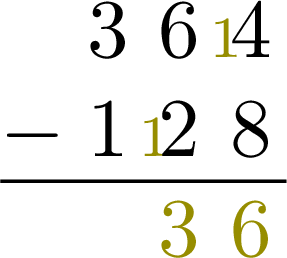
- Step 4: Subtract the hundreds $$3 - 1 = 2$$
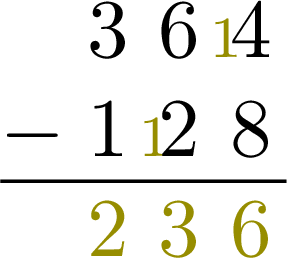
- The Result: $$364 - 128 = 236$$
Example
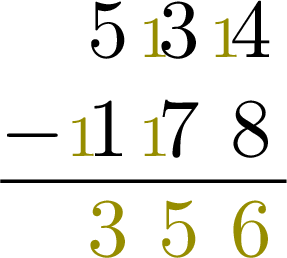
Calculate \(534 - 178\) by compensation.
Compensate twice, once for each blocked column.
- Ones: add \(10\) ones on top, \(1\) ten below: \(14 - 8 = 6\).
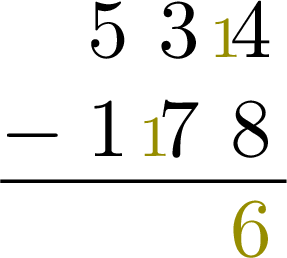
- Tens: add \(10\) tens on top, \(1\) hundred below: \(13 - 8 = 5\).
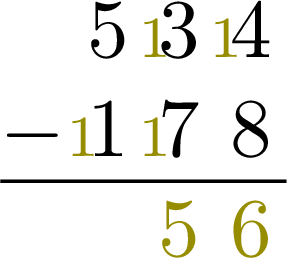
- Hundreds: \(5 - 1 - 1 = 3\).
Skills to practice
- Subtracting in Columns up to 100 with Compensation
- Subtracting in Columns up to 1 000 with Compensation
- Subtracting in Columns up to 1 000 with Double Compensation
- Solving Real-World Problems
- Setting Up a Column Subtraction
III
Subtracting up to 10 000
Example
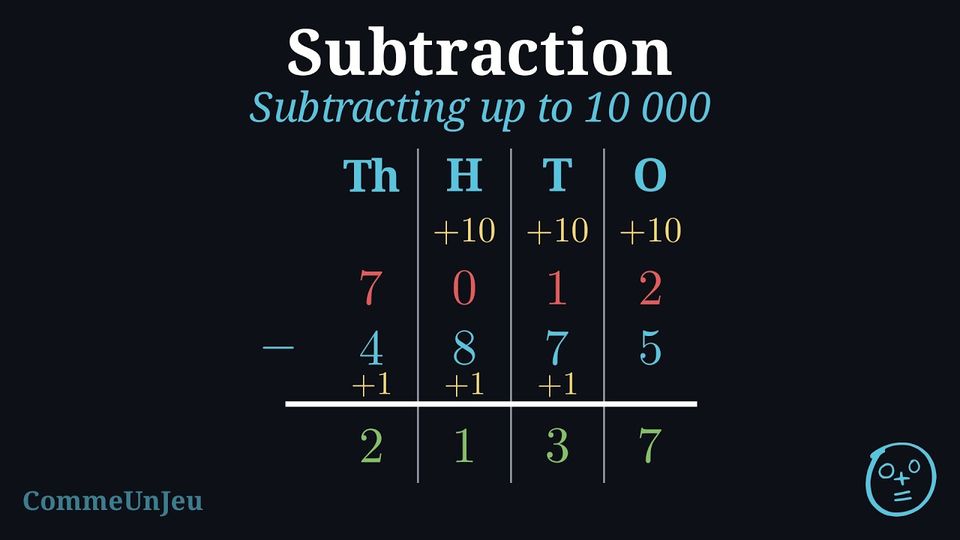
Compute \(7\,012 - 4\,875\) in columns.
Compensation works with thousands too. Ones: \(2 - 5\) is not possible, add \(10\) ones on top and compensate with \(1\) ten below: \(12 - 5 = 7\). Tens: \(1 - 7 - 1\) is not possible, add \(10\) tens on top, compensate with \(1\) hundred below: \(11 - 7 - 1 = 3\). Hundreds: \(0 - 8 - 1\) is not possible, add \(10\) hundreds on top, compensate with \(1\) thousand below: \(10 - 8 - 1 = 1\). Thousands: \(7 - 4 - 1 = 2\). 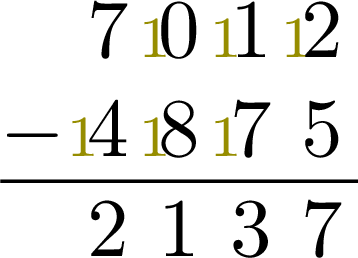
\(7\,012 - 4\,875 = 2\,137\). Check: \(2\,137 + 4\,875 = 7\,012\).
The Terms, the Sum and the Difference
The numbers added in an addition are its terms; the result is their sum. In a subtraction, the two numbers are also called its terms; the result is their difference.
- In \(4\,738 + 2\,589 = 7\,327\), the terms are \(4\,738\) and \(2\,589\): the sum of \(4\,738\) and \(2\,589\) is \(7\,327\).
- In \(76 + 7 + 568 = 651\), there are three terms: \(76\), \(7\) and \(568\).
- In \(7\,012 - 4\,875 = 2\,137\), the terms are \(7\,012\) and \(4\,875\): the difference between \(7\,012\) and \(4\,875\) is \(2\,137\).
Skills to practice
- Solving Problems up to 10 000
- Subtracting in Columns up to 10 000
- Setting Up a Column Subtraction to 10 000
- Naming the Terms, the Sum and the Difference
IV
Going further
Skills to practice
- Choosing a Strategy and Explaining Compensation
- Two-Step Problems
- Quiz
Jump to section