International Baccalaureate · PYP 3
2D Shapes and Polygons
I
Polygons
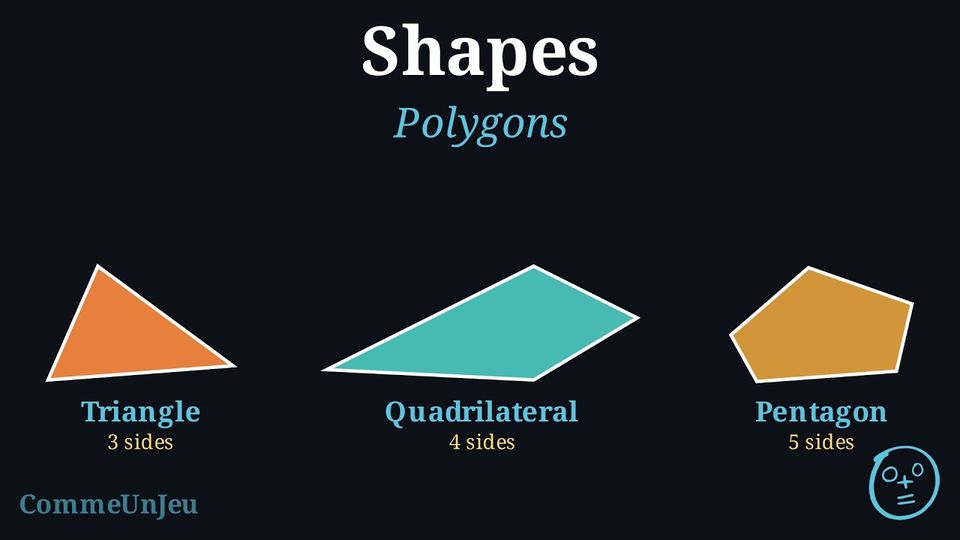
Lina is helping to label a display of road signs. The signs are different sizes and colours, and several are tilted on the board, so sorting them by appearance leads to mistakes: she nearly files a tilted triangular sign with the four-sided signs. 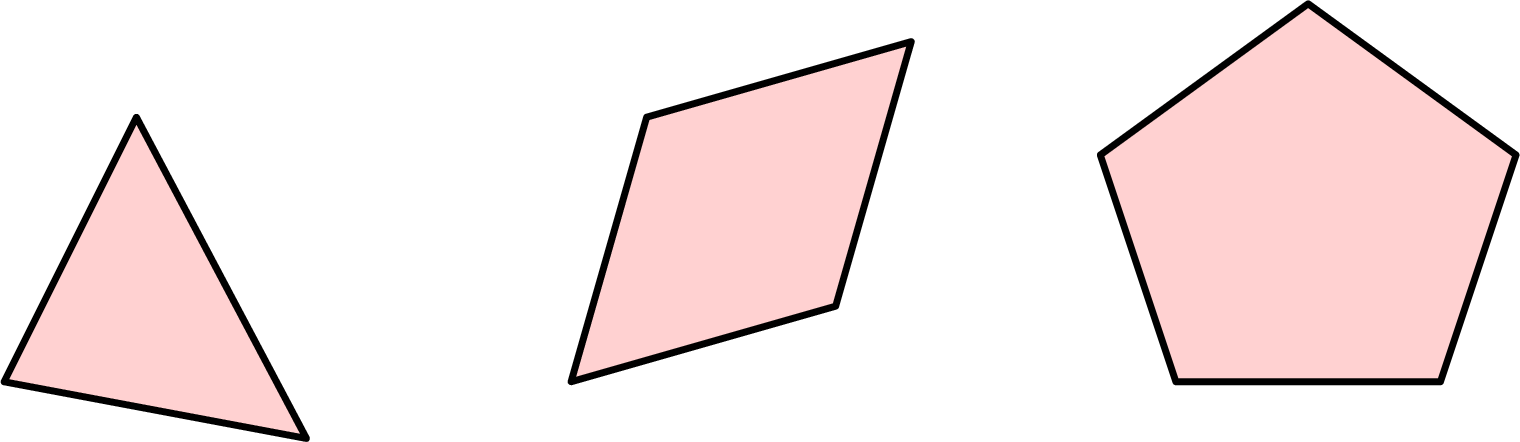
Instead, Lina counts the straight sides of each sign. A sign with three sides is a triangle, one with four sides is a quadrilateral, one with five sides is a pentagon, and so on. The number of sides is a property of the figure, fixed whatever its size, its colour, or the way it leans. By counting sides, Lina names and files every sign correctly.
Definition — Polygon
A polygon is a flat, closed shape made of straight sides that do not cross each other. Example
Look at the shapes below. Decide if each one is a polygon.  \(\quad\)
 \(\quad\)
 \(\quad\)

 \(\quad\)
 \(\quad\)
 \(\quad\)

Definition — Classification of Polygons
A polygon is named by the number of sides it has. Here are some common polygons:  |  |  |  |
| Triangle | Quadrilateral | Pentagon | Hexagon |
| 3 sides | 4 sides | 5 sides | 6 sides |
Definition — Regular Polygon
A regular polygon has all sides the same length and all its angles equal.  \(\quad\)
 \(\quad\)

Definition — Quadrilateral
A quadrilateral is a polygon with four sides (and therefore four vertices and four angles). Skills to practice
- Identifying Polygons
- Naming Polygons
- Marking Vertices and Sides
- Drawing Polygons on the Grid
- Drawing Polygons
II
Special Quadrilaterals and the Right-Angled Triangle
Definition — Rectangle
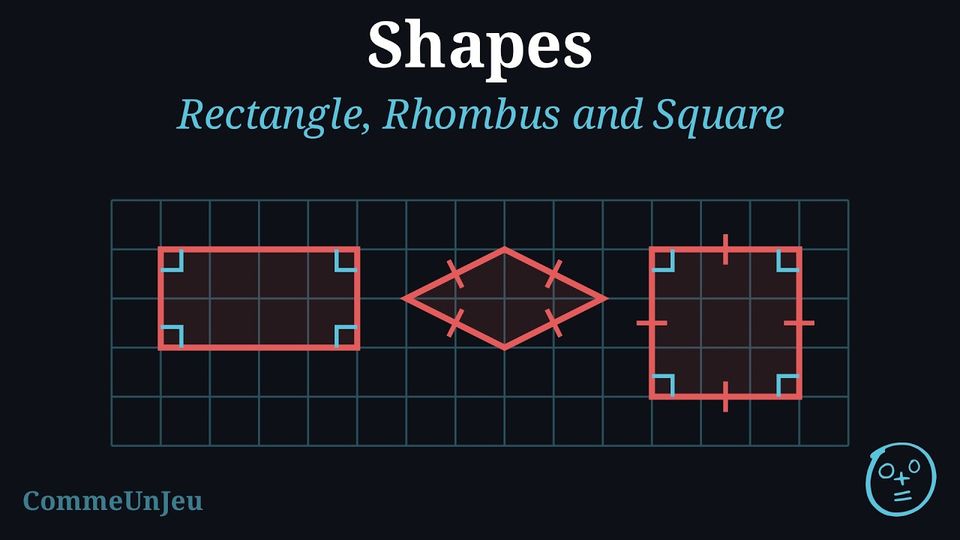
A rectangle is a quadrilateral (a 4-sided polygon) with four right angles. In a rectangle, opposite sides are equal in length. 
Proposition — The Square and the Rectangle
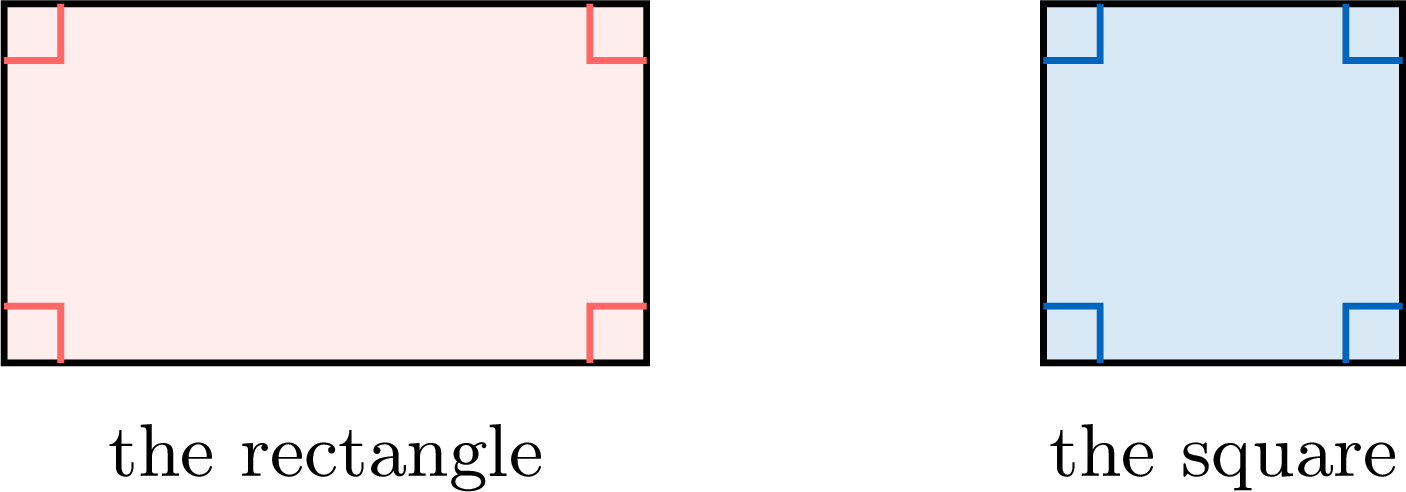
Two shapes with \(4\) sides are known by their angles and by their side lengths: - a rectangle has \(4\) sides, \(4\) vertices and \(4\) right angles; its opposite sides have the same length;
- a square has \(4\) sides, \(4\) vertices, \(4\) right angles, and its \(4\) sides have the same length.
Example
Is this shape a rectangle? Say why. 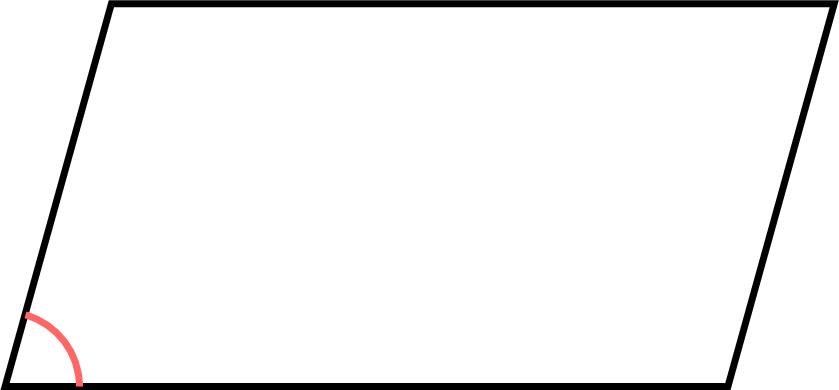
It has \(4\) sides and its opposite sides have the same length — but we check the corners with the template: the marked angle is more closed than a right angle. It is not a rectangle, because one of its angles is not a right angle.
Definition — Rhombus
A rhombus is a quadrilateral with four equal sides. 
A Square is Both
A rectangle has four right angles, and its opposite sides have the same length. When they are not all equal, the two longer ones give its length and the two shorter ones its width. On a drawing, small identical strokes across two sides mean that these two sides have the same length — the section “Coding a Figure” comes back to it.
A rhombus has four sides of the same length.
A square has four right angles and four sides of the same length: it is therefore a rectangle and a rhombus at the same time — a rectangle whose length equals its width. Saying “it is a rectangle” about a square is not a mistake; saying “it is a square” just says more.
Definition — Diagonal
A diagonal of a polygon is a line segment that joins two vertices which are not next to each other — two corners not already joined by a side. A quadrilateral has two diagonals. 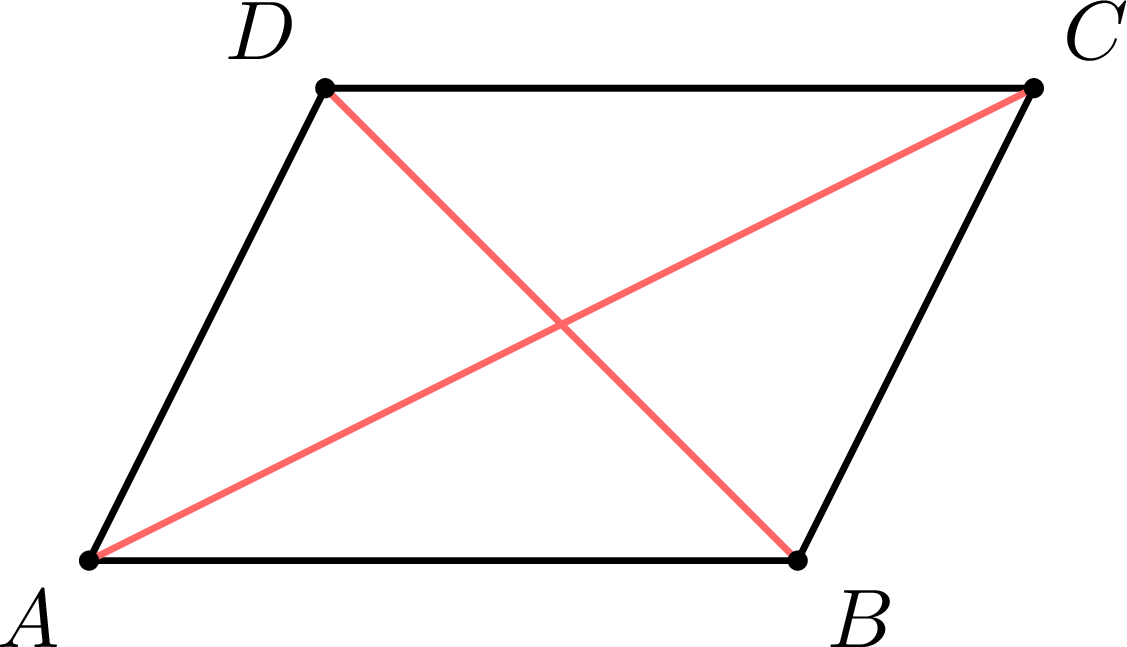
Definition — Right-angled triangle
A right-angled triangle is a triangle that has a right angle. To check it, place the right angle of the set square on one corner of the triangle: if the two sides are aligned with its two edges, that corner is a right angle and the triangle is right-angled. On a figure, that right angle is marked with its small square, the code of the right angle. 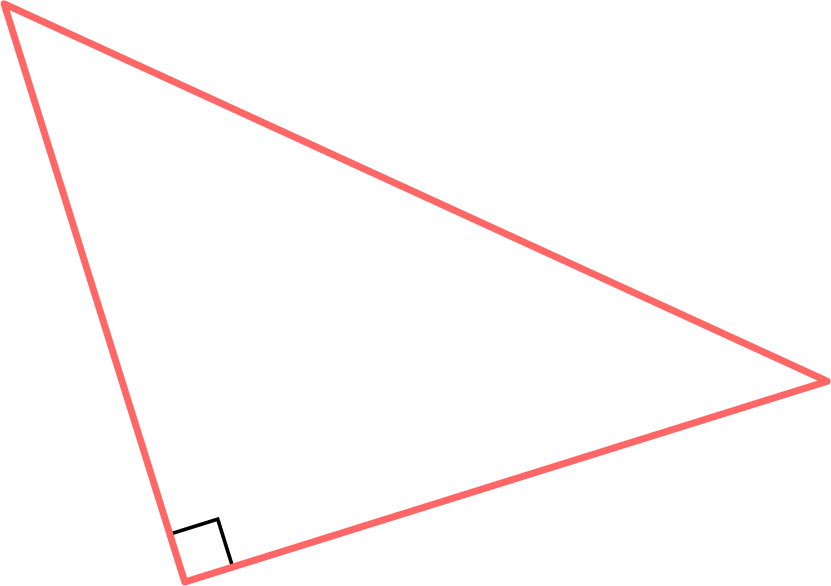
Skills to practice
- Justifying with the Properties
- Completing a Figure on the Grid
- Checking and Justifying in Writing
III
Coding a Figure
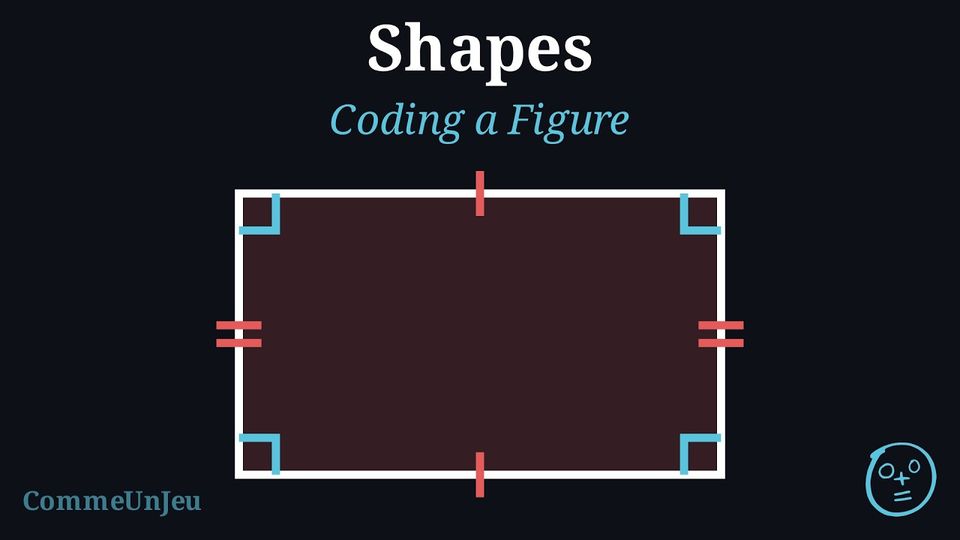
Example — Why Code a Figure?
Léa has added signs to her rectangle so that a friend knows, without measuring, that its four angles are right angles and that its opposite sides are equal. What does each sign say? 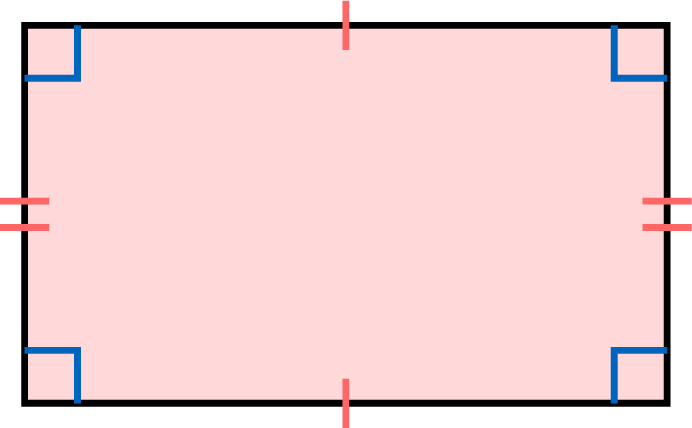
She adds the codes. A small square in a corner says: this angle is a right angle — there are four of them. Small identical strokes across two sides say: these two sides have the same length. The two long sides carry one stroke each, the two short ones carry two: same number of strokes means same length, different number means nothing is claimed.
Method — Coding a Figure
Coding a figure means writing on the drawing what is true, so that no one needs to measure: - The right angle is coded by a small square placed in the corner. It is the code already used for right angles.
- Equal lengths are coded by small identical strokes drawn across the sides. Sides carrying the same number of strokes have the same length.
Example — Coding a Square and a Rhombus
Read the coding of this square, then of this rhombus: what does each sign claim? 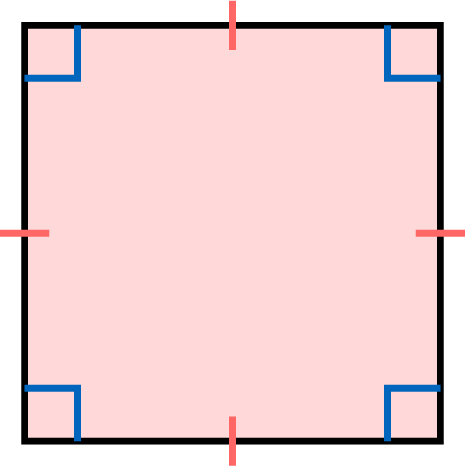
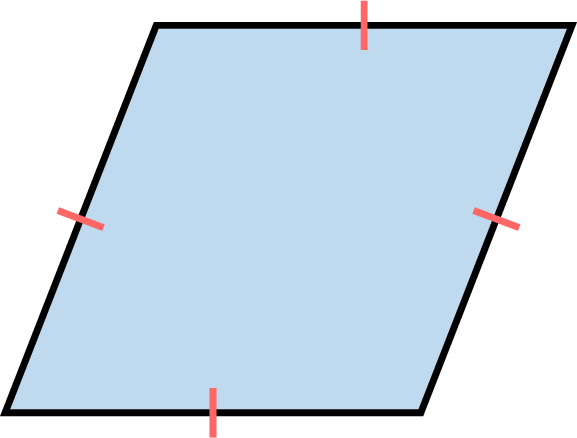
The square: four small squares for the four right angles, and one stroke on each of the four sides, because they all have the same length. The rhombus: one stroke on each of the four sides, and no small square — its angles are not right angles, so coding one would say something false.
Skills to practice
- Reading a Coded Figure
- Coding a Figure
IV
Naming a Figure, and Saying it is Not One
Example
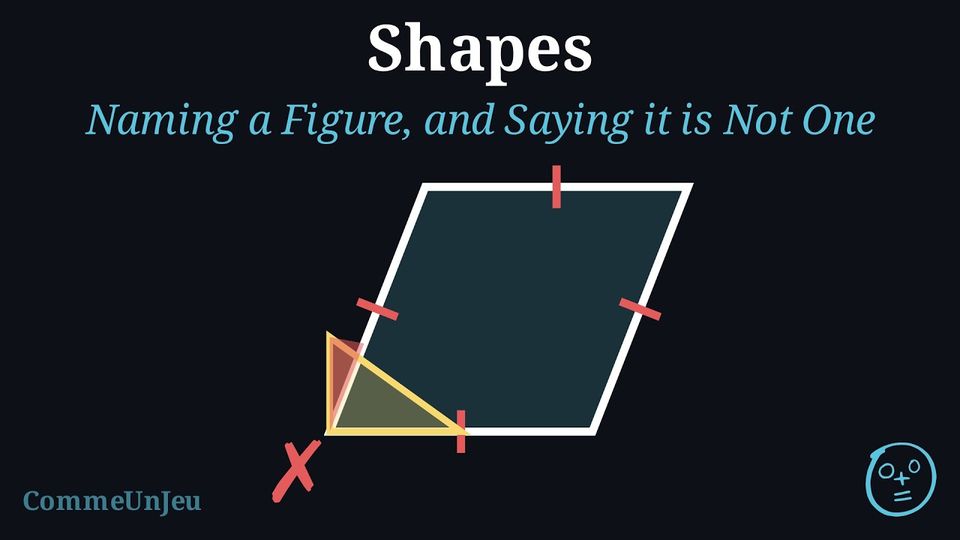
Tom looks at this quadrilateral and says: “It has four sides of the same length, so it is a square.” Is he correct?
What Tom says is true: the four sides do have the same length. That is enough to say rhombus — a rhombus asks for nothing more. But it is not enough for a square, which also asks for four right angles: place the set square on a corner and you will see this one is not a right angle. A true property proves only what it is enough for.
Method — Naming, or Saying it is Not
Two different jobs, and they do not take the same work: - To name a figure, check every property the name requires: the number of sides, their lengths, the right angles. “It has four sides, all of the same length, and its four angles are right angles: it is a square.”
- To say it is not, one property is enough — one that the name requires and that the figure does not have. “It is not a square, because one of its angles is not a right angle. But a square has four right angles.”
Example
Name this figure, giving your arguments.
It has four sides, so it is a quadrilateral. Its four angles are right angles — the four small squares say so. The strokes say that the opposite sides are equal in pairs. It is a rectangle. Is it a square? The codes do not answer that: different strokes say nothing. We must measure: the long sides are clearly longer than the short ones, so it is not a square.
Example
Say why this figure is not a rectangle. 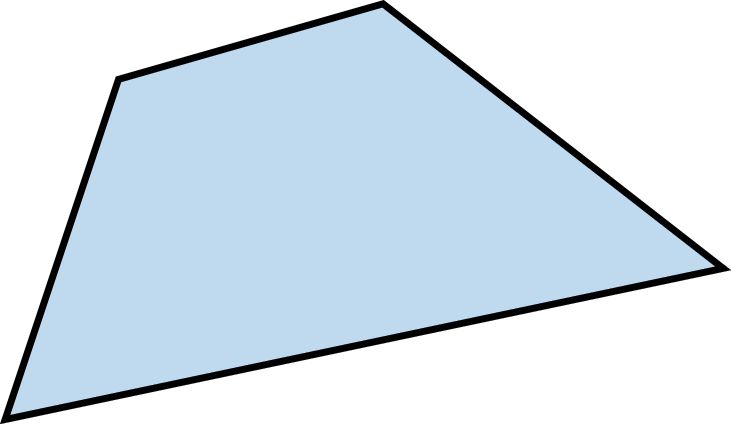
It is not a rectangle, because none of its angles is a right angle. But a rectangle has four right angles. One line is enough: we do not need to speak about its sides.
Skills to practice
- Naming a Figure or Saying It Is Not One
V
Circle, Radius and Diameter
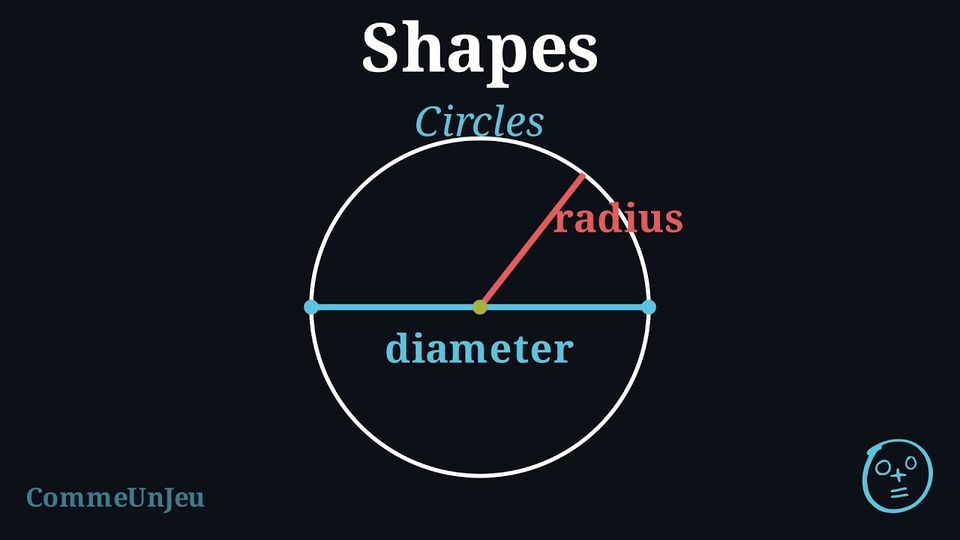
Definition — Radius and Diameter
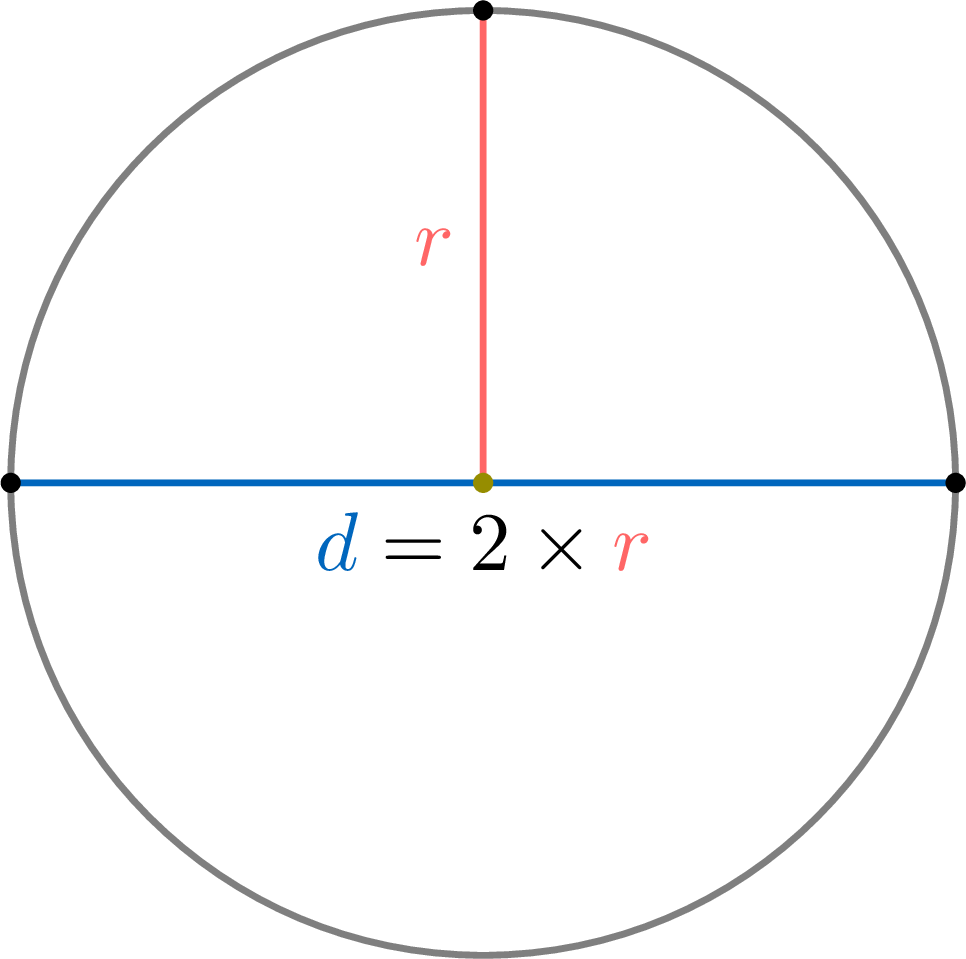
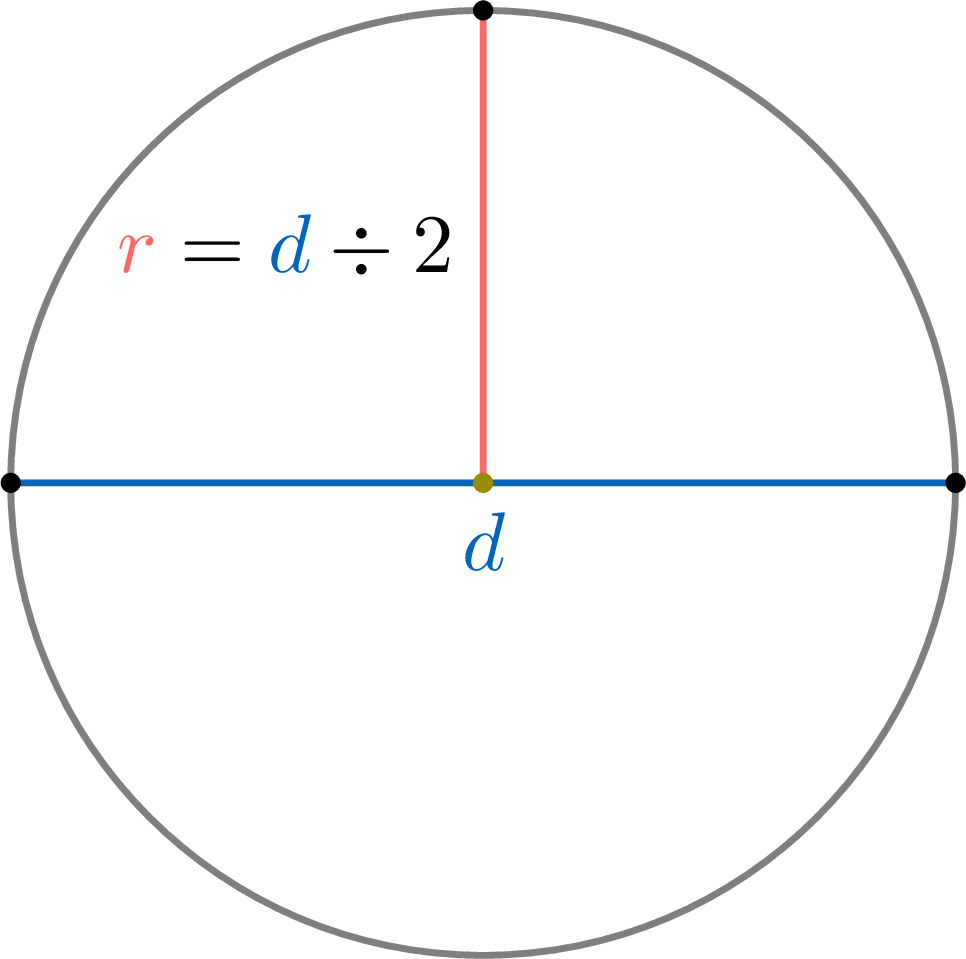
The radius of a circle is a segment joining the centre to a point of the circle; it is also its length, the opening of the compass. The diameter is a segment joining two points of the circle through the centre; it is also its length. 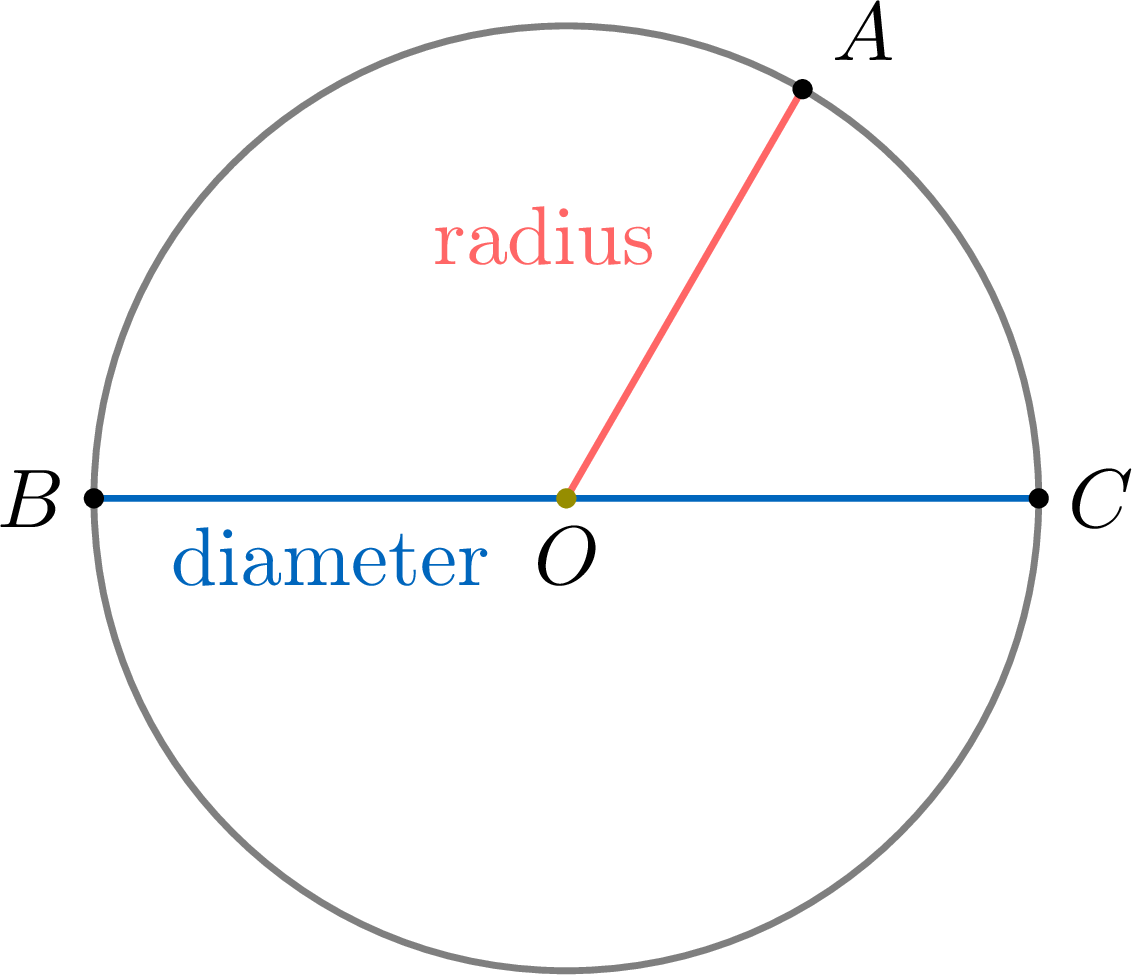
Definition — Disc
A circle is only the curve — the boundary line itself. A disc is the whole flat region the circle encloses: the circle together with every point inside it. 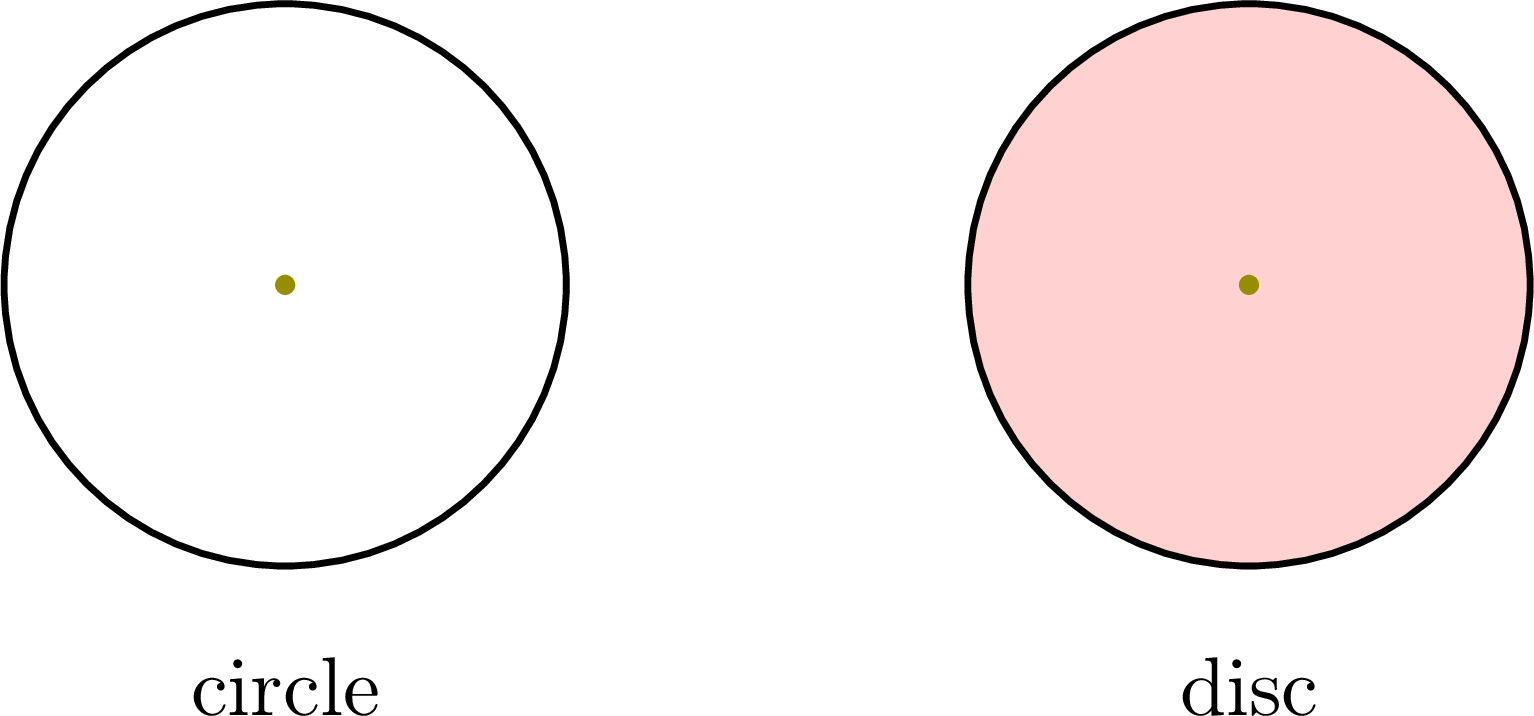
Proposition — Diameter-Radius Rule
- The diameter is twice as long as the radius.
- The radius is half of the diameter.
Skills to practice
- Finding the Radius and the Diameter
VI
Constructing with the Ruler, the Set Square and the Compass
Method — Drawing a Rectangle on Plain Paper
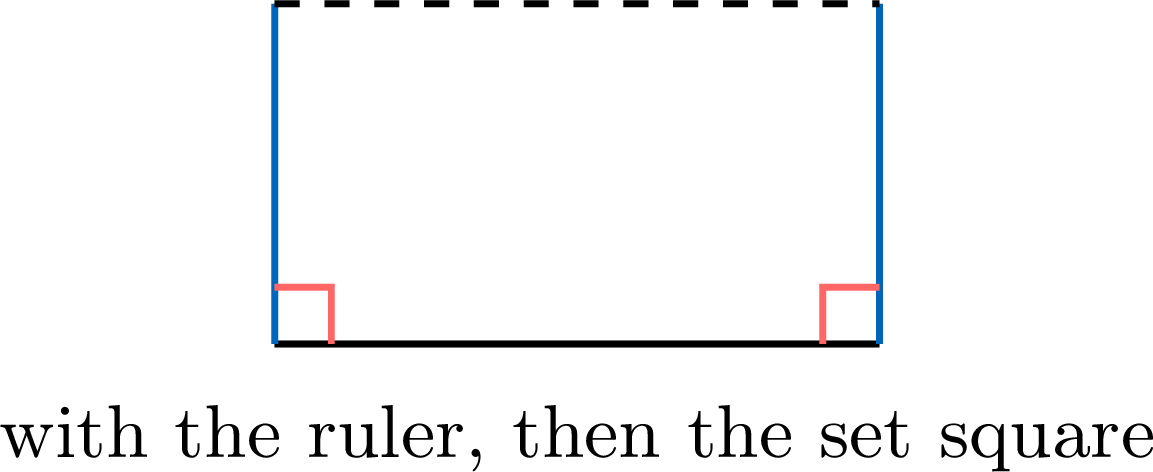
Without squares to count, the ruler and the set square do the work: - One side with the ruler: draw the first side and mark its two ends.
- Two right angles with the set square: place the corner of the set square on one end, one edge along the side, and draw the next side; do the same at the other end.
- The same length on both: with the ruler, carry the same length onto the two sides just drawn — otherwise the figure closes as a slanted shape, not a rectangle.
- Close the figure: join the two ends with the ruler, and code the four right angles.
Method — Constructing a Right-Angled Triangle with a Set Square
To build a right-angled triangle when the two sides of the right angle are given (\(10\) cm and \(4\) cm, say), on plain paper: - Draw the first side with the ruler: a segment of \(10\) cm. Name one of its ends.
- Place the set square so that the corner of its right angle sits on that end and one of its edges lies along the segment.
- Draw along the other edge of the set square, then measure \(4\) cm on this new line from the same end.
- Close the triangle: join the two free ends with the ruler, and code the right angle with its small square.
Example
Construct a right-angled triangle whose two sides of the right angle measure \(4\) cm and \(3\) cm, and code the right angle. 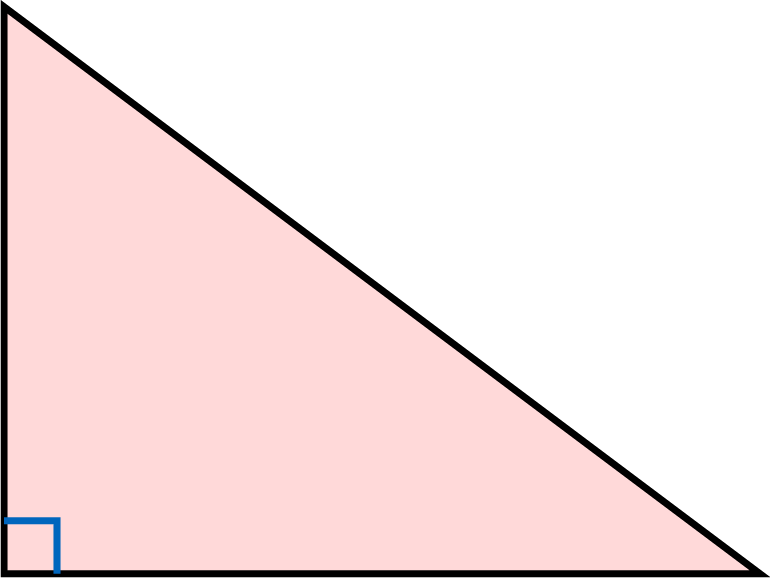
Draw a segment of \(4\) cm. Put the corner of the set square on its left end, one edge along the segment, and draw upwards. Measure \(3\) cm on that line. Join the two free ends. The small square in the corner shows the right angle.
Skills to practice
- Reproducing a Figure on the Grid
- Constructing on Plain Paper
VII
Going further
Skills to practice
- Reproducing and Constructing
- Solving Harder Polygon Problems
- Quiz
Jump to section