International Baccalaureate · PYP 2
Addition to 100 and beyond
I
Adding Ones Then Adding Tens
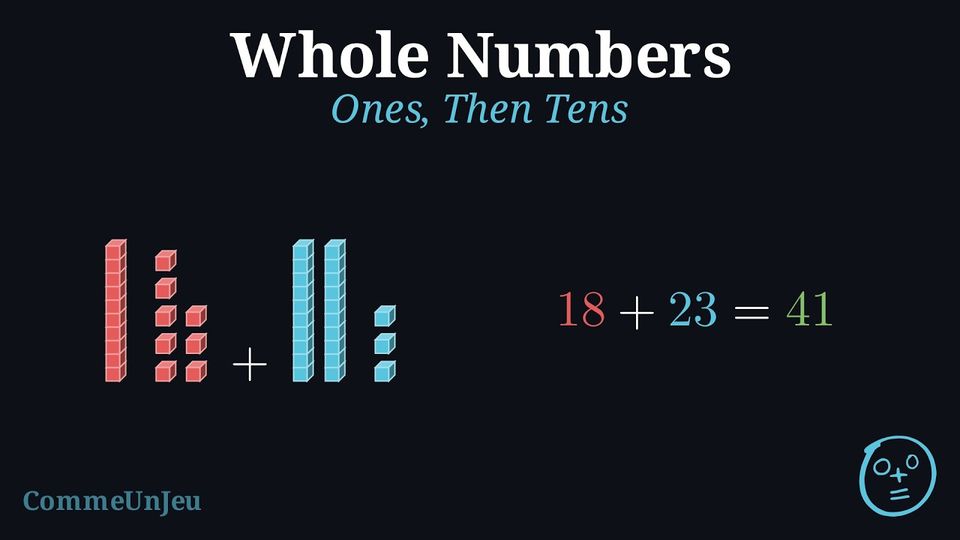
Su has a collection of cubes. She has 18 red cubes and 23 blue cubes.  \(+\)

How can we find out how many cubes Su has in total?
\(+\)
To find the total, we need to add the red cubes and the blue cubes together: $$\textcolor{colordef}{18} + \textcolor{colorprop}{23}$$ When we join the groups, we can see the total. \(+\)\(=\) \(=\)

In total, there are \(\textcolor{colordef}{18} + \textcolor{colorprop}{23} = \textcolor{olive}{41}\) cubes.
Counting every single cube one by one is slow. The Methods “Adding Ones Then Tens” and “Adding in Columns” give faster ways to add.
\(+\)\(=\)\(=\)Counting every single cube one by one is slow. The Methods “Adding Ones Then Tens” and “Adding in Columns” give faster ways to add.
Method — Adding Ones Then Tens Using Cubes
To calculate:  \(+\)

- Step 1: Group the tens and ones

- Step 2: Add the ones $$\textcolor{colordef}{2} \text{ ones} + \textcolor{colorprop}{3} \text{ ones} = 5 \text{ ones}$$
- Step 3: Add the tens $$\textcolor{colordef}{1} \text{ ten} + \textcolor{colorprop}{2} \text{ tens} = 3 \text{ tens}$$
- Result: There are 3 tens and 5 ones. So, $$\textcolor{colordef}{12} + \textcolor{colorprop}{23} = 35$$ \(+\) \(=\)

We now calculate \(\textcolor{colordef}{18} + \textcolor{colorprop}{23}\). This time, adding the ones gives a number greater than \(9\): the ones are regrouped into a new ten.
Method — Adding Ones Then Tens with Regrouping
To calculate:  \(+\)
- Step 1: Group the tens and ones

- Step 2: Add the ones $$\textcolor{colordef}{8} \text{ ones} + \textcolor{colorprop}{3} \text{ ones} = 11 \text{ ones} = 1 \text{ ten} + 1 \text{ one}$$

- Step 3: Add the tens $$\textcolor{colordef}{1} \text{ ten} + \textcolor{colorprop}{2} \text{ tens} + 1 \text{ ten (regrouped)} = 4 \text{ tens}$$
- Result: There are 4 tens and 1 one. So, $$\textcolor{colordef}{18} + \textcolor{colorprop}{23} = 41$$ \(+\) \(=\)

Skills to practice
- Adding Without Regrouping in a Table
- Adding Without Regrouping
- Adding With Regrouping in a Table
- Adding With Regrouping
II
Adding Using Columns
Method — Adding in Columns
To calculate:$$\textcolor{colordef}{12} + \textcolor{colorprop}{23}$$ - Step 1: Set up the addition
Write the numbers in a vertical column, making sure the digits line up by place value (ones under ones, tens under tens).
- Step 2: Add the ones $$\textcolor{colordef}{2} \text{ ones} + \textcolor{colorprop}{3} \text{ ones} = 5 \text{ ones}$$

- Step 3: Add the tens $$\textcolor{colordef}{1} \text{ ten} + \textcolor{colorprop}{2} \text{ tens} = 3 \text{ tens}$$

- Result: There are 3 tens and 5 ones. So,$$\textcolor{colordef}{12} + \textcolor{colorprop}{23} = 35$$
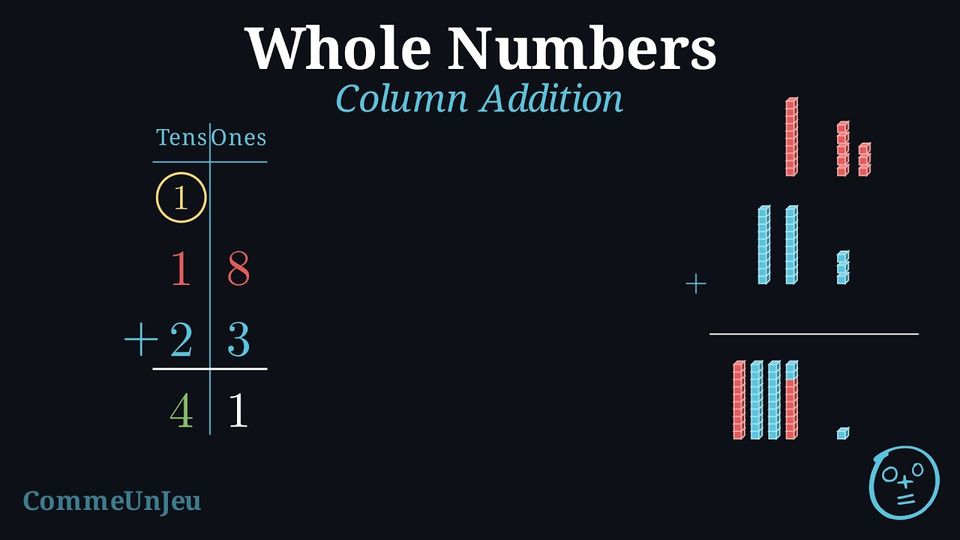
We add \(\textcolor{colordef}{18} + \textcolor{colorprop}{23}\) in columns. This time, adding the ones gives a number greater than \(9\): the ones are regrouped into a new ten. We move (or carry) a group of ten to the tens place.
Method — Adding in Columns with Carrying
To calculate:$$\textcolor{colordef}{18} + \textcolor{colorprop}{23}$$ - Step 1: Set up the addition
Write the numbers in a vertical column, making sure the digits line up by place value (ones under ones, tens under tens).
- Step 2: Add the ones $$\textcolor{colordef}{8} \text{ ones} + \textcolor{colorprop}{3} \text{ ones} = 11 \text{ ones} = 1 \text{ ten} + 1 \text{ one}$$ Write the 1 in the ones place and carry the 1 ten to the top of the tens column.

- Step 3: Add the tens $$\textcolor{colordef}{1} \text{ ten} + \textcolor{colorprop}{2} \text{ tens} + 1 \text{ ten (carried)} = 4 \text{ tens}$$

- Result: $$\textcolor{colordef}{18} + \textcolor{colorprop}{23} = 41$$
Example
Set out and compute \(28 + 8 + 56\).
Ones under ones, tens under tens (\(8\) goes in the ones column). Ones: \(8 + 8 + 6 = 22\), that is \(2\) tens and \(2\) ones: we write \(2\) and carry two tens. Tens: \(2 + 5 + 2 = 9\). Result \(92\). \(\begin{array}{r@{\;}r@{\;}r} & \scriptstyle 2 & \\ & 2 & 8 \\ & & 8 \\ + & 5 & 6 \\ \hline & 9 & 2 \\ \end{array}\) With three numbers, the ones can go past \(19\): the carry can be \(2\).
Is the Sum Reasonable?
After a column addition, a quick check tells whether the result is reasonable: each number is replaced by the whole ten closest to it (for a number ending in \(5\), the ten above), and these tens are added. The sum must be about this number. 
- Tom computes \(48 + 37\) in columns and finds \(\textcolor{colordef}{75}\). \(48\) is close to \(50\) and \(37\) is close to \(40\): the sum is about \(50 + 40 = \textcolor{olive}{90}\). \(\textcolor{colordef}{75}\) is far from \(\textcolor{olive}{90}\): something is wrong.
- Tom forgot the carry. The ones make \(8 + 7 = 15\), that is one more ten: \(48 + 37 = \textcolor{colorprop}{85}\), close to \(\textcolor{olive}{90}\).
Skills to practice
- Reading a Column Addition Without Carrying
- Reading a Column Addition With Carrying
- Solving Real-World Problems
- Adding in Columns Without Carrying
- Adding Two or Three Numbers in Columns with Carrying
- Checking a Sum with an Estimate
III
Adding and Subtracting Whole Tens and Hundreds
Léa has \(234\) stickers. She wins \(60\) more. Tom says: “Only the tens change: \(3\) tens and \(6\) tens make \(9\) tens.” How many stickers does she have? And if she then wins \(500\) more?
\(234\) is \(2\) hundreds, \(3\) tens and \(4\) ones. Adding \(60\) adds \(6\) tens: \(9\) tens, so \(294\). Adding \(500\) adds \(5\) hundreds: \(7\) hundreds, so \(794\). The ones never moved.
Method — Only the Tens or the Hundreds Change
- Adding or taking away whole tens: count in tens, the ones do not move. \(541 - 20\): \(4\) tens minus \(2\) tens make \(2\) tens, so \(521\).
- Adding or taking away whole hundreds: count in hundreds, the tens and the ones do not move. \(354 + 500\): \(3\) hundreds plus \(5\) hundreds make \(8\) hundreds, so \(854\). \(765 - 200\): \(565\).
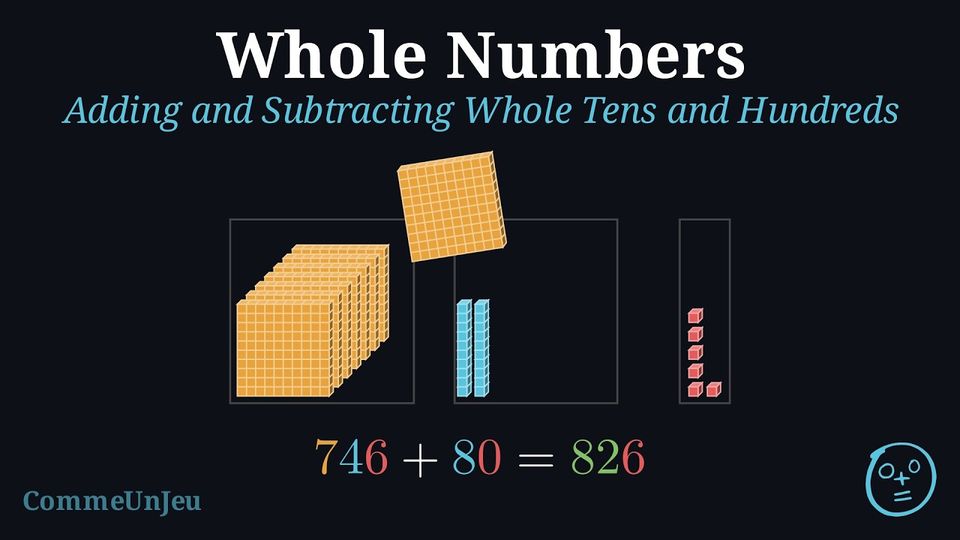
- When the tens go past ten: \(746 + 80\): \(4\) tens plus \(8\) tens make \(12\) tens, that is \(1\) hundred and \(2\) tens. So \(7\) hundreds become \(8\), and \(746 + 80 = 826\). Ten tens are regrouped into one hundred, just as ten ones make one ten.
Example
Compute: (a) \(382 + 40\), (b) \(869 - 50\), (c) \(128 + 700\), (d) \(385 + 40\).
(a) \(8\) tens \(+ 4\) tens \(= 12\) tens \(= 1\) hundred and \(2\) tens: \(422\). (b) \(6\) tens \(- 5\) tens \(= 1\) ten: \(819\). (c) \(1 + 7 = 8\) hundreds: \(828\). (d) \(8\) tens \(+ 4\) tens \(= 12\) tens: \(425\).
Skills to practice
- Adding or Subtracting Whole Tens
- Adding or Subtracting Whole Hundreds
- Adding Tens Past a Hundred
IV
Adding and Subtracting 9, 19 and 29 up to 1000
Method — Going Through the Whole Ten
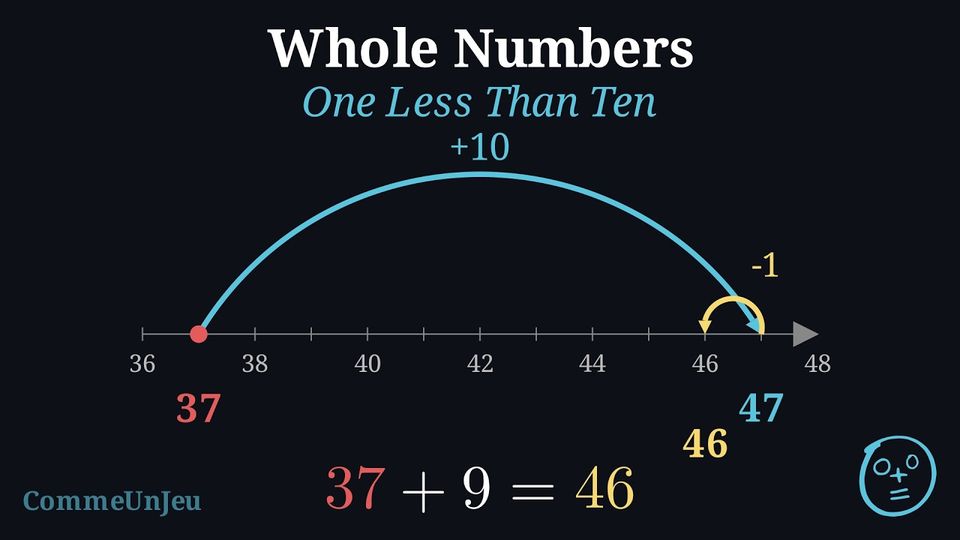
\(9\), \(19\) and \(29\) are just one less than \(10\), \(20\) and \(30\): - to add \(9\), \(19\) or \(29\): add \(10\), \(20\) or \(30\), then take away \(1\);
- to take away \(9\), \(19\) or \(29\) (when the number is at least \(10\), \(20\) or \(30\)): take away \(10\), \(20\) or \(30\), then give back \(1\).
Léa computes \(356 + 19\). She says: “\(19\) is \(20\) minus \(1\): I add \(20\), then take \(1\) away.” What does she find? And for \(423 - 9\)?
\(356 + 20 = 376\), then \(376 - 1 = 375\). For \(423 - 9\): \(9\) is \(10\) minus \(1\), so take \(10\) away and give \(1\) back: \(423 - 10 = 413\), \(413 + 1 = 414\).
Method — The Same Trick with Three-Digit Numbers
The trick of the whole ten works up to \(1\,000\): - To add \(9\), \(19\) or \(29\): add \(10\), \(20\) or \(30\), then take \(1\) away. \(675 + 29\): \(705 - 1 = 704\).
- To take \(9\) away: take \(10\) away, then give \(1\) back. \(540 - 9\): \(530 + 1 = 531\).
- Not needed for an addition when the ones digit is \(0\) or \(1\): \(240 + 9 = 249\) and \(330 + 19 = 349\) are read directly. To take \(9\) away, the trick still helps: \(540 - 9 = 531\) above.
Example
Compute: (a) \(247 + 9\), (b) \(488 + 19\), (c) \(815 - 9\), (d) \(230 + 29\).
(a) \(257 - 1 = 256\). (b) \(508 - 1 = 507\). (c) \(805 + 1 = 806\). (d) The ones digit is \(0\): \(259\) directly.
Skills to practice
- Adding 9, 19 or 29
- Taking Away 9, 19 or 29
- Adding 9, 19 or 29 and Subtracting 9
- Explaining the Path Through the Whole Ten
- Choosing the Path
V
Going further
Skills to practice
- Completing Equalities with Pictures
- Quiz
Jump to section