International Baccalaureate · PYP 3
Perimeter and Area
I
What Is Perimeter?
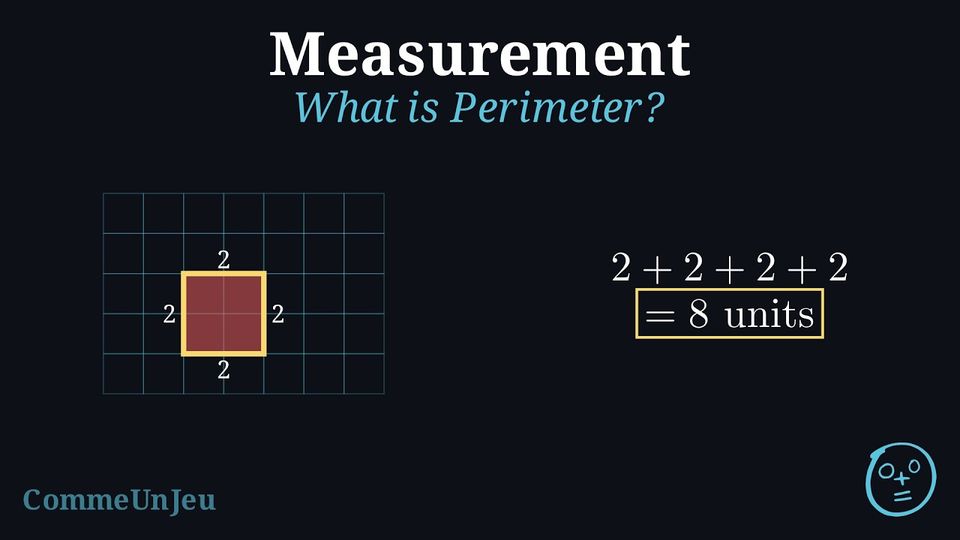
Definition — Perimeter
The perimeter of a shape is the total distance all the way around its outside edge. Method — Finding the perimeter
To find the perimeter of any shape with straight sides, add the lengths of all its sides together. Example
Find the perimeter of the red shape. Each square on the grid is 1 unit long. 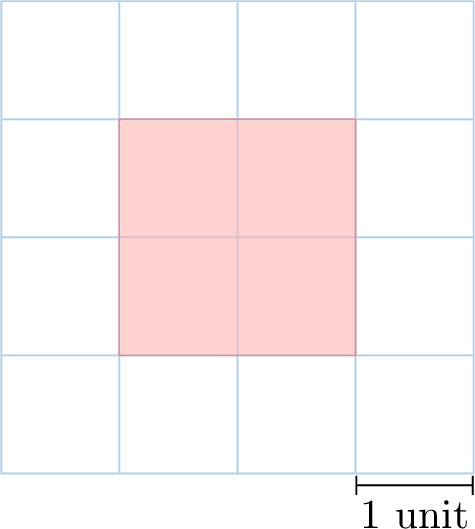
- Step 1: Find the length of each side by counting the units on the grid.
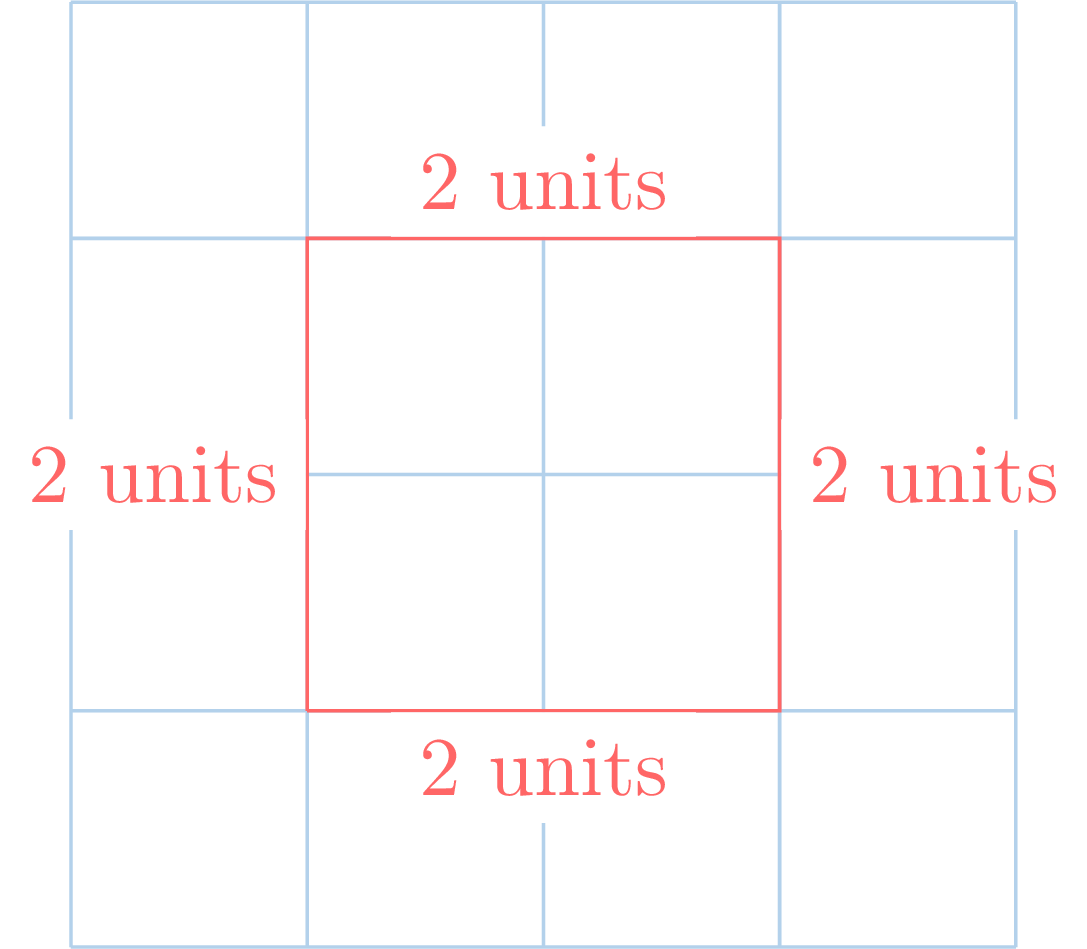
- Step 2: Add the lengths of all the sides. $$\begin{aligned} \text{Perimeter} &= 2 + 2 + 2 + 2\\ &= 8 \end{aligned} $$ The perimeter of the shape is 8 units.
Skills to practice
- Finding the Perimeter of a Shape
- Finding the Perimeter from the Side Lengths
II
Copying a Length with a Compass
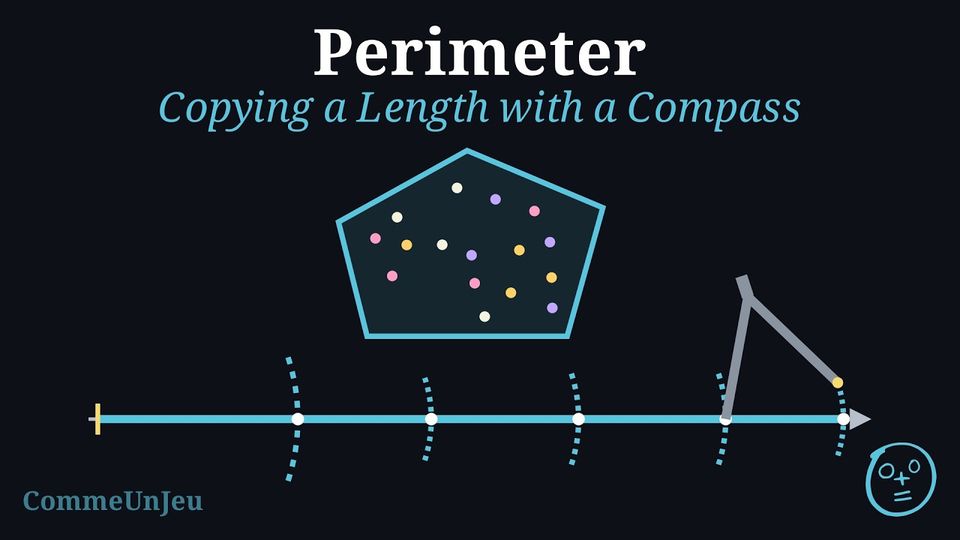
Two flowerbeds have the shape of the polygons below. Their sides are not the same, and no ruler is allowed. 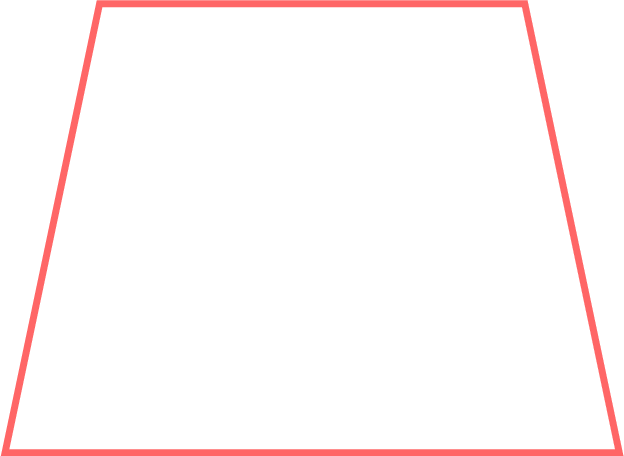
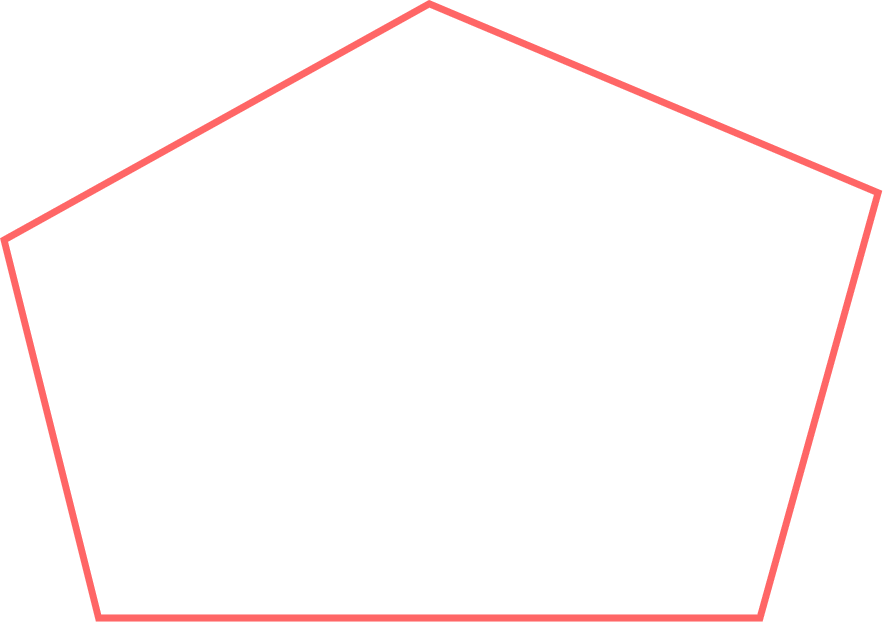
Say how to find out which flowerbed needs the longer fence.
The fence of a flowerbed is its perimeter: the length of its outline. Without a graduated ruler, the compass carries each side onto a line, one after the other: the compass opening is the side, and the arc is drawn from the mark where the previous side stopped. 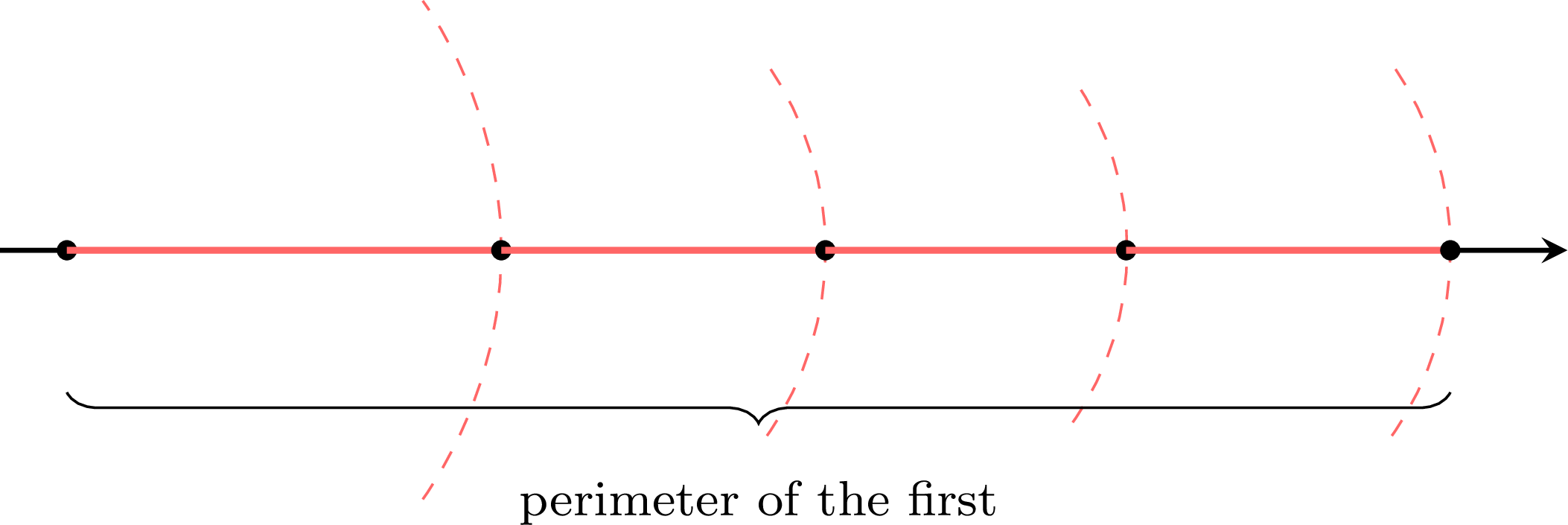
The same is done for the second flowerbed, starting from the same mark on a second line. 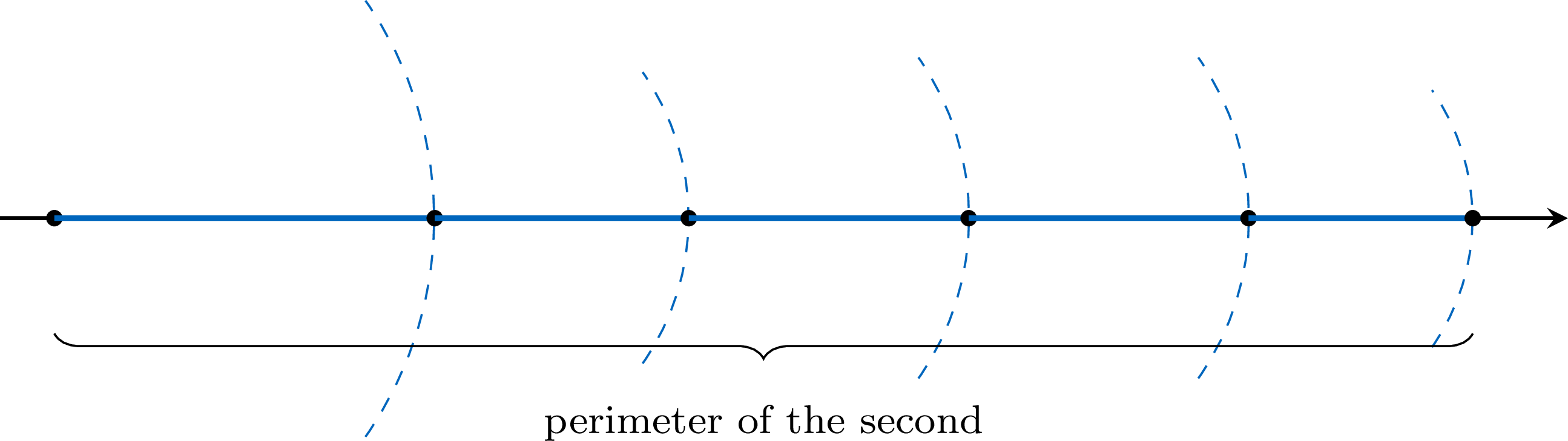
The second segment goes further: the second flowerbed has the bigger perimeter — and no length has been measured.
Method — Carrying a Length with the Compass
The compass keeps a length without measuring it. - Take the length: open the compass so that one point is on one end of the side and the other point on the other end. The opening is the length of the side.
- Carry it: without changing the opening, place the point on the line at the mark where the previous side stopped, and draw a small arc that cuts the line further along, always in the same direction. The new mark ends the carried side.
- Add the sides: carry all the sides of the polygon one after the other on the same line. The segment obtained, from the first mark to the last, has the same length as the whole outline.
- Compare: two polygons are carried onto two lines drawn one under the other, from the same starting mark. The one whose segment goes further has the bigger perimeter.
Example
Carry the three sides of this triangle onto a line, then compare its perimeter with the segment drawn below. 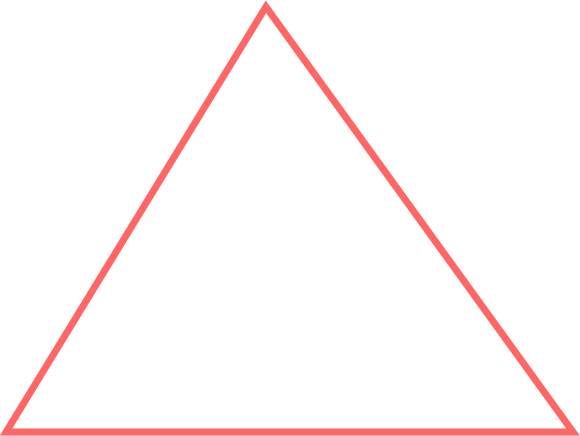

The three sides are carried one after the other, each arc starting from the mark where the previous side stopped: 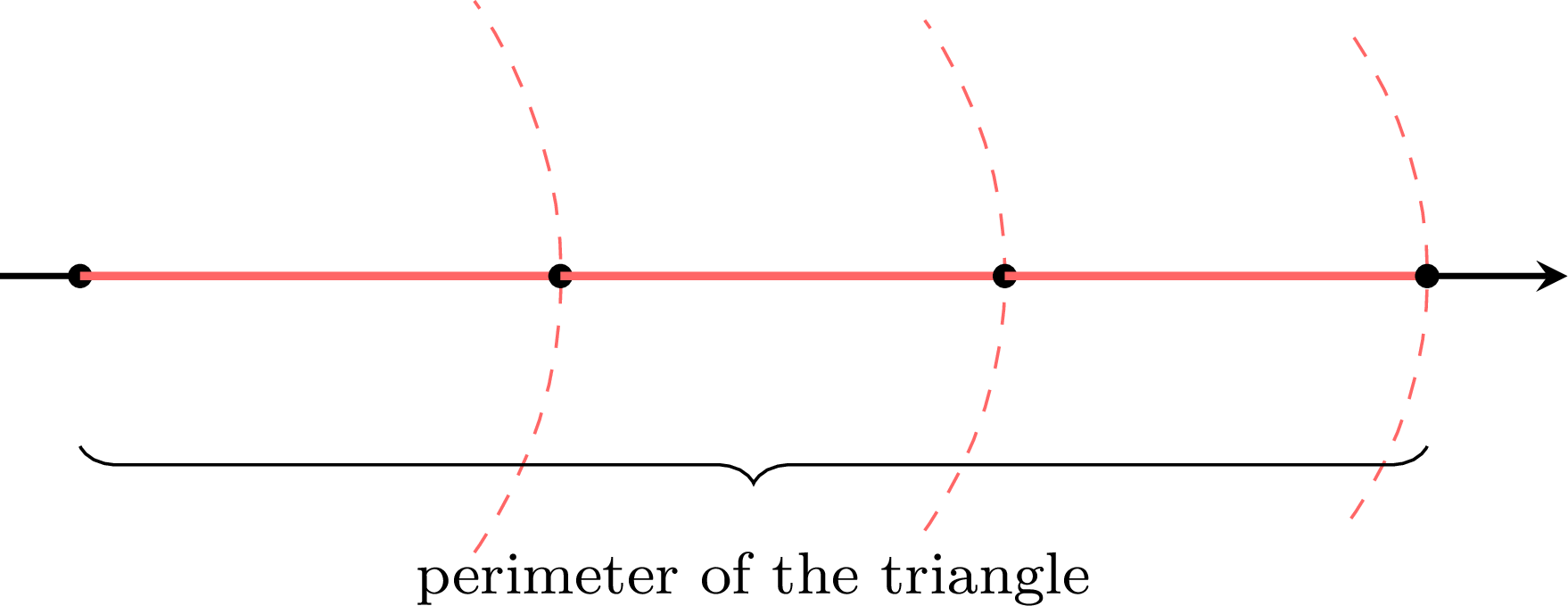
The segment obtained goes further than the drawn segment, so the perimeter of the triangle is the bigger one. Nothing was measured: only the compass openings were carried.
Skills to practice
- Carrying, Comparing and Drawing Perimeters
III
Perimeter of Squares and Rectangles
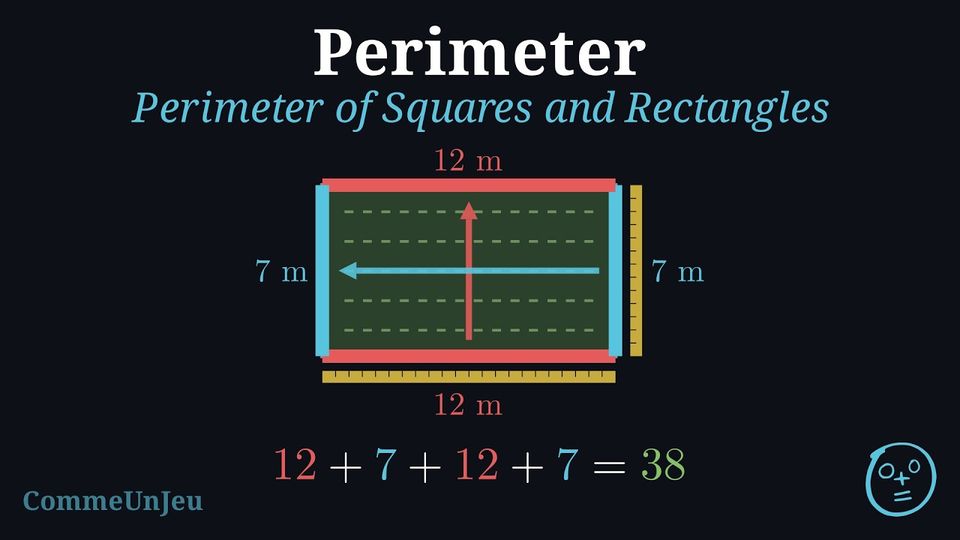
A gardener wants to put a fence around a rectangular vegetable patch. He measures one side: \(12~\mathrm{m}\). Then he measures the next one: \(7~\mathrm{m}\). 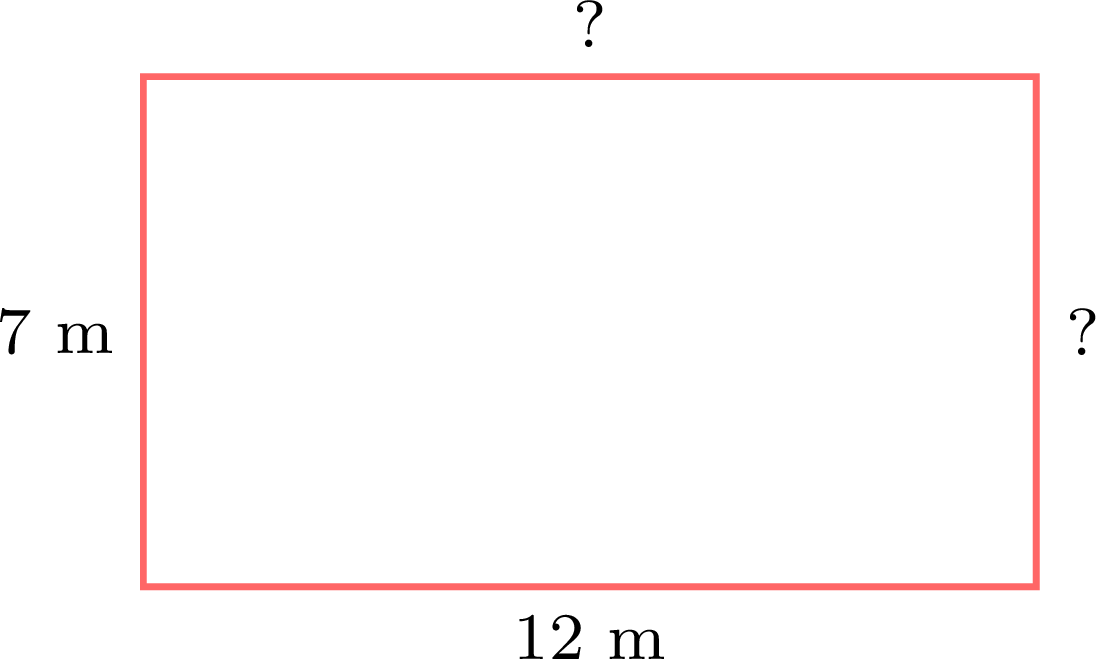
Say whether the two other sides still have to be measured, then give the length of the fence.
In a rectangle the opposite sides have the same length: the side facing \(12~\mathrm{m}\) also measures \(12~\mathrm{m}\), and the one facing \(7~\mathrm{m}\) also measures \(7~\mathrm{m}\). Two measurements are enough, the two others are read off the figure. $$\textcolor{colordef}{12}+\textcolor{colorprop}{7}+\textcolor{colordef}{12}+\textcolor{colorprop}{7}=\textcolor{olive}{38}$$ The fence is \(38~\mathrm{m}\) long. Check: the outline goes twice along a long side and twice along a short one, and \(38\) is bigger than each side: it is possible.
Method — Fewer Measurements for the Square and the Rectangle
The perimeter of a polygon is always the sum of the lengths of its sides. For two shapes, not every side has to be measured. - The square: its four sides have the same length. One measurement is enough, and the length is added four times. A square of side \(9~\mathrm{cm}\): \(9+9+9+9=36~\mathrm{cm}\).
- The rectangle: the opposite sides have the same length. Two measurements are enough, a long side and a short one, each added twice. A rectangle of \(12~\mathrm{m}\) and \(7~\mathrm{m}\): \(12+7+12+7=38~\mathrm{m}\).
- Careful with the units: if the sides are not written in the same unit, convert before adding.
- For any other polygon, the length of every side has to be known, and all of them are added.
Example
A square tile has a side of \(15~\mathrm{cm}\). What is its perimeter?
One measurement is enough: the four sides measure \(15~\mathrm{cm}\). $$\textcolor{colordef}{15}+\textcolor{colordef}{15}+\textcolor{colordef}{15}+\textcolor{colordef}{15}=\textcolor{olive}{60}$$ The perimeter is \(60~\mathrm{cm}\). Check by grouping the sides two by two: \(15+15=30\), then \(30+30=60\).
Skills to practice
- Finding the Perimeter of a Square
- Finding the Perimeter of a Rectangle
IV
What Is Area?
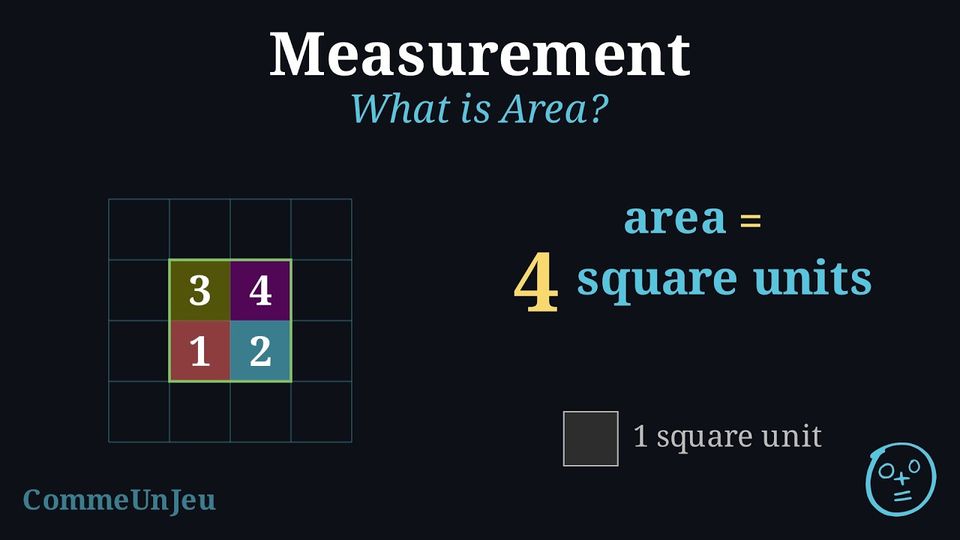
Definition — Area
The area of a shape is how much space it covers on a flat surface. We measure area by counting how many square units are needed to cover it exactly, with no gaps and no overlaps.
To find the area of a shape, we can place it on a grid and count the total number of squares it covers.
You can think of it like tiling a floor — the area is the total number of tiles you use.
You can think of it like tiling a floor — the area is the total number of tiles you use.
Example
Find the area of the red shape. Each small square in the grid is 1 square unit. 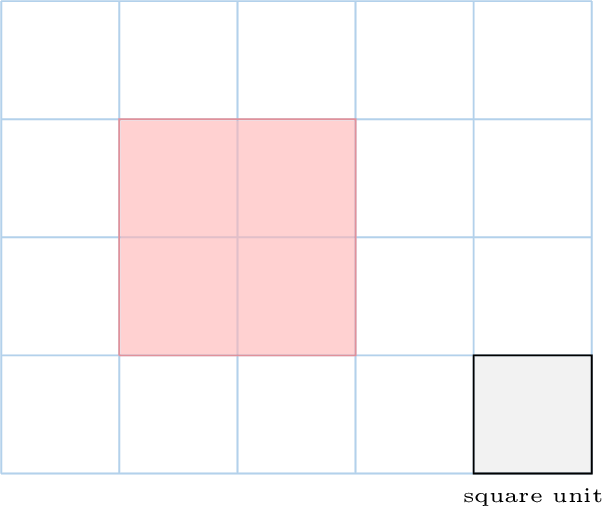
To find the area, we count each square unit inside the shape. 
There are 4 small squares inside the shape.
So, the area is 4 square units.
So, the area is 4 square units.
Skills to practice
- Finding the Area of a Shape
V
Comparing Areas Without Measuring
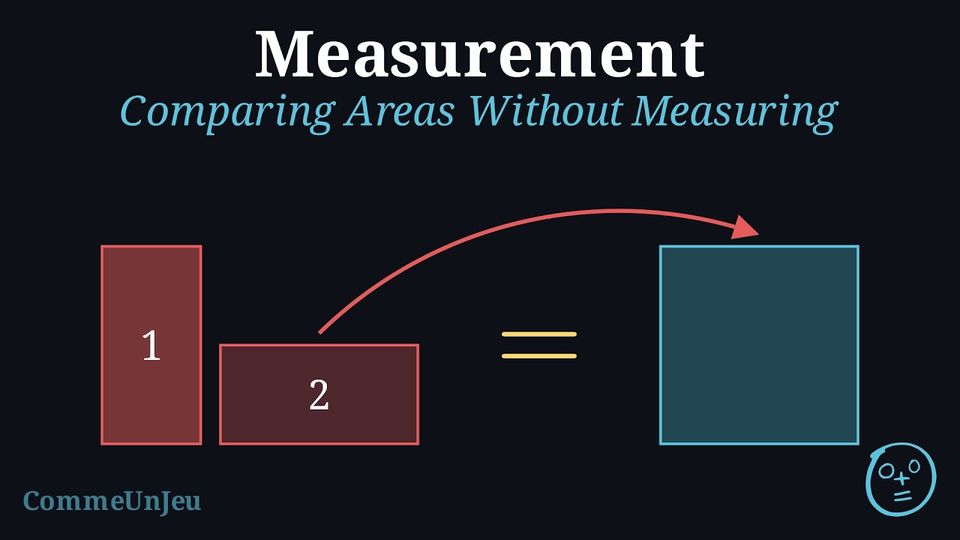
Hugo and Léa each put a napkin on the table. Which napkin covers more of the table? 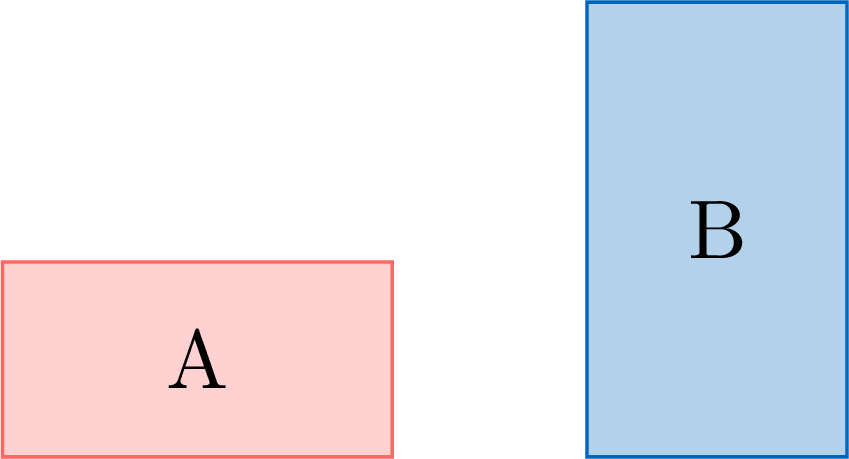
Just looking is not enough: napkin A is wider, but napkin B is taller. Turn napkin A upright and place it on top of napkin B: it fits entirely inside, and part of B stays uncovered. Napkin B covers more of the table.
Method — Comparing Areas Without Measuring
To compare the areas of two shapes without measuring: - Superpose: place one shape on top of the other (turning it is allowed). If it fits inside and part of the other shape stays uncovered, it has the smaller area; if the two shapes match exactly, the areas are equal.
- Cut and rearrange: if neither fits inside the other, cut one shape into pieces and place all the pieces on the other shape, without overlaps — moving pieces does not change the area. If they cover it exactly, the areas are equal; if part of the other shape stays uncovered, that shape has the bigger area.
Example
When the small card is placed on the big card, it fits entirely inside. Compare their areas. 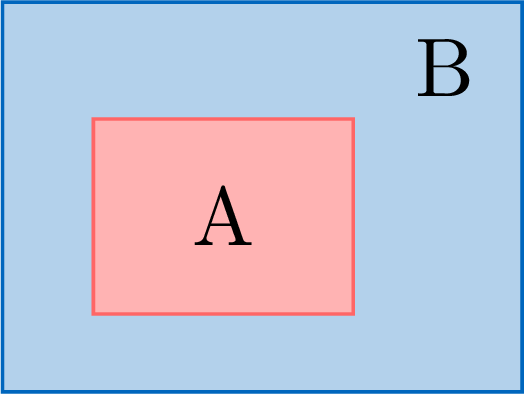
Card A fits entirely inside card B, and part of B stays uncovered: the area of A is smaller than the area of B.
Example
Compare the areas of the L-shape A and the square B. 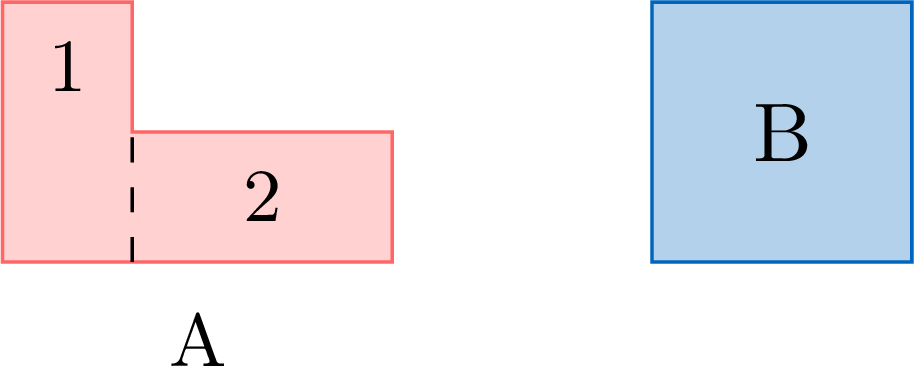
Cut the L-shape along the dashed line, then place the two pieces on square B — piece 2 is turned upright: 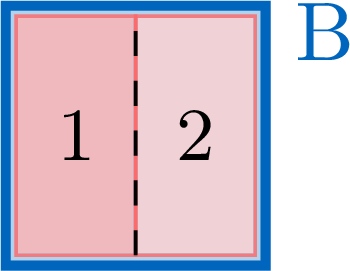
The two pieces cover square B exactly, without gaps and without overlaps. Moving pieces does not change the area: the two shapes have the same area.
Skills to practice
- Comparing by Superposing and Cutting
- Explaining and Drawing Areas
VI
Going further
Skills to practice
- Counting All Around the Shape
- Counting the Squares Inside
- Perimeter or Area: Choosing the Calculation
- Solving Problems with Several Questions
- Quiz
Jump to section