International Baccalaureate · PYP 5
Order of Operations and Problem Solving
I
Order of Operations
Hugo has 4 apples and 2 baskets. Each basket contains 3 oranges. 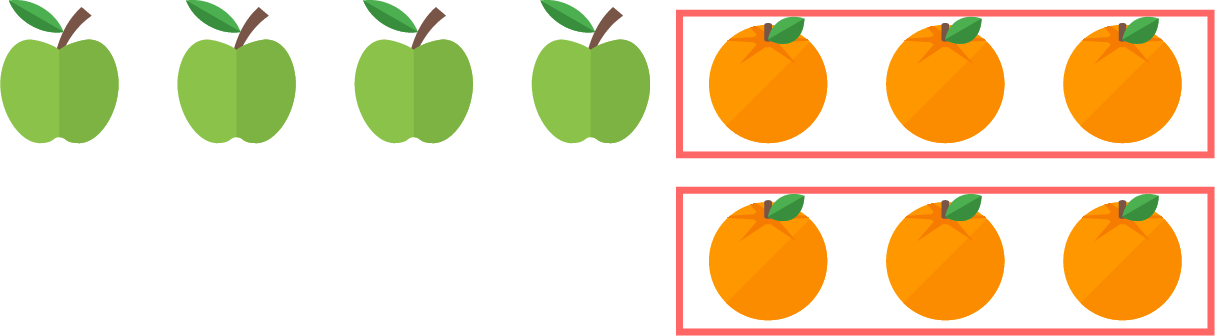
To find the total number of fruits, Hugo writes the expression:$$4 + 2 \times 3$$
- His brother Louis calculates it like this: “I'll do \(4 + 2\) first, which is 6. Then I'll multiply by 3. The answer is 18 fruits.”
- Hugo replies: “No, you have to do \(2 \times 3\) first, which is 6. Then you add my 4 apples. The answer is 10 fruits.”
Hugo is correct. The picture shows 4 apples and a separate group of \(2 \times 3 = 6\) oranges, making 10 fruits in total.
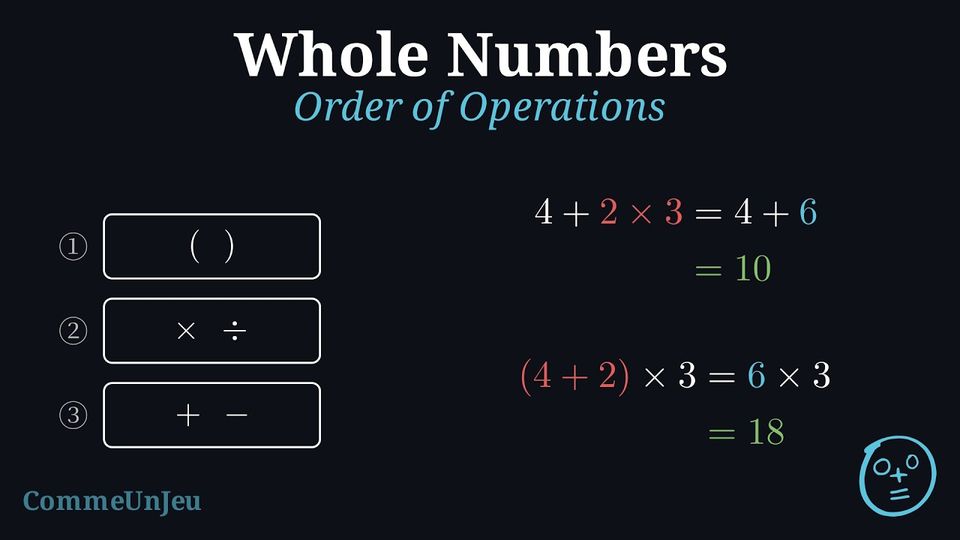
To prevent this kind of confusion, the rules of Maths say that some operations have priority over others: they are done first. Rule: In a calculation without brackets, always do multiplication before addition. We solve \(4 + 2 \times 3\) in the correct order: $$\begin{aligned}[t] 4 + \textcolor{colordef}{2 \times 3} &= 4 + \textcolor{colorprop}{6} && (\text{multiplication } \textcolor{colordef}{2 \times 3}=\textcolor{colorprop}{6})\\
&= 10 && (\text{addition } 4 + 6 = 10) \end{aligned}$$ Following the Order of Operations gives the correct answer: 10 fruits.
To prevent this kind of confusion, the rules of Maths say that some operations have priority over others: they are done first.
Method — Order of operations
To calculate an expression, we follow these steps in order: - Brackets ( ) (also called parentheses): first carry out the calculations in brackets, starting with the innermost ones; inside the brackets, the same rules apply.
- Multiplication (\(\times\)) and Division (\(\div\)): Do them next, working from left to right.
- Addition (\(+\)) and Subtraction (\(-\)): Do them last, also working from left to right.
Example
Calculate \(5 + 3 \times 2\).
We follow the order: $$\begin{aligned}[t]5+3 \times 2 & = 5 +6&&\text{(multiplication } 3 \times 2 = 6)\\
& = 11&&\text{(addition } 5 + 6 = 11)\end{aligned}$$
Example
Compute \(7 + 2 \times 3\), then \((7 + 2) \times 3\).
$$\begin{aligned} 7 + 2 \times 3 &= 7 + 6 &&\text{(multiplication first)}\\
&= 13 \end{aligned}$$ $$\begin{aligned} (7 + 2) \times 3 &= 9 \times 3 &&\text{(brackets first)}\\
&= 27 \end{aligned}$$ Same numbers, same operations — but the brackets change the order, and the result changes.
Example
Calculate \(24 \div 4 \times 2\), then \(20 - 8 + 3\).
A calculation that contains only multiplications and divisions is carried out from left to right. $$\begin{aligned} 24 \div 4 \times 2 &= 6 \times 2 &&\text{(from left to right: the division first)}\\
&= 12 \end{aligned}$$ and not \(24 \div 8 = 3\), which would do the multiplication first. The same holds for addition and subtraction: $$\begin{aligned} 20 - 8 + 3 &= 12 + 3 &&\text{(from left to right: the subtraction first)}\\
&= 15 \end{aligned}$$ and not \(20 - 11 = 9\).
Skills to practice
- Calculating without Brackets
- Calculating from Left to Right
- Calculating with Brackets
- Calculating with One or Two Pairs of Brackets
II
Vocabulary of Operations and Naming an Expression
Definition — Vocabulary of Operations
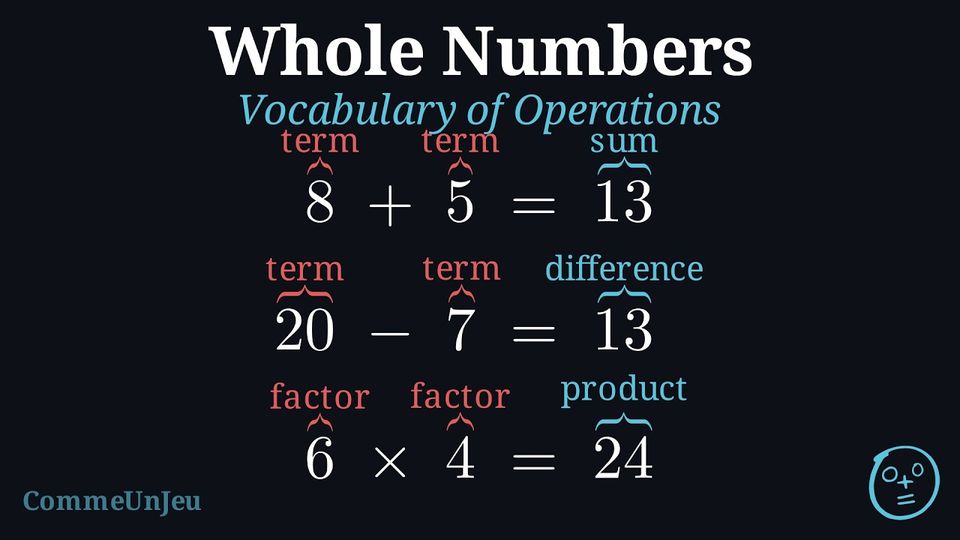
Each operation has a name for its result and for the numbers it combines: - the result of an addition is a sum; the numbers added are its terms;
- the result of a subtraction is a difference; the numbers are also called its terms;
- the result of a multiplication is a product; the numbers multiplied are its factors;
- the result of a division is a quotient; the number being divided is the dividend, the number dividing it (never zero) is the divisor.
Example
- In \(8 + 5 = 13\), the number \(13\) is the sum; \(8\) and \(5\) are its terms.
- In \(20 - 7 = 13\), the number \(13\) is the difference of the terms \(20\) and \(7\).
- In \(6 \times 4 = 24\), the number \(24\) is the product; \(6\) and \(4\) are its factors.
- In \(15 \div 3 = 5\), the number \(5\) is the quotient when \(15\) is divided by \(3\).
Definition — Naming an Expression
An expression with several operations is named after the last operation performed: - if the last operation is an addition, the expression is a sum;
- if the last operation is a subtraction, the expression is a difference;
- if the last operation is a multiplication, the expression is a product;
- if the last operation is a division, the expression is a quotient.
Example
- \(8 \times 5 + 3\) is a sum: the multiplication is done first, so the last operation is the addition. Its terms are \(8 \times 5\) and \(3\).
- \((2 + 7) \times 4\) is a product: because of the brackets, the addition is done first, so the last operation is the multiplication. Its factors are \((2+7)\) and \(4\).
Method — Writing an Expression
To turn a sentence into one expression: - Spot the operation named first: in a sentence that names the calculation, it is performed last (“twice the sum” — “twice” applies to the whole sum). In a list of instructions it is the other way round: “add \(3\) to \(2\), then multiply the result by \(4\)” is written \((2 + 3) \times 4\) — the first instruction is performed first, so it goes between brackets.
- Put between brackets every calculation that must be done first: the sum in “twice the sum”, the result that the next instruction uses.
- Check by computing: calculate the expression back, brackets first — is the sentence recovered?
Example
Write as one expression, then compute: - three times the difference between \(10\) and \(4\);
- the sum of \(9\) and the product of \(5\) and \(2\).
- “Three times” applies to the whole difference: \(10 - 4\) is computed first, so it goes between brackets. $$3 \times (10 - 4) = 3 \times 6 = 18$$
- The product \(5 \times 2\) is computed first: \(9 + (5 \times 2)\). Since multiplication has priority, these brackets can be left out. $$9 + 5 \times 2 = 9 + 10 = 19$$
Skills to practice
- Telling Terms from Factors
- Deciding Whether an Expression Is a Sum or a Product
- Computing a Named Operation
- Writing a Composite Expression
III
Solving a Problem with One Expression
For the cinema, Léa buys \(3\) tickets at \(\dollar 8\) each and one drink at \(\dollar 3\). Can you write the total cost in one single expression, then compute it?
The tickets cost \(3 \times 8\) and the drink adds \(3\): in one expression, $$(3 \times 8) + 3 = 24 + 3 = 27.$$ The total cost is \(\dollar 27\). The brackets show that the product is computed first. Writing the whole story in one expression is the method of this section.
Method — A Procedure for Solving Word Problems
The four steps of a problem stay the same; at the Model step, the plan is now written as a single expression instead of one calculation per step. - Understand: read the problem and identify the question and what is given.
- Model: determine which operations are needed, and in which order, then write them as one expression, with brackets wherever they are needed so that the calculations are done in the intended order.
- Calculate: evaluate the expression.
- Answer and check: write the sentence that answers the question, then ask the usual question — is this possible?
Example
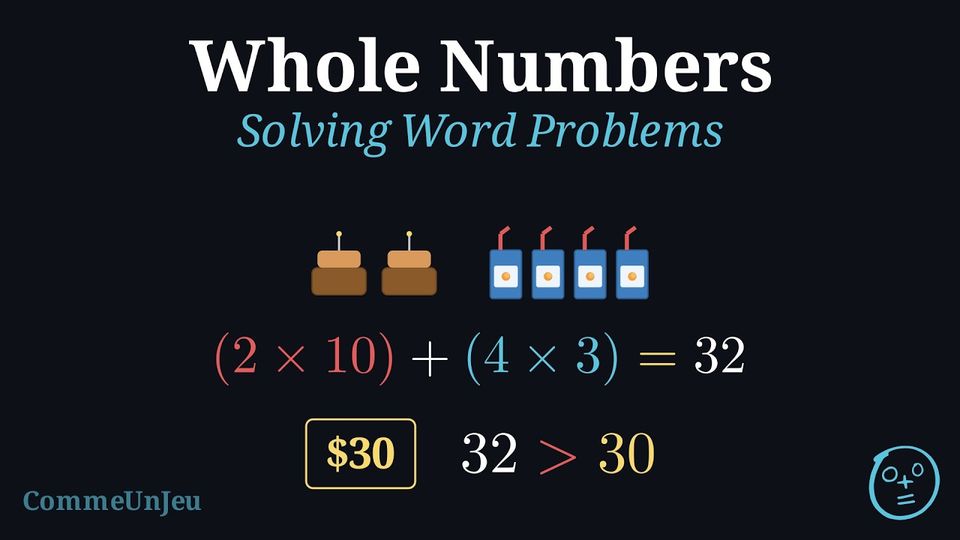
Hugo is planning his birthday party and needs to purchase cakes and juice. The items on his list are: - Cakes: \(2\) cakes at a cost of \(\dollar 10\) each.
- Juice: \(4\) cans of juice at a cost of \(\dollar 3\) each.
Applying the four steps:
- 1. Understand: We need to calculate the total cost of the cakes and juice, and then compare that total to Hugo's budget of \(\dollar 30\).
- 2. Model:
- Calculate the cost of the cakes (multiplication).
- Calculate the cost of the juice (multiplication).
- Add the two costs together to find the total cost (addition).
- Compare the total cost to \(\dollar 30\).
- 3. Calculate: $$\begin{aligned}[t] \text{Total cost} &= (2 \times 10) + (4 \times 3) \\ &= 20 + (4 \times 3) && (\text{brackets } 2 \times 10 = 20) \\ &= 20 + 12 && (\text{brackets } 4 \times 3 = 12) \\ &= 32 && (\text{addition } 20 + 12 = 32) \end{aligned}$$
- 4. Answer and check: The total cost is \(\dollar 32\). Since \(\dollar 32\) is greater than \(\dollar 30\), Hugo cannot afford to buy everything. Check: the cakes cost \(\dollar 20\) and the juice a little more than \(\dollar 10\); a total of a little more than \(\dollar 30\) is plausible.
Brackets Around a Product
Brackets around a product are not needed: \(\times\) comes before \(+\) anyway. They can be written to show the steps: \((2 \times 10) + (4 \times 3)\) and \(2 \times 10 + 4 \times 3\) are both worth \(20 + 12 = 32\).
Skills to practice
- Building the Expression
- Solving Real-World Problems
- Writing One Expression
IV
Bar Models with Several Unknowns
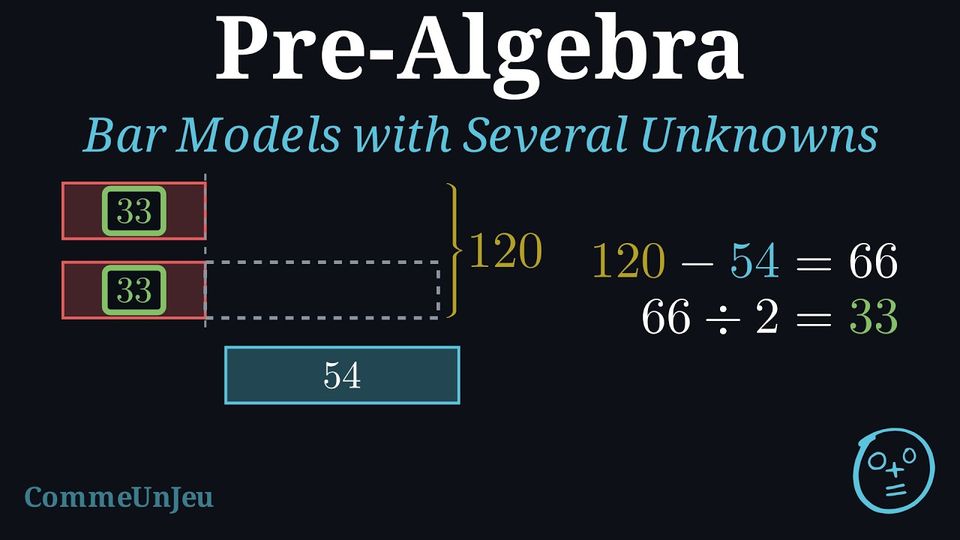
Nour buys an umbrella and a walking cane for \(\dollar 120\) in all. The umbrella costs \(\dollar 54\) more than the cane. What is the price of each object? 
The two bars share the same hidden part \(\square\) (the price of the cane); the umbrella bar has an extra piece of \(54\). Without that extra piece, the total would be \(120 - 54 = 66\), made of two equal parts: \(\square = 66 \div 2 = 33\). The cane costs \(\dollar 33\) and the umbrella \(33 + 54 = \dollar 87\). Check: \(33 + 87 = 120\).
Method — Comparing Two Quantities with Bars
When two quantities are compared (“\(54\) more than”, “\(12\) fewer than”) and their total is known: - Draw one bar per quantity, one under the other, starting from the same left edge: both contain the same hidden part \(\square\), and the larger one has an extra piece equal to the difference (for a quantity that is smaller by a known amount, hatch on its bar the piece to remove).
- Make the bars equal: if one has an extra piece, subtract it from the total; if one has a missing piece (hatched), add it to the total. As many equal parts as there are bars remain, each worth \(\square\).
- Share equally to find \(\square\), then deduce the other quantity (add or subtract the difference).
- Check that the two quantities give back the total and the difference.
Example
A father and his son are \(72\) years old together. The father is \(36\) years older than his son. How old is each of them? 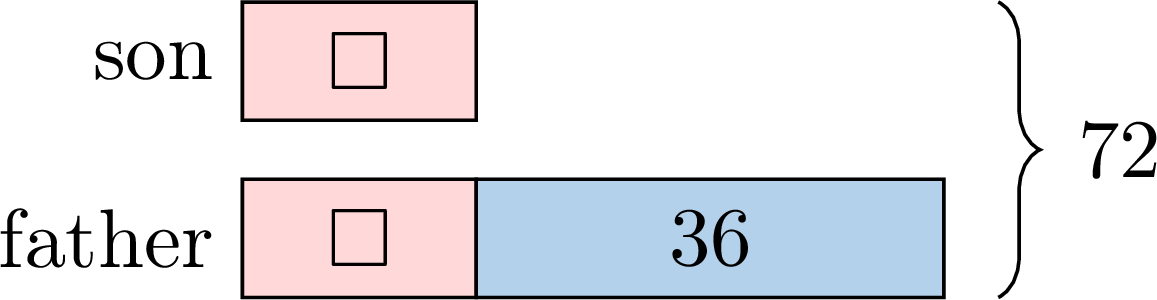
Example
For a village fair, a cycling race is organised. A total prize of \(\dollar 320\) is shared between the first three riders: the gold prize, the silver prize and the bronze prize. The gold prize is \(\dollar 70\) more than the silver prize, and the bronze prize is \(\dollar 80\) less than the silver prize. What is each prize? 
Skills to practice
- Comparing Two Quantities
V
The Balance Model
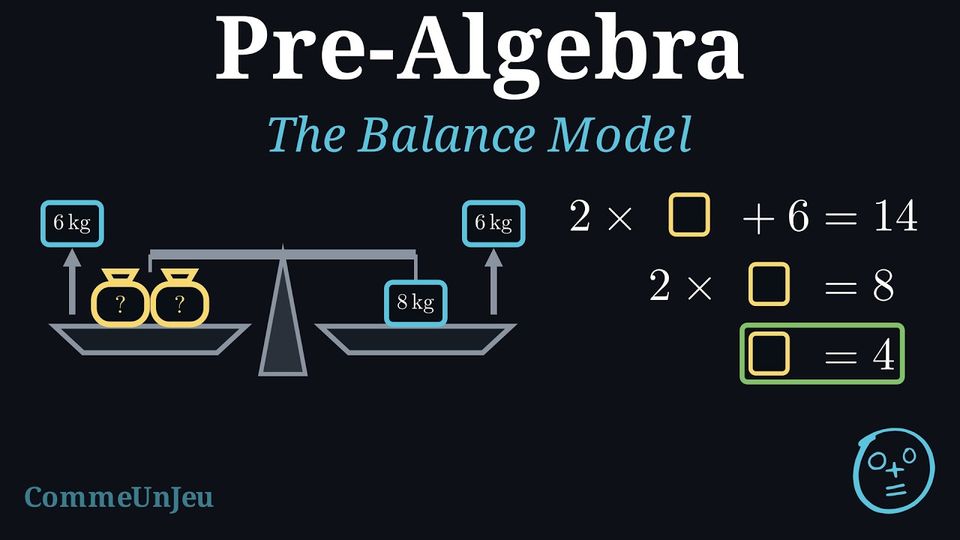
On the left pan of a balance there are two identical bags and a \(6\) kg mass; on the right pan, a \(14\) kg mass. The balance is level. How much does one bag weigh? 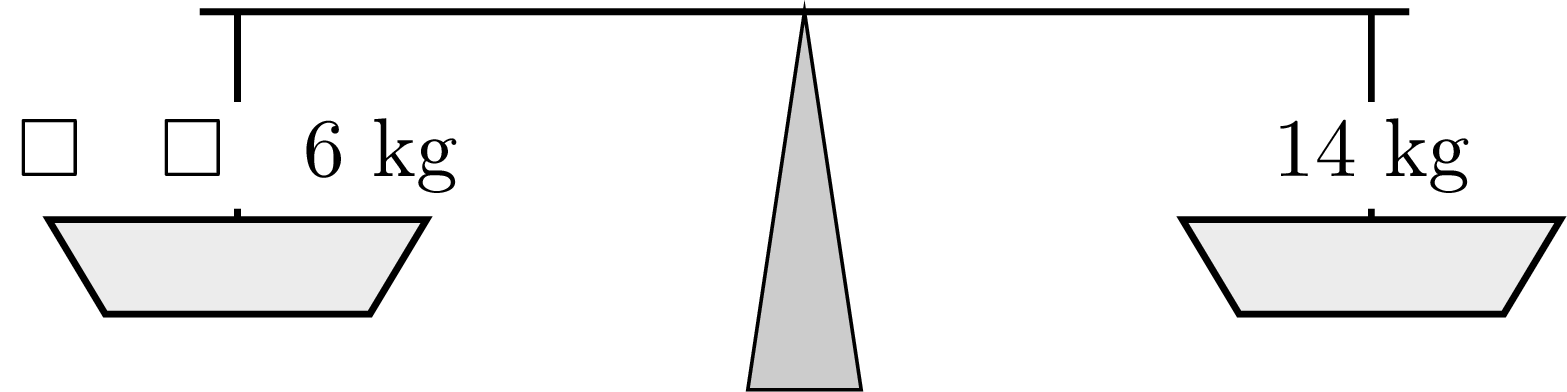
Take \(6\) kg off both pans: the balance stays level, with two bags on the left and \(14 - 6 = 8\) kg on the right. Two identical bags weigh \(8\) kg, so one bag weighs \(8 \div 2 = 4\) kg. Check: \(4 + 4 + 6 = 14\).
Method — Keeping the Balance Level
A level balance is a picture of an equality: the two pans hold the same mass, just as the two sides of an equality are worth the same number. It stays level when: - the same mass is removed from both pans (or added to both);
- both pans are shared into the same number of equal parts.
Example
Three identical tubes (\(\triangle\)) balance one tube and an \(8\) g mass. How much does one tube weigh? 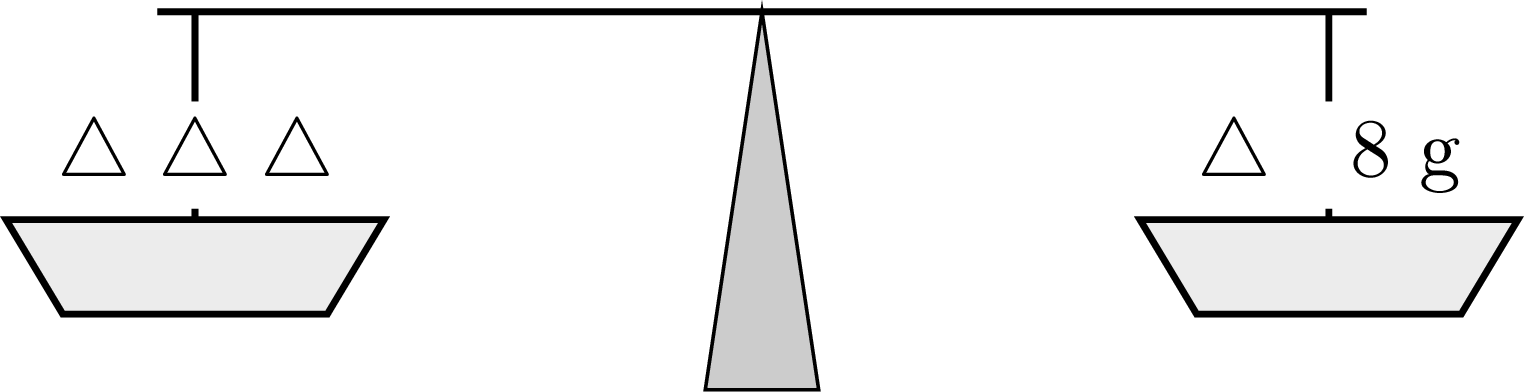
Take one tube off both pans: two tubes balance \(8\) g, so one tube weighs \(8 \div 2 = 4\) g. Check: \(3 \times 4 = 12\) and \(4 + 8 = 12\).
From the Balance to the Equality
A balance with two identical bags and a \(6\) kg mass on one pan, and a \(14\) kg mass on the other, can be written as the missing-number equality \(\square + \square + 6 = 14\), that is \(2 \times \square + 6 = 14\). Removing \(6\) kg from both pans is subtracting \(6\) from both sides: \(2 \times \square = 8\). Sharing both pans in two is dividing both sides by \(2\): \(\square = 4\). The bar model, the balance and the equality are three pictures of the same reasoning.
Skills to practice
- Reading a Balance
- Drawing Bar Models and Explaining the Balance
VI
Calculation Programs
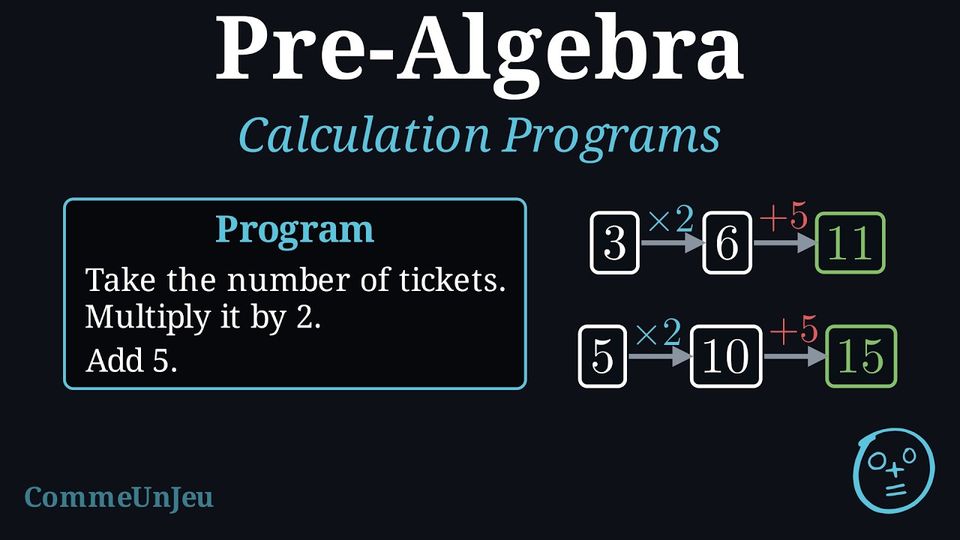
Definition — Calculation Program
A calculation program is a list of instructions to follow in order, starting from a chosen number. | Program A |
| Choose a number. |
| Multiply it by \(2\). |
| Add \(5\). |
Example
Run Program A starting from the number \(7\).
$$7 \xrightarrow{\;\times 2\;} 14 \xrightarrow{\;+ 5\;} \textbf{19}$$ Starting from \(7\), Program A gives \(19\).
Every week, Jade sells raffle tickets for the school fair: \(\dollar 2\) per ticket, plus a \(\dollar 15\) donation from the bakery. Every week she redoes the whole reasoning from the start — and last week she got it wrong. What could she write once and for all, so that the week's count is just one run?
A calculation program: take the number of tickets \(\rightarrow\) multiply by 2 \(\rightarrow\) add 15. The number of tickets changes every week, but the program never changes: each week, Jade only runs it with the new number.
Method — Producing a Calculation Program
A calculation program can be written from a situation: read what happens to the starting number, in order, and turn each event into an instruction. - Find the starting number — the quantity that can change: the number of magazines, of tickets, of laps.
- Follow the events in order — each “times”, “more”, “less” becomes one instruction of the program.
- Say the program in words, one instruction per line.
Example
A minibus ride costs \(\dollar 4\) per passenger, and the group also pays \(\dollar 5\) for the luggage. Produce the calculation program that gives the total price from the number of passengers, then run it for \(6\) passengers.
The starting number is the number of passengers. In order: each passenger costs \(\dollar 4\) (multiply by \(4\)), then the luggage adds \(\dollar 5\) (add \(5\)): Take the number of passengers \(\rightarrow\) multiply by 4 \(\rightarrow\) add 5. $$\begin{aligned}[t] 6 &\rightarrow 6 \times 4 = 24 && \text{(multiply by 4)} \\
&\rightarrow 24 + 5 = 29 && \text{(add 5)} \end{aligned}$$ For \(6\) passengers, the ride costs \(\dollar 29\).
Method — Finding the Starting Number
To find the starting number from the result, walk the program backwards: undo each instruction with its inverse operation, starting from the last one. Then check forwards. Example
Program A gives the result \(23\). What was the starting number?
Walk backwards: the last instruction was “add \(5\)”, undone by subtracting \(5\): \(23 - 5 = 18\). Before that, “multiply by \(2\)”, undone by dividing by \(2\): \(18 \div 2 = \textbf{9}\).
Check forwards: \(9 \xrightarrow{\;\times 2\;} 18 \xrightarrow{\;+ 5\;} 23\). \(\checkmark\)
Check forwards: \(9 \xrightarrow{\;\times 2\;} 18 \xrightarrow{\;+ 5\;} 23\). \(\checkmark\)
Skills to practice
- Running Programs
- Writing the Program of a Situation
- Walking Backwards
- Inventing and Fixing Programs
VII
Following a Step-by-Step Procedure
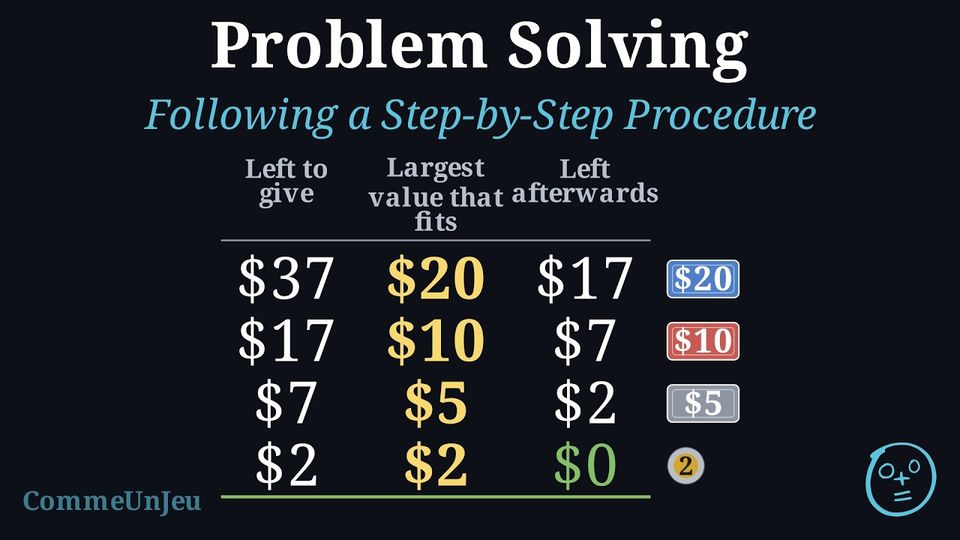
A cashier has to give \(\dollar 37\) back. The till prints the same instruction every time: “take the largest value that does not exceed what is left to give, hand it over, and start again with what is left, until nothing is left”. The notes are \(\dollar 20\), \(\dollar 10\) and \(\dollar 5\), the coins \(\dollar 2\) and \(\dollar 1\), and the till holds as many of each as needed. What does the cashier hand over?
- Understand: the instruction is not a calculation to invent — it is a rule to apply, again and again, until nothing is left to give.
- Model: one line per turn. What is left, the largest value that fits, what is left afterwards.
Turn Left to give Largest value that fits Left afterwards \(1\) \(\dollar 37\) \(\dollar 20\) \(\dollar 17\) \(2\) \(\dollar 17\) \(\dollar 10\) \(\dollar 7\) \(3\) \(\dollar 7\) \(\dollar 5\) \(\dollar 2\) \(4\) \(\dollar 2\) \(\dollar 2\) \(\dollar 0\) - Calculate: the table stops on its own at turn \(4\), when nothing is left.
- Answer and check: the cashier hands over \(\dollar 20\) \(+\) \(\dollar 10\) \(+\) \(\dollar 5\) \(+\) \(\dollar 2\), that is four notes and coins. Check: \(20 + 10 + 5 + 2 = 37\) dollars.
Method — Following a Step-by-Step Procedure
A procedure is a list of instructions precise enough that the person applying them never has a choice to make of their own. Applying one is a skill in itself. - Read the whole procedure before starting. An instruction cannot be judged on its own: one has to see where it leads, and above all where the procedure stops.
- Keep a table of the turns: one line per turn — what the procedure looks at, what it does, what is left afterwards. The table is the proof of what was done.
- Apply in order, without deciding instead of the procedure. If an instruction says “the largest”, it is the largest, even when another choice looks better.
- Find the stopping condition. A list of instructions read once ends by itself. But as soon as one instruction sends the reader back to an earlier one, the procedure must say when to stop — nothing left, a result smaller than a given number, an answer found — and that stop must really be reached.
- Check against the question. The procedure gives a result; the problem asked something. The last line of the answer is still a sentence, with its word.
A procedure is written once and serves for every number of its domain. This is what makes it different from one particular calculation — the change-giving one needs a whole number of dollars and enough of each note and coin; outside that, it says nothing. What changes with the numbers are its turns and its choices: giving back \(\dollar 37\) takes four turns, giving back \(\dollar 6\) takes only two. This is also what brings it close to the calculation program, which is run and produced in the same way.
And the smallest number of notes and coins? With the usual notes and coins, and provided there are enough of each, this procedure does give it: it is accepted here. What is learnt in this section is to apply it without a mistake.
And the smallest number of notes and coins? With the usual notes and coins, and provided there are enough of each, this procedure does give it: it is accepted here. What is learnt in this section is to apply it without a mistake.
Example — A Procedure with a Hole
Here is a procedure that answers “is this number in the \(4\) times table?”. One instruction has been erased. - Start with the number.
- If the number is \(0\), answer YES and stop. If it is smaller than \(4\), answer NO and stop.
- \(\dots\) Then go back to instruction \(2\).
The turns go \(12\), \(8\), \(4\), \(0\): each one is \(4\) less than the one before. Instruction \(3\) is subtract \(4\). Check on \(18\): \(18\), \(14\), \(10\), \(6\), \(2\) — and \(2\) is smaller than \(4\), so the answer is NO, which is correct, since \(18\) is not in the \(4\) times table. Note where the test sits: it comes before subtracting, which is why \(0\) answers YES straight away.
Skills to practice
- Applying a Procedure
- Applying and Completing a Procedure
VIII
Going further
Skills to practice
- Solving Problems
- Quiz
Jump to section