International Baccalaureate · PYP 5
Operations with Decimals
I
Adding and Subtracting Decimals in Columns
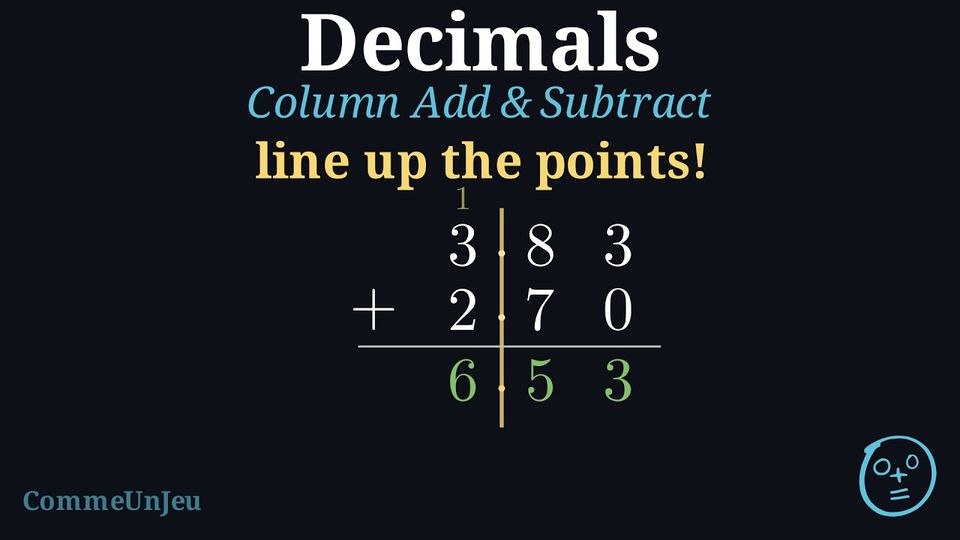
Method — Column addition and subtraction
- Step 1: Line up the decimal points. Write the numbers one under the other so their decimal points are in a vertical line.
- Step 2: Fill in the gaps. Add zeros to the end of the numbers so they all have the same length after the decimal point.
- Step 3: Add or subtract. Work from right to left, column by column, as you would with whole numbers.
- Step 4: Place the decimal point. Bring the decimal point straight down into your answer.
Proposition — Why Line Up the Decimal Points
Lining up the decimal points lines up the place values: ones under ones, tenths under tenths, hundredths under hundredths. The addition then combines like units with like units, exactly as with whole numbers. | Ones | . | Tenths | Hundredths |
| 3 | . | 8 | 3 |
| 2 | . | 7 | 0 |
Example
Calculate \(3.83 + 2.7\). - Line up the decimal points and add a zero:
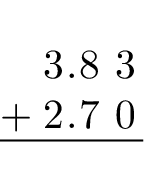
- Add column by column from right to left, carrying over when needed.
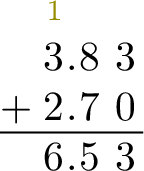
- Hundredths: \(3 + 0 = 3\)
- Tenths: \(8 + 7 = 15\). Write down 5, carry over 1.
- Ones: \(1 + 3 + 2 = 6\).
- Bring down the decimal point.
Example
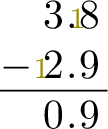
Calculate \(3.8 - 2.9\). - Line up the decimal points. No zeros are needed.
- Subtract from right to left, borrowing when needed.
- Tenths: We can't do \(8 - 9\). Borrow 1 from the ones place, changing the 3 to a 2 and the 8 to an 18. Now, \(18 - 9 = 9\).
- Ones: \(2 - 2 = 0\).
- Bring down the decimal point.
Skills to practice
- Adding and Subtracting Decimal Numbers
- Setting Out an Addition or a Subtraction
- Finding a Missing Term
- Solving Real-World Problems
II
Multiplying Decimals in Columns
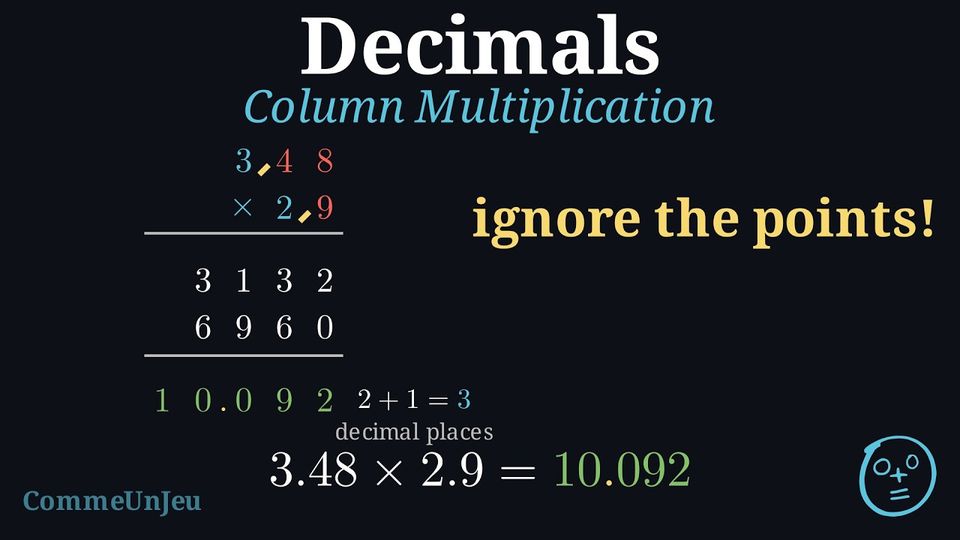
Method — Column multiplication
- Step 1: Ignore the decimals. Write the calculation as if the numbers were whole numbers. You do not need to line up the decimal points.
- Step 2: Multiply. Perform the multiplication as you would with whole numbers.
- Step 3: Count the decimal places. Count the digits after the decimal point in each factor and add these counts (a whole-number factor adds none).
- Step 4: Place the decimal point. In your answer, place the decimal point so it has the same number of decimal places you counted in Step 3.
Example
Calculate \(3.45 \times 3\).
Ignore the decimal point: \(345 \times 3 = 1035\). The factor \(3.45\) has \(2\) decimal places, so place the decimal point \(2\) digits from the right: $$3.45 \times 3 = \textbf{10.35}$$ Why it works: \(3.45\) is \(345\) hundredths, so \(3.45 \times 3 = 1035\) hundredths \(= 10.35\).
Example
Calculate \(3.48 \times 2.9\). - Multiply as whole numbers (\(348 \times 29\)).
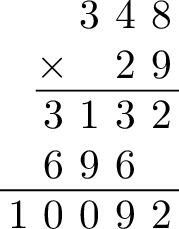
- Count the decimal places in the original numbers.
- \(3.48\) has 2 decimal places.
- \(2.9\) has 1 decimal place.
- Total: \(2 + 1 = \textcolor{colorprop}{3}\) decimal places.
- Place the decimal point in the answer (10092) so it has 3 decimal places. $$ 10.092 $$
Proposition — Why Count the Decimal Places
A decimal number is a decimal fraction: \(3.48 = \dfrac{348}{100}\) and \(2.9 = \dfrac{29}{10}\), because dividing by \(100\) or by \(10\) moves the decimal point to the left (see the sections on multiplying and dividing by \(10\), \(100\) and \(1\,000\)). Therefore $$3.48 \times 2.9 = \frac{348}{100} \times \frac{29}{10} = \frac{348 \times 29}{1000} = \frac{10\,092}{1000} = 10.092 .$$ The \(2\) decimal places of \(3.48\) divide the product by \(100\); the \(1\) decimal place of \(2.9\) divides it by \(10\). In total, the whole-number product \(348 \times 29\) is divided by \(1000\), so the result has \(2 + 1 = 3\) decimal places. Counting the decimal places of both numbers is counting the zeros of this division by a power of \(10\). Skills to practice
- Multiplying in Columns
- Setting Out and Explaining a Multiplication
- Solving Real-World Problems
III
Dividing by a Whole Number
Method — Long Division by a Whole Number
- Step 1: Set up the division. Write the problem in the long division format.
- Step 2: Place the decimal point. Write the decimal point in the answer space, directly above the decimal point in the number being divided.
- Step 3: Divide from left to right. Divide as you would with whole numbers, ignoring the decimal point now.
Example
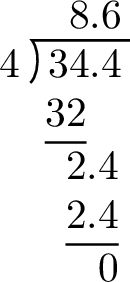
Calculate \(34.4 \div 4\). - Set up and place the decimal point.
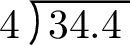
- Divide.
- How many 4s in 34? 8. (\(8 \times 4 = 32\))
- Subtract: \(34 - 32 = 2\).
- Bring down the 4 to make 24.
- How many 4s in 24? 6. (\(6 \times 4 = 24\))
- Subtract: \(24 - 24 = 0\). The division is complete.
Method — Continuing a Division by Appending Zeros
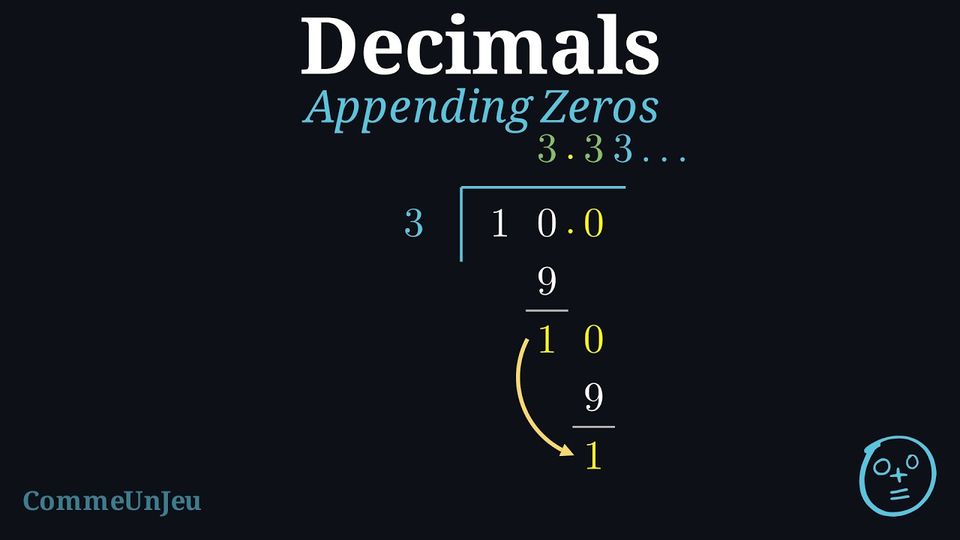
When the digits of the dividend are used up, the Euclidean division stops there: a whole-number quotient and a remainder. For a decimal quotient, the division is continued, because appending zeros after the decimal point does not change the value of a number: \(10 = 10.0 = 10.00\). - Step 1: Use up the digits. Divide as usual. If the remainder is not zero after the last digit of the dividend, continue.
- Step 2: Write the decimal point and append a zero. Write the decimal point in the quotient (if it is not there already). Append a zero to the dividend (\(10\) becomes \(10.0\)) and bring this zero down.
- Step 3: Keep dividing. Continue the division. Append another zero each time the digits run out, until the remainder is zero or the quotient reaches the requested number of decimal places.
Example
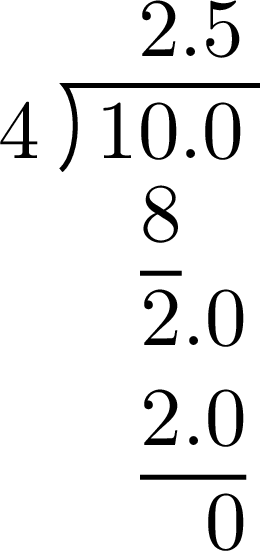
Calculate \(10 \div 4\). - Use up the digits.
- How many 4s in 10? 2. (\(2 \times 4 = 8\))
- Subtract: \(10 - 8 = 2\). The digits of the dividend are used up: the Euclidean division stops there, quotient 2 and remainder 2. For a decimal quotient, the division is continued.
- Write the decimal point and append a zero. Since \(10 = 10.0\), write the decimal point in the quotient and bring down the appended zero: the new number is 20 (twenty tenths).
- Keep dividing.
- How many 4s in 20? 5. (\(5 \times 4 = 20\))
- Subtract: \(20 - 20 = 0\). The division is complete.
Example
Calculate \(10 \div 3\). Give the quotient rounded to the hundredth. - Use up the digits. How many 3s in 10? 3 (\(3 \times 3 = 9\)); the remainder is \(10 - 9 = 1\): continue.
- Write the decimal point and append a zero. Since \(10 = 10.0\), bring down a zero: the new number is 10 (ten tenths). How many 3s in 10? 3 again, and the remainder is 1 again.
- The division never ends. Each appended zero gives the number 10 again, so the digit 3 repeats for ever: $$10 \div 3 = 3.333\ldots$$
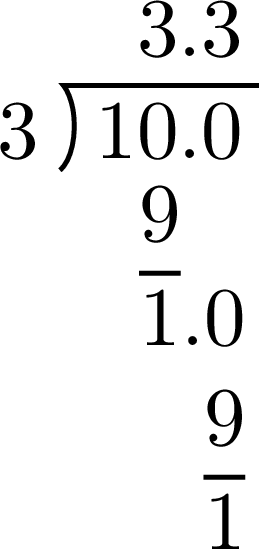
- Round the quotient. To round to the hundredth, look at the digit of the thousandths: it is 3, which is “4 or less”, so the hundredths digit stays the same.
Two Different Endings
- In \(10 \div 4\), the remainder became \(0\): the division stops, and the quotient \(2.5\) is a decimal number.
- In \(10 \div 3\), the remainder \(1\) comes back at every step: the division never stops. The quotient is not a decimal number; we only give an approximate value of it, such as \(3.33\).
Skills to practice
- Dividing by Whole Numbers
- Dividing a Decimal by a Whole Number Mentally
- Decimal Quotient or Not?
- Solving Real-World Problems
IV
Dividing by a Decimal
Léa pours \(6\) L of apple juice into bottles of \(0.75\) L. Tom claims: “Dividing always makes smaller: fewer than \(6\) bottles will be filled.” How many bottles does Léa fill? Is Tom correct?
We look for how many times \(0.75\) L goes into \(6\) L: that is the quotient \(6 \div 0.75\). In millilitres the two quantities become \(6\,000\) mL and \(750\) mL, and the question does not change: $$\begin{aligned} 6 \div 0.75 &= 6\,000 \div 750 &&\text{(the same quantities, in millilitres)}\\
&= 8 &&\text{(since } 750 \times 8 = 6\,000\text{)} \end{aligned}$$ Léa fills \(8\) bottles; check: \(0.75 \times 8 = 6\). Tom is wrong: here dividing \(6\) by a number smaller than \(1\) gives a result greater than \(6\) — dividing does not always make smaller. And changing the unit multiplied both numbers by \(1\,000\) without changing the quotient: that is the idea that makes it possible to divide by a decimal number.
Method — Long Division by a Decimal Number
In long division, first convert the divisor to a whole number. - Step 1: Make the divisor whole. Move the decimal point in the divisor to the right until the divisor is a whole number. Count how many places you moved it.
- Step 2: Move the other decimal. Move the decimal point in the dividend the same number of places to the right, adding zeros if there are no digits left (\(6 \div 0.75\) becomes \(600 \div 75\)).
- Step 3: Divide. Now the problem is a "division by a whole number" problem. Follow the steps of that division.
Proposition — The Quotient Does Not Change
A quotient does not change when the dividend and the divisor are both multiplied by the same non-zero number: there are as many times \(1.2\) cm in \(4.56\) cm as \(12\) mm in \(45.6\) mm — changing the unit multiplies both numbers by \(10\) without changing the answer. $$4.56 \div 1.2 = (4.56 \times 10) \div (1.2 \times 10) = 45.6 \div 12$$ “Moving both decimal points one place to the right” is exactly “multiplying both numbers by 10”. The method replaces the division by a decimal with an equal division whose divisor is a whole number — a division that can already be set up. Example
Calculate \(2.34 \div 0.6\).
The divisor \(0.6\) has one digit after the decimal point: both numbers are multiplied by \(10\), which does not change the quotient. $$\begin{aligned} 2.34 \div 0.6 &= (2.34 \times 10) \div (0.6 \times 10) &&\text{(the quotient does not change)}\\
&= 23.4 \div 6 &&\text{(a divisor with one digit)}\\
&= 3.9 &&\text{(long division)} \end{aligned}$$ 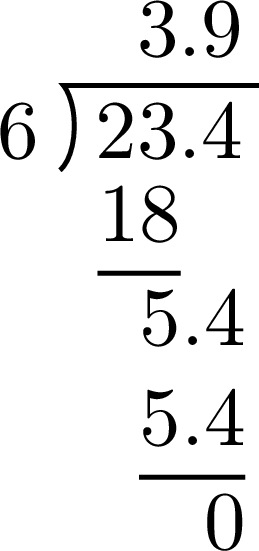
Check: \(0.6 \times 3.9 = 2.34\).
Example
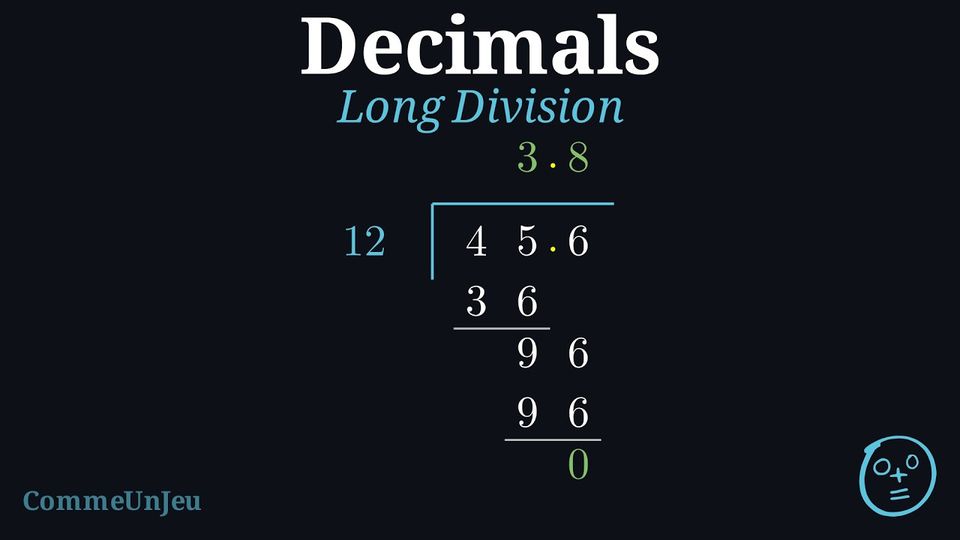
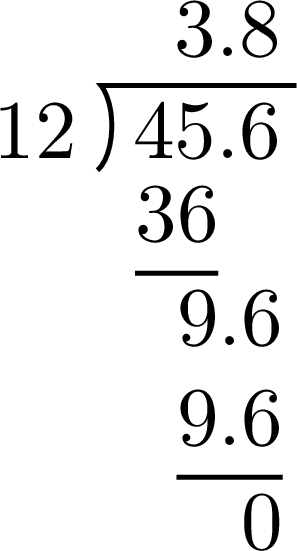
Calculate \(4.56 \div 1.2\). - Make the divisor (1.2) whole. Move the decimal point one place right to make it 12.
- Move the other decimal. We must also move the decimal in 4.56 one place right. It becomes 45.6.
- The new problem is \(45.6 \div 12\).
- Divide.
Skills to practice
- Making the Divisor a Whole Number
- Setting Out Long Divisions
V
Mental Calculation with Decimals
Method — Complements to the Next Whole Number
To find what must be added to reach the next whole number, complete place by place: first the hundredths to reach a round tenth, then the tenths to reach the whole. $$5.62 + \square = 6 \qquad\rightarrow\qquad 5.62 + \textcolor{colorprop}{0.38} = 6$$ because \(62\) hundredths \(+ \textcolor{colorprop}{38}\) hundredths \(= 100\) hundredths \(= 1\). Example
Complete: \(\square + 42.85 = 43\).
$$\begin{aligned}[t] 85 \text{ hundredths} + 15 \text{ hundredths} &= 100 \text{ hundredths} && \text{(complete the hundredths)} \\
0.15 + 42.85 &= 43 && \end{aligned}$$
Method — Rearranging with the Properties of Operations
The order of the terms in a sum, and of the factors in a product, can be changed to make round numbers appear: - Group what completes: \(2.3 + 18.6 + 0.7 = (2.3 + 0.7) + 18.6 = 3 + 18.6 = 21.6\).
- Pair the factors that make 100: \(4.7 \times 25 \times 4 = 4.7 \times 100 = 470\).
- Go through the round number and adjust: \(26 + 399 = 26 + 400 - 1 = 425\), and \(35 \times 19 = 35 \times 20 - 35 = 665\).
Example
Compute cleverly: \(1.8 + 45.9 + 0.2\).
$$\begin{aligned}[t] 1.8 + 45.9 + 0.2 &= (1.8 + 0.2) + 45.9 && \text{(group what completes)} \\
&= 2 + 45.9 && \\
&= 47.9 && \end{aligned}$$
Method — Doubles and Halves
Doubling and halving work on decimals exactly as on whole numbers, place by place: - Double: the double of \(3.6\) is \(7.2\) (double \(3\), double \(6\) tenths \(= 12\) tenths).
- Half: the half of \(8.4\) is \(4.2\) — and the half of an odd number is a decimal: the half of \(9\) is \(4.5\) (\(8 \div 2 = 4\) and \(1 \div 2 = 0.5\)).
- Divide by 4 or by 8 by halving: \(\div 4\) is the half of the half; \(\div 8\) is one half more. \(60 \div 4 = 30 \div 2 = 15\).
Example
Compute: the half of \(13\), then \(72 \div 8\).
$$\begin{aligned}[t] \text{half of } 13 &= 6.5 && \text{(half of an odd number: a decimal)} \\
72 \div 8 &= 36 \div 4 = 18 \div 2 = 9 && \text{(three halvings)} \end{aligned}$$
Skills to practice
- Finding the Complement to the Next Whole Number
- Rearranging to Compute Cleverly
- Doubling and Halving
VI
Checking with an Order of Magnitude
Method — The Order-of-Magnitude Check
The most frequent error in decimal calculations is not a wrong digit but a misplaced decimal point — a result ten or a hundred times too large or too small. A quick estimate catches it. - Step 1: Round. Round each number to the nearest whole number (or to a simple nearby number).
- Step 2: Estimate. Compute mentally with the rounded numbers.
- Step 3: Compare. Compare the estimate with the exact result: they must be of the same order of magnitude. If they do not, look for the error — most often a misplaced decimal point.
Example
Léo computes \(42.7 + 9.8\) in columns and finds \(52.5\). Check with an order of magnitude that his result is plausible.
$$\begin{aligned}[t] 42.7 + 9.8 &\approx 43 + 10 &&{\scriptstyle\text{(rounding to the nearest whole number)}}\\
&= 53 &&{\scriptstyle\text{(addition)}} \end{aligned}$$ The exact result \(52.5\) is close to the estimate \(53\): Léo's result is plausible.
Example
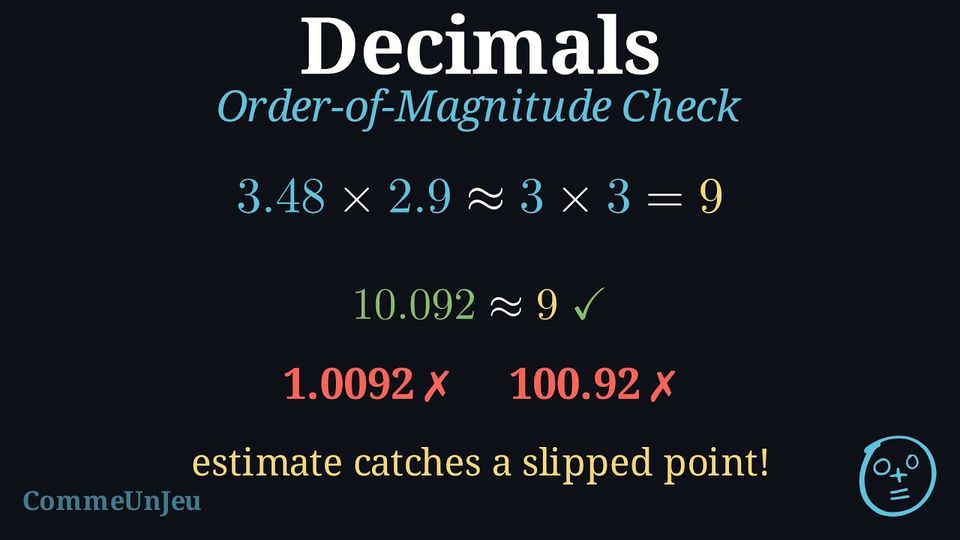
The column multiplication gives \(3.48 \times 2.9 = 10.092\). Use an order of magnitude to check that the result \(10.092\) is plausible. - Round and estimate: $$\begin{aligned}[t] 3.48 \times 2.9 &\approx 3 \times 3 &&\text{(rounding to the nearest whole number)}\\ &= 9 &&\text{(multiplication)} \end{aligned}$$
- Compare. The exact result \(10.092\) is close to the estimate \(9\): the decimal point is well placed.
- The results \(1.0092\) (ten times too small) and \(100.92\) (ten times too large) would have been rejected by the same estimate.
Skills to practice
- Estimating Before Computing
- Finding the Impossible Results
VII
Going further
Skills to practice
- Analysing Wrong Calculations and Placing the Decimal Point
- Solving Multi-Step Problems
- Solving Real-Life Problems with Decimals
- Investigating Patterns in Decimals
- Quiz
Jump to section