International Baccalaureate · PYP 5
Number sequences and rules
I
Finding the Rule of a Sequence
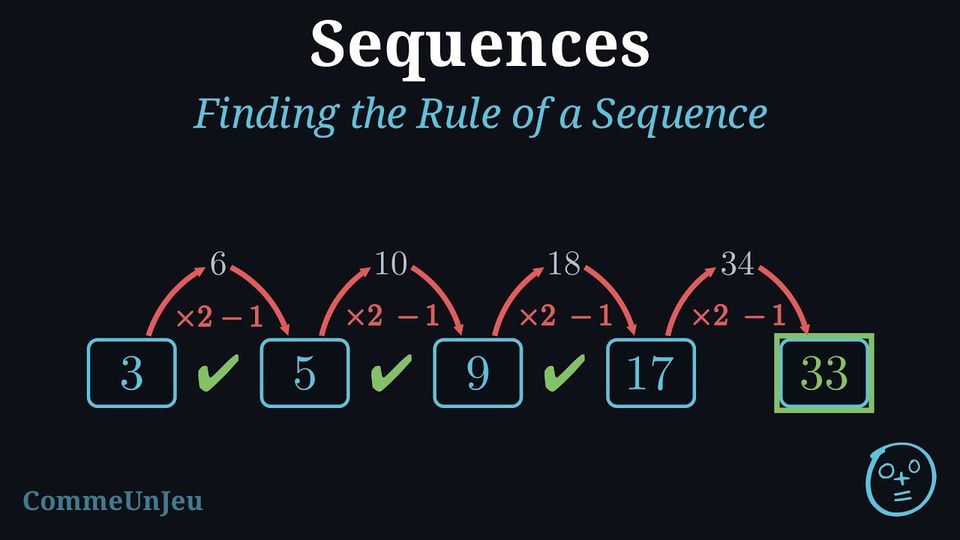
Method — Finding the Rule of a Sequence
The rule of a sequence is a rule that goes from one term to the next. To find it, try the simple rules first: - Is the same number always added? Compute the jumps between consecutive terms: if they are all equal, the rule is “add that number”.
- Is each term always multiplied by the same number? If so, the rule is “multiply by that number”.
- If neither works, look for a composite rule: two instructions chained, like “double, then add 1”.
Skills to practice
- Continuing a Sequence: Two Steps from One Term to the Next
II
Tables of Values
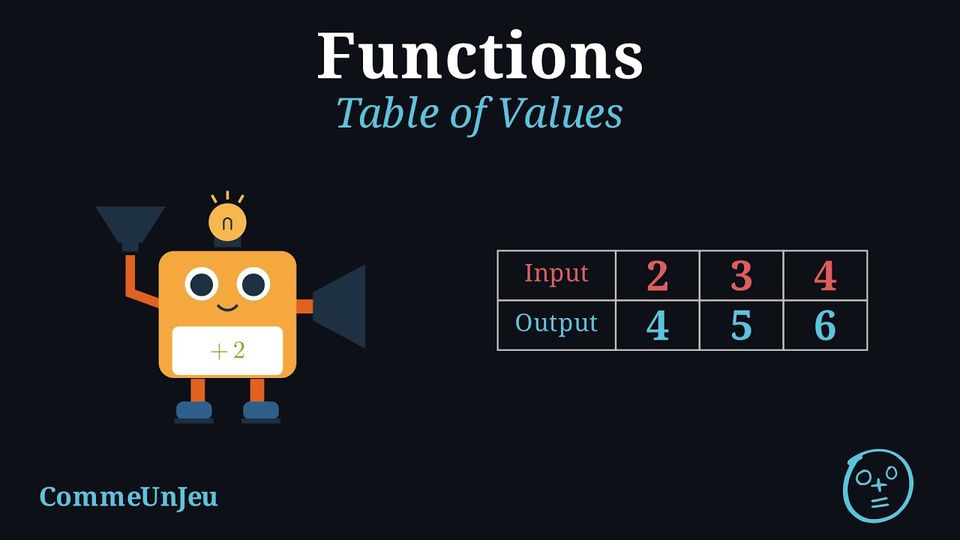
Some quantities depend on others in a regular way. For example, the number of wheels is always the number of bicycles multiplied by 2. In mathematics, a rule that gives one number from another has a special name: a function.
A function works like a machine: a number goes in (the input), the machine applies its rule, and one number comes out (the output). The same input always gives the same output.
The In/Out tables of number patterns work in the same way, and so does a table of positions and terms: a position table is an In/Out table, where the position goes in and the term comes out.
Definition — Function
A function is a rule that takes an input number and gives back exactly one output number. For each input, the function machine always gives the same output and follows the same rule every time.
A function machine follows one rule, but we can give it many different inputs. To keep track of the output for each input, we can organise our results in a special chart called a table of values.
Definition — Table of Values
A table of values is a table that organises and displays several pairs of input and output values for one function. Example
Here is a table of values for the function with the rule “add 2” to the input. 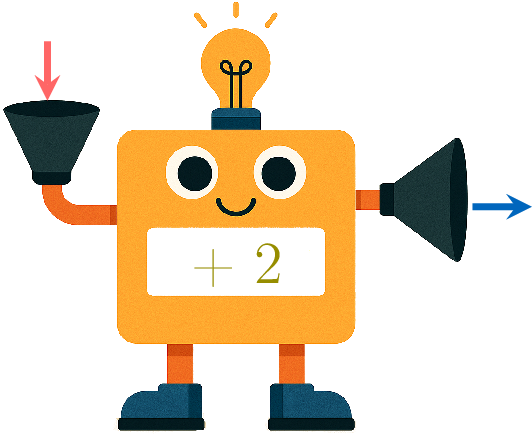
| Input | 2 | 3 | 4 |
| Output | 4 | 5 | 6 |
Skills to practice
- Calculating the Outputs of a Function
III
Finding the Count at a Far Step
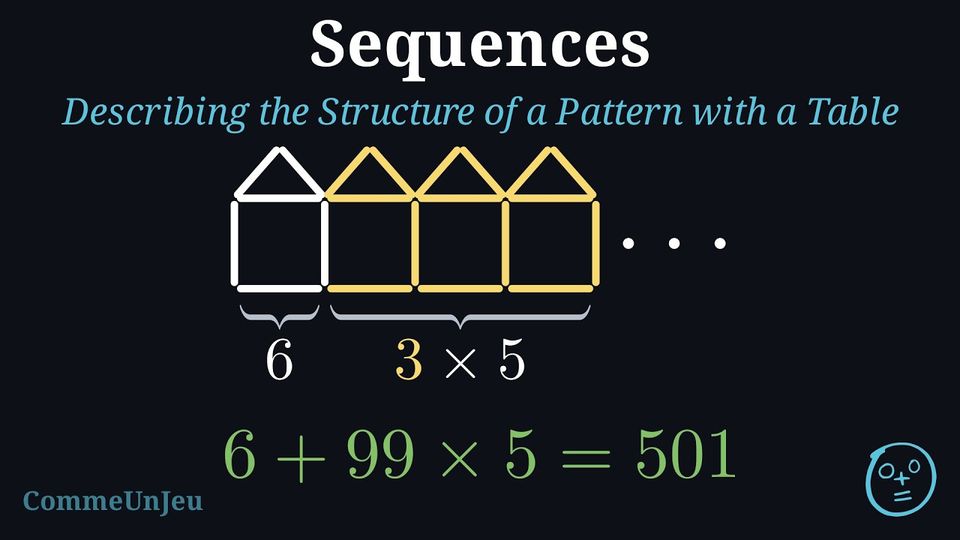
Method — Describing the Structure of a Pattern with a Table
For a growing pattern that adds the same number of elements at each new diagram (the most frequent case), to find how many elements a far diagram has, without drawing it: - Count the first diagrams and put them in a table: diagram \(1\), diagram \(2\), diagram \(3\), … (the diagrams are numbered in order).
- Say the structure in words: what is there at the start, and what each new diagram brings — “\(6\) sticks, then \(5\) more sticks per house”.
- Write each count as a calculation that shows this structure: diagram \(2\) is \(6 + 1 \times 5\), diagram \(3\) is \(6 + 2 \times 5\), diagram \(4\) is \(6 + 3 \times 5\): the number of “\(5\) more” is always the diagram number minus \(1\). In \(6 + 3 \times 5\) the multiplication is done first: \(6 + 15 = 21\).
- Use the calculation for the far diagram, and check it on a diagram of the table.
Example
Small houses are built with matchsticks, as in the pattern below: one house uses \(6\) sticks, and each new house shares a wall with the previous one. 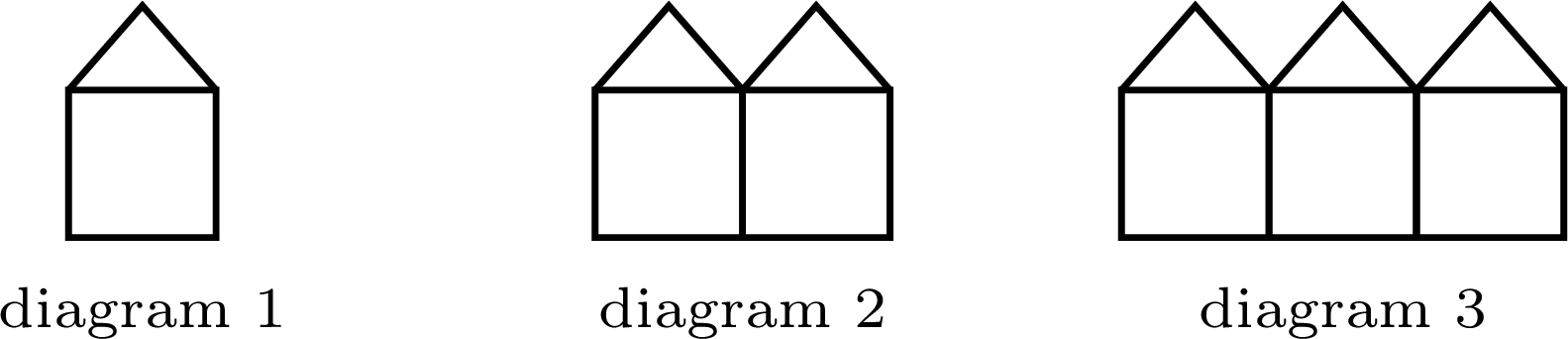
| \hline Houses | Sticks | Calculation |
| \(1\) | \(6\) | \(6\) |
| \(2\) | \(11\) | \(6 + 1 \times 5\) |
| \(3\) | \(16\) | \(6 + 2 \times 5\) |
| \(4\) | \(21\) | \(6 + 3 \times 5\) |
Skills to practice
- Finding the Count at a Given Step
- Using the Structure of a Pattern
- Justifying the Count at a Given Step
IV
Finding the Formula for Diagram n
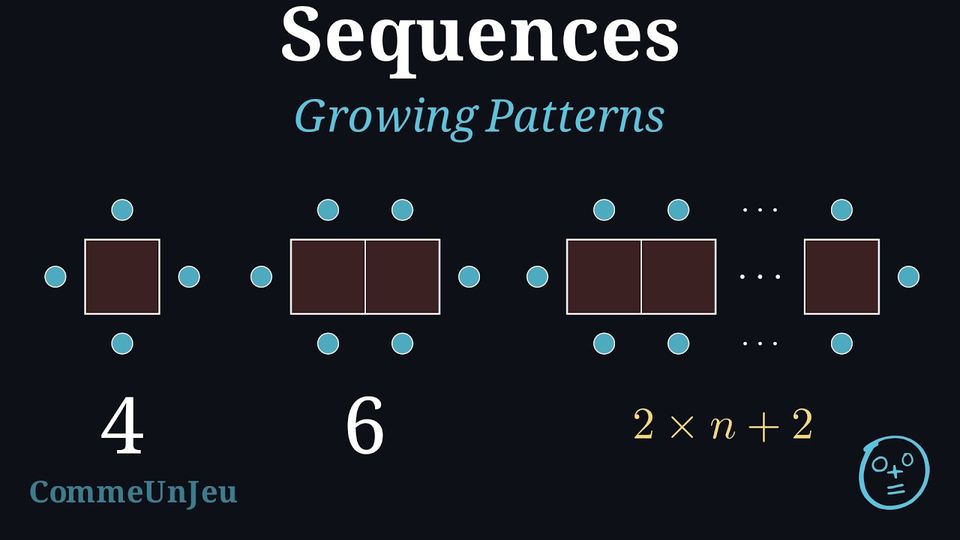
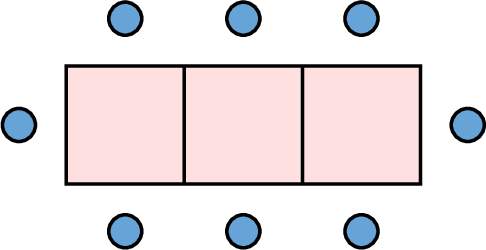
For a party, square tables are lined up in a row. A table on its own seats \(4\) people, one on each side. When tables are joined, the joined sides seat nobody. 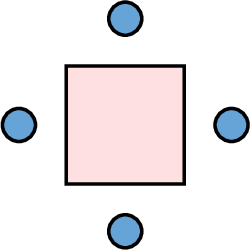 \(\;,\quad\)
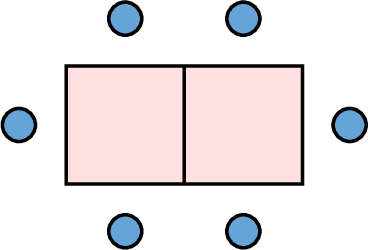 \(\;,\quad\)
 \(\;,\; \dots\)
\(\;,\quad\) \(\;,\quad\) \(\;,\; \dots\) - Count the seats in each diagram and complete the table.
Number of tables 1 2 3 4 Number of seats \(4\) \(?\) \(?\) \(?\) - Describe the rule in words: start with how many seats, and add how many for each extra table?
- How many people can sit at a row of \(10\) tables?
- And at a row of \(100\) tables? Counting one by one is unreasonable: find a formula giving the number of seats for any number \(n\) of tables.
- Each extra table removes two joined sides and brings two new front seats: the count grows by \(2\) each time.
\(4 \xrightarrow{\;+2\;} 6 \xrightarrow{\;+2\;} 8 \xrightarrow{\;+2\;} 10\) - The rule is: start with \(4\) seats and add \(2\) seats for each extra table.
- From \(4\) tables to \(10\) tables there are \(6\) extra tables, so \(6 \times 2 = 12\) extra seats: the \(10\) seats of the \(4\) tables plus the \(12\) new ones give \(10 + 12 = 22\) seats.
- Look at the structure of a row of \(n\) tables: each table offers \(2\) seats (one above, one below), and the \(2\) ends of the row each offer one more. So the number of seats is $$\mathbf{2 \times n + 2}.$$ Check with the table: for \(n = 4\), \(2 \times 4 + 2 = 8 + 2 = 10\) (the multiplication is done first). \(\checkmark\)
For \(100\) tables, the formula answers in one line: \(2 \times 100 + 2 = 202\) seats.
Method — Finding the Formula for Diagram \(n\)
- Complete the table for the first diagrams, and say the rule in words: start with ..., add ... each time.
- Look at the structure: where do the new sticks or dots land in the figure? What does each new diagram bring?
- Write the count for diagram \(n\): express what is seen with \(n\) — so many per cell plus the start, or so many arms of \(n\) minus the shared centre. In a formula, \(2n\) is short for \(2 \times n\), and \(3n + 4\) is short for \(3 \times n + 4\).
- Check: the formula must give back every number of the table.
Example
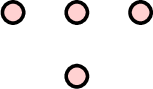
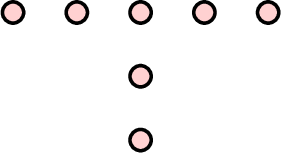
This growing “T” pattern is made with dots.  \(\quad,\quad\)
 \(\quad,\quad\)
 \(\quad,\; \dots\)
- Table and rule: the numbers of dots are \(1, 4, 7, \dots\) — start with \(1\) dot and add \(3\) dots each time.
Diagram number 1 2 3 Number of dots 1 4 7 - Structure: the “T” has \(3\) arms (left, right, down) of \(n\) dots each, and they share the centre dot — counted \(3\) times instead of \(1\).
- Formula: \(3\) arms of \(n\) dots, minus the centre counted twice too often: $$\mathbf{3 \times n - 2}.$$
- Check: \(n = 2\) gives \(3 \times 2 - 2 = 4\) \(\checkmark\) ; \(n = 3\) gives \(3 \times 3 - 2 = 7\) \(\checkmark\).
For diagram \(10\): \(3 \times 10 - 2 = 28\) dots.
Skills to practice
- Recognising the Formula of a Pattern
- Finding Rules in Stick Patterns
- Finding Rules in Dot Patterns
- Justifying with the Structure of a Pattern
V
Going further
Skills to practice
- Reasoning and Problem-Solving
- Solving Problems with Tables
- Solving Pattern Problems
- Quiz
Jump to section