International Baccalaureate · PYP 5
Time
I
Reading the Time to the Second
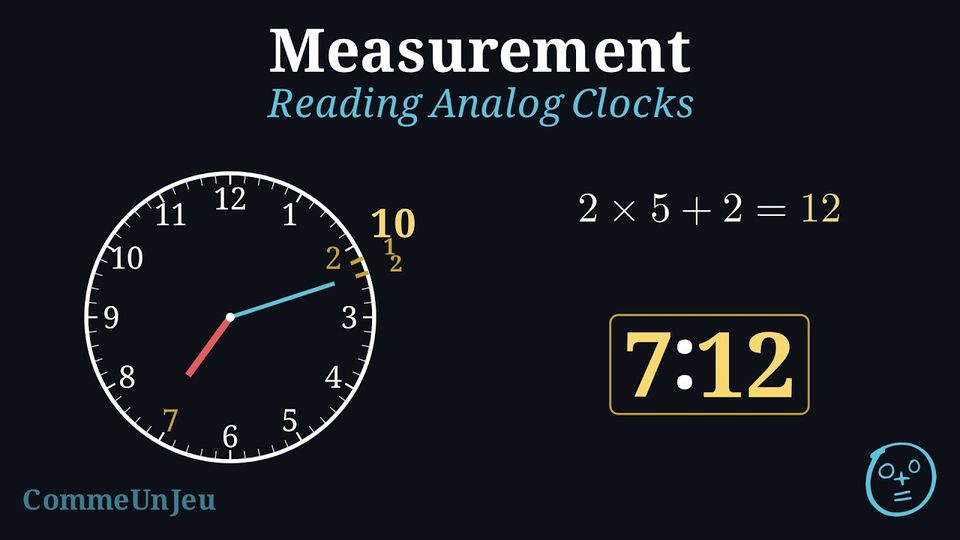
Method — Reading and Positioning to the Second
The third hand of a clock, long and thin, is the seconds hand. It goes all the way round in \(60\) seconds \(= 1\) minute: each small mark is \(1\) second, each number is \(5\) seconds. - Read: the short hand gives the hours, the long hand the minutes (the last mark it has reached or passed), the thin hand the seconds — written \(7\):\(25\):\(40\), that is \(7\) h \(25\) min \(40\) s.
- Position: place the seconds hand first (on the mark of the seconds), then the minute hand on the mark of the minutes — a little past it when the seconds have gone by — and the hour hand past the hour, in proportion to the minutes gone.
Example
Read the time shown, in hours, minutes and seconds. 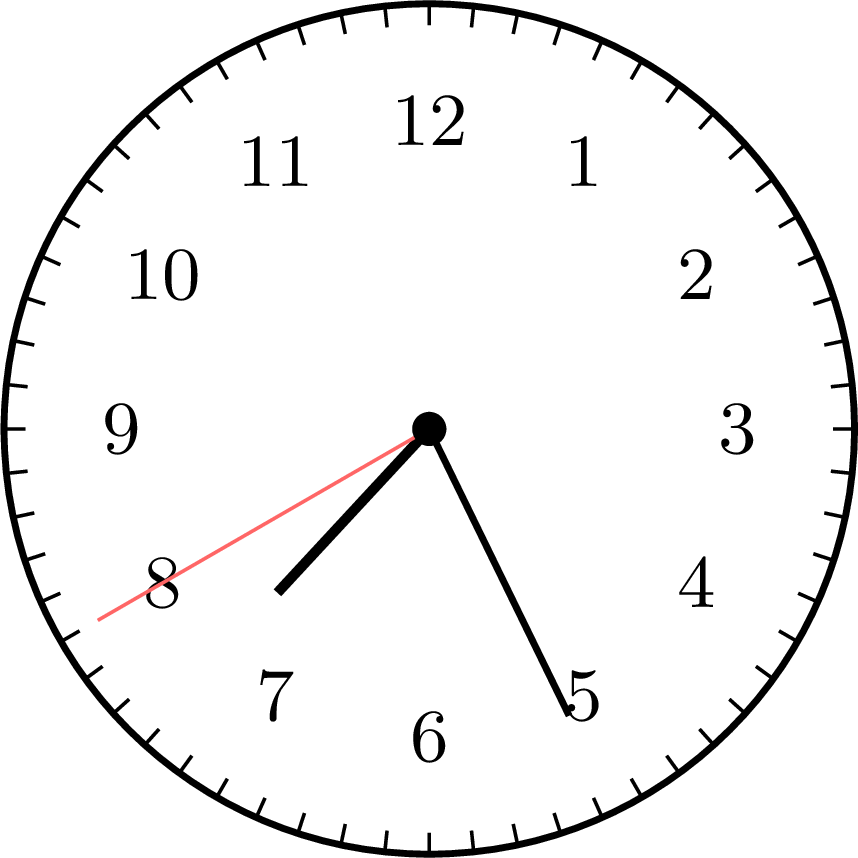
The short hand is between \(7\) and \(8\): it is \(7\) o'clock and some minutes. The long hand has just passed the mark of \(25\) minutes (it moves on as the seconds go by): \(25\) min. The thin red hand points at \(8\), that is \(8 \times 5 = 40\) seconds. The clock shows \(7\):\(25\):\(40\), that is \(7\) h \(25\) min \(40\) s.
Skills to practice
- Reading the Time to the Second
II
Calculating with Time Durations
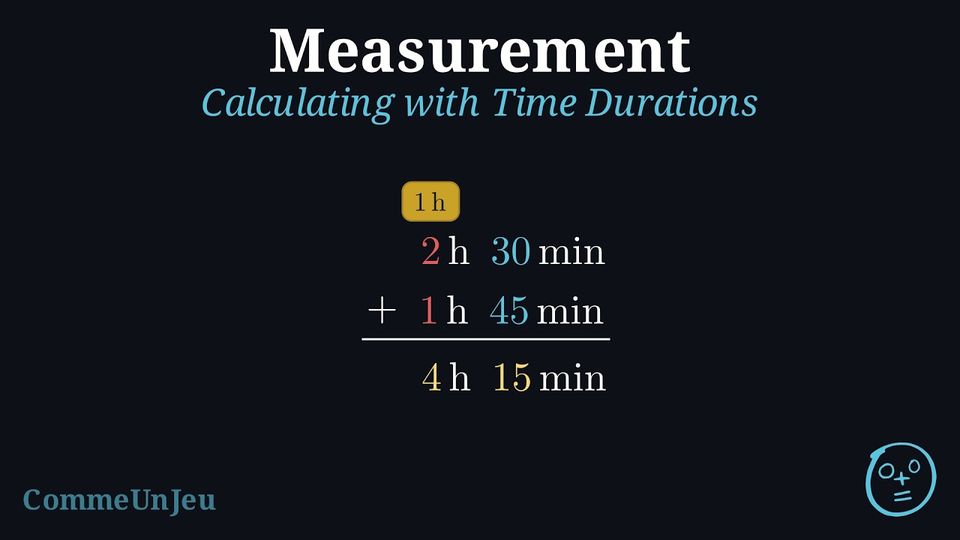
Method — Adding Time Durations
To add durations, set them out in columns and work one column at a time, minutes first — the carry happens at \(60\), because \(60\) minutes make \(1\) hour. To compute \(2\) h \(40\) min \(+ 1\) h \(35\) min: - Step 1: set out in columns — hours under hours, minutes under minutes. $$\begin{array}{r@{\;\;}r@{\,}l@{\;\;}r@{\,}l} & \textcolor{colordef}{2} & \textcolor{colordef}{\text{h}} & \textcolor{colorprop}{40} & \textcolor{colorprop}{\text{min}} \\ + & \textcolor{colordef}{1} & \textcolor{colordef}{\text{h}} & \textcolor{colorprop}{35} & \textcolor{colorprop}{\text{min}} \\ \hline & \phantom{0} & & \phantom{0} \end{array}$$
- Step 2: add the minutes — \(40 + 35 = 75\) min. \(75\) is more than \(60\): \(75\) min \(= 1\) h \(15\) min. Write \(15\) min, and carry the \(1\) hour above the hours column. $$\begin{array}{r@{\;\;}r@{\,}l@{\;\;}r@{\,}l} & \textcolor{orange}{\scriptstyle 1} & \\ & \textcolor{colordef}{2} & \textcolor{colordef}{\text{h}} & \textcolor{colorprop}{40} & \textcolor{colorprop}{\text{min}} \\ + & \textcolor{colordef}{1} & \textcolor{colordef}{\text{h}} & \textcolor{colorprop}{35} & \textcolor{colorprop}{\text{min}} \\ \hline & & & \textcolor{colorprop}{15} & \textcolor{colorprop}{\text{min}} \end{array}$$
- Step 3: add the hours — \(2 + 1 + 1\) (carry) \(= 4\) h. $$\begin{array}{r@{\;\;}r@{\,}l@{\;\;}r@{\,}l} & \textcolor{orange}{\scriptstyle 1} & \\ & \textcolor{colordef}{2} & \textcolor{colordef}{\text{h}} & \textcolor{colorprop}{40} & \textcolor{colorprop}{\text{min}} \\ + & \textcolor{colordef}{1} & \textcolor{colordef}{\text{h}} & \textcolor{colorprop}{35} & \textcolor{colorprop}{\text{min}} \\ \hline & \textcolor{colordef}{4} & \textcolor{colordef}{\text{h}} & \textcolor{colorprop}{15} & \textcolor{colorprop}{\text{min}} \end{array}$$
- Result — \(2\) h \(40\) min \(+ 1\) h \(35\) min \(= \mathbf{4}\ \text{h}\ \mathbf{15}\ \text{min}\).
Example
You play a game for 2 hours 30 minutes and read a book for 1 hour 45 minutes. What is the total duration? Method — Subtracting Time Durations
To subtract durations, set them out in columns and work one column at a time, minutes first — when the minutes on top are too few, borrow \(1\) hour, which comes down as \(60\) minutes. To compute \(3\) h \(10\) min \(- 1\) h \(35\) min: - Step 1: set out in columns — the larger duration on top. $$\begin{array}{r@{\;\;}r@{\,}l@{\;\;}r@{\,}l} & \textcolor{colordef}{3} & \textcolor{colordef}{\text{h}} & \textcolor{colorprop}{10} & \textcolor{colorprop}{\text{min}} \\ - & \textcolor{colordef}{1} & \textcolor{colordef}{\text{h}} & \textcolor{colorprop}{35} & \textcolor{colorprop}{\text{min}} \\ \hline & \phantom{0} & & \phantom{0} \end{array}$$
- Step 2: the minutes — \(10\) min is not enough to take away \(35\) min: borrow \(1\) hour, which comes down as \(60\) min — the top line becomes \(2\) h \(70\) min. Then \(70 - 35 = 35\) min. $$\begin{array}{r@{\;\;}r@{\,}l@{\;\;}r@{\,}l} & \textcolor{orange}{\scriptstyle 3 \to 2} & & \textcolor{orange}{\scriptstyle 10 \to 70} & \\ & \textcolor{colordef}{2} & \textcolor{colordef}{\text{h}} & \textcolor{colorprop}{70} & \textcolor{colorprop}{\text{min}} \\ - & \textcolor{colordef}{1} & \textcolor{colordef}{\text{h}} & \textcolor{colorprop}{35} & \textcolor{colorprop}{\text{min}} \\ \hline & & & \textcolor{colorprop}{35} & \textcolor{colorprop}{\text{min}} \end{array}$$
- Step 3: the hours — \(2 - 1 = 1\) h. $$\begin{array}{r@{\;\;}r@{\,}l@{\;\;}r@{\,}l} & \textcolor{orange}{\scriptstyle 3 \to 2} & & \textcolor{orange}{\scriptstyle 10 \to 70} & \\ & \textcolor{colordef}{2} & \textcolor{colordef}{\text{h}} & \textcolor{colorprop}{70} & \textcolor{colorprop}{\text{min}} \\ - & \textcolor{colordef}{1} & \textcolor{colordef}{\text{h}} & \textcolor{colorprop}{35} & \textcolor{colorprop}{\text{min}} \\ \hline & \textcolor{colordef}{1} & \textcolor{colordef}{\text{h}} & \textcolor{colorprop}{35} & \textcolor{colorprop}{\text{min}} \end{array}$$
- Result — \(3\) h \(10\) min \(- 1\) h \(35\) min \(= \mathbf{1}\ \text{h}\ \mathbf{35}\ \text{min}\).
Example
You have 4 hours and 15 minutes of free time. You play a game for 1 hour and 45 minutes. How much time is left? Method — Adding and Subtracting Durations with Seconds
Durations in hours, minutes and seconds are added and subtracted column by column, one column at a time, like whole numbers — but the carry works in sixties, not tens: \(60\) seconds become \(1\) minute, \(60\) minutes become \(1\) hour.Adding \(1\) h \(44\) min \(35\) s \(+\) \(2\) h \(35\) min \(40\) s:
- Step 1: set out in columns — hours under hours, minutes under minutes, seconds under seconds. $$\begin{array}{r@{\;\;}r@{\,}l@{\;\;}r@{\,}l@{\;\;}r@{\,}l} & \textcolor{colordef}{1} & \textcolor{colordef}{\text{h}} & \textcolor{colorprop}{44} & \textcolor{colorprop}{\text{min}} & \textcolor{olive}{35} & \textcolor{olive}{\text{s}} \\ + & \textcolor{colordef}{2} & \textcolor{colordef}{\text{h}} & \textcolor{colorprop}{35} & \textcolor{colorprop}{\text{min}} & \textcolor{olive}{40} & \textcolor{olive}{\text{s}} \\ \hline & \phantom{0} & & \phantom{0} & & \phantom{0} \end{array}$$
- Step 2: add the seconds — \(35 + 40 = 75\) s \(= 1\) min \(15\) s. Write \(15\) s, and carry the \(1\) minute above the minutes column. $$\begin{array}{r@{\;\;}r@{\,}l@{\;\;}r@{\,}l@{\;\;}r@{\,}l} & & & \textcolor{orange}{\scriptstyle 1} & \\ & \textcolor{colordef}{1} & \textcolor{colordef}{\text{h}} & \textcolor{colorprop}{44} & \textcolor{colorprop}{\text{min}} & \textcolor{olive}{35} & \textcolor{olive}{\text{s}} \\ + & \textcolor{colordef}{2} & \textcolor{colordef}{\text{h}} & \textcolor{colorprop}{35} & \textcolor{colorprop}{\text{min}} & \textcolor{olive}{40} & \textcolor{olive}{\text{s}} \\ \hline & & & & & \textcolor{olive}{15} & \textcolor{olive}{\text{s}} \end{array}$$
- Step 3: add the minutes — \(44 + 35 + 1\) (carry) \(= 80\) min \(= 1\) h \(20\) min. Write \(20\) min, and carry the \(1\) hour above the hours column. $$\begin{array}{r@{\;\;}r@{\,}l@{\;\;}r@{\,}l@{\;\;}r@{\,}l} & \textcolor{orange}{\scriptstyle 1} & & \textcolor{orange}{\scriptstyle 1} & \\ & \textcolor{colordef}{1} & \textcolor{colordef}{\text{h}} & \textcolor{colorprop}{44} & \textcolor{colorprop}{\text{min}} & \textcolor{olive}{35} & \textcolor{olive}{\text{s}} \\ + & \textcolor{colordef}{2} & \textcolor{colordef}{\text{h}} & \textcolor{colorprop}{35} & \textcolor{colorprop}{\text{min}} & \textcolor{olive}{40} & \textcolor{olive}{\text{s}} \\ \hline & & & \textcolor{colorprop}{20} & \textcolor{colorprop}{\text{min}} & \textcolor{olive}{15} & \textcolor{olive}{\text{s}} \end{array}$$
- Step 4: add the hours — \(1 + 2 + 1\) (carry) \(= 4\) h. $$\begin{array}{r@{\;\;}r@{\,}l@{\;\;}r@{\,}l@{\;\;}r@{\,}l} & \textcolor{orange}{\scriptstyle 1} & & \textcolor{orange}{\scriptstyle 1} & \\ & \textcolor{colordef}{1} & \textcolor{colordef}{\text{h}} & \textcolor{colorprop}{44} & \textcolor{colorprop}{\text{min}} & \textcolor{olive}{35} & \textcolor{olive}{\text{s}} \\ + & \textcolor{colordef}{2} & \textcolor{colordef}{\text{h}} & \textcolor{colorprop}{35} & \textcolor{colorprop}{\text{min}} & \textcolor{olive}{40} & \textcolor{olive}{\text{s}} \\ \hline & \textcolor{colordef}{4} & \textcolor{colordef}{\text{h}} & \textcolor{colorprop}{20} & \textcolor{colorprop}{\text{min}} & \textcolor{olive}{15} & \textcolor{olive}{\text{s}} \end{array}$$
- Step 1: set out in columns — the larger duration on top. $$\begin{array}{r@{\;\;}r@{\,}l@{\;\;}r@{\,}l@{\;\;}r@{\,}l} & \textcolor{colordef}{4} & \textcolor{colordef}{\text{h}} & \textcolor{colorprop}{20} & \textcolor{colorprop}{\text{min}} & \textcolor{olive}{15} & \textcolor{olive}{\text{s}} \\ - & \textcolor{colordef}{2} & \textcolor{colordef}{\text{h}} & \textcolor{colorprop}{35} & \textcolor{colorprop}{\text{min}} & \textcolor{olive}{40} & \textcolor{olive}{\text{s}} \\ \hline & \phantom{0} & & \phantom{0} & & \phantom{0} \end{array}$$
- Step 2: the seconds — \(15\) s is not enough to take away \(40\) s: borrow \(1\) minute, which comes down as \(60\) s — the top line becomes \(4\) h \(19\) min \(75\) s. Then \(75 - 40 = 35\) s. $$\begin{array}{r@{\;\;}r@{\,}l@{\;\;}r@{\,}l@{\;\;}r@{\,}l} & & & \textcolor{orange}{\scriptstyle 20 \to 19} & & \textcolor{orange}{\scriptstyle 15 \to 75} & \\ & \textcolor{colordef}{4} & \textcolor{colordef}{\text{h}} & \textcolor{colorprop}{19} & \textcolor{colorprop}{\text{min}} & \textcolor{olive}{75} & \textcolor{olive}{\text{s}} \\ - & \textcolor{colordef}{2} & \textcolor{colordef}{\text{h}} & \textcolor{colorprop}{35} & \textcolor{colorprop}{\text{min}} & \textcolor{olive}{40} & \textcolor{olive}{\text{s}} \\ \hline & & & & & \textcolor{olive}{35} & \textcolor{olive}{\text{s}} \end{array}$$
- Step 3: the minutes — \(19\) min is not enough to take away \(35\) min: borrow \(1\) hour, which comes down as \(60\) min — \(3\) h \(79\) min. Then \(79 - 35 = 44\) min. $$\begin{array}{r@{\;\;}r@{\,}l@{\;\;}r@{\,}l@{\;\;}r@{\,}l} & \textcolor{orange}{\scriptstyle 4 \to 3} & & \textcolor{orange}{\scriptstyle 19 \to 79} & & \textcolor{orange}{\scriptstyle 15 \to 75} & \\ & \textcolor{colordef}{3} & \textcolor{colordef}{\text{h}} & \textcolor{colorprop}{79} & \textcolor{colorprop}{\text{min}} & \textcolor{olive}{75} & \textcolor{olive}{\text{s}} \\ - & \textcolor{colordef}{2} & \textcolor{colordef}{\text{h}} & \textcolor{colorprop}{35} & \textcolor{colorprop}{\text{min}} & \textcolor{olive}{40} & \textcolor{olive}{\text{s}} \\ \hline & & & \textcolor{colorprop}{44} & \textcolor{colorprop}{\text{min}} & \textcolor{olive}{35} & \textcolor{olive}{\text{s}} \end{array}$$
- Step 4: the hours — \(3 - 2 = 1\) h. We are back to the first duration: \(1\) h \(44\) min \(35\) s. $$\begin{array}{r@{\;\;}r@{\,}l@{\;\;}r@{\,}l@{\;\;}r@{\,}l} & \textcolor{orange}{\scriptstyle 4 \to 3} & & \textcolor{orange}{\scriptstyle 19 \to 79} & & \textcolor{orange}{\scriptstyle 15 \to 75} & \\ & \textcolor{colordef}{3} & \textcolor{colordef}{\text{h}} & \textcolor{colorprop}{79} & \textcolor{colorprop}{\text{min}} & \textcolor{olive}{75} & \textcolor{olive}{\text{s}} \\ - & \textcolor{colordef}{2} & \textcolor{colordef}{\text{h}} & \textcolor{colorprop}{35} & \textcolor{colorprop}{\text{min}} & \textcolor{olive}{40} & \textcolor{olive}{\text{s}} \\ \hline & \textcolor{colordef}{1} & \textcolor{colordef}{\text{h}} & \textcolor{colorprop}{44} & \textcolor{colorprop}{\text{min}} & \textcolor{olive}{35} & \textcolor{olive}{\text{s}} \end{array}$$
Example
Compute \(2\) min \(45\) s \(+\) \(1\) min \(30\) s, then \(5\) min \(10\) s \(-\) \(2\) min \(35\) s. Skills to practice
- Adding Time Durations
- Subtracting Time Durations
- Adding Durations with Seconds
- Subtracting Durations with Seconds
- Setting Out with Hours, Minutes and Seconds
- Setting Out Additions and Subtractions of Durations
III
Solving Word Problems with Time
Method — Solving Time Problems
To solve time problems, first identify the goal. Are you finding a total, a difference, a repeated amount, or splitting time into equal groups? This will tell you which operation to use. Example
You spend 3 hours 30 minutes at school this morning and 2 hours 15 minutes studying this evening. How long is that altogether?
Analysis: “altogether” asks for a total: we add. Minutes first: \(30 + 15 = 45\) min (less than \(60\), no carry). Then the hours: \(3 + 2 = 5\) h. $$\begin{array}{r@{\;\;}r@{\,}l@{\;\;}r@{\,}l} & \textcolor{colordef}{3} & \textcolor{colordef}{\text{h}} & \textcolor{colorprop}{30} & \textcolor{colorprop}{\text{min}} \\
+ & \textcolor{colordef}{2} & \textcolor{colordef}{\text{h}} & \textcolor{colorprop}{15} & \textcolor{colorprop}{\text{min}} \\
\hline & \textcolor{colordef}{5} & \textcolor{colordef}{\text{h}} & \textcolor{colorprop}{45} & \textcolor{colorprop}{\text{min}} \end{array}$$ In total: \(5\) h \(45\) min.
Example
A train journey starts at 11:20 and arrives at 13:30. How long does the trip take?
Analysis: To find the duration between a start time and an end time, we subtract. $$ \begin{aligned} & 13 \, \text{h} \, 30 \, \text{min} \\
- \, & 11 \, \text{h} \, 20 \, \text{min} \\
\hline & 2 \, \text{h} \, 10 \, \text{min} \end{aligned} $$ The train trip takes 2 hours and 10 minutes.
Example
Hugo has to prepare 20 spring rolls for a party. It takes him 2 minutes to make each spring roll. How long will it take to prepare all the spring rolls?
Analysis: The action (making one spring roll) is repeated 20 times. For repeated addition of the same amount, we multiply. $$ \begin{aligned} 20 \times 2 \, \text{minutes} &= 40 \, \text{minutes} \end{aligned} $$ It will take Hugo 40 minutes to prepare all the spring rolls.
Example
You have 1 hour for an exam. Each exercise takes you 4 minutes. How many exercises can you do?
Analysis: We are splitting a total amount of time (1 hour) into equal groups (4 minutes each) to see how many groups we can make. This requires division. First, we must convert all units to be the same.
- Step 1: Convert. 1 hour = 60 minutes.
- Step 2: Divide.
Example
A teacher has 36 minutes to mark tests. Each test takes 3 minutes to mark. How many tests can the teacher mark?
Analysis: We are finding how many equal groups of 3 minutes fit into a total of 36 minutes. This is a division problem. $$ \begin{aligned} 36 \, \text{minutes} \div 3 \, \text{minutes per test} &= 12 \, \text{tests} \end{aligned} $$ The teacher can mark 12 tests.
Example
A relay starts at \(9\):\(58\):\(40\). The first runner takes \(1\) min \(50\) s and the second \(1\) min \(45\) s. At what time does the relay end? Skills to practice
- Solving Word Problems Involving Time
- Solving Problems with Delays and Durations
- Solving Multi-Step Time Problems
IV
Reading and Using Timetables
Method — Measuring a Duration by Going Through the Next O'Clock Time
An o'clock time is a whole hour, like \(16\):\(00\): the long hand points to the \(12\). - If the two times are in the same hour, simply count the minutes from the first to the second.
- Otherwise, go through the next o'clock time:
- Count the minutes up to the next o'clock time.
- Count the whole hours up to the last o'clock time before the arrival (the arrival itself if it falls on an o'clock time).
- Count the remaining minutes, then add everything.
Method — Reading a Timetable
A timetable gives, in a table, the times of buses, trains or events. - Rows and columns: in a bus or train timetable, each row is a stop and each column is one bus or one train. Reading down a column follows that bus from stop to stop.
- Empty cells: a dash means that the bus or the train does not stop there. A station may show two times, arr (arrival) and dep (departure): the gap between them is the stop at that station.
- Journey time: for a journey on the same day, subtract the departure time from the arrival time, both read in the same column. A journey that goes past midnight is counted in two parts: up to midnight, then after it.
- Arriving in time: in the row of the destination, find the latest arrival that is early enough, then go up its column: check that this bus or train stops where you start (no dash), and read its departure time there.
Example
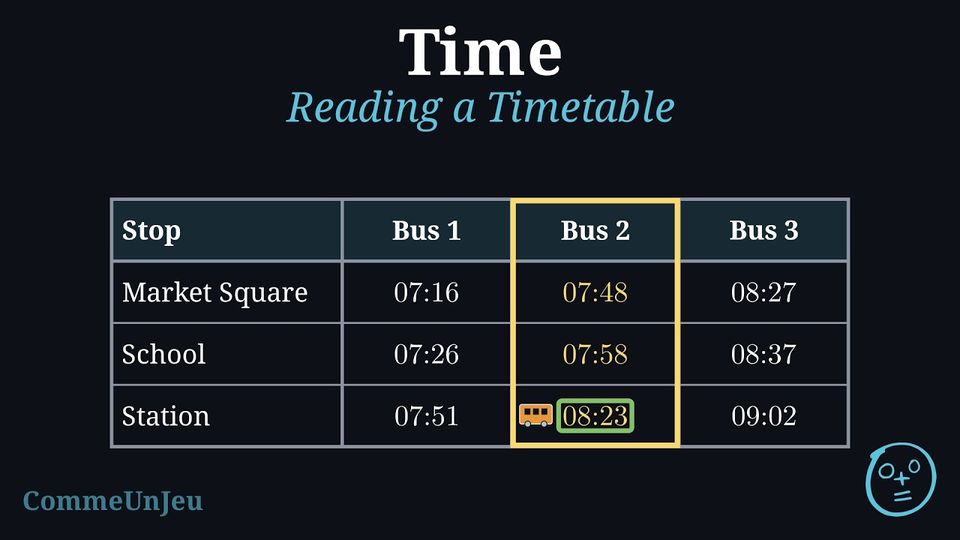
Here is the timetable of the shuttle bus to the station. | Stop | Bus 1 | Bus 2 | Bus 3 |
| Market Square | 07:16 | 07:48 | 08:27 |
| School | 07:26 | 07:58 | 08:37 |
| Station | 07:51 | 08:23 | 09:02 |
Each column is one bus; reading it from top to bottom gives its times at each stop.
- Bus 2 reaches the station at \(8\):\(23\), after the train has left. Bus 1 reaches it at \(7\):\(51\): Zoé must take bus 1, at \(7\):\(16\).
- Ride: from \(7\):\(16\) to \(7\):\(51\), that is \(35\) min.
- Wait: from \(7\):\(51\) to \(8\):\(07\), that is \(16\) min.
Skills to practice
- Reading Timetables
- Planning with Timetables
V
Time Zones
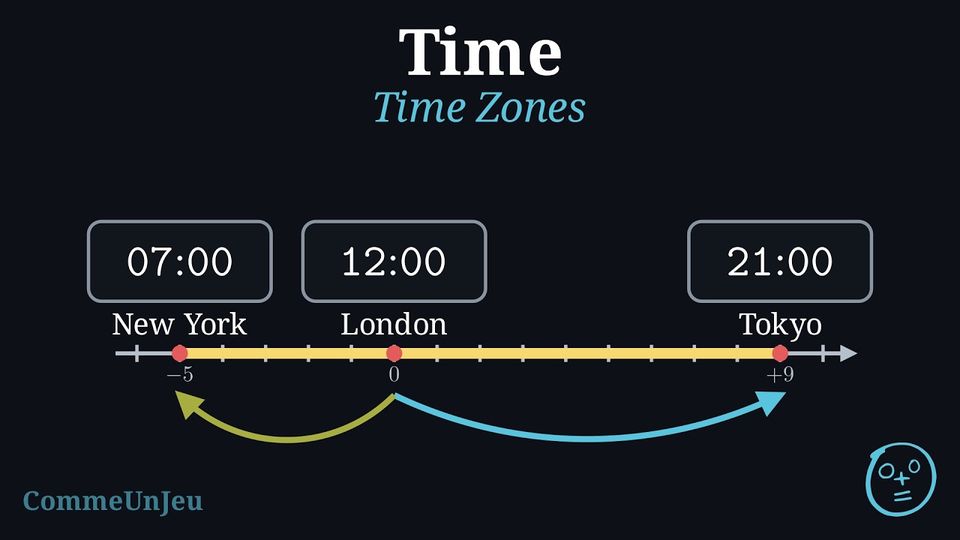
The Earth turns on itself once a day. At every moment the Sun lights only one half of the Earth: on that half it is day, on the other half it is night. So the middle of the day does not come at the same moment everywhere. When it is 12:00 (noon) in London, it is already 21:00, in the evening, in Tokyo, and only 07:00, early in the morning, in New York. 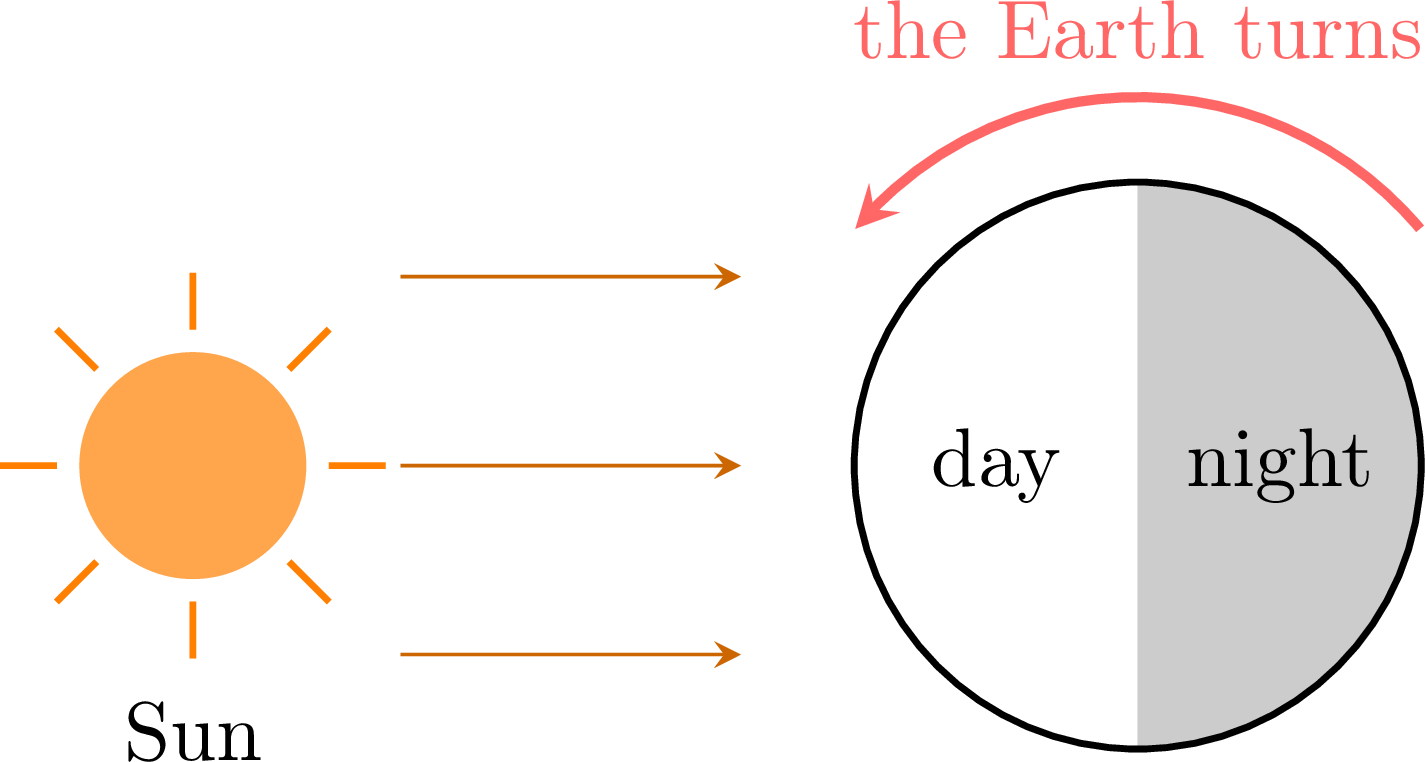
Each place therefore keeps its own local time, the time shown by its clocks, so that noon always comes around the middle of its day.
Definition — Time Zones
The local time of a place is the time shown by the clocks of that place. The Earth is divided into time zones: all the places of one time zone have the same local time.Each time zone is described by the number of hours it is ahead of or behind a reference time called UTC (Coordinated Universal Time), which is the local time of London in winter.
- UTC\(+3\) means \(3\) hours ahead of UTC: when it is 12:00 UTC, it is 15:00 in that time zone.
- UTC\(-5\) means \(5\) hours behind UTC: when it is 12:00 UTC, it is 07:00 in that time zone.
| City | Time zone | City | Time zone |
| Los Angeles | UTC\(-8\) | Cairo | UTC\(+2\) |
| New York | UTC\(-5\) | Moscow | UTC\(+3\) |
| Rio de Janeiro | UTC\(-3\) | Dubai | UTC\(+4\) |
| London | UTC\(+0\) | Beijing | UTC\(+8\) |
| Paris | UTC\(+1\) | Tokyo | UTC\(+9\) |
| Berlin | UTC\(+1\) | Sydney | UTC\(+10\) |
Method — Finding the Time in Another City
The time-zone line places each city at its time zone; each step of the line is one hour.  }
- Place the two cities on the time-zone line.
- Count the steps from one city to the other: this is the time difference, in hours.
- The city further to the right is ahead. Going from a city to a city further right, add the time difference; going to a city further left, subtract it.
- Check the day: a time past 24:00 is on the next day (subtract \(24\) h); a time before 00:00 is on the previous day (add \(24\) h before subtracting).
Example
It is 10:00 in Paris (UTC\(+1\)). What time is it in Tokyo (UTC\(+9\))? And in New York (UTC\(-5\))? 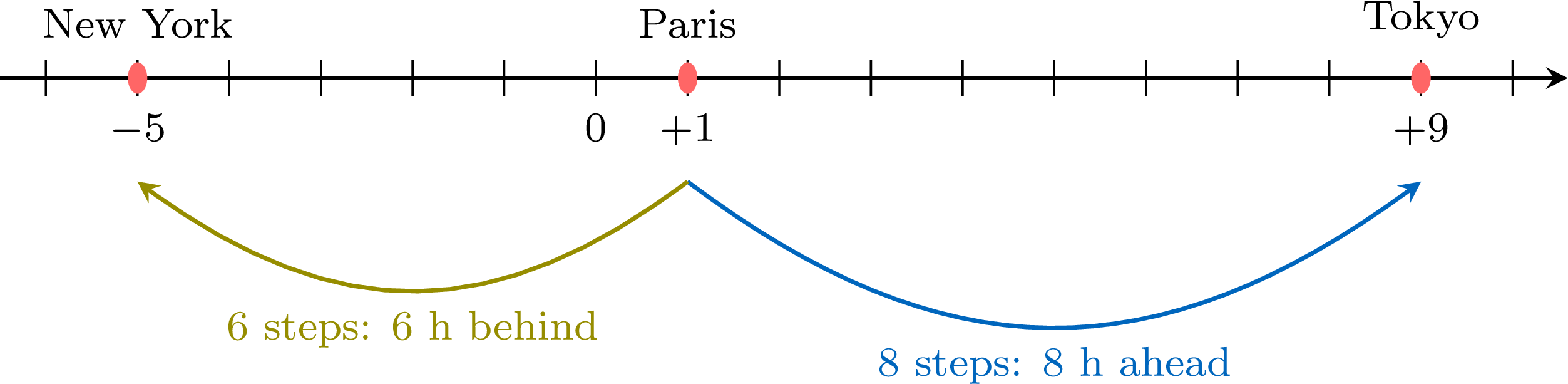
- From Paris (\(+1\)) to Tokyo (\(+9\)) there are \(8\) steps: the time difference is \(8\) hours. Tokyo is further right, so its clocks are ahead: we add. $$10{:}00 + 8 \text{ h} = 18{:}00.$$ It is 18:00 in Tokyo.
- From Paris (\(+1\)) to New York (\(-5\)): \(1\) step back to \(0\), then \(5\) more steps, \(6\) steps in all. New York is further left, so its clocks are behind: we subtract. $$10{:}00 - 6 \text{ h} = 04{:}00.$$ It is 04:00 in New York, in the middle of the night.
Example
- It is 20:00 in London (UTC\(+0\)). What time is it in Sydney (UTC\(+10\))?
- It is 03:00 on Tuesday in Tokyo (UTC\(+9\)). What time and which day is it in Rio de Janeiro (UTC\(-3\))?
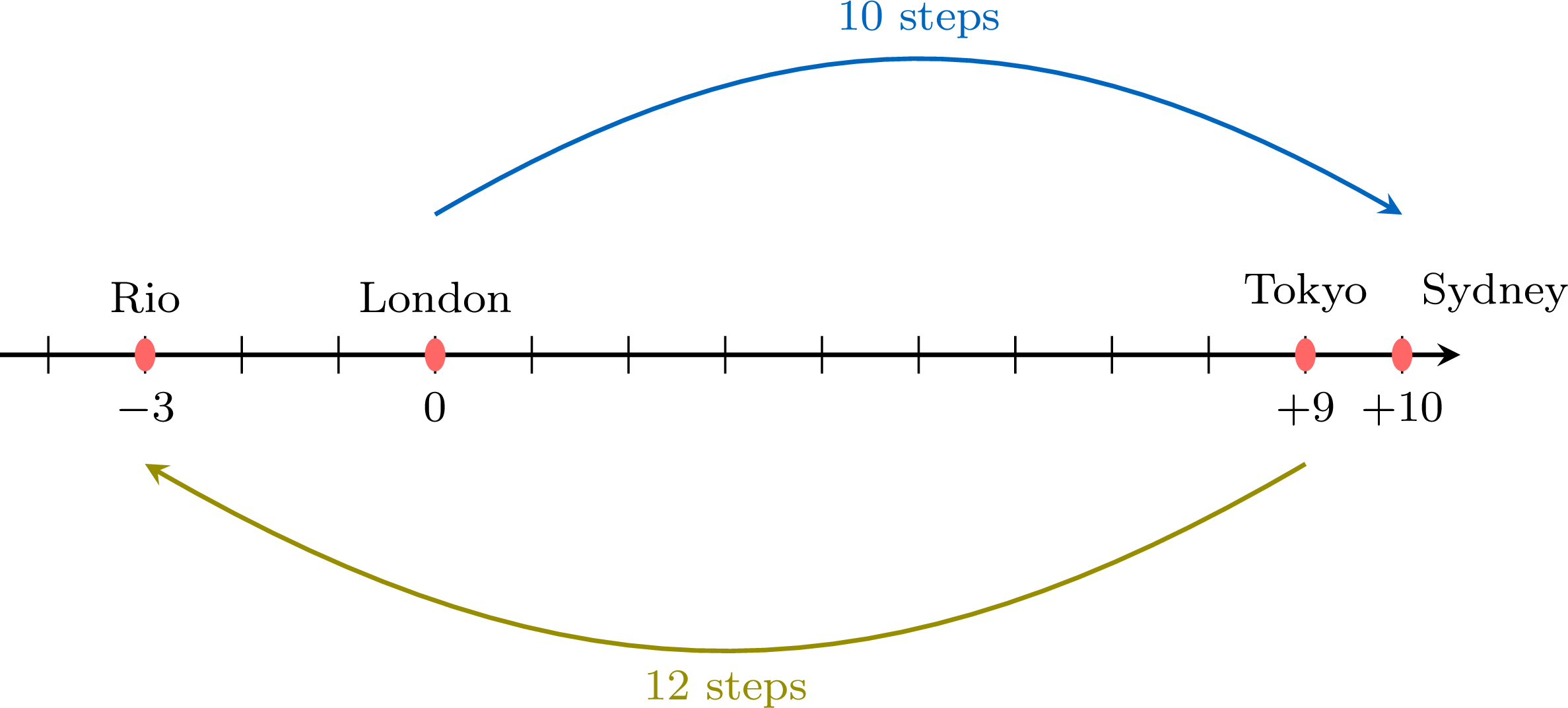
- From London (\(0\)) to Sydney (\(+10\)): \(10\) steps, and Sydney is further right, so we add \(10\) hours: $$\begin{aligned}[t] 20{:}00 + 10 \text{ h} &= 30{:}00 && \text{(past 24:00)}\\ &= 06{:}00 \text{ the next day.} && (30 - 24 = 6) \end{aligned}$$ It is 06:00 the next day in Sydney: the morning has already come there.
- From Tokyo (\(+9\)) to Rio (\(-3\)): \(9\) steps back to \(0\), then \(3\) more steps, \(12\) steps in all. Rio is further left, so we subtract \(12\) hours. On Tuesday there are only \(3\) hours before 03:00, so we go back to Monday: 03:00 on Tuesday is 27:00 on Monday. $$\begin{aligned}[t] 03{:}00 \text{ Tuesday} - 12 \text{ h} &= 27{:}00 \text{ Monday} - 12 \text{ h} && \text{(add 24 h, one day back)}\\ &= 15{:}00 \text{ Monday.} \end{aligned}$$ It is 15:00 on Monday in Rio de Janeiro.
Method — Flights Across Time Zones
- A timetable gives local times: the departure time is the local time of the departure city, and the arrival time is the local time of the arrival city.
- Add the flight duration to the departure time: this gives the arrival time in the time of the departure city.
- Change this time into the local time of the arrival city, as for the time in another city, and check the day.
Example
A plane leaves Paris (UTC\(+1\)) at 10:30, local time, and flies to New York (UTC\(-5\)). The flight lasts \(7\) h \(45\) min. At what local time does the plane land in New York? - Step 1: arrival time in Paris time. Minutes first: \(30 + 45 = 75\) min \(= 1\) h \(15\) min (carry \(1\) h); then the hours: \(10 + 7 + 1 = 18\). $$\begin{array}{r@{\;\;}r@{\,}l@{\;\;}r@{\,}l} & \textcolor{orange}{\scriptstyle 1} & \\ & \textcolor{colordef}{10} & \textcolor{colordef}{\text{h}} & \textcolor{colorprop}{30} & \textcolor{colorprop}{\text{min}} \\ + & \textcolor{colordef}{7} & \textcolor{colordef}{\text{h}} & \textcolor{colorprop}{45} & \textcolor{colorprop}{\text{min}} \\ \hline & \textcolor{colordef}{18} & \textcolor{colordef}{\text{h}} & \textcolor{colorprop}{15} & \textcolor{colorprop}{\text{min}} \end{array}$$ When the plane lands, it is 18:15 in Paris.
- Step 2: local time in New York. From Paris (\(+1\)) to New York (\(-5\)) there are \(6\) steps, and New York is further left: we subtract \(6\) hours. $$18{:}15 - 6 \text{ h} = 12{:}15.$$
Example
A plane leaves Dubai (UTC\(+4\)) on Friday at 21:40, local time, and flies to Tokyo (UTC\(+9\)). The flight lasts \(9\) h \(35\) min. On which day and at what local time does the plane land in Tokyo? - Step 1: arrival time in Dubai time. Minutes: \(40 + 35 = 75\) min \(= 1\) h \(15\) min (carry \(1\) h); hours: \(21 + 9 + 1 = 31\). $$\begin{array}{r@{\;\;}r@{\,}l@{\;\;}r@{\,}l} & \textcolor{orange}{\scriptstyle 1} & \\ & \textcolor{colordef}{21} & \textcolor{colordef}{\text{h}} & \textcolor{colorprop}{40} & \textcolor{colorprop}{\text{min}} \\ + & \textcolor{colordef}{9} & \textcolor{colordef}{\text{h}} & \textcolor{colorprop}{35} & \textcolor{colorprop}{\text{min}} \\ \hline & \textcolor{colordef}{31} & \textcolor{colordef}{\text{h}} & \textcolor{colorprop}{15} & \textcolor{colorprop}{\text{min}} \end{array}$$ 31:15 is past 24:00: \(31 - 24 = 7\), so it is 07:15 on Saturday in Dubai.
- Step 2: local time in Tokyo. From Dubai (\(+4\)) to Tokyo (\(+9\)) there are \(5\) steps, and Tokyo is further right: we add \(5\) hours. $$07{:}15 + 5 \text{ h} = 12{:}15.$$
Skills to practice
- Reading Time Zones
- Finding the Time in Another City
- Finding the Arrival Time of a Flight
- Planning Across Time Zones
VI
Timelines in History
Method — Reading and Placing Events on a Timeline
- Find what one step stands for: take two numbered marks, find the duration between them and count the steps. From \(2000\) to \(2010\), \(10\) years make \(5\) equal steps, so one step is \(2\) years.
- To place an event, find the last numbered mark before its date (or the start of its month) and count the steps from it up to the date. A date halfway between two marks goes halfway between them: \(1985\) is halfway between \(1980\) and \(1990\).
- To find the duration between two events, count the steps between them and add what each step stands for, or, when the dates are years, subtract the earlier year from the later one.
Timelines are essential tools in history and other subjects to visualise sequences of events. They help us understand cause and effect, compare different historical periods, and analyse how long events or eras lasted.
Example
This timeline shows the reigns of two famous kings of France. The bar shows the duration of Louis XIII’s reign, and the arrow shows when Louis XIV’s reign begins.
- According to the timeline, the reign of Louis XIII starts in 1610.
- His reign ends, and Louis XIV's begins, in 1643.
- To find the duration, we subtract the start year from the end year.
Definition — BCE and CE
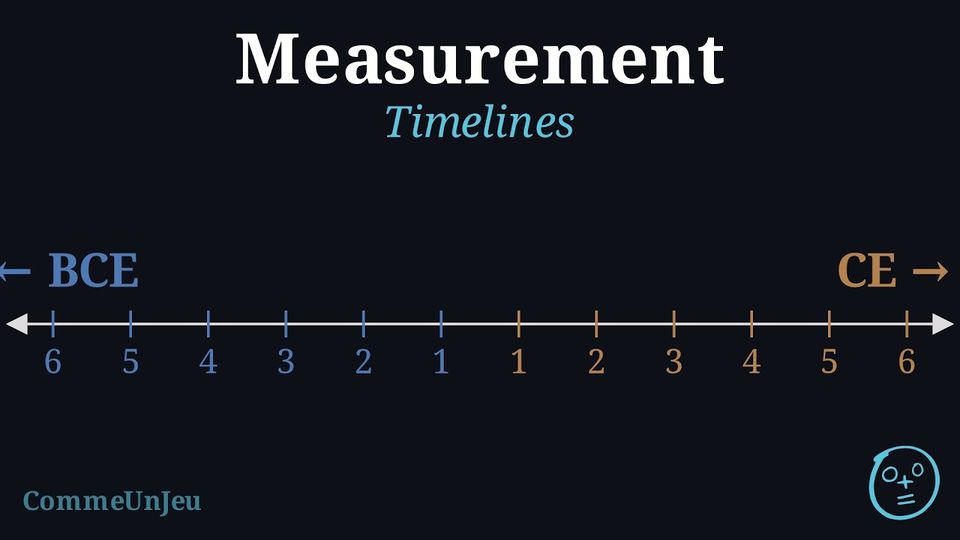
To date events in history, historians often use a system that divides time into two major eras. You may have seen the abbreviations BC and AD; in modern academic and historical work, we usually use the neutral terms BCE and CE. - BCE stands for “Before the Common Era”. Years in BCE count backwards from year 1. For example, 100 BCE happened before 50 BCE.
- CE stands for “Common Era”. This is the era we live in. Years in CE count forwards from year 1.
Example
This timeline shows two major events in Roman history.
To find the duration between a BCE date and a CE date, we combine the years from both sides of the timeline and remember that there is no year 0.
- From 100 BCE to 1 BCE, there are 99 years.
- From 1 CE to 70 CE, there are 69 years.
- There is 1 year between 1 BCE and 1 CE.
- We add these three parts together.
Example
- King Louis XIV reigned for \(72\) years. Is that more or less than a century?
- The castle is \(3\) centuries old. How many years is that?
- The pyramids were built more than \(4\) millennia ago. How many centuries is that?
- A century is \(100\) years and \(72 < 100\): Louis XIV reigned less than a century.
- \(1\) century \(= 100\) years, so \(3\) centuries \(= 3 \times 100 = 300\) years.
- \(1\) millennium \(= 10\) centuries, so more than \(4\) millennia is more than \(4 \times 10 = 40\) centuries.
Method — Counting in Centuries
- Numbering the centuries. Centuries are numbered in order: the 1st century, the 2nd century, and so on (some languages write the number in Roman numerals, XVII for the 17th). The 1st century runs from year \(1\) to year \(100\), the 2nd from \(101\) to \(200\), and so on: the 17th century runs from \(1601\) to \(1700\). A year belongs to the century whose number is its number of full hundreds plus one, except the round hundreds: \(1638\) is in the 17th century (\(16\) full centuries, then \(38\) years), \(1700\) is the last year of the 17th century.
- Duration of a period in centuries. Subtract the years, then divide by \(100\): the Middle Ages, from \(476\) to \(1492\), lasted \(1492 - 476 = 1016\) years, that is a little more than \(10\) centuries, a little more than one millennium.
- Centuries between two dates. \(1715\) to \(2015\): \(300\) years, \(3\) centuries.
Example
Louis XIV was born in \(1638\) and died in \(1715\). In which century was he born, and in which century did he die? How many centuries separate his death from the year \(2015\)? - \(1638\): \(16\) full centuries and \(38\) years, so the 17th century.
- \(1715\): \(17\) full centuries and \(15\) years, so the 18th century.
- \(2015 - 1715 = 300\) years: \(3\) centuries.
Skills to practice
- Reading Dates, Centuries and Millennia
- Reading Dates and Durations on a Timeline
- Counting in Centuries
VII
Review & Quizz
Skills to practice
- Quiz
Jump to section