International Baccalaureate · PYP 5
Squares, square roots and exponents
I
Squares and Cubes
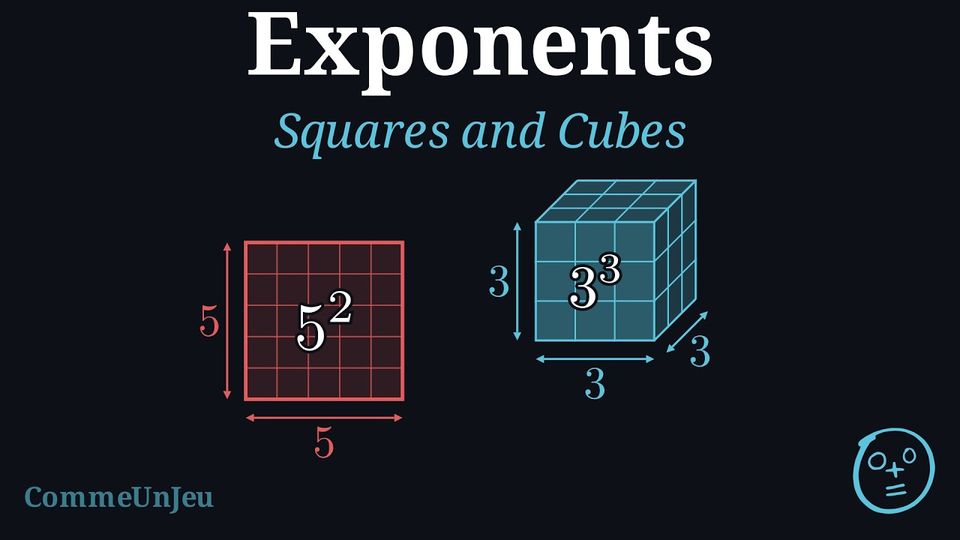
Exponents are a short way to write repeated multiplication. They help us work with large numbers more easily.
Two exponents appear so often that they have their own names, and both come from geometry: the area of a square and the volume of a cube.
Definition — Square and Cube
The square of a number \(s\) is the product of \(s\) by itself, written \(s^2\) and read “\(s\) squared”. The cube of a number \(s\) is the product of three factors all equal to \(s\), written \(s^3\) and read “\(s\) cubed”. $$s^2 = s \times s \qquad\text{and}\qquad s^3 = s \times s \times s.$$ A square of side \(s\) has area \(s^2\); a cube of edge \(s\) has volume \(s^3\) — which is where the two names come from: 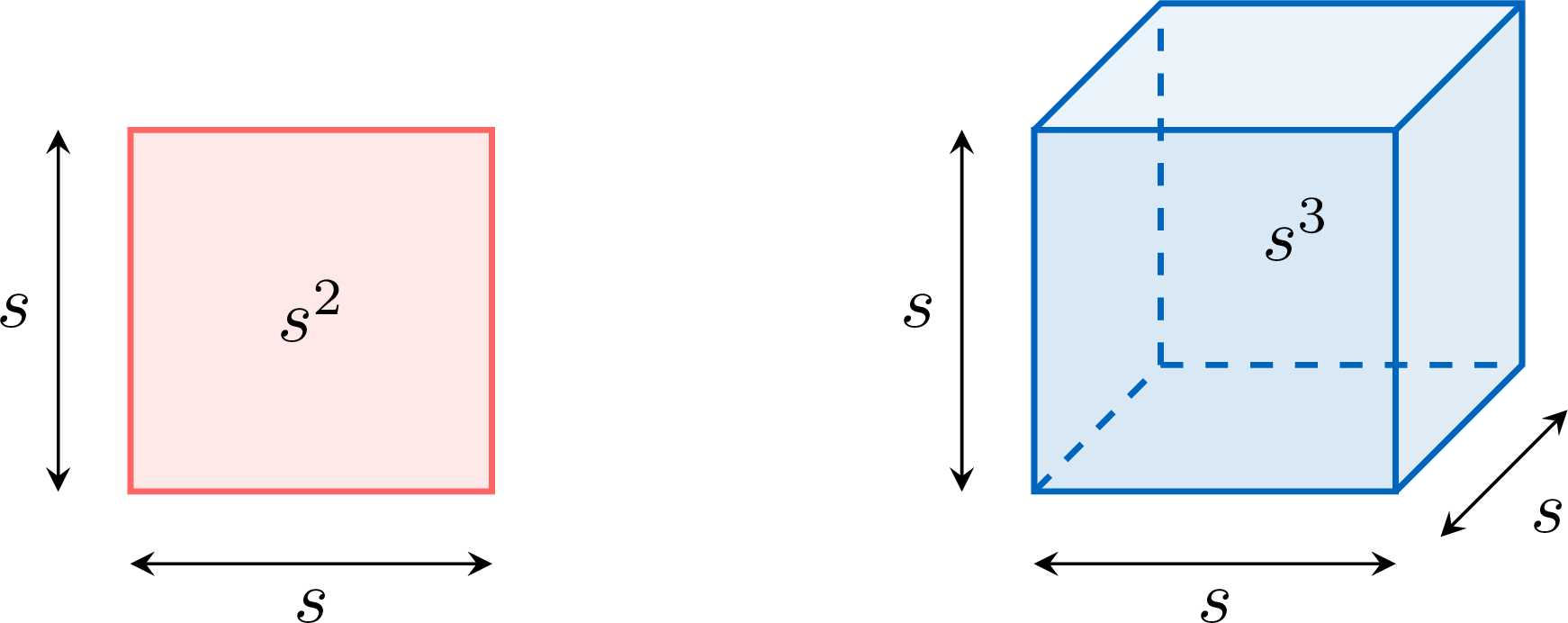
The same idea names the units: an area in \(\mathrm{cm}^2\) is a product of two lengths in cm, a volume in \(\mathrm{cm}^3\) a product of three.
Proposition — Squares to Know
The squares of the whole numbers from \(0\) to \(12\) are worth knowing by heart: | \(0^2 = 0\) | \(1^2 = 1\) | \(2^2 = 4\) | \(3^2 = 9\) | \(4^2 = 16\) | \(5^2 = 25\) | \(6^2 = 36\) |
| \(7^2 = 49\) | \(8^2 = 64\) | \(9^2 = 81\) | \(10^2 = 100\) | \(11^2 = 121\) | \(12^2 = 144\) |
Example
Knowing the table backwards is what makes a number recognisable as a square: \(49\) is \(7 \times 7\), so \(49 = 7^2\); \(144\) is \(12 \times 12\), so \(144 = 12^2\). Likewise \(1\,000 = 10 \times 10 \times 10 = 10^3\). Example
A square has an area of \(20\ \mathrm{m}^2\). Between which two whole numbers does its side lie?
\(20\) is not in the table of squares: it lies between two consecutive squares, $$4^2 = 16 < 20 < 25 = 5^2,$$ and a longer side gives a larger area. So \(20\) is not the square of a whole number, and the side lies between \(4\) m and \(5\) m.
Skills to practice
- Choosing the Correct Power and Unit
- Finding the Two Whole Numbers Around a Side Length
- Computing Squares and Cubes
- Using Squares and Cubes in Geometry
II
Square Roots
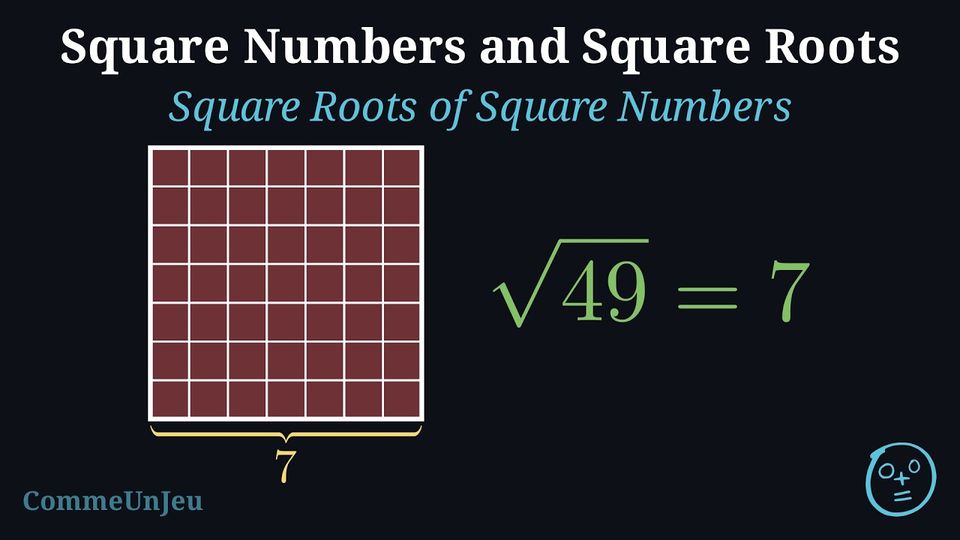
A square patio is covered with \(49\) square tiles, all the same size, with no gaps and no overlaps. 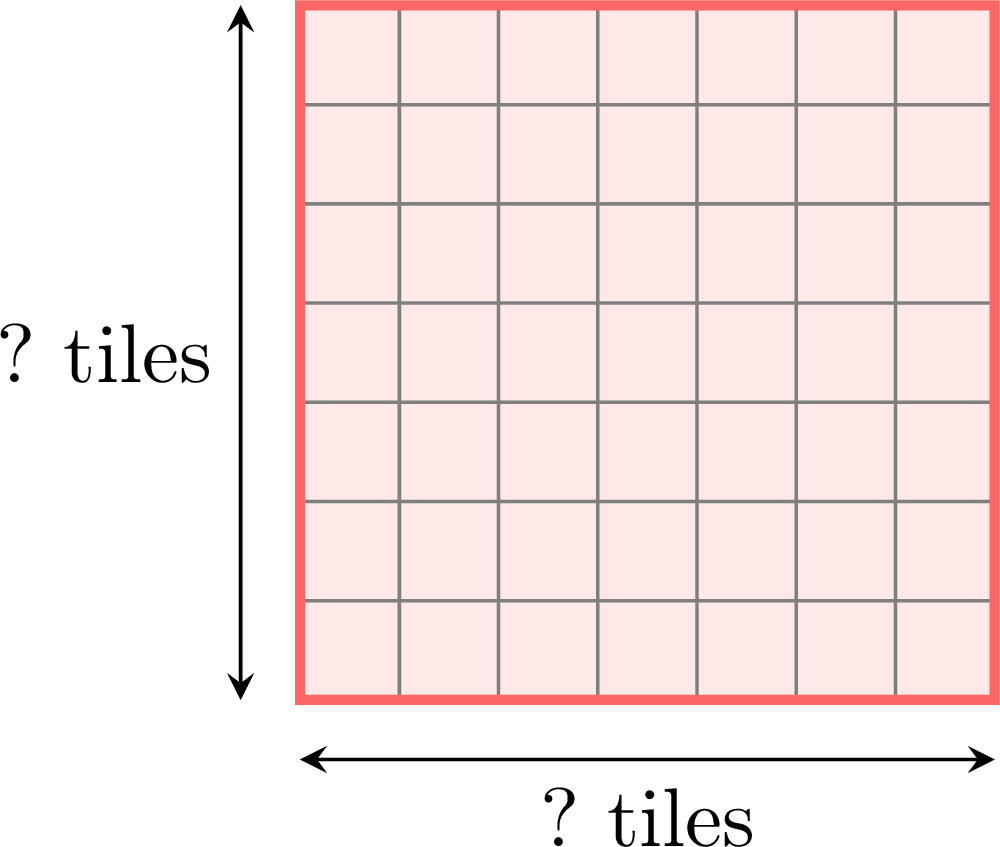
How many tiles are there along one side of the patio?
The patio is a square: it has as many rows as there are tiles in one row. So we look for a number that, multiplied by itself, gives \(49\): $$\begin{aligned}[t] 6 \times 6 &= 36 && \text{(too small)}\\
7 \times 7 &= 49 && \text{(this is it)} \end{aligned}$$ There are 7 tiles along each side. Going from \(7\) to \(49\) is squaring; going back from \(49\) to \(7\) is called taking the square root.
Definition — Square Number
A square number, also called a perfect square, is the result of multiplying a whole number by itself: it is the number of dots, or of tiles, that fill a square. 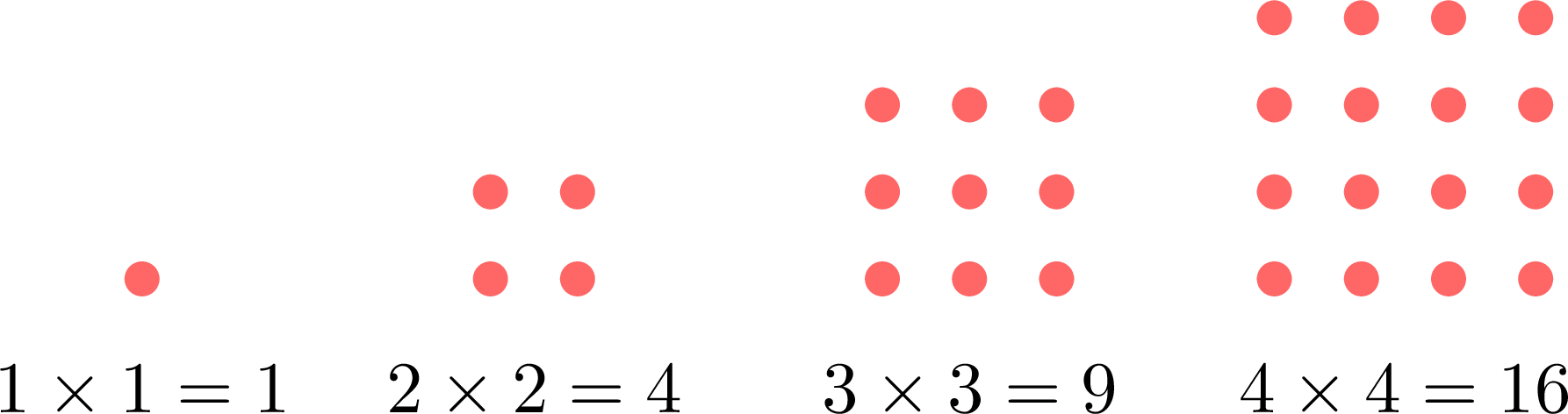
Definition — Square Root
The square root of a square number is the whole number (\(0\), \(1\), \(2\), \(3\), …) that, multiplied by itself, gives this square number. It is written with the sign \(\sqrt{\quad}\): $$\sqrt{49} = 7 \qquad \text{because} \qquad 7 \times 7 = 49.$$ Taking the square root undoes squaring: 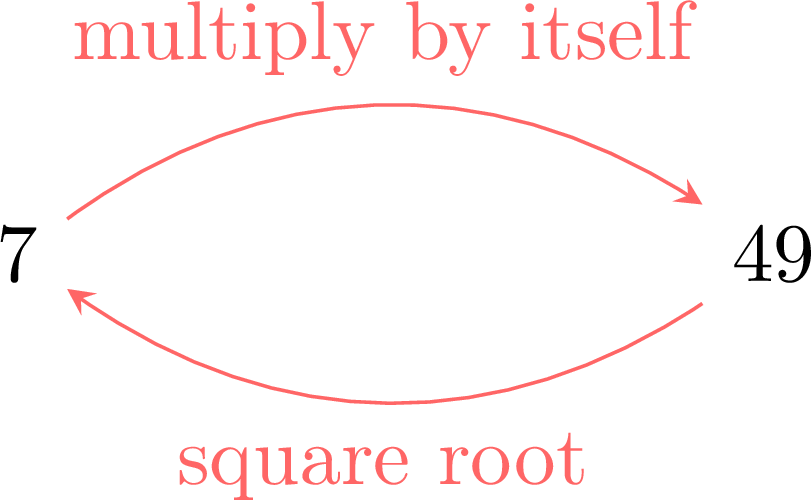
Method — Finding the Square Root of a Square Number
To find the square root of a square number: - look for the number among the square numbers and read the product backwards: \(81 = 9 \times 9\), so \(\sqrt{81} = 9\);
- check by multiplying the answer by itself: \(9 \times 9 = 81\).
Example
Find \(\sqrt{64}\) and \(\sqrt{121}\).
Both numbers are square numbers: $$\begin{aligned}[t] \sqrt{64} &= 8 && \text{(because \(8 \times 8 = 64\))}\\
\sqrt{121} &= 11 && \text{(because \(11 \times 11 = 121\))} \end{aligned}$$ Check: \(8 \times 8 = 64\) and \(11 \times 11 = 121\). Taking a square root is not the same as halving: \(64 \div 2 = 32\), but \(32 \times 32\) is far more than \(64\).
Example
A square vegetable garden has an area of \(36\ \mathrm{m}^2\). How long is one side? 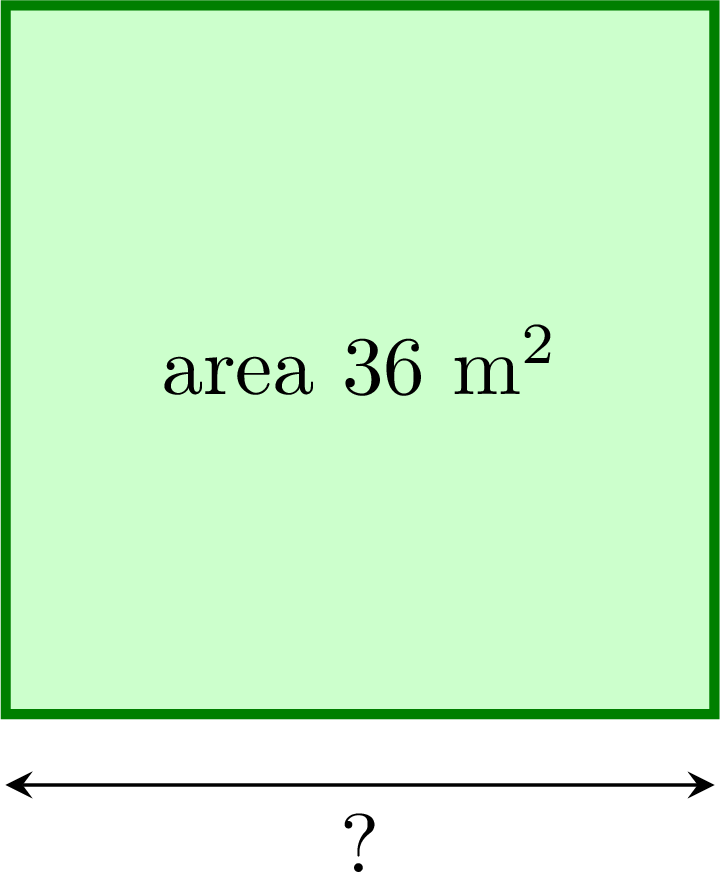
The side of a square is the square root of its area: $$\begin{aligned}[t] \text{side (in m)} &= \sqrt{36} && \text{(side of a square of area \(36\ \mathrm{m}^2\))}\\
&= 6 && \text{(because \(6 \times 6 = 36\))} \end{aligned}$$ Each side is 6 m long. Check: \(6\ \mathrm{m} \times 6\ \mathrm{m} = 36\ \mathrm{m}^2\).
Skills to practice
- Recognising Square Numbers and Square Roots
- Finding Square Roots
- Finding the Side of a Square from Its Area
- Explaining with Square Numbers
III
The Power Notation
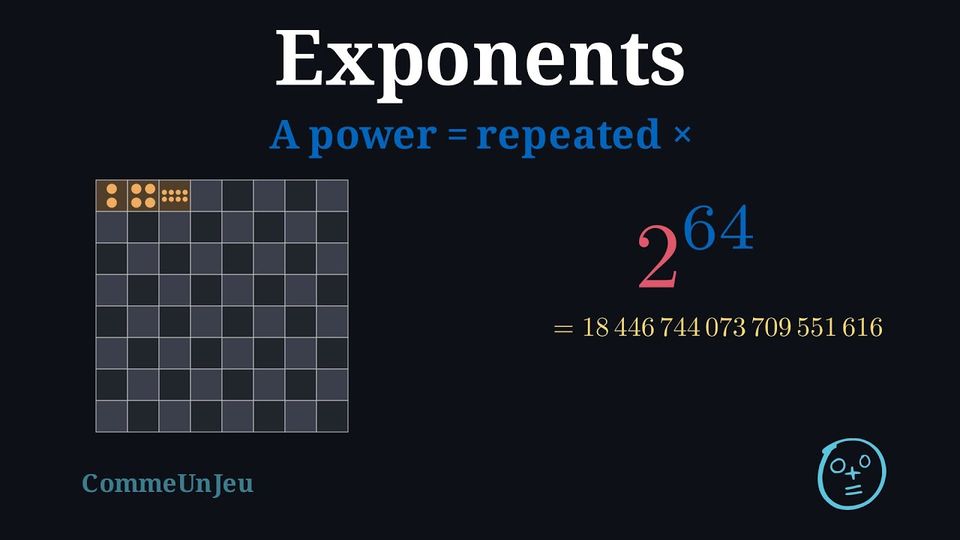
Imagine you have a chessboard. You place two grains of wheat on the first square, four grains on the second square, eight grains on the third square, and so on, doubling the number of grains on each next square. 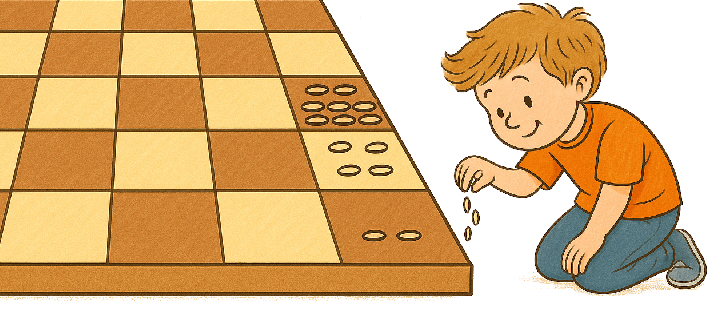
How many grains of wheat are on the last square of a chessboard with 64 squares?
Rather than writing \(\overbrace{2 \times 2 \times \dots \times 2}^{64\ \text{factors}}\), we can write this product as \(2^{64}\).
This means there are \(2^{64}\) grains on the last square. A calculator shows only the start of this number; written in full it has twenty digits: $$2^{64}=18\,446\,744\,073\,709\,551\,616.$$ This is an enormous number.
| Square on the board | Number of grains |
| \(1\) | \(2\) |
| \(2\) | \(2 \times 2\) |
| \(3\) | \(2 \times 2 \times 2\) |
| \(\vdots\) | \(\vdots\) |
| \(64\) | \(\overbrace{2 \times 2 \times \dots \times 2}^{64\ \text{factors}}\) |
This means there are \(2^{64}\) grains on the last square. A calculator shows only the start of this number; written in full it has twenty digits: $$2^{64}=18\,446\,744\,073\,709\,551\,616.$$ This is an enormous number.
Definition — Powers
A power is a short way to write a repeated multiplication of a number by itself: For a number \(a\) and a positive whole number \(n\), $$ a^n = \overbrace{a \times a \times \dots \times a}^{n\ \text{factors}}. $$
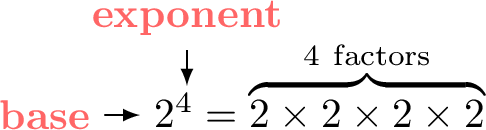
Definition — Vocabulary
$$ \begin{array}{|c|c|c|c|} \hline \text{Value} & \text{Expanded form} & \text{Exponent notation} & \text{Spoken form} \\
\hline 2 & 2 & 2^1 & 2\ \text{or}\ 2\ \text{to the power of}\ 1 \\
4 & 2 \times 2 & 2^2 & 2\ \text{squared or}\ 2\ \text{to the power of}\ 2 \\
8 & 2 \times 2 \times 2 & 2^3 & 2\ \text{cubed or}\ 2\ \text{to the power of}\ 3 \\
16 & 2 \times 2 \times 2 \times 2 & 2^4 & 2\ \text{to the power of}\ 4 \\
32 & 2 \times 2 \times 2 \times 2 \times 2 & 2^5 & 2\ \text{to the power of}\ 5 \\
\hline \end{array} $$ Example
Find the value of \(2^3\).
$$ \begin{aligned}[t] 2^3 &= 2 \times 2 \times 2 \\
&= 8 \end{aligned} $$
Skills to practice
- Interpreting Powers
- Checking Equality between Products and Powers
- Writing Repeated Multiplication in Exponent Form
- Writing in Exponent Form from Words
- Calculating Powers
- Expressing Numbers in Exponent Form
IV
Review & Quizz
Skills to practice
- Quiz
Jump to section